
2019年人教版八下英语unit1精学笔记
【用法】run out与run out of的区别.表示______________事物等无生命的东西作主语用run out ,相当于use up。______作主语用run out of.
【例题】He told the man that he hadrun out ofmoney to buy old bikes.
【例题】
He used toto office in his car,but he is used tothe bus stop.
A.going; taking B.going ;take C. go ;taking
【检测】Dickin American,but he has beenChinese food since he moved to Hainan.
【常用短语】表示身体状况或者所处困境的短语或句式。
What’s the matter with her ?她怎么啦?
She has a bad cold.她患了重感冒。
【例题】考查交际用语
---Hi, John.?
---It’s Lucy, my dog . Her leg is hurt.
A. How are you B. What’s the matter
5.疼痛,受伤__________6 .麻烦__________
7.按、压__________8 .生病的__________
9.事故__________10.情况__________
11.重要性__________12.决定__________
13.掌控,控制__________14.精神,勇气__________
9.咽喉痛__________10.躺下来休息__________
11.带蜂蜜的热茶__________ 12.看牙医__________
13.照X光__
15.在上面上些药__________ 16.觉得很热__________
17.听起来像__________18.整个周末__________
令我惊讶的是,他昨天收到那所大学校长的来信了。
my surprise, hefrom the principal of the university yesterday.
【检测】To(she),she got a very good grade.
考点六:Someone feltsick.有人生病了。
【常用短语】have a sore throat喉咙疼have a fever发烧
have a cough咳嗽have a toothache牙疼
【例题】---- I have a. What do I have to do ?
----- You should see a dentist.
A. headache B toothache C. sore back D. sore throat
15.胃疼_________16.脖子__________
17.发烧__________18.咳嗽__________
19.间歇__________20.乘客__________
21.击、打__________22.绷带__________
23.呼吸__________24.登山者__________
29.及时__________30.挽救某人的生命__________
31.陷入麻烦__________32.立刻__________
33.因为__________34.出来,离开__________
35.伤了某人自己__________36.用绷带包扎__________
37.跌倒,摔倒__________38.感觉生病_________
19.以同样的方式__________ 20.去看医生__________
21.沿着__________22.在路的一边__________
23.求助__________24.没有多想__________
25.下车__________26.有心脏病__________
27.使······惊讶的__________ 28.多亏,由于__________
提示词
cold感冒,fever发烧,cough咳嗽,headache头疼,should应该,sleep睡觉,rest休息
Dear Gina,
I’m sorry to hear that____________________________________________________________
A.put away B.turned off C.taken out ed up
【检测】Many peopleall the money to buy a house in big cities.
A.give out B.run out C.give out of D.run out of
【用法】feel sick=be sick,二者都可回答“How do you feel?/What’s the matter?”等句型,但feel强调的是,be强调的是。
【例题】Please take good care of the sick boy.
【检测】When she got up ,she felt a little _______and took some medicine.
47.如此······以至于__________ 48.掌管,管理___________________
49.在困境中__________50.继续,坚持做某事__________
51.做决定__________52.放弃___________________________
53.冒险__________54.怎么了?______________________
_____________________________________________________________________________________
____________________________________________________________________________________________________________________________________________________________________________________________________________________________________________________________________________________________________________________________________________________________________________________________________________________________________________________________________________________________________________________________________________________________________________________________________________________________________________________________________________________________________________________________________
【检测】--Judy eatsfood,and now she has a stomachache.
A. too much B. too many C. much too D. a few
考点四:情态动词should +动词原形
【用法】should为情态动词,意为“应该”,用来表示提出建议或要求等,后跟_________.其否定形式为shouldn’t.
【检测】I’m afraid you have a f. Please go and buy some medicine.
考点三:too much太多
【用法1】too much意为“太多”,修饰动词,置于动词之。
【例句】Don’t eat too much ,or you’ll get fat..
【用法2】too much后跟_______________,much too后跟________。
55.主语+ should/shouldn't + _______
互检互签
考点一:What’s the matter ?怎么了?出什么事情了?
【用法】What’s the matter ?﹦________________________________ ?用来询问病情或某人遇到的麻烦·问题。其后跟询问的对象时,与介词_______连用,构成“What’s the matter with…?”
39.流鼻血__________40.划破膝盖__________
41.把头向后仰__________42.呼吸困难__________
43.爬山__________44.习惯于做某事__________
45.用完,用尽__________46.以至于_________________________
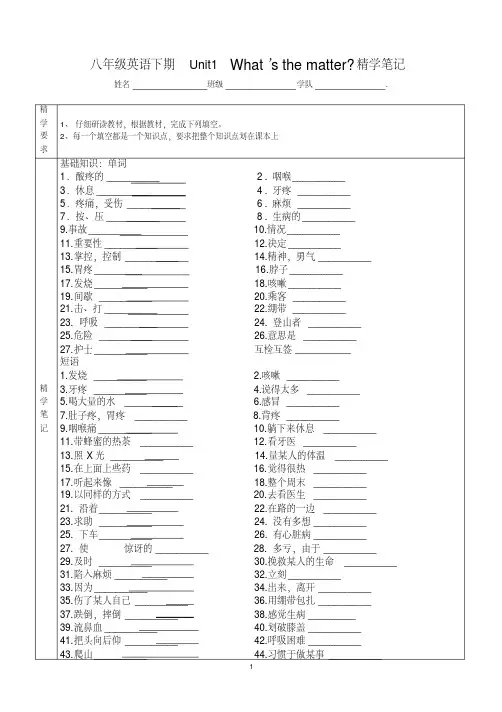
八年级英语下期Unit1What’s the matter?精学笔记
姓名班级学队.
精学要求
1、仔细研读教材,根据教材,完成下列填空。
2、每一个填空都是一个知识点,要求把整个知识点划在课本上
精学笔记
基础知识:单词
1.酸疼的__________2 .咽喉__________
(完整版)2019年人教版八下英语unit1精学笔记
八年级英语下期Unit1 What’s the matter?精学笔记姓名班级学队.精学要求1、仔细研读教材,根据教材,完成下列填空。
2、每一个填空都是一个知识点,要求把整个知识点划在课本上精学笔记基础知识:单词1.酸疼的__________ 2 . 咽喉__________3.休息__________ 4 . 牙疼__________5.疼痛,受伤__________ 6 . 麻烦__________7.按、压__________ 8 . 生病的__________9.事故__________ 10.情况__________11.重要性__________ 12.决定__________13.掌控,控制__________ 14.精神,勇气__________15.胃疼_________ 16.脖子__________17.发烧__________ 18.咳嗽__________19.间歇__________ 20.乘客__________21.击、打__________ 22.绷带__________23. 呼吸__________ 24. 登山者__________25.危险__________ 26.意思是__________27.护士__________ 互检互签短语1.发烧__________2.咳嗽__________3.牙疼__________4.说得太多__________5.喝大量的水__________6.感冒__________7.肚子疼,胃疼__________ 8.背疼__________9.咽喉痛__________ 10.躺下来休息__________ 11.带蜂蜜的热茶__________ 12.看牙医__________13.照X光__________ 14.量某人的体温__________ 15.在上面上些药__________ 16.觉得很热__________17.听起来像__________ 18.整个周末__________19.以同样的方式__________ 20.去看医生__________21. 沿着__________ 22.在路的一边__________ 23.求助__________ 24. 没有多想__________25. 下车__________ 26. 有心脏病__________27. 使······惊讶的__________ 28. 多亏,由于__________ 29.及时__________ 30.挽救某人的生命__________ 31.陷入麻烦__________ 32.立刻__________33.因为__________ 34.出来,离开__________35.伤了某人自己__________ 36.用绷带包扎__________37.跌倒,摔倒__________ 38.感觉生病_________39.流鼻血__________ 40.划破膝盖__________41.把头向后仰__________ 42.呼吸困难__________43.爬山__________ 44.习惯于做某事__________45.用完,用尽__________ 46.以至于_________________________ 47.如此······以至于__________ 48.掌管,管理___________________49.在困境中__________ 50.继续,坚持做某事__________51.做决定__________ 52.放弃___________________________ 53.冒险__________ 54.怎么了?______________________55.主语+ should/shoul dn't + _______互检互签考点一:What ’s the matter ? 怎么了?出什么事情了?用来询问病情或某人遇到的麻烦·问题。
人教英语八年级下册 1单元知识点笔记
人教英语八年级下册 1单元知识点笔记第一部分:图标词汇1. airliner:n. 客机,航空公司2. airport:n. 机场3. ambulance:n. 救护车4. bank:n. 银行5. bookshop:n. 书店6. bus station:n. 汽车站7. car park:n. 停车场8. cinema:n. 电影院9. convenience store:n. 便利店10. factory:n. 工厂11. fire station:n. 消防站12. hospital:n. 医院13. hotel:n. 酒店14. library:n. 图书馆15. museum:n. 博物馆16. police station:n. 警察局17. post office:n. 邮局18. restaurant:n. 餐厅19. school:n. 学校20. supermarket:n. 超市21. train station:n. 火车站22. zoo:n. 动物园第二部分:词组和句子1. get to:到达- How can I get to the nearest supermarket?我怎么才能到达最近的超市?2. turn left/right:向左转/向右转- Turn left at the traffic lights.在红绿灯处向左转。
3. go straight:直走- Go straight for 200 meters, and you will see the bank on your right.直走200米,你会在右边看到银行。
4. on the left/right:在左边/右边- The museum is on the right side of the road.博物馆在马路右边。
5. across from:在...的对面- The library is across from the post office.图书馆在邮局的对面。
八年级下册英语u1课文笔记

八年级下册英语u1课文笔记
标题:八年级下册英语Unit 1 大致主题
1. 词汇学习:
- 新词列表(包括单词、短语及它们的词性和含义)
- 关键词的固定搭配与用法
- 同义词与反义词
2. 语法点:
- 本单元主要涉及的语法结构(例如:一般过去时、现在完成时等)
- 重点句型及其变化形式
- 规则与不规则动词的变化
3. 课文要点:
- 概括每篇课文的主要内容和主旨大意
- 文中关键句子的理解和翻译
- 对于对话或故事的情节梳理和角色分析
4. 练习解析:
- 针对课后习题的解答方法和技巧
- 错误类型总结及避免方法
5. 拓展知识:
- 相关的文化背景知识
- 与主题相关的延伸阅读材料和话题讨论
请根据实际课本内容填充上述框架,这将帮助你系统地整理和巩固所学知识,
并为后续的学习打下坚实的基础。
记得结合老师的讲解和个人理解,形成个性化的笔记,以便更好地吸收和运用所学内容。
人教版八年级英语下册Unit 1知识点
人教版八年级英语下册Unit 1知识点人教版八年级英语下册Unit 1知识点Unit 1 Will people have robots?重点语法:一般将来时态的应用do/does 的一般将来时态形式:(shall/will) dodo/does 的一般将来时态的被动语态:(shall/will)be done一般将来时态的肯定句、否定句、疑问句形式:肯定句例句:People will have robots in a few years.否定句例句:People (will not/won't) have robots in a few years.一般疑问句例句:Will people have robots in a few years?特殊疑问句例句:What will people have in a few years?重点短语:won't = will notthey'llwillshe'll = she willhe'll = he willI'll = I willfall in love with(sb./sth.)爱上(某人/某物)be able to do sth. 能够做某事come true 实现uture 未来hundreds of 数以百计的thousands of 数以千计的look for(sb./sth.)寻找(某人/某物)will → would 情态动词 will 的原形和过去式may → might 情态动词 may 的原形和过去式Reading Strategy(阅读方法)Look ale and picture, and predict what you will read about. (看着标题和图片,预知你要阅读那些方面的内容。
)This helps you get ready to acquire new information. (这样可以帮助你获得一些新的信息。
八年级下册英语一单元笔记

八年级下册英语一单元笔记以下是一份关于八年级下册英语第一单元的笔记,供您参考:八年级下册英语第一单元重点笔记一、单词和短语1. future:未来,名词时翻译为“未来”。
作形容词时翻译为“将来的;未来的”。
2. prediction:预测,名词时翻译为“预报;预言”。
动词时翻译为“预报;预言;预计”。
3. astronaut:宇航员,名词时翻译为“宇航员”。
动词时翻译为“做航天飞行”。
4. inhabitant:居民,名词时翻译为“居民”。
作动词时翻译为“居住;栖息;生存”。
5. disaster:灾难,名词时翻译为“灾难;大破坏;大失败(specific灾难)”。
作形容词时翻译为“灾难性的”。
作动词时翻译为“遭受灾难;失败”。
6. anniversary:周年纪念日,名词时翻译为“周年纪念日”。
作形容词时翻译为“周年的;周年纪念的”。
7. receptionist:接待员,名词时翻译为“接待员”。
作动词时翻译为“接待;招待;欢迎(一般群众或官方人士)”。
8. firefighter:消防员,名词时翻译为“消防员”。
作动词时翻译为“执行消防任务;同火作战”。
9. police officer:警官,名词时翻译为“警官;警察”。
作动词时翻译为“由警方处理(犯罪)问题”。
10. engineer:工程师,名词时翻译为“工程师;机械师”。
作动词时翻译为“从事工程师的工作;驾驶(火车、轮船、飞机等)”。
二、句子结构1. What do you want to be in the future?你想未来成为什么?2. I want to be a teacher.我想成为一名老师。
3. What do you want to be when you grow up?你长大后想成为什么?4. How are you going to do that?你打算怎么做?5. I am going to study hard and go to university.我打算努力学习并上大学。
八年级下册英语第一单元笔记人教版

八年级下册英语第一单元笔记人教版English:The first unit of the eighth grade English textbook focuses on the topic of "School Life". In this unit, students will learn about various aspects of school life, including school facilities, rules and regulations, extracurricular activities, and school events. They will also learn to express their opinions and make suggestions about improving school life. The unit includes vocabulary and grammar exercises, as well as listening, speaking, reading, and writing activities to help students communicate effectively in English. Throughout the unit, students will develop their language skills and cultural awareness related to school life, and they will be able to apply what they learn to their own school experiences.中文翻译:八年级英语教科书的第一单元聚焦于“校园生活”这一主题。
在本单元中,学生将学习关于校园生活的各个方面,包括校园设施、规章制度、课外活动以及学校活动。
人教版八年级下册笔记 —— Unit 1
人教版八年级下册笔记——Unit 1主要短语be in control of 掌管;管理because of 由于fall down 摔倒feel sick 感到恶心get an X-ray 拍X 光片get into trouble 造成麻烦get off 下车get on 上车get out of 离开;从……出来give up 放弃go along/down 沿着……走go to a doctor 看医生have a cold 受凉;感冒have a cough 咳嗽have a fever 发烧have a heart problem 有心脏病have a nosebleed 流鼻血have a sore back 背疼have a sore throat 喉咙痛have a stomachache 胃疼have a toothache 牙疼have problems breathing 呼吸困难hot tea with honey 加蜂蜜的热茶lie down and rest 躺下休息take some medicine 吃一些药in a difficult situation 在闲境中in the same way 以同样的方式in time 及时on time 准时keep on doing sth. 继续或坚持做某事keep doing sth. 继续或坚持做某事make a decision 做出决定on the side of the road 在马路边right away, right now, at once, soon 立刻;马上run out (of) 用完;用尽see a dentist 看牙医see a doctor 看医生shout for help 大声呼救so that 以便so/such...that... 如此…… 以至于……sound like 听起来像take one's temperature 量体温take risks/ take a risk 冒险talk too much/ a lot 说得太多know much/ a lot知道得多learn much/ a lot学到得多thanks to 多亏了;由于thanks for因为……而感谢to one's surprise 令某人惊讶的是to one's joy 令某人高兴的是without thinking twice 没有多想be/get used to doing习惯于做某事used to do 过去常常做某事主要知识点讲解1.I have a stomachache.我胃痛。
2019-2020学年度人教版八年级下册Unit1知识点
2019-2020学年度人教版八年级下册Unit 1知识点ed to do过去经常做(现在不做了)be/get/become used to doing sth.习惯于做某事be used to do被用来做2.mean to do打算做mean doing意味着mean meant meant3.fall down from=fall off从......掉下来4.hit hit hit撞,打hurt hurt hurt受伤,疼痛5.lie lay lain lying躺,位于lie lied lied lying撒谎lay laid laid laying 放置,下蛋6.人+run out of+sth 用尽物+run out 用尽(不及物短语)7.give up doing放弃做8.put off doing推迟做9.have trouble/difficulty/problems (in) doing sth.做某事有困难10.think twice认真考虑11.be sick生病(表语)the sick person生病的那个人(定语)be ill生病(表语)12.make a decision to do sth.下决心做某事13.It is sad that many people.......“it”是形式主语,that从句是真正的主语。
14.see/watch/hear/sb. doing (正在做)see/watch/hear/sb. do (经常或整个过程)15.She said that the man......“said”是及物动词,that从句做宾语,介词后面的句子也是宾语从句,that在宾语从句中不作成分,无词义,只起连接作用。
16.期盼expect to do sth. expect sb.to do sth. expect that从句17.Aron Ralston is an American man who is interested in mountain climbing. 阿伦·罗尔思是一个对爬山感兴趣的美国人。
八下英语unit1书上笔记
八下英语unit1书上笔记以下是八下英语Unit1的笔记,供您参考:
1. 重点单词:
vocation 假期
honey 蜜糖;亲爱的(用于称呼对方或其所爱的人) centigrade 摄氏度
Kyoto 日内瓦
Switzerland 瑞士
gross 大量的;严重的
correspondence 通信;一致
factor 因素
2. 重点短语:
on vacation 在度假
in the north of 在某事物的北部(接壤)
to the south of 在某事物的南部(不相邻)
go to Beijing 去北京
3. 重点句子:
I will go to Beijing on vacation. 我将去北京度假。
My family and I are on vacation in the north of China. 我和我的家人正在中国北部度假。
We are going to Kyoto in Japan for our vacation. 我们打算去日本京都度假。
I am staying in Switzerland during the vacation. 我正在瑞士度假。
4. 语法点:
现在进行时态的用法:表示正在发生的动作或存在的状态,常与now、at the moment等时间状语连用,结构为be doing sth。
5. 阅读理解:掌握文章主旨和细节,了解作者的意图和态度。
注意文中的转折、因果、举例等关键信息,理解长难句的结构和意义。
提高阅读速度和准确性,培养阅读技巧和策略。
(完整)新版人教版八年级下册unit1-8笔记整理
(完整)新版人教版八年级下册unit1-8笔记整理Unit1笔记整理1、What’ s the matter with you?= What’s the trouble with you? = What’ s wrong with you?你怎么了?= What’s up? = What happens to sb.?2、as a matter of fact= in fact 事实上, 实际上【拓展】matter的用法It doesn’t matter 没关系(用来回答别人道歉时的用语)3、have a cold 受凉;感冒have a/an + 疾病名词“患……病” (cold/fever/cough)have a sore throat 患喉咙痛have a sore back 患背痛have a fever 发烧have a cold =catch a cold 患感冒have a stomachache 患胃痛have a toothache患牙痛have a headache 患头痛have a backache患背痛4、back n 背;背部at the back of......在......的后面go/come back 返回give back 归还5、hand in hand 手拉手V 交给;传递hand in 上交hand on 依次传递hand out 分发6、enough 的用法(1) adj.足够的,充分的修饰名词时,可放在名词之前或之后enough time,enough money(2) adv. “足够地,十分,相当”修饰adj./adv,必须放在adj./adv 后expensive enough(3) be +adj. +enough to do sth.足够……的去做某事He is strong enough to carry the box.7、drink some hot tea with honey.喝一些加蜂蜜的热茶。