
人教版七年级英语第五单元教案
第1课时Unit 5 Section A 1a—2c【学习目标】:1、掌握本节课的9个单词和2个短语2、学会句型Do you have -----?以及其回答Yes, I do. /No, I don't.【学习重点】:学会就有关人与物所属关系进行问答的句子。
【学习过程】:一、自主学习(教师寄语:Where there is a will, there is a way.)学习任务一: 熟练掌握本节课的9个词汇和2个短语。
过程:(1)个人试读,组内相互纠正发音。
(2)教师领读,学生纠正自己的发音(3)自己读并记住汉语意思,组内检查。
(4)小组竞赛,看谁记的快而多。
学习任务二:(1)认真观察1a的图画,将单词与图中物品搭配,小组讨论并核对答(2)听录音,完成1b,小组核对答案学习任务三: 熟练运用询问人与物所属关系的句型Do you have ----?及回答Yes, I do. /No, I don't.1、看图片1a,引入A:Do you have a pingpong ball?B:Yes, I do. /No, I don't.2、利用1a中物品来练习句型Do you have----?Yes,I do.No, I don't.3、小组竞赛看谁练的快而多。
二、合作共建(教师寄语:Many hands make light work. )小组讨论:Do you have a soccer ball?中的you能否替换为he?三、系统总结(教师寄语:No man can do two things at once.)(1)这节课你学会了哪些表示球类的词。
(2)总结一下询问人与物所属关系的句型。
四、诊断评价(教师寄语:It's easier said than done.)(一)英汉互译:soccer ball_____________ tennis racket_____________有_____________球________排球____________篮球____________网球____________乒乓球_________球拍_________ (二)选择:1、根据句意及首字母补全单词(1)Is that her e________(2)This is a pencil c_______(3)What's this ? It's a r______(4)E______me. Is this your pencil?2、选择(1)—Is this your eraser?—__________A.Yes, it's .B. Array Yes,it is.C.Yes,is.D.It is.(2)Is that ______pencil sharpener?A.heB. himC. hisD.you(3)This is _____ bag.A. meB. IC. my.D.you(4) ----Is that his case? -----__________.A.Yes, that is .B.Yes, it isn't.C. No, it is.D.No, it isn't.3、完成下列句子(1)—______ _______(这是) your pencil?—______ , ________ ________(是,它是)(2)—_______ _______(那是)his book?—______, it _____(不,它不是).It is_______(我的)book.4、翻译下列句子(1)这是你的字典吗?不,它不是。
(2)这是他的钢笔吗?是,它是。
(3)那是她的课本吗?不,那是我的课本。
五、【课后反思】(教师寄语:Never do things by halves)第2课时Unit 5 Section A 3a-4【学习目标】:1.掌握单词let,play,well,good,sport,many,club,class,more2.掌握提建议的句型Let's--【学习重点】:1.学会使用Let's---- 提建议【学习过程】:一、自主学习(教师寄语:Many hands make light work. )学习任务一: 熟练掌握本课的12个单词1.个人自读,记忆本课单词.2.小组互相检查单词读写情况.3.根据汉语写出下列英语单词并展示.让_______ 玩,打_________ 听起来____________ 运动___________大量的_________ 我们__________ 社团___________ 更多的____________ 班级,课________________ 学习任务二:完成3a的练习,根据3b练习Let's--的用法1.完成3a的练习.2.两人一组,练习下面的对话A: Let's play soccer.B: I don't have a soccer ball.A: Well, let's play volleyball.B: That sounds good.3.两人一组做替换练习二、合作共建(教师寄语:Many hands make light work. )小组讨论play+soccer,tennis,volleyball,ping-pong,sports的翻译三、系统总结(教师寄语:No man can do two things at once.)总结本单元的主要句型四、【诊断评价】(教师寄语:Never do things by halves)(一)用所给词的适当形式填空1. That _______ (sound ) good.2. ______ you _____ (have) a tennis racket?3. We have many sports _________(club).4. Let's_________(play) ping-pong.5.I _________(not have) a soccer ball.(二)选择1. ___________ you have a pen?A. doB. doesC. DoD. Does2.—Let's play ping-pong. —_____________.A. it's good.B.That interestingC.That's sound goodD. it's fun3. Do you play ________ volleyball?A. theB. aC. anD.\4. Let me ________ you.A. helpB. to helpC. for helpD. helping5. _____ Tom ________ a computer?A. Do, hasB. Does, haveC. Do haveD. Does,has6. My brother_________ have a hat.A. am notB. dontC.don'tD.doesn't(四)根据首字母完成单词1.Do you have a tennis r__________.2.In our school,we have manty s_______ clubs.3.That s_______ good.4. Let's play s_________.5. Miss Li has a c__________ game.(五)根据汉语完成句子1.我没有一个网球拍.I ______ ______ a _______ racket.2. 让我们去踢足球吧._____________________________3. 那听起来很好.That _________ good.4. 我们有很多运动俱乐部.We _______ many _______ clubs.5.你打网球吗?你踢足球吗?Do you ____________? ___________ play soccer?.五、【课后反思】(教师寄语:Never do things by halves)通过本节课的学习我最大的收获_________________________________感到自己有待加强的是________________________________________第3课时Unit 5 Section B 1a-2c【学习目标】:1.掌握单词interesting,boring,fun,difficult,relaxing,watch,watch TV2.熟练掌握提建议的句型Let's--【学习重点】:1.学会使用描述性形容词对事物做出评价如:interesting/boring/difficult/relaxing/TV等2.熟练掌握Let's--句型【学习过程】:一、自主学习(教师寄语:Many hands make light work. )学习任务一: 熟练掌握本课的7个单词1.个人自读,记忆本课单词.2.小组互相检查单词读写情况.3.根据汉语写出下列英语单词并展示.有趣的,令人感兴趣的______________/__________ 无聊的,令人生厌的__________ 困难的______________ 轻松的______________ 看电视_________________4.小组合作完成1a,从而做1b的活动.学习任务二:听录音,练习Let's--的用法1.听录音完成2a.2.再听一遍,完成2b内容.二、合作共建(教师寄语:Many hands make light work. )小组讨论play basketball能否play the basketball三、系统总结(教师寄语:No man can do two things at once.)小组讨论总结sound 为什么词?后需加什么样的词?举例说明.四、【诊断评价】(教师寄语:Never do things by halves)(一)根据句意及首字母提示补全单词1. These questions are very d_____________.2. They play football e__________ day.3. D________ she like sports?4. That s__________ interesting.5. I don't w____________ TV in the evening.6.—Let's play tennis.—No, it's b______________.7. We have many c________:volleyball,basketball,ping-pong and more.(二)翻译短语1.打排球____________________2.玩电子游戏_________________3.看电视___________________4.足球踢_____________________5.做运动___________________6.听起来很有趣________________7.体育俱乐部_______________ 8.那么难______________________(三)选择1.—Do Lucy and Lily have a baseball? —Yes,____________.A. she doesB. she hasC. they doD. they have2.—Let's play basketball. —No,_____________.A. it's boringB. it's interestingC. it's goodD. it's fun3.That's an ___________ question.A. interestingB. boringC. difficultD. relaxing4. Do you play _______?A. basketballsB. a basketballC. basketballD. the basketball5. Let's _____________.A. play ping-pongB.t o play ping-pongC. playing ping-pongD. play the ping-pong6. I _________ have a watch..A .am not B. dont C.don't D.doesn't7.That sounds ___________.A. wellB. badlyC. goodD. fine(四)用所给动词的正确形式填空.1. Let's ___________ (play) soccer.2. That ___________ (sound) boring.3. He ____________ (have) a book.(五)翻译句子.1.—咱们去打篮球吧. —那听起来很有趣.—________________________________________.—________________________________.2.—你爸爸有电脑吗? —不,没有.他有个手表.—___________________________________________?—_________, _______________. ___________________________.五、【课后反思】(教师寄语:Never do things by halves)通过本节课的学习我最大的收获_________________________________感到自己有待加强的是________________________________________第4课时Unit 5 Section B 3a—4【学习目标】:1.掌握本节课的9个单词和4个短语2.学会写某人所拥有物品的短文【学习重点】:学会写某人所拥有物品的短文【学习过程】:一、自主学习(教师寄语:Knowledge is power.)学习任务一: 会读写29页上的单词和短语过程:1.自读并记忆单词5分钟2.两人一组,相互提问3.展示交流,小组竞赛(以听写形式进行展示)单词:美妙的;大的收藏品;收集物但是只;仅仅他们(的宾格)每个天;一日复数:racket basketball vollayball三单:have watch play短语:体育收集品参加体育运动每天通过电视看---节目三个棒球学习任务二: 学习3a3b部分过程:1.学生自读3短文,圈出与体育有关的物品2.组内交流,理解短文意思3.学生展示,其他学生质问或补充,教师点拨,完成3a4.学生背诵3a短文并展示5.看3b图画,补全3b短文6.组内交流,核对答案7.展示成果学习任务三:学写某人所拥有物品的短文二、合作共建(教师寄语:Many hands make light work. )结合句子He only watches them on TV.I have three watches.你能说出watch 的用法吗?三、系统总结(教师寄语:No man can do two things at once.)1. 总结一下你所学过的物品单词2.如何介绍某人所拥有的物品四、诊断评价1.根据句意及首字母提示补全单词(1) Here is a t________racket.(2) They play football e _______day.(3) I don't w _______ TV in the evening.(4) We have many c _______: vollyball, basketball, ping--pong .(5) Let's p_______ soccer.(6)Sue _________(not have) a great sports collection.(7)—Let's watch TV.—That ________(sound) fun.(8)He _______(have) a tennis racket.(9)—______she _______(have) a phone? —No, she doesn't.2.完成下列句子他不做体育运动,他只在电视上看。
人教版英语七年级上册第五单元第一课时优秀教学案例方案
3.教师巡回指导,关注小组合作过程,及时给予支持和帮助。
4.各小组展示讨论成果,分享彼此的学习心得。
(四)总结归纳
1.教师引导学生回顾本节课的学习内容,帮助学生巩固所学知识。
2.学生进行自我评价,反思自己在课堂上的表现,找出需要改进的地方。
2.设置小组竞赛环节,如哪个小组能够最快地完成听力练习,激发学生的学习积极性。
3.教师巡回指导,关注小组合作过程,及时给予支持和帮助。
4.鼓励学生相互评价,培养他们的自主学习和评价能力。
(四)反思与评价
1.教师引导学生回顾本节课的学习内容,帮助学生巩固所学知识。
2.学生进行自我评价,反思自己在课堂上的表现,找出需要改进的地方。
2.邀请学生分享他们对学校的认识和感受,创设真实、生动的情境,激发学生的学习兴趣。
3.设计各种课堂活动,如角色扮演、小组讨论等,让学生在实际情境中运用所学知识。
4.创设趣味性的听力练习,如听力游戏、听力竞赛等,提高学生的听力兴趣和效果。
(二)问题导向
1.教师提出引导性问题,如“你们学校有什么特点?”“你的班级有哪些学科?”等,引导学生思考和回答。
2.通过对学校主题的学习,培养学生的集体荣誉感和归属感,使他们更加热爱自己的学校。
3.引导学生尊重和理解不同文化背景下的学习方式,拓宽国际视野。
4.通过对同学和老师的介绍,培养学生的人际交往能力,增进同学间的友谊。
三、教学策略
(一)情景创设
1.利用多媒体课件展示学校的图片,如教学楼、操场、教室等,让学生直观地了解学校的基本情况。
4.教师对作业进行及时批改,给予反馈,帮助学生提高。
五、案例亮点
人教版英语七年级上册第五单元第一课时教学设计方案
2. Share your experiences about school life with your group members.
3. Make a list of things you do every day at school.
a.录制一段视频或音频,用英语介绍自己的学校,包括学校的位置、设施、老师和同学等。
b.与同学进行英语对话,运用本节课所学的核心词汇和一般现在时,分享彼此的学校生活。
c.家庭作业:与家人进行英语交流,用一般现在时描述家人的日常活动,提高实际交际能力。
3.预习作业:
a.预习下一课的内容,提前了解新的词汇和语法点。
2.教学过程设计:
a.导入:通过播放一首关于学校生活的英文歌曲,引起学生的兴趣,为新课的学习做好铺垫。
b.呈现:展示与本节课相关的图片,引导学生学习新词汇,同时讲解一般现在时的用法。
c.练习:设计各种听说练习,如问答、对话、小组活动等,让学生在实际操作中巩固所学知识。
d.应用:组织学生进行角色扮演,模拟学校生活中的场景,运用一般现在时进行口语表达。
人教版英语七年级上册第五单元第一课时教学设计方案
一、教学目标
(一)知识与技能
1.让学生掌握本节课的核心词汇,如:school, class, teacher, student, desk, chair等,并能够熟练运用这些词汇描述自己的学校和日常生活。
2.使学生掌握一般现在时的用法,并能运用一般现在时描述自己的学校生活。
2.重点:培养学生的听说能力和口语表达能力,提高学生的英语交际能力。
人教版英语七年级上册Unit5优秀教学案例
4.反思与评价:教师引导学生进行自我反思和相互评价,帮助学生发现自己的不足和提高方向。反思与评价的教学策略培养了学生的自我认知和自我评价能力,使学生能够更好地监控自己的学习过程和成果。
5.教学策略的灵活运用:本案例中,教师根据学生的特点和能力,灵活运用了情景创设、问题导向、小组合作和反思与评价等多种教学策略。这些策略的有效结合,使教学内容与过程丰富多彩,提高了学生的学习兴趣和参与度,促进了学生的全面发展。
人教版英语七年级上册Unit5优秀教学案例
一、案例背景
本案例背景基于人教版英语七年级上册Unit 5,该单元主题围绕“My family and friends”(我的家庭和朋友)展开,主要介绍家庭成员和朋友的相关知识。通过本单元的学习,学生能够掌握描述家庭成员和朋友的词汇,学会使用英语进行简单的交流,并能运用所学知识进行日常生活中的实际应用。
3.设计开放性问题,鼓励学生发表自己的观点和看法,培养学生的批判性思维和创新能力。例如:你认为什么是真正的朋友?朋友对我们的生活有什么意义?
(三)小组合作
1.将学生分成小组,根据小组成员的特点和能力,分配不同的任务和角色,让每个学生在小组合作中都能发挥自己的优势和特长。
2.设计小组活动,如角色扮演、小组讨论、小组竞赛等,激发学生的团队合作精神和竞争意识,提高学生的口语表达能力和团队协作能力。
3.引导学生相互评价,鼓励学生给予他人肯定和鼓励,培养学生的友善和尊重他人的态度。
4.教师对学生的学习过程和成果进行总结和评价,给予及时的反馈和指导,帮助学生发现自己的不足和提高方向。
Unit 5 Section A(1a-1d)教学设计人教版(2024)七年级英语上册

Unit 5Fun Clubs一、单元内容分析单元主题:学校社团。
该主题属于“人与自我”范畴,涉及“生活与学习”主题群,其子主题内容为“多彩、安全、有意义的学校生活”和“自我认识、自我管理、自我提升”,以及“人与社会”范畴,涉及“社会服务与人际沟通”主题群,其子主题内容为“交流与合作,团队精神”。
本单元的核心语言主要涉及社团活动的参与,引导学生主动了解学校开设的各种社团,并能结合自己的爱好、特长等多种因素来选择合适的社团,积极参与到社团活动中。
Section A主要为听说及语法练习,由四组对话及一篇人物介绍构成。
在前三组听力对话中,通过社团招募新成员的活动场景,呈现了选择社团时需要考虑的因素,对话四是三位同学商量一起加入社团,询问各自的特长,也很好地展现了同学之间互相鼓励和支持,一起做喜欢的事情。
Grammar Focus部分的语篇是介绍了多才多艺的好朋友Linda,通过对Linda擅长的各个方面的描述,再次复习了介绍他人的核心语言。
通过对Section A部分的学习,学生能够熟练地介绍自己和他人的能力。
Section B主要为读写练习,由学校的三个社团发布的招新广告构成。
招新广告,文本语言简洁且有号召力,聚焦社团活动内容以及学生能获得的收获。
三则广告都使用了疑问句吸引、启发读者,同时用感叹句激励和号召读者。
本语篇三则广告比较精练,语言难度与学生能力匹配,适合学生仿写练习。
Project的活动是建立自己的社团,学生需要自主创建一个既有新意又有意义的社团、制作招新广告,并招募合适的成员。
让学生了解建立社团及招募成员的基本内容,引导学生对单元主题意义的探究,体会并感悟培养健康兴趣的意义。
二、单元内容框架三、单元教学目标1. 语音知识:能认读辅音音标/p/,/b/,/t/,/d/,/k/,/ɡ/,/f/,/v/的发音,并掌握辅音字母及字母组合的发这些音的规则;能够了解不完全爆破的发音特点。
2. 词汇知识:掌握本单元的核心语言如join,choose,feeling,exactly,art club,music club,scienceclub,chess club,drama club,pingpong club,play the guitar,play musical instruments,sing well,play the violin,act out stories,read maps,be interested in nature,fall in love withbooks等。
人教版英语七年级上册Unit5SectionA3a3C优秀教学案例
2.设计一个家庭聚会的小场景,邀请学生参与其中,通过角色扮演,让学生在实际语境中运用所学词汇和句型。
3.创设“家庭介绍”的任务,要求学生结合所学知识,向同学们介绍自己的家庭成员,激发学生的学习兴趣。
(二)问题导向
1.在课程导入阶段,提出问题:“Can you introduce your family members in English?”,引发学生对家庭成员词汇的思考。
四、教学内容与过程
(一)导入新课
1.教师以一张全家福照片作为导入,引导学生关注家庭成员,激发学生的学习兴趣。
2.邀请学生用中文介绍自己的家庭成员,为接下来的英语学习做好语言铺垫。
3.提问:“Can you introduce your family members in English?”,让学生尝试用英语描述家庭成员,从而引出本节课的主题。
3.培养学生的合作精神,学会与人沟通、交流,增强社会适应能力。
4.培养学生正确的人生观和价值观,树立正确的家庭观念,关注家庭和谐。
5.通过学习英语,拓宽学生的国际视野,增强跨文化交际能力,为未来的学习和发展奠定基础。
三、教学策略
(一)情景创设
为了让学生更好地融入本节课的学习,我将采用以下情景创设策略:
(二)讲授新知
1.教师展示Unit5 Section A 3a-3c的课文内容,引导学生学习描述家庭成员的词汇和句型。
2.对关键词汇进行讲解,如:sister, brother, father, mother, grandmother, grandfather等,并让学生跟读、模仿。
3.分析课文中的句型,如:“This is my ...”,并让学生进行实际操作,用所学词汇和句型进行家庭成员的介绍。
七年级英语上册(人教版)Unit5单元整体说课稿
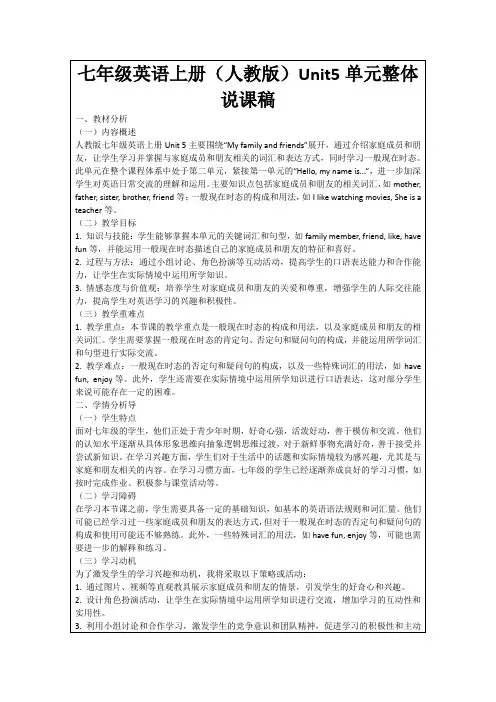
一、教材分析
(一)内容概述
人教版七年级英语上册Unit 5主要围绕“My family and friends”展开,通过介绍家庭成员和朋友,让学生学习并掌握与家庭成员和朋友相关的词汇和表达方式,同时学习一般现在时态。此单元在整个课程体系中处于第二单元,紧接第一单元的“Hello, my name is...”,进一步加深学生对英语日常交流的理解和运用。主要知识点包括家庭成员和朋友的相关词汇,如mother, father, sister, brother, friend等;一般现在时态的构成和用法,如I like watching movies, She is a teacher等。
3.情感态度与价值观:培养学生对家庭成员和朋友的关爱和尊重,增强学生的人际交往能力,提高学生对英语学习的兴趣和积极性。
(三)教学重难点
1.教学重点:本节课的教学重点是一般现在时态的构成和用法,以及家庭成员和朋友的相关词汇。学生需要掌握一般现在时态的肯定句、否定句和疑问句的构成,并能运用所学词汇和句型进行实际交流。
(三)巩固练习
为了帮助学生巩固所学知识并提升应用能力,我计划设计以下巩固练习和实践活动:
1.小组讨论:学生分组讨论自己的家庭成员和朋友,用英语进行介绍和描述,并练习运用一般现在时态。
2.角色扮演:学生分组进行角色扮演,模拟真实场景,用英语介绍家庭成员和朋友,并尝试运用一般现在时态。
3.练习题:设计一些练习题,让学生在纸上完成,检测他们对家庭成员和朋友词汇和一般现在时态的掌握情况。
为了激发学生的学习兴趣和动机,我将采取以下策略或活动:
1.通过图片、视频等直观教具展示家庭成员和朋友的情景,引发学生的好奇心和兴趣。
Unit+5单元教案2024-2025学年人教版英语七年级上册
新版人教(2024)七上Unit 5 Section A (1a-2e) 教案T eaching goals:1.Be able to master key words like drama, chess, club, etc.2.Be able to talk about clubs at school.Teaching procedure:Step I Lead-inWatch a video, and say what clubs are mentioned in the video.Have students list clubs as many as they can.Step II Pre - listeningWork on 1a. Match the clubs with the pictures.Read the phrases in 2a.Step III While - listeningWork on 1b. Listen to the conversations and finish the table in 1b.Listen again and complete the sentences with the words in the box in 1c..Read the tape script.Step IV Pair workWork in pairs and make up a conversation.Role-play a conversation between a club leader and a student.-- Hello, I want to join ...-- Great ! Can you ...?-- Yes, I can. / No, I can’t.-- ...Step V PronunciationWork on 1. Listen and repeat.Work on 2. Listen and repeat. Notice that the letters in brackets are silent.Step VI Listening and speakingWork on 2a. Listen to the conversation and fill in the blanks.Work on 2b. Read the conversation and complete the table.Work on 2c. Read again. And pay attention to the letters that are silent.Role-play the conversation.Work on 2d. Circle can or can’t with your own information. Then tick the club you want to join. You can add more items.Step VII Pair workWork on 2e. Discuss what clubs you want to join.Give a report about your discussing results.-- What club do you want to join?-- I want to join the sports club.-- Can you ...?-- Yes, I can. /No, I can’t. How about you?-- I ...Step VIII Homework1.Read the conversation in 2a and try to remember it.2.Finish the exercises on the work book.Blackboard DesignHow do you choose a school club?What club do you want to join?I want to join the ...Can you ...?新版人教(2024)七上Unit 5 Section A Grammar focus教案T eaching goals:1.Be able to master key words like climb, musical, instrument, sing, etc.2.Be able to talk about abilities using can.Teaching procedure:Step I Lead-inShow some pictures and ask students the question:Can you play football/basketball/the piano/ ...What can you do?Have them talk about their abilities.Step II PresentationRead the sentences in grammar focus.Pay attention to the word “can”.Step III Group workWork in groups and talk about how to use “can”. Think and talk about the following questions:1.What’s the meanings of “can”?2.Where do we put the word “can” in the question sentences?3.How to answer to the questions with “can” in the beginning?Make a conclusion about the usage of “can”.Have students make some sentences with “can”.Step IV ExerciseWork on 3b. Match the parts to make sentences. Then make more sentences with “can”.Check the answers and read the sentences.Finish the exercises in 3c. complete the passage with the words in the box.Step V Pair workInterview your classmates and tick can or can’t. Then give a report.Step VI Homework1.Read and try to remember the sentences in the grammar focus.2.Finish exercises in this unit on the work book.Blackboard DesignWhat can you do?Can you ...?Yes, I can. / No, I can’t.What club do you want to join?I want to join the ...club.T eaching goals:1.Be able to master key words like mind, fall, nature, etc.2.Be able to find out what people do in different clubs.Teaching procedure:Step I Lead-inShow them some pictures of different clubs. And practice the following talk:-- What can you do?-- I can ...-- Can you ...?-- Yes, I can. / No, I can’t.-- What club do you want to join?-- I want to join the ... club.Step II ReadingRead the comments from some students and discuss what clubs they should join.-- I’m good at telling stories. I often act out stories with my brother at home.-- I’m interested in nature. I love hiking, and I can read maps.-- I can’t cook, but I love great food. I want to cook for my family.Read the ads. Choose a mistake club for each student in 1a and tell your reasons. Read again and complete the table in 1c.Step III Pair workWork in pairs and discuss the following questions:1.What food can you cook? What other food do you want to learn to cook?2.What can you learn from a book club?3.What do you want to be in a nature club?Complete the email with the words in the box.Read the ads again. And circle key words.Step IV Language points1.learn to do sth2.You name it.3.more than4.act out5.make friends with sb6.aall in love withStep V WritingWork on 2b. Choose one club from 2a. Write an email to the organizer and say why you’d like to join the club.Step VI Homework1.Polish your writing.2.Finish exercises in this unit on the work book.Blackboard DesignI wan to join .... I have some reasons. / Let me tell you why. First of all, ....T eaching goals:1.Be able to master key words robotics, team, contact, etc.2.Be able to know how to start your own club.Teaching procedure:Step I RevisionAsk students what club they want to join.Work on 3a. Think of a club you would like to set up in your school.Read the ad in 3a. And think about how to write an ad for a club.Step II Group workWork in groups. Interview your classmates. Find new members for your club. -- Can you work well with your hands?-- Yes, I can.-- Can you come at 12:30 p.m. on Tuesday?-- Yes, I can. / No, I can’t.Step III Show timeMake a report about your group members’ situations.Step IV ReflectingAll students finish the table according to their own situation.Step V Homework1.Read and remember the words in this unit.2.Finish exercises in this unit on the work book.Blackboard Designbe interested in / have an interest inlook forwork well with ...think up new ideas = come up with new ideaswork as a team。
七年级英语上册(人教版)Unit5单元整体优秀教学案例
2.教师提出问题,如“你们在学校都做些什么?”,引导学生用英语进行思考和表达,为新课的学习做好铺垫。
3.利用学生Leabharlann 有的学校相关知识,如课程、老师、同学等,引出新课的关键词汇和学习内容。
4.通过创设情境,如学校场景的角色扮演,激发学生的学习兴趣,引发他们对新课的好奇心。
2.教师设计评价量表,让学生进行互相评价,培养学生的评价能力和批判性思维能力。
3.教师对学生的学习成果进行及时反馈,鼓励他们的努力和进步,提高他们的自信心和学习动力。
4.利用课堂讨论、问卷调查等方式,收集学生对教学活动的反馈意见,不断调整和改进教学策略,提高教学质量。
四、教学内容与过程
(一)导入新课
4.通过听力练习,让学生听懂并理解英语对话中关于学校的信息,提高他们的听力理解能力。
5.通过阅读练习,让学生阅读并理解英语文章中关于学校的信息,提高他们的阅读理解能力。
(三)学生小组讨论
1.教师提出讨论话题,如“你们的学校有哪些特色?”,让学生在小组内进行讨论和分享。
2.学生通过讨论,运用英语表达自己的观点,提高他们的口语表达能力和交际能力。
在教学过程中,我以学生为主体,注重培养学生的英语听说读写能力,提高他们的语言运用能力。针对七年级学生的特点,我采用生动有趣的教学方法,如情景教学、任务型教学等,激发学生的学习兴趣,让他们在轻松愉快的氛围中学习英语。
在教学内容上,我注重联系学生的生活实际,让学生在介绍自己学校的同时,提高他们的自信心和合作意识。同时,我还结合单元主题,开展丰富多样的课堂活动,如小组讨论、角色扮演等,使学生在实践中掌握英语知识,提高他们的实际运用能力。
人教版新目标七年级英语下册 Unit 5 教案
人教版新目标七年级英语下册 Unit 5 教案一. 教材分析人教版新目标七年级英语下册Unit 5主要讲述了日常生活中的一些活动,如游泳、打篮球、跳舞等。
本单元的话题贴近学生的生活,有利于激发学生的学习兴趣。
教材通过听说读写等多种活动,帮助学生掌握日常生活中的交际用语,提高学生的语言运用能力。
二. 学情分析七年级的学生已经掌握了基本的英语语法和单词,对于日常生活中的交际用语也有了一定的了解。
但部分学生可能在发音和口语表达上还存在困难,需要教师在教学中加以引导和纠正。
此外,学生可能对一些体育活动相关的词汇和表达不够熟悉,需要在课堂上进行拓展和练习。
三. 教学目标1.知识目标:学生能够掌握本单元的生词和短语,了解日常生活中的交际用语。
2.能力目标:学生能够听懂、会说、会读、会写与日常生活相关的英语句子。
3.情感目标:学生能够积极参与课堂活动,提高学习英语的兴趣。
四. 教学重难点1.重点:本单元的生词和短语,日常生活中的交际用语。
2.难点:情态动词can的用法,以及与日常生活相关的句型结构。
五. 教学方法1.任务型教学法:通过设置各种任务,让学生在完成任务的过程中学习英语。
2.情景教学法:创设各种生活情境,让学生在真实的环境中学习英语。
3.交际法:鼓励学生积极参与课堂交际,提高口语表达能力。
六. 教学准备1.准备单词卡片、短语卡片、图片等教学辅助材料。
2.准备与本单元话题相关的视频或音频材料。
3.准备课堂练习题和测试题。
七. 教学过程1.导入(5分钟)利用图片或视频引导学生谈论日常生活中喜欢的活动,引出本课话题。
2.呈现(10分钟)老师展示本课的生词和短语,让学生朗读并解释其意思。
同时,老师用情态动词can提问,引导学生回答。
3.操练(15分钟)学生分角色扮演,用情态动词can进行问答。
老师巡回指导,纠正发音和表达错误。
4.巩固(10分钟)学生完成课堂练习题,老师及时批改和讲解。
5.拓展(5分钟)老师引导学生谈论更多关于日常活动的表达,如游泳、打篮球、跳舞等。
2024年七年级上册英语第五单元全英语教案
2024年七年级上册英语第五单元全英语教案一、教学目标1. 知识与技能目标Students will be able to recognize and use new vocabulary related to the topic of the unit.Pupils will learn to use the present continuous tense correctly in speaking andwriting.Pupils will develop reading comprehension skills by understanding main ideas and details in texts.2. 过程与方法目标Pupils will practice listening skills by responding to questions and performing tasks using audio materials.Pupils will collaborate in group activities to enhance their communication and teamwork skills.Pupils will engage in problem-solving activities to develop critical thinking and analytical skills.3. 情感、态度和价值观目标Pupils will develop a positive attitude towards learning English and appreciate its role in globalcommunication.Pupils will learn to respect diverse opinions and cultures presented in the unit's materials.Pupils will enhance their confidence in using English to express their ideas and feelings.二、教学重点和难点1. 教学重点Mastering the new vocabulary and its application in context.Correct usage of the present continuous tense in speaking and writing activities.Enhancing reading comprehension through activities that promote deep understanding of texts.2. 教学难点Distinguishing between the present continuous tense and other tenses, especially the present simple ing appropriate vocabulary to express ideas effectively in writing.Improving listening comprehension, especially when dealing with native speaker speed and pronunciation.三、教学过程1. 导入新课 (Lead-in)Begin with a relevant and engaging activity, such as a short video or a discussion about a topic related to the unit.Ask students to predict what the unit will cover based on the lead-in activity.Briefly introduce the topic and main points of the unit.2. 呈现新课 (Presentation)Introduce new vocabulary and its meanings through visual aids, context, or examples.Explain the structure and usage of the present continuous tense using examples andexercises.Present a reading text and guide students through it, highlighting main ideas and vocabulary.3. 巩固练习(Practice)Conduct controlled practice activities such as fill-in-the-blanks, matching exercises, or true/falsequestions.Encourage students to work in pairs or groups to practice speaking and using the present continuous tense in context.Provide writing prompts related to the unit topic and let students practice writing using the new vocabulary and tense.4. 应用拓展 (Extension)Engage students in role-playing activities or simulations that require them to use the present continuous tense inreal-life situations.Ask students to create their own stories or dialogues using the new vocabulary and tense.Introduce higher-order thinking activities, such as debates or critical discussions, to encourage students to think critically about the unit's content.5. 课堂小结 (Summary)Recap the main points and vocabulary learned in theunit.Ask students to share their learning experiences and challenges faced during the lesson.Encourage students to continue practicing the new vocabulary and tense at home and in other contexts.四、教学方法和手段1. 教学方法Communicative approach to encourage student-centered interactions and language use.Cooperative learning techniques to promote teamwork and collaborative problem-solving.Task-based learning to engage students in meaningful and purposeful activities.2. 教学手段Multimedia presentations using projectors or interactive whiteboards.Audio materials such as podcasts or recorded conversations for listening practice.Online resources and digital tools for additional practice and homework assignments.五、课堂练习、作业与评价方式1. 课堂练习Provide in-class exercises that cover the vocabulary, grammar, and reading comprehension skills taught in theunit.Conduct oral practice activities that involve speaking and listening skills.2. 作业布置Assign homework that reinforces the new vocabulary and grammar points learned in class.Include reading comprehension exercises and writing tasks that require students to apply their knowledge.3. 评价方式Use formative assessments, such as quizzes or oral reports, to monitor students' progress throughout theunit.Conduct a summative assessment at the end of the unit to evaluate students' understanding of the material.Encourage peer review and self-assessment to promote metacognition and self-improvement.六、辅助教学资源与工具1. 教材及配套练习册Provide students with the necessary textbooks and workbooksthat contain the vocabulary, grammar, and practice exercises related to the unit's content.2. 数字资源和学习平台Utilize online resources, such as educational websites, digital dictionaries, and online learning platforms, to provide additional materials for students to review and practice.Introduce students to adaptive learning tools that adjust the difficulty level based on their performance, offering personalized learning experiences.3. 多媒体教学材料Prepare interactive PowerPoint presentations or pre-recorded videos to illustrate key concepts and grammar e educational games and quizzes to make learning more engaging and fun for students.七、结论After completing this unit, students should have a solid grasp of the new vocabulary, grammar rules, and reading comprehension skills introduced. The variety of teaching methods and resources used throughout the unit ensures that different learning styles are catered to, and regularpractice opportunities promote language retention. Ongoing formative assessments allow teachers to monitor student progress and adjust teaching strategies as needed.八、教学反思As a teacher, it is crucial to reflect on the effectiveness of the lesson plans implemented. Considerations include:1. Student EngagementWere students actively involved in class discussions and activities?Were there opportunities for all students, including those with different learning styles and abilities, to participate?2. Teaching MethodsDid the chosen teaching methods align with the learning objectives?Were there any strategies that worked well and should be continued in future lessons?3. Student Progress Did students demonstrate an understanding of the new vocabulary and grammar rules?Were there any areas where students struggled, and how can these be addressed in the future?By reflecting on these points, teachers can continuously improve their teaching practices and ensure that students receive the most effective and engaging learning experiences possible.。