
常见溶剂化学位移
C(i)
137.89
138.48
137.35
137.91
138.9
138.85
CH(o)
129.07
129.76
128.88
129.33
129.94
129.91
CH(m)
128.26
129.03
128.18
128.56
129.23
129.2
CH(p)
125.33
126.12
125.29
125.68
126.28
126.29
三乙胺
CH3
11.61
12.49
11.74
12.35
12.38
11.09
9.07
CH2
46.25
47.07
45.74
46.77
47.1
46.96
47.19
乙醚
CH3
15.2
15.78
15.12
15.46
15.63
15.46
14.77
CH2
65.91
66.12
62.05
65.94
66.32
66.88
66.42
二甲亚砜(DMSO)
CH3
40.76
41.23
40.45
40.03
41.31
40.45
39.39
乙醇
CH3
18.41
18.89
18.51
18.72
30.29
氯仿
CH
77.36
79.19
79.16
77.79
79.17
79.44
环己烷
CH2
26.94
27.51
26.33
27.23
27.63
27.96
1,2-二氯乙烷
CH2
43.5
45.25
45.02
43.59
45.54
45.11
二氯甲烷
CH2
53.52
54.95
54.84
53.46
55.32
54.78
135.96
136.56
136.05
135.285
136.89
138.35
138.27
四氢呋喃
CH2
25.62
26.15
25.14
25.72
26.27
26.48
25.67
CH20
67.97
68.07
67.03
67.8
68.33
68.83
68.68
甲苯
CH3
21.46
21.46
20.99
21.1
21.5
118.06
119.68
CH3
1.89
1.12
1.03
0.2
1.79
0.85
1.47
苯
CH
128.37
128.15
128.3
128.62
129.32
129.34
叔丁醇
C
69.15
68.13
66.88
68.19
68.74
69.4
70.36
CH3
31.25
30.72
30.38
30.47
30.68
30.91
18.8
18.4
17.47
CH2
58.28
57.72
56.07
57.86
57.96
58.26
58.05
乙酸乙酯
CH3CO
21.04
20.83
20.68
20.56
21.16
20.88
21.15
CO
171.36
170.96
170.31
170.44
171.68
172.89
175.26
CH2
60.49
60.56
c这些来源于可交换的质子的信号通常不容易被观察到。
D在某些情况下(见注释a),CH2和OH中的耦合作用可以被观察到(J=5Hz)
G六甲基磷酰胺
H在某些情况下(见注释a,d)CH3和OH中质子可以观察到(J=5.5Hz)
常见溶剂中13C在不同氘代试剂中的化学位移值
CDCl3
(CD3)2CO
(CD3)2SO
2.05
1.97
1.99
1.65
1.97
2.01
2.07
CH2CH3
q
4.12
4.05
4.03
2.89
4.06
4.09
4.14
CH2CH3
t
1.26
1.2
1.17
0.92
1.2
1.24
1.24
正己烷
CH3
t
0.88
0.88
0.86
0.89
0.89
0.9
CH2
m
1.26
1.28
1.25
1.24
1.28
m
7.25
7.1-7.2
7.25
7.13
7.1-7.3
7.16
三乙胺
CH3
t
1.03
0.96
0.93
0.96
0.96
1.05
0.99
CH2
q
2.53
2.45
2.43
2.4
2.45
2.58
2.57
a在这些溶剂中,分子间的交换频率很低,从而导致HDO峰可以被观测到,在丙酮和DMSO中它分别位于2.82ppm和3.30ppm,在前一个溶剂中,它通常为1:1:1的三重峰,2Jhd-Hz
3.42
3.49
3.56
二甲亚砜(DMSO)
CH3
s
2.62
2.52
2.54
1.68
2.5
2.65
2.71
乙醇
CH3
q
1.25
1.12
1.06
0.96
1.12
1.19
1.17
CH2
qd
3.72
3.57
3.44
3.34
3.54
3.6
3.65
OH
Scd
1.32
3.39
4.63
2.47
乙酸乙酯
CH3CO
s
7.73
7.85
7.87
四氢呋喃
CH2
m
1.85
1.79
1.76
1.4
1.8
1.87
1.88
CH20
m
3.76
3.63
3.6
3.57
3.64
3.71
3.74
甲苯
CH3
s
2.36
2.32
2.3
2.11
2.11
2.32
CH(o/p)
m
7.17
7.1-7.2
7.18
7.02
7.1-7.3
7.16
CH(m)
1.55
2.08
2.15
2.22
乙腈
CH3
s
2.1
2.05
2.07
1.55
1.96
2.03
2.06
苯
CH
s
7.36
7.36
7.37
7.15
7.37
7.33
叔丁醇
CH3
s
1.28
1.18
1.11
1.05
1.16
1.4
1.24
OH
s
4.19
1.55
2.18
氯仿
CH
s
7.26
8.02
8.32
6.15
7.58
质子
多重性
CDCl3
(CD3)2CO
(CD3)2SO
C6D6
CD3CN
CD3OD
D2O
溶剂残留峰
7.26
2.05
2.5
7.16
1.94
3.31
4.79
水
s
1.56
2.84
3.33
0.4
2.13
4.87
乙酸
CH3
s
2.1
1.96
1.91
1.55
1.96
1.99
2.08
丙酮
CH3
s
2.17
2.09
2.09
1.29
甲醇
CH3
Sh
3.49
3.31
3.16
3.07
3.28
3.34
3.34
OH
Sgh
1.09
3.12
4.01
2.16
吡啶
CH(2)
m
8.62
8.58
8.58
8.53
8.57
8.53
8.52
CH(3)
m
7.29
7.35
7.39
6.66
7.33
7.44
7.45
CH(4)
m
7.68
7.76
7.79
6.98
59.74
60.21
60.98
61.5
62.32
CH3
14.19
14.5
14.4
14.19
14.54
14.49
13.92
正己烷
CH3
14.14
14.34
13.88
14.32
实验室常用溶剂的化学位移

NMR Chemical Shifts of Common Laboratory Solvents as Trace Impurities Hugo E.Gottlieb,*Vadim Kotlyar,andAbraham Nudelman*Department of Chemistry,Bar-Ilan University,Ramat-Gan52900,IsraelReceived June27,1997In the course of the routine use of NMR as an aid for organic chemistry,a day-to-day problem is the identifica-tion of signals deriving from common contaminants (water,solvents,stabilizers,oils)in less-than-analyti-cally-pure samples.This data may be available in the literature,but the time involved in searching for it may be considerable.Another issue is the concentration dependence of chemical shifts(especially1H);results obtained two or three decades ago usually refer to much more concentrated samples,and run at lower magnetic fields,than today’s practice.We therefore decided to collect1H and13C chemical shifts of what are,in our experience,the most popular “extra peaks”in a variety of commonly used NMR solvents,in the hope that this will be of assistance to the practicing chemist.Experimental SectionNMR spectra were taken in a Bruker DPX-300instrument (300.1and75.5MHz for1H and13C,respectively).Unless otherwise indicated,all were run at room temperature(24(1°C).For the experiments in the last section of this paper,probe temperatures were measured with a calibrated Eurotherm840/T digital thermometer,connected to a thermocouple which was introduced into an NMR tube filled with mineral oil to ap-proximately the same level as a typical sample.At each temperature,the D2O samples were left to equilibrate for at least 10min before the data were collected.In order to avoid having to obtain hundreds of spectra,we prepared seven stock solutions containing approximately equal amounts of several of our entries,chosen in such a way as to prevent intermolecular interactions and possible ambiguities in assignment.Solution1:acetone,tert-butyl methyl ether,di-methylformamide,ethanol,toluene.Solution2:benzene,di-methyl sulfoxide,ethyl acetate,methanol.Solution3:acetic acid,chloroform,diethyl ether,2-propanol,tetrahydrofuran. Solution4:acetonitrile,dichloromethane,dioxane,n-hexane, HMPA.Solution5:1,2-dichloroethane,ethyl methyl ketone, n-pentane,pyridine.Solution6:tert-butyl alcohol,BHT,cyclo-hexane,1,2-dimethoxyethane,nitromethane,silicone grease, triethylamine.Solution7:diglyme,dimethylacetamide,ethyl-ene glycol,“grease”(engine oil).For D2O.Solution1:acetone, tert-butyl methyl ether,dimethylformamide,ethanol,2-propanol. Solution2:dimethyl sulfoxide,ethyl acetate,ethylene glycol, methanol.Solution3:acetonitrile,diglyme,dioxane,HMPA, pyridine.Solution4:1,2-dimethoxyethane,dimethylacetamide, ethyl methyl ketone,triethylamine.Solution5:acetic acid,tert-butyl alcohol,diethyl ether,tetrahydrofuran.In D2O and CD3OD nitromethane was run separately,as the protons exchanged with deuterium in presence of triethylamine.ResultsProton Spectra(Table1).A sample of0.6mL of the solvent,containing1µL of TMS,1was first run on its own.From this spectrum we determined the chemical shifts of the solvent residual peak2and the water peak. It should be noted that the latter is quite temperature-dependent(vide infra).Also,any potential hydrogen-bond acceptor will tend to shift the water signal down-field;this is particularly true for nonpolar solvents.In contrast,in e.g.DMSO the water is already strongly hydrogen-bonded to the solvent,and solutes have only a negligible effect on its chemical shift.This is also true for D2O;the chemical shift of the residual HDO is very temperature-dependent(vide infra)but,maybe counter-intuitively,remarkably solute(and pH)independent. We then added3µL of one of our stock solutions to the NMR tube.The chemical shifts were read and are presented in Table 1.Except where indicated,the coupling constants,and therefore the peak shapes,are essentially solvent-independent and are presented only once.For D2O as a solvent,the accepted reference peak(δ)0)is the methyl signal of the sodium salt of3-(trimeth-ylsilyl)propanesulfonic acid;one crystal of this was added to each NMR tube.This material has several disadvan-tages,however:it is not volatile,so it cannot be readily eliminated if the sample has to be recovered.In addition, unless one purchases it in the relatively expensive deuterated form,it adds three more signals to the spectrum(methylenes1,2,and3appear at2.91,1.76, and0.63ppm,respectively).We suggest that the re-sidual HDO peak be used as a secondary reference;we find that if the effects of temperature are taken into account(vide infra),this is very reproducible.For D2O, we used a different set of stock solutions,since many of the less polar substrates are not significantly water-soluble(see Table1).We also ran sodium acetate and sodium formate(chemical shifts: 1.90and8.44ppm, respectively).Carbon Spectra(Table2).To each tube,50µL of the stock solution and3µL of TMS1were added.The solvent chemical shifts3were obtained from the spectra containing the solutes,and the ranges of chemical shifts(1)For recommendations on the publication of NMR data,see: IUPAC Commission on Molecular Structure and Spectroscopy.Pure Appl.Chem.1972,29,627;1976,45,217.(2)I.e.,the signal of the proton for the isotopomer with one less deuterium than the perdeuterated material,e.g.,C H Cl3in CDCl3or C6D5H in C6D6.Except for CHCl3,the splitting due to J HD is typically observed(to a good approximation,it is1/6.5of the value of the corresponding J HH).For CHD2groups(deuterated acetone,DMSO, acetonitrile),this signal is a1:2:3:2:1quintet with a splitting of ca.2 Hz.(3)In contrast to what was said in note2,in the13C spectra the solvent signal is due to the perdeuterated isotopomer,and the one-bond couplings to deuterium are always observable(ca.20-30Hz). Figure1.Chemical shift of H DO as a function of tempera-ture..Chem.1997,62,7512-7515S0022-3263(97)01176-6CCC:$14.00©1997American Chemical Societyshow their degree of variability.Occasionally,in order to distinguish between peaks whose assignment was ambiguous,a further1-2µL of a specific substrate were added and the spectra run again.Table1.1H NMR Dataproton mult CDCl3(CD3)2CO(CD3)2SO C6D6CD3CN CD3OD D2O solvent residual peak7.26 2.05 2.507.16 1.94 3.31 4.79 H2O s 1.56 2.84a 3.33a0.40 2.13 4.87acetic acid CH3s 2.10 1.96 1.91 1.55 1.96 1.99 2.08 acetone CH3s 2.17 2.09 2.09 1.55 2.08 2.15 2.22 acetonitrile CH3s 2.10 2.05 2.07 1.55 1.96 2.03 2.06 benzene CH s7.367.367.377.157.377.33tert-butyl alcohol CH3s 1.28 1.18 1.11 1.05 1.16 1.40 1.24 OH c s 4.19 1.55 2.18tert-butyl methyl ether CCH3s 1.19 1.13 1.11 1.07 1.14 1.15 1.21 OCH3s 3.22 3.13 3.08 3.04 3.13 3.20 3.22 BHT b ArH s 6.98 6.96 6.877.05 6.97 6.92OH c s 5.01 6.65 4.79 5.20ArCH3s 2.27 2.22 2.18 2.24 2.22 2.21ArC(CH3)3s 1.43 1.41 1.36 1.38 1.39 1.40chloroform CH s7.268.028.32 6.157.587.90 cyclohexane CH2s 1.43 1.43 1.40 1.40 1.44 1.451,2-dichloroethane CH2s 3.73 3.87 3.90 2.90 3.81 3.78 dichloromethane CH2s 5.30 5.63 5.76 4.27 5.44 5.49diethyl ether CH3t,7 1.21 1.11 1.09 1.11 1.12 1.18 1.17 CH2q,7 3.48 3.41 3.38 3.26 3.42 3.49 3.56 diglyme CH2m 3.65 3.56 3.51 3.46 3.53 3.61 3.67 CH2m 3.57 3.47 3.38 3.34 3.45 3.58 3.61OCH3s 3.39 3.28 3.24 3.11 3.29 3.35 3.37 1,2-dimethoxyethane CH3s 3.40 3.28 3.24 3.12 3.28 3.35 3.37 CH2s 3.55 3.46 3.43 3.33 3.45 3.52 3.60 dimethylacetamide CH3CO s 2.09 1.97 1.96 1.60 1.97 2.07 2.08 NCH3s 3.02 3.00 2.94 2.57 2.96 3.31 3.06NCH3s 2.94 2.83 2.78 2.05 2.83 2.92 2.90 dimethylformamide CH s8.027.967.957.637.927.977.92 CH3s 2.96 2.94 2.89 2.36 2.89 2.99 3.01CH3s 2.88 2.78 2.73 1.86 2.77 2.86 2.85 dimethyl sulfoxide CH3s 2.62 2.52 2.54 1.68 2.50 2.65 2.71 dioxane CH2s 3.71 3.59 3.57 3.35 3.60 3.66 3.75 ethanol CH3t,7 1.25 1.12 1.060.96 1.12 1.19 1.17 CH2q,7d 3.72 3.57 3.44 3.34 3.54 3.60 3.65OH s c,d 1.32 3.39 4.63 2.47ethyl acetate CH3CO s 2.05 1.97 1.99 1.65 1.97 2.01 2.07C H2CH3q,7 4.12 4.05 4.03 3.89 4.06 4.09 4.14CH2C H3t,7 1.26 1.20 1.170.92 1.20 1.24 1.24 ethyl methyl ketone CH3CO s 2.14 2.07 2.07 1.58 2.06 2.12 2.19C H2CH3q,7 2.46 2.45 2.43 1.81 2.43 2.50 3.18CH2C H3t,7 1.060.960.910.850.96 1.01 1.26 ethylene glycol CH s e 3.76 3.28 3.34 3.41 3.51 3.59 3.65“grease”f CH3m0.860.870.920.860.88CH2br s 1.26 1.29 1.36 1.27 1.29n-hexane CH3t0.880.880.860.890.890.90CH2m 1.26 1.28 1.25 1.24 1.28 1.29HMPA g CH3d,9.5 2.65 2.59 2.53 2.40 2.57 2.64 2.61 methanol CH3s h 3.49 3.31 3.16 3.07 3.28 3.34 3.34 OH s c,h 1.09 3.12 4.01 2.16nitromethane CH3s 4.33 4.43 4.42 2.94 4.31 4.34 4.40 n-pentane CH3t,70.880.880.860.870.890.90CH2m 1.27 1.27 1.27 1.23 1.29 1.292-propanol CH3d,6 1.22 1.10 1.040.95 1.09 1.50 1.17 CH sep,6 4.04 3.90 3.78 3.67 3.87 3.92 4.02 pyridine CH(2)m8.628.588.588.538.578.538.52 CH(3)m7.297.357.39 6.667.337.447.45CH(4)m7.687.767.79 6.987.737.857.87 silicone grease i CH3s0.070.130.290.080.10 tetrahydrofuran CH2m 1.85 1.79 1.76 1.40 1.80 1.87 1.88 CH2O m 3.76 3.63 3.60 3.57 3.64 3.71 3.74 toluene CH3s 2.36 2.32 2.30 2.11 2.33 2.32CH(o/p)m7.177.1-7.27.187.027.1-7.37.16CH(m)m7.257.1-7.27.257.137.1-7.37.16 triethylamine CH3t,7 1.030.960.930.960.96 1.050.99 CH2q,7 2.53 2.45 2.43 2.40 2.45 2.58 2.57a In these solvents the intermolecular rate of exchange is slow enough that a peak due to HDO is usually also observed;it appears at2.81and3.30ppm in acetone and DMSO,respectively.In the former solvent,it is often seen as a1:1:1triplet,with2J H,D)1Hz. b2,6-Dimethyl-4-tert-butylphenol.c The signals from exchangeable protons were not always identified.d In some cases(see note a),the coupling interaction between the CH2and the OH protons may be observed(J)5Hz).e In CD3CN,the OH proton was seen as a multiplet atδ2.69,and extra coupling was also apparent on the methylene peak.f Long-chain,linear aliphatic hydrocarbons.Their solubility in DMSO was too low to give visible peaks.g Hexamethylphosphoramide.h In some cases(see notes a,d),the coupling interaction between the CH3and the OH protons may be observed(J)5.5Hz).i Poly(dimethylsiloxane).Its solubility in DMSO was too low to give visible peaks.Notes .Chem.,Vol.62,No.21,19977513.Chem.,Vol.62,No.21,1997NotesTable2.13C NMR Data aCDCl3(CD3)2CO(CD3)2SO C6D6CD3CN CD3OD D2O solvent signals77.16(0.0629.84(0.0139.52(0.06128.06(0.02 1.32(0.0249.00(0.01206.26(0.13118.26(0.02acetic acid CO175.99172.31171.93175.82173.21175.11177.21 CH320.8120.5120.9520.3720.7320.5621.03 acetone CO207.07205.87206.31204.43207.43209.67215.94 CH330.9230.6030.5630.1430.9130.6730.89 acetonitrile CN116.43117.60117.91116.02118.26118.06119.68 CH3 1.89 1.12 1.030.20 1.790.85 1.47 benzene CH128.37129.15128.30128.62129.32129.34tert-butyl alcohol C69.1568.1366.8868.1968.7469.4070.36 CH331.2530.7230.3830.4730.6830.9130.29 tert-butyl methyl ether OCH349.4549.3548.7049.1949.5249.6649.37 C72.8772.8172.0472.4073.1774.3275.62C C H326.9927.2426.7927.0927.2827.2226.60 BHT C(1)151.55152.51151.47152.05152.42152.85C(2)135.87138.19139.12136.08138.13139.09CH(3)125.55129.05127.97128.52129.61129.49C(4)128.27126.03124.85125.83126.38126.11CH3Ar21.2021.3120.9721.4021.2321.38C H3C30.3331.6131.2531.3431.5031.15C34.2535.0034.3334.3535.0535.36chloroform CH77.3679.1979.1677.7979.1779.44cyclohexane CH226.9427.5126.3327.2327.6327.961,2-dichloroethane CH243.5045.2545.0243.5945.5445.11 dichloromethane CH253.5254.9554.8453.4655.3254.78diethyl ether CH315.2015.7815.1215.4615.6315.4614.77 CH265.9166.1262.0565.9466.3266.8866.42 diglyme CH359.0158.7757.9858.6658.9059.0658.67 CH270.5171.0369.5470.8770.9971.3370.05CH271.9072.6371.2572.3572.6372.9271.63 1,2-dimethoxyethane CH359.0858.4558.0158.6858.8959.0658.67 CH271.8472.4717.0772.2172.4772.7271.49 dimethylacetamide CH321.5321.5121.2921.1621.7621.3221.09 CO171.07170.61169.54169.95171.31173.32174.57NCH335.2834.8937.3834.6735.1735.5035.03NCH338.1337.9234.4237.0338.2638.4338.76 dimethylformamide CH162.62162.79162.29162.13163.31164.73165.53 CH336.5036.1535.7335.2536.5736.8937.54CH331.4531.0330.7330.7231.3231.6132.03 dimethyl sulfoxide CH340.7641.2340.4540.0341.3140.4539.39 dioxane CH267.1467.6066.3667.1667.7268.1167.19 ethanol CH318.4118.8918.5118.7218.8018.4017.47 CH258.2857.7256.0757.8657.9658.2658.05 ethyl acetate C H3CO21.0420.8320.6820.5621.1620.8821.15 CO171.36170.96170.31170.44171.68172.89175.26CH260.4960.5659.7460.2160.9861.5062.32CH314.1914.5014.4014.1914.5414.4913.92 ethyl methyl ketone C H3CO29.4929.3029.2628.5629.6029.3929.49 CO209.56208.30208.72206.55209.88212.16218.43C H2CH336.8936.7535.8336.3637.0937.3437.27CH2C H37.868.037.617.918.148.097.87 ethylene glycol CH263.7964.2662.7664.3464.2264.3063.17“grease”CH229.7630.7329.2030.2130.8631.29n-hexane CH314.1414.3413.8814.3214.4314.45CH2(2)22.7023.2822.0523.0423.4023.68CH2(3)31.6432.3030.9531.9632.3632.73HMPA b CH336.8737.0436.4236.8837.1037.0036.46 methanol CH350.4149.7748.5949.9749.9049.8649.50c nitromethane CH362.5063.2163.2861.1663.6663.0863.22 n-pentane CH314.0814.2913.2814.2514.3714.39CH2(2)22.3822.9821.7022.7223.0823.38CH2(3)34.1634.8333.4834.4534.8935.302-propanol CH325.1425.6725.4325.1825.5525.2724.38 CH64.5063.8564.9264.2364.3064.7164.88 pyridine CH(2)149.90150.67149.58150.27150.76150.07149.18 CH(3)123.75124.57123.84123.58127.76125.53125.12CH(4)135.96136.56136.05135.28136.89138.35138.27 silicone grease CH3 1.04 1.40 1.38 2.10 tetrahydrofuran CH225.6226.1525.1425.7226.2726.4825.67 CH2O67.9768.0767.0367.8068.3368.8368.68 toluene CH321.4621.4620.9921.1021.5021.50C(i)137.89138.48137.35137.91138.90138.85CH(o)129.07129.76128.88129.33129.94129.91CH(m)128.26129.03128.18128.56129.23129.20CH(p)125.33126.12125.29125.68126.28126.29triethylamine CH311.6112.4911.7412.3512.3811.099.07 CH246.2547.0745.7446.7747.1046.9647.19a See footnotes for Table1.b2J PC)3Hz.c Reference material;see text.For D2O solutions there is no accepted reference for carbon chemical shifts.We suggest the addition of a drop of methanol,and the position of its signal to be defined as49.50ppm;on this basis,the entries in Table2were recorded.The chemical shifts thus obtained are,on the whole,very similar to those for the other solvents. Alternatively,we suggest the use of dioxane when the methanol peak is expected to fall in a crowded area of the spectrum.We also report the chemical shifts of sodium formate(171.67ppm),sodium acetate(182.02and 23.97ppm),sodium carbonate(168.88ppm),sodium bicarbonate(161.08ppm),and sodium3-(trimethylsilyl)-propanesulfonate[54.90,19.66,15.56(methylenes1,2, and3,respectively),and-2.04ppm(methyls)],in D2O. Temperature Dependence of HDO Chemical Shifts.We recorded the1H spectrum of a sample of D2O, containing a crystal of sodium3-(trimethylsilyl)propane-sulfonate as reference,as a function of temperature.The data are shown in Figure1.The solid line connecting the experimental points corresponds to the equation which reproduces the measured values to better than1 ppb.For the0-50o C range,the simplergives values correct to10ppb.For both equations,T is the temperature in°C.Acknowledgment.Generous support for this work by the Minerva Foundation and the Otto Mayerhoff Center for the Study of Drug-Receptor Interactions at Bar-Ilan University is gratefully acknowledged.JO971176Vδ)5.060-0.0122T+(2.11×10⁻⁵)T2(1)δ)5.051-0.0111T(2)Notes .Chem.,Vol.62,No.21,19977515。
溶剂峰化学位移表__解释说明以及概述

溶剂峰化学位移表解释说明以及概述1. 引言1.1 概述溶剂峰化学位移表是有机化学中一个重要的参考工具,用于研究和识别在核磁共振(NMR)光谱中出现的溶剂峰。
在有机合成和结构鉴定等领域,正确解读溶剂峰化学位移对准确确定分子结构起着至关重要的作用。
因此,我们需要深入了解并掌握溶剂峰化学位移表的使用方法。
1.2 文章结构本文将从以下几个方面对溶剂峰化学位移表进行解释说明和概述:- 第2部分将解释定义溶剂峰化学位移,以及影响其数值的因素,并介绍计算这一参数的方法。
- 第3部分将详细阐述如何使用溶剂峰化学位移表,并提供一些范例解析。
同时,还将介绍在有机合成中应用该数据的实际案例,以及常见溶剂的峰化学位移数据。
- 第4部分将讨论溶剂峰化学位移表存在的局限性和问题,并提出改进方法来提高其可靠性和应用价值。
- 最后,在第5部分中我们将对全文进行总结,并展望溶剂峰化学位移表的发展和应用前景。
1.3 目的本文的目的是帮助读者深入理解溶剂峰化学位移表,并掌握准确使用该表以解读NMR光谱中的溶剂峰。
同时,我们还将讨论溶剂峰化学位移表存在的局限性,并提出改进方法来提高其可靠性与应用价值。
期望本文能对有机化学研究者、有机合成领域从业人员以及相关科研工作者提供有益的参考信息。
2. 溶剂峰化学位移表的解释说明2.1 溶剂峰化学位移的定义溶剂峰化学位移是指在核磁共振(NMR)光谱中,由于不同溶剂对样品的影响而导致的化学位移变化。
每种溶剂都会产生一个特定的峰,其化学位移值可以作为溶剂信号进行测量和分析。
2.2 影响溶剂峰化学位移的因素溶剂峰化学位移受多种因素影响,包括物理性质、磁性等。
其中一些可能影响峰位置和强度以及NMR光谱形状的因素包括普透明度、离子强度、极性、粘度、重金属离子污染等。
2.3 计算溶剂峰化学位移的方法计算溶剂峰化学位移常使用参考标准物质与待测样品进行比较。
通过测量已知标准物质并确定其相对于参考峰位置的差距,可以计算待测样品中各个组分的相对位置。
NMR常见溶剂峰和水峰

N M R常见溶剂峰和水峰 Revised as of 23 November 202013C的耦合常数,H2O和交换了D的HOD上的1H产生的即水峰的化学位移氯仿:小、中小、中等极性DMSO:芳香系统(日光下自然显色、紫外荧光)。
对于酚羟基能够出峰。
芳香化合物还是芳香甙,都为首选。
吡啶:极性大的,特别是皂甙对低、中极性的样品,最常采用氘代氯仿作溶剂,因其价格远低于其它氘代试剂。
极性大的化合物可采用氘代丙酮、重水等。
针对一些特殊的样品,可采用相应的氘代试剂:如氘代苯(用于芳香化合物、芳香高聚物)、氘代二甲基亚砜(用于某些在一般溶剂中难溶的物质)、氘代吡啶(用于难溶的酸性或芳香化合物)等。
丙酮:中等极性甲醇:极性大氯仿—甲醇:石:乙5;1小极性石:丙2:1——1:1中等极性氯仿:甲醇6:1极性以上含有一个糖2:1含有两个糖含有糖的三萜皂甙:一般用吡啶常见溶剂的化学位移常见溶剂的1H在不同氘代溶剂中的化学位移值常见溶剂的化学位移常见溶剂的13C在不同氘代溶剂中的化学位移值核磁知识(NMR)一:样品量的选择氢谱,氟谱,碳谱至少需要,1H-1HNOESY,1H-13CHMBC,1H-13CHSQC需要10-15mg.碳谱需要30mg.二:如何选择氘代溶剂常用氘代溶剂:CDCl3,DMSO,D2O,CD3OD.特殊氘代溶剂:CD3COCD3,C6D6,CD3CN。
极性较大的化合物可以选择用D2O或CD3OD,如果想要观察活泼氢切记不能选择D2O 和CD3OD。
CDCl3为人民币2-3元,D2O为人民币6元,DMSO为人民币10元,CD3OD为人民币30元。
Solvent化学位移(ppm)水峰位移(ppm)CDCl3DMSOCD3ODD2OCD3COCD3。
NMR常见溶剂峰和水峰

数,H2O与交换了D得HOD上得1H产生得即水峰得化学位移氯仿:小、中小、中等极性DMSO:芳香系统(日光下自然显色、紫外荧光)。
对于酚羟基能够出峰。
芳香化合物还就是芳香甙,都为首选。
吡啶:极性大得,特别就是皂甙对低、中极性得样品,最常采用氘代氯仿作溶剂,因其价格远低于其它氘代试剂。
极性大得化合物可采用氘代丙酮、重水等。
针对一些特殊得样品,可采用相应得氘代试剂:如氘代苯(用于芳香化合物、芳香高聚物) 、氘代二甲基亚砜(用于某些在一般溶剂中难溶得物质) 、氘代吡啶(用于难溶得酸性或芳香化合物)等。
丙酮:中等极性甲醇:极性大氯仿—甲醇:石:乙5;1小极性石:丙 2:1——1:1中等极性氯仿:甲醇6:1极性以上含有一个糖2:1 含有两个糖含有糖得三萜皂甙:一般用吡啶ﻬ常见溶剂得化学位移常见溶剂得1H在不同氘代溶剂中得化学位移值常见溶剂得化学位移常见溶剂得13C在不同氘代溶剂中得化学位移值核磁知识(NMR)ﻫ一:样品量得选择氢谱,氟谱,碳谱至少需要5mg。
1H-1H COSY, 1H—1HNOESY, 1H-13C HMBC, 1H-13C HSQC需要10—15mg。
碳谱需要30mg.ﻫ二:如何选择氘代溶剂ﻫ常用氘代溶剂: CDCl3, DMSO, D2O, CD3OD、特殊氘代溶剂: CD3COCD3,C6D6, CD3CN。
极性较大得化合物可以选择用D2O或CD3OD,如果想要观察活泼氢切记不能选择D2O与CD3OD。
CDCl3为人民币2-3元,D2O为人民币6元,DMSO为人民币10元,CD3OD为人民币30元。
ﻫSolvent 化学位移(ppm) 水峰位移(ppm)ﻫCDCl3 7、26 1、56DMSO 2。
50 3.33CD3OD3。
314、87D2O 4、79CD3COCD3 2、05 2。
84。
NMR常见溶剂峰与水峰
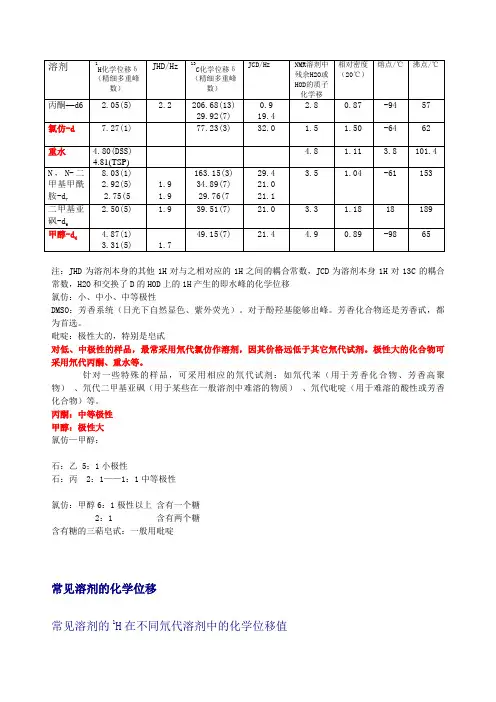
注:JHD为溶剂本身的其他1H对与之相对应的1H之间的耦合常数,JCD为溶剂本身1H对13C的耦合常数,H2O和交换了D的HOD上的1H产生的即水峰的化学位移氯仿:小、中小、中等极性DMSO:芳香系统(日光下自然显色、紫外荧光)。
对于酚羟基能够出峰。
芳香化合物还是芳香甙,都为首选。
吡啶:极性大的,特别是皂甙对低、中极性的样品,最常采用氘代氯仿作溶剂,因其价格远低于其它氘代试剂。
极性大的化合物可采用氘代丙酮、重水等。
针对一些特殊的样品,可采用相应的氘代试剂:如氘代苯(用于芳香化合物、芳香高聚物)、氘代二甲基亚砜(用于某些在一般溶剂中难溶的物质)、氘代吡啶(用于难溶的酸性或芳香化合物)等。
丙酮:中等极性甲醇:极性大氯仿—甲醇:石:乙 5;1小极性石:丙 2:1——1:1中等极性氯仿:甲醇6:1极性以上含有一个糖2:1 含有两个糖含有糖的三萜皂甙:一般用吡啶常见溶剂的化学位移常见溶剂的1H在不同氘代溶剂中的化学位移值常见溶剂的化学位移常见溶剂的13C在不同氘代溶剂中的化学位移值核磁知识(NMR) 一:样品量的选择氢谱,氟谱,碳谱至少需要5mg. 1H-1H COSY, 1H-1H NOESY, 1H-13C HMBC, 1H-13C HSQC需要10-15mg. 碳谱需要30mg.二:如何选择氘代溶剂常用氘代溶剂: CDCl3, DMSO, D2O, CD3OD.特殊氘代溶剂: CD3COCD3, C6D6, CD3CN。
极性较大的化合物可以选择用D2O或CD3OD,如果想要观察活泼氢切记不能选择D2O和CD3OD。
CDCl3为人民币2-3元,D2O为人民币6元,DMSO为人民币10元,CD3OD为人民币30元。
Solvent 化学位移(ppm) 水峰位移(ppm) CDCl3 7.26 1.56 DMSO 2.50 3.33 CD3OD 3.31 4.87 D2O 4.79CD3COCD3 2.05 2.84。
常用氘代溶剂和杂质峰在1H谱中的化学位移

常用氘代溶剂和杂质峰在1H谱中的化学位移测试核磁的样品一般要求比较纯,并且能够溶解在氘代试剂中,这样才能测得高分辨率的图谱。
为不干扰谱图,所用溶剂分子中的氢都应被氘取代,但难免有氢的残余(1%左右),这样就会产生溶剂峰;除了残存的质子峰外,溶剂中有时会有微量的H2O 而产生水峰,而且这个H2O峰的位置也会因溶剂的不同而不同;另外,在样品(或制备过程)中,也难免会残留一些杂质,在图谱上就会有杂质峰,应注意识别。
常用氘代溶剂和杂质峰在1H谱中的化学位移单位:ppm溶剂—CDCl3 (CD3)2CO (CD3)2SO C6D6 CD3CN CD3OH D2O溶剂峰—7.26 2.05 2.49 7.16 1.94 3.31 4.80水峰— 1.56 2.84 3.33 0.40 2.13 4.87 —乙酸— 2.10 1.96 1.91 1.55 1.96 1.99 2.08丙酮— 2.17 2.09 2.09 1.55 2.08 2.15 2.22乙腈— 2.10 2.05 2.07 1.55 1.96 2.03 2.06 苯—7.36 7.36 7.37 7.15 7.37 7.33 —叔丁醇CH3 1.28 1.18 1.11 1.05 1.16 1.40 1.24 OH —— 4.19 1.55 2.18 ——叔丁基甲醚CCH3 1.19 1.13 1.11 1.07 1.14 1.15 1.21 OCH3 3.22 3.13 3.08 3.04 3.13 3.20 3.22氯仿—7.26 8.02 8.32 6.15 7.58 7.90 —环己烷— 1.43 1.43 1.40 1.40 1.44 1.45 —1,2-二氯甲烷 3.73 3.87 3.90 2.90 3.81 3.78 —二氯甲烷— 5.30 5.63 5.76 4.27 5.44 5.49 —乙醚 CH3(t) 1.21 1.11 1.09 1.11 1.12 1.18 1.17 CH2(q) 3.48 3.41 3.38 3.26 3.42 3.49 3.56二甲基甲酰胺CH 8.02 7.96 7.95 7.63 7.92 7.79 7.92 CH3 2.96 2.94 2.89 2.36 2.89 2.99 3.01CH3 2.88 2.78 2.73 1.86 2.77 2.86 2.85 二甲基亚砜— 2.62 2.52 2.54 1.68 2.50 2.65 2.71二氧杂环— 3.71 3.59 3.57 3.35 3.60 3.66 3.75乙醇 CH3(t) 1.25 1.12 1.06 0.96 1.12 1.19 1.17 CH2(q) 3.72 3.57 3.44 3.34 3.54 3.60 3.65OH(s) 1.32 3.39 3.63 — 2.47 ——乙酸乙酯CH3CO 2.05 1.97 1.99 1.65 1.97 2.01 2.07 OCH2(q) 4.12 4.05 4.03 3.89 4.06 4.09 4.14CH3(t) 1.26 1.20 1.17 0.92 1.20 1.24 1.24 甲乙酮CH3CO 2.14 2.07 2.07 1.58 2.06 2.12 2.19 CH2(q) 2.46 2.45 2.43 1.81 2.43 2.50 3.18CH3(t) 1.06 0.96 0.91 0.85 0.96 1.01 1.26 乙二醇— 3.76 3.28 3.34 3.41 3.51 3.59 3.65润滑脂 CH3(m) 0.86 0.87 —0.92 0.86 0.88 —CH2(br) 1.26 1.29 — 1.36 1.27 1.29 —正己烷CH3(t) 0.88 0.88 0.86 0.89 0.89 0.90 —CH2 (m) 1.26 1.28 1.25 1.24 1.28 1.29 —甲醇CH3 3.49 3.31 3.16 3.07 3.28 3.34 3.34 OH 1.09 3.12 4.01 2.16 ——正戊烷 CH3(t) 0.88 0.88 0.86 0.87 0.89 0.90 —CH2(m) 1.27 1.27 1.27 1.23 1.29 1.29 —异丙醇CH3(d) 1.22 1.10 1.04 0.95 1.09 1.50 1.17 CH 4.04 3.90 3.78 3.67 3.87 3.92 4.0 2硅脂—0.07 0.13 —0.29 0.08 0.10 —四氢呋喃 CH2 1.85 1.79 1.76 1.40 1.80 1.87 1.88 CH2O 3.76 3.63 3.60 3.57 3.64 3.71 3.74 甲苯 CH3 2.36 2.32 2.30 2.11 2.33 2.32 —CH(o/p)7.17 7.20 7.18 7.02 7.30 7.16 —CH(m) 7.25 7.20 7.25 7.13 7.30 7.16 —三乙基胺 CH3 1.03 0.96 0.93 0.96 0.96 1.05 0.99 CH2 2.53 2.45 2.43 2.40 2.45 2.58 2.57 石油醚—0.5-1.5 0.6-1.9 —————。
核磁共振中常见溶剂在氘代试剂中的化学位移值
c 这些来源于可交换的质子的信号通常不容易被观察到。
d 在某些情况下(见注释 a),CH2 和 OH 中质子的偶合作用可以被观察到(J=5Hz)。 g 六甲基磷酰胺。 h 在某些情况下(见注释 a,d)CH3 和 OH 中质子的偶合可以观察到(J=5.5Hz)。
常见溶剂的 C13 在不同氘代溶剂中的化学位移值
1.8 1.87 1.88
甲苯
CH2O
m
CH3
s
3.76 2.36
3.63 2.32
3.6 3.57 2.3 2.11
3.64 2.33
3.71 3.74 2.32
CH(o/p) m
7.17 7.1-7.2
7.18 7.02 7.1-7.3 7.16
CH(m) m
7.25 7.1-7.2
7.25 7.13 7.1-7.3 7.16
三乙胺
CH3
t
1.03
0.96 0.93 0.96
0.96 1.05 0.99
CH2
q
2.53
2.45 2.43 2.4
2.45 2.58 2.57
a 在这些溶剂中,分子间的交换速率很低,从而导致 HDO 峰可以被观测到,在丙酮和 DMSO 中它分别位于 2.82ppm 和
3.30ppm。在前一个溶剂中,他通常为 1:1:1 的三重峰,2JH,D=1Hz
CH2CH3 t
1.26
1.2 1.17 0.92
1.2 1.24 1.24
正己烷
CH3
t
0.88
0.88 0.86 0.89
0.89 0.9
甲醇
CH2
m
CH3
sh
OH
sgh
dmso的化学位移
dmso的化学位移DMSO,二甲亚砜,是一种常见的溶剂,广泛应用于有机合成、化学生物学和药物研究等领域。
在NMR(核磁共振谱)分析中,DMSO的化学位移也是一个重要的参数,可以帮助我们确定化合物的结构和纯度。
下面将按照步骤分析DMSO的化学位移。
第一步:理解化学位移化学位移是指分子中某个原子核在不同化学环境下所表现出来的吸收频率发生的改变。
在NMR分析中,化学位移通常用ppm(partsper million,百万分之一)来表示。
化学位移的大小受多种因素影响,例如环境、邻近的化学键等。
对于有机分子,质子(氢原子核)是最常见的NMR信号来源之一,因此质子的化学位移常常被用来描述有机化合物的结构信息。
第二步:DMSO的结构在理解DMSO的化学位移之前,我们首先需要了解DMSO的结构。
DMSO的化学式为(CH3)2SO,其结构式如下图所示。
图中,DMSO的中心是一个硫原子(S),周围是两个甲基基团(CH3)和一个氧原子(O)。
这种结构使得DMSO在溶剂中具有较强的极性,表现出较好的溶解性。
第三步:DMSO的化学位移在NMR分析中,DMSO的化学位移通常在2.5-3.1 ppm范围内。
这个数值反映了DMSO分子中甲基基团的环境对质子谱的影响。
具体来说,DMSO中甲基基团的邻近化学键会对质子的化学位移产生影响,而这种影响可以通过不同的谱峰来观察到。
在有机合成中,DMSO常常用作反应溶剂。
在这种情况下,如果化合物中含有甲基基团,那么由于溶剂中DMSO分子的存在,这些甲基基团的化学位移通常会显示在2.5-3.1 ppm的范围内。
因此,当我们用DMSO作为反应溶剂时,对反应物质NMR谱图中出现的这些峰的分析有助于确定化合物的结构和纯度。
第四步:结论总之,DMSO是一种常见的溶剂,在有机合成、化学生物学和药物研究等领域有着广泛的应用。
在NMR分析中,DMSO的化学位移是一个重要的参数,可以帮助我们确定化合物的结构和纯度。
dmf 化学位移
dmf 化学位移
DMF(二甲基甲酰胺)是一种常用的有机溶剂,在化学领域有着广
泛的应用。
它不仅可以在有机合成中作为溶剂、反应媒介和催化剂,还可以作为高分子化学反应中的溶剂和酸性催化剂。
由于其较高的极性和低的挥发性,DMF 同样也被作为一种优良的萃取剂。
在实际应用过程中,DMF 可能会发生化学位移 (Chemical Shift) 现象。
化学位移是指同一个分子中不同原子核的共振频率发生变化的现象。
而这种变化与原子核周围的化学环境有关,因此可以用来确定分子的结构与化学性质。
对于 DMF 来说,它的化学位移主要是受到分子中甲基基团和酰
基团周围化学环境的影响。
例如,当 DMF 中的甲基基团与相邻的芳
香环发生交互作用时,其 NMR 谱图中的甲基峰会发生化学位移。
同时,当 DMF 分子与其他化合物发生作用时,其化学位移也会受到影响。
研究 DMF 化学位移不仅可以揭示其分子结构和性质,还可以为
合成新型 DMF 衍生物提供参考。
因此,在化学研究中,对 DMF 化学位移的深入研究具有重要意义。
- 1 -。