
最新航海英语听力与会话评估大纲
最新航海英语听力与会话评估大纲(无限航区船舶二/三副993)
1、评估目的
通过本适任评估项目,使被评估者达到中华人民共和国海事局《海船船员适任评估大纲》对船员所规定的实操、实作技能要求,满足国家海事局签发船员适任证书的必备条件。
2、评估内容
1公共用语
1.1日常用语(打招呼、互相介绍、约会、告别、道歉等)
1.2 接待psco、验船师、物料商、船东代表等用语
1.3 船东面试时用语
2进出港业务
2.5代理业务
2.6物料加载
3靠离与锚泊业务
3.1呼叫
3.4船尾作业
3.5引航员接送
3.8锚泊班值守
4装卸作业
4.1备舱
4.3甲板值班
4.7事故处理
4.9进入封闭处所
4.10污油水处理
5航行
5.1航行值班交接
5.2海图作业
5.3航行警告
5.4避碰操作
5.5VHF值守
5.6航海仪器使用
5.13雾中航行
5.14大风浪航行
5.15狭水道航行
6修船与船体保养
6.5仪器检修
6.7船体保养
6.8物料管理
7事故处理
7.7船舶损坏
7.9人员伤亡
8消防与船员自救作业
8.4救船
8.5救人
8.6保全设备与仪器
9救助
9.5施救作业
9.6拖带作业
10遇险
10.6货载管理
10.7船员管理
10.8联络搜救中心
10.9联络救助船
10.12弃船
11港口国检查
11.3安全应急设备检查
11.4防污染检查
11.5 ISM、SMS检查
11.6不合格项纠正
11.7检查报告
12船舶保安
12.1值班安全检查
12.2船舶保安设备的安全检查与操作
12.3安全等级的设定与操作
12.4与岸上应急沟通
12.5申请武装援助
3、评估要素及标准
3.2 听力评估要素及标准
听力部分按大纲及双向细目表进行,由电脑自动评判。
3.3 会话评估要素及标准
3.3.1 朗读题(20分)
(1)评估要素:
发音、朗读流利程度
(2)评估标准:
①语音清晰正确,语调正确,朗读流利(20分)
②发音正确无误,朗读较为流利(16分)
③发音基本正确,语调平淡,朗读较为流利(12分)
④发音不清楚,部分单词读音错误,朗读不流利(8分)
⑤发音错误太多、朗读非常不流畅(0~4分)
3.3.2 口述题(20分)
(1)评估要素:
内容、语法、发音、朗读流利程度
(2)评估标准:
①内容符合题意,语法正确,发音正确无误,朗读流利(20分)
②内容基本符合题意,语法一般,发音正确无误,朗读较为流利(16分)
③内容基本符合题意,语法较差,发音基本正确,朗读较为流利(12分)
④内容偏离题意,发音基本正确,朗读不流利(8分)
⑤内容不正确,语法很差,发音错误太多,朗读非常不流畅(0~4分)
3.3.3 问答题(共10题,每题6分共60分)
(1)评估要素:
内容、发音、朗读流利程度
(2)评估标准:
①回答内容符合,发音正确无误、朗读流利(6分)
②回答内容基本符合,发音正确无误、朗读较为流利(5分)
③回答内容基本符合,发音基本正确、朗读较为流利(4分)
④回答内容偏离问题,发音基本正确、朗读不流利(3分)
⑤回答内容不正确,发音错误太多,朗读非常不流畅(0~2分)
4、评估方法
4.1 评估形式及内容:
1)评估形式
计算机终端。
2)评估内容
本评估项目的组题办法是:根据无限航区船舶二/三副(993)听力与会话双向细目表进行计算机自动组卷。
4.2 成绩评定
一套评估题目分两部分,听力100分,会话100分,总分200分。
听力和会话都为60分及以上者为及格,60分以下者为不及格。
4.3 评估时间
每人次不超过60分钟。
航海英语考试大纲.
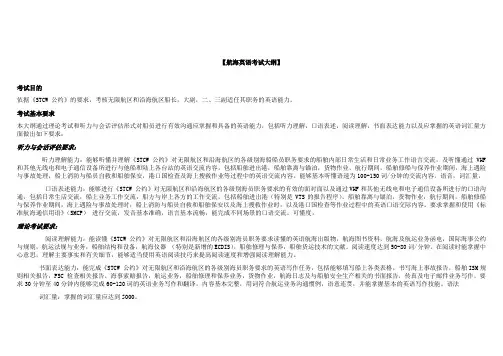
【航海英语考试大纲】考试目的依据《STCW 公约》的要求,考核无限航区和沿海航区船长,大副,二、三副适任其职务的英语能力。
考试基本要求本大纲通过理论考试和听力与会话评估形式对船员进行有效沟通应掌握和具备的英语能力,包括听力理解,口语表述,阅读理解,书面表达能力以及应掌握的英语词汇量方面做出如下要求:听力与会话评估要求:听力理解能力:能够听懂并理解《STCW 公约》对无限航区和沿海航区的各级别海船船员职务要求的船舶内部日常生活和日常业务工作语言交流,及听懂通过VHF 和其他无线电和电子通信设备所进行与他船和陆上各台站的英语交流内容,包括船舶进出港,船舶靠离与锚泊,货物作业,航行期间,船舶修船与保养作业期间,海上遇险与事故处理,船上消防与船员自救和船舶保安,港口国检查及海上搜救作业等过程中的英语交流内容。
能够基本听懂语速为100-150词/分钟的交流内容。
语音,词汇量,口语表述能力:能够进行《STCW 公约》对无限航区和沿海航区的各级别海员职务要求的有效的面对面以及通过VHF和其他无线电和电子通信设备所进行的口语沟通,包括日常生活交流,船上业务工作交流,船方与岸上各方的工作交流,包括船舶进出港(特别是VTS的报告程序),船舶靠离与锚泊,货物作业,航行期间,船舶修船与保养作业期间,海上遇险与事故处理时,船上消防与船员自救和船舶保安以及海上搜救作业时,以及港口国检查等作业过程中的英语口语交际内容。
要求掌握和使用《标准航海通信用语》(SMCP)进行交流,发音基本准确,语言基本流畅,能完成不同场景的口语交流。
可懂度,理论考试要求:阅读理解能力:能读懂《STCW 公约》对无限航区和沿海航区的各级别海员职务要求读懂的英语航海出版物,航海图书资料,航海及航运业务函电,国际海事公约与规则,航运法规与业务,船舶结构和设备,航海仪器(特别是新增的ECDIS),船舶修理与保养,船舶货运技术的文献。
阅读速度达到50-80词/分钟。
GMDSS英语听力与会话评估介绍

GMDSS英语听力与会话评估介绍GMDSS英语听力与会话评估是指对接受过全球海上无线电通信系统(GMDSS)培训的船员进行听力和会话能力的测试。
GMDSS是国际海事组织(IMO)制定的全球统一的海上无线电通信系统,用于保障海上航行的安全与救援工作。
考试措施船员在应对紧急情况时的能力,以确保他们能够有效地与地面无线电站和其他船只进行有效的通信。
首先,听力测试要求船员能够通过无线电收发设备接收到来自其他船只或地面无线电站的信息,并能够理解其中的重要信息。
考试会根据国际通信语言英语进行,测试内容包括接收并理解指令、报告海上情况、接收航行警告等。
船员需要通过听取广播信息、收到其他船只的呼叫等来回答相关问题。
听力测试旨在确保船员在海上紧急情况下能够准确地理解来自其他船只或无线电站的指令和信息。
GMDSS英语听力与会话评估是船员获得GMDSS操作资格证书的重要环节。
通过这一考试,船员能够证明他们具备应对海上紧急情况的能力,能够与其他船只和无线电站进行有效的通信。
这对保障航行安全和救援行动的顺利进行至关重要。
在进行GMDSS英语听力与会话评估时,考试机构会提供相应的无线电通信设备,船员需要使用这些设备进行考试。
考试机构会根据IMO规定的标准对船员的听力和会话能力进行评估,根据评估结果给予合格或不合格的评定。
GMDSS英语听力与会话评估对航海人员来说是非常重要的,它不仅是获得GMDSS操作资格的必要条件,也是船员在海上紧急情况下能够有效应对的基础。
它要求船员具备良好的听力和口头表达能力,能够准确地接收和传递信息。
只有通过这一评估,船员才能获得GMDSS操作资格证书,并在海上无线电通信中发挥作用。
因此,航海人员在备考GMDSS英语听力与会话评估时,应注重加强听力和口头表达的训练,确保能够胜任相关的工作。
航海英语听力与会话TXT版

4. Your favorite port you have called at.
a) A simple introduction of the port.
b) Reasons why you like it.
c) Anything special about it.
I have called at Shanghai harbor and I like it very much. Shanghai is a large seaport. It lies at the mouth of the Yangtze River on the east coast of China. I was impressed by its prosperousness and its size. Everyday a number of ships with imported and exported goods come in and out of Shanghai harbor. Large vessels of 50 thousand tonnages can enter it freely and the annual shipping volume of Shanghai Harbor has reached about 440 million tons. There are a lot of stevedoring areas and the port has been equipped with all kinds of advanced loading and unloading facilities. Shanghai Harbor is playing an important part in our nation’s shipping industry.
航海专业 英语听力与会话标准版

航海英语听力与会话(标准版)Maritime English for Listening and Conversation对本课程总体的说明教学目的本课程为航海技术海洋船舶驾驶专业的主干课程。
本课程是船舶驾驶专业学生必修的专业英语课程,为学生进行海船船员航海英语听力与评估打下基础,同时也是学生毕业后能在外派船舶上工作而进行的语言技能准备。
教学要求通过本课程的学习和相关听、说学习,要求学生达到:能用英语熟练地传达并应答车令、舵令、靠离泊令、锚泊令及与代理联系靠泊等业务;基本上能使用英语与引水员、海关、移民局及港口国检查人员进行沟通;能较好地进行船舶遇险、救助、申请免除检疫的VHF对话;掌握船舶公共用语,能用英语表达进出港业务和装卸作业;熟悉船舶航行、消防救生和船上结构设备等英语术语,并能用英语部署应急演习。
本课程是航海技术专业的课,也是该专业学生参加评估的课程之一。
与其他课程相比,本课程具有以下明显特点:1.授课过程侧重于专业词汇的解释,学生利用课程所配的光盘不断练习听力能力,根据所听到的内容来选择答案。
2.课程中所需要听明白的句子本身并不复杂,所要选择的项目也较简单,但如果没有听清楚,则答案将无法正确选择,因此本课程在授课过程中将有大部分时间分配给学生,自主练习听力,教师针对学生的个别问题作单独的辅导、讲解。
3.口述和问答部分涉及到航海技术的各专业课程,针对学生部分专业课尚未学习的具体情况及学生用英语来回答问题存在的障碍,宜采用:作业----范例讲解/作业讲评----反复练习的授课方式。
4.阅读部分的授课采用:教师领读---学生课后练习的方法。
5.考试采用口试,试题由计算机从海事局题库中随机抽取,教师根据学生回答情况:语义表达准/正确程度----发音---语速等综合评定成绩。
第一章公共用语首次讲授《航海英语听力与会话》(本科学生----课程名称为《航海英语会话》)时,首先向学生讲明本课程的特点和授课方法,并介绍听力系统的使用方法。
航海英语听说教学大纲

航海英语听说教学大纲课程名称(中文):航海英语听说课程名称(英文):Listening and Conversation of Navigation English课程编码:0251071,0251072 开课学期:3、4学时—学分:32—2 课程性质:专业选修课适用专业:航海技术专业先修课程:大学英语、航海技术专业各专业课一、课程教学目的与任务航海英语听说,是海洋船舶驾驶专业学生的一门选修课,是培养船员日常会话能力的重要课程。
他将为使学生适应以后的船东面试,航海英语听力与会话评估,以及船员生活和工作奠定良好基础。
二、课程教学内容与基本要求听懂日常的招呼以及相互介绍的用语,并加以使用;熟悉有关住宿的会话用语并加以操练;熟悉船舶结构以及有关信息的用语;熟悉驾驶台设备有关的用语;熟悉与轮机有关的术语,如主机,辅机以及他们对航海的重要性;听懂简单的会话并学会表达。
了解有关聚会用语,以及常用的英文菜名。
了解有关船舶航行,航行安全,导航标志的简单用语;熟悉关于谈论时间,日期,以及一天活动的用语。
了解简单的航海图书名称;熟悉有关谈论天气,尤其是风暴之类的用语;熟悉有关看病时问诊,自述病情以及吃药的用语;了解与办理移民局和海关手续的程序有关的用语,以及所涉及到的术语;熟悉有关问路,乘车,以及谈论城市景观的用语;熟悉与购物有关的用语,如寻找柜台,谈论物品,讨价还价等;熟悉有关邮寄,打电话的用语;熟悉有关点菜,用餐的用语。
了解谈论和介绍某一城市的用语;了解有关道别,买机票,以及登记的用语;熟悉与检疫,移民,海关手续有关的用语,以及专业词汇;熟悉与船舶细节,进港途中船舶操作的口令,避碰,雷达操作有关的用语;熟悉与船舶靠码头,离码头有关的用语。
了解有关二副交接班手续,以及交接内容的术语;熟练掌握用甚高频进行呼叫与通信;熟悉与安全航行和避碰有关的用语;熟悉与消防演习,救生演习有关的用语;熟悉与防油污,尤其是在港区防止油污,以及海上油污清理工作有关的用语;了解港口国管理检查的内容;熟悉相关的用语;熟悉有关卸货的准备工作,卸货过程,以及结束卸货工作的用语;熟悉有关装货准备工作,装货过程,以及平舱的用语;了解与船舶补给淡水,燃油等物料,以及与价格问题有关的用语;了解与碰撞事故调查,确认和处理有关的用语;了解与修理清单,修理要求,修理工作验收有关的用语和术语。
全国海船船员英语评估指南

全国海船船员英语评估指南National Seafarer English Assessment GuidelinesIn order to ensure the competency of seafarers in English language communication, the following guidelines have been established for the assessment of English proficiency among seafarers on a national level.1. Speaking and Listening SkillsSeafarers will be assessed on their ability toeffectively communicate in English through speaking and listening. This includes the ability to understand and respond to instructions, communicate with crew members and officers, and engage in effective communication with shore personnel.2. Reading and Writing SkillsSeafarers will also be assessed on their ability to read and understand English language materials related to their duties, including safety instructions, navigational charts, and equipment manuals. Additionally, their writing skills will be evaluated in terms of their ability to completereports, logbooks, and other written documentation in English.3. Maritime English Vocabulary and TerminologyThe assessment will include a focus on the specific vocabulary and terminology used in the maritime industry. This will encompass a range of topics including navigation, engineering, safety procedures, and communication protocols.4. Cultural and Interpersonal CommunicationIn addition to language proficiency, seafarers will be evaluated on their ability to effectively communicate and interact with individuals from diverse cultural backgrounds. This includes the ability to understand and respectcultural differences, as well as the capacity to engage in effective teamwork and conflict resolution.5. Assessment MethodologyThe assessment will be conducted through a combinationof written tests, oral interviews, and practical exercises. Seafarers will be evaluated based on their performance in each of these areas, and an overall proficiency level will be assigned based on their cumulative results.中文版:全国海船船员英语评估指南为了确保海船船员在英语语言交流方面的能力,制定了以下指南,用于全国范围内对海船船员英语水平进行评估。
海船船员二三副英语评估会话及答案(第三版)
目录第一题朗读(20分×1题) (2)第二题口述题(20分×1题) (14)第1章公共用语 (14)第3章靠泊与锚泊业务 (16)第4章装卸作业 (17)第5章航行 (19)第6章修船与船体保养 (21)第7章事故处理 (22)第8章消防与船员自救 (24)第9章救助 (25)第10章遇险 (26)第11章港口国检查 (28)第12章船舶保安 (30)第三题问答题(60分:6分×10小题) (32)第1章公共用语 (32)第3章靠泊与锚泊业务 (32)第4章装卸作业 (34)第5章航行 (35)第6章修船与船体保养 (37)第7章事故处理 (38)第8章消防与船员自救 (39)第9章救助 (41)第10章遇险 (43)第11章港口国检查 (44)第12章船舶保安 (46)航海英语听力与会话二/三副评估:会话答案(第三版)航海英语听力与会话评估分为听力和会话两部分,考试时间为1小时。
听力部分共100分,有三道题:第1题单句30分(3分×10小题)),第二题对话30分(3分×10小题),第3题短文40分(2.5分×16小题, 四篇短文)。
会话部分共100分,有三道题:第1题朗读20分,第二题口述20分,第3题问答60分(6分×10小题)。
听力和会话部分需同时达60分,整个航海英语听力与会话评估才视为合格。
航海英语听力与会话评估题库共有12章。
听力部分单句题,对话题,短文题。
会话部分朗读30篇,口述题,问答题。
根据评估大纲:无限航区二/三副(995)不考第2章进出港业务。
345678910第二题口述题(20分×1题)第1章公共用语1.Please say something about your hometown.a) The geographical position, population, and features of your hometown.b) The environment and customs of your hometown.c) The specialties of your hometown.My hometown is located in the southeast part of China.It is a seashore city.There are 3 million people in my hometown.My hometown is developing very fast.The environment in my hometown is very good.People keep their traditional customs.Fishery industry is important to my hometown.It is a major fishery products providing place in China.Nowadays, my hometown has rapid development in tourism.Thousands of tourists from different parts of China and other countries visit my hometown. And people’s living standard has been improved greatly.I am very proud of my hometown.2. Please say something about yourself.a) Your name, age, rank, working experiences, hobbies.b) Your daily work..c) Your spare time activities.My name is____________.I am_________ years old.I am from_________ province.I am a student majoring in navigation in Guangzhou Maritime College.I will graduate in the year _______.I go to class to learn some navigational subjects from Monday to Friday.In the evening, I usually review my lessons.Sometimes, I go to downtown to buy something.During my spare time, I usually read novels or do some sports.I like playing basketball and football very much.Life at school is interesting to me.I will work hard to master the basic navigational knowledge and skills.I am confident that I will become a qualified seafarer in the future.3. Say something about your family.a) Members of your family.b) Their occupations.c) Their hobbies and characteristics.There are _____ people in my family.My grandpa, grandma, father, mother, brother, sister and me.My father is a worker( farmer, teacher, doctor, company staff, government staff, seafarer)My mother is a ___________.(housewife)They work very hard to support my education at school.I am very thankful to them.My father likes reading newspaper very much.(watching TV, playing cards)My mother likes shopping very much.My father and mother are very kindMy father is and he talks little.My mother is ____ and she talks a lot.I love my family very much.4.Your favorite port you have called at.a) A simple introduction of the port.b) Reasons why you like it.c) Anything special about it.My favorite port is Singapore port.Singapore port is located in the south coast of the Singapore Island.It is the largest cargo trannshipment port in the Asian and Pacific region.And it is one of the busiest ports in the world.Its cargo throughput always ranks in the world top-tens.I like Singapore port because the procedure for ship’s entry and departure is simple and rapid. Besides, there are modern and complete port facilities in the port.High technologies and effective measures are applied in the port operation management.“Highly effective is the special feature of Singapore port.5. Your responsibilities on boarda) Your position on board..b) Your daily work on board..c) Your duties on board .My position on board is Third Officer.While the vessel is at sea, I keep navigational watch on the bridge from 0800 to 1200 hours and from 2000 to 2400 hours.I keep the safety equipment record book and ship’s log book.I also work out contingency plan for the whole ship. 应急部署表I am responsible for the care of all lifesaving and fire fighting equipment.And I shall ensure that all of them are in good condition.While the vessel is in port, my watch focuses on duties such as cargo operations, fire watches, security watches, monitoring communications, and monitoring the anchor or mooring lines.While the ship is entering or leaving port, I shall be on the bridge to assist operation.As a Third Officer, my post is very important on board.第3章靠泊与锚泊业务1.Describe the responsibilities as a watch officer while the ship is at anchor?a) Regular operations for anchor watch .b) Emergency handling in case of dragging .c) Conclusion .While the ship is at anchor, I shall keep watch as an officer on duty. ✌☠☜/锚I shall take the anchor position at regular intervals.I shall keep a proper lookout.I shall make inspections round the ship regularly. ❒♏♈☺●☜●✋有规律地I shall check the situation of the anchor chains.And I shall keep an alert on the movement of the ships nearby. ☜●☜♦警惕的I shall pay attention to change in wind direction and speed, tide, current and sea.If the anchor is dragging, I will inform the Captain immediately.At the same time I will take emergency measures.Then I will act a ccording to the Captain’s instructions.2.Describe the proper way of using VHF?a) How to operate VHF set proper .b) General rules of using VHF .c) Rules of using VHF Channel 16 .First, turn on the power.Then , choose a correct channel.Use the transmitting power as low as possible. ♦❒✌⏹❍♓♦发射Press the transmitting button to speak.Speak slowly and clearly.Use the IMO Standard Marine Communication Phrases.Avoid non-essential transmissions. ♦❒✌⏹❍♓☞☜⏹发射Always transmit with correct identification. ♋♓♎♏⏹♦♓♐♓♏♓☞☜⏹辨认Do not occupy one particular channel under poor conditions. ◆☐♋♓占用Do not use offensive language. ☜♐♏⏹♦♓❖adj.无礼的When another channel is available, do not call on channel 16 except for distress, urgency and very brief safety communications.3. Describe the procedures before arrival at a port.a) The preparations from the bridge.b) The preparations from the engine room.c) The preparations from the deck.Before a vessel arrives at a port, some preparation work must be done.Inform the agent at the port about the ship’s ETA.Ask the agent to arrange berthing, pilot, tug and so on.Prepare the documents and certificates required for inspections.All navigational equipment should be tested and recorded.Gather detailed information of the port such as fairway, tides and currents.Inform the engine room about ETA.Arrange mooring ropes on the deck.Prepare cargo gears. ♈♓☜Remind the crew to obey the port rules and regulation.4. Describe the procedures before leaving at a port.a) The preparations from the bridge .b) The preparations from the engine room .c) The preparations from the deck .Before a vessel leaves a port, some preparation work must be done.Inform the agent at the port about the ship’s ETD.Ask the agent to arrange unberthing, pilot, tug and so on.Prepare the documents and certificates required for port clearance.All navigational equipment should be tested and recorded.Close and secure the hatch covers.Lash and secure the goods.Check the seaworthiness of the holds. ♦♓♦☜❆♓⏹♓♦适航性Inform the engine room about ETD.Recover mooring ropes on the deck.Recover and secure cargo gears.5.Describe the procedures of pilotagea) The general procedures for pilot request .b) The preparations for receiving the pilot .c) The general rules for pilotage .If a vessel requires pilotage in a port,She can ask her agent to arrange the pilotage 24 hours in advance.The vessel should provide the pilot station with the following information:Ship’s name, call sign, gross tonnage, maximum draft, cargo, ETA and so on.The vessel should inquire the pilot station about the time for pilot to embark and the place to pick up pilot.An Officer and a sailor should be appointed to stand by at pilot ladder when pilot embarks or disembarks.Lifebuoy, heaving line, manropes should be prepared beside the pilot ladder.The pilot ladder should be clean and in good condition.The pilot ladder should be rigged on leeside, clear of outlets.The Master of the ship has the final responsibility on the ship even when the pilot is on the bridge. 第4章装卸作业1. Describe the procedures of carrying dangerous cargo on board.a) The acquisition of information about the dangerous cargo .b) Procedures on loading and discharging .c) Maintenance during the voyage .First, the dangerous cargo should be declared to the authority concerned.And the class of the goods should be verified.Before loading, the cargo holds should be cleaned out completely.The precautionary and emergency measures must be taken to ensure the safety requirements must be followed.During loading and discharging, the appropriate handing procedures and safety requirements must be followed.In general, the dangerous cargo should be checked at regular intervals.If they become an actual to the vessel, the Carrier may throw such goods over board.2.Describe the precautions before entering an enclosed space.a) The potential dangers in an enclosed space .b) The normal procedures .c) The important precautions .The potential dangers in an enclosed space are toxic fumes and the lacking of oxygen.The normal procedures for entering an enclosed space is thatFirst, check whether the oxygen is enough or not;You can use an oxygen indicator;Second, check whether there are toxic fumes or not.Third, decide whether ventilation is needed or not.The enclosed space must be well ventilated,Otherwise we must wear breathing apparatus before entering.Before entering the enclosed space, make sure there is another crew waiting outside.3.Describe the procedures of cargo stowage.a) The acquisition of information about the cargo to be carried .b) The principles and considerations on navigation safety .c) The modification of stowage plan .First, the stowage factor must be calculated.The cargo’s nature, discharging schedule must be taken into account.Some cargo needs segregation to protect them against tainting damage.During loading, the cargo work should be supervised by an officer.If the cargo is in poor condition, a remark should be inserted in the mate’s receipt.And the cargo plan needs modification to ensure the stability of the vessel.After completion of loading, the cargo must be checked to detect if there is any leakage or damage. During voyage, the goods should also be checked at regular intervals.4.Describe the actions to be taken in case of an oil spill on board.a) The initial responses .b) The actions following up according to the SOPEP on board .c) The precautions to be taken .The initial responses for an oil spill on board are sound the alarm at once.According to the SOPEP, five emergency teams will be formed.They are the command and communication team, clean-up team, collecting team, engine-room team and rescue team.As to the handling of oil spill, typical procedures are as follows.Stop all oil transfer operations at once.Shut off all the valves on the pipeline.Inform the oil supply barge or installation with details.Clean up the oil spill on the deck.If necessary, ask for outside assistance to combat the pollution.5.Describe how to ensure a proper stowage of general cargo.a) General factors to be taken into account in cargo stowage .b) Special considerations for cargo stowage .First, the cargo plan should be worked out according to the stowage factor and specific gravity. The cargo nature, discharging schedule should also be taken into account.Some cargo needs segregation to protect them against damage.During loading, the cargo work should be supervised by an officer.If the cargo is in poor condition, a remark should be inserted in the mate receipt.The cargo plan needs modification to ensure the stability of the vessel.After completion of loading, the cargo must be secured and lashed.And the vessel must be in a good sea-going trim.During voyage, the goods should also be checked at regular intervals to detect if there is any leakage or damage.第5章航行1 Describe the duties of the watch-keeping officer when underway.a)General rules as to watch-keeping .b)Items to be checked and monitored each watch.c)Special attention for bridge watch-keeping .When the vessel is underway, the OOW shall ensure safe navigation of the ship.He must not leave the bridge during the watch.He must call the captain when in any doubt or in restricted visibility or congested waterways. During the watch, the items to be check are ship’s position, speed, and course.He must monitor the status of navigational equipment and the movement of other vessels nearby. Arrange proper lookout when necessary.Make proper recoreds during the watch.Pay special attention to avoid collision, stranding and other dangers to navigation.Pay attention to the state of weather, visibility, traffic density and so on.2Describe the bridge shift change.a) The conditions which must be satisfied before taking over a bridge watch .b) The procedures for shift change .c) Special attention for shift change .During bridge shift change, the relieved officer shall ensure that the relieving officer is able to perform his duty. At night time, he shall ensure that the relieving officer’s vision is fully adjusted to the night condition.The procedures for shift change are that:The relieved officer shall tell the relieved officer about the ship’s navigation status, such asThe ship’s position, course, speed, or any danger to navigation.He shall ensure that the relieving officer fully understand all standing orders or the Master’s night orders.The relieving officer shall check the ship’s position, course and speed;be aware of the tides, currents, weather, visibility;note the status of all bridge equipment;note the movement of other vessels nearby.special attention for shift change is to make sure everything is clearly stated and understood.3. Describe the differences between navigation in a narrow channel and in a traffic separation scheme.a) The rules in navigating in a narrow channel .b) The rules in navigating in a traffic separation scheme .c) The major differences in terms of technical navigation.Rule 9 of COLREG specifies rules for vessel navigating in a narrow channel.In a narrow channel, a vessel shall proceed near to the starboard limit of the channel if it is safe and possible.A vessel shall avoid crossing a narrow channel.Any vessel shall, if the circumstances of the case admit, (如果情况容许)avoid anchoring in a narrow channel. Rule10 of COLREG specifies rules for vessel navigating in a traffic separation scheme.In a traffic separation scheme (TSS [♦♏☐☜❒♏♓☞☜⏹] [♦♓❍]分道通航制)a vessel shall proceed in the general direction of the traffic flow of that traffic lane.But usually she will proceed along the centerline of the traffic lane and shall keep clear of a traffic separation line(通航分隔线)or separation zone(通航分隔带).This is different from narrow channel navigation.4. Describe advantages of various tools or technologies for proper lookout.a) The features of radar observation .b) The advantages of visual lookout .c) The correct uses of various tools or technologies .There are various tools or technologies for keeping a proper lookout at sea.Radar can detect the presence of an object within its working range in various weather conditions. The bearing and distance of the object are noted and plotted.But radar cannot tell the shape, size or height of the object.Besides, radar has blind sectors, so we cannot rely totally on the detection of radar.Visual lookout can discover object and find out its shape, size and height.But this can only be possible within a certain distance in favorable weather conditions. Therefore, in some circumstances, lookout should be stationed even when radar is in operation. Different tools or technologies have their respective advantages and disadvantages,so we should use all available means to keep a proper lookout in order to ensure safe navigation.5.Describe the preparations to be done by the Deck Department prior to arrivala) General introduction of the responsibilities of Deck Department in pre-arrival situation .b) Preparations to be done prior to arrival .Before a vessel arrives at a port, some preparation work must be done.Inform the agent at the port about the ship’s ETA.Ask the agent to arrange berthing, pilot, tug and so on.Prepare the documents and certificates required for inspections.All navigational equipment should be tested and recorded.Arrange mooring ropes on the deck.Prepare cargo gears.Inform the engine room about ETA.Gather detail information of the port such as fairway, tides and currents.Remind the crew to obey the port rules and regulation.第6章修船与船体保养1 Describe the formalities before carrying out a ship’s repair.a) The necessity of carrying out a ship’s repair .b) The formalities before a ship’s repair begins .c) Special attention paid to the repair .After a period of operation, a ship as well as its equipment needs repairing inOrder to keep it in an efficient state.Usually the Company will inform the Captain of ship repair three months inadvance.Then the Captain will instruct the Chief Officer and the Chief Engineer tocompile repair lists with relevant personnel.If any replacement is necessary and no corresponding spare is on board,spareOrder lists should also be compiled.The repair lists, spare order lists and store lists for ship repair will be sent to theCompany for approval.Preparations including fire-protection preparations should be made before the ship repair.2、Describe the procedures of carrying out hull maintenance .a) The preparations before carrying out hull maintenance .b) The contents of hull maintenance .c) The cautions to be taken while carrying out hull maintenance .3、Describe the procedures of carrying out an overhaul for navigational aids .a) The necessity of carrying out overhaul for navigational aids .b) The contents of the overhaul .c) The cautions to be taken.Navigational aids play an important role in ensuring the ship’s safety navigation.It is very necessary carry out periodical overhaul for them.Important navigational aids include radar, compass, GPS, AIS, GMDSS and so on.The contents of the overhaul normally includeChecking the effective operation of these aids;Checking the important parts of the navigational aids,Repairing or replacing the faulty parts.In overhauling, the cautions to be taken are safety prevention.The process of overhauling must be recorded.4、Describe the procedures of carrying out the maintenance of riggings .a) The preparations before carrying out the maintenance of riggings .b) The contents of the maintenance of riggings .c) The cautions to be taken while carrying out the maintenance .It is very necessary to carry out the maintenance of riggings on board ship.Some preparations must be done before the maintenance.Prepare necessary tools and materials.The contents of the maintenance of riggings include:Finding out any rust marks on the wire rope and fittings;Replace any broken items;Adjust the tension of the wires properly.While carrying out the maintenance, ensure that the riggings receive proper replacement.第7章事故处理1 Describe the procedures in handling fire on board.a) The alarms .b) The measures taken after the fire has been extinguished .c) Your position and function during fire-fighting .If there is a fire, sound the alarm immediately.Use proper extinguishers at hand to fight the fire. [ ]灭火器Some measures must be taken after the fire has been extinguished.Check the fire spot carefully to ensure that there is no remaining flame.Post watchmen to prevent any re-ignition.As a third officer, during fire fighting I am on the bridge to assist the captain.I will carry out the captain’s orders.2Describe the emergency procedures in handling ship-borne oil pollution.a) The alarms .b) Typical and detailed procedures .c) Your position and function during handling ship-borne oil pollution .If an oil spill ocurrs on board, sound the alarm at once and inform the master immediately.The typical procedures are:activate emergency response procedures according to the SOPEP.Stop all oil transfer operations.Shut off all the valves on the pipeline.Inform the oil supply barge or oil terminal with details.Clean up the oil spill immediately.The chief officer is the on-scene commander in handling ship-borne oil pollution.The master shall submit a Statement of Fact to certain authority.3Describe briefly one of the cases that you have experienced or heard as to collision, fire, flooding, or grounding.a) The brief introduction to the story .b) Your comments on the successes of the measures .c) Your comments on the improperness of the measures .I have heard of a case happening on board a crude carrier.At first, a fire broke out in the engine room of the ship.The fire prevented access to the engine room fire pump.The emergency fire pump could not be started successfully.Foam was not available because there was no water pressure on the foam line.Only portable extinguishers were usable and these had little effect.At last, the vessel was abandoned.I think that the measures taken in that case were correct.But the emergency fire pump on board was not properly maintained and frequently tested.4Describe the procedures in refloating ship aground.a) The different situations of being aground .b) The measures taken to refloat the ship aground .c) Special attention paid to refloat the ship .Ship’s being aground has different situations, such asaground forward, aground aft and aground full length.We should judge the aground situation.We must pay attention to the water depth around the ship, tide situation, damage situation and so on.Then we will take proper measures to reploat the ship.The measures to refloat a ship include pumping out ballast water, jettisoning cargo,tide riding and so on.In refloating ship aground, special attention should be paid to keep the ship’s seaworthiness..5Describe the procedures in handling cargo damage.a) Descriptions on different cargo damages .b) The general procedures for handling cargo damages .c) Special attention paid to the handling of damages .Cargo damage includes breakage, leakage, water damage, contamination and so on .[ ☜⏹♦✌❍♓⏹♏♓☞☜⏹]污染During discharging, the Chief Officer should check any cargo damage before the cargo leaves the ship.Then a discharging report should be written out with the cause and extent of the damage.The receipt and the discharging report should be sent to the Company as soon as possible.[❒♓♦♓♦]收条In handling cargo damage, special attention should be paid to choosing the words of remarks on the receipt carefully in order that the liability will not be increased. [ ●♋♓☜♌♓●♓♦♓]责任, 义务第8章消防与船员自救1 Describe fire precautions on boarda) Fire protection-equipment to be checked .b) Procedures of a fire drill .c) Summary .Fire precautions on board are very important. [ ]防范Check the fire-fighting equipment regularly.Recharge the fire extinguishers in good time.Cargo ships should have a fire drill every month.The drill should be conducted as if there is an actual fire.Ever crew must perform their own duties well in the drill.Drill details should be entered into the logbook.The better we are prepared, the safer the ship will be.2 Describe damage control on board.a) Equipment to be checked .b) Damage control activities .c) Summary .To prepare for damage control, we must check relevant equipment regularly such aswatertight doors, pumps, damage control outfits.If flooding ocurrs on board ship, damage control team will be immediately mustered.Close relevant openings on board.Switch on relevant pumps.Take actions to stop flooding.Use damage control materials properly.To succeed in damage control, crewmembers in both deck and engine departments should cooperate and perform their respective duties well.3 Describe the measures taken on board if agrounda) Particulars to be clarified .b) Actions to be taken in different situations .c) Summary .After the vessel is aground, take the following measures:(1) Stop your vessel.(2) Sound the general alarm to alert the crew.(3) Close watertight doors.(4) Send s a Mayday message.(5) Exhibit light and shape signals.(6) Check the ship’s position on chart.(7) Sound bilges and tanks.(8) Take overboard soundings around the ship.(9) If a leak is found, try to stop the leak.(10)Evaluate risk of pollution(11) Record every measures taken.Proper measures will help to prevent heavy loss of life and property.4 Describe the measure taken on board if on fire .a) Particulars to be clarified .b) Actions to be taken in different situations .c) Summary .If fire occurs on board , first we should judge the situation .We should find out where the fire is ,what is on fire ,fire strength, extent and so on .If the fire is in cargo holds, close all openings and switch off the ventilation, and then use fixed CO2 system .If the fire is on deck ,we can use foam to isolate the fire ,and then extinguish it with dry chemical or other agents .If the fire is in the engine room, fixed extinguishing system is usually used .Different situations should be dealt with differently.第9章救助1. Describe the procedures of search and rescue operations.a) The ways to transmit distress alerts .b) The procedures for emergency responding .c) The patterns of search and the ways to implement a SAR mission .In the event of distress, transmit a distress alert with the permission of the master.Distress-alerts can be transmitted through satellite or using DSC.A ship receiving a distress alert should permit coast stations to acknowledge first.If no response from any coast station, any ship nearby should answer the distress vesseland proceed with all speed to the assistance of the persons in distress.The patterns of search for the persons in distress include sector search, expanding square search and others.To carry out a SAR mission, we need good on scene co-ordination.2. Describe the response when a person falls overboard.a) The responses of the officers on watch .b) The ship manoeuvres available to man overboard responding .c) Attention to be paid in such operation .After knowing that someone has fallen overboard the officer on watch should turn the ship towards the side overboard.He should report it to the captain and keep the man in water in sight.In man overboard responding, there are various maneuvering methods for returning to the spot of man overboard.These maneuvers include simple turn, double turn, and Williamson turn.In the operation, attention should be paid to keep the stern away from the overboard man to prevent the propeller from injuring him.And the ship should approach the overboard man from windward and launch the rescue boat at the。
《航海英语听力与会话》教学大纲
《航海英语听力与会话》教学大纲课程代码:12010112课程类型:理论课课程性质:必修课适用专业:航海技术学分:8总学时:120一、课程性质与作用本课程主要为适应STCW78/10公约、二、三副评估大纲及航运企业对国际海员的需要。
旨在培养学习者的英语运用能力。
通过本课程的学习和模拟训练,使学习者掌握一定的专业词汇、口令和专业用语,基本能用英语进行生活和工作方面的交流,最终通过国家海事局英语听力与会话评估考试。
本课程的开设应在学习者掌握了一定的语音基础、词汇和语法、听力、会话基础以及一定的自主学习能力的前提下开设。
二、课程任务与目标通过模拟真实情景教学和任务型教学活动,使学习者掌握航海英语专业词汇、口令的复诵和报告、生活口语以及与进出港、靠离泊、装卸、航行、海上呼救、事故处理、求生、船舶保养修理、港口国检查及船舶保安相关的基本用语,符合经2010年马尼拉修正的《1978年海员培训、发证和值班标准国际公约》对船员英语应用能力和交流沟通能力的要求,形成一定的自主学习能力和综合运用知识、独立分析和具体实施的实践能力,并培养学习者诚实、敬业、团队合作等良好品质。
在此基础上满足以下岗位职业能力:1、知识目标(1)掌握船舶结构名称的英语词汇及其驾驶台和轮机舱设备的英语表达;(2)掌握航行操作、航标、避碰及其相关的标准海事通信用语;(3)掌握进出港和靠离泊船舶操纵的相关英语口令;(4)掌握消防和救生设备的英语词汇以及PSC检查的相关英语表达;(5)掌握积载、卸货的相关英语表达及其装卸货设备的术语;2、专业能力目标(1)具备用英语介绍不同类型的船舶及结构的能力;(2)具备结合船舶航行实际情况用所掌握的专业用语和专业知识进行有效沟通的能力;(3)具备船舶进出港和靠离泊船舶操纵时相关口令复诵和报告的能力;(4)具备处理船舶事故时与本船船员以及与岸上有效沟通的能力;(5)具备与港口国检察官沟通交际的能力。
3、素质能力目标(1)具有良好的心理素质和克服困难的能力;(2)具有良好的团队精神和协作能力;(3)具有强烈的安全意识和水域环境保护的意识;(4)具有依法遵章行事的意识;(5)具有自主学习的能力和综合运用船舶专业词汇的能力。
三副英语纲要
11. 港口国检查 (PSC inspections)
操作性要求检查 安全应急设备检查 防污染检查 ISM, SMS 检查 不合格项纠正 检查报告
4.装卸作业 (Loading & discharging operation)
备舱 (Cargo hold preparations) 甲板值班 (Deck cargo watch) 理货业务 (Cargo operations) 事故处理 (Accidents handling) 特殊货物作业 (Special cargo operations) 进入封闭场所 (Entering enclose space) 污泊水处理 (Discharge sewage )
12. 船舶保安 (ISPS)
值班安全检查 船舶保安设备的安全检查与操作 安全等级的设定与操作 A & LSA)
救生与消防演习 (Abandon ship & firefighting drills) 救火 (Fire-fighting) 救货 (Saving cargo) 救船 (Saving ship) 救人 (Saving people) 保全设备与仪器 (Saving equipment and instruments)
9.救助 (Rescue)
与遇险船通信 (Contact vessel in distress) 海面搜索 (Searching the sea) 施救作业 (Rescue operations) 拖带作业 (Towing operations)
18-《航海英语听力与会话》教学大纲
18-《航海英语听力与会话》教学大纲一、课程性质和任务本课程是高等职业技术院校海洋船舶驾驶专业的一门主干专业课程。
它的任务是:训练学生在船值班工作的英语听说能力,为上船工作进行业务交流打下良好的语言基础。
二、课程教学目标本课程的教学目标是:使学生具备一定的听力能力和较流利的值班驾驶员会话能力,达到《1978/95公约》和中华人民共和国海事局所规定的船舶操作级驾驶员的适任标准。
(一)知识教学目标通过听和说获得知识,信息和语言,经过思维,在原有知识及语言的基础上对所获得的内容和语言加工和重组,开发学生的语言能力和运用英语进行交际的能力。
(二)能力培养目标①能用英语进行日常生活交流。
②能听懂船舶口令并准确地复诵、报告。
③能熟练掌握IMO标准航海通信用语。
④能较流利地进行与专业有关的业务会话。
(三)思想教育目标①养成文明、礼貌的语言交流习惯。
②具有强烈的爱国主义意识。
③具有良好的职业道德。
三、教学内容和要求(一)甲板工作任务分配与甲板设备能熟练讲出甲板设备的名称。
具有分配和接受工作任务的交流能力。
(二)船舶口令熟练掌握并能正确使用船舶口令(舵令、车钟令、系解船缆令、锚令和进运河、船闸、船坞、狭水道等特殊口令)标准用语。
(三)进出港业务熟练掌握接待来船(移民、卫检、引水、代理、海关及其他)人员用语。
(四)靠离与锚泊业务熟练掌握驾驶台值班用语,并能与其他人员进行沟通。
熟练掌握呼叫、船首尾作业及锚泊班值守等相关业务用语。
(五)消防与救生熟练掌握消防、救生没备使用用语。
熟练掌握救生与消防演习、船员自救作业的相关标准用语。
(六)遇险与救助能熟练掌握遇险、紧急、安全呼叫的标准用语。
能熟练掌握与遇险船、救助中心、救助者之问的标准通信用语。
(七)装卸货作业能熟练掌握备舱、甲板值班、理货业务、事故处理、特殊货物作业、进入封闭处所、污泊水处理等装卸业务用语。
(八)航行能熟练掌握航行值班交接、海图作业、避碰操作、航海仪器使用等业务用语。