
美国文学史及选读AmericanDrama
美国文学史——精选推荐

Abstract: America's history of literature began with the swarming in of immigrants with different background and cultures. After that, American literature had been greatly influenced by the European culture for a long period. It was not until America's independence, did Americans realized that they need national literature strongly, and American literature began to developed. The Civil War was a watershed in the history, after which American literature entered a period of full blooming. Romantics, which emphasized individualism and intuition and Tnscendentalism represented by Emerson came out into being. This was an exciting period in the history of American literature. Like the flowers of spring, there were suddenly many different kinds of writing at the same time. They have given depth and strength to American literature, and accelerated the forming of High Romantics. But due to the influence of Civil War, the American society was in a turbulent situation. The writings about local life, critical realism and unveiling the dark side of the society were increased. After The First World War, Americans were at a loss postwar, and the Modern American literature began. My piece of paper is written in chronological order as these periods developed in order to have a clear outline of its progress. Keywords: National Literature, Romanism, Transcendentalism, Local Color, Realism, Modern literature 摘要:从殖民地时期起,欧洲殖民者和清教徒翻开了美国⽂学史的第⼀页。
吴伟仁《美国文学史及选读》(重排版)笔记和考研真题详解

20.1复习笔记 20.2考研真题与典型题详解
21.1复习笔记 21.2考研真题与典型题详解
22.1复习笔记 22.2考研真题与典型题详解
23.1复习笔记 23.2考研真题与典型题详解
24.1复习笔记 24.2考研真题与典型题详解
25.1复习笔记 25.2考研真题与典型题详解
0 1
第26章埃 兹拉·庞德
目录分析
第1章约翰·史密斯
第2章威廉·布拉德 福德和约翰·温思罗
普
第3章约翰·科顿和 罗杰·威廉姆斯
第4章安妮·布雷兹 特里特和爱德华·泰 勒
1.1复习笔记 1.2考研真题与典型题详解
2.1复习笔记 2.2考研真题与典型题详解
3.1复习笔记 3.2考研真题与典型题详解
4.1复习笔记 4.2考研真题与典型题详解
11.1复习笔记 11.2考研真题与典型题详解
12.1复习笔记 12.2考研真题与典型题详解
13.1复习笔记 13.2考研真题与典型题详解
14.1复习笔记 14.2考研真题与典型题详解
15.1复习笔记 15.2考研真题与典型题详解
16.1复习笔记 16.2考研真题与典型题详解
17.1复习笔记 17.2考研真题与典型题详解
第5章本杰明·富兰 克林
第6章托马斯·佩恩
第7章托马斯·杰斐 逊
第8章菲利普·弗瑞 诺
5.1复习笔记 5.2考研真题与典型题详解
6.1复习笔记 6.2考研真题与典型题详解
7.1复习笔记 7.2考研真题与典型题详解
8.1复习笔记 8.2考研真题与典型题详解
第9章华盛
1
顿·欧文
第10章詹姆
2
27.1复习笔记 27.2考研真题与典型题详解
美国文学史及选读Herman Melville

3. Social Background
• Economic boom:
Industrialism Immigration Westward expansion
optimism and hope among people
4. Features
• American Romanticism was both imitative and independent.
下令攻打“叛乱”州。此战不但改变当时美国的
政经情势,导致奴隶制度在美国南方被最终废除, 也对日后美国的民间社会产生巨大的影响。
2. Ideals:
• Ideals: Democracy and political equality became the ideals of the new nation.
Moby Dick
is hidden all the time
Mirrors(反 映) its enviorment
unknown and
inscrutable,
unknowable truths mysterious
only the surface of the ocean is available for human observation and interpretation
Some events in this period
• American Civil War (1861-1865)
• 南北战争,又称美国内战(American Civil War),是美国历史上一场大规模的内战,参战 双方为美利坚合众国(简称联邦)和美利坚联盟
国(简称邦联)。这场战争的起因为美国南部十 一州以亚伯拉罕·林肯于1861年就任总统为由而 陆续退出联邦,另成立以杰斐逊·戴维斯为“总 统”的政府,并驱逐驻扎南方的联邦军,而林肯
自考英美文学选读(美国文学史)
PART TWO: AMERICAN LITERATUREChapter1 The Romantic Period1.主要作家及其作品:i.Washington Irving:The Sketch Book; Rip Van Winkle;The Legend of Sleepy Hollowii.Ralph Waldo Emerson:Essays; The American Scholar; Self-Reliance;The Over-Soul; The Poet; Experience; Nature iii.Nathaniel Hawthorne:Mosses from an Old Manse; The Scarlet Letter;The Snow-Image and Other Twice-Told Tales;The House of the Seven Gables;The Blithedale Romance;The Marble Fauniv.Walt Whitman:Leaves of Grass; There was a Child Went Forth;Drum Taps; Cavalry Crossing a Ford; Song of Myself;When Lilacs Last in the Dooryard Bloom’dv.Herman Melville:Moby-Dick; Billy Budd; Typee; Omoo;Mardi; Redburn; White Jacket.2.清教主义Puritanism is the practices and beliefs of the Puritans. As the word itself hints,Puritans wanted to purify their religious beliefs and practices. They felt that the Church of England was too close to the Church of Rome in doctrine form of worship,and organization of authority. American Puritans,like their brothers back in England,were idealists,believing that the church should be restored to complete "purity". They accepted the doctrine of predestination,original sin and total depravity,and limited atonement through a special infusion of grace from God. But in the grim struggle for survival that followed immediately after their arrival in America,they became more and more practical,as indeed they had to be. Puritans were noted for a spirit of moral and religious earnestness that determinated their whole way of life. As a culture heritage,Puritanism did have a profound influence on the early American mind and American values. American Puritanism also had a conspicuously noticeable and an enduring influence on American literature. It had become,to some extent,so much a state of mind,so much a part of the national cultural atmosphere,rather than a set of tenets.3.超验主义Transcendentalism has been defined philosophical1y as "the recognition in man of the capacity of knowing truth intuitively,or of attaining knowledge transcendingthe reach of the senses." Emerson once proclaimed in a speech,"Nothing is at last sacred but the integrity of your own mind." Other concepts that accompanied Transcendentalism inc1ude the idea that nature is ennobling and the idea that the individual is divine and,therefore,self-re1iant. The transcendentalists reacted against the cold,rigid rationalism of Unitarianism in Boston. They adhered to an idealistic system of thought based on a belief in the essential unity of all creation ,the innate goodness of man,and the supremacy of insight over logic and experience for the revelation of the deepest truths.4.象征主义5.自由诗Whitman is also radically innovative in terms of the form of his poetry. He adopted "free verse," that is,poetry without a fixed beat or regular rhyme scheme. A looser and more open-ended syntactical structure is frequently favored. Lines and sentences of different lengths are left lying side by side just as things are,undisturbed and separate. There are few compound sentences to draw objects and experiences into a system of hierarchy. Whitman was the first American to use free verse extensively. By means of "free verse," Whitman turned the poem into an open field,an area of vital possibility where the reader can allow his own imagination to play.6.爱默生的超验主义思想及他的自然观In his essays, Emerson put forward his philosophy of the over-soul, the importance of the Individual, and Nature. Emerson rejected both the formal religion of the churches and the Deistic philosophy. Emerson and other Transcendentalists believed that there should be an emotional communication between an individual soul and the universal ―over-soul,‖ since the over-soul is an all-pervading power from which all things come from and of which all are a part. Emerson is affirmative about man’s intuitive knowledge, with which a man can trust himself to decide what is right and to act accordingly. The ideal individual should be a self-reliant man.. he means to convince people that the possibilities for man to develop and improve himself are infinite. Emerson’s nature is emblematic of the spiritual world, alive with God’s overwhelming presence; hence, it exercises a healthy and restorative influence on human mind. ―God back to nature, sink yourself back into its influence and you’ll become spiritually whole again.‖ By employing nature as a big symbol of the Spirit, or God, or the over-soul. Emerson has brought the Puritan Legacy of symbolism to its perfection. 7.《小伙子布朗》中的寓言和象征In ―Young Goodman Brown,‖ Hawthorne set out to prove that everyone possesses some evil secret. The story illustrates Hawthorne's allegorical theme of human evil. In the manner of its concern with guilt and evil,it exemplifies what Milville called the" power of blackness" in Hawthorne's work. In "Young Goodman Brown," he sets out to prove that everyone possesses some evil secret. "Evil is thenature of mankind." Its hero,a naive young man who accepts both society in general and his fellow men as individuals worth his regard,is confronted with the vision of human evil in one terrible night,and becomes thereafter distrustful and doubtful.Allegorically,our protagonist,becomes an Everyman named Brown,a "young man" who will be aged in one night by an adventure that makes everyone in this world a fallen idol.However, The story is manipulated in such a way that we as readers feel that Hawthorne poses the question of Good and Evil in man but withholds his answer,and he does not permit himself to determine whether the events of the night of trial are real or the mere figment of a dream.8.霍桑的清教思想和他人性本恶的观点As we can see, Hawthorne’s literary world turns out to be a most disturbed, tormented and problematical one possible to imagine. This has much to do with his ―black‖ vision of life and human beings. According to Hawthorne, ―There is evil in every human heart, which may remain latent, perhaps, through the whole life; but circumstances may rouse it to activity. One source of evil that Hawthorne is concerned most is overreaching intellect, which usually refers to someone who is too proud, too sure of himself. He believed that ―the wrong doing of one generation lives into the successive ones,‖ and often wondered if he might have inherited some of their guilt. This sensibility led to his understanding of evil being at the very core of human life., which is typical of the Calvinistic belief that human beings are basically depraved and corrupted, hence, they should obey God to atone for their sins.9.麦尔维尔长篇小说《白鲸》的象征意义Moby-Dick is not merely a whaling tale or sea adventure,it is also a symbolic voyage of the mind in quest of the truth and knowledge of the universe,a spiritual exploration into man's deep reality and psychology.Like Hawthorne,Melville is a master of allegory and symbolism. He uses allegory and symbolism in Moby-Dick to present its mighty theme. Instead of putting the battle between Ahab and the big whale into simple statements,he used symbols,that is,objects or persons who represent something else. Different people on board the ship are representations of different ideas and different social and ethnic groups;facts become symbols and incidents acquire universal meanings;the Pequod is the microcosm of human society and the voyage becomes a search for truth. The white whale,Moby Dick,symbolizes nature for Melville,for it is complex,unfathomable,malignant,and beautiful as well. For the character Ahab,however,the whale represents only evil. Moby Dick is like a wall,hiding some unknown,mysterious things behind. Ahab wills the whole crew on the Pequod to join him in the pursuit of the big whale so as to pierce the wall,to root out the evil,but only to be destroyed by evil,in this case,by his own consuming desire,his madness. For the author,as well as for the reader and Ishmael,the narrator,Moby Dick is still a mystery,an ultimate mystery of the universe,inscrutable and ambivalent,and the voyage of the mind will forever remain a search,not a discovery,of the truth.10.惠特曼《草叶集》的结构(自由诗)、主题、语言特色1. The themes in Whitman's poetry:His poetry is filled with optimistic expectation and enthusiasm about new things and new epoch. Whitman believed that poetry could play a vita1 part in the process of creating a new nation. It could enab1e Americans to celebrate their release from the Old World and the colonia1 rule. And it could also help them understand their new status and to define themse1ves in the new wor1d of possibi1ities. Hence,the abundance of themes in his poetry voices freshness. He shows concern for the whole hard-working people and the burgeoning life of cities. Pursuit of love and happiness is approved of repeatedly and affectionately in his lines. Sexual 1ove,a rather taboo topic of the time,is displayed candidly as something adorable. The individual person and his desires must be respected.2.Leaves of GrassWalt Whitman is a poet with a strong sense of mission,having devoted all his life to the creation of the "single" poem,Leaves of Grass.(1)the title :It is significant that Whitman entitled his book Leaves of Grass . He said that where there is earth,where there is water,there is grass. Grass,the most common thing with the greatest vitality,is an image of the poet himself,a symbol of the then rising American nation and an embodiment of his ideals about democracy and freedom.(a)theme:In this giant work,openness,freedom,and above all,individua1ism(the belief that the rights and freedom of individual people are most important)are all that concerned him. Whitman brings the hard-working farmers and laborers into American literature ,attack the slavery system and racial discrimination. In this book he also extols nature,democracy,labor and creation ,and sings of man's dignity and equality,and of the brightest future of mankind . Most of the poems in Leaves of Grass sing of the "en-masse" and the self as well.(b)the poet's essentia1 purposeHis aim was nothing less than to express some new poetica1 feelings and to initiate a poetic tradition in which difference shou1d be recognized. The genuine participation of a poet in a common cultural effort was,according to Whitman,to behave as a supreme individualist;however,the poet's essentia1 purpose was to identify his ego with the world,and more specifically with the democratic "en-masse" of America,which is established in the opening lines of "Song of Myself".3.Whitman's poetic style and languageTo dramatize the nature of these new poetical fee1ings,Whitman employed brand-new means in his poetry,which would first be discerned in his style and language.(1)Whitman's poetic style is marked,first of a1l,by the use of the poetic "I." Whitman becomes all those people in his poems and yet still remains "Walt Whitman",hence a discovery of the self in the other with such an identification. Insuch a manner,Whitman invites his readers to participate in the process of sympathetic identification.(3)Whitman is conversational and casual,in the fluid,expansive,and unstructured style of talking. However,there is a strong sense of the poems being rhythmical. The reader can feel the rhythm of Whitman's thought and cadences of his feeling. Parallelism and phonetic recurrence at the beginning of the lines also contribute to the musicality of his poems.(4)Whitman's languageContrary to the rhetoric of traditional poetry,Whitman's is relatively simple and even rather crude. Most of the pictures he painted with words are honest,undistorted images of different aspects of America of the day. The particularity about these images is that they are unconventional in the way they break down the social division based on religion,gender,class,and race. One of the most often-used methods in Whitman's poems is to make colors and images fleet past the mind's eye of the reader. Another characteristic in Whitman's language is his strong tendency to use oral English. Whitman's vocabulary is amazing. He would use powerfu1,colorful,as well as rarely-used words,words of foreign origin and sometimes even wrong words.美国现实主义时期1.Mark Twain: Adventures of Huckleberry Finn;The Adventures of Tom Sawyer;The Celebrated Jumping Frog of Calaveras County;Innocents Abroad; The Gilded Age2.Henry James: The American; Daisy Miller;The Europeans; The Portrait of A Lady;What Maisie Knows; The Wings of the Dove;The Ambassadors; The Golden Bowl; The Art to Fiction3.Emily Dickinson:4. Theodore Dreiser: Sister Carrie; American Tragedy1.What is Realism?In art and literature, Realism refers to an attempt to describe human behavior and surroundings or to represent figures exactly as they act or appear in life. Realism emerged as a literary movement in Europe in the 1850s. In reaction to Romanticism, realistic writers should set down their observations impartially and objectively. They insisted on accurate documentation, sociological insight, and avoidance of poetic diction and idealization. The subjects were to be taken from everyday life, preferably from lower-class life. Realism entered American literature after the Civil War. William Dean Howells, Mark Twain, and Henry James were the pioneers of realism in the U.S.1.What is Naturalism? (or American Naturalism)In literature, the term refers to the theory that literary composition should aim at a detached, scientific objectivity in the treatment of natural man. The movement is an outgrowth of 19th –century scientic thought, following in general the biological determinism of Darwin’s theory, or the economic determinism of Karl Marx. American Naturalism is a more advanced stage of realism toward the close of the 19th century. The American naturalists accepted the more negative implications of Darwin’s theory and used it to account for the behavior of those characters in literary works who were conceived as more or less complex combinations of inherited attributes, their habits conditioned by social and economic forces. And consciously or unconsciously the American naturalists followed the French novelist and theorist Emile Zola's cal l that the 1iterary artist ―must operate with characters, passions, human and social data as the chemist and the physicist work on inert bodies, as the physiologist works on living bodies.‖ They chose their subjects from the lower ranks of society and portrayed the people who were demonstrably victims of society and nature. And one of the most familiar themes in American Naturalism is the theme of human ―bestiality‖, especially as an explanation of sexual desire.Artistically, naturalistic writings are usually unpo1ished in language, lacking in academic skills and unwieldly in structure. Philosophically, the naturalists believe that the real and true is always partially hidden from the eyes of the individual, or beyond his control. Devoid of rationality and caught in a process in which he is but a part, man cannot fully understand, let alone contro1, the world he lives in; hence, he is left with no freedom of choice.In a word, naturalism is evolved from realism when the author's tone in writing becomes less serious and less sympathetic but more detached, ironic and more pessimistic. It is no more than a different philosophical approach to reality, or to human existence. Notable writers of naturalistic fiction were Frank Norris, Sherwood Anderson, and Theodore Driser.2.The distinction between Realism and NaturalismNaturalism is evolved from realism when the author's tone in writing becomes less serious and less sympathetic but more detached, ironic and more pessimistic. It is no more than a different philosophical approach to reality, or to human existence.The distinction lies, first of all, in the fact that Realism is concerned directly with what is absorbed by the senses; Naturalism, a term more properly applied to literature, attempts to apply scientific theories to art. Second, Naturalism differs from Realism in adding an amoral attitude to the objective presentation of life. Naturalistic writers, adopting Darwin’s biological determinism and Marx’s economic determinism, regard human behavior as controlled by instinct, emotion, or social and economic conditions, and reject free will. Third, Naturalism had an outlook often bleaker than that of Realism, and it added a dimension of predetermined fate that rendered human will ultimately powerless.3.What is (Social) Darwinism?Social Darwinism is a belief that societies and individual human beings compete in astruggle for existence in which natural selection results in ―struggle of the fittest.‖ Social Darwinists base their beliefs on theories of evolution developed by British naturalist Charles Darwin. Social Darwinists typically deny that they advocate a ―law of jungle.‖ But most propose arguments that justify imbalances of power between individuals, races, and nations because they consider some more fit to survive than others. The theory had produced a big impact on Naturalism.马克吐温1.Twain as a local coloristTwain is also known as a local colorist, who preferred to present social life through portraits of the local characters of his regions, including people living in that area, the landscape, and other peculiarities like the customs, dialects, costumes and so on. Consequently, the rich material of his boyhood experience on the Mississippi became the endless resources for his fiction, and the Mississippivalley and the West became his major theme. Unlike James and Howe1ls, Mark Twain wrote about the lower-class people, because they were the people he knew so we1l ancl their 1ife was the one he himself had lived. Moreover he successfully used local color and historical settings to i1lustrate and shed light on the contemporary societyAnother fact that made Twain unique is his magic power with language, his use of vernacular. His words are col1oquial, concrete and direct in effect, and his sentence structures are simp1e, even ungrammatical, which is typical of the spoken 1anguage. Mark Twain's humor is remarkable, too. It is fun to read Twain to begin with, for most of his works tend to be funny, containing some practical jokes, comic details, witty remarks, etc., and some of them are actually tall ta1es.(2) The novel’s theme, characterization of ―Huck‖ and the novel’s social significance: Theme: The novel is a vindication of what Mark Twain called ― the damned human race.‖ That is the theme of man’s inhumani ty to man---of human cruelty, hypocrisies, dishonesties, and moral corruptions. Mark Twain’s thematic contrasts between innocence and experience, nature and culture, wilderness and civilization. Adventures of Huckleberry Finn is best known for Mark Twain’s wonderful characterization of ―Huck,‖ a typical American boy whom its creator described as a boy with ―a sound heart and a deformed conscience,‖ and remarkable for the raft’s journey down the Mississippi river, which Twain used both realistically and symbolically to shape his book into an organic whole.Through the eyes of Huck, the innocent and reluctant rebel, we see the pre-Civil War American society fully exposed and at the same time we are deeply impressed by Mark Twain’s thematic contrasts between i nnocence and experience, nature and culture, wilderness and civilization.黛西米勒的主题和主要人物的性格分析1.The theme of the novelDaisy Miller is one of James’s early works that dealt with the international theme, i.e.,to set against a large international background, usual1y between Europe and America, and centered on the confrontation of the two different cu1tures with two different groups of peop1e representing two different value systems: American innocence in contact and contrast with European decadence and the moral and psychological complications arising therefrom.2.Characterization of Daisy MillerIn this novel, the ―Americanness ‖in Daisy is revealed by her relatively unreserved manners. Daisy Miller, a typical young American girl who goes to Europe and affronts her destiny. The unsophisticated girl is cruelly wronged because of the confrontation between the two value systems. Miller has ever since become the American Girl in Europe, a celebrated cultural type who embodies the spirit of the New World. However, innocence, the keynote of her character, turns out to be an admiring but a dangerous quality and her defiance of social taboos in the Old World finally brings her to a disaster in the clash between two different cultures. In this novel James’s sympathy for Daisy could be easily felt when we think of a tender flower crushed by the harsh winter in Rome.3.The content of this selection: Daisy has just arrived at Switzerland with her family and meets Winterborne for the first time. Two days later Daisy goes alone with Winterborne on an excursion to an old castle, which is soon in the air among theby its narration from the point of view of the American youth Winterborne狄金森诗歌的主题结构及艺术特色The thematic concerns and the original artistic features of Dickinson's poetry: 1.Themes: Dicksinson’s poems are usually based on her own experiences, her sorrows and joys. But within her litlle lyrics Dickinson addresses those issues that concern the whole human beings, which include religion, death, immortality, love, and nature.2.Artistic features: Her poetry is unique and unconventional in its own way. Her poems have no titles, hence are always quoted by their first lines. In her poetry there is a particular stress pattern, in which dashes are used as a musica1 device to create cadence and capital letters as a means of emphasis. Most of her poems borrow the repeated four-line, rhymed stanzas of traditional Christian hymns, with two lines of four-beat meter alternating with two lines of three-beat meter. A master of imagery that makes the spiritual materialize in surprising ways, Dickinson managed manifold variations within her simple form: She used imperfect rhymes, subtle breaks of rhythm, and idiosyncratic syntax and punctuation to create fascinating word puzzles, which have produced greatly divergent interpretations over the years. Dickinson’s irregular or sometimes inverted sentence structure also confuses readers. However, her poetic idiom is noted for its laconic brevity, directness and plainness. Her poems are usually short, rarely more than twenty lines, and many of them are centered on a single image or symbo1 and focused on one subject matter. Due to her deliberate sec1usion, her poems tend to be very personal and meditative. She frequently uses personae to render the tone more familiar to the reader, and personification to vivifysome abstract ideas. Dickinson's poetry, despite its ostensible formal simplicity, is remarkable for its variety, subtlety and richness; and her limited private world has never confined the limitless power of her creativity and imagination.美国现代时期1.Ezra Pound: The Cantos; In a Station of the Metro.2.Robert Lee Frost: The Road Not Taken; Stopping by Woods on aSnowy Evening3.Eugene O’Neill: Beyond the Horizon; The Emperor Jones; The HairyApe;All God’s Chillun Got Wings; Desire under the Elms;Anna Christie; The Great God Brown; Lazarus Laughed;Strange Interlude; The Iceman Cometh;Long Day’s Journey Into Night.4. F Scott Fitzgerald: This Side of Paradise; The Beautiful andDamned;The Great Gatsby; Tender is the Night;Flappers and Philosophers; Tales of the Jazz Age;All the Sad Young Men; Taps at Reveille;Babylon Revisited.5.Ernest Hemingway: In Our Time; The Sun Also Rises;A farewell to Arms; For Whom the BellTolls;The Old Man and the Sea; Men Without Women.6.William Faulkner: The Sound and the Fury; Light in August;Absalom, Absalom; Go Down, Moses;A Rose for Emily.1)The Imagist Movement and the artistic characteristics of imagist poems:Led by the American poet Ezra Pound,Imagist Movement is a poetic movement that flourished in the U.S. and England between 1909-1917. It advances modernism in arts which concentrates on reforming the medium of poetry as opposed to Romanticism,especially Tennyson's worldliness and high-flown language in poetry. Pound endorsed three main principles as guidelines for Imagism,including direct treatment of poetic subjects,elimination of merely ornamental or superfluous words,and rhythmical composition should be composed with the phrasing of music,not a metronome. The primary Imagist objective is to avoid rhetoric and moralizing,to stick closely to the object or experience being described,and to move from explicit generalization. The leading poets are Ezra Pound,Wallace Stevens,wrence,etc.The characteristic products of the movement are more easily recognized than its theories defined;they tend to be short,composed of short lines of musical cadence rather than metrical regularity,to avoid abstraction,and to treat the imagewith a hard,clear precision rather than with overt symbolic intent. The influence of Japanese forms,tanka and haiku,is obvious in many. Most of the imagist poets wrote in free verse and they like to emply common speech. They stressed the freedom in the choice of subject matter and form.2)The Lost GenerationIt refers to,in general,the post-World WarⅠgeneration,but specifically a group of expatriate disillusioned intellectuals and artists,who experimented on new modes of thought and expression by rebelling against former ideals and values and replacing them only by despair or a cynical hedonism. The remark of Gertrude Stein,"You are all a lost generation,"addressed to Hemingway,was used as an epigraph to the latter's novel The Sun Also Rises,which brilliantly describes those expatriates who had cut themselves off from their past in America in order to create new types of writing. The generation was "lost" in the sense that its inherited values were no longer relevant in the postwar world and because of its spiritual alienation from a U.S. that seemed to its members to be hopelessly provincial,materialistic,and emotional barren. The term embraces Hemingway,F. Scott Fitzgerald,Ezra Pound,E.E.Cummings,and many other writers who made Paris the center of their literary activities in the 1920s.3)What is Expressionism?Expressionism is used to describe the works of art and literature in which the representation of reality is distorted to communicate an inner vision,transforming nature rather than imitating it. In literature it is often considered a revolt against realism and naturalism,a seeking to achieve a psychological or spiritual reality rather than to record external events.In drama,the expressionist work was characterized by a bizarre distortion of reality. writers's concern was with general truths rather than with particular situations,hence they explored in their plays the predicaments of representative symbolic types rather than of fully developed individualized characters. Emphasis was laid not on the outer world,which is merely sketched in and barely defined in place or time,but on the internal,on an individual's mental state;hence the imitation of life is replaced in Expressionist drama by the ecstatic evocation of states of mind. In America,Eugene O'Neille's Emperor Jones,The Hairy Ape,etc. are typical plays that employ Expressionism4)The concept of "wasteland" in relation to the works of those writers in the twentieth-century American literatureThe Waste Land is a poem written by T.S.Eliot on the theme of the sterility and chaos of the contemporary world. This most widely known expression of the despair of the post-War era has appeared over and again in the works of those writers in the twentieth-century American literature. Fitzgerald sought to portray a spiritual wasteland of the Jazz Age. Beneath the masks of relaxation and joviality,there was only sterility,meaninglessness and futility amid the grandeur and extravagance,。
外研社美国文学史及选读(第三版)(第二册)教学课件0 Part V-Introduction
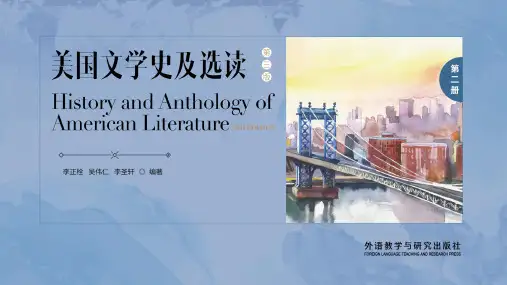
Waste Land, the most significant American poem of the 20th century, helped to establish a modern tradition of literature rich with learning and allusive thought.
ICnhatprtoerd3uction
American society. Early in the century Ezra Pound and T. S. Eliot published works that would change the nature of American poetry, but their impact (and that of other modernist writers) on the general reading public was slight. The genteel tradition and popular romanticism still dominated the nation’s literary tastes.
美国文学史及选读(下册)PPT优秀课件

5
Whitman and Dickinson
• 4. His ideas: • “a catalog and great acceptor” • Enlightenment, humanitarianism • Idealism and Transcendentalism
• Emerson and Whitman:
• 5. Whitman’s Poetic Experimentation
• He was a daring experimentalist who “broke the new wood”
• He began to experiment around 1847 which lead to a complete break with traditional poetics.
• A. Themes: both praised in their different ways, an emergent America, its expansion, its individualism, and its Americanness.
• B. Techniques: breaking free of the poetic tradition and pioneering American modernist poetry with their poetic innovation.
• Father of American Free Verse
• Celebrating America as a Poem
• 2. Life
• Working-class background
• He grew up in New York and worked there.
美国文学史及选读目录
PartⅠThe Literature of Colonial AmericaHistorical IntroductionThe First American WriterEarly New England LiteratureWilliam Bradford and John WinthropPuritan ThoughtsJohn Cotton and Roger WilliamsAnne Bradstreet and Edward TaylorPartⅡThe Literature of Reason and RevolutionHistorical IntroductionBenjamin Franklin [From The Autobiography]Thomas Paine [From The American Crisis]Thomas Jefferson [The Declaration of Independence]Philip Freneau [The Wild Honey Suckle; The Indian Burying Ground; To a Caty-Did] PartⅢThe Literature of RomanticismHistorical IntroductionWashington Irving [The Author’s Account of Himself; The Legend of Sleepy Hollow]James Fenimore Cooper [The Last of the Mohicans; From The Last of the Mohicans:Chapter12]William Cullen Bryant [Thanatopsis; To a Waterfowl]Edgar Allan Poe [To Helen; The Raven; Annabel Lee; The Fall of the House of Usher]Ralph Waldo Emerson [From Nature: ChapterⅠ; From Self-Reliance]Henry David Thoreau [From Walden]Nathaniel Hawthorne [The Scarlet Letter; From The Scarlet Letter: Ⅴ. Hester at HerNeedle]Herman Melville [Moby Dick; From Moby Dick Chapter54: The Town-Ho’s Story]Henry Wadsworth Longfellow [A Psalm of Life: What the Heart of the Young ManSaid to the Psalmist; The Slave’s Dream; My LostYouth; The Song of Hiawatha]PartⅣThe Literature of RealismHistorical IntroductionWalt Whitman [Song of Myself (1&10); I Sit and Look Out; Beat! Beat! Drums!]Emily Dickinson [I taste a liquor never brewed; I felt a Funeral, in my Brain; A Birdcame down the Walk—; I died for Beauty—but was scarce; I hearda Fly buzz—when I died—; Because I could not stop for Death]Harriet Beecher Stowe [Uncle Tom’s Cabin; Uncle Tom’s Cabin (Chap. Ⅶ) TheMother’s Struggle]Mark Twain [The Adventure of Tom Sawyer; The Adventure of Tom Sawyer (Chaps.ⅩⅩⅠ,ⅩⅩⅠⅠ)]O. Henry [The Cop and Anthem]Henry James [The Portrait of A Lady; The Portrait of A Lady (Chaps. Ⅵ,Ⅶ)]Jack London [The Sea Wolf; The Sea Wolf (Chap. ⅩⅩⅠ); Martin Eden; (Chap. Ⅰ)]Theodore Dreiser [Sister Carrie; Sister Carrie (Chap. Ⅰ)]PartⅤTwentieth-Century LiteratureHistorical IntroductionEzra Pound [A Virginal; Salutation the Second; A Pact; In a Station of the Metro; TheRiver-Merchant’s Wife: A Letter]Edwin Arlington Robinson [The House on the Hill; Richard Cory; Miniver Cheevy]Robert Frost [After Apple-Picking; The Road Not Taken; Stopping by Woods on aSnowy Evening; Departmental; Design; The Most of It]Carl Sandburg [Chicago; The Harbor; Fog; Cool Tombs; Flash Crimson; The People,Yes]Wallace Stevens [Peter Quince at the Clavier; Anecdote of the Jar; The Emperor ofIce-cream]Thomas Stearns Eliot [The Song of J. Alfred Prufrock; PreludesⅠ—Ⅳ; Journey of theMagi; The Hollow Men]F. Scott Fitzgerald [The Great Gatsby; The Great Gatsby (Chap. Ⅲ)]Ernest Hemingway [A Farewell to Arms; A Farewell to Arms (Chap. XLI)]John Steinbeck [The Grapes of Wrath; The Grapes of Wrath (XXIII)]William Faulkner [A Rose for Emily]。
美国文学 PPT课件
Benjamin Franklin Philip Freneau
➢ Chapter III American Romanticism
Washington Irving James Fenimore Cooper William Cullen Bryant Edgar Allan Poe Nathaniel Hawthorne
Brief Outline of American literature
1. Colonial period (1607-1775)
Anne Bradstreet Edward Taylor
2. Revolutionary period
(1775-1783) Benjamin Franklin Philip Freneau
The early settlers
❖ Christopher Columbus discovered the American continent in 1492.
❖ Captain John Smith reached Jamestown, Virginia in 1607.
❖ Puritans came the New England area, by Mayflower in 1620.
❖ Literature is characterized by beauty of expression and form and by universality of intellectual and emotional appeal.
2. Forms (genres) of literature? Poetry, novel (fiction), drama, prose, essay, epic, elegy, short story, journalism, ts, novelette, etc.
美国文学史及作品选读PPT5
Whitman’s great work: Leaves of Grass
(Marking the birth of true American poetry) ● Went through 9 editions: 1855, 1856, 1860, 1867, 1871, 1876, 1881, 1889, 1891-92.
Discussion of Dickinson’s Poem “Success Is Counted Sweetest”
◆ Who are “the purple host”? ◆ Who is “he” in the last stanza?
◆ Why is success “counted sweetest by those who never succeed”?
Whitman’s Poetics
● Whitman’s poetic style is marked, first of all, by the use of the poetic “I” (usually a triangular relationship: “I” the poet, subject in the poem and “you” the reader. ● Whitman is also radically innovative in terms of the form of his poetry. What he prefers is “free verse”.
Whitman has been compared to a mountain in American literary history.
His innovations in diction and versification, his frankness about sex, his inclusion of the commonplace and the ugly and his censure of the weakness of the American democratic practice paved his way to a share of immortality in American Literature.
美国文学史概述及选读复习资料
美国文学史American Literature in the colonical and Revolutionary:Franklin(本杰明.富兰克林)Freneau 菲利普·费瑞诺Benjamin Franklin(本杰明.富兰克林)1)"Poor Richard's Almanac" 穷人查理德的年鉴(以笔名Richard Sunders)2)“annual collection of proverbs “流行谚语集 (It soon became the mostpopular book of its kind, largely because of Franklin's shrewd humor, and first spread his reputation)3)The Way to Wealth (Father Abraham’s Sermon)致富之道(as the “perface to PoorRichard Improved)4)The Autobiography自传 (18世纪美国唯一流传至今的自传)5)Founded the Junto, a club for informal discussion of scientific, economic andpolitical ideas. 建立了一个秘密俱乐部,讨论的主题是政治、经济和科学等时事方面的问题.6)established America's first circulating library, founded thecollege--University of Pennsylvania. 建立了美国第一个可租借的图书馆,还创办了一所大学——就是现在的宾夕法尼亚大学.7)first applied the terms "positive" and "negative" to electrical charges.8)Writer,printer,publisher,scientist,philanthropist,and diplomat,he was themost famous and respected private figure of his time.The Rising Glory of America蒸蒸日上的美洲;The British Prison Ship英国囚船;To the Memory of the Brave Americans纪念美国勇士-----同类诗中最佳;The Wild Honeysuckle野生的金银花;The Indian Burying Ground印第安人殡葬地(1)poet and political journalist 诗人和政治方面的新闻记者(2)perhaps the most outstanding writer of the post-revolutionary period.(3)has been called the "Father of American Poetry" 美国诗歌之父(4)Imaginative and melancholy treatment of nature and human life,and sharp satire against the British tyranny19th Century American LiteratureWashington Irving(华盛顿.欧文)1.James Fenimore Cooper(詹姆斯.芬尼莫.库珀)2.Nathaniel Hawthorne(纳萨尼尔.霍桑)3.Edgar Allan Poe (埃德加.阿伦.坡)4.Henry Daived Thoreau(亨利.戴维.梭罗)5.Herman Melville(赫尔曼.麦尔维尔)6.Walt Whiteman(沃尔特.惠特曼)The Rise of American RomanticismOne of the most important periods in the history of American literature, stretches from the end of the 18th century to the outbreak of the Civil War(1861-65).It started with the publication of Washington Irving's e The h Sketch Book(1820) and ended with Whitman's s Leaves f of Grass(1855)..Romanticism的特点:frequently shared certain general characteristics, moralenthusiam, faith in the value of individualism andintuitive perception, and a presumption that he naturalworld was a source of corruption.浪漫主义之间大多是相通的,都注重道德,强调个人主义价值观和直觉感受,并且认为自然是美的源头,人类社会是腐败之源。