
人教版九年级英语unit10同步练习
单元巩固训练(Unit 10) Section A
Ⅰ.根据句意和汉语提示,填写单词。 1. Don’t forget to _________(锁) your bike. Five bikes were lost last night. 2. The children _________(冲,奔) out of the school when the bell rang. 3. Yesterday the girl _________(违反) the rule and her teacher was angry. 4. When I was about to read my book, I found I had ________(忘了带) it at home. 5. He _________(睡过头) this morning and went to school late. Ⅱ.根据句意,用括号内所给动词的适当形式填空。 1. By the end of last year, I ________(be) to the West Hill Farm three times. 2. By the time I got up, Mom _________(go) out for some exercise. 3. I __________(learn) 1,000 English words by last term. 4. By 9 o’clock last night, we ________(get) 200 pictures from the spaceship. 5. When I went into the classroom, the final bell ________(ring). I was happy that I wasn’t late. Ⅲ.根据句意和汉语提示,填写恰当的短语完成下列句子。 1. He ___________(醒来) very early and went out for a walk in the park. 2. I ___________(让她搭便车), so she invited me to have dinner. 3. I hope that all of you will come to the meeting ____________(准时). 4. His car ___________(出故障), so he had to get it repaired. 5.This Monday my alarm clock didn’t __________(发出响声) and I got up late. Ⅳ. 选择可以填入空白处的正确答案。 ( ) 1. — Did you meet Tom at the airport? — No. His plane ________ by the time I ________ there. A. has taken off; got B. took off; had got C. took off; arrived D. had taken off; arrived ( ) 2. We ______ four thousand new words by the end of last year. A. learned B. had learned C. have learned D. will learn ( ) 3. By nine o’clock yesterday evening, we ______ our work. A. have finished B. finished C. had finished D. finish ( ) 4. He told us that he ______ the letters in the morning. A. will post B. have posted C. was posting D. had posted ( ) 5. — Did you see Mr Smith when you were in France? — No. When I _______ France, he _______ to China. A. had arrived in; had gone B. arrived in; has been C. got to; had gone D. had got to; had been Ⅴ. 根据汉语意思,翻译下列句子。每空一词。 1. 她匆匆洗了个澡,就去上班了。 She _______ ________ ________ shower and went to work. 2. 我从不上班迟到。 I’m ________ ________ _ ________ work. 3. 当我跑出去后,那只狗已经跑掉了。 The dog ________ ________ ________when I ran out. 4. 昨天上午十点钟前,我们已经到火车站了。 We ________ ________ the train station before 10 yesterday morning. 5. 当我到了电影院时,电影已经开始了。 ________ ________ ________ I got to the cinema, the movie _______ ________. Ⅵ.根据对话内容,从方框内选择合适的句子补全对话。(有两项多余 A. Why were you late? B. My bike broke down halfway. C. I usually get to school on time. D. Have you ever been late for school? E. He said I shouldn’t stay up so late at night. F. I rushed to the bus shop without breakfast. G. By I got to the school, the class had been on 15 minutes. A: Can I ask you some questions, Lisa? B: Sure. A: (1)_________ B: Yes, I have. But only once last term. A: (2)_________ B: I stayed up watching the football match the evening before, so I overslept the next morning. A: What did you do after you got up? B: (3)_________ But unfortunately, by the time I got there, the bus had already left. A: Poor guy! And then? B: So I started walking. Luckily, my uncle drove by and gave me a ride. A: But you didn’t make it in the end, did you? B: No, I didn’t. (4)_________ A: What did your teacher say? B: (5)_________ A: Yes, he is right. Thanks for your answering. B: It’s my pleasure.
Section B & Self check Ⅰ.根据句意及首字母提示,填写单词。 1. Your glass is e_________ , but mine is full. 2. My uncle is a teacher and my aunt is a f________ on the farm. 3. My parents have been m_________ for 15 years. 4. Words cannot d________ the beauty of his girlfriend. 5. April 1st is April F Day. Ⅱ.根据句意,用括号内所给单词的适当形式填空。 1. The little boy is too young to get (dress). 2. The soldiers were ________(exhaust) after a month’s fight. 3. Their ideas all sound so ________(convince). 4. Girls like reading stories with happy __________(end). 5. I have heard that one bear ________(flee) from the zoo last night. Ⅲ.根据句意,从方框内选择合适的短语,并用其正确形式填空。 get married, set off, sell out, show up, stay up 1. Sue and Mike _________ last month. 2. The T-shirts were cheap and ________ fast. 3. Don’t ___________ so late again. It’s bad for your health. 4. The hoax about earthquake ___________ a panic this morning in the village. 5. She hasn’t ___________ yet, and we have been waiting for her for half an hour. Ⅳ. 根据汉语提示完成下列句子,每空词数不限。 1. 我们从未想像过人类能登上月球。 We never imagined that man could _____________________. 2. 他买了尽可能多的食品。 He bought . 3. 请递给我两片面包好吗? Could you please pass me ____________________________? 4. 当我们到了电影院时,票已经卖完了。 By the time we got to the cinema, the tickets _____________________________. 5. 吉米太小了,不能理解你刚才所说的。 Jimmy is so young ______________________________. Ⅴ. 根据短文内容和首字母提示,填写适当的单词,使短文完整、连贯。 The first day of April is full of fun. It is April Fool’s Day. A fool on that day is a p________(1) who does not think carefully and easily b (2) things that are not true. On April Fool’s Day, people tell lies (撒谎) to fool o (3) people. They play tricks (恶作剧). Then everyone around l (4). You can tell a lie on April Fool’s Day. If someone believes the lie, say, “April Fool!” But you should be c (5). Someone may tell you a lie, too. If you believe it, he or she will say, “April Fool!” Here are some April Fool lies. “Your shoe is untied.” “There’s a bug on your shoulder (肩膀).” “Our teacher says we’re having a math t (6) today.” “Your bike has a flat tire (扁的轮胎).” You can play such an April Fool’s trick: You n (7) a coin or a dollar bill, and the thread (线). Tape (用……绑起) a very long thread to the money. Put the m (8) down on the ground. H (9) the other end of the thread. Stand away. When someone sees the money and tries to p (10) it up, pull (拉) back the thread quickly. Laugh and say, “April Fool!”
人教版九年级英语(全一册)Unit 10 检测卷附答案 (1)
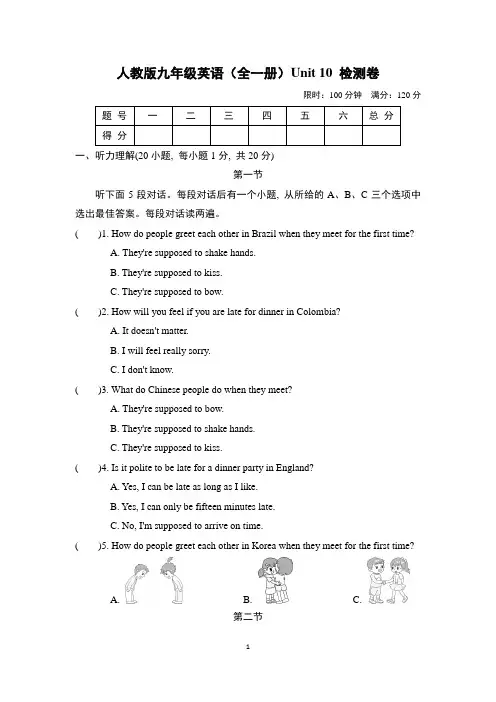
人教版九年级英语(全一册)Unit 10 检测卷限时:100分钟满分:120分一、听力理解(20小题, 每小题1分, 共20分)第一节听下面5段对话。
每段对话后有一个小题, 从所给的A、B、C三个选项中选出最佳答案。
每段对话读两遍。
()1. How do people greet each other in Brazil when they meet for the first time?A. They're supposed to shake hands.B. They're supposed to kiss.C. They're supposed to bow.()2. How will you feel if you are late for dinner in Colombia?A. It doesn't matter.B. I will feel really sorry.C. I don't know.()3. What do Chinese people do when they meet?A. They're supposed to bow.B. They're supposed to shake hands.C. They're supposed to kiss.()4. Is it polite to be late for a dinner party in England?A. Yes, I can be late as long as I like.B. Yes, I can only be fifteen minutes late.C. No, I'm supposed to arrive on time.()5. How do people greet each other in Korea when they meet for the first time?A. B. C.第二节听下面几段对话或独白。
人教版九年级英语(全一册)Unit10_同步话题阅读与答案详解
得阅读者得高分九年级全册同步话题阅读理解与答案详解Unit 10 You are supposed to shake hands话题阅读阅读话题:风俗习惯。
语言目标:说明你应该做什么。
阅读提示:与“风俗习惯”相关的题材多为“人际关系”,不同的地区有不同的人交往习俗;人们的社会交往必须遵循这些习俗。
AAround the world, people have different ideas about what good manners are. When you go to restaurants in different parts of the world, it is important to know the right and wrong things to do. For example, in China it is OK to make noise in a restaurant. In fact, if a restaurant isn’t noisy and lively, you may think there is something wrong with it. However, in many Western countries, restaurants are quiet places. If a table is too loud, other people who are eating there might even complain to the owner of the restaurant.Paying the bill is also different from country to country. In China, one person usually pays for everybody. In Western countries, one person pays if he or she is entertaining clients. But when friends eat together, they usually share the cost. This is called going Dutch. Also, when Westerners pay the bill, they usually leave some extra money for the waiter. This is called “leaving a tip”. Leaving a tip is thought to be polite. In the U.S., it’s common to leave tips of 10%, 15%, or 20% of the bill; the amount is decided by how good the service is. Good waiters can make a lot of money!The way people eat food is different around the world, but you can find the same kinds of food in many countries. Chinese and Italian food, for example, are popular all over the world.1.In China, you _________ make noise in a restaurant.A. aren’t supposed toB. canC. can’tD. allowed to2.In many Western countries, restaurants are _________ places.A. quietB. livelyC. noisyD. secret3.The underlined words “going Dutch” mean _________ in Chinese.A. 宴请宾客B. 均摊费用C. 去荷兰D. 免费用餐4.When Westerners pay the bill, they usually leave some money as a tip for the _________.A. sellerB. waiterC. visitorD. boss5.What is the main idea of the passage?A. People have different ideas about what good manners are.B. Chinese food is popular all over the world.C. Paying the bill differs from country to country.D. It is polite to give tips to the restaurant waiters or waitresses.BThe customs in different countries are rather different.If I have dinner with a Chinese host, he always puts more food onto my plate as soon as I have emptied it. That often discomforts me greatly.I have to eat the food even if I do not want to because it is considered bad manners in the west to leave one’s food on the plate.I have also noticed that when a Chinese sits at an American’sdinner party, he often refuses the offer of food or drink though he’s in fact still hungry or thirsty.This might be good manners in China but is not in the West at all.In the United Sates, it is impolite to keep asking someone again and again or insist on his accepting something. Americans have a direct way of speaking. If they want something, they will ask for it. If not, they will say, “No,Thanks.” When an American is served with beer by host, for example, he might say, “No, thanks.I’ll take some orange juice if you have it.” That is what an American will do. So when you go to the United States, you’d better remember the famous saying: “When in Rome, do as the Romans do.”1.From this passage we can see that the writer is ___________ .A.ChineseB.AmericanC.RomanD.European2.When a Chinese host kept putting more food onto his plate, the writer felt _____.A.happyB.sadC.badD.great3.In the West, people consider it bad manners ____ .A.to refuse an offer at a dinner partyB.to keep asking someone to accept somethingC.to eat much at a dinner partyD.to ask for something directly at a dinner party4.A guest at all American’s dinner party shoul d show his politeness by___________.A.eating up all the food offeredB.putting more food onto his plate as soon as he emptied itC.refusing the offer of food or drinking though he is still hungry or thirstyD.refusing to drink anything5.“When in Rome, do as the Romans do.”means ___________ .A.the Romans are people of good mannersB.Americans always do the same things as the Romans doC.you should do things like Romans doD.you should get used to the local customs where you goCWhen we want to tell other people what we think, we can do it not only with the help of words, but also in many other ways. For example, we sometimes move our heads up and down when we want tosay“Yes”, and we move our heads from side to side when we want to say “No”.People who can neither hear nor talk to each other can communicate with the help of their fingers.People who don’t understand each other’s language have to do the same.The following story shows how they sometimes do it.An Englishman who couldn’t speak Italian was once travelling in Italy. One day he entered a restaurant and sat at a table. When the waiter came, the Englishman opened his mouth, put his fingers in it, took them out again and moved his lips. In this way he meant to say,“Bring me something to eat. ” The waiter soon brought him a cup of tea.The Englishman shook his head and the waiter understood that he didn’t want tea, so he took it away and brought him some coffeeThe Englishman was very hungry at this time and looked very sad. He was just going to leave the restaurant when another traveller come in. When this man saw the waiter, he put his hands on his stomach. That was enough. After a few minutes there was a large plate of bread and meat on the table for him..11.How do people who don’t understand each other’s language usually express themselves?A.Look for help of words.B.Move their heads.e body language.D.Move their fingers from side to side.12.What did the Englishman want the waiter to bring him?A. A cup of tea.B. A cup of coffee.C. A glass of water.D. Something to eat.In this way he meant to say,“Bring me something to eat. ”可知答案应为D。
人教版九年级下册英语UNIT 10 达标测试卷 (2)
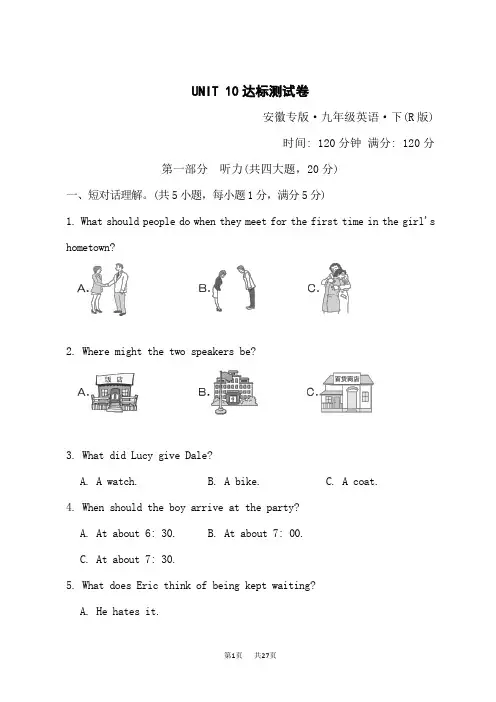
UNIT 10达标测试卷安徽专版·九年级英语·下(R版)时间: 120分钟满分: 120分第一部分听力(共四大题,20分)一、短对话理解。
(共5小题,每小题1分,满分5分)1. What should people do when they meet for the first time in the girl's hometown?2. Where might the two speakers be?3. What did Lucy give Dale?A. A watch.B. A bike.C. A coat.4. When should the boy arrive at the party?A. At about 6: 30.B. At about 7: 00.C. At about 7: 30.5. What does Eric think of being kept waiting?A. He hates it.B. He doesn't mind it.C. He can't stand it.二、长对话理解。
(共5小题,每小题1分,满分5分)听下面一段对话,回答第6、7小题。
6. What is the girl interested in?A. Painting.B. Reading.C. Writing.7. Where is Tony's hometown?A. In America.B. In Asia.C. In Africa. 听下面一段对话,回答第8至10小题。
8. What are they doing?A. Listening to music.B. Drinking coffee.C. Having a class.9. When is the rock concert?A. Tomorrow evening.B. Next Sunday.C. Neusic does the girl like?A. Pop music.B. Soft music.C. Classical music.三、短文理解。
Unit 10 单元课时练习 2022-2023学年人教版九年级英语全册
九年级英语 Unit 10 单元课时练习一、单项选择1.1Some parents would rather ________ the walls blue for their children ________ them a feeling of peace. A.to paint; give B.paint; giveC.to paint; to give D.paint; to give 2—Sophie, I can carry the heavy bag for you, if you can't.—That's a very kind________. Thanks a lot. A.promise B.service C.offer D.suggestion 3. We all went swimming Tom,because he was ill at home.A. withB. besidesC. exceptD. including4.-I'm very______about tomorrow's exam.--Take it easy. I'm sure you can pass it easily.A.nervousB.relaxedC.angryD.excited5.We can ask him for some advice at any time ________ during his holidays.A.exceptB.andC.butD.so6.—You don’t know what great difficulty I had getting the two tickets.—But the match is really worth .A.watchB.watchingC.to watchD.being watched7.— Do we have to read anything next week, Mr Wu? —Sure. You to read Black Beauty from page 58 to85.A. were expectedB. will expectC. are expectingD. are expected8. Most of the time, we should make decisions by ourselves., no one knows us better than ourselves.A. In additionB. For exampleC. After allD. At first9 .The little boy his hands and got his birthday gifts happily.A shut offB held outC fell downD cared about10.People are expected _______ in Korea when they meet for the first time.A. to bowB. bowC. to bowingD.bowing二、完形填空The English often go out with an umbrella or a raincoat. Why 1___ the weather in Britain often changes quickly. Spring can be rainy or windy, 2 ___the weather is getting warmer and you can hope more sunny days. In fact, there 3___ as much sunshine in spring as in summer. Summer is 4 ___time for visitors to go to the seaside. People often go out to have a walk or swim. Autumn is a beautiful season. During autumn it is still nice to be outside, too. In winter, I gets colder, and it might 5 ___, especially in the north. There are 6___ very heavy winds in this season.February is usually the coldest 7___ of the year, while the warmest 8 ___often July.The difference 9___ temperature between winter and summer is not so great in Britain. The average temperature for winter is about 4.5 ℃, and for 10___ is about 15.5℃.1. A. Because B. As C. For D. Since2. A. so B. but C. or D. for3. A. have B. can have C. can be D. can4. A. the worst B. the best C. the latest D. the earliest5. A. rain B. wind C. hot D. snow6. A. too B. either C. also D. as well7. A. weather B. season C. month D. day8. A. is B. was C. are D. were9. A. in B. on C. by D. for10. A. spring B. summer C. autumn D. winter三、阅读理解Are you able to send a letter with pictures and sounds to someone somewhere in the world without a stamp on it? Using a computer you can send e-mails quickly and easily. The post is much slower than e-mail. E-mail can send its message to the other side of the world in seconds.E-mail is easy to use and it saves time and money. The differences in time in different parts of the world do not matter when sending e-mail. It’s twenty-four-hour service that you can send e-mail at any time of the day or night. No one has to be there to get e-mail. It does not matter if your friends are in beds when you send e-mail to them, or you are seeinga movie at the movie theater when they send e-mail back. ( ) 1. We can use a _______ to send e-mail.A. robotB. videoC. computerD. letter( ) 2. E-mail is ______ the post.A.faster thanB. as fast asC. much slower thanD. not so fast as( ) 3. It takes_______ to send e-mail to the other side of the world.A. minutesB. secondsC. seven daysD. hours ( ) 4. You can send e-mail at any time______.A.in the daytimeB. at nightC. on weekendsD. ofthe day or night( ) 5. _______ send e-mail to your friends when they are sleeping.A. You can’tB. you mustC. You canD. You shouldn’t四、根据句意及首字母提示补全单词。
人教版九年级英语Unit 10单元测试卷及答案
人教版九年级英语Unit 10单元测试卷第一部分(听力共30分)I.听对话,选答案(共15小题,计20分)第一节:听下面10段对话,每段对话后有一个问题,读两遍。
请根据每段对话的内容和后面的问题,从所给的三个选项中选出最恰当的一项。
(共10小题,计10分)( ) 1. A. I am full. B. It was delicious. C. I don’t want to eat more.( ) 2. A. At about 6:30. B. At about 7:00. C. At about 7:30.( ) 3. A. Being on time. B. Greeting others C. Buying some presents.( ) 4. A. To eat with his chopsticks. B. To put his chopsticks on the table.C. To stick his chopsticks into his food.( ) 5. A. Korea. B. Japan. C. Brazil.( ) 6. A. India. B. America. C. Brazil.( ) 7. A. At 8:50. B. At 9:00. C. At 9:10.( ) 8. A. some snacks. B. Some books C. Some flowers( ) 9. A. What to take to her friend’s party. B. How to behave at the dinner table.C. What to wear at her friend’s party.( )10. A. They are supposed to kiss. B. They are supposed to bow.C. They are supposed to shake hands.第二节:听下面两段对话,每段对话后有几道小题,请根据每段对话的内容和后面的问题,从所给的三个选项中选出最恰当的一项。
人教版九年级英语上册unit10基础知识复习及训练(含答案)
Unit 10 You are supposed to shake hands 基础知识点复习一、重点词组1、drop by顺便拜访2、after all毕竟/终归3、get mad大动肝火/气愤4、make an effort作出努力5、clean sth off把…擦掉6、take off脱下/起飞7、go out of one’s way to..特地/格外努力8、make sb feel at home使某人宾至如归9、be used to doing习惯于10、shake hands握手11、Sb be supposed to do被期望做/应该做12、Sb be expected to do被期待着做…13、be important to do (做)…是重要的14、meet for the first time首次见面15、make some mistakes犯一些错误16、to one’s surprise使…惊讶的是17、invite sb to do sth邀请某人做…18.as soon as一…就…19. greet sb=say hello to sb20. be different from 与…不同21.on time 按时 in time及时22. clean…off把……擦掉23. as…as sb. can / could= as…as possible 尽可以地 be worth doing sth. 值得做某事24、avoid heavy traffic避开交通高峰期25、eat with one’s hand用手(拿)饭吃26、stick sth into …插入…里27、on the plate在盘子里28、point at sb with sth用…指点…29、the biggest challenge最大的挑战30、have a good time/have fun=enjoy oneself玩得高兴/过得愉快31、learn how to do sth学会怎样做…32、because of …由于/因为33、cut up sth切开34、make sb adj使得某人…二、重点语法句型1、be supposed to do=should do sth应该,被期望(1)用来表示被要求,希望做某事,含有必须、应该或理应做某事(2)时态、人称、和句式变化在be动词上体现。
人教版九年级英语(全一册)Unit10_期末知识梳理、习题加练、考点讲解练习
Unit 10 You are supposed to shake hands.一、短语归纳1.be supposed to/be expected to应当2.hold out my hand伸出手3.shake hands握手4.greet sb. the wrong way用错误的方式问候某人5.be relaxed about…对……松懈6.the welcome party 欢迎晚会7.as soon as…一……就……8.value the time 珍惜时间9.drop by顺便访问;随便进入11.at noon在中午12.get mad大动肝火;气愤13.make an effort作出努力14. clean…off把……擦掉15. take off脱下(衣服); (飞机等)起飞16.stick the chopsticks into the food把筷子插在食物上17 hit an empty bowl敲打空碗18.go out of one’s way 特地;格外努力19.make…feel at home使(某人)感到宾至如归20.give sb. some suggestions and advice给某人一些建议21.after all毕竟;终归22. shake hands 握手23. hold out 伸出24. get used to习惯于25. look forward to 期盼; 盼望26.be relaxed about…对……松懈27.rush around慌慌张张28.the capital of clocks and watches钟表之都29.mind your manners 注意你的礼仪30.eat with hands 用手吃饭31.after all毕竟;终归32.at noon在中午33.It’s no big deal! 这没什么大不了的!34.social situations社交环境35.be worth the trouble麻烦一点也是值得的36.table manners餐桌礼仪37.mind your manners 注意你的礼仪38.eat with hands 用手吃饭词形变换1. relaxed→(动词)relax→(形容词)relaxing2. value→(形容词)valuable3. northern→(名词)north4. eastern→(名词)east5. gradually→(形容词)gradual6. suggestion→(动词)suggest语法讲解♣ suppose的用法总结suppose作为动词,其意思是“猜想,设想,认为,假设”,其常见用法为:1. be supposed to do sth.意思是“被期望做某事;应该做某事”,to是不定式符号,不是介词,后接动词原形。
人教版九年级英语units9-10单元测试题(1)
九年级Unit9-10 测试题一.1. I noticed him ___________ the office. A. entered B. entering C. to enter D. to entered2. She is __________ with the gift. A. glad B. pleased C. pleasant D. pleasing3. —My car _______ on my way home yesterday. —Oh, bad luck!A. break downB. break offC. broke offD. broke down4. —Hi, Jack. Did you go to Jim’s birthday party —No, I felt so sad. I .A. didn’t inviteB. wasn’t invitedC. am not invitedD. hadn’t invited5. Don’t put off today’s work for tomorrow. I mean, today’s work ______ today.A. may doB. must doC. may be doneD. must be done6. What weather it is! A. pleasant B. pleased C. glad D. cheerful7. —Do you have any problems if you ______ this job —Well, I’m thinking about the workingday.A. offerB. will offerC. are offeredD. will be offered8. —Can you tell me where the students of Class2 are—They _________reading the book on Scientific Outlook on Development just now.A. will findB. have foundC. were foundD. found9. —It’s difficult for the village children to cross the river for school.—I thinka bridge __ over the river.A. was builtB. is being builtC. has been builtD. should be built10. Don’t discuss the problems with your partner unless you____________ to do so.A. askB. are askedC. will askD. will be asked11. I took your umbrella by . A. mistake B. error C. fault D. wrong12. Australia wool and meat. A. produce B. product C. produces D. products13. He as quickly as possible because he didn’t want to be late.A. took a showerB. take a showerC. take showerD. took shower14. I walked into class, the teacher had started teaching already.A. By the timeB. WhileC. AfterD. Because15. My mother is ill. I stay at home and look after her. A. had to B. must C. have to D. want16. When I got the news that ship would sink, I was frightened my legs couldn’tmove forward.A. so; thatB. very; thatC. too; thatD. too; to17. When I wanted to pay for this sweater, I realized I my money in the pocket.A. lostB. have lostC. had lostD. lose18. I was by his comments(评论)about my clothes.A. exhaustedB. embarrassedC. embarrassingD. hungry19. Because of H1N1 Flu,panic________ across the whole world.A. set upB. set offC. setted offD. had set off20. He looks sad now. Do you know__________ him last nightA. what was happenedB. what was happened toC. what happened toD. what happened二. Farley worked for the Canadian government. One day, he was told to learn more aboutwolves. Do wolves kill lots of caribou (big animals) Do they kill __21__They gave him lots of food, clothes and guns. Then they put him on a plane and took him to __22__. The plane put him down and went away. There were __23__ houses or people in this place. But there were lots of animals and lots of wolves.People tell terrible stories about wolves. They say wolves like to kill and eat people. Farley remembered these stories, and he was __24__. He had his gun with him __25__. Then one day, he saw a group of __26__. There was a mother wolf with four baby wolves.A father wolf and another young wolf lived with them.Farley watched these wolves every day. The mother was a very __27__ mother. She gave milk to her babies. She gave them lessons about life. They learned how to __28__ food. The father wolf got food for the mother. The young wolf __29__ the children. They were a nice, happy family—a wolf family! Farley did not need his __30__ any more. In a short time, he got on well with the wolf family! Farley watched them for five months. He learned many new things about wolves. He learned that many stories about the wolves were not true.Wolves do not eat people, and they do not eat many large animals. And they also learned bad things about men. It was men who killed many caribou and wolves. Later, Farley wrotea book about wolves. He wanted people to understand them and not to kill them.21. A. other wolves B. people C. insects D. small animals22. A. a small town B. a big city C. a far place D. a lonely village23. A. many B. a little C. no D. a few24. A. afraid B. happy C. angry D. tired25. A. at times B. all the time C. once a week D. every afternoon26. A. animals B. wolves C. people D. babies27. A. bad B. good C. hungry D. thirsty28. A. cook B. make C. get D. pick29. A. shouted at B. looked into C. laughed at D. played with . food B. clothes C. gun D. plane三.任务型阅读Dragon-Boat Festival(端午节)Dragon-Boat Festival also called the Duanwu Festival, is celebrated on the fifth day of the fifth month according to the Chinese calendar. For thousands of years, the festival has been marked by eating Zong Zi and racing dragon boats. To hold the dragon-boat races is in memory of Qu Yuan, one of the greatest poets(诗人)in China.Qu Yuan was born in Zigui of Hubei Province over 2200 years ago. Qu Yuan was an honest minister(大臣)of the State of Chu, during the Warring States Period (475—221BC)(战国时期). He was upright and . He wanted to bring his country peace and make the State more stronger, but the country was in the hands of bad officials, he failed. At last, he was very discouraged 69. he ended his life by throwing himself into the Miluo River. It was said that people jumped from the boat into the river and tried to save it was too late. Also, they were very sad and they threw rice into the water to feed Qu Yuan’s spirit.Now we read his poem Li Sao which was filled with deep love for his country. We can see the dragon—boat races and have a kind of Chinese food named Zong Zi to eat during the Dragon—boat Festival.66. What day is Duanwu Festival_______________________________________________________________________________ 67. What are the two important things on the Dragon—Boat Festival_______________________________________________________________________________ 68. 把划线部分译为汉语。
人教版九年级英语unit 10能力测试试题含答案
Unit 10 You're supposed to shake hands.一、单项选择。
从A、B、C、D四个选项中选择可以填入空白处的最佳答案。
( ) 1. All the students went to the park yesterday _________ Eric. He had to look after his sister at home.A. betweenB. exceptC. besideD. with( ) 2. —Could you give me some _________ on how to keep healthy?—Yes. Eat less junk food and do more sports.A. mannersB. suggestionsC. introductionsD. customs ( ) 3. Nancy enjoys light music. She thinks it can make her feel _________.A. scaredB. excitedC. relaxedD. tired( ) 4. —Do you mind if I sit next to you?—Of course not. The seat is _________.A. fullB. comfortableC. emptyD. valuable( ) 5. Cathy _________ very well at the party. All the guests liked her.A. remainedB. triedC. grewD. behaved( ) 6. Tina doesn’t mind _________ a try, but she has no time now.A. hadB. haveC. to haveD. having( ) 7. —What do you think of the film Jurassic World?—Very wonderful. It is well worth _________.A. seeingB. being seenC. to seeD. to be seen( )8. In those days in the middle school I _________ taking a walk after supper.A. was used forB. used toC. am used toD. got used to( ) 9. Kevin is supposed _________ at six o’clock, but he hasn’t shown up so far.A. to arriveB. to arrivingC. arriveD. arriving( ) 10. You _________ never believe that Ben, an honest man, didn’t tell the truth.A. wouldB. willC. needD. shall( ) 11. Jason, please give me a call _________ you arrive in Beijing.A. as well asB. as soon asC. as long asD. as far as( ) 12. —Mom, let’s _________ to see Aunt Laura on our way home.—Good idea.A. drop byB. wait forC. look forD. pass by( ) 13. The plane didn’t _________ on time because of the heavy rain.A. take offB. stay upC. get upD. go off( ) 14. _________ is very difficult to finish the work before 3:00 p.m.A. OneB. ItC. ThisD. That( ) 15. —Sorry, I didn’t pay 1 yuan back to you. —It’s only 1 yuan! _________.A. That sounds interestingB. I don’t mind itC. That’s too badD. It’s no big deal( )16. Everybody should make ________ effort to reduce pollution and create a clean environment. A. a B. an C. the D. 不填( )17. You can have any of the cakes __ __ this one because it is for your mother.A. amongB. exceptC. onD. without( )18. —Father's Day is coming. Could you please give me some ________ for Father's Day activities? —Sure. You may have a family picnic or a family camping trip.A. introductionsB. competitionsC. resolutionsD. suggestions ( )19. One of the boys kept talking in class, which made Mrs. Jackson very ________.A. lonelyB. madC. weakD. sleepy( )20. Mandy finished all the work on time. Now she feels ________ and happy.A. worriedB. shockedC. relaxedD. interested( )21. —Studying English grammar is the key to speaking correctly.—I'm afraid I disagree. _______ is more important to practice listening.A. ThisB. OneC. ItD. That( )22. The guests praised Mario and his younger brother because they ________well at the party.A. behavedB. arguedC. addedD. replied( )23. The Long March 7 made its successful inaugural flight (首飞). Zhang Yangtold me the news ________ he saw it on the Internet.A. so thatB. even thoughC. as soon asD. ever since ( )24. Cathy used to ________ much for dinner, but in order to keep fit, recentlyshe has got used to ________ less.A. eating; eatB. eat; eatingC. eat; eatD. eating; eating ( )25. —Ruby, ________ the steps when you wear shoes with high heels.—Thanks, I will.A. mindingB. to mindC. mindD. to minding( )26. The celebration begins at seven in the evening and is expected ________ around half past ten.A. finishingB. to finishingC. finishD. to finish( )27. Jessica seems strange. I find ________ hard ________ on with her.A. it; to getB. it; getC. that; getD. that; to get( )28. Tourists were told ________ their sunglasses to protect their eyes from the strong sunlight.A. not to take offB. to take offC. to clean offD. not to clean off ( )29. —Jason hasn't finished the work, but don't punish him. ________, he has done his best. —Yes, you're right.A. At firstB. For exampleC. After allD. In total( )30. —Sorry, I couldn't do more to help you get that job.—________. There will be other jobs.A. It's up to youB. It's no big dealC. Well, that's too badD. Well, it's hard to say二、完形填空。
人教版九年级英语全册教师用书:Unit 10
Unit 10You're supposed to shake hands.1.be expected to do被预期会做……expect的被动形式后面加不定式,意为“被预期会做……”。
如:①He is expected to arrive at five in the afternoon.预期他将会在下午五点到达。
②My teacher is expected to come to the party today.预计我的老师会参加今天的聚会。
③He studies hard these days, and he's expected to do well in the exam.他最近学习很用功,预计他能在考试中取得好成绩。
2.It's very important to be on time.准时很重要。
(1)important是形容词,常用句式是It's important (for sb.) to do sth.。
如:It's important for us to learn English well.对我们来说学好英语是重要的。
(2)如果只是说“对某人是重要的”,可以用be important to sb.。
如:Knowing Western customs is important to us.了解西方习俗对我们很重要。
3.I greeted Paul's mother the wrong way.我用错误的方式问候保罗的母亲。
greet意为“问候;向……打招呼”。
如:①He greeted her by saying “Good morning”.他向她打招呼,说“早上好”。
②She greeted me with a friendly smile.她向我微笑致意。
③A beautiful view greeted us.美丽的景色呈现在我们的面前。