
人教版英语八年级上册全册十单元语法总结
人教版英语八年级上册全册十单元语法总结Unit 1 Where did you go on vacation?一复合不定代词1、由some, any, no, every加上one, body, thing构成不定代词,成为复合不定代词。
2、用法(1)复合不定代词相当于名词,在句中可以用作主语、宾语和表语。
Someone is knocking at the door.I don’t have anything to say today.Money isn’t everything.(2)复合不定代词被形容词、动词不定式修饰时,形容词和动词不定式后置。
I have something important to tell you.There is nothing wrong with the radio.(3)复合不定代词做主语时,表示单数概念,谓语动词用单词形式。
Everything begins to grow in spring.(4)some-不定代词用在肯定句中或者表示请求的一般疑问句中;any-不定代词多用于疑问句中否定句中。
Will you ask someone to carry the box for me?Would you like something to drink?(5)anyone和anything也可以用在肯定句中,表示“任何人”和“任何事”。
Anyone can do it.I can do anything for you.二一般过去时的规则动词和不规则动词(一)规则变化构成规则:在动词末尾直接加-ed . 例如,work -worked , look -looked , play –played以不发音的字母e结尾的动词,直接加-d . 例如,live –lived , hope –hoped , use –used以辅音字母+y结尾的,变y为i再加-ed . 例如,study –studied , carry –carried , worry –worried 以重读闭音节结尾且末尾只有一个辅音字母的,双写最后的辅音字母,再加-ed . 例如,stop –stopped , plan–planned(二)不规则变化1. 没有变化,即:与动词原形一样。
例如,cut –cut , put –put , read –read2. 变化元音,例如,write- wrote , know –knew , come –came3. 变化辅音,例如,make –made , spend –spent , send –sent4. 辅音和元音都变化,例如,leave –left , teach –taught , think –thought5. 其他情况,例如,is –was , are –were , have –hadUnit 2 How often do you exercise?频度副词一、频度副词的含义英语中常见的频度副词有usually, sometimes, always, often, seldom, never等,它们用来表示动作发生的频率,但是在程度上有所区别,频率由高到低依次是:always>usually>often>sometimes>seldom>never。
频度副词放在be动词、情态动词和助动词之后,实义动词之前,对频率的提问用how often。
He’s always busy.I never play a trick on others.Sometimes I go to school by bus.二、频度副词在句中的位置频度副词一般放在实义动词之前,be动词、情态动词和助动词之后。
Lucy is sometimes busy.I can hardly say a word.They often have coffee at night.Unit 3 I'm more outgoing than my sister形容词和副词的比较级① 形容词比较级的变化规则。
I. 规则变化II. 不规则变化① 形容词比较级用法。
I. 比较级用于两者进行比较,结构为“A is 比较级than B”。
e.g: 1. My bike is more beautiful than hers.我的自行车比她的漂亮。
2. He works harder than before. 他工作比以前努力。
II. 表示两者之间选择,用“which/who is 比较级,A or B?”表示“两者之间较……之一”时,用“the + 比较级”结构。
e.g: 1. Which is nearer to the sun, the moon or the earth? 哪个离太阳更近,月球还是地球?2. He is the thinner of the two. 他是两人中较瘦的那个。
III.“越来越……”用“比较级and 比较级”结构,多音节和部分双音节词用“more and more 原级”。
e.g: 1. The weather is becoming colder and colder. 天气变得越来越冷了。
2. She is becoming more and more beautiful. 她变得越来越美了。
IV. 表示“越……越……”时,用“the+比较级,the+比较级”结构。
e.g: The more careful you are, the more points you will get. 你越细心,得分越多。
Unit 4 What's the best movie theater?形容词和副词最高级一、变化规则I. 规则变化II. 不规则变化二、用法I. 表示三者及以上人或物进行比较时用最高级,结构为“the + 最高级+in/of + 范围”。
e.g: 1. The picture is the best of all. 这幅画是所有画中最好的。
2. She is the most beautiful girl in the class. 她是班上最美的女孩。
II. 表示在三者及以上之间选择,用“which/who is the+最高级,A, B or C?”。
e.g: Who is the tallest, Tom, Kate or Bill? 汤姆、凯特、比尔,谁最高?III. 表示“最……之一”用“one of the最高级+可数名词复数”。
e.g: She is one of the most popular teachers in our school. 她是我们学校最受欢迎的老师之一。
IV. 形容词最高级前面加序数词,表示“第几……”。
e.g: She is the second tallest girl in our class. 她是我班上第二高的女孩。
V. 比较级和最高级之间的互换。
例如:He is taller than any other boy in our class.= He is taller than the other boys in our class.= He is the tallest boy in our class.注意比较以下两个句子:Shanghai is larger than any other city in China.(范围之内)= Shanghai is larger than any city in Japan.(范围之外)Unit 5 Do you want to watch a game show?动词不定式作宾语①常见的能带动词不定式作宾语的动词有:want,like,love,wish,hope,need,try,ask,seem,help,learn,decide,plan,start,begin,forget,remember,choose ,prepare,agree等。
Kate wants to be a doctor when she grows up.He decided to buy a new MP4.We all hope to go to Taizhou next month.I don’t like to be late for school.I forgot to bring the MP4 hem.①有些动词后面接复合宾语时,常用it作形式宾语,而真正的宾语则由动词不定式来担当,并位于宾语补足语之后。
常见的这样的动词有find,think,feel,make等。
I find it interesting to play computer games我发现玩电脑游戏很有趣。
We all think it very difficult to finish the work in an hour.①“疑问词+不定式”结构疑问词who,what,which,when,where和how后接动词不定式可在句中作宾语、主语、表语。
I don’t know What to do next.Can you tell me how to get to the hospital?Unit 6 I'm going to study computer science.一般将来时定义:一般将来时表示将来某个时间要发生的动作,事情或存在的状态,也表示将来经常或反复发生的动作或事情。
1.will/shall+动词原形shall用于第一人称,常被will 所代替。
will 在陈述句中用于各种人称,在征求意见时常用于第二人称。
will not=won't shall not=shan't例如:e.g. Which paragraph shall I read first?我先读哪一段呢?Will you be at home at seven this evening? 今晚七点回家好吗?2. be going to +不定式,表示将来。
a. 主语的意图,即将做某事。
e.g. What are you going to do tomorrow? 明天打算做什么呢?b. 计划,安排要发生的事。
e.g. The play is going to be produced next month。
这出戏下月开播。
c. 有迹象要发生的事。
e.g. Look at the dark clouds, there is going to be a storm.看那乌云,快要下暴雨了。
人教版英语八年级上册Unit10【重点短语+词法语法句法精讲】

【课堂笔记】人教版英语八年级上册Unit10重点短语1. wear jeans to the party穿着牛仔裤去参加聚会2. have a class meeting 开个班会3. watch a video at the party在聚会上看录像videos (video 的复数形式)4. potato chips炸土豆片5. too lazy to cook 太懒了而不想煮(东西)6. be/feel upset 感到难过7. take a taxi 乘出租车. travel around the world 周游世界9. make a lot of money 赚许多钱10. get an education 接受教育11. get advice from an expert从一个专家那里得到建议advise(advice 的动词形式)12. keep... to oneself 保守秘密13. have a lot of worries 有许多烦恼14. have problems with their schoolwork在他们的学校作业上有困难15. have problems doing sth. 做某事有困难16. a teenager from London一个来自伦敦的少年17. be afraid to do sth. 害怕做某事1. lose one's wallet 丢了某人的钱包19. walk three miles to school 步行三英里去学校20. keep thinking 一直在想21. be angry with sb./be angry at sth.对某人生气/对某事生气angrier; angriest(angry 的比较级与最高级) 22. make careless mistakes 犯粗心的错误more/most careless(careless 的比较级与最高级)23. be more careful 更仔细24. advise sb. to do sth. 建议某人做某事25. feel the same way as sb. 和某人有同感26. run away from your problems逃避你的问题27. have experience in sth. 在某方面有经验2. cut... in half 把……切成两半cut; cutting(cut 的过去式以及现在分词)29. give sb. some advice about sth.就某事给某人提些建议30. discuss your problems with sb.和某人讨论你的问题31. be halfway to doing sth.做某事已经成功一半32. more understanding更善解人意的重点句型1. —What will happen if they have the party today?如果他们今天举办聚会会怎样?—If they have it today, half the class won't come.如果他们定在今天,一半的学生将不会来。
人教版8年级上 第十单元语法小结
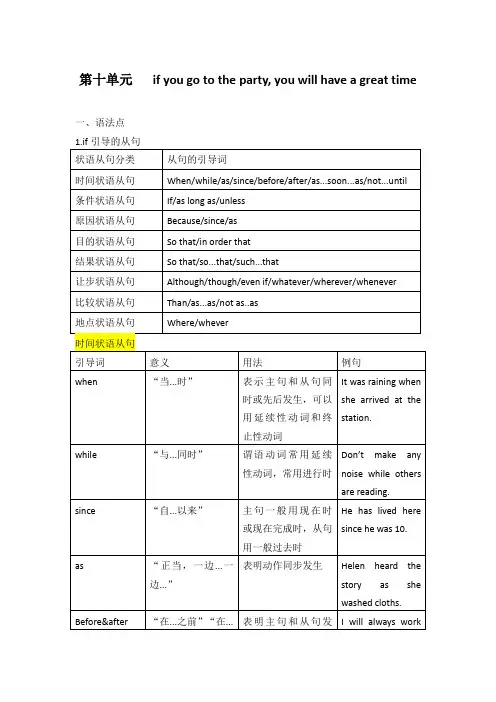
第十单元if you go to the party, you will have a great time 一、语法点
2.情态动词引导的问句(第九单元语法点已总结在内)
二、高频词汇及词组
1.Experience
作不可数名词,译为“经验”;作可数名词,译为“经历”。
作动词,译为“经历、经受”
例句:It is important to try and learn from experience.(经验)
It was her first experience of living alone.(经历)
Everyone experiences these problems at some time in their lives.
4.hear
Hear from sb “收到某人来信”
Hear of sth/sb“听说某人某事”
例句:I heard from my father last week.
Have you ever heard of the Great Wall?
5.travel
作动词,旅行,游历
作名词(不可数),旅行;旅游。
travels 表示游历总数,不是旅行的含义。
Travel--travelling(现在分词)--travelled(过去分词)
例句:I love travelling by train.。
人教版八年级上册英语语法、短语和知识点总结归纳
人教版初二上册英语学问点总结归纳八年级〔初二〕上册英语语法、短语和学问点总结归纳Unit 1 Where did you go on vacation?本单元的话题:谈论假期活动内容,复习一般过去时。
本单元的语法:1.复习一般过去时;2.学习不定代词和不定副词的用法。
2.不定代词和不定副词的用法:(1)左边的some、any、every、no 与右边的body、one、thing 构成不定代词,some、any、every、no 与右边的疑问副词where 构成不定副词;(2)一般状况下以some 开头的不定代词和不定副词用于确定句,以any 开头的不定代词和不定副词用于否认句、疑问句;以no 开头的不定代词和不定副词表示否认含义(no one 为两个单词);(3)不定代词或不定副词和形容词连用时,形容词放在后面。
He has something important to do. 他有重要的事情要做。
(确定句用something,形容词important 放后)Did you buy anything special? (一般疑问句用anything,形容词special 放后)Did you go anywhere interesting last month? 上个月你去令人感兴趣的地方了吗?(一般疑问句用不定副词anywhere,形容词interesting 放后)(4)不定代词和不定副词做主语时,后面的动词用单数形式。
Everone is here today.今日每个人都在这里。
本单元的短语和学问点:1.go on vacation 去度假go to the mountains 上山/进山2.s tay at home 呆在家go to the beach 去海滩visit museums 参观博物馆go to summer camp 去参观夏令营3. study for tests 为考试而学习\备考go out 出去4. quite a few 相当多,不少(后跟可数名词复数)take photos 照相most of the time大局部时间5.buy sth for sb = buy sb sth为某人买某物6.taste good. 尝起来很好taste(尝起来)、look(看起来)、sound(听起来)为感官动词,后跟形容词7.h ave a good\great\fun time 过得快活,玩得开心(=enjoy oneself) 8. go shopping 去购物9. nothing…but+动词原形:除了……之外什么都没有He had nothing to do at home but read yesterday.昨天他在家除了读书无事可做。
八年级上册第十单元语法知识点
八年级上册第十单元语法知识点八年级上册第十单元主要介绍了一些英语语法方面的知识点。
这些知识点在日常生活中使用频率较高,是英语学习中不可或缺的一部分。
本文将简要介绍本单元重点内容,希望能帮助广大英语学习者更好地掌握这些知识。
一、连词在英语语法中,连词是将两个句子或不同的短语连接起来的词语。
主要分为并列连词和从属连词两类。
并列连词用来连接两个或以上同级的句子或词组,如and, or, but;而从属连词用来连接从属句和主句,如because, since, although等。
使用连词要注意其所连接的句子或短语应该是同一种类型的。
二、代词英语中的代词是用来代替名词和名词短语的。
代词分为人称代词、物主代词、反身代词、相对代词等。
人称代词分为主格和宾格两种,主格用作主语或表语,宾格用作宾语。
例如I, me, he,him, she, her, we, us等。
在使用代词时要注意其指代的对象清晰,避免产生歧义。
三、冠词冠词主要分为定冠词和不定冠词两种。
定冠词是特指某一个事物,例如the;而不定冠词是泛指,没有具体指定,例如a, an。
在使用冠词时要注意与名词的性、数的一致性,以及在特定语境下使用。
四、形容词和副词形容词用来修饰名词,在句子中通常是在名词前面使用。
例如beautiful, lovely等。
而副词用来修饰动词、形容词、其他副词等,在句子中通常是在动词后面使用。
例如quickly, slowly等。
在使用形容词和副词时要注意其修饰对象的正确性,以及形容词的比较级和最高级形式。
五、虚拟语气虚拟语气表示的是与事实相反的假设或不可能实现的情况。
虚拟语气主要分为三种,分别是与现在事实相反的虚拟语气、与过去事实相反的虚拟语气和与将来事实相反的虚拟语气。
在使用虚拟语气时要注意语境和使用时态,以表达正确的意思。
以上就是本单元的主要语法知识点。
掌握这些知识点,可以在英语学习和日常运用中更加得心应手,表达更为准确和流畅。
最新人教版八年级英语上册Unit10语法小结与重点词汇
语法小结1.if引导的条件状语从句:(1)概念连词if意为如果,它引导的句子表示某事发生所需要的条件,即“在……条件下某事才能发生”,在句子中充当状语,因此我们称之为条件状语从句。
在复合句中if引导的句子为从句,被修饰的句子为主句。
(2)构成:If+陈述句,主语+谓语(shall/will+动词原形)+其他。
(3)用法:在谈论将来可能出现的情况时,主句常用于一般将来时,从句常用一般现在时表将来。
Eg: If they have it today, half the class won’t come.主句也可用祈使句或者含有情态动词的句子来表示可能的结果,从句仍然用一般现在时。
Eg: Please call me if he comes next Sunday.Eg: Call you call the policeman if you are in trouble?(4)注意事项:宾语从句中的if意思是“是否”,相当于whether,引导的宾语从句时态需要根据语境确定。
Eg: I don’t know if it will rain tomorrow.2.I think I’ll take t he bus to the party.我想我将乘公汽去参加聚会。
这个句子是宾语从句,主句是I think,宾语从句是I’ll take the bus to the party.此句变否定句是I don’t think I’ll take the bus to the party.重点词汇1.go to the party 去从句聚会2.have a great time 过得开心3.stay at home 呆在家4.have a class party 开班会5.half the class 一半的学生6.want to play the games 想玩游戏7.study for my English test 为英语考试学习8.take a taxi 乘出租车9.go to college 去上大学10.travel around the world 旅行全世界11.make a lot of money 赚很多钱12.get an education 获得教育13.agree with 赞同14.run away from 与……保持距离15.get enough exercise 得到足够的锻炼。
(完整版)人教版八年级上册第十单元知识点归纳总结全八上unit10知识点.doc

Unit 10 If you go to the party ,you 'll have a great time重要短go to the party with和⋯⋯一起参加晚会wear jeans to穿⋯牛仔到⋯⋯take the bus to乘公⋯共汽到stay at home 待在家里have a class meeting开班会plan to do 划做make some food 做食物ask sb.to do sth.要某人做某事play the game 做游work hard努力工作/努力学a soccer player 一个足球运,school clean-up 学校大除keep ⋯ to oneself 把⋯留自己 /独 /避免与人交往talk to sb. 与某人in life 在一生中,in the end 在最后be angry at/about sth 因某事而生气,make mistakes 弄 /出差in the future在将来,run away 逃跑the first step 第一步,in half成半solve a problem 解决,Grammar :一、含有if 引的条件状从句的主从复合句由一个主句和一个或一个以上的从句构成的句子叫复合句。
若由接引的句子在复合句中表示条件,作主句的条件状,句子被称条件状从句。
when,as soon as,while , until 等引的状从句,如果主句用一般将来,此状从句与if 引的状从句一,也用一般在代替将来。
1.条件状从句的引。
条件状从句通常由if( 如果,假如), unless(= if ⋯ not,除非,如果不)引。
eg: You will get good grades if you study hard. If you don't leave right away , you will be late.如果你努力学,就会取得好成。
最全面人教版八年级上册英语第十单元知识点归纳总结
最全面人教版八年级上册英语第十单元知识点归纳总结Unit 10: If You Go to the Party。
You'll Have a Great Time!In this unit。
we will XXX related to social events。
travel。
and advice。
Vocabulary:A) Meeting - XXX。
B) Travel - the act of going from one place to another。
often for leisure or business purposes。
C) Expert - XXX。
D) Normal - something that is XXX。
E) Mile - a unit of measurement used to express distance。
F) Careful - XXX。
G) Solve - to find a n to a problem or difficulty。
H) Trust - to have faith or confidence in someone or something。
I) Experience - something that one has XXX。
J) Else - XXXPhrases:A) Have a great/good/wonderful time - to enjoy oneself。
B) Go to college - to XXX。
C) It's best (not) to do something - an n used to give advice。
D) Run away - to leave a place or XXX it。
E) Keep。
to oneself - to not share n or XXX。
Now。
202X年人教版八年级英语上册第十单元知识点总结
千里之行,始于足下。
202X年人教版八年级英语上册第十单元知识点
总结
第十单元主要掌握以下知识点:
1. 情态动词must的用法:表示必须,务必;用于肯定句中,后接动词原形。
2. 情态动词must的否定形式mustn't的用法:表示禁止,不得。
3. 情态动词need的用法:表示需要,后接动词原形,也可用于疑问句和否定句中。
4. have to的用法:表示不得不,必须;后接动词原形。
5. 表示建议的句型:You'd better (not) + 动词原形。
6. 表示能力的句型:be able to + 动词原形。
7. 过去进行时的构成及用法:was/were + 现在分词。
8. 表示过去能力的句型:used to + 动词原形。
9. 表示目标的介词短语:go to + 地点。
10. 表示目的的介词短语:for + 名词/代词 + to + 动词原形。
第1页/共2页
锲而不舍,金石可镂。
11. 详细描述地点的介词短语:in the front of, next to, on the right/left, in the middle, at the end, etc.。
人教版八年级英语上册语法总结
人教版八年级英语上册语法总结一、一般现在时。
1. 概念。
- 表示经常或习惯性的动作或状态;表示客观事实或普遍真理。
- 例如:I often get up at six o'clock.(经常的动作)- The earth goes around the sun.(客观真理)2. 动词形式。
- 当主语是第三人称单数(he/she/it等)时,动词要加 -s或 -es。
- 一般情况加 -s,如:like - likes;以s, x, ch, sh, o结尾的动词加 -es,如:go - goes, watch - watches;以辅音字母 + y结尾的动词,把y变为i再加 -es,如:study - studies。
- 当主语不是第三人称单数时,动词用原形。
例如:They play football every day.3. 句型结构。
- 肯定句:主语+动词(原形/第三人称单数形式)+其他。
- 否定句:主语+don't/doesn't+动词原形+其他。
(do not = don't,does not = doesn't)- 一般疑问句:Do/Does+主语+动词原形+其他?回答:Yes, 主语+do/does. No, 主语+don't/doesn't.二、一般过去时。
1. 概念。
- 表示过去某个时间发生的动作或存在的状态。
- 例如:I went to the park yesterday.2. 动词形式。
- 一般动词在词尾加 -ed,如:play - played;以不发音的e结尾的动词加 -d,如:live - lived;以重读闭音节结尾且末尾只有一个辅音字母的动词,双写这个辅音字母再加 -ed,如:stop - stopped;以“辅音字母 + y”结尾的动词,把y变为i再加 -ed,如:study - studied。
还有一些不规则动词,如:go - went, see - saw等。
人教版八年级上册英语 Unit 10单元知识点总结
人教版八年级上册英语Unit 10单元知识点总结Unit 10 If you go to the party, you’ll have a great time Grammar:含有if引导的条件状语从句的主从复合句复合句:一个主句和一个或一个以上的从句构成的句子条件状语从句:由连接词引导的句子在复合句中表示条件,作主句的条件状语when,as soon as,while,until等引导的时间状语从句,如果主句用一般将来时,此类状语从句与if引导的状语从句一样,也应用一般现在时代替将来时。
1.条件状语从句的引导词条件状语从句通常由连词if(如果,假如),unless(=if…not,除非,如果不)引导。
例:You will get good grades if you study hard. 如果你努力学习,就会取得好成绩If you don't leave right away,you will be late. 如果你不马上来,你将会迟到的2.条件状语从句的位置条件状语从句既可以放在主句之前,也可以放在主句之后放在主句之前,要用逗号与主句隔开放在主句之后,中间不必用逗号例:If it doesn't rain tomorrow,we will go shopping. 如果明天不下雨,我们将去购物You can pass the exam if you study hard. 如果你努力学习,你就会通过考试3.条件状语从句的时态若主句为将来时态或是含有情态动词的句子或祈使句,则条件状语从句用一般现在时例:He will not leave if it isn't fine tomorrow.如果明天天气不好,他就不会走。
(主句用一般将来时,从句用一般现在时)If he comes,let me know. 如果他来,让我知道(主句是祈使句,从句用一般现在时)知识点:1.have a good/great/wonderful time have fun=enjoy oneself玩得高兴,过得愉快(后接ving)2.half adj一半的,半个的常位于冠词之前n 半,一半复数形式,halvesTwo years and a half = two and a half years 两年半Half of ... 半数的half of 后面的名词或代词若为单数形式,谓语动词用单数形式若为复数形式,谓语动词用复数形式例:Half of the students are from China. 半数的学生来自中国Half of his life lives in the country. 他半辈子住在农村halfway adv 在中途部分地做(或达到)be/come/go halfway to doing sth. 完成某事的一半3.class 集体名词类似的集体名词有family,police,crowd,team,people等,作主语时,谓语用复数形式例:All my family are at home today. 今天我家人都在家Half the class come from the village. 一半的学生学生来自这个村庄class班级,表示整体,作主语谓语动词用单数形式例:Our class is in the fourth floor. 我们班在四层4.order及物动词订购,订货,点菜order sth.from 从某处订购某物order sb. to do sth.命令某人做某事例:I order some clothes from the Internet.Order him to act at once. 命令他立即行动order 秩序、顺序不可数名词例:Put the sentences in right order. 按正确的顺序排列句子in order to 或in order that 为了例:He gets up early in order to catch the early bus.=He gets up early in order thar he can catch the early bus.他早起床为了能赶上早班车5.too…to…太……而不能……too是副词,后跟形容词或副词原级,to是动词不定式符号,后跟动词原形too…to…结构可与so…that…结构进行转换too…to…结构可与not…enough to…结构互换,但not后面的形容词是too后形容词的反义词例:She is too young to go to school.=She is so young that she can't go to school.=She is not old enough to go to school.她太小了,还不能去上学6.be upset with sb.对某人感到不快,生某人的气7.英语中表示交通方式的表达方式:take+a/the+表示交通工具的名词by+表示交通工具的名词(用单数)前面不能有任何的修饰词walk to...drive to...fly to...对交通方式提问用疑问词how----How do you go to school?---By bus.8.a piece of advice9.travel v 旅行;游历n 旅行不可数名词如果要谈“某一次旅行”,则用trip或journeyaround the world=all over the world全世界travel around the world周游世界10.go to college 上大学11.seem 的用法:+ 形容词似乎……,好像……seem to do sth 好像要做某事12.join,join in与take part injoin 成为……的一员,参加,加入加入某一政党、团队、组织或人群join in 参加某种活动,尤其指和其他人一起参加某项活动take part in 强调参加会议、活动或比赛等,并且在活动中或比赛中发挥作用例:He joined the party in 1989. 他在1989年入党John took part in all the activities at school. 约翰参加学校所有的活动13.get an education获得教育14.keep…to oneself 保守秘密oneself是反身代词,我们已学过的反身代词有themselves,yourself,himself 15.unless用法小结:unless引导条件状语从句,含有否定意义= if…not,意为“除非;如果不……”在unless引导的条件状语从句中用一般现在时表示将来。