
Unit4 reading A night the earth didn't sleep
All hope was not lost.
Who went into the city? rescue workers, army, soldiers, doctors, nurses, eers ……
What did the soldiers and rescue workers do for the city?
of the people died or were injured during the earthquake.
The number of people who were killed or injured reached more than 400,000 .
All of the city’s hospitals, 75% of its factories _ and buildings and 90% of its homes were gone.
A. places B. time C. events D. importance
3.How will you divide the text into 3 parts?
Main idea of the text
Part1
Paragraph 1
The army came to help the rescue work.
What did the soldiers and rescue workers do for the city?
Reading Comprehension Make a timeline as below TIME EVENTS
For three days
At about 3:00 am on July 28, 1976
Para. 2-3
Data(数据)
of the nation felt the earthquake .
1/3 15 2/3
A huge crack that was
30
In
8
kilometres long and
metres wide cut across houses. terrible seconds a large city lay in ruins.
What damage did the earthquake cause? Find out sentences from the text to match the following pictures.
A huge crack that was 8 kilometers long and 30 meters wide cut across houses, roads and canals.
(before the earthquake)
What things were strange
before the earthquake?
What strange things happened to them?
Things water in the well well walls chickens & pigs mice fish sky sound water pipes What happened rose and fell deep cracks, smelly gas too nervous to eat ran out of the fields, looking for places to hide jumped out of bowls & ponds bright lights sound of planes heard even no planes cracked and burst
At 3:42 am on July 28, 1976
Afternoon of July 28, 1976
Soon after the quake
TIME
For three days
EVENTS 1 water in the village wells rose and fell 2 well walls had deep cracks 3 a smelly gas came out of the cracks 4 chickens and pigs were too nervous to eat 5 mice ran out of the fields 6 fish jumped out of their bowls and ponds
TIME
EVENTS
1 bright lights appeared At about in the sky 3:00 am 2 the sound of planes on July 28, could be heard 1976 although there were no planes 3 some water pipes burst
All hope was not lost.
1 dug out the people who were trapped 2 buried the dead 3 saved the coal miners 4 built shelters for survivors 5 transported the water
Railway tracks are now useless pieces of steel.
The number of people who were killed or injured reached more than 400,000.
More damage caused by the quake • • • •
Reading
Fast reading
1.What is the text mainly about ?
A.Soldiers in Tangshan B. Tangshan earthquake C. Love in Tangshan D. People in Tangshan
2. The text is organized in the order of___.
Do you know any natural disasters?
earthquake
natural disasters
floods
volcano eruption
drought
tornado
typhoon/ hurricane
Unit 4
我国地震分布
How much do you know about the following earthquake?
All of the city’s hospitals ,75% of its factories and buildings and 90% of its homes were gone.
Two dams and most of the bridges fell or were not safe for travelling.
• • • • • • • • • • •
I'll find my way through night and day 我会找到度日的
方式
Cause I know I just can't stay here in heaven 因为我
知道我不能留在天堂
Time can bring you down 时间使人消沉 Time can bend your knees 时间使人屈服 Time can break your heart 时间使人伤心 Have you begging please 你是否向它祈求 Begging please 祈求 Beyond the door 在那道门后 There's peace I'm sure 必定是一片祥和 And I know there’ll be no more 而我知道我将不再 Tears in heaven 泪洒天堂
Bright lights flash in the sky
Please listen to Part 2 and then answer the following questions. What time did the earthquake happen? Where did the earthquake begin? How long did the earthquake last?
Tears in Heaven
Eric Clapton • • • • Would you know my name 你还记得我的名字吗 If I saw you in heaven 如果我在天堂遇见你 Would it be the same 你我还能像从前一样吗 If I saw you in heaven 如果我在天堂遇见你 I must be strong and carry on 我必须坚强、坚持下
3:42 am At about ___________
11 kilometers _____________directly
below the city
15 _______ seconds.
Details
Part 2
(Para. 2-3)
1.At _____ am, the __________ earthquake of 3:42 greatest the 20th century began . 2._______ burst from holes in the ground. Steam dirt 3.Hard hills of the rock became rivers of ____. Bricks 4.________ covered the ground like red autumn leaves. 5.Two _______ and most of the bridges fell. dams useless 6.The railway tracks were now ________pieces steel of _______. Sand 7.______ now filled the wells instead of water. 8.Water,food,andelectricitywere hard to get. __________
人教版高中英语 必修一 Unit4 《EarthquakeReading》 课件 (共33张PPT)
❖
Reao get the main idea.
Task 2
Divide the text into 3 parts.
❖Before the earthquake ❖During the earthquake ❖After the earthquake
Task 1
火山爆发
earthquake
❖
9、要学生做的事,教职员躬亲共做; 要学生 学的知 识,教 职员躬 亲共学 ;要学 生守的 规则, 教职员 躬亲共 守。21.8.1121.8.11Wednesday, August 11, 2021
❖
10、阅读一切好书如同和过去最杰出 的人谈 话。12:49:5012:49:5012:498/11/2021 12:49:50 PM
❖Before the earthquake ❖During the earthquake ❖After the earthquake
Part 1 (signs)
What are the signs before the earthquake?
Things
What happened
the water in the wells the well walls chickens & pigs mice fish in the sky the water pipes
Book 1
Unit 4 Earthquakes
Reading A night the Earth
Didn’t Sleep
How many natural disasters do you know?
flood drought
typhoon
fire
Tsunami (海啸)
高一英语必修一Unit 4 earthquake reading A night the earth didn't sleep 知识点
1) There is a clothes shop a_t__th_e__e_n_d_o_f_ the street 2) They gave up the plane_i_n_t_h_e__en__d_. 3) How many English words had you
learned _b_y__th_e__e_n_d_o_f_ last term?
as if 用虚拟语气的情况
与过去事实相反 与现在事实相反 与将来事实相反
从句谓语
had done 过去完成时 were/did 过去式
would/could/might + 动词原形
At an end 意为“结束终 止”在句中多用作表语。
1、战争结束了。 The war was at an end. 2、他继续大把的用钱直到用完 为止。 He went on spending freely until his money was at an end.
用burst或其短语的适当形式填空。 1. The plane crashed and _b_u_r_s_t _in__to_ flames.
(坠落)
2. The dam _b_u_r_s_t because of the heavy rain.
4. Everyone was quiet when John suddenly _b_u_r_s_t_o_u_t_ laughing.
It seemed as if the world was at an end! 这是一个复合句。主句是 _I_t_s_e_em__e_d_, as if 引导表语从句 【翻译】 世界似乎到了末日!
as if 在表语从句中相当于that = It seemed that the world was at an end!
高一英语必修一Unit4课文翻译
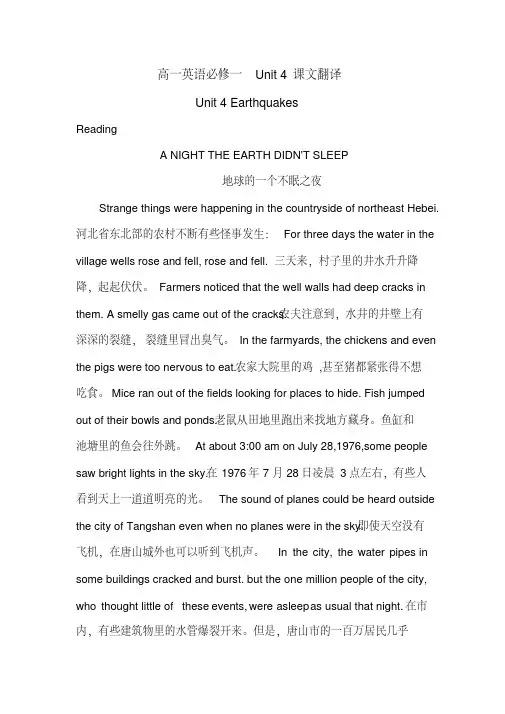
高一英语必修一Unit 4课文翻译Unit 4 EarthquakesReadingA NIGHT THE EARTH DIDN'T SLEEP地球的一个不眠之夜Strange things were happening in the countryside of northeast Hebei.河北省东北部的农村不断有些怪事发生:For three days the water in the village wells rose and fell, rose and fell.三天来,村子里的井水升升降降,起起伏伏。
Farmers noticed that the well walls had deep cracks in them. A smelly gas came out of the cracks.农夫注意到,水井的井壁上有深深的裂缝,裂缝里冒出臭气。
In the farmyards, the chickens and even the pigs were too nervous to eat.农家大院里的鸡,甚至猪都紧张得不想吃食。
Mice ran out of the fields looking for places to hide. Fish jumped out of their bowls and ponds.老鼠从田地里跑出来找地方藏身。
鱼缸和池塘里的鱼会往外跳。
At about 3:00 am on July 28,1976,some people saw bright lights in the sky.在1976年7月28日凌晨3点左右,有些人看到天上一道道明亮的光。
The sound of planes could be heard outside the city of Tangshan even when no planes were in the sky.即使天空没有飞机,在唐山城外也可以听到飞机声。
高一英语上册Unit 4 Earthquakes 课文讲解+知识点
@dig out 掘出;发现 eg: 他把狐狸从洞中掘出来了, He dug out the fox from/dug the fox out of the hole. to dig information out of books 从书本挖掘知识 to dig out truth 寻求真理
Homework:
F
)
4. Later that afternoon, a terrible earthquake
shook Tangshan again. (
T)
5. After the second earthquake, everyone
including the rescue workers and doctors were died. (
True or false:
1. Two-third of the nation felt the earthquake.
(
F
)
2. All the people in Tangshan died or were
Байду номын сангаас
injured during the earthquake. (
F
)
3. All of the city’s hospitals, factories, buildings and homes were damaged in the earthquake. (
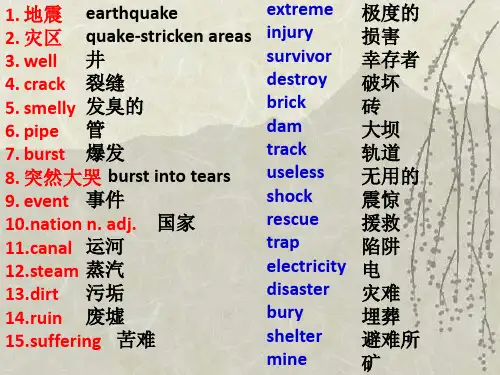
1. 地震 earthquake 2. 灾区 quake-stricken areas 3. well 井 4. crack 裂缝 5. smelly 发臭的 6. pipe 管 7. burst 爆发 8. 突然大哭 burst into tears 9. event 事件 10.nation n. adj. 国家 11.canal 运河 12.steam 蒸汽 13.dirt 污垢 14.ruin 废墟 15.suffering 苦难
英语必修一unit4 课文原文+单词+音标
Unit4A NIGHT THE EARTH DIDN'T SLEEPStrange things were happening in the countryside of northeast Hebei.For three days the water in the village wells rose and fell,rose and fell.Farmers noticed that the well walls had deep cracks in them.A smelly gas came out of the cracks.In the farmyards,the chickens and even the pigs were too nervous to eat.Mice ran out of the fields looking for places to hide. Fish jumped out of their bowls and ponds.At about3:00am on July28,1976,some people saw bright lights in the sky.The sound of planes could be heard outside the city of Tangshan even when no planes were in the sky.In the city,the water pipes in some buildings cracked and burst.But the one million people of the city,who thought little of these events,were asleep as usual that night.At3:42am everything began to shake.It seemed as if the world was at an end!Eleven kilometres directly below the city the greatest earthquake of the20th century had begun.It was felt in Beijing,which is one hundred kilometres away.One-third of the nation felt it.A huge crack that was eight kilometres long and thirty metres wide cut across houses,roads and canals. Steam burst from holes in the ground.Hard hills of rock became rivers of dirt.In fifteen terrible seconds a large city lay in ruins.The suffering of the people was extreme.Two-thirds of them died or were injured.Thousands of families were killed a nd many children were left without parents.The number of people who were killed or injured reached more than400,000. But how could the survivors believe it was natural?Everywhere they looked nearly everything was destroyed.All of thecity's hospitals,75%of its factories and buildings and90%of its homes were gone.Bricks covered the ground like red autumnleaves.No wind,however,could blow them away.Two dams fell and most of the bridges also fell or were not safe for travelling.The railway tracks were now useless pieces of steel.Tens of thousands of cows would never give milk again. Half a million pigs and millions of chickens were dead.50People were shocked.Then,later that afternoon,another big quake which was almost as strong as the first one shook Tangshan.Some of the rescue workers and doctors were trapped under the ruins.More buildings fell down.Water,food,and electricity were hard to get.People began to wonder how long the disaster would last.All hope was not lost.Soon after the quakes,the army sent150,000soldiers to Tangshan to help the rescue workers. Hundreds of thousands of people were helped.The army organized teams to dig out those who were trapped and to bury the dead.To the north of the city,most of the10,000miners were rescued from the coal mines there.Workers built shelters for survivors whose homes had been destroyed.Fresh water was taken to the city by train,truck and plane.Slowly,the city began to breathe again.单词:Book1Unit4earthquake/'ə:θkweik/n.地震quake/kweik/n.地震right away立刻;马上well/wel/n.井△crack/kræk/n.裂缝;噼啪声vt.&vi.(使)开裂;破裂△smelly/'smeli/adj.发臭的;有臭味的△farmyard/'fɑ:mjɑ:d/n.农场;农家pipe/paip/n.管;导管burst/bə:st/vi.(burst,burst)爆裂;爆发n.突然破裂;爆发million/'miljən/n.百万event/i'vent/n.事件;大事as if仿佛;好像at an end结束;终结nation/'neiʃən/n.民族;国家;国民canal/kə'næl/n.运河;水道steam/sti:m/n.蒸汽;水汽dirt/də:t/n.污垢;泥土ruin/'ru:in/n.废墟;毁灭vt.毁灭;使破产in ruins严重受损;破败不堪suffering/'sʌfəriŋ/n.苦难;痛苦extreme/ik'stri:m/adj.极度的injure/'indʒə/vt.损害;伤害△survivor/sə'vaivə/n.幸存者;生还者;残存物destroy/di'strɔi/vt.破坏;毁坏;消灭brick/brik/n.砖;砖块dam/dæm/n.水坝;堰堤track/træk/n.轨道;足迹;痕迹useless/'ju:slis/adj.无用的;无效的;无益的shock/ʃɔk/vt.&vi.(使)震惊;震动n.休克;打击;震惊rescue/'reskju:/n.&vt.援救;营救trap/træp/vt.使陷入困境n.陷阱;困境electricity/ilek'trisəti/n.电;电流;电学disaster/di'zɑ:stə/n.灾难;灾祸dig out掘出;发现bury/'beri/vt.埋葬;掩埋;隐藏mine/main/n.矿;矿山;矿井miner/main/n.矿工shelter/'ʃeltə/n.掩蔽;掩蔽处;避身处a(great)number of许多;大量的title/'taitl/n.标题;头衔;资格reporter/ri'pɔ:tə/n.记者bar/bɑ:/n.条;棒;条状物damage/'dæmidʒ/n.&vt.损失;损害frighten/'fraitən/vt.使惊吓;吓唬frightened/'fraitnd/adj.受惊的;受恐吓的frightening/'fraitəniŋ/adj.令人恐惧的congratulation/kənɡrætʃu'leiʃən/n.祝贺;(复数)贺词judge/dʒʌdʒ/n.裁判员;法官vt.断定;判断;判决sincerely/sin'siəli/adv.真诚地;真挚地express/ik'spres/vt.表示;表达n.快车;速递outline/'autlain/n.要点;大纲;轮廓headline/'hedlain/n.报刊的大字标题cyclist/'saiklist/n.骑自行车的人。
高中英语《Unit4 Earthquakes》优质课教案、教学设计
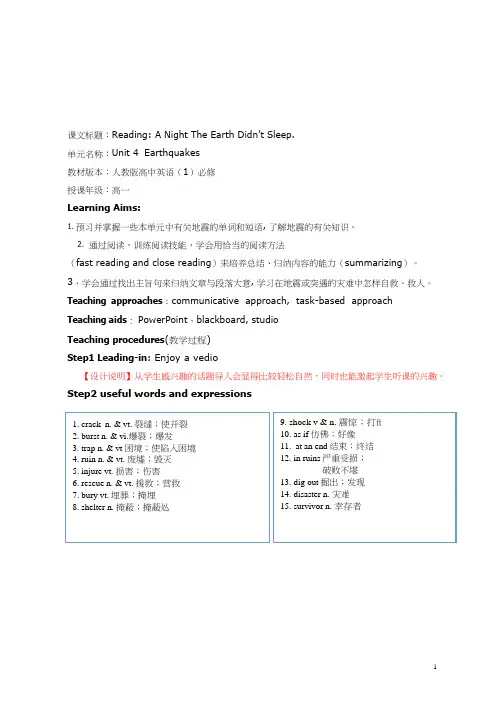
课文标题:Reading: A Night The Earth Didn’t Sleep.单元名称:Unit 4 Earthquakes教材版本:人教版高中英语(1)必修授课年级:高一Learning Aims:1.预习并掌握一些本单元中有关地震的单词和短语, 了解地震的有关知识。
2.通过阅读,训练阅读技能,学会用恰当的阅读方法(fast reading and close reading)来培养总结、归纳内容的能力(summarizing)。
3.学会通过找出主旨句来归纳文章与段落大意, 学习在地震或突遇的灾难中怎样自救、救人。
Teaching approaches:communicative approach, task-based approach Teaching aids:PowerPoint,blackboard, studioTeaching procedures(教学过程)Step1 Leading-in: Enjoy a vedio【设计说明】从学生感兴趣的话题导入会显得比较轻松自然,同时也能激起学生听课的兴趣。
Step2 useful words and expressions【设计说明】单词是基础,复习巩固生词为下一步阅读扫清障碍。
Step3 Fast-readingTry to get the structures of the passage main idea of the text .【设计说明】旨在锻炼学生快速搜索信息的能力。
跳读找出文章的主体大意及各段的主题,这样设计是为让学生了解、抓住本文的主题思想,为下一步细读做准备。
Step4 Careful readingPart 1 Before the earthquake: the signs【设计说明】文章较长,采取分段学习,课文层次清晰,学生自读与听力相结合,能帮助学生理解与提高听力水平,通过与搭档相互核对答案同时培养了学生合作学习的意识。
高一必修一Unit4 Earthquakes Reading-A Night the Earth Didn’t Sleep教学设计
分发挥 自己的潜能 ,提高 自主 学 习的能
4、一般 了解定语从句。
老 师 :学 习的组 织者 ,促进 者 。启发 思
力 ,形成有个性的学 习方法和风格。
能力 目标
路的过程 。
我 以课 程 目标 (三 维 目标 )作 为本
1、培 养分析主题 ,围绕 主题 阐述 问
2、Task-.cycle.任 务 的 完 成 过 程 。
单 元教学设计 和本课 教学 的指 导思 想和 题 的能力。
学生 :用 英语做事 ,做 中学 ,运用体验 、
教学依据 。
2、训练学生 的阅读技巧和方法 ,提 参 与、合 作、 实践交 流 ,探 究 等方式 进
一 、 教材分析发依据
高 学生的阅读能 力。
行 自主 学 习的 过程 。 发展 听、说 、 读 、
二 、教学 目标
提 高人 身素养。
语 必修一 Unit4,阅读课文 ANighttheEarm
理论依据 <新课程标准>
2、掌握课文 中重要 的词、短语和重
Didn’tSleep为例 ,从教材分析、教 法与
知识 目标
点句型 ,提 高学生的阅读 能力和技 巧。
学法 ,教学过程等几方面进行设计 。
自主学 习的主体 模式
值 观 ,增 强社会 责任感 ,全面提 高人 文 ie at an end,nati0n steam , ure,extreme,
说 明 :1、Prc-task.引 入 话 题 ,激
素养。另 外课程 的设计与 实施 有利 于 学 destroy,brick,tracks,useless,rescue, 活学生 知识 网络和 清 除词 汇障碍 ,明确
人教版英语必修一Unit-4(A-night-the-earth-didn’t-sleep)教学设计
(2)What does the last sentence“ Slowly, the city began to breathe again.” mean?
A.Th.animal.bega.t.breathe.
B.Th.cit.returne.t.norma.gradually.
.i.ruins...
of the people died or wereinjuredduring the earthquake.
The number of people who were killed or injured reached more than.
Step4: Careful-reading
Para1:What happened before the earthquake hit Tangshan?
Signsbefore the earthquake(Show some pictures on the screen and let the Ss fill in the blanks.
1)Which of the following is NOT true according to the passage?
A.Man.soldier.helpe.t.rescu.th.peopl.wh.wer.trappe.unde.th.ruins.
B.Mos.o.th.twent.thousan.miner.wer.rescue.fro.th.coa.mines.
Natural disasters:before the earthquake signs
while the earthquake damage
新人教版必修一unit4 reading and thinking 课文中英对照
THE NIGHT THE EARTH DIDN’T SLEEPStrange things were happening in the countryside of northeastern Hebei. For several days,the water in the village wells rose and fell,rose and fell. There were deep cracks that appeared in the well walls. At least one well had some smelly gas coming out of it. Chickens and even pigs were too nervous to eat,and dogs refused to go inside buildings. Mice ran out of the fields looking for places to hide,and fish jumped out of the water. At about 3:00 a.m., on 28 July 1976,bright lights were seen in the sky outside the city of Tangshan and loud noises were heard. But the city’s one million people were asleep as usual that night.At 3:42 a.m., everything began to shake. It seemed as if the world were coming to an end! Eleven kilometres directly below the city, one of the most deadly earthquakes of the 20th century had begun, a quake that even caused damage more than 150 kilometres away in Beijing. Nearly one third of the whole nation felt it! A huge crack, eight kilometres long and 30 metres wide, cut across houses, roads, and waterways. Hard hills of rock became rivers of dirt. In less than one minute, a large city lay in ruins. Two thirds of the people who lived there were dead or injured. Thousands of children were left without parents. The number of people who were killed or badly injured in the quake was more than 400,000.Everywhere survivors looked,there was nothing but ruins. Nearly everything in the city was destroyed. About 75 percent of the city’s factories and buildings,90 percent of its homes,and all of its hospitals were gone. Bricks covered the ground like red autumn leaves,but no wind could blow them away. Most bridges had fallen or were not safe to cross. The railway tracks were now useless pieces of metal. Tens of thousands of cows,hundreds of thousands of pigs,and millions of chickens were dead. Sand now filled the wells instead of water. People were in shock—and then,later that afternoon,another big quake shook Tangshan again. Even more buildings fell down. Water,food,and electricity were hard to get. People began to wonder how long the disaster would last.But hope was not lost. Soon after the quakes,the army sent 150,000 soldiers to Tangshan to dig out those who were trapped and to bury the dead. More than 10,000 doctors and nurses came to provide medical care. Workers built shelters for survivors whose homes had been destroyed. Hundreds of thousands of people were helped. Water and food were brought into the city by train,truck,and plane. Slowly,the city began to breathe again.Tangshan started to revive itself and get back up on its feet. With strong support from the government and the tireless efforts of the city’s people,a new Tangshan was built upon the earthquake ruins. The new city has become a home to more than seven million people,with greatimprovements in transportation,industry,and environment. Tangshan city has proved to China and the rest of the world that in times of disaster,people must unify and show the wisdom to stay positive and rebuild for a brighter future.地球的一个不眠之夜河北省东北部的农村地区怪事连连:一连几天,村子里的井水升升降降,起起伏伏,井壁上出现了深深的裂缝。
Unit4 A night the earth didn't sleep教案 2021-2022学年
Unit4 A night the earth didn't sleep教案 2021-2022学年高中英语人教新课标必修一教材分析:《A night the earth didn't sleep》是必修一Unit 4中的一篇短文,文章主要讲述印度尼西亚瓜达卢佩的火山爆发,引起了大规模的灾难,人们在灾难中互相帮助,展现出了人类的团结一心。
教学重点是阅读理解,同时还涉及到地理知识、环保理念等。
教学目标:1.能够正确理解文章的主旨大意,并能根据文章内容回答相关问题。
2.能够了解火山爆发引起的各种灾害,增强环保意识。
3.能够通过分组合作,收集研究其他有关火山及自然灾害的资料,并能够用英语展示。
教学重难点:1.文章的阅读理解。
2.火山的形成和各种灾害的产生。
教学方法:阅读、讲解、讨论和展示。
教学过程:Step 1. Warm-up教师用图片展示一些著名的火山并让学生根据图片进行描述。
T: Look at the pictures, what do you know about these mountains?S: They are volcanoes.T: Which one is the most famous one?S: Mount Fuji/ Mount Everest/ Mount Rainier, etc.T: Good job. What do you think are the dangers associated with volcanoes?S: Lava, ash, pyroclastic flows, toxic gases, etc.T: Great, you guys are knowledgeable about volcanoes. However, do you know what to do when facing a volcanic eruption?(Present some tips about volcanic eruption and discuss with students)Step 2. Pre-readingLead-in the article and introduce some basic information about the article.T: We all know that volcanic eruption can bring about a lot of harm to humans and the environment. In today’s lesson, we will read an article about a volcanic eruptionin Indonesia in 1815, which was considered the most destructive one in modern history. Now, let’s watch a video to tune in.(Teachers play a video or show some pictures about volcanic eruption)T: After watching the video/pictures, have you ever been caught up in such scenes? Can you imagine how people survive in such a disaster? Let’s read the text to find out.Step 3. While-readingTask 1: Scan and answer the questionsT: Before reading, let’s have a quick look at the questions.1. Why did people in England feel a strange phenomenon in the sky?2.What caused the famine in Europe and North America in 1816?3.How did people in Java react when the volcano erupted?4.What impact did the eruption have on the environment?5.How did the eruption bring benefit to the local economy?T: Read the text and find the answer to each question.Task 2: Explain key sentencesT: Read the following sentences, and discuss what they mean.1.The eruption was so huge that the world was plunged into darkness.2.Thousands of people died instantly or later becauseof the ash and pumice floating in the air.3.Jave became the site of one of the greatest disasters in recorded history.4.It is believed that the effect of the eruption wasfelt as far afield as Europe and North America.5.But from the darkness and the grayness came a revelation.Task 3: DiscussionT: After reading, let’s think about the following questions and discuss them in groups.1.How would you compare the power of nature to human beings? What do you think we can learn from natural disasters?2.What measures should be taken to prevent natural disasters?3.How can we help people who are affected by natural disasters?Step 4. Post-readingTask 1: Research workT: To have a deeper understanding of volcanoes, please work in groups and do some research on volcanoes, including their formation, distribution, types, the dangers they bring, and the measures that could be taken to minimize the damage.Task 2: PresentationT: After finishing the research, please prepare a report and present it in class using English.Task 3: WritingT: Write a composition about the measures you propose to mitigate the negative effects caused by natural disasters.Step 5. Summary and HomeworkT: Today, we have learned a lot about natural disasters through reading this article. Do you think we should take some actions to protect our environment and prevent natural disasters? What kind of actions can we take? Please think and make some notes as your homework.Homework:1. Review the reading passage.2. Finish the composition about the measures you propose to mitigate the negative effects caused by natural disasters.。