
双咪唑的新法合成
双咪唑的新法合成3蒋宗林 鄢家明 刘长路 苏晓渝 谢如刚33(化学系)摘要 报道了合成双咪唑的一种新方法.12(22氰乙基)咪唑1与α,ω2二卤化合物2反应生成双咪唑钅翁盐3,3在碱的作用下发生选择性Hofmann 型消去反应以90.0%~94.6%的高产率制得一系列双咪唑4.关键词 双咪唑,季铵化反应,消去反应,合成方法学中图法分类号 O626.23咪唑具有特异的质子授2受性能、共轭酸碱性能及选择络合性能,作为许多天然酶的活性中心功能基,参与一系列重要生物化学反应[1].咪唑、双咪唑及其衍生物是许多药物、农药、酶抑制剂、“蛋白质类似物”(protein analogs )及精细化学品的有效结构组分[2~4].近年来,已选用咪唑、双咪唑成功地构筑了多种酶模型化合物和仿生功能体系[5~11].因此,探索和发展咪唑、双咪唑及其衍生物的简便有效的合成方法,进一步开拓它们在化学、生命、材料等高新科技领域的应用,很有必要,意义重大.文献报道了双咪唑的一些合成方法[12~16].新近,Horvath 报道了通过32位取代咪唑钅翁盐的消去反应生成咪唑12位取代衍生物的方法[17].我们改进这一方法,曾成功地制备了在文献极少报道的一类12(ω2卤烷基)咪唑化合物[18].现进一步改进和拓展文[17,18]的方法[17,18],将12(22氰乙基)咪唑1与过量α,ω2二卤化合物2反应生成相应的双咪唑钅翁盐3,3不经分离纯化继与NaOH 水溶液发生选择性Hofmann 型消去反应,以90.0%~94.6%的高产率合成了一系列双咪唑化合物4.目标物的结构已由1HNMR ,MS 和元素分析所证实.其反应式如为本文于1998年3月3日收到3国家自然科学基金(No.29402012,29632004)和教委博士点基金资助课题33通讯联系人1998年8月第35卷第4期四川大学学报(自然科学版)Journal of Sichuan University (Natural Science Edition )Aug.1998Vol.35No.41 实验部分1.1 仪器红外光谱:F T 2IR ITOSX 型红外光谱仪,液膜或溴化钾压片.核磁共振谱:J EOL FX90Q 型核磁共振仪,CDCl 3为溶剂,TMS 为内标.质谱:Finnigan MA T4510型质谱仪.元素分析:Carlo Erba 1106型元素分析仪.熔点:XRC 2I 型显微熔点测定仪.温度计未经校正.1.2 试剂二苄溴、2,62双(溴甲基)吡啶、二甘醇二氯化合物和三甘醇二氯化合物:按一般文献方法制备.12(22氰乙基)咪唑:按文献方法制备[19].1.3 合成制备双咪唑钅翁盐的一般方法 将12(22氰乙基)咪唑1(60~500mmol )与计算量的α,ω2二卤化合物2(30~250mmol )加入20~80mL 乙腈或硝基甲烷中,加热回流搅拌反应8~30h ,薄层色谱(硅胶板,展开剂:CHCl 32MeOH ,9∶1)监测反应至终点.冷却,滤出固体物,用预冷的少量丙酮洗涤得双咪唑钅翁盐3,薄层色谱(硅胶板,展开剂:MeOH 2N H 3・H 2O 2N H 4HCO 3・H 2O ,9∶1∶1)检查为单点,不需纯化直接用于后续反应.制备双咪唑的一般方法 将双咪唑钅翁盐3(40mmol )和NaOH (2g ,50mmol )溶于20mL 水的溶液在室温下搅拌反应10~60min ,薄层色谱(硅胶板,展开剂:MeOH 2N H 3・H 2O 2N H 4HCO 3・H 2O ,5∶3∶1)监测反应至终点.反应混合物用10%盐酸调p H 值至7~8,CHCl 3(4×80mL )提取,合并有机相,水洗至近中性,无水MgSO 4干燥,蒸出溶剂得粗品,进一步用重结晶或硅胶柱层析得纯品.4a :油状物,产率:92.4%.IR (cm -1):1640,1610(Im.ring ),1108(C -O ),739,662(Im ,ring ).δH (ppm ):3.63(4H ,t ),4.06(4H ,t )6.87~7.02(4H ,d ),7.44(2H ,s ).m /z (%):206(M +,100),139(M +2Im ,50).元素分析:C 10H 14N 4O 计算值:C ,58.24;H ,6.84;N ,27.16;测定值:C ,58.52;H ,7.27;N ,26.51.4b :油状物,产率:90.0%.IR (cm -1):1656(Im.ring ),1108(C -O ),740,662(Im ,ring ).δH (ppm ):3.67(8H ,t ),4.08(4H ,t )6.97~7.02(4H ,d ),7.53(2H ,s ).m /z (%):250(M +,100),155(M +2ImCH 2CH 2,30).元素分析:C 12H 8N 4O 2计算值:C ,57.58;H ,7.25;N ,22.38;测定值:C ,57.10;H ,7.34;N ,22.01.4c :产率:94.1%.m.p.:85~86℃(文献值[12]83~84℃).m/z (%):191(M ++1,90).4d :产率:92.1%.m.p.:84~85℃(文献值[12]84~85℃).m /z (%):238(M +,80).4e :产率:94.6%.m.p.:134~134.5℃(文献值[12]132~134℃).m /z (%):238(M +,90).4f :产率:90.4%.m.p.:98~99℃(文献值[12]99~100℃).m /z (%):239(M +,100).2 结果与讨论 文[17]采用单卤化合物与12(22氰乙基)咪唑进行季铵化反应.我们试用计算量的α,ω2二卤化合物与两分子12(22氰乙基)咪唑进行双季铵化反应发现,在乙腈或硝基甲烷中该反应能顺利进行,定量生成相应的双咪唑钅翁盐.结果表明,二卤化合物活性不同,反应时间差异较大,高活性的二苄溴或2,62二(溴甲基)吡啶仅需数小时;活性较低的二(三)甘醇二氯化合物则需数日,加入碘化钠后,反应可在20~30h 完成.716第4期 蒋宗林等:双咪唑的新法合成816四川大学学报(自然科学版) 第35卷双咪唑钅翁盐吸湿性强,易溶于水,难溶于乙腈或硝基甲烷等有机溶剂.影响双咪唑钅翁盐的Hofmann型消去反应的主要因素是碱的品种和浓度.使用Na2CO3水溶液或低浓度(小于5%)的NaOH水溶液,消去反应均难于发生和完成,使用10%~20% NaOH或KOH水溶液有利于反应的进行,1小时内反应即可完成.本法特点.“一锅合成”操作简便;条件温和,不要求无氧无水条件;产率高;结构、活性不同的二卤化合物多可适用.参 考 文 献1 Oberhaven K J,Riehardson J P,Bvehanan R M,et al.Inorg.Chem,1990,30:13572 Wong W C,G luchowski C.Synthesis,1995,1393 Al2Said N H,Lown J W.Tetrahedron,1994,35:75774 Mallik S,Johnson R D,Arnold F H.J.Am.Chem.S oc,1994,116:89025 Lu Q,Luo Q H,Dai A B,et al.J.Chem.S mun,1990,1:4296 Luo Q H,Zheng L M,Lu Q,et al.Science in China,1993,36(B):1707 Luo M M,Guo S J,Zhou C H,et al.Heterocycles,1995,41:14218 Zhou C H,Xie R G,Zhao H .Prep.Proced.Int,1996,28:3459 鄢家明,谢如刚,赵华明.化学学报,1996,54:30410 Y an J M,Jiang Z L,Liu W Q,et al.Chin.Chem.Lett,1997,8:39311 Y an J M,Xie G R,Zhao H M.Chin.J.Chem,1997,15:43812 Zhou C H,Guo S J,Xie R G,et al.Chin.Chem.Lett,1996,7:32113 Dhal P K,Arnold F H.Macromolecules,1992,25:705114 Y asumoto M,Shimanone K.Jpn.K okai Tokkyo K oho J.P,1992,82(4):87915 Y an J M,Xie R G,Zhao H mun,1994,24:4716 蒋宗林,鄢家明,谢如刚.合成化学,1998,6(1):11~1817 Horvath A.Synthesis,1994,10218 Y an J M,Jiang Z L,Zhang L,et al.Chin.Chem.Lett,in press19 Y amauchi M,Masui M.Chem.Pharm.Bull,1976,24:1480A NEW SY NTHESIS OF BIS2IMIDAZOL ESJiang Zongli n Yan Jiami ng L i u Changl u S u Xiaoyu Xie R ugang3(Department of Chemistry)Abstract A convenient and efficient preparation of bis2imidazoles4has been developed.The procedures are described involving a selective Hofmann2type elimination of the22cyanoethyl groups from the bis2imidazolium salts3obtained by the reaction ofα,ω2dihalides2with1H2imida2 zole212propanenitrile1.K ey w ords bis2imidazole,quaternization,elimination,synthetic methodology。
二甲基苯并咪唑的合成实验工艺流程

二甲基苯并咪唑的合成实验工艺流程下载温馨提示:该文档是我店铺精心编制而成,希望大家下载以后,能够帮助大家解决实际的问题。
文档下载后可定制随意修改,请根据实际需要进行相应的调整和使用,谢谢!并且,本店铺为大家提供各种各样类型的实用资料,如教育随笔、日记赏析、句子摘抄、古诗大全、经典美文、话题作文、工作总结、词语解析、文案摘录、其他资料等等,如想了解不同资料格式和写法,敬请关注!Download tips: This document is carefully compiled by theeditor. I hope that after you download them,they can help yousolve practical problems. The document can be customized andmodified after downloading,please adjust and use it according toactual needs, thank you!In addition, our shop provides you with various types ofpractical materials,such as educational essays, diaryappreciation,sentence excerpts,ancient poems,classic articles,topic composition,work summary,word parsing,copy excerpts,other materials and so on,want to know different data formats andwriting methods,please pay attention!一、实验目的。
本实验旨在合成二甲基苯并咪唑,并对其进行表征和分析。
唑来膦酸的合成新工艺研究

文献标识码 : A
唑来膦 酸 ( 是 由瑞 士 N ral 公 司开 发的异环 型第三代 双 1) ovrs i 膦酸类药物 , 2 0 于 0 0年 1 O月首次在加拿 大上市 , 品名 Z m t规 商 o ea ,
至恒重 , 白色 2固体 10克。收率 2 . iP16 18C注释③ 得 9 6 %。n . — 9qr 5 .9
I l
7 /一 … … 一
7 / 一 一。
I
HO —— P — O H —
I }
O
图 1唑来膦 酸的合成路线
Fg Th y te i r ue o oe r nc a i i1 e s n h ss o t f Z ld o i cd
过滤 , 滤液冷 至室温 , 压过滤 , 液减压浓 缩 , 无色油状 物 , 减 滤 得 加
本品通过抑制破骨 细胞 的异 常活性 ,使 高钙血症 时严重升 高的血
钙浓度 正常化。具有用量小 、 疗效强 、 耐受性 良好等优点。
文献[】 2报道 , 关键 中间体 2 (一咪唑基) 一1 乙酸盐酸盐 ( 的制备 2)
—
—
一
塑
口 韩 春 亮 吴 爱 华 回 1
匦
唑来膦 酸 的合成新 工艺研 究
(】 [ 河南教育学院化 学系 河南・ 州 40 1; 1 郑 504 [ 平顶山市第四十四中学 河南・ 2 ] 平顶山 47 0 ) 60 0
摘 要
关键词
以咪唑 为起 始原料 , 和咪唑基) -i 乙酸盐酸盐()2g_ 2, -  ̄亚磷酸、 - 三氯
1 3 1 5C , 9 — 9 ) o 纯度 9 . H L 9 %( P C法 ) O 。
(4"R,5"R)-1,1′-双(2″-4″,5″-二氢-4",5″-二苯基-1″-H-咪唑基)二茂铁的合成新方法
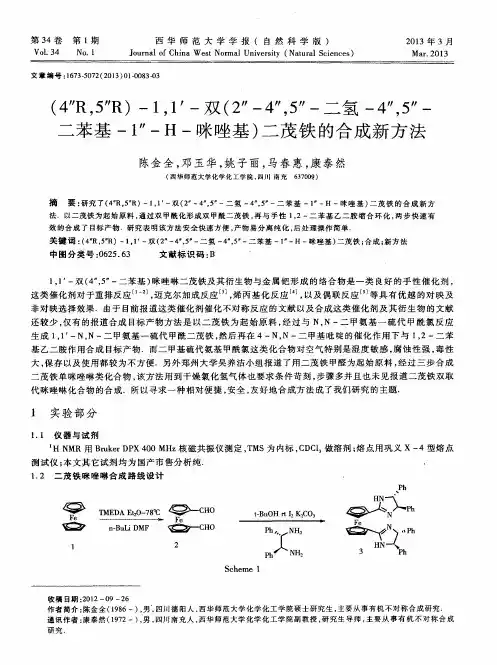
H N MR用 B r u k e r D P X 4 0 0 MH z 核 磁共 振仪 测定 , T MS为 内标 , C D C l , 做 溶剂 ; 熔 点用巩 义 x一 4型熔 点
测试 仪 ; 本 文其 它试 剂 均为 国产 市 售分 析纯 .
第3 4卷 第 1期
Vo 1 . 3 4
No .1
西 华 师 范 大 学 学 报 (自 然 科 学 版 )
J o u r n a l o f Ch i n a We s t N o r ma l Un i v e r s i t y( Na t u r a l S c i e n c e s )
关键 词 : ( 4 R , 5 R ) 一 1 , 1 一 双( 2 一 4 , 5 一 二氢 一 4 , 5 一 二 苯基 一 1 一 H一 咪唑基 ) 二茂铁 ; 合成 ; 新 方法
中图 分类号 : 0 6 2 5 . 6 3
文献 标 识码 : B
研究 .
西华师 范大 学学 报 ( 自然科 学版 )
1 . 2 . 1 化 合 物 2的 合 成
2 0 1 3焦
氮气 保护 下 , 在干燥 5 0 mL双 颈瓶 中依 次加 入磁 力搅 拌子 , 二茂 铁 ( 1 . 0 g , 2 6 m mo ] ) , 置 于 冰浴 中冷 却 , 加 入干燥 乙醚 ( 1 5 m L ) 使 其充 分溶解 , 再加 入 1 . 6 M 溶 于正 己烷 中 的正 丁基 锂 ( 7 . 5 mL ,1 1 . 2 m mo 1 ) 和 N, N, N’ , N’一四 甲基 乙二胺 ( T M E D A) ( 1 . 7 mL ) , 缓 慢升 至室温 搅拌 约 1 4小 时 , 将 反应 冷却 至 一 7 8  ̄ ( 2 , 缓 慢滴
硝基咪唑合成实验报告(3篇)

第1篇一、实验目的1. 学习硝基咪唑的合成方法。
2. 掌握硝化反应的实验操作。
3. 了解硝基咪唑的物理化学性质。
二、实验原理硝基咪唑是一种重要的有机化合物,具有广泛的用途。
本实验采用硝化反应合成硝基咪唑,反应原理如下:咪唑 + 硝酸→ 硝基咪唑 + 水及副产物三、实验仪器与试剂1. 仪器:圆底烧瓶、冷凝管、滴液漏斗、搅拌器、恒温水浴锅、干燥器、分析天平、试管、移液管、烧杯等。
2. 试剂:咪唑、浓硝酸、浓硫酸、蒸馏水、乙醇、无水硫酸钠、碘化钾、醋酸、氢氧化钠等。
四、实验步骤1. 准备反应物:称取一定量的咪唑,加入圆底烧瓶中。
2. 配制硝化剂:将浓硝酸与浓硫酸按一定比例混合,配制成硝化剂。
3. 滴加硝化剂:将配制好的硝化剂缓慢滴加到咪唑溶液中,边滴加边搅拌,控制温度在40-50℃。
4. 反应完成后,将反应混合物倒入冰水中冷却,析出沉淀。
5. 过滤、洗涤:将沉淀过滤,用蒸馏水洗涤数次,得到硝基咪唑粗品。
6. 结晶:将硝基咪唑粗品溶于适量乙醇中,加入适量的无水硫酸钠作为干燥剂,搅拌后静置过夜,析出晶体。
7. 收集、干燥:将晶体过滤,用滤纸吸干表面水分,放入干燥器中干燥至恒重。
五、实验结果与分析1. 硝基咪唑的物理性质:无色晶体,熔点为122-124℃,易溶于乙醇、丙酮等有机溶剂。
2. 硝基咪唑的化学性质:硝基咪唑具有硝基咪唑的特征吸收峰,通过红外光谱分析可知其结构。
3. 实验收率:本实验硝基咪唑的收率为80%。
六、实验讨论1. 反应温度对硝化反应的影响:实验中控制反应温度在40-50℃,温度过高会导致副反应增加,温度过低则反应速度慢。
2. 硝化剂配比对硝化反应的影响:实验中采用浓硝酸与浓硫酸按一定比例混合,该比例有利于硝化反应的进行。
3. 搅拌对硝化反应的影响:搅拌有利于硝化反应的进行,防止反应混合物局部过热。
4. 洗涤对硝基咪唑纯度的影响:洗涤可以去除硝基咪唑中的杂质,提高其纯度。
七、实验结论本实验采用硝化反应合成硝基咪唑,实验操作简便,收率较高。
咪唑的合成(共2篇)

咪唑的合成(共2篇)以下是网友分享的关于咪唑的合成的资料2篇,希望对您有所帮助,就爱阅读感谢您的支持。
苯并咪唑的合成篇一Weinreb amide as an efficientreagent in the one pot synthesis of benzimidazoles and benzothiazoles Yadaganahalli K. Bommegowda a , Gejjalagere S. Lingaraju a , Saji Thamas b , Koravangala S. Vinay Kumar a , Challanayakanahally S. Pradeepa Kumara a , Kanchugarakoppal S. Rangappa a , ⇑, Marilinganadoddi P. Sadashiva a , ⇑a bDepartment of Studies in Chemistry, University of Mysore, Manasagangotri, Mysore 570006, India Jubilant Life Sciences Ltd., C-26, Sector 59, Noida 201301, Indiaa r t i c l e i n f o ab s t r ac tOne pot synthesis of 2-substituted benzimidazoles/benzothiazolesthrough condensation is followed by cyclization of Weinreb amide with o -diaminoarene or o -aminothiophenol is reported. In the presence of boron trifluorideetherate in 1,4-dioxane solvent, a high yield (75–94%)was achieved within 60min. Weinreb amide shows high selectivity in the reaction, even in presence of other active functional groups such as carboxyl, halogen, cyano, and methoxy.Article history:Received 31December 2012Revised 9March 2013Accepted 13March 2013Available online 23March 2013Keywords:Weinreb amide Benzimidazoles BenzothiazolesBoron trifluorideetherate o -Diaminoarene o -AminothiophenolÓ2013Elsevier Ltd. All rights reserved.2-Substituted benzimidazoles and benzothiazoles have gained importance in medicinal chemistry. They have been in use as anti-inflammatory,1a antimicrobial, 1b anti-ulcer, 1c antihelmentic, 1c antihypertensive, 1d anti-analgesic, 1eantivirus, 1f and anticancer agents. 1g The general method of synthesis of 2-substituted benzim-idazoles involves the reaction between o -diaminoarene and a car-boxylic acid or an acid chloride or nitrile or imadates or ortho esters. The condensation of arenealdehyde with 1,2-diaminoben-zene to form a Schiff base which undergoes intramolecular cycliza-tion generating a dihydrobenzimidazole which undergoes dehydrogenation by 1,4-benzoquinone. 2Alternative oxidants that can be used are 2,3-dichloro-5,6-dicyanobenzoquinone (DDQ),3manganese dioxide, 4lead tetraacetate {Pb(OAC)4},5potassium-monopersulfate (oxone),6and sodium bisulfate. 7Synthesis ofCorresponding authors. T el.:+918212419661; fax:+918212500846.E-mail addresses:************************.in, ********************(K.S.Rangappa),*********************(M.P.Sadashiva).0040-4039/$-see front matter Ó2013Elsevier Ltd. All rights reserved. ing all these problems.N -Methoxy-N -methylamide is popularly known as Weinreb amide, which Nahm and Weinreb firstemployed inthe synthesis of ketones from organometallics and also used as acylating agent to synthesize ester enolate. 22Nowadays, the versatility of this re-agent has been increased in organic synthesis for instance, in the preparation of aldehydes, 23a ketones by classical Wittig reaction, 23b Grignard reactions, 24a,b organolithium additions, 24c–elithium aluminum hydride reductions, 24f acylation of oxazole, 25pyrazoles, 26nitriles, 27pyrrole carbaldehyde and pyrrolidinones, 28trifluoromethylketones, 29etc. The four main reasons for its in-creased use by chemists as a reagent in organic synthesis are the stability of Weinreb amide functionality, ease of preparation, the scalability of reaction and predictability. As part of our research on Weinreb amide application, we tried one pot syntheses of 2-substituted benzimidazoles and benzothiazoles.Weinreb amides were synthesized from the carboxylic acid by coupling with N , O -dimethyl-hydroxyl amine. 30Optimization of the reaction conditions and parameters were stabilized for the syn-thesis of 2-phenyl-1H -benzimidazole (3a ) by cyclization of N -methoxy-N -methylbenzamide (1a ) with o -diamino benzene (2a ) using various Lewis acids in 1,4-dioxane solvent (T able 1).The reaction was carried out initially between 1a and 2a in the presence of zinc chloride as Lewis acid in 1,4-dioxane at room tem-perature, but product 3a was not obtained even after a prolonged time of 24h (T able 1, entry 1). When the reaction was continued at 100°C no improvement in yield was observed (T able 1, entry 2). Further, the reaction was done with various Lewis acids such as AlCl 3, FeCl 3, SnCl 4, BF 3ÁOEt 2, Sc(OTf)3, InCl 3and PTSA to enhance the product yield (T able 1, entries 3–9).Among these reagents, only BF 3ÁOEt 2gave the highest product yield of 88%(T able 1, entry 6).The solvent and temperature factors on the cyclization reaction between 1a and 2a in the presence of boron trifluorideetherate were optimized (T able 2). Although most of the solvents promoted the reaction, 1,4-dioxane and toluene were found suitable media at 100°C conditions (T able 2, entries 1and 4).Finally, the optimized reaction conditions were used to study the generality of the protocol and scope of this cyclization reaction. We have studied the reactivity of various alkyl, alkenyl, aryl, and hetero aryl Weinreb amides and the selectivity of Weinreb amideT able 2The reactivity of boron trifluorideetherate in various solvents and at temperatures during the synthesis of 2-phenyl-1H -benzimidazole 3a from N -methoxy-N -methylb-enzamide 1a with o -diaminoarene 2a Entry Equivalent Solvent T emperature (°C) Time (min)Yield a (%)011.01,4-Dioxane 1006089021.0EDC 906040031.0DMF 1006045041.0T oluene 1006082051.0Benzene 906076061.0THF 706032071.0CH 3CN906025aIsolated yields.T able 3Synthesis of 2-substituted bezimidazoles 3a –l from Weinreb amides 1a –j Entry R1R 13Yield a (%)01Phenyl1a H 3a 90024-Carboxyphenyl 1b H 3b 81032-Carboxyethyl 1c H 3c 78044-Pyridyl1d H 3d 75052-(4-Pyridyl)ethyl1e H 3e 7806Allyl 1f H 3f 8007Me1g H 3g 90084-Bromophenyl 1h H 3h 8909Phenyl 1a CH 33i 8710Me1g Br 3j 84113-Pyridyl1i H 3k 7712Cyclohexylmethyl1jH3l86aIsolated yields.was examined in the presence of active carboxyl, halogens, cyano, and methoxy groups.Weinreb amide showed high reactivity and selectively partici-pated in the cyclization reaction to obtain a very good yield within a short time (T able 3, entries 2and 3)(Scheme 1).The optimized reaction conditions were further used to synthe-size 2-alkyl/aryl/heteroarylbenzothiazoles from Weinreb amides by replacing o -diminoarene with o-aminothiophenol (Scheme 2). 31The reaction afforded 2-substituted benzothiazole with good yield (T able 4, entries 1–9).Further, the reaction was carried out with o -aminophenol with the expectation to generate 2-arylbenzoxazole, but the yield obtained was very low ($15%)(Scheme 3). This may be due to lower nucleophilicity of oxygen than of nitrogen and sulfur.In conclusion, Weinreb amide has proved to be an effective re-agent to synthesize 2-substituted benzimidazoles and benzothiaz-oles in the presence of boron trifluorideetherate in 1,4-dioxane solvent at 100°C. The optimized procedure is a one pot synthesis and shows high selectivity, because the amide function alone par-ticipates in the cyclization reaction even in the presence of active functional groups like carboxyl, halogens, cyano, and methoxy on the carbon skeleton of the Weinreb amide. This method may suc-cessfully replace the earlier methods for the preparation of 2-substituted benzimidazoles and benzothiazoles which are cur-rently prepared with non-commercial and unstable or sensitive aldehydes and acid chlorides.Y. K. Bommegowda et al. /T etrahedron Letters 54(2013)2693–26952695T able 4Synthesis of 2-substituted benzothiazoles 4a –i from Weinreb amides 1a , b , d , f , j –n Entry R14Yield a (%)01Phenyl1a 4a 94024-Carboxyphenyl 1b 4b 76033-Cyano phenyl 1k 4c 81044-Pyridyl1d 4d 75054-Fluoro-3-methoxyphenyl 1l 4e 89064-Ethylphenyl1m 4f 9207Benzo[1,3]dioxolyl1n 4g 9408Allyl1f 4h 88092-Carboxyethyl1j4i89aIsolated yields.AcknowledgementsThe authors thank UGC, Govt. of India for the financialsupports to M.P.S under the projects vide F. No. 37-456/2009[SR]dated:12-01-2010andUOM/IOE/RESEARCH/1/2010-11dated:22-04-2010. Supplementary dataSupplementary data (Supplementarydata 1H NMR and 13C NMR of the synthesized compounds described in Schemes 1and 2are associated with this article are available, in the on-line version) associated with this article can be found, in the online version, at pletion of the reaction as indicated by TLC, the mixture was quenched with saturated ammonium chloride solution (40mL) and extracted with ethyl acetate (3Â25mL). The combined organic layers were washed with water (2Â25mL), brine solution (2Â25mL), dried over anhydrous sodium sulfate, filtered,and concentrated in vacuum. The resulting residue was purifiedby column chromatography on silica gel (Merck,60–120mesh, appropriate ethyl acetate and hexane mixture, 1:1or 3:7)to afford the pure product.咪唑类离子液体的合成篇二咪唑类离子液体的合成(可以在查找有关咪唑类离子液体的合成作为文献综述的一部分)咪唑环是具有芳香性的五元含氮杂环,氮原子经烷基化反应后将烷基链引入咪唑环,使咪唑环成为带正电荷的阳离子。