
外研版英语八年级上册Module11 Unit2
新外研版八年级上册英语重点短语和句子汇总

1/6
3. _____________________ 记住去参观
4. 在……的东部 14. _____________________ 为……加油 新外研版八年级上册英
语重点短语和句子汇总
Module1HowtolearnEnglish
1. ____________________ 尽可能多
2. ____________________ 犯错误
3. 跟……交谈
4. 在课堂上
5. _________________ 练习说
6.请求
7. _________________ 看电影
8. _________________ 说英语
9. 在……旁边
10. _______________________ 听英文歌曲
11.写下
12. 建议某人去做某事
13. .......... 和■样
14. 害怕去做某事
15.查找
16.对她微笑
17.一天4或5个单词
18.尽量做某事
Module2Myhometown andmycountry
1.在海岸边
2. 深圳的人口是多少?
6. 在……的西部
7. 在……的北部
8. 许多别的城市
9. 比如
10.一年当中的任何时候
11.坐船
12在20世纪80年代
13. 受……欢迎
14. 事实上
15. 以……而闻名
16. 来自
Module3Sports
1. 看足球比赛
2. 在电视上
3. 一分钟之前
4. 你怎么啦?
5. 打网球
6. 我不确定
7. 待在家里
8. 大量时间
9. ___________________ 去上课 2/6
10.踢足球
11.迟到
12.真可惜!
13. 有一个更好赢的好机会
16.以便
Module4Planes,shipsand
trains
1. ___________________ 坐公交车
2交通繁忙
3. ___________________ 骑自行车
4. _________________ 坐地铁
外研版八年级英语上册单词表
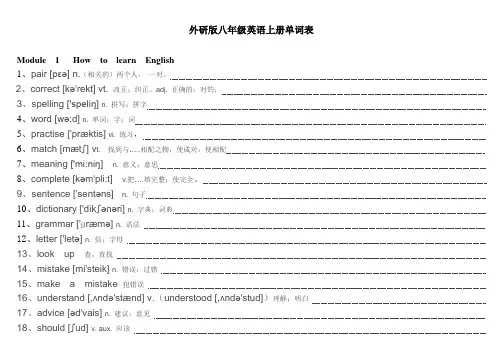
外研版八年级英语上册单词表
Module 1 How to learn English
1、pair [pεə] n.(相关的)两个人, 一对。
2、correct [kə'rekt] vt. 改正;纠正。adj. 正确的;对的;
3、spelling ['speliŋ] n. 拼写;拼字
4、word [wə:d] n. 单词;字;词
5、practise ['præktis] vi. 练习,
6、match [mætʃ] vt. 找到与…..相配之物,使成对;使相配
7、meaning ['mi:niŋ] n. 意义;意思
外研版八年级上册英语课文翻译
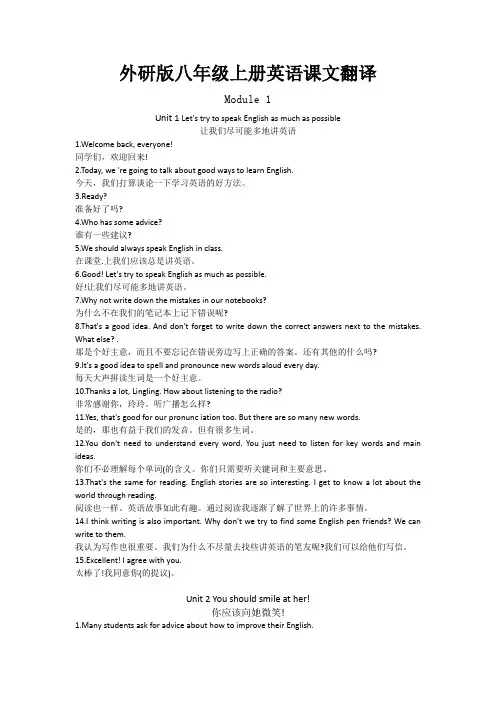
外研版八年级上册英语课文翻译
Module 1
Unit 1 Let's try to speak English as much as possible
让我们尽可能多地讲英语
1.Welcome back, everyone!
同学们,欢迎回来!
2.Today, we 're going to talk about good ways to learn English.
今天,我们打算谈论一下学习英语的好方法。
3.Ready?
准备好了吗?
4.Who has some advice?
谁有一些建议?
5.We should always speak English in class.
在课堂.上我们应该总是讲英语。
6.Good! Let's try to speak English as much as possible.
好!让我们尽可能多地讲英语。
7.Why not write down the mistakes in our notebooks?
为什么不在我们的笔记本上记下错误呢?
8.That's a good idea. And don't forget to write down the correct answers next to the mistakes.
What else? .
那是个好主意,而且不要忘记在错误旁边写上正确的答案。还有其他的什么吗?
9.It's a good idea to spell and pronounce new words aloud every day.
每天大声拼读生词是一个好主意。
10.Thanks a lot, Lingling. How about listening to the radio?
非常感谢你,玲玲。听广播怎么样?
11.Yes, that's good for our pronunc iation too. But there are so many new words.
外研版八年级上册英语 小册子背记手册及答案

第1页 共56页 Module 1 How to learn English
Unit 1 Let's try to speak English as much as possible.
核心单词
1. __pair__n. 一对,(相关的)两个人 2. __correct__v. 改正;纠正adj. 正确的;对的
3. __practise__v. 练习
4. __match__v. 找到与……相配之物,使相配;使成对
5. __complete__v. 把……填完整;使完全 6. __grammar____n. 语法
7. __understand__v. 理解 8. __mistake__n. 错误;过错
9. __advice__n. 建议 10. __notebook__n. 笔记本
11. __forget__v. 忘;忘记 12. __aloud__adv. 大声地
13. __radio__n. 电台;广播 14. __main__adj. 主要的
15. __excellent__adj. 优秀的;极好的
单词变形
1. spell→__spelling__(名词) 2.
possible→__possibly__(副词)
3. pronounce→__pronunciation__(名词) 4.
agree→__agreement__(名词)
5. meaning→__mean__(动词) 6.
dictionary→__dictionaries__(复数)
核心短语
第2页 共56页 1. __in__pairs__成对地,成双地 2.
__practise__doing__sth.
__练习做某事
3. __look__up__查;查找 4. __welcome____back__欢迎回来
5. __as__much__as__possible__尽可能多地 6.
外研版八年级上册英语课文电子版(全册)

Module 1 How to learn English
Unit 1 Let’s try to speak English as much as possible.
Ms James: Welcome back, everyone! Today, we’re going to talk about good ways to learn English. Ready Who has some advice
Lingling: We should always speak English in class.
Ms James: Good! Let’s try to speak English as much as possible.
Daming: Why not write down the mistakes in our notebooks
Ms James: That’s a good idea. And don’t forget to write down the correct answers next to the mistakes. What else
Lingling: It’s a good idea to spell and pronounce new words aloud every day.
Ms James: Thanks a lot, Lingling. How about listening to the radio
Lingling: Yes, that’s good for our pronunciation too. But there are so many new word. Ms James: You don’t need to understand every word. You just need to listen for key words and main ideas.
(完整版)外研版八年级上册英语课文(全册),推荐文档

-
--Module 1 How to learn English Unit 1 Let’s try to speak English as much as possible. Ms James: Welcome back, everyone! Today, we’re going to talk about good ways to learn English. Ready? Who has some advice? Lingling: We should always speak English in class. Ms James: Good! Let’s try to speak English as much as possible. Daming: Why not write down the mistakes in our notebooks? Ms James: That’s a good idea. And don’t forget to write down the correct answers next to the mistakes. What else? Lingling: It’s a good idea to spell and pronounce new words aloud every day. Ms James: Thanks a lot, Lingling. How about listening to the radio? Lingling: Yes, that’s good for our pronunciation too. But there are so many new word. Ms James: You don’t need to understand every word. You just need to listen for key words and main ideas. Daming: That’s the same for reading. English stories are so interesting. I get to know a lot about the world through reading. Lingling: I think writing is also important. Why don’t we try to find some English pen friends? We can write to them. Ms James: Excellent! I agree with you.Unit 2 You should smile at her! Send your questions to Diana, the Language Doctor. Many students ask for advice about how to improve their English. Here are three basic questions. The first question is about understanding English films and songs. Li Hao from Hubei wrote, “I like watching English films and listening to English songs, but I can only understand a little. What can I do?” Watching films and listening to songs are great way to learn English! Watch and listen several times, and guess the meaning of the new words. Each time you will learn something new. I also advise you to talk about the films or songs with your friends. The second question is about speaking. Wang Fan from Jilin wrote, “Our school has a teacher from the US. I am shy and I am afraid to speak to her. What should I do?” You can say, “Hello! How are you?” “Do you like China?” These are good ways to start a conversation. And before you begin, you should smile at her! Remember this: Do not be shy. Just try. The third question is about vocabulary. Zhang Lei from Anhui wrote, “I write down new words, but I forget them quickly. How can I remember them?” Do not worry. It is natural to forget new words! I suggest you write four or five words a day on pieces of paper and place them in your room. Read the words when you see them, and try to use them. Module 2 My home town and my country Unit 1 It’s taller than many other buildings. Tony: Hey, Daming! How was your weekend? Daming: Pretty good! I went to Shenzhen. -
2013新外研版八上Module11复习资料
Module 11 Way of life
单词:
1. 帽子
2. 国际象棋
3. 一副,一套
4. 一副国际象棋
5. 筷子
6. 玩具
7. 视频的
8. 电子游戏
9. 礼物
10. 惊奇,意外之事
11. 立刻,立即
12. 差别,差异
13. 收受,接受
14. 传统习俗
15. 例子
16. 例如
17. 必须,应该
18. 月份
19. 认真严肃的
20. 有…的味道
21. 经历,经验
22. 逗留,停留
23. 某人
24. 首次
25. 三明治
26. 炸土豆条
27. 炸鱼+炸薯条
28. 到……之上
29. 先生,男士
30. 肩膀
词组:
1.一副国际象棋
2.电子游戏
3.打扫卫生
4.倒霉
5.春节
6.结婚
7.例如
8.首次;初次
9.握手
10.喝下午茶
11.便餐;便饭
12.与……不同
13.互相
14.准时;按时
15.查寻
16.在……岁时
17.打扫干净
18.洗刷;饭后洗餐具
19.待在户外;不回家
20.迫不及待
21.犯错;出错
22.推开(人群)
23.站成一排
24.鱼和炸土豆条店
25.生日快乐
26.最好做…
27.有一天,总有一天
28.到达
29.试着做
30.处理,处置
31. ……怎么样
32.在右边
33.迟到
34.不仅仅……而且……
外研版八年级英语上册Module 11讲义(含导入及详细知识点)
Module 11. Way of life
一、主题:社会行为/风俗(Social behaviour/customs)
二、必背单词
名词:cap(有檐的)帽子 chess 国际象棋 set(同类事物的)(一)套,(一)副,(一)组
chopstick 筷子 toy 玩具 gift 礼物 difference 差别;差异 tradition 传统习俗 example 例子;
实例 month 月;月份 experience 经历;经验 stay 逗留;停留 sandwish 三明治;夹心面
包片 chip 炸土豆条;炸薯条 gentleman 先生;男士 shoulder 肩;肩膀
动词:accept 收受;接受 must 必须;应该
代词:someone 某人;有人
形容词:video(电子)视频的 serious 认真严肃地;不开玩笑的
副词:immediately 立即;当即
介词:onto 到……之上;向……之上
兼类词:surprise n.惊奇;意外之事 v.使(某人)吃惊 taste v.有……的味道 n.味道;滋味
三、常用短语
1、a chess set 一副国际象棋
2、video game 电子游戏
3、accept a gift 接受礼物
4、in the West 在西方
5、Chinese traditions 中国传统
6、for example 例如
7、do some cleaning 打扫卫生
8、have sth. done 让某人做某事
9、the English way of life 英国人的生活方式
10、for the first time 首次;初次
11、have afternoon tea 喝下午茶
12、not just…but… 不仅………而且………
13、tea with milk 奶茶
14、fish and chips 炸鱼加炸薯条
外研版-八年级全册Unit2-英语课文-翻译
可编辑
精品文档,欢迎下载 Module 2 Friendship Unit 2 No one knew who I was.
1. 当我十三岁的时候,一个男孩给了我一件重要的礼物。
2. 那是一个微笑。
3. 在初中的第一个学期的早秋,我的旧学校离我远了。
4. 结果,没有人知道我是谁。
5. 我非常孤独,害怕和任何人交朋友。
6. 每次我听到其他同学在讨论和笑的时候,我感到心碎了。
7. 我不能和任何人说我的问题,我不想我的父母担心我。
8. 一天,我的同学和他们的朋友很开心的讨论着,但是,我像往常一样不开心地坐在椅子上。
外研版(新)八年级上册英语各模块知识点归纳总结(完美)
新外研版英语八年级初二上册重点知识点讲解
附送每单元重点练习题课堂作业
Module 1 How to learn English
1. pair n. (相关的)两个人,一对,一双,一副
a pair of socks a pair of gloves two pairs of trousers
一双袜子 一副手套 两条裤子
e.g.A pair of teenage boys are watching a football game.
两个青少年正在看足球赛。
2.correct
(1)v. 改正,纠正
e.g.The teacher returned to her room to correct exercise books.
老师回到房间去改练习本。
Correct the spelling.
纠正拼写。
(2)adj. 正确的;恰当的
e.g.correct pronunciation 正确发音
Do you have the correct time?
你的表走得准吗?
3.advice
(1)n.意思是“意见,建议”,为不可数名词,可用some,much,a piece of,pieces
of等修饰,不能说an advice或many/a few advices。
(2)表示“有关……的建议”时,用介词on,接名词、代词或由疑问词引导的不定式。
e.g.Let’s ask for his advice on what to do next.
我们去征求一下他的意见下一步该怎么办。 常见搭配:
take/follow one’s advice 接受某人的建议
ask for advice 征求意见
accept/refuse one’s advice 接受(拒绝)某人的建议
offer advice to sb. 向某人提供建议