
高中英语Unit 4 Body language warming up & reading
核心素养下教案Unit 4 Body language
1
Unit 4 Body language
The first period: Warming up and Listening
The unit gives a general view of body language in a variety of situation. Body
language is generally defined as the use of posture, gestures, and facial expressions
that communicate attitudes, emotions and reactions. Verbal language expresses words,
but body language expresses meaning and emphasis. In many cases, body language is
in fact more powerful in expressing than verbal language is. Verbal language can be
controlled more easily than body language, and can be used to detective and to
misinform. It is important for students to understand their own body language and
that of others. The two very general areas discussed in the unit are culture body
language and personal body language. Both of these are in fact determined to some
extent by social and cultural practices. Students should be encouraged to consider the
2019_2020学年高中英语Unit4Bodylanguage课时跟踪检测(二)(含解析)新人教版必修4
课时跟踪检测(二)
Warming Up & Reading — Language Points
Ⅰ.单词拼写或用所给单词的正确形式填空
1.You can select five things that represent (代表) Chinese culture.
2.Her major (主修的) subject is chemistry.
3.What flights (航班) are there to Beijing tomorrow?
4.We often practise spoken English in our dormitory (宿舍).
5.As I approached (接近) the house, I noticed a light on upstairs.
6.We need more troops to defend (defence) our country against attack.
7.I benefited much from my association (associate) with him.
8.The majority (major) of people seem to prefer TV to radio.
9.Downing Street issued a statement (state) late last night.
10.I don't want any misunderstanding (misunderstand) between us.
Ⅱ.选词填空
in association with, be
curious
about, defend ...
against, major in, on
the
contrary,
dash out of, be likely to, in general
1.He was_curious_about how she would react.
Textbook 4 Unit 4 Body language导学案
Textbook 4 Unit 4 Body language导学案
Name: Class: No.: Team:
Period 1 Vocabulary Learning
Task 1 Follow the teacher and read the vocabulary of Unit3. Please write these words on
paper while you are reading them. 跟随老师读第四单元的单词,并边读边写,加强记忆。
Task 2 Please write down the words or phrases according to the following Chinese meaning.
根据中文意思写出相应单词及词性。
Ⅰ.Words
1. 哥伦比亚________________ 2. 十字路口________________
3. 食堂________________ 4. 西班牙________________
5. 误解;误会________________ ________________ ________________
6. 误解;误会________________ 7. 口语的________________
8. 未说出口的;非口语的 ________________ 9. 接近;靠近________________
10. 真实地;真诚地________________ 11. 飞行;航班________________
12. 猛冲;突进________________ 13. 作用;功能________________
《Unit 4 Reading and Thinking》示范课教案【高中英语选修一人教版】
1 / 2 Unit 4 Body Language
Reading and Thinking教学设计
教材分析
本单元围绕“肢体语言”(Body Language)这一主题,介绍了不同国家、不同文化、不同场合、不同语境中的肢体语言所表达的意义。开篇页主题图由四张反映不同场景中的典型肢体语言的照片拼接而成。而图中的引言“我的身体会说出我用言语掩饰的话”出自法国作家、社会评论家和文学评论家罗兰·巴特。引言与主题图相呼应,旨在引出本单元“肢体语言”的主题。同时也为本单元Reading and Thinking有关肢体语言的内容作铺垫。阅读板块围绕“理解(读懂)肢体语言”(Understand body language)为第一个重要活动主题,该部分主要从地域文化的角度解读肢体语言。学生需要理解肢体语言与语言表达在实际交流中是共存的,并在一定程度上承担着传情达意的功能;同时,学生还应理解,因为地域文化的不同,肢体语言也可能有相应的变化,同一个动作可能传递不同的意义和情绪。
教学目标
1. 能正确理解使用下列词汇:interaction,vary,approve,cheek,bow,anger等。
2. 能读懂并理解说明文,了解用以说明现象和阐明事理。
3. 通过阅读开篇页信息,熟悉单元主题语境,预测单元内容,明确学习内容。
4. 能够在阅读语篇中根据上下文线索正确理解文本没有直接表达的意义。
5. 能够梳理和比较不同文化背景中的肢体语言的共性和差异。
教学重难点
【教学重点】
引导学生了解肢体语言的地域文化属性,形成有深度的文化对比,进而培养基于文化理解的尊重与自觉意识。
【教学难点】
在阅读策略中,培养学生读出语篇言外之意的能力。
教学过程
Step 1 Warming-up
1. Look at the opening page and discuss the following question.
高中英语人教新课标必修四Unit-4Body-language教(学)案

. . . . .
1 / 9 Unit 4 Body language
阅读课
一、教学容Pre-reading (p.25); Reading (p.26); Comprehending (p.27)
二、教学目标
1. 能力目标
让学生通过阅读,能够理解并尊重不同区域的人的身体语言和其文化涵义。
进一步训练学生推测、略读、找读、归纳容等阅读技巧;培养学生把握篇章中心容、归纳段落大意、获取关键信息、并且能针对阅读容表达自己的观点的能力。
2. 语言目标
重点词汇与短语
greet prediction represent association dormitory canteen flight curious
curiouly Colombia approach cheek defend defence major
misunderstanding Jordan dash adult spoken Spain Italy likely crossroads
defend against be likely to in general
重点句子结构与用法
Yesterday, another student and I, representing our university’s student association, went
to …
After half an hour of waiting for their flight to arrive, I saw several young people enter
the waiting area looking around curiously.
I stood for a minute watching them and then went to greet them.
Unit 4 Body language
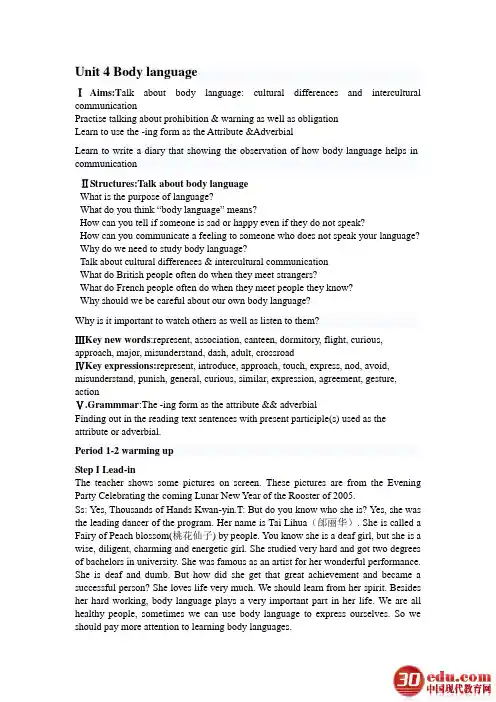
Unit 4 Body language
ⅠAims:Talk about body language: cultural differences and intercultural
communication
Practise talking about prohibition & warning as well as obligation
Learn to use the -ing form as the Attribute &Adverbial
Learn to write a diary that showing the observation of how body language helps in
communication
ⅡStructures:Talk about body language
What is the purpose of language?
What do you think “body language” means?
How can you tell if someone is sad or happy even if they do not speak?
How can you communicate a feeling to someone who does not speak your language?
Why do we need to study body language?
Talk about cultural differences & intercultural communication
What do British people often do when they meet strangers?
What do French people often do when they meet people they know?
Why should we be careful about our own body language?
高中英语(必修一)教师用书:Unit 4 Section Ⅱ Warming Up 26 Reading—Language Points Word版含答案
Section Ⅱ Warming Up & Reading —Language Points
burst vi.爆裂;爆发n.突然破裂;爆发
(教材P26)In the city,the water pipes in some buildings cracked and burst.
在市内,有些建筑物里的水管爆裂开来。
(1)burst out crying/laughingburst into tears/laughter 突然哭起来/笑起来
burst with anger/joy 勃然大怒/乐不可支
(2)burst in/into 闯进;突然破门而入
①She burst into tears when she learned her failure in the exam.
她一听说自己考试不及格就失声大哭。
②The class burst out laughing(laugh).
全班突然大笑起来。
③I felt as if my heart would burst with joy.
我觉得自己高兴得心花怒放。
爆裂 突然(大笑……) 冲,闯进,突然出现
at an end结束;终结
(教材P26)It seemed as if the world was at an end!
仿佛到了世界末日!
(1)at the end of 在……末端
by the end of 到……为止(用于完成时)
in the end 最后;终于
(2) bring sth.to an endput an end to (使)结束;终结
come to an end 结束
①Only two teams go down in the Chinese Super League at the end of this season.
本赛季末在中超只有两支队伍降级。
②All reports must be sent in by the end of this week.
教学设计-8-24
奖项: 教学设计 学科: 高中政治 获奖总数: 32 〔篇〕
奖 级 标 题 作 者 单 位 作者
一等奖
6篇 《树立正确的消费观》教学设计 绍兴一中分校 郑 颖
《我国处理国际关系的决定因素:国家利益》教学设计 嵊州市爱德外国语学校 张秋芬
《处理民族关系的原则:平等团结、共同繁荣》教学设计 嵊州一中 许群爱
《做好就业和处方创业的准备》教学设计 绍兴市稽山中学 周 虹
《树立正确的消费观》教学设计 上虞市华维外国语学校 魏 红
《新时代的劳动者》教学设计 绍兴一中分校 董凌玲
二等奖
10篇 《价格变动的影响》教学设计 绍兴县越崎中学 宋华苗
《消费及其类型》教学设计 诸暨中学 骆利群
《社会主义市场经济》教学设计 绍兴县柯桥中学 沈丽丽
《政府的责任:对人民负责》教学设计 上虞市城南中学 章琳琳
《发展生产 满足消费》教学设计 诸暨市学勉中学 骆 巍
《公司的经营与发展》教学设计 绍兴一中 吴盖妃
《面对经济全球华》教学设计 绍兴市稽山中学 钱煜明
《权力的行使需要监督》教学设计 上虞市春晖中学 朱丽萍
《社会历史的主体》教学设计 新昌县知新中学 梁双英
《树立正确的消费观》教学设计 绍兴县鉴湖中学 孙国伟
三等奖
16篇 《政治权利和义务:参与政治生活的准则》教学设计 绍兴县越崎中学 尉李军
《促进小康社会的经济发展》教学设计 上虞市东关中学 阮宗林
《我国处理国际关系的决定性因素:国家利益》教学设计 诸暨市中学暨阳分校 方匡虞
《共创幸福生活》教学设计 绍兴县鉴湖中学 蒋国钦
《政府的责任:对人民负责》教学设计 上虞市春晖中学 程 波
《人民代表大会:国家权力机关》教学设计 嵊州市崇仁中学 周剑锋
《处理民族关系的原则:平等、团结、共同繁荣》教学设计 新昌知新中学 梁景琼
《新时代的劳动者》教学设计 绍兴市高级中学 胡潇斐
英语人教版必修4学案:Unit 4 Section Ⅱ Warming Up Reading Language Points含解析
人教版高中英语必修四
1 Section_ⅡWarming Up & Reading —
Language Points
一、这样记单词
记得准·写得对 记得快·记得多
Ⅰ.基础词汇
1.greet vi. & vt. 迎接;问候
2.represent vt. 代表;象征
3.dormitory n. 宿舍
4.canteen n. 食堂
5.flight n. 飞行;航班
6.approach vt. & vi. 接近;靠近;走近
n. 接近;方法;途径
7.cheek n. 面颊
8.dash vi. 猛冲;突进
9.adult n. 成年人;成人
adj. 成人的;成熟的
10.likely adj. 可能的
11.crossroads n. 十字路口
Ⅱ.拓展词汇
1.statement n.陈述;说明→state vt.陈述;说明
2.association n.社团;联系;联想→associate
vt.结交;联合
3.curious adj.好奇的→curiously adv.好奇地→curiosity n.好奇心
4.defend vt.保护;保卫→defence n.防御;保卫
5.major adj.主要的→majority n.大多数 1.represent vt.代表;象征
[记法] re-(再)+present(呈现,赠送)→再现→代表,象征;再赠送,描绘
[词块] represent ideas by words 用言语表达思想
[同义] ①stand for 代表
②display v. 展现
2.approach v.接近;靠近;走近n.方法;途径;接近
[记法] ap-(=to)+proach(近)→向……靠近→接近
[词块] ①try a new approach to teaching
尝试新的教学法
②traditional approach 传统方法
Book 4 unit4 Body Language导学案
1 2013-2014学年第二学期高一英语学案 使用时间:2014年春季学期
Book 4 Unit 4 Body Language导学案
高一英语备课组
【使用说明及学法指导】
1.课前20分钟自学课本第26页课文,独立完成学案题目,并上交。
2.先快读课文1遍,把握文章的主旨大意,完成Task1 Task2。
3.再精读课文1遍,把握文章的细节,完成Task3和课内探究。
【学习目标】:1. 进一步培养推测、略读、找读、归纳内容等阅读技巧
2.深入理解课文,分析文章长难句,培养快速阅读和整体理解的能力。
3.通过合作探究,主动质疑.,学会概括主旨,分析句子和复述课文的方法。
4. 通过阅读,能够理解并尊重不同区域的人的身体语言和其文化涵义。激情投入课堂,享受英语学习的快乐。
【课前预习】
【疯狂背诵、强化记忆】 (10分钟)
Ⅰ. 短语翻译
1. express one’s feelings_________ 2. stand close to sb. _________
3. a world of cultural crossroads________ 4. look sb in the eye_________
5. spoken English _________ 6. shake the head from side to side_________
7. defend against_________ 8. be likely to_________
9. lose face_________ 10. at ease________
11. turn one’s back to_________ 12. on the contrary_________