
初中英语译林牛津版七年级下册Unit4 Finding your way单元练习
初中英语译林牛津版七年级下册Unit4 Finding your way单元练习一、听力(听力)(共20小题;共20分)听力部分(20分)Ⅰ.听句子,选出句子中所包含的信息(5分)1. A. tree B. trip C. travel2. A. excited B. exciting C. expensive3. A. 428 B. 728 C. 7824. A. bell B. bike C. believe5. A. They are taking a plane to Lanzhou.B. They are going on a trip to Lanzhou by train.C. They will take a plane to Lanzhou.II.听对话和问题,选择正确答案(5分)6. How far is Jack's home from the centre of the city?A. 20 minutes by bus.B. 40 minutes by underground.C. 40 minutes by bus.7. When does the train leave?A. At 5:30.B. At 4:30.C. At 6:30.8. How much is the car?A. 3,000 yuan.B. 30,000 yuan.C. 300 yuan.9. Where is the man going?A. B. C.10. What does the man like?A. B. C.Ⅲ.听长对话和问题,选择正确答案(5分)11. What is the woman doing now?A. Making a phone call.B. Giving a lesson.C. Asking the way.12. What place is the woman going to?A. A school.B. A cinema.C. A shop.13. Which bus is the woman going to take?A. No. 4.B. No. 14.C. No. 44.14. Where is the bus stop?A. On the right along the road.B. On the left along the road.C. In the middle of the road.15. How long will it take the woman to get there?A. 20 minutes.B. 12 minutes.C. 2 minutes.IV.听短文填空(5分)16. Jack Wilson is from Toronto, .17. Jack is a schoolboy.He knows China is a country.18. Jack wants to go on a to China.19. There are students in his class.20. Jack and his friends often play football on afternoon.二、单项选择(共15小题;共15分)21. There is old pencil in pencil box.A. a; theB. an; theC. an; aD. the; a22. There is no bridge the river, so we the river by boat.A. cross; crossB. cross; acrossC. across; crossD. across; across23. --- Why are you standing there, Anna?--- I can't see the words on the blackboard. Two tall boys are sitting me.A. in front ofB. behindC. next toD. beside24. Could you help me ?A. with open the windowB. open the windowC. to opening the windowD. opening the window25. --- You're coughing badly. Have you gone to see a doctor?--- No, but I .A. am going toB. will notC. am not going toD. haven't26. Wu Yan wants to buy dress for her mother on Mother's Day.A. an; theB. /; aC. a; /D. the; a27. Turn right the second crossing and the bank is your left.A. in; onB. in; atC. at; inD. at; on28. --- have dinner with my wife and me next weekend?--- Yes, I'd like to. Thank you.A. Would you likeB. Do you likeC. Would you like toD. Do you29. There is a bridge the river. Many boats go it every day.A. over; throughB. over; belowC. on; throughD. above; under30. --- Excuse me, how can I get to the post office?--- .A. Never mindB. Sorry, I am new hereC. That's OK31. --- What does your English teacher ?--- He is tall and thin. He's really handsome.A. lookB. likeC. look likeD. be like32. Help others, you'll feel happier!A. andB. orC. butD. when33. more, and you will improve your spoken English.A. To speakB. SpeaksC. SpeakD. Speaking34. he forward a class trip?A. Is; looking; to haveB. Does; look; havingC. Is; looking; to havingD. Does; looking; to having35. --- I don't care what my teachers think.--- Well, you .A. couldB. wouldC. shouldD. might三、完形填空(共10小题;共15分)My aunt, Jenny Lee lives in a town in Canada. She has a 36 face like the sun. Her favorite 37 is Hu Xinger. Now she's in the 38 Wonderful Friends (《奇妙的朋友》) with five other stars. They live and play with many kinds of 39 in the zoo in Guangzhou. These animals are very cute.My aunt often tells stories about animals to her son. Today she wants to take him to the40 to see animals. In the morning, Jenny gets up early and helps her son get dressed. They can41 the subway to the zoo easily. Her son is only five years old, so he doesn't need to pay for the ticket(票). It's 42 . At the zoo, they watch the monkeys 43 the trees. After lunch they enjoy drinking 44 in the park. They like to spend time in the park. In the evening, they have dinner in a 45 and go home. The restaurant is near their house.36. A. long B. round C. short D. tall37. A. actor B. actress C. police D. teacher38. A. movie B. book C. newspaper D. show39. A. persons B. animals C. mountains D. trees40. A. cinema B. bank C. hospital D. zoo41. A. by B. get C. take D. ride42. A. busy B. bad C. free D. young43. A. crossing B. putting C. making D. climbing44. A. juice B. salad C. vegetables D. fruits45. A. restaurant B. school C. bus stop D. hotel四、阅读理解(共16小题;共32分)AAt 9:30, my parents and I are driving a car to my grandparents' home. Today is the Dragon Boat Festival. Everyone wants to be with his or her family this day.At 10:40, at my grandparents' home, my grandfather and grandmother are making zongzi. They are happy to see us visit them.At 11:30, we are sitting in the yard(院子). My father and uncle are helping my mother and aunt cook lunch. They are preparing some chicken, fish and fruit. How delicious the food is!At 12:15, we are sitting at the table. Before lunch, we say something good to my grandparents. We wish them to live a happy and healthy life. They are so happy to hear that.At 13:10, my mother and aunt are doing the dishes. My father and uncle are watching a basketball game on TV. My grandparents are talking with my cousin and me. We really have fun. It's so good to be with our family.46. What's the writer's grandparents making?A. Soup.B. Fish.C. Zongzi.D. Mooncakes.47. When may the writer's uncle get to his grandparents' home?A. At twenty past eleven.B. At a quarter to twelve.C. At half past twelve.D. At twelve o'clock.48. They can't eat .A. fishB. chickenC. zongziD. salad49. Who is talking with my cousin and me at 13:10?A. My father.B. My uncle.C. My aunt.D. My grandparents.50. Which of the following statements is TRUE?A. The writer goes to his grandparents' home by bus.B. At 10:40, the writer's father is reading in the living room.C. The writer's grandmother is washing the dishes at 13:10.D. The writer has a good time that day.BOne of my favourite things to do is hiking in mountains. Because nobody likes the idea of getting lost, I always prepare before every trip. But what's the best navigation tool, a Global Positioning System (GPS) or a good old map and compass? Five of my friends and I hiked through the mountains on a trail I marked. One team of three carried a GPS, and the other team used a map and compass.It took the GPS team 3 hours and 11 minutes to get through the whole hike, however, it took the map and compass team only 2 hours and 49 minutes. The biggest problem the GPS team met was that they lost the satellite signal (卫星信号) in some places. With no map or compass, they had to walk around until they were in a place where the signal was good. The map and compass team was able to spot(认出) different landmarks, compare them to their maps and then use the compass to point them in the right direction.When I head out on my future hikes, I'm bringing a map, a compass and a GPS to show me the way.51. The writer prepares before every trip because he doesn't .A. like the old map or compassB. know how to use the GPSC. want to get lost in mountainsD. want to get into the mountains alone52. The two teams .A. had the same navigation toolB. went along the same trailC. had the same problemD. finished the whole hike at the same time53. In the end, the writer found out .A. the map and the compass were too old navigation tools to use any moreB. it wasn't necessary to bring a map and a compass together with a GPSC. the GPS had some disadvantages in hiking in mountainsD. he wouldn't use a GPS any moreCSchool trips are one of the things that school children hope for about school. They are one way to show children that they can also learn much outside the classroom.A good side of having a school trip is that children can use the learned or the learning things in class in true life. Knowledge in science and maths can be used. Then students will remember their lessons well. Also, students will have first-hand information on how their school subjects work outside classroom. For example, a visit to a museum can not only learn about history but can also learn about science or geography.What's more, always learning in classroom may make some kids lose interest in a subject. This is really true for some difficult subjects. However, kids can learn in new environments during school trips and take on as much information as they want and can.School trips also help kids get to know each other in a more relaxed environment, without thinking about tests or grades.Showing students the larger world around them can really help them learn more.54. Why can students remember their lessons easily by taking school trips?A. Because they can get the first-hand information.B. Because they like visiting museums and learning science.C. Because they can put what they learned in class into action.D. Because they know the good side of a school trip.55. How will students feel when they are in new environment of school trips?A. Interesting and active.B. Difficult and tired.C. Friendly and easy.D. Relaxed and fun.56. What's the main point about school trips in the passage?A. They are helpful for kids to show what they learned at school.B. Kids should learn more about science outside classroom.C. Kids should learn more from school trips.D. They are good for improving students' learning.DChristopher Columbus is famous because he found something he wasn't looking for.In 1492, Columbus sailed across the Atlantic Ocean in order to reach India. What he found was something far different. He found the New World. How did this come about? It all started in Italy.Christopher Columbus was born in Genoa in 1451. His family didn't have a lot of money, and Christopher wasn't an only child. He didn't have much of an education until he was much older. Instead, he went to sea. He sailed around the Mediterranean(地中海) and as far north as England and Ireland.During his travels, Columbus heard the reports of land to the west of the Madeira and Azores Islands. They were in the Atlantic Ocean west of Portugal. He wanted to know more and got maps and books on geography.Marco Polo said that Japan was only 1,500 miles east of China. As a result, Columbus thought that Japan was only 3,000 miles west of Portugal. And 3,000 miles was a distance that ships could travel in those days.So, Columbus decided that he wanted to get to the East by going west. He thought that if he sailed far enough west, he would sail around the world enough to reach the East. Based on his calculations(计算), Japan was only 3,000 miles away, after all.57. Where did Columbus want to go when he sailed across the Atlantic Ocean in 1492?A. America.B. India.C. Japan.D. China.58. Which of the following is true according to the third paragraph?A. There were many people in Columbus' family.B. Columbus was an only boy of his parents.C. Columbus did well in school when he was young.D. Columbus once traveled to Ireland.59. During his travels, Columbus was interested in .A. geographyB. physicsC. chemistryD. history60. We can infer from the passage that .A. Columbus had a dream to visit AmericaB. Marco Polo was a great traveler from PortugalC. Columbus had the idea that earth was roundD. nobody believed Columbus could reach China61. The passage is mainly about .A. Columbus's childhoodB. the reports of Azores IslandsC. how Columbus began his sailD. what Marco Polo said in his book五、单词拼写(根据中文提示拼写单词)(共10小题;共10分)62. There is always much (交通) on the city roads.63. They want to go on a long (旅行) to the west of China.64. Jim sits in the (角) of the classroom, on the right side.65. I (跟随) him to see what he is going to do.66. My sister works in a (银行).67. We still (记得) those wonderful days.68. The (桥梁) make people cross the rivers easily.69. Don't play with the knife(小刀). It's (危险的).70. Look, that elephant is eating tree (叶).71. The light is red. You can't (过) the road.六、翻译(根据中文提示完成句子)(共5小题;共10分)72. 大卫的父亲病了, 他不得不照看父亲。
牛津译林版英语七下Unit 4《Finding your way》(Welcome to the u
牛津译林版英语七下Unit 4《Finding your way》(Welcome to the unit)教学设计一. 教材分析《Finding your way》是人教版牛津译林英语七年级下的一个单元,主题是关于方向和地点的询问与描述。
本节课的主要内容是通过学习如何描述路线和地点,提高学生的语言运用能力和人际沟通能力。
教材中包含了丰富的图片、对话和活动,为学生提供了充足的语言实践机会。
二. 学情分析七年级的学生已经掌握了基本的英语语法和词汇,对于日常生活中的简单交流已经没有太大问题。
但是,他们在描述具体地点和路线时,可能会存在一定的困难。
此外,部分学生可能对方向感不强,需要在教学过程中加以引导和训练。
三. 教学目标1.知识目标:学生能够掌握描述路线和地点的常用词汇和句型,如:turn left/right, go strght on, take the second/third turning on the left/right等。
2.能力目标:学生能够在实际情境中运用所学语言描述路线和地点,提高人际沟通能力。
3.情感目标:培养学生对探索和发现的兴趣,增强团队协作精神。
四. 教学重难点1.重点:描述路线和地点的词汇和句型。
2.难点:如何在实际情境中灵活运用所学语言进行交流。
五. 教学方法1.情境教学法:通过设定具体的生活场景,让学生在实际情境中学习和使用语言。
2.任务型教学法:通过完成各种任务,培养学生运用英语进行实际交流的能力。
3.小组合作学习:鼓励学生分组进行讨论和实践活动,提高团队协作能力。
六. 教学准备1.准备相关图片和地图,用于展示和练习。
2.准备录音机和磁带,用于播放对话和歌曲。
3.准备教案和教学课件。
七. 教学过程1.导入(5分钟)利用图片和歌曲《London Bridge》引导学生进入话题,激发学生对方向的兴趣。
2.呈现(10分钟)展示一幅学校地图,引导学生观察并找出学校各个场所的位置。
牛津译林版七年级下册英语课件:Unit4Findingyourwayr

5. Sally is now behind the supermarket. How can she get to the school?
When we speak, we drop our tone at the end of a statement.
1. There is a path between the hills.
(If possible, ask the students to give more sentences)
Listen and answer: • Which cinema does Millie want to
go to? • When will they meet?
Practice reading the dialogue on P53 .
2.You are standing at B.
Go down the street,
walk past the restaurant
and take the third turning on the right. Then take the second turning on the lWhen we ask a wh- question, our tone usually falls at the end of the question.
1.What can you see across the bridge?
2. How do I get there?
3. Which way should I go at the traffic lights?
2. Pandas are cute.
3. There’s an English Corner at Sunny Garden this Saturday afternoon.
牛津译林版七年级英语下册Unit 4 Finding your way优质课件

and see(10) _t_h_e_ elephant.
Fill in the blanks with a, an, the , / .
1. Where is Peter? He isn’t at ___/school. 2. There is __a_norange in the fridge. 3. _T_h_e_ pencil on the desk belongs to
Sandy.
4. I have _a_ new bike. I clean __t_hbeike
every day.
5. Dad often goes fishing in _/___ summer. 6. A: Can I help you?
B: I’m looking for _a__ pair of shoes. 7. People in Nanjing now go to work by
定冠词the的用法
1. 指上文提到过的人或物。如:
Lucy 买了一辆新自行车,那辆自行车是绿色的。
Lucy bought a new bike, the bike is green.
2. 世界上独一无二的事物。如: the sun the moon the earth
地球绕着太阳转。
The earth runs around the sun.
an egg
an orange
不定冠词a / an 的用法
1. 第一次提到某人或某物时
我有一本书。 I have a book.
2. 泛指某一类的人或物。
熊猫非常可爱。 A panda is very lovely.
牛津译林七年级下册第四单元Unit 4 Finding your wayGrammar‖教案
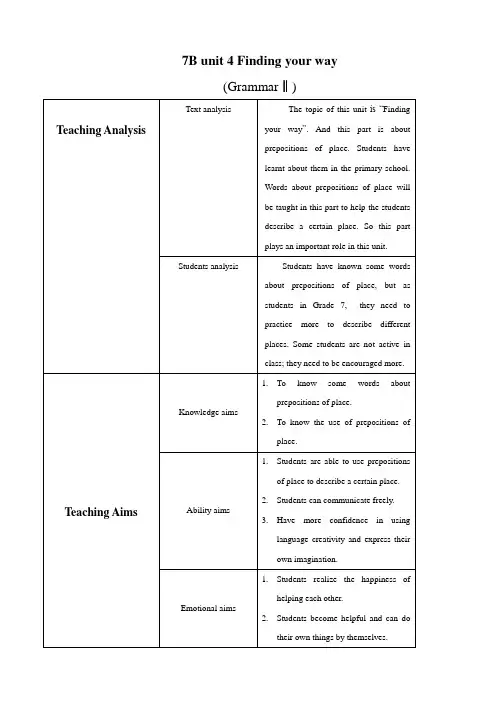
Blackboard
7B unit 4 Finding Your Way
Where is the cat? He’s…
in above outside
1.Students describe the picture orally.
2. Fill in the blanks and then find out the cat’s house on the picture.
Chant
1.Lead the students to complete the chant.
2.Students become helpfulandcan do their own things by themselves.
Teaching
Important Points
1.below, above, over, under, behind, inside, outside
2.Train the students’speaking ability.
Purpose
Warming-up
1.Introducemyself to the students.
2.Tell them my problem and ask them to help em.
1.Practice greetings with the teacher.
2.Chant it.
1.Work in groups and complete the chant.
2.Chant with the teacher.
牛津译林版七年级英语下Unit4Findingyourway复习课件共35张PPT

__B_ir_d_s____ like singing. Then can __m__a_k_e_b_e_au_t_i_fu_l_s_o_u_n_d_s _____when they sing.
__M__o_nk_e_y_s____ are __c_le_v_e_r_a_n_d_f_u_n_n_y________. They_j_u_m_p__a_ro_u_n_d_____ to ___m__a_k_e_p_e_o_p_le_l_a_u_g_h___.
9、在红绿灯处我应该走那一条路? _W__h_ic_h__w_a_y__s_h_o_u_ld__I_g_o__a_t _th_e__t_ra_f_fi_c__li_g_h_t_s_?______________
10、经过超市在第一个交叉口左转。 W__a_lk__p_a_s_t_t_h_e_s_u_p__e_rm__a_r_t _a_n_d_t_u_r_n_r_i_g_h_t_a_t_t_h_e_f_ir_s_t_c_r_o_s_s_in_g__.
Talk about each place and the animal. Pay attention to the features(特征) of the animal.
monkeys
birds
elephants
giraffes Useful lions expressions:
pandas
Go straight on Walk along the road Turn left/ right Cross the road
7. We are in _t_h_e__ same school. But John is __a_n_
American boy.
初中英语 牛津译林版七年级下册 Unit 4 Finding your way 知识点
牛津译林版七年级下册Unit4 Finding your way1.Let’s go down here.让我们一起下去吧。
go down 下降,沉没,屈服,被记下At sunset, the sun looks as if it is going down.日落时,太阳看起来好像在降落。
Go down to the grocer’s and get some sugar.去杂货店给我买点糖来。
2.Don’t be afraid. Come with me.不要害怕。
跟着我来。
Don’t be afraid to pet the dog.不要害怕抚摸这条狗。
3.I think we have to go up again.我觉得我们必须再次上去了。
have to 不得不,必须We’ll have to change the bulb again.我们又得换个灯泡了。
与must 的区别:have to 通俗用语,指受客观条件或环境迫使而“不得不”做某事,突出客观性。
must 通常表示命令或说话人主观认为必须要做某事,含强调语气,侧重主观性。
I have to have someone to look after.我必须去照顾某人。
Then you must be my cousin.那么你一定是我的远亲了。
go up 增长,建起,炸毁Go up to the fork and turn left.走到岔口处向左拐。
Production is going up in leaps and bounds.产量飞速增长。
4.Sunshine Zoo is north of Sunshine Middle School.阳光动物园在阳光中学的北面。
be + 方位词+ of ... (某地)在(另一地)的......方向Our school is south of the zoo.我们学校在动物园的南面。
英语中东南、东北、西南和西北的表达分别是south-east, north-east, south-west, north-west。
牛津译林版七年级英语下册7BUnit4Findingyourway单元测试卷(含答案)
⽜津译林版七年级英语下册7BUnit4Findingyourway单元测试卷(含答案)7B Unit4单元测试卷⼀、单项选择1. ─You've dropped "s" in the word "across".─Oh,letter "s" should be doubled.A. a; aB. an; aC. an; theD. the; the2.Look at the__________words on the blackboard and_________me to read them.A. following;followingB.follow;followingC. follow;followD.following;follow3.Elephants ______Cute. Their large ears ______ open fans.A. look;lookB. look like;lookC. look;look likeD.look like;look like4. Walk ______ the road and turn left _______ Park Road,you will find the shop _____ your left.A. down, into, onB. along, to, inC. straight, into, onD. on, into, in5. We are happy ____you ____ a farewell party for our friends from Beijing.A. invite, toB. to invite, joinC. inviting, toD. to invite, to6. Tom, follow this morning.A. me homeB. me to homeC. have homeD. I to home7. Be sure ______ send my greetings to your mother.A. to sendB. sendingC. sendD. for sending8. _________ book on the table is __________useful one.A. A; anB. The; anC. A; theD. The; a9. Shanghai is __________ the east of China and is the west of Japan.A. in; inB. in; toC. to; inD. to; to10. your friend Jenny afraid of in front of her classmates?A. Is; speakingB. Is; to speakC. Are; speakingD. Are; to speak11. Work hard, you _________ pass the English exam this time.A. or, canB. but, canC. because, willD. and, will12. The zoo is only ________ my school, so you can walk __________ there.A. five miles away, toB. five miles far away; from, toC. five miles away from, /D. five miles far from, /13. Next to the school a road and across the road some fruit shops.A. are; isB. is; areC. are; areD. is; is14. Tom,to your teachers carefully in class,and you it easy to study well.A. listen; will findB. listens; findC. listen; findD. listens; will find15. ─Would you like to come to my party this afternoon?─ . I will have to help my mother look after my little brother.A. Good ideaB. I'd love to,but I can'tC. Sorry to hear thatD. See you then⼆、完形填空Things are always changing, like the clock, the weather, and even me. Nothing can always stay 1. My life is full of changes. Sometimes I don’t feel good about 2___, but later things become 3___.My pet cat, Taffy, runs away. We look for her 4__ the house but we cannot 5__ her. I miss her a lot and I am sad. Dad tells me that we can get 6 one. That makes me happy again, but I will always remember Taffy.My best friend, Robin, just moves away. The moving van takes away everything and the house is 7___ . Maybe I can not see her any more. Robin now lives _8__ the hills far away from here. Mums says we can take 9__ there and play with Robin again.The day I start the new school year, I am afraid of all my new 10__ in my class. I am afraid they _11_ like me, and I can’t run as they do. Now I am happy because I have lots of new friends. I __12_ my class and my teacher.Isn’t that wonderful? Yesterday I looked in the mirror. My __13_ looked like a Halloween pumpkin __14___ I lost my first tooth. I had a big surprise when I woke up this morning. Mum says long ago, she was _15__ just like me. Do you think some day I will change and grow up to be an artist like her?1. A. healthy B. the same C. different D. alive2. A. me B. him C. her D. them3. A. better B. more C. terrible D. interesting4. A. all over B. at C. between D. from5. A. look at B. listen C. find D. follow6. A. other B. the other C. another D. a7. A. old B. broken C. bright D. empty8. A. in the middle of B. under C. over D. at the foot of9. A. a bike B. a boat C. a walk D. a plane10. A. neighbours B. friends C. classmates D. students11. A. don’t B. aren’t C. can’t D. won’t12. A. miss B. love C. hate D. dislike13. A. face B. eyes C. ears D. mouth14. A. because B. so C. but D. or15. A. short B. young C. tall D. strong三、阅读理解AChinese people call the Spring Festival “Nian”. But do you know that Nian was once the name of a monster(妖怪)?A long time ago, the monster Nian lived in the mountains. It ate animals. But in winter, it could not find food. So it came to villages and ate a lot of people.People were so afraid of Nian that they locked their doors before evening came during the winter. One day, an old man came to a village. He told people there that Nian was afraid of three things---the color red, fire and noise.He told people to play drums and gongs, make big fires and set off fireworks to make Nian go away.On a moonless, cold night, Nian went to the village again. As soon as it opened its big mouth, people made loud noise and made fire. Nian was really afraid and ran away. Wherever it went, there was noise and fire.When Nian was tired and could not run any more, people killed(杀死) the monster.After that, on the coldest day of winter, people play drums and gongs, and set off fireworks to celebrate the death of the monster of Nian. They put up red lanterns and have a big dinner without sleeping during the night.In the morning, people greet each other happily. So now we have the Spring Festival.1. From the story, we know that long long ago, Nian was a(an) __________________.A. ghostB. animalC. monsterD. tortoise2. Nian ate people in winter because it __________________.A. had no food to eatB. liked to live in a villageC. wanted to make people afraidD. celebrated the Spring Festival3. The underlined words “drums and gongs” mean __________________.A. 扬琴B. ⼆胡C. 笛⼦D. 锣⿎4. People killed Nian after __________________.A. it ate all the animalsB. the old man came to a villlageC. people knew what it was afraid ofD. it was so tired that it couldn’t run away5. What is the best title(题⽬) for the passage?A. How the Spring Festival CameB. What the Spring Festival WasC. What People Did During NianD. How People Celebrated NianBA person spends three whole years of his life in the toilet. It's funny, isn't it? Toilets are very important in our life. But we don't care them too much. There is a special day for toilets. November 19 is World Toilet Day. It is a day to learn about toilets. There are some different kinds of toilets around the world. In Western countries,most people have toilets and running water in their homes. In Japan and South Korea,some people have special toilets. The toilets have heaters and can even play music. But, in some places, toilets are outdoors and they are called "outhouses". In China, you can find some outhouses on the street. Some cleaners work there to keep them clean.When you use the toilet,you should keep some manners(礼仪).Here are some good manners. Flush the toilet after you have finished using it. Wash your hands before you leave the restroom. If you need to go to a public toilet,don't forget to wait in line.1 .When is World Toilet Day?A. On November 9.B. On November 19.C. On November 29.D. On December 19.2. The underlined word "they" probably refers to(指的是) " ".A. the heatersB. the cleanersC. the toiletsD. the countries3. Here are some manners of using toilets. Which is a good manner?A. Flush the toilet before you use it.B. Wash hands before you leave the restroom.C. You don't need to wait for your turn.D. Invite one of your friends to go to the restroom.4 .Which of the following is NOT true according to the passage?A. We don't care toilets too much.B. Some westerners have toilets and running water.C. Some toilets can even play music.D. All the toilets are indoors.5 . What's the best title for the passage?A. Learn about ToiletsB. World Toilet DayC. Outdoor ToiletsD. Toilets with Heaters四、词汇A)请根据句意及汉语提⽰,写出所缺单词。
译林牛津7年级下册Unit4Findingyourway单元测试卷(电子档包含答案)
7B Unit4 Finding your way 单元测试卷一、单项选择(每小题 1 分,满分 15 分)1. ___ woman over there is ____ popular teacher in our school. A. A; an B. The; a C. The; the D. A; the2. Lianyungang is ______ the east of China and China is ________ the west of Japan. A. in; on B. to; in C. in; to D. to; on3. We would like you ______ and we look forward _______ you. A. to come, to see B. come, to seeing C. come, to see D. to come, to seeing4. Jack often tells us jokes to make us _____ . A. laughs B. to laugh C. laugh D. laughing5. We ______ wear sports shoes when we climb a mountain. A. can ' t B. shouldn ' t C. needn ' t D. have to6. Let's help the old man walk ____ the street. A. cross B. across C. crossing D. acrossing7. Remember ___ off the lights when you leave the classroom.A. turnB. to turnC. turningD. turned8. _________________________________ - Excuse me , can you tell me the tothe Sunshine Hotel ?- I'm afraid I can't help you. I'm new here.A. street B. road 9. - What'swrong with your watch A. walkB. go 10. It is going to rain soon. You __C. wayD. path ? - It doesn't ______ .C. doD. work ___ take an umbrella with you.A. don ' t play on the road C. come to school on foot14. You must be tired. Why not B. not be late again D. to take the first turning_________ a rest?A. to stop to have B. to stop having C. stop to have15. --- Can you help me to buy some bananas? --- _________ . A. No problem B. That ' s right C. Not any more二、词汇检测(每小题 1 分,满分 15 分)A )请根据句意及汉语提示,写出所缺单词。
牛津译林版七年级下册(新) Unit 4 Finding your way Welcome to the unit课件(22张PPT)
Level 1
Think and learn
Sunshine Zoo is north of Sunshine Middle School.
Sunny Garden is west of the zoo. Lake Park is south of Sunny Garden. Sunshine Park is east of Lake Park.
——————————————————————————————-
Read aloud
Pay attention to your prononciation(语音) and intonation(语调)to make it more interesting
travel around the world
`
Are you sure to go down here?
2.Don’t be afraid . be afraid of sb/sth 害怕某人或某物 be afraid of doing sth 害怕做某事 be afraid to do sth
3. I think we have to go up again. have to 不得不,必须 正下着雨。他不得不待在家里。 It’s raining. He has to stay at home.
Level 2
Pair work:
A: B: A: B: A: B:
Where are we going for our class trip? We’re going to … Where is …? It’s … of the school, about … away. How will we get there? We’ll get there by …
牛津译林版七年级下册Unit 4《Finding your way》(Reading II)教学设计
牛津译林版七年级下册Unit 4《Finding your way》(Reading II)教学设计一. 教材分析《Finding your way》是牛津译林版七年级下册Unit 4的一篇阅读文章,主要讲述了一位游客在伦敦游玩时,通过询问警察和阅读地图找到了目的地的经历。
文章涉及到方位词、问路和指路的相关表达,适合学生学习如何在实际生活中运用英语进行问路和指路。
二. 学情分析七年级的学生已经掌握了一定的英语基础词汇和语法知识,具备一定的阅读理解能力。
但对于方位词和问路指路的语言功能,可能还不够熟练。
因此,在教学过程中,需要引导学生通过阅读理解文章内容,掌握相关词汇和表达,提高实际运用英语的能力。
三. 教学目标1.知识目标:学生能够掌握文章中涉及到的方位词和问路指路的相关表达。
2.能力目标:学生能够通过阅读理解文章内容,提高阅读能力;能够运用所学知识,进行简单的问路和指路交流。
3.情感目标:培养学生对英语学习的兴趣,增强自信心,提高合作意识。
四. 教学重难点1.重点:学生能够掌握文章中涉及到的方位词和问路指路的相关表达。
2.难点:学生能够运用所学知识,进行实际的问路和指路交流。
五. 教学方法1.任务型教学法:通过设定具体任务,引导学生参与课堂活动,提高学生的实践能力。
2.情境教学法:创设真实情境,让学生在实际情境中学习并运用英语。
3.合作学习法:引导学生进行小组讨论和合作,提高学生的团队协作能力。
六. 教学准备1.教师准备:备好相关教学材料,如PPT、地图、卡片等。
2.学生准备:预习课文,了解文章大意。
七. 教学过程1.导入(5分钟)利用图片或视频展示伦敦的风景,引导学生谈论他们对伦敦的印象,激发学生的学习兴趣。
2.呈现(10分钟)教师通过PPT展示文章标题和图片,引导学生预测文章内容。
然后,教师 read the passage aloud, and ask students to pay attention to the key words and expressions.3.操练(10分钟)教师设计一些简单的问路和指路的情景,让学生进行角色扮演,练习文章中的相关表达。