
中国传统文化英语作文
Chinese Traditional Culture
The human race has entered a completely new stage in its
history,along with the advance of the society and the
increaceingly rapid economic globalization and urbanization,
which resulted in the phenomenon that we are accustomed to
living a very fast rhythm lifestyle,ignoring the Chinese
traditional culture.
It is universally acknowledged that Chinese culture has a
history of more than two thousand years, which once had great
influence on the world, such as Japan, South Korea and other
Asian and European countries. As one of the four ancient
civilizations,China creates many splendid cultures,such as
the four ancient Chinese inventions,which benefited human
society in the history.
Although China risks copying the Western lifestyle’s
worst aspects, especially of unhealthy eating and
drinking,Which once gave rise to many
problems.Fortunately,Chinese begin to realize the importance
of Chinese traditional culture.Such examples might be given
easily,Chinese traditional culture was added into our CET4 and
CET6 ,which help us get hold of it better.
All in all,Chinese traditional culture accompanies our
growth all the time,which has already deeply rooted in our daily
lives.As a Chinese,What we ought to do is to transmitte Chinese
traditional culture from generation to generation.Only with
these efforts adopted can we ensure that Chinese traditional
culture will be leaded to a brilliant future.
中国传统文化主要内容英语作文

中国传统文化主要内容英语作文The Rich Tapestry of Chinese Traditional CultureChina's traditional culture is a profound and multifaceted tapestry that has woven its way through centuries of history, shaping the beliefs, values, and practices of the Chinese people. At the heart of this rich cultural heritage lies a deep respect for harmony, balance, and the interconnectedness of all things. From the ancient philosophies of Confucianism and Taoism to the intricate traditions of Chinese medicine and the arts, the essence of Chinese culture continues to captivate and inspire people around the world.Confucianism, one of the foundational pillars of Chinese tradition, emphasizes the importance of social harmony, ethical conduct, and the cultivation of virtues such as filial piety, righteousness, and benevolence. The Confucian scholar-officials, who held positions of power and influence throughout much of China's history, were responsible for promoting these values and ensuring the smooth functioning of society. The concept of the "Mandate of Heaven," which granted legitimacy to the ruling dynasty, was closely tied to the Confucian ideals of moral leadership and social stability.Complementing the Confucian emphasis on social order and hierarchy, the philosophical tradition of Taoism offers a contrasting perspective that celebrates the natural flow of the universe and the importance of individual spiritual cultivation. Taoism's reverence for the Dao, or the "way," encourages a harmonious coexistence with the natural world and a deep appreciation for the cyclical nature of life. The Taoist principles of Wu Wei, or effortless action, and the pursuit of inner peace and simplicity, have had a profound impact on Chinese art, literature, and the martial arts.The rich tapestry of Chinese traditional culture is further woven with the intricate traditions of Chinese medicine, which have been practiced for thousands of years. The holistic approach of traditional Chinese medicine, which seeks to restore balance and harmony within the body, has gained widespread recognition and popularity worldwide. The use of herbal remedies, acupuncture, and other modalities to treat a wide range of ailments reflects the Chinese belief in the interconnectedness of the physical, mental, and spiritual realms.The artistic expressions of Chinese culture, from the graceful calligraphy and intricate ink paintings to the mesmerizing performances of Peking Opera and the delicate craftsmanship of Chinese porcelain, are a testament to the country's deep appreciation for beauty, symbolism, and the harmonious blending ofform and function. These artistic traditions not only serve as a means of cultural expression but also reflect the philosophical underpinnings of Chinese thought, such as the importance of balance, the interplay of opposites, and the connection between the individual and the cosmos.The influence of Chinese traditional culture can also be seen in the country's rich culinary heritage, which has evolved over centuries to reflect the diverse regional cuisines and the emphasis on using fresh, seasonal ingredients. The principles of yin and yang, as well as the concept of the Five Elements, are often incorporated into the preparation and presentation of Chinese dishes, creating a harmonious balance of flavors and textures.Beyond the realms of philosophy, medicine, and the arts, Chinese traditional culture has also shaped the country's social and political structures, as well as its approach to education and family life. The concept of the extended family, with its emphasis on filial piety and the respect for elders, has had a profound impact on the way Chinese society is organized and how individuals navigate their roles and responsibilities within the larger social fabric.In conclusion, the rich tapestry of Chinese traditional culture is a testament to the enduring wisdom and resilience of the Chinese people. From the philosophical teachings of Confucianism andTaoism to the intricate traditions of Chinese medicine and the arts, this cultural heritage continues to influence the lives of millions of people, both within China and around the world. As the world becomes increasingly interconnected, the appreciation and understanding of Chinese traditional culture can serve as a bridge to foster greater cross-cultural understanding and appreciation, and to inspire new ways of thinking and living in the modern era.。
高考英语作文 范文4篇 中国传统文化

高考英语作文范文4篇中国传统文化1. The Importance of Chinese Traditional CultureAs we move forward in the modern world, it's important to remember the significance of Chinese traditional culture. The customs, beliefs, and practices that have been passed down for generations have shaped our society and provided a foundation for our values.One of the most important aspects of Chinese traditional culture is the importance placed on family and community. Respect for elders, filial piety, and strong family bonds are all values that have been instilled in us since childhood. These values continue to be important today, as they provide a sense of belonging and support in an increasingly isolated world.Another key aspect of Chinese traditional culture is the emphasis on education and scholarship. The Confucian philosophy of lifelong learning has been a guiding principle for centuries, and has contributed greatly to the intellectual and cultural achievements of our society.In addition to these values, Chinese traditional culture is also rich in art, literature, and philosophy. From the poetry of Li Bai to the calligraphy of Wang Xizhi, our cultural heritage is a testament to the creativity and ingenuity of our ancestors.In conclusion, Chinese traditional culture is an essential part of our identity as a people. By preserving and promoting these customs and beliefs, we can ensure that our society continues to thrive and flourish in the years to come.2. The Influence of Chinese Traditional Culture on Modern SocietyChinese traditional culture has had a profound impact on modern society, shaping our values, beliefs, and customs in countless ways.One of the most significant ways in which Chinese traditional culture has influenced modern society is through its emphasis on harmony and balance. The concept of yin and yang, for example, has inspired many aspects of Chinese medicine, feng shui, and even modern management theory. By promoting a holistic view of the world and encouraging cooperation and collaboration, these ideas have helped to create a more harmonious and balanced society.Another way in which Chinese traditional culture has influenced modern society is through its emphasis on education and scholarship. The Confucian philosophy of lifelong learning and the importance placed on education have been instrumental in shaping our modern educational system. From the traditional emphasis on rotememorization to the modern focus on critical thinking and problem-solving, these values continue to be a driving force in our society.In addition to these values, Chinese traditional culture has also had a significant impact on the arts, literature, and philosophy. From the poetry of Du Fu to the films of Zhang Yimou, our cultural heritage is a testament to the creativity and ingenuity of our ancestors.In conclusion, the influence of Chinese traditional culture on modern society cannot be overstated. By recognizing and appreciating our cultural heritage, we can continue to build a society that is both harmonious and innovative.3. The Challenges of Preserving Chinese Traditional Culture in the Modern AgeAs we move further into the modern age, the preservation of Chinese traditional culture has become an increasingly difficult task. The rapid pace of technological and social change has created a number of challenges that threaten to erode our cultural heritage.One of the biggest challenges facing the preservation of Chinese traditional culture is the loss of language skills. As more and more people adopt English or other foreign languages as their primary means of communication, there is a risk that our native language and its rich cultural heritage will be lost.Another challenge is the increasing homogenization of global culture. As Western values and lifestyles become more prevalent around the world, there is a risk that traditional Chinese customs and beliefs will be marginalized or even forgotten.Finally, the rapid pace of economic development and urbanization has created a sense of disconnection from our cultural roots. As people migrate to cities and adopt modern lifestyles, there is a risk that traditional customs and practices will be abandoned in favor of more modern ways of life.In conclusion, the preservation of Chinese traditional culture is a complex and ongoing challenge. By recognizing the importance of our cultural heritage and taking steps to promote and preserve it, we can ensure that our society continues to thrive and flourish in the years to come.4. Promoting Chinese Traditional Culture in the Global CommunityAs China's influence on the world stage continues to grow, there is an opportunity to promote and share our rich cultural heritage with the global community. By doing so, we can enhance our reputation as a nation of creativity, innovation, and cultural richness.One way to promote Chinese traditional culture is through cultural exchange programs. By inviting artists, scholars, and other cultural figures from around the world to participate in cultural events and exchanges, we can showcase the diversity and richness of our cultural heritage.Another way to promote Chinese traditional culture is through the arts. From traditional music and dance to contemporary film and literature, our cultural heritage is a rich source of inspiration and creativity. By promoting these works on a global stage, we can share our traditions with a wider audience and foster greater understanding and appreciation of our culture.Finally, we can promote Chinese traditional culture by incorporating it into our educational system. By teaching our young people about our cultural heritage and its significance, we can ensure that future generations will continue to value and preserve our traditions.In conclusion, promoting Chinese traditional culture in the global community is an important task that requires collaboration and innovation. By sharing our cultural heritage with the world, we can enrich our own lives and enhance our reputation as a nation of cultural richness and diversity.。
高考英语作文 范文4篇 中国传统文化
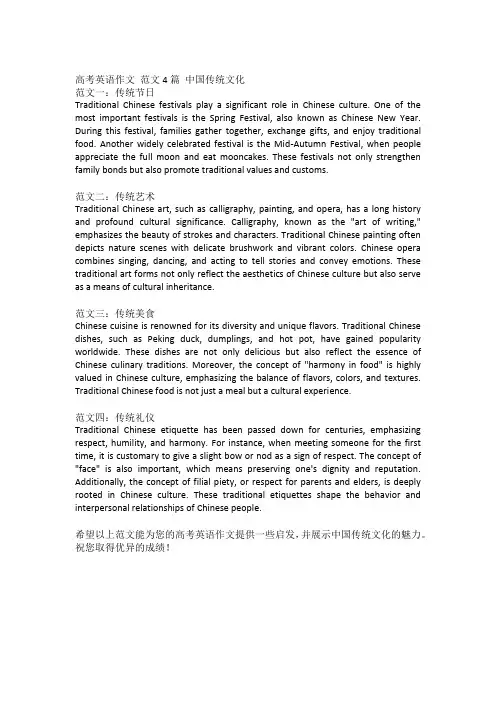
高考英语作文范文4篇中国传统文化范文一:传统节日Traditional Chinese festivals play a significant role in Chinese culture. One of the most important festivals is the Spring Festival, also known as Chinese New Year. During this festival, families gather together, exchange gifts, and enjoy traditional food. Another widely celebrated festival is the Mid-Autumn Festival, when people appreciate the full moon and eat mooncakes. These festivals not only strengthen family bonds but also promote traditional values and customs.范文二:传统艺术Traditional Chinese art, such as calligraphy, painting, and opera, has a long history and profound cultural significance. Calligraphy, known as the "art of writing," emphasizes the beauty of strokes and characters. Traditional Chinese painting often depicts nature scenes with delicate brushwork and vibrant colors. Chinese opera combines singing, dancing, and acting to tell stories and convey emotions. These traditional art forms not only reflect the aesthetics of Chinese culture but also serve as a means of cultural inheritance.范文三:传统美食Chinese cuisine is renowned for its diversity and unique flavors. Traditional Chinese dishes, such as Peking duck, dumplings, and hot pot, have gained popularity worldwide. These dishes are not only delicious but also reflect the essence of Chinese culinary traditions. Moreover, the concept of "harmony in food" is highly valued in Chinese culture, emphasizing the balance of flavors, colors, and textures. Traditional Chinese food is not just a meal but a cultural experience.范文四:传统礼仪Traditional Chinese etiquette has been passed down for centuries, emphasizing respect, humility, and harmony. For instance, when meeting someone for the first time, it is customary to give a slight bow or nod as a sign of respect. The concept of "face" is also important, which means preserving one's dignity and reputation. Additionally, the concept of filial piety, or respect for parents and elders, is deeply rooted in Chinese culture. These traditional etiquettes shape the behavior and interpersonal relationships of Chinese people.希望以上范文能为您的高考英语作文提供一些启发,并展示中国传统文化的魅力。
介绍中国传统文化的英语作文(五年级)

介绍中国传统文化的英语作文(五年级)全文共6篇示例,供读者参考篇1The Wonderful World of Chinese CultureHave you ever wondered about the unique traditions and customs of China? As one of the oldest civilizations in the world, China has an incredibly rich cultural heritage that has been passed down for thousands of years. From delicious cuisines to beautiful arts and crafts, there is so much to explore and appreciate. Let me take you on a journey through the wonderful world of Chinese culture!Chinese FestivalsOne of the most exciting aspects of Chinese culture is the various festivals celebrated throughout the year. The most important one is the Chinese New Year, also known as the Spring Festival. This is a time for families to get together, enjoy delicious food, and welcome the new year with fireworks and lion dances. Children receive red envelopes filled with money as a symbol of good luck.Another popular festival is the Mid-Autumn Festival, where families gather to admire the full moon and eat mooncakes, a dense and sweet pastry filled with lotus seed paste or other delicious fillings. The Qingming Festival, also called Tomb Sweeping Day, is when people visit the graves of their ancestors and pay respect to them.Chinese Arts and CraftsChina is famous for its beautiful and intricate arts and crafts. One of the most well-known is Chinese calligraphy, which is the art of writing Chinese characters with a brush and ink. Calligraphers spend years mastering the strokes and techniques to create stunning works of art.Another iconic Chinese craft is paper cutting, where delicate and intricate designs are cut out of paper using scissors or knives. These paper cuttings are often used as decorations during festivals or special occasions.Chinese pottery and porcelain are also highly prized. The most famous type is called "blue and white porcelain," which features beautiful blue designs painted on a white background. These porcelain pieces are not only functional but also true works of art.Chinese CuisineChinese cuisine is one of the most diverse and delicious in the world, with countless regional variations and specialties. One of the most popular dishes is dumplings, which can be steamed, boiled, or fried and filled with various ingredients like meat, vegetables, or even sweet fillings.Another iconic Chinese dish is Peking duck, a crispy-skinned roasted duck that is often served with thin pancakes, scallions, and a sweet bean sauce. Hot pot is also a beloved communal dish, where a simmering pot of broth is placed in the center of the table, and everyone cooks their own meats, vegetables, and noodles in it.Chinese Philosophy and LiteratureChina has a rich history of philosophy and literature that has influenced the world. One of the most well-known philosophers is Confucius, who taught about ethics, morality, and the importance of education and respect for elders.Another influential philosopher was Lao Tzu, the founder of Taoism, a philosophy that emphasizes living in harmony with nature and the universe.Chinese literature is also incredibly diverse, with genres ranging from poetry to novels and plays. One of the most famous works is the "Journey to the West," a classic novel that tells the story of a monk's pilgrimage to India to obtain sacred texts, accompanied by his faithful companions, including the beloved Monkey King.Chinese ArchitectureChinese architecture is known for its stunning temples, palaces, and gardens, which are often designed with intricate details and symbolic meanings. One of the most famous examples is the Forbidden City in Beijing, a vast complex that served as the imperial palace for 24 emperors during the Ming and Qing dynasties.Another iconic structure is the Great Wall of China, which stretches for thousands of miles and is one of the most impressive engineering feats in human history. It was built to protect ancient Chinese states from invasions and is now a UNESCO World Heritage site.Chinese gardens are also renowned for their beauty and harmony with nature. These gardens often feature carefully designed landscapes with ponds, pavilions, and winding paths, creating a serene and tranquil atmosphere.ConclusionChinese culture is truly a rich tapestry woven with thousands of years of history, tradition, and wisdom. From vibrant festivals to intricate arts and crafts, delectable cuisines to profound philosophies, there is so much to appreciate and learn from this ancient civilization.I hope this journey through the wonderful world of Chinese culture has sparked your curiosity and inspired you to explore more about this fascinating part of our world. Who knows, maybe one day you'll have the opportunity to experience it firsthand and create your own memories and stories to cherish.篇2The Wonders of Chinese Traditional CultureHi there! My name is Xiaoming and I'm a 5th grader. Today, I want to share with you some of the amazing things about Chinese traditional culture. It's a topic I find really fascinating, and I hope you'll enjoy learning about it too!Let's start with Chinese festivals. We have so many colorful and exciting festivals throughout the year. One of my favorites is the Spring Festival, also known as Chinese New Year. It's themost important festival in China and a time for families to get together and celebrate. The celebrations last for 15 days, and there are lots of fun traditions like decorating our homes with red lanterns, eating dumplings, and watching amazing fireworks displays.Another festival I love is the Mid-Autumn Festival. It's a harvest festival where we get to eat delicious mooncakes and admire the full moon. Legend has it that there was once a beautiful lady living on the moon. During this festival, we carry brightly lit lanterns and enjoy spending time with our loved ones under the moonlight.Chinese traditional culture is also famous for its incredible arts and crafts. One of the most well-known is Chinese calligraphy. It's the art of writing Chinese characters using a brush and ink. Calligraphers put a lot of effort into making each character look beautiful and expressive. Some of their works are so intricate and stunning that they're considered true works of art.Another amazing Chinese art form is paper cutting. It involves cutting intricate designs out of paper using scissors or knives. The results are often breathtakingly beautiful anddetailed. Paper cutting is used to decorate things like lanterns, windows, and even clothing.Chinese traditional architecture is something that always leaves me in awe. The buildings have such unique and striking designs, with curved roofs, ornate carvings, and vibrant colors. One of the most famous examples is the Forbidden City in Beijing, which was the imperial palace of the Ming and Qing dynasties. It's a vast complex with nearly a thousand buildings, and it's a true masterpiece of Chinese architecture.Chinese traditional medicine is also a fascinating part of our culture. It's been practiced for thousands of years and uses natural remedies like herbs, acupuncture, and massage to treat various ailments. One of the key principles of Chinese medicine is the concept of yin and yang, which refers to the balance of opposing forces in the body and nature.Speaking of nature, Chinese traditional culture has a deep respect and appreciation for it. This is reflected in practices like feng shui, which is all about harmonizing our living spaces with the natural world around us. It involves arranging buildings, furniture, and objects in a way that promotes positive energy flow.Chinese traditional clothing is also incredibly beautiful and rich in symbolism. One of the most iconic garments is the qipao or cheongsam, which is a form-fitting dress with a high collar and intricate embroidery or patterns. It's considered a symbol of Chinese elegance and femininity.Another aspect of Chinese traditional culture that I find fascinating is martial arts. Practices like kung fu, tai chi, and wushu are not only forms of self-defense but also ways to cultivate physical and mental discipline. They involve intricate movements, forms, and techniques that have been passed down for generations.I could go on and on about the wonders of Chinese traditional culture, but I'll leave it at that for now. I hope this has given you a glimpse into the richness and diversity of our cultural heritage. From festivals and arts to architecture and cuisine, there's so much to explore and appreciate.So, the next time you see a Chinese lantern or try a delicious plate of dumplings, remember the deep history and cultural significance behind them. And who knows, maybe you'll be inspired to learn more about this incredible culture that has shaped the lives of billions of people over thousands of years.篇3Chinese Culture is Amazing!China has such a rich culture that has been developing for thousands of years. There are so many fascinating aspects of Chinese traditional culture that I find really cool. Let me tell you about some of my favorite parts!Chinese Written LanguageOne thing that makes Chinese culture unique is the written language. Chinese writing uses characters instead of an alphabet like English. Each character represents a whole word or concept rather than just a single sound. Isn't that wild?The characters are made up of different strokes and radicals that can give hints about the meaning. Some characters even look a bit like the thing they represent! For example, the character for "person" kind of looks like a person standing up.Learning to read and write Chinese takes a lot of practice since there are thousands of characters. But it's really awesome to be able to communicate through such an ancient and artistic written system. Calligraphy, or the art of beautiful handwriting, is very important in Chinese culture.Chinese PhilosophyChina has had many great philosophers throughout history who have influenced Chinese culture and ways of thinking. Three of the most famous are Confucius, Lao Tzu, and Buddha.Confucius lived around 500 BC and his teachings focused a lot on having proper behavior, respect for others, and societal rules. His philosophy of Confucianism emphasizes ideas like filial piety (respect for your parents and elders), ritual, harmony, and moral cultivation.Lao Tzu was another ancient philosopher who founded the school of thought called Taoism. Taoism teaches that there is a natural order in the universe (called the Tao) that we should try to live in harmony with, rather than working against nature. Some key Taoist concepts are "wu wei" (going with the flow) and "yin and yang" (finding balance between opposites).Finally, Buddhism originated in ancient India but became very influential in China too. Buddhists follow the teachings of Buddha to end suffering and achieve enlightenment. Buddhist principles like non-violence, meditation, and reincarnation have been incorporated into Chinese culture and philosophy.Traditional FestivalsThe Chinese have such vibrant and fun celebrations for traditional festivals throughout the year! My favorite is definitely the Lunar New Year festival.Lunar New Year is the biggest holiday in Chinese culture. It's also called Spring Festival since it marks the arrival of spring on the lunisolar calendar. The date changes every year but it's usually in late January or February.During Lunar New Year, people clean their homes thoroughly to sweep away any bad luck and decorate with red lanterns, couplets, and paper cuts. Families get together for a huge reunion dinner on New Year's Eve with lots of amazing dishes like dumplings, noodles, whole fish, and sweet rice balls. Kids receive red envelopes with money inside for good luck.There are awesome Lunar New Year traditions like setting off firecrackers and watching amazing lion and dragon dances performed! People wear new clothes and kids love receiving little gifts. It's just such a joyous and festive time.Two other super cool traditional Chinese festivals are the Qingming Festival and the Mid-Autumn Festival. Qingming honors ancestors with tomb sweeping, while Mid-Autumn is a harvest celebration where we eat mooncakes and admire the bright full moon.Amazing FoodYou probably already know that Chinese cuisine is absolutely delicious! The food is a major part of the culture that I really love.Chinese food is so amazing because it uses such a wide variety of fresh ingredients and cooking techniques from different regions across the vast country. In the north, foods tend to be wheat-based with breads, noodles, and dumplings. Southern cuisine uses more rice and has lots of fresh seafood dishes.There are eight major cuisine traditions including Sichuan, Cantonese, Hunan, Fujian, Shandong, Jiangsu, Zhejiang, and Anhui. Each style has its own distinct flavors and signature dishes. Like Sichuan food is known for being super spicy with lips篇4My Amazing Chinese CultureHi there! My name is Lin and I'm in 5th grade. Today I want to tell you all about the awesome culture of China - the country where I was born and live. Chinese culture is one of the oldest in the world and has so many cool traditions and customs. Get ready to learn some really neat stuff!Let's start with festivals, because those are my favorite! The biggest celebration of the year is Chinese New Year. It takes place in late January or early February, depending on the lunar calendar. Families get together, eat delicious foods like dumplings and noodles, watch fireworks, and give out red envelopes with money inside as gifts. Everything turns red because it's considered a lucky color that scares away evil spirits.Another major festival is the Mid-Autumn Festival in September or October. We eat mooncakes, which are thick pastries stuffed with lotus seed paste or other fillings. Families get together to admire the bright harvest moon. The full moon is so pretty! The Dragon Boat Festival in June is lots of fun too. People race boats shaped like dragons and eat sticky rice dumplings called zongzi. So many great festivals to celebrate each year.Speaking of celebrations, Chinese New Year wouldn't be the same without the lion and dragon dances! Dancers hold up a giant lion or dragon costume made of cloth and bamboo. As they move around, it looks like the lion or dragon is coming to life. It's so energetic and vibrant, with the bright colors and loud drumbeats. Watching the dances is my favorite part of New Year's festivities.Another huge part of Chinese culture is the food - oh man, do we have some delicious dishes! Many meals include rice, noodles, vegetables, and sauce. Popular foods are dumplings, wontons, spring rolls, Peking duck, hand-pulled noodles, hot pots, and dim sum (bite-sized dishes). A favorite is Kung Pao chicken made with chicken, peanuts, veggies, and a spicy sauce. Just writing about the cuisine is making me hungry!Then there are the traditional customs and philosophies that have influenced China for thousands of years. Two of the biggest are Confucianism and Taoism. Confucianism teaches ethics, courtesy, and discipline. Following Confucian values like respect for elders and education is very important. Taoism promotes living in harmony with nature and the universe. The principles of yin and yang (opposite but complementary forces) come from Taoism. Ancient ideas like these have really shaped Chinese culture.I can't talk about China without mentioning its long history and some famous inventors and contributors. The Four Great Inventions that originated in ancient China were the compass, gunpowder, printing, and paper! Isn't that amazing? Can you imagine life without any of those things today? Other notable innovations were the abacus, silk, the practice of inoculationagainst disease, and incredible architectural wonders like the Great Wall and the Forbidden City in Beijing.Let me tell you about some other symbols and traditions that are part of Chinese culture. One is the zodiac animals that represent each year in the 12-year cycle - for example, 2023 is the Year of the Rabbit. Children learn poems and stories about the different zodiac animals. The five elements of wood, fire, earth, metal, and water are also very important symbols incorporated into everything from architecture to traditional medicine practices.Speaking of medicine, traditional Chinese medicine has been around for centuries using herbal remedies, acupuncture, and practices like tai chi. It focuses on balancing the body's spiritual energy or "chi". I've never had any treatments, but it's a huge part of the culture's medical history.Two popular games originating in China are mahjong (atile-based game) and Chinese chess (a really complex strategy game). I'm still learning to play those! Calligraphy - the art of beautiful handwritten Chinese characters - is another honored tradition that takes years to master. My grandfather loves doing calligraphy in his free time.Those are some of the biggest parts of Chinese culture, but I could go on and on! We also have historic temples and gardens, tea ceremonies, silk embroidery, shadow puppets, face-changing mask performances at Sichuan operas...there's just too much to fit into one essay. The roots of Chinese civilization go back over 5,000 years. Just thinking about how long these traditions have existed amazes me.My family makes sure I learn all about our cultural heritage. My grandparents teach me old stories, songs, and customs. We observe festivals and traditions together as a family. I feel really lucky to be part of such an ancient, rich culture with values focused on kindness, respect, balance, and family. I'm proud of my Chinese identity and background.Even though some traditions are changing with modern times, I hope China's unique cultural history will continue to be celebrated for thousands of years to come. We have so many special symbols, foods, philosophies, and customs unlike anywhere else on earth. I could spend forever exploring the diversity in Chinese culture! If you ever get the chance to experience Chinese traditions firsthand, I highly recommend it. Who's ready to try dumplings, watch a lion dance, and soak in thousands of years of history and wisdom?篇5The Wonders of Chinese CultureHi there! Today I want to tell you all about the amazing culture of China. China is an ancient country with a fascinating history and traditions that have been passed down for thousands of years. Let me take you on a journey to explore some of the coolest parts of Chinese culture!One of the most recognizable symbols of China is the Great Wall. This massive wall stretches for thousands of miles across northern China. It was built over 2,000 years ago to protect ancient Chinese empires from invasions by nomadic groups. Walking along the Great Wall must have been an incredible experience for the soldiers guarding it long ago. These days, millions of people visit the Great Wall every year to marvel at this impressive feat of construction from ancient times.Speaking of ancient times, China has some delightfully fun festivals that started a very long time ago. My favorite is the Lunar New Year celebration. This holiday welcomes the start of the new year based on the lunar calendar. Families get together for huge feasts with tasty dishes like dumplings and noodles. They decorate with lucky red lanterns, give out red envelopeswith money inside, and watch fireworks light up the night sky. The Lunar New Year is a joyous and vibrant celebration.Another amazing part of Chinese culture is the variety of traditional arts and crafts. One craft I find super cool is paper cutting. Using special scissors, artists cut intricate designs out of red paper. The designs often depict animals, flowers, symbols for luck, and more. These delicate paper cuts get hung up as decorations. Other traditional arts include calligraphy (beautiful handwritten poems and sayings) and ceramics (fancy vases and dishes).Martial arts like kung fu originated in ancient China too. Kung fu masters practice different fighting styles using punches, kicks, blocks and weapons like swords or staffs. They perform incredible acrobatic moves by jumping, flipping and dodging. While kung fu grew out of ancient combat needs, today it is also practiced for fitness, focus and discipline. I think the different kung fu animal styles like praying mantis or drunken fist look so awesome!Those are just a few glimpses into the amazingly vibrant world of Chinese culture and traditions. From the Lunar New Year to martial arts to the mythical dragon, China's ancient heritage continues to fascinate people all around the globetoday. We can learn so much from cultures like China that have deep historic roots and rich symbolic meaning behind their customs, arts and folklore. I hope you've enjoyed our little journey into the wonders of Chinese culture! It has inspired me to keep exploring this fascinating world.篇6Chinese Traditional CultureHi there! My name is Xiaoming and I'm a 5th grader in China. Today I want to tell you all about the rich traditional culture of my country. China has a loooong history going back thousands of years, so there's a whole lot of awesome cultural stuff to learn about!Let's start with festivals. We Chinese sure do love our festivals and holidays. The biggest one is Chinese New Year, also called the Spring Festival. It's kind of like Christmas and New Year's rolled into one big celebration. Families get together, eat lots of yummy food, watch fireworks, and give kids like me those cool red envelopes with money inside! Another major festival is the Mid-Autumn Festival, when we eat those tasty mooncakes and appreciate the bright full moon. I also really enjoy theLantern Festival with all the beautiful lanterns lighting up the sky. So many fun festivals to look forward to every year!Speaking of food, Chinese cuisine is something really special. We've got dishes from all across the different regions like Sichuan, Hunan, Cantonese, and more. My personal favorites are dumplings, noodles, and Peking duck. But really, it's all delicious - just don't ask me to share my last egg tart! Traditional Chinese food isn't just about the taste though. There are also lots of customs and etiquette around meals, like never sticking your chopsticks straight up in your rice. It's all part of the culture.Then there are the amazing places and historical sites all over China. In Beijing, you've got the Forbidden City where emperors used to live. It's this gigantic palace complex that's just mind-blowing. The Great Wall of China is another iconic spot that stretches across thousands of miles of countryside. It was built ages ago to protect China from invaders. I went there on a field trip last year and climbed up a watch tower - it was both tiring but totally worth the incredible views! There are also stunning natural areas like the karst hills around Guilin, the Yellow Mountains, and lots more.I can't talk about Chinese culture without mentioning some of the cool traditions and customs. For example, there's thetradition of names where the family name comes first. My name "Li Xiaoming" means "Little Ming from the Li family." We take our middle names from our moms. There are also etiquette rules about things like greeting elders properly, bringing certain gifts for occasions, and other polite behaviors passed down for generations.Two other things I really like about Chinese traditions are the festivals with their firecrackers and dragon dances, and the ancient stories and legends. The Lunar New Year celebrations always have incredible dragon dances performed by a whole team making this looong dragon costume move and sway through the streets. As for the stories, I'm a huge fan of classics like Journey to the West and Romance of the Three Kingdoms. They're these long epic tales filled with myth, fantasy, adventure, and philosophical lessons. Maybe I'll write my own legendary story one day!That's just a peek into the amazing world of Chinese traditional culture. There's soooo much more I could go on about, like calligraphy, traditional medicine, clothing, arts and crafts, and more. But I'm out of space for today. Hopefully this gave you a taste of the richness and history behind Chinese culture. We've got a heritage that goes back centuries andtraditions that are still very much alive today, which I'm really proud of. Thanks for reading!。
高中高考英语作文范文5篇 中国传统文化

高中高考英语作文范文5篇中国传统文化当谈到中国传统文化时,以下是五篇高中高考英语作文范文供您参考:1. Chinese Traditional Festivals(中国传统节日)Chinese traditional festivals are an essential part of our rich cultural heritage. These festivals not only provide us with opportunities to relax and enjoy ourselves, but also carry deep cultural meanings. For example, the Spring Festival is a time for family reunions and represents the beginning of a new year. The Dragon Boat Festival, on the other hand, commemorates the poet Qu Yuan and promotes traditional Chinese sports. These festivals not only connect us to our heritage, but also serve as a bridge between generations, passing down our traditions and values.2. Chinese Calligraphy(中国书法)Chinese calligraphy, a unique art form in China, has a long history and profound cultural significance. It not only serves as a means of communication, but also embodies the aesthetic values of balance, harmony, and elegance. The strokes and lines in Chinese characters are carefully crafted, reflecting the beauty of simplicity and precision. Learning calligraphy not only helps us appreciate the beauty of Chinese characters, but also cultivates our patience, concentration, and appreciation for art. It is truly a treasure that showcases the essence of Chinese culture.3. Traditional Chinese Medicine(中医药)Traditional Chinese Medicine (TCM) is a holistic medical system that has been practiced in China for thousands of years. Unlike Western medicine, TCM focuses on maintaining the balance of Qi, or vital energy, within the body. It utilizes a combination of herbal medicine, acupuncture, and other techniques to diagnose and treat illnesses. TCM not only treats the symptoms, but also addresses the root causes of diseases. It emphasizes the importance of preventive care and a harmonious lifestyle. With its long history and effectiveness, TCM has gained recognition and popularity worldwide.4. Chinese Tea Culture(中国茶文化)Chinese tea culture has a history of thousands of years and is deeply rooted in our daily lives. Tea is not only a beverage, but also a symbol of etiquette, hospitality, and harmony. Tea ceremonies, such as Gongfu tea, are performed to demonstrate respect for the tea and the tea-making process. Drinking tea is not only a way to quench our thirst, but also a way to relax, socialize, and appreciate the beauty of nature. Chinese tea culture embodies the values of tranquility, mindfulness, and balance, reflecting the essence of Chinese philosophy.5. Traditional Chinese Cuisine(中国传统美食)Chinese cuisine is known for its diversity, exquisite flavors, and health benefits. Each region in China has its own unique culinary traditions, using a wide variety of ingredients and cooking techniques. Traditional Chinese cuisine emphasizes the harmony of colors, flavors, and textures. It values the freshness and quality of ingredients, as well as the balance of Yin and Yang in the dishes. From the spicy Sichuan cuisine to the delicate Cantonese dim sum, Chinese cuisine is a reflection of our rich cultural heritage and the importance of good food in our daily lives.。
描写中国传统节日英语作文(通用21篇)
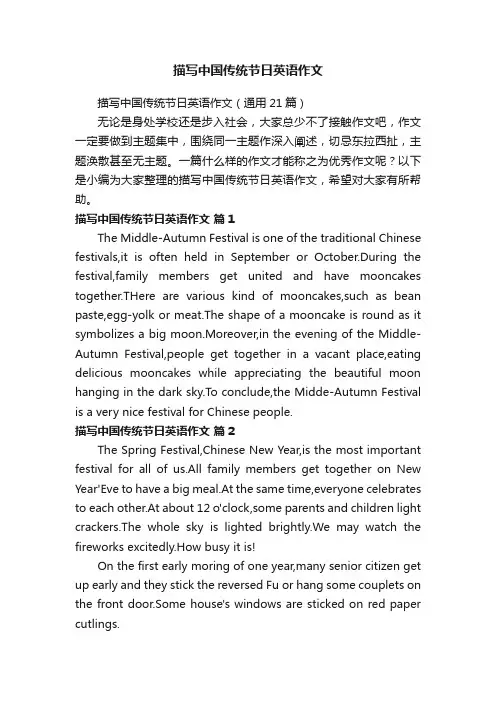
描写中国传统节日英语作文描写中国传统节日英语作文(通用21篇)无论是身处学校还是步入社会,大家总少不了接触作文吧,作文一定要做到主题集中,围绕同一主题作深入阐述,切忌东拉西扯,主题涣散甚至无主题。
一篇什么样的作文才能称之为优秀作文呢?以下是小编为大家整理的描写中国传统节日英语作文,希望对大家有所帮助。
描写中国传统节日英语作文篇1The Middle-Autumn Festival is one of the traditional Chinese festivals,it is often held in September or October.During the festival,family members get united and have mooncakes together.THere are various kind of mooncakes,such as bean paste,egg-yolk or meat.The shape of a mooncake is round as it symbolizes a big moon.Moreover,in the evening of the Middle-Autumn Festival,people get together in a vacant place,eating delicious mooncakes while appreciating the beautiful moon hanging in the dark sky.To conclude,the Midde-Autumn Festival is a very nice festival for Chinese people.描写中国传统节日英语作文篇2The Spring Festival,Chinese New Year,is the most important festival for all of us.All family members get together on New Year'Eve to have a big meal.At the same time,everyone celebrates to each other.At about 12 o'clock,some parents and children light crackers.The whole sky is lighted brightly.We may watch the fireworks excitedly.How busy it is!On the first early moring of one year,many senior citizen get up early and they stick the reversed Fu or hang some couplets on the front door.Some house's windows are sticked on red paper cutlings.The Chinese New Year lasts fifteen days.So during the fifteen days,we always visit our relatives from door to door.At that time,children are the happiest because they can get many red packets form their parents,grandparents,uncles,aunts and so on.The last day of the Chinese New Year is another festival.It names the Lantern Festival.So the Chinese New Year comes to the end.描写中国传统节日英语作文篇3There are a lot of holidays for chinese people,such as Nationalday,May Day,etc.However,chinese people look on spring festival as their most important one of all.And it's also my favorite festival,especially when I was a child,because In those days,I could have a plenty of delicious food to eat,enjoy a very long holiday and wear beautiful clothes.And what is more important is that I could received much new year's gift money.So,everyyear,I expected the spring festival would come soon.After I grew up,it's no longer as important to me as before .For I can have my delicious food and wear my favorite clothes every day.It's like I'm having spring festival every day!一年有很多节日,如国庆节,劳动节等等,但中国人看的最重的还是春节。
介绍自己最喜欢的中国传统文化英语作文
介绍自己最喜欢的中国传统文化英语作文One of my favorite Chinese traditional culture is the Chinese tea ceremony. The Chinese tea ceremony is a traditional practice that involves the preparation and consumption of tea. It is a way to enjoy the art of tea, and it has a long history and rich cultural significance in China.During the tea ceremony, there are specific steps and rituals that are followed to prepare and serve the tea. The tea is carefully selected and brewed, and then it is presented to the guests in a beautiful and graceful manner. The ceremony also emphasizes the importance of mindfulness and being present in the moment, as well as the appreciation of the beauty of nature.I am particularly drawn to the Chinese tea ceremony because of its emphasis on mindfulness and tranquility. It is a way to slow down and appreciate the simple pleasuresin life, and it provides a sense of calm and relaxation. The ceremony also encourages social bonding and the sharingof experiences, which I find to be very meaningful and valuable.The Chinese tea ceremony also has a deep cultural significance, as it has been a part of Chinese culture for thousands of years. It is a way to connect with the traditions and values of the past, and it serves as a reminder of the importance of preserving and honoring our cultural heritage.Overall, the Chinese tea ceremony is a beautiful and meaningful tradition that I greatly admire and enjoy. It embodies the values of mindfulness, tranquility, and cultural preservation, and it is a practice that I believe has a lot to offer in our modern, fast-paced world.我最喜欢的中国传统文化之一是中国茶艺。
给外国朋友介绍中国的传统文化 英语作文
给外国朋友介绍中国的传统文化英语作文全文共5篇示例,供读者参考篇1My Awesome Chinese CultureHi! My name is Xiaoming and I'm 10 years old. I was born in Beijing which is the capital city of China. China is a really big country in Asia with over 5,000 years of history and culture. I'm so excited to tell you all about the awesome traditions we have!Let me start with Chinese New Year. This is the biggest festival and celebration we have every year. The date changes a little based on the lunar calendar, but it's usually in late January or early February. For Chinese New Year, families get together and have a huge feast with lots of yummy foods like dumplings, noodles, fish, and sweet desserts. We decorate our houses with red lanterns, couplets with good luck symbols, and depictions of the zodiac animal for that year.Did you know the Chinese zodiac has 12 different animals that cycle every 12 years? 2023 was the Year of the Rabbit. I was born in the Year of the Horse. Each zodiac animal is believed to have different lucky traits. Isn't that cool?For New Year's Eve, we stay up really late to watch amazing fireworks and firecrackers light up the sky at midnight. The fireworks are so bright and colorful! Kids also receive red envelopes filled with "lucky money" from their parents and grandparents. My grandma always puts a crisp new bill in mine. One of my favorite traditions is hanging up paper cuts with lucky symbols and characters. My mom is a master at cutting the most intricate designs.Another big deal in Chinese culture is calligraphy and painting. Many homes have artwork and scrolls with ancient Chinese proverbs or poems written in beautiful brushstrokes. Chinese writing looks so elegant and artistic. My grandpa does calligraphy as a hobby and his works are hung all around our house. I'm trying to learn to write some basic characters too, but it's really hard!We also really value ancient philosophy and literature from scholars like Confucius and Lao Tzu. Confucius taught important ideas about ethics, respect for elders, education, and relationships that shaped Chinese culture for centuries. I'm still too young to fully understand it, but my parents say studying classics like these will shape my moral character as I grow older. Sounds important!When it comes to celebrations, another major holiday is the Mid-Autumn Festival. This one honors the full moon and the yearly harvest. We eat delicious mooncakes which are round pastries stuffed with lotus seed paste or other yummy fillings. I love the ones with salted egg yolks in the center! My family likes to get together, gaze at the full moon, and tell ancient legends and myths under the moonlight while eating mooncakes. It's a magical night.Speaking of legends, Chinese folklore has some wild stories! Like the tale of Ne Zha, a child deity who could re-attach his head after being decapitated. Or Sun Wukong, the Monkey King who could transform into all sorts of animals and wielded a magical staff that could grow huge or shrink down tiny. There are also tales of ferocious dragons, phoenix birds, terrifying demons, and mystical lands. The stories have so much imagination and fantasy.I could go on and on about Chinese martial arts, traditional medicine, jade/silk/porcelain crafts, architecture, cuisines, and everything else...but I'm running out of space here. Hopefully you can see how amazing and rich my cultural heritage is! We have spectacular festivals, deep philosophies, artistic writing, fantastical tales, and so many more customs and traditionsdeveloped over thousands of years. I'm really proud to be part of this incredible culture. You should totally come visit China sometime to experience it all yourself! Let me know if you have any other questions.篇2My Dear Foreign Friend,Hi there! I'm so excited to tell you all about the amazing traditional culture of China. You're going to love learning about it because it's super cool and goes way, way back in history. Get ready for some awesome stories and fun facts!First up, let me tell you about Chinese New Year. This is the biggest and most important festival we celebrate every year. The date changes a little bit each year because it follows the lunar calendar, but it's always in late January or early February. For Chinese New Year, we decorate our homes with red lanterns, red scrolls with lucky sayings, and papercuts of lucky symbols like the word 'Fu' which means good fortune.On New Year's Eve, we have a huge family dinner called the Reunion Dinner. All the relatives come over and we eat special foods like dumplings, fish, and nian gao (a sweet sticky rice cake). The fish is really important because the Chinese word for fish 'yu'sounds a lot like the word for leftovers, so we leave some uneaten to make sure we have leftovers for the new year to bring us luck!After dinner, we give the kids little red envelopes called'hong bao' with money inside for good luck. Then at midnight, we light firecrackers and watch amazing fireworks shows to celebrate and scare away any bad spirits or evil ghosts from the old year. For the next two weeks, we visit friends and family, watch dragon dances and lion dances, and eat lots of delicious festive foods. It's such a fun and exciting time!Another very old and important part of Chinese culture is the zodiac animals. There are 12 zodiac animals that represent each year in a cycle - the rat, ox, tiger, rabbit, dragon, snake, horse, sheep, monkey, rooster, dog, and pig. The year you are born in has a big influence on your personality traits according to Chinese beliefs. For example, people born in the year of the dragon are supposed to be brave, energetic, and natural leaders.All the zodiac animals have cool legends and myths behind them too. My favorite is the story of how the animals raced across a river to decide their order in the cycle. The rat was very sneaky and hitched a ride on the ox's back, jumping off at thelast second to come in first place! Each zodiac animal also has its own personality and lucky numbers, colors, flowers, and more.You might have seen the cute zodiac animal figurines or stuffed animals sold as decorations and gifts, especially around Chinese New Year. Matching your baby's zodiac animal and getting predictions are still important traditions in many families when a new child is born.Speaking of cute animals, I have to tell you about the four symbols that represent the main ideas in ancient Chinese philosophy and culture. They are the dragon, phoenix, tortoise, and unicorn (which we call the 'qilin'). These four spiritual creatures stand for the elements and values like courage, beauty, longevity, and wisdom.The dragon is the most famous one, symbolizing the Emperor and representing power, strength, and good luck. You'll see dragon images and carvings all over the place in China on palaces, temples, pagodas, and more. Phoenix carvings decorated the homes of the Empress and noblewomen because the bird represents virtue, beauty, and new life. The tortoise and qilin were very sacred and magical creatures too, both standing for long life, intelligence, and wisdom.These four spiritual animal symbols reflect the main ideas of ancient Chinese philosophies like Confucianism, Taoism, and Buddhism that shaped so much of China's culture for thousands of years. They taught moral values and ideas about living in harmony with nature and self-discipline that many Chinese people still try to follow today.Let me also tell you a little bit about the awesome stuff that ancient Chinese inventors and scholars came up with. You know about fireworks, gunpowder, and the compass, but did you know the ancient Chinese also invented paper, woodblock printing, the first playing cards, and kites? So cool!One of my favorite ancient Chinese inventions is calligraphy - the beautiful art of writing Chinese characters with a special brush and ink. It takes years to master, and the styles of calligraphy were traditionally linked to different philosophies and spiritual beliefs like Taoism, Buddhism, and Confucianism.The look of each character depends on factors like the balance of thick and thin brush strokes, the amount and density of ink used, and the composition or structure of the character on the page. To me, Chinese calligraphy looks almost like visual poetry or paintings - but they're all made up of written characters and words. Isn't that amazing?I wish I had more time to tell you about all the other awesome parts of traditional Chinese culture like martial arts, silk weaving, traditional medicines, and more. But I'm running out of space, so I'll leave you with one last fun fact - did you know that the very first examples of paper currency (banknotes) were created in China way back in the 7th century AD? Mind-blowing, right?Anyways, I hope you enjoyed learning a little bit about the rich traditional culture of China. There's just so much cool history, folklore, inventions, and customs dating back thousands of years. If you ever get a chance to visit China, I know you'll be blown away by all the beautiful ancient temples, palaces, gardens and more. Let me know if you have any other questions - I'd be happy to tell you even more stories next time!Your friend,[Your name]篇3My Foreign Friend, Let Me Tell You About Chinese Culture!Hi there! My name is Xiaoming and I'm 10 years old. I live in Beijing, the capital of China. Today I want to tell you all about my country's amazing traditional culture! China has such a longhistory, over 5,000 years, so our culture is super duper old and really fascinating. Get ready to learn some really cool stuff!First up, Chinese festivals! We have loads of traditional festivals that we celebrate every year. The biggest one is Chinese New Year. This usually happens in late January or early February. For New Year's we put up red decorations, eat special foods like dumplings and nian gao (a sticky rice cake), and set off a ton of firecrackers and fireworks! It's so loud and bright and fun. Kids also get red envelopes filled with money from their parents and grandparthe whole family gets together for a huge feast on New Year's Eve. Yum!Another big festival is the Mid-Autumn Festival in the fall. For this one, we eat mooncakes (sweet pastries) and admire the bright, full moon. There's a legend about a lady named Chang'e who lives on the moon! The Lantern Festival is pretty too - we hang up colorful lanterns and solve riddles written on them. During the Qingming Festival in spring, we visit the graves of our ancestors and tidy them up out of respect. So many cool festivals!Speaking of cool stuff, Chinese traditional clothing is awesome. You've probably seen qi pao or cheongsam dresses before - they're those pretty dresses that are tight at the top andget looser towards the bottom. Women wear those for fancy occasions. Men sometimes wear tang suits, which are kinda like shirts and pants. But the coolest outfits are the ones that emperors and nobles used to wear! They had long, flowing robes with amazing patterns and designs. The emperor's robe had a huge dragon on the front and back because the dragon was a symbol of power.Oh oh, let me tell you about some of the coolest places and buildings in China too! In Beijing, there's the Forbidden City which was the home of ancient emperors. It's this massive palace complex with nearly 1000 buildings and 9000 rooms! It has beautiful gardens, huge courtyards, and a massive wall around it. No wonder they called it "forbidden" - it was off limits to regular people back then! The Summer Palace in Beijing is another must-see. It centers around a massive lake and has amazing gardens, temples, bridges and pavilions.But the most famous sight is probably the Great Wall of China. This huuuuge wall winds across mountains and deserts for over 13,000 miles! It was built a long time ago to protect China from invaders. You can actually walk along portions of the wall - it's an incredible experience. Just watch out for the really steepsteps! China has so many other cool palaces, temples, gardens and UNESCO sites too.Now for my favorite part - Chinese arts and crafts! Chinese calligraphy using a brush and ink is so intricate and beautiful. Poets and scholars spent years perfecting their calligraphy skills. Speaking of poetry, there are tons of famous ancient Chinese poems you should check out someday. Chinese paintings are amazing too, especially landscape scenes with misty mountains, rivers and pagodas.But my #1 favorite is definitely Chinese opera! The performers wear such vibrant costumes with elaborate headpieces and makeup. The singing is loud and dramatic with performers making crazy vocal sounds. And the martial arts fighting sequences they act out are just mind-blowing! Flipping, kicking, tumbling - they make it look effortless but it takes years of training. I've been to a few operas and they are a dazzling spectacle.Other cool Chinese arts include paper cutting (which is just like it sounds - creating incredibly detailed paper cuttings), shadow puppetry (putting on little puppet shows behind a backlit screen), Beijing opera masks (colorful masks worn in, youguessed it, Beijing opera!), and making cloisonné enameled jewelry and vases. Chinese arts and crafts are so visually striking.Oh man, I could go on forever about Chinese culture but I'll wrap it up soon. I also have to mention martial arts like kung fu and wushu. Those choreographed fighting sequences with kicks, punches and acrobatics are just the coolest! Many kung fu styles and techniques actually originated at the famous Shaolin Monastery.Last but not least, Chinese food! You're probably familiar with dishes like dumplings, fried rice, noodles, and dim sum (little bite-sized dishes). But traditional Chinese cooking uses a lot of fresh veggies, tofu, pork, chicken, beef, and seafood. We looove to stir fry everything in a wok with garlic, ginger, soy sauce and other yummy seasonings. Chinese desserts like sesame balls, mango pudding, egg tarts and candied fruits are delish too. Okay, now I'm getting hungry thinking about it all!Well, that's just a tiny peek into China's amazing traditional culture. There's sooo much more I could tell you about - traditional Chinese medicine, tea culture, pottery, silk, jade, you name it. I hope you've learned some fun new things! Chinese culture is truly incredible with its long history, beautiful arts, delicious cuisine, cool festivals and more. I'm so lucky to grow upsurrounded by it all. Come visit China someday and you can experience it for yourself!篇4My Culture is Super Cool!Hi friends! I want to tell you all about the amazing culture of my country, China. We have such a long history going back thousands of years, with so many interesting traditions. Get ready to learn some really cool stuff!First up, let me tell you about our festivals. We sure do love celebrating in China! One of the biggest is Chinese New Year. This holiday lasts for 15 days of fun activities and events. We decorate our houses with red lanterns and papers with lucky symbols on them. Kids get red envelopes filled with money, how awesome is that? We also set off a ton of firecrackers and fireworks to scare away evil spirits. Yummy foods like dumplings and noodles are shared during New Year too.Another big festival is the Mid-Autumn Festival. This one is all about celebrating the bright, beautiful moon. We eat special moon cakes filled with lotus seed paste or other yummy fillings. Kids get to carry cute little lanterns and there are big lanternshows with dragons and other cool lantern shapes. So pretty at night!Then there's the Qingming Festival, which honors our ancestors. Families visit graves, clean them up nicely and make offerings like food, flowers or burn paper money and objects for their ancestors' spirits. We also fly colorful kites during this festival. So much fun!Our traditional clothes are super elegant too. We call them hanfu. There are different styles for men and women, with beautiful colors and embroidery. My favorite are the dresses with wide flowing sleeves for ladies. They look like lovely butterfly wings! The kids' hanfu outfits are cute too, with little vests or jackets over long robes.Speaking of clothes, you should see our traditional Chinese opera costumes! The colors are so bright and vivid. The actors wear thick makeup with special paintings on their faces. The female role costumes have these incredible long silk sleeves and decorated headdresses called phoenix crowns. The costumes make the actors look like real life warriors, heroes and beauties from ancient times!China is famous for its four great inventions too - the compass, gunpowder, printing and papermaking. The magneticcompass was a brilliant navigation tool that helped explorers travel safely in ancient times. Gunpowder was originally used just for fireworks, but then got used for weapons too. Can you imagine reading books or going to school without paper? That's why papermaking was such an amazing invention that spread worldwide. Printing using wooden blocks was also first developed in China before modern day printing presses.Our traditional arts are stunning as well. Chinese calligraphy where ink brushes paint beautiful handwritten characters is a respected art form. It looks so graceful and people spend years perfecting it. Then there's the colored opaque glass decorations called liuli that are just mesmerizing to look at. The glass swirls of colors are made into vases, sculptures and other pretty artwork using very old techniques.Martial arts like kung fu are a very cool part of Chinese culture too! Kung fu fighters train their minds and bodies using different animal styles like the snake or monkey styles. They learn to use staffs, swords and other weapons for fighting moves that look like dances. Speaking of dances, we have traditional lion and dragon dances for celebrations where the costumes are operated by dozens of dancers working together. So much skill is needed for these dances that involve acrobatics too!Our architecture has some of the most striking buildings on earth. The Forbidden City in Beijing was the grand palace for emperors and has over 9000 rooms! The entire palace complex is made of carved wooden structures with beautiful roofs covered in yellow glazed tiles. So majestic! The Temple of Heaven in Beijing is another incredible masterpiece, with blue tiledcone-shaped roofs adorned with intricate ceramic decorations.Of course I have to mention Chinese food! Our cuisine differs across regions but some staple dishes are dumplings, noodles, rice, stir fries with veggies and meat, steamed buns, and dim sum small plates. We use a ton of different sauces like soy sauce, oyster sauce, hoisin sauce and more that pack so much flavor. And don't forget about our beloved hot pot, where you cook your own meats and veggies in a boiling soup! Yum!That's just a small taste of the wonders of Chinese culture. There's honestly too much to fit into one essay. I'm so proud of my country's incredible history and heritage that has given the world so many contributions. Chinese culture rocks!篇5Hello my friend! Today I want to tell you all about the awesome traditional culture of China. It's super cool and goes way way back to ancient times.First, I have to talk about Chinese festivals. We have so many fun festivals! The biggest one is Chinese New Year. This is when we welcome the new year with a huge celebration lasting 15 days! We decorate our homes with red lanterns, red is a lucky color. On New Year's Eve, we have a massive family dinner called a reunion dinner. All the families get together and eat amazing food like dumplings and noodles. After dinner, kids get lucky red envelopes with money inside from their parents and grandparents. So awesome! During the 15 days, we watch dragon and lion dances performed on the streets and visit temples. It's a vibrant, joyful time.Another big festival is the Mid-Autumn Festival. This one celebrates the autumn moon and the yearly harvest. We eat delicious mooncakes which are round pastries filled with lotus seed paste or other sweet fillings. People also hang lanterns and there are lantern festivals at night which are breathtaking. The Lantern Festival marks the end of the New Year celebrations too.Then there are tons of other festivals like the Qingming Festival to remember ancestors, the Dragon Boat Festival withdragon boat races and zongzi rice dumplings, and the Qixi Festival which is like a Chinese Valentine's Day. Festivals are super important in Chinese culture!Speaking of food, Chinese cuisine is out of this world! We have so many different regional styles like Cantonese, Sichuan, Hunan and more. My favorite is Sichuan food which is nice and spicy! Must-try dishes are dumplings, noodles, steamed buns, Peking duck, hot pot and dim sum. Chinese food is famous for using fresh ingredients and having sophisticated flavors and cooking techniques that go back thousands of years.Another huge part of Chinese culture is traditional arts and crafts. Chinese opera is a classic performing art that combines music, singing, dancing, martial arts and amazing costumes and makeup. It dates back to 200 AD! Then we have arts like calligraphy writing with brushes, ink painting on silk or paper, paper cutting, pottery, jade carving, embroidery and so much more. Chinese arts and crafts use beautiful, symbolic designs with elements like dragons, phoenixes, peonies and landscapes.Let me tell you about some famous ancient attractions too. First is the Great Wall of China, one of the man-made wonders of the world! It was built over 2000 years ago to protect from invaders and it snakes across mountains for thousands of miles.So incredible to walk on! The Forbidden City in Beijing used to be the home of emperors. It's a massive palace complex with temples, gardens and museums now.I can't leave out Chinese philosophy, which had a big impact on culture. The main philosophies are Confucianism, which teaches ethical principles for society like respect and kindness; Taoism, which teaches living in harmony with nature; and Buddhism, which originated in India but became very popular in China too. These ideas shaped Chinese beliefs about morality, nature and the cosmos.Finally, Chinese culture has deep traditions of medicine, science, inventions and literature too! Traditional Chinese medicine uses natural herbs and treatments. The four great inventions of ancient China are the compass, gunpowder, printing and papermaking - how cool is that?! Famous classics of Chinese literature include Journey to the West, Romance of the Three Kingdoms, and poets like Li Bai.There's just soooo much about China's long, incredible cultural history. I hope this gives you a little taste of the vibrant festivals, delicious cuisine, beautiful arts and ancient traditions. Chinese culture has had such a big impact on the world forcenturies. I'm proud to share this intro with you! Let me know if you have any other questions.。
高中英语 高考英语作文有关中国传统文化的范文5篇
高中英语高考英语作文有关中国传统文化的范文5篇范文一:Title: The Beauty of Chinese Traditional CultureIntroduction: Chinese traditional culture is known for its richness and profundity. In this essay, we will explore five aspects of Chinese traditional culture: Confucianism, Chinese calligraphy, Chinese painting, traditional festivals, and Chinese cuisine.Body:1. Confucianism: Confucianism is an ethical and philosophical system that has had a profound impact on Chinese society. It emphasizes the importance of filial piety, respect for elders, and moral virtues. These principles have shaped Chinese social values and etiquette.2. Chinese Calligraphy: Chinese calligraphy is not only a form of artistic expression but also a way to cultivate one's character. It requires patience, concentration, and precision. The strokes and characters in calligraphy reflect the beauty and elegance of Chinese culture.3. Chinese Painting: Chinese painting is another important aspect of traditional culture. It embodies the Chinese philosophy of harmony between man and nature. Traditional Chinese paintings often depict landscapes, flowers, and birds, expressing the artist's inner world and appreciation for nature.4. Traditional Festivals: Chinese traditional festivals, such as the Spring Festival and Mid-Autumn Festival, are an integral part of Chinese culture. These festivals are occasions for family reunions, traditional rituals, and the exchange of blessings. They provide an opportunity for people to connect with their roots and celebrate their cultural heritage.5. Chinese Cuisine: Chinese cuisine is renowned for its diversity and unique flavors. It reflects the Chinese philosophy of balancing yin and yang, as well as the importance of harmony in taste and nutrition. From dim sum to hotpot, Chinese cuisine has become a global culinary sensation.Conclusion: Chinese traditional culture is a treasure that has been passed down from generation to generation. It embodies the wisdom, values, and aesthetics of the Chinese people. As young individuals, we should take pride in our cultural heritage and strive to promote and preserve it for future generations.范文二:Title: The Significance of Traditional Chinese FestivalsIntroduction: Traditional Chinese festivals are an important part of Chinese culture. In this essay, we will explore the significance of three major Chinese festivals: the Spring Festival, the Dragon Boat Festival, and the Mid-Autumn Festival.Body:1. The Spring Festival: The Spring Festival, also known as Chinese New Year, is the most important festival in Chinese culture. It marks the beginning of the lunar new year and is a time for family reunions, feasting, and celebrations. It is believed that celebrating the Spring Festival will bring good luck and prosperity for the coming year.2. The Dragon Boat Festival: The Dragon Boat Festival, celebrated on the fifth day of the fifth lunar month, commemorates the ancient poet Qu Yuan. People participate in dragon boat races and eat zongzi, a traditional sticky rice dumpling wrapped in bamboo leaves. The festival symbolizes the spirit of teamwork, bravery, and the pursuit of justice.3. The Mid-Autumn Festival: The Mid-Autumn Festival, also known as the Moon Festival, is celebrated on the 15th day of the eighth lunar month. It is a time for family gatherings and moon-watching. People eat mooncakes, a special pastry filled with various sweet or savory fillings. The festival symbolizes unity, harmony, and the appreciation of the moon's beauty.Conclusion: Traditional Chinese festivals not only provide a glimpse into the rich cultural heritage of China but also serve as a platform for fostering family bonds, preserving traditions, and promoting cultural exchange. They are an important part of Chinese identity and should be cherished and celebrated by future generations.范文三:Title: The Enduring Legacy of Chinese Traditional MedicineIntroduction: Chinese traditional medicine, with its long history and unique theories, has played a significant role in the health and well-being of the Chinese people. In this essay, we will explore the enduring legacy of Chinese traditional medicine.Body:1. Holistic Approach: Chinese traditional medicine takes a holistic approach to health, focusing on the balance between the body, mind, and environment. It emphasizesthe prevention of diseases and the maintenance of overall well-being through practices such as acupuncture, herbal medicine, and tai chi.2. Yin-Yang Theory: The concept of yin and yang is fundamental to Chinese traditional medicine. It represents the opposing but complementary forces in the universe and in the human body. The balance of yin and yang is believed to be essential for good health.3. Herbal Medicine: Chinese traditional medicine utilizes a wide range of herbs to treat various ailments. These herbs are carefully selected and combined to create personalized prescriptions based on individual needs. Chinese herbal medicine has been proven effective in treating chronic conditions and improving overall health.4. Acupuncture: Acupuncture is a technique that involves inserting thin needles into specific points on the body to stimulate energy flow and restore balance. It has been used for thousands of years to alleviate pain, promote healing, and improve overall well-being. Acupuncture has gained recognition and popularity worldwide.Conclusion: Chinese traditional medicine is a treasure trove of wisdom and knowledge that has stood the test of time. Its holistic approach, yin-yang theory, herbal medicine, and acupuncture have provided effective solutions to countless health problems. As we embrace modern medicine, we should also appreciate and preserve the enduring legacy of Chinese traditional medicine for the benefit of future generations.范文四:Title: The Art of Chinese CalligraphyIntroduction: Chinese calligraphy, known as "shufa" in Chinese, is not only a form of writing but also an art form that embodies the beauty and aesthetics of the Chinese culture. In this essay, we will explore the art of Chinese calligraphy.Body:1. Historical Significance: Chinese calligraphy has a long history dating back thousands of years. It has been considered one of the highest forms of art in Chinese culture. Many famous Chinese scholars and emperors were skilled calligraphers, and their works have been treasured and admired throughout history.2. Aesthetic Principles: Chinese calligraphy is guided by various aesthetic principles, including balance, rhythm, and harmony. The strokes and characters are meticulously crafted to create a sense of rhythm and balance. The composition of the characters is also important, with each stroke and component carefullyconsidered to achieve visual harmony.3. Personal Expression: Calligraphy is not merely about copying characters but also a way for artists to express their emotions and inner world. Each calligrapher has their own unique style and brushwork, which reflects their personality and individuality. Calligraphy is a means of self-expression and a reflection of the calligrapher's spirit.4. Cultivation of Character: The practice of calligraphy requires patience, concentration, and discipline. It is not only a way to create beautiful characters but also a means of cultivating one's character. The process of writing characters can be meditative and helps to develop qualities such as focus, perseverance, and attention to detail.Conclusion: Chinese calligraphy is not just a form of writing but also an art form that embodies the beauty and aesthetics of Chinese culture. It is a reflection of history, a means of personal expression, and a way to cultivate one's character. The art of Chinese calligraphy should be cherished and appreciated as an important part of our cultural heritage.范文五:Title: Chinese Traditional Cuisine: A Culinary DelightIntroduction: Chinese cuisine is renowned worldwide for its diversity, flavors, and unique cooking techniques. In this essay, we will explore the richness and culinary delights of Chinese traditional cuisine.Body:1. Regional Diversity: China is a vast country with diverse regional cuisines. From the fiery flavors of Sichuan cuisine to the delicate and subtle flavors of Cantonese cuisine, each region has its own unique culinary traditions and specialties. This diversity reflects the rich cultural heritage and geographical differences of China.2. Balance of Flavors: Chinese cuisine places great importance on the balance of flavors. The five key flavors - sweet, sour, bitter, spicy, and salty - are often combined to create a harmonious taste. The combination of different ingredients and seasonings in Chinese cooking results in a complex and satisfying flavor profile.3. Culinary Techniques: Chinese cuisine is known for its various cooking techniques, such as stir-frying, steaming, braising, and deep-frying. These techniques are used to bring out the natural flavors and textures of the ingredients while preserving their nutritional value.4. Cultural Significance: Food has always held a special place in Chinese culture. It is not just about sustenance but also a way to express love, hospitality, and cultural traditions. Chinese traditional cuisine is often associated with festivals, family gatherings, and important occasions, where food plays a central role in bringing people together.Conclusion: Chinese traditional cuisine is a culinary delight that reflects the diversity, flavors, and cultural significance of China. It is a testament to the rich culinary heritage and traditions that have been passed down through generations. As we continue to appreciate and enjoy Chinese cuisine, we also honor and preserve an important part of our cultural identity.。
高考英语作文 范文5篇 中国传统文化
高考英语作文范文5篇中国传统文化1. Title: The Importance of Preserving Chinese Traditional CultureContent: In this essay, I will discuss the significance of preserving Chinese traditional culture. Firstly, I will explain how traditional culture reflects the essence of a nation and serves as a cultural heritage. Secondly, I will explore how the preservation of traditional culture promotes national unity and pride. Lastly, I will suggest some effective measures to preserve and promote traditional culture.2. Title: The Influence of Chinese Traditional Culture on Modern SocietyContent: This essay will examine the impact of Chinese traditional culture on modern society. I will discuss how traditional values, such as filial piety and respect for elders, continue to shape our social relationships and moral standards. Additionally, I will explore how traditional arts, such as calligraphy and traditional opera, contribute to the enrichment of modern cultural life.3. Title: The Revival of Chinese Traditional Culture in the Digital AgeContent: In this essay, I will discuss how traditional Chinese culture can be revived and promoted in the digital age. I will highlight the role of the internet and social media platforms in spreading traditional cultural knowledge and fostering cultural exchange. Furthermore, I will suggest ways in which individuals and organizations can actively participate in preserving and promoting traditional culture through digital means.4. Title: The Significance of Traditional Chinese FestivalsContent: This essay will explore the importance of traditional Chinese festivals. I will discuss how festivals like Spring Festival and Mid-Autumn Festival not only provide opportunities for family reunions but also serve as a way to pass down cultural values and customs from one generation to another. Moreover, I will highlight the role of traditional festivals in promoting cultural diversity and understanding.5. Title: The Cultural Exchange Between Chinese Traditional Culture and the WorldContent: In this essay, I will discuss the cultural exchange between Chinese traditional culture and the world. I will examine how traditional Chinese elements, such as Chinese cuisine and traditional medicine, have gained international recognition and influence. Furthermore, I will explore the benefits of cultural exchange in fostering mutual understanding and appreciation among different cultures.。