
英语四级真题:2024年6月大学英语四级听力原文
英语四级真题:2024年6月大学英语四级听力原文
大学英语四级听力考试是英语水平测试的重要组成部分,考查学生在英语听力方面的实际能力。
2024年6月的大学英语四级听力原文题目及内容如下:
Part I
Directions: In this part, you will hear 8 short conversations. At the end of each conversation, a question will be asked. Both the conversation and the question will be spoken twice. After each question, you will have 15 seconds to choose the best answer from the four choices marked A, B, C and D.
1、M: The concert starts at 7:30. Let's hurry up. W: I'm sorry,
I can't go with you. I have to finish this report first. Q: Why can't the woman go to the concert with the man? A. She is not interested in music. B. She has an important meeting to attend.
C. She has to finish a report.
D. She is sick and tired.
2、M: Are you free this Sunday afternoon? W: Yes, why? M: Would you like to go watch a football match? W: Oh, no. I've never been interested in football. Q: What is the woman's attitude towards watching a football match? A. Positive. B. Negative.
C. Neutral.
D. Indifferent.
3、M: What a nice watch! Is it new? W: Yes, my husband bought it for me last month. M: Oh, it's beautiful. But I've never seen him wear a watch. Q: What can we infer from the conversation?
A. The man doesn't like watches.
B. The woman doesn't know her husband well.
C. The woman's husband doesn't wear a watch.
D. The man is uninterested in watches.
Part II
Directions: In this part, you will hear 2 long conversations. At the end of each conversation, you will hear some questions. Both the conversation and the questions will be spoken twice. After each question, you will have 20 seconds to answer the question.
4、M: Hi, Mary, how was your weekend? W: It was great! I went to the beach with my family and had a lot of fun in the sun. M: That sounds nice. What did you do there? W: We played beach volleyball, built sandcastles, and went for swimming in the sea. It was really relaxing and enjoyable. M: Sounds like you had a blast! What did you do on the last day? W: We went to a nice seafood restaurant and had some delicious meals. It was a perfect ending to a wonderful weekend. Q: What did the woman do on the last day of her weekend? A. She played beach volleyball.
B. She built sandcastles.
C. She went for swimming in the sea.
D. She went to a seafood restaurant and had meals.
41、M: Hi, Sarah, how was your trip to Europe? W: It was fantastic!
I visited several countries and saw many beautiful景点. M: That's great. Which country did you like best? W: Well, I really loved Italy because of its famous art and culture. And I also enjoyed visiting France because of its delicious food and fashion industry. M: Sounds like you had an excellent time! Did you take any photos? W: Yes, I took many photos of the景点and the food. I'll show you some of them when we meet next time. Q: What does the woman say about her trip to Europe?。
2024年6月第3套英语四级真题
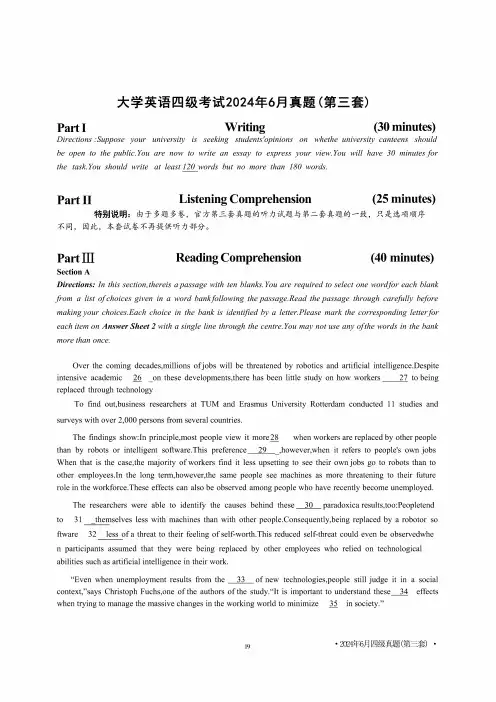
大学英语四级考试2024年6月真题(第三套)Part I Writing(30minutes) Directions:Suppose your university is seeking students'opinions on whethe university canteens should be open to the public.You are now to write an essay to express your view.You will have30minutes for the task.You should write at least120words but no more than180words.Part II Listening Comprehension(25minutes)特别说明:由于多题多卷,官方第三套真题的听力试题与第二套真题的一致,只是选项顺序不同,因此,本套试卷不再提供听力部分。
Part III Reading Comprehension(40minutes) Section ADirections:In this section,thereis a passage with ten blanks.You are required to select one wordfor each blank from a list of c hoices given in a word bankfollowing the passage.Read the passage through carefully before making your choices.Each choice in the bank is identified by a letter.Please mark the corresponding letter f or each item on Answer Sheet2with a single line through the centre.You may not use any of t he words in the bank more than once.Over the coming decades,millions of j obs will be threatened by robotics and artificial intelligence.Despite intensive academic26on these developments,there has been little study on how workers27to being replaced through technologyTo find out,business researchers at TUM and Erasmus University Rotterdam conducted11studies and surveys with over2,000persons from several countries.The findings show:In principle,most people view it more28when workers are replaced by other people than by robots or intelligent software.This preference29however,when it refers to people's own jobs When that is the case,the majority of workers find it less upsetting to see their own jobs go to robots than to other employees.In the long term,however,the same people see machines as more threatening to their future role in the workforce.These effects can also be observed among people who have recently become unemployed.The researchers were able to identify the causes behind these30paradoxica results,too:Peopletend to31themselves less with machines than with other people.Consequently,being replaced by a robotor so ftware32less of a threat to their feeling of self-worth.This reduced self-threat could even be observedwhe n participants assumed that they were being replaced by other employees who relied on technological abilities such as artificial intelligence in their work."Even when unemployment results from the33of new technologies,people still judge it in a social context,"says Christoph Fuchs,one of the authors of the study."It is important to understand these34effects when trying to manage the massive changes in the working world to minimize35in society."19.202样6月四级真题(M三套).A)compare I)introductionB)contradicts^modificationsC)conventional K)posesD)debate L)psychologicalE)disruptions M)reactF)drastically N)reversesG)favorably O)seeminglyH)guaranteeSection BDirections:In this section,you are going to read a p assage with ten statements attached to it.E ach statement contains information given in one of t he paragraphs.Identify the paragraph f rom which the information is derived.You may choose a paragraph more than once.Each paragraph is marked with a letter.Answer the questions by marking the correspondingletter on Answer Sheet2.No escape as'snow day!becomes fe-learning day'A)C ertain institutions,such as schools,are likely to close when bad weather,such as snow,flooding or extremeheat or cold,causes travel difficulties,power outages(断供),or otherwise endangers public safety.When snowy weather arrives in the US,it means the chance of school children benefiting from the long-standing tradition of t he"snow day",when schools are forced to close and students get an unexpected day offB)The criterion for a snow day is primarily the inability of school buses to operate safely on their routes anddanger to children who walk to school.Often,the school remains officially open even though buses do not run and classes arecanceled.Severe weather that causes cancellation or delayis more likely in regions that are less able to handle the situation.Snow days are less common in more northern areas of t he United States that are used to heavy winter snowfall,because municipalities are well equipped to clear roads and remove snow.In areas less accustomed to snow even small snowfalls of a n inch ortwo may render roads unsafe.C)S now days are a familiar theme in American film and TV shows,with children getting the good news andthen running outside for some seasonal snowman-building and snowball throwing,against a background ofjoyful pop music.But the tradition is now over for pupils in several US states such as South Carolina, Nevada,Georgia and Indiana.This academic year,many school boards have introduced policies which require students to work from home if t he school is shut by snow or extreme weather.They are known as t4e-leaming days",which certainly sounds less fon than a snow day.D)T eachers are also losing their snow days and instead will be expected to be on hand to take a virtual registerand answer students'questions online.A pilot programme in a school district in Anderson County,South Carolina,has supplied students with electronic tablets loaded with assignments to complete in the event of a school closure.If it is successful,it could be rolled out across the state.E)But some parents object to the new policy if t he vigorous debate on the Facebook page of A nderson Countyschool district is anything to go by."When it snows,let the kids enjoy it,"said one commenter.Another said the decision would"ruin school even more",and someone else called snow days"a fun part of c hildhood,^.But supporters of t he policy say it means children will miss fewer days of school.lt will also bring to an enda less popular US high school tradition:the“make-up day?,,which requires students in many states to makeup the time lost due to weatherby working during school holidays.-2024年6月四级真题第三套)-2)F) S tudents in North Carolina already have several make-up days scheduled because of school closures duringHurricane Florence,which struck in September.Tom Wilson,the superintendent(i^)of Anderson County school district,said the change away from snow days makes practical and financial sense.He said technology has changed every profession,so it makes sense to use it to^eliminate^make-up days.Adam Baker of the Department of Education in Indiana said e-learning days were proving a cc great success,^.He said most Indiana schools already use digital devices during lessons,so it was an cc easy decision^to extend this to days when schools are closed.He denies the decision is depriving children of the chance to enjoy the snow."Students are still able to enjoy snow days and outside time,"he said."Many have PE and science assignments that have them out enjoying the weather.^But local school superintendents in Ohio are resisting proposals to adopt e-learning days.They fear that students without internet access at home will be disadvantaged by the policy,and superintendent Tom Roth is concerned that e-learning days will offer a lower quality of education.G)T here are also so-called tc blizzard bags",with assignments that children take home ahead of an expected snowclosure.But Mr Roth says it is not sufficient as a replacement/!think we still need the class time to give our kids the education that they deserve,^he said."Youcan't get that with a blizzard bag or doing the work from home like that.If s not going to be as effective.H) T here is a long-running debate on whether missing days of school affects attainment.In England,there hasbeen a focus on tackling absenteeism(0T from school.The Department for Education(DFE)published research in2016arguing that missing any days at school could have a negative impact on results.Even a few days lost in a year could be enough to miss out on getting a good exam grade,the DFE's research concluded.This differed from the findings of a study from Harvard University in the US,which concluded that missing a few occasional days because of t he weather did not damage learning.I)The Harvard study examined seven years of school results data and could not find any impact from snowclosures.What caused moredisruption was when schools tried to stay open in bad weather,even though many staff and pupils were absent.But weather can make a difference to school results,according to another piece of Harvard research published last summer.Ifs hot weather that has the negative impact.The results of 10million school students were examined over13years and researchers found a^significanfUink between years with extremely hotweather and lower results.J)I fs obvious that students should go to school every day to get the most out of education.I n cases of extreme weather students don't always have that option.However,research shows that authorised absences from school such as during extreme weather are less problematic for students than absences that are not authorised.This is because unauthorised absences tend to reflect patterns and behaviours of student disengagement,or the possible negative attitudes of parents towards education that students adopt and carry with them through schooling.The level of impact on students f educational performance is all to do with the length of time that a student is absent from school and how regularly this occurs.36.There is opposition to the practice of giving children assignments to take home before extreme weather forcesa school closure.37.N ew policies adopted by many US schools require students to do online learning at home in case of a schoolclosure38.A ccording to some research,extreme hot weather negatively affects students^erfbrmance.39.There is a time-honoured tradition in the US fbr school kids to stay at home on^snow days".21.202仰6月四级真题(M三套).40.Debates on social media show some parents are opposed to ending the^snowday^tradition.41.In more northern regions of t he US,school is less likely to be affected by snowy weather.42.R esearch indicates absences from school with permission do not cause as many problems as those withoutpermission.43.T here is objection to e-learning days owing to fear that students with no access to the Internet at home willsuffer44.In a pilot programme,students are given electronic devices to doassignments when schools areclosed.45.A long-standing debate is going on over the impact of school absences on students^cademic performance.Section CDirections:There are2passages in this section.Each passage is followed by some questions or unfinished statements.For each of them there are f our choices marked A),B),C)and D).You should decide on the best choice and mark the corresponding letter on Answer Sheet2with a single line through the centre.Passage OneQuestions46to50are based on the following passage.It may sound surprising,but you don't have to be interested in fashion,or even in history,to enjoy Dress Codes:H ow the Laws of F ashion Made History.I happen to be interested in both,and ended up enjoying the book for completely different reasons.Richard Thompson Ford is a law professor,and you probably won't forget that for even one page.His carefully reasoned arguments,packed with examples,sound almost like reading a court opinion,only maybe wordier.Y ou will probably never think of fashion as a trifle again.Ford's thesis is that the best way to understand what particular fashions meant in any given era is to look at the restrictions placed on them.Through this lens,he shows us that the first laws passed in the1200s to ensure that only the nobility were allowed to wear certain fabrics,colors and ornaments reflected the rise of the middle class,who were now able to imitate some of these fashions.The status of the upper classes was threatened; fashion was a tool to preserve it.Ford takes the reader through the evolution of fashion while examining the underlying motivations of status sex,power,and personality,which,he assumes,influenced all innovations in fashion in the past and which continue to influence us today.His writing is more than alittle dense—dense with research,clauses,and precise adjectives and nouns.But there's also humor and enough interesting episodes to make the writing appealing.No one is spared his sharp analysis:not the easy targets of19th century women's crippling(伤害身体的)fashions nor the modem uniforms of Silicon Valley T-shirts.But the greatest strength of this book(on fashion!)is its intellectual profoundness.Ford asks us to question unconscious beliefs,to realize thatwe almost never do so,to understand that the simplest choices are charged with meaning,and yet that meaning can and does change all thetime.Consider the fact that a1918catalog insisted that boys and girls be dressed in the appropriate color.We believe our thinking today is evolved;Ford shows us it's not.46.W hat does the author think of t he book Dress Codes:How the Laws of F ashion Made History?A)I t is read by people fbr entirely different reasonsB) I t is meant fbr those interested in fashion history.202砰6月四级真题三套).22C)I t makes enjoyable as well as informative reading.D)I t converts fashion into something fbr deliberation.47.H ow can people best understand a particular fashion in an era,according to Ford?A)B y examining the restraints imposed on it.C)By glancing at its fabrics,colors and ornaments.B)B y looking at what the nobility were wearing.D)By doing a survey of t he upper and middle classes.48. W hat was the aim of t he first laws passed regarding fashion in the1200s?A)T o facilitate the rise of the middle class C)To help initiate some novel fashions.B)T o loosen restrictions on dress codes.D)To preserve the status of the nobles.49. W hat does the author think of Ford's writing?A)I t uses comparison and contrast in describing fashions of different erasB)I t makes heavy reading but is not lacking in humor or appealC)It is filled with interesting episodes to spare readers intolerable boredom.D)I t is characteristic of academics in presenting arguments.50.W hat does the author say is the greatest strength of F ord's book?A)P lentiful information.C)Evolved thinkingB)M eaningful choices.D)Intellectual depthPassage TwoQuestions51to55are based on the followingpassage.The art of p ersuasion means convincing others to agree with your point of view or to follow your course of action.For some ofus,persuasion is an instinctive quality and the power of influencing comes naturally.For the rest of u s,persuasion skills can be learned and developed over time.Employers place a great value on employees with persuasion skills because they can impact several aspects of j ob perfbrmance.Besides,teamwork and leadership rely heavily on the power of persuasion to get things done.Without persuasion skills,employees may not be as committed to or convinced of the importance of an organization^vision and long-term mission.Effective use of persuasion skills will not only help get your coworkers excited about your ideas,ifll also help you motivate them to achieve a common goal.In order to learn the art of persuasion at the workplace,you need to understand how to handle conflicts and reach agreements.Good communication is the first step in effective persuasion,but logic and reasoning are just as important.Befbre you can get somebody on-board with your goal,you should help them understand why they should pursue ing visual aids to back up your ideas can help communicate your ideas better and make compelling arguments so your listeners will come to a logical choice and become fully committed to your ideas and plans.Successful persuasion skills are based on your ability to have positive interactions and maintain meaningful relationships with people.In order to sustain thoserelationships,you must be able to work in their best interests as well.Your coworkers are more likely to agree with you when they succeed alongside you.The more they achieve and the greaterprogress they make,the more they trust your judgement and strength.We persuade and get persuaded every daywe're either convincing or being convinced.A vast majority of people prefer collaboration and teamwork over traditional organizational structures;no one likes to be told what to do or to be pushed around.Therefore,organizations and leaders should adopt powerful persuasion skills to bring about necessary changes.23.202砰6月四级真题三套).51.What does the author say about the ability to be persuasive in the first paragraph?A)P eople may either be born with it or be able to cultivate it.B) I t proves crucial in making others follow one's course of action.C)It refers to the natural and instinctive power of influencing one!s coworkers.D)P eople may view it as both a means to convince others and an art of communication.52.Why are persuasion skills greatly valued in the workplace?A)T hey enable employees to be convinced oftheir long-term gains.B) T hey enable employees to trust their leaders unconditionally.C)They help motivate coworkers to strive for a common goal.D)T hey help an organization to broaden its vision effectively.53.W hat should people do to learn the art of p ersuasion atthe workplace?A)A cquire effective communication skills.C)Understand the reason for pursuing their goalsB) A void getting involved in conflicts with others.D)Commit themselves fully to their ideas and plans54.W hen are you more likely to succeed in persuading your coworkers?A)W hen they are convinced you work in their interests while sacrificing your own.B)W hen they become aware of the potential strength of t he judgements you make.C)When they become aware of t he meaningful relationships you keep with them.D)W hen they are convinced they will make achievements together with you.55.W hy are organizations and leaders advised to adopt powerful persuasion skills to bring about necessarychanges?A)T o convince employees of t he value of collaboration.B)T o allow for the preferences of m ost people of t odayC)To improve on traditional organizational structuresD)T o adapt to employees'ever-changing working styles.Part IV Translation(30minutes) Directions:For this part,you are allowed30minutes to translate a passage f rom Chinese into English.You should write y our answer on Answer Sheet2.汉语中的“福”字(the character fU)表示幸福和好运,是中国传统文化中最常用的吉祥(auspicious符号之一。
2024年6月四级英语试卷

2024年6月四级英语试卷Part I Writing (30 minutes)Directions: For this part, you are allowed 30 minutes to write an essay on the topic "The Importance of Cultural Heritage Protection". You should write at least 120 words but no more than 180 words.Part II Listening Comprehension (25 minutes)Section A.Directions: In this section, you will hear three news reports. At the end of each news report, you will hear two or three questions. Both the news report and the questions will be spoken only once. After you hear a question, you must choose the best answer from the four choices marked A), B), C) and D).News Report 1.Questions 1 and 2 will be based on the following news item.A new study shows that urban green spaces can significantly reduce the risk of certain diseases. The research, which was conducted over a five - year period in several major cities, found that people living near large parks or gardens had a lower incidence of respiratory and heart diseases compared to those in areas with little or no greenery.1. What did the new study mainly find?A) Urban green spaces are getting smaller.B) People prefer to live near large parks.C) Green spaces can reduce disease risks.D) Respiratory diseases are on the rise.2. How long was the research period?A) Three years.B) Four years.C) Five years.D) Six years.News Report 2.Questions 3 and 4 will be based on the following news item.A well - known tech company has announced a major breakthrough in battery technology. The new battery is said to be more efficient, longer - lasting, and safer than current models. This could have a huge impact on the development of electric vehicles and portable electronics.3. What is the achievement of the tech company?A) A new type of electric vehicle.B) A major breakthrough in battery technology.C) A new marketing strategy for electronics.D) An improvement in portable electronics.4. Which fields could be influenced by this achievement?A) Only electric vehicles.B) Only portable electronics.C) Both electric vehicles and portable electronics.D) Neither electric vehicles nor portable electronics.News Report 3.Questions 5 to 7 will be based on the following news item.A group of international scientists has discovered a new species of deep - sea fish. The fish was found at a depth of over 2,000 meters in the Pacific Ocean. It has unique physical characteristics that distinguish it from other known species.5. Where was the new species of fish discovered?A) In the Atlantic Ocean.B) In the Indian Ocean.C) In the Arctic Ocean.D) In the Pacific Ocean.6. At what depth was the fish found?A) Over 1,000 meters.B) Over 2,000 meters.C) Over 3,000 meters.D) Over 4,000 meters.7. What makes the new fish different from others?A) Its color.B) Its size.C) Its unique physical characteristics.D) Its living habits.Section B.Directions: In this section, you will hear two long conversations. At the end of each conversation, you will hear four questions. Both the conversation and the questions will be spoken only once. After you hear a question, you must choose the best answer from the four choices marked A), B), C) and D).Conversation 1.Questions 8 to 11 will be based on the following conversation.M: Hi, Lisa. How was your weekend?W: It was great. I went to a concert with some friends.M: That sounds fun. Who did you see?W: A local rock band. They were really good.M: I like rock music too. Do you often go to concerts?W: Not really. This was my first time in a while.8. What did Lisa do on the weekend?A) She went to a movie.B) She went to a concert.C) She went to a party.D) She stayed at home.9. What kind of band did Lisa see?A) A pop band.B) A jazz band.C) A rock band.D) A classical band.10. Does Lisa often go to concerts?A) Yes, she does.B) No, she doesn't.C) She used to.D) She never goes.11. What does the man like?A) Pop music.B) Jazz music.C) Rock music.D) Classical music.Conversation 2.Questions 12 to 15 will be based on the following conversation. W: John, I'm thinking about taking a Spanish course.M: That's a great idea. Why do you want to learn Spanish?W: Well, I'm planning a trip to Spain next year, and I think it will be useful.M: You're right. Spanish is also very useful in business these days.W: Do you know any good language schools?M: There's one near my office. I heard it has very good teachers.12. What is the woman thinking about?A) Taking a French course.B) Taking a Spanish course.C) Taking a German course.D) Taking an Italian course.13. Why does the woman want to learn Spanish?A) She is interested in Spanish culture.B) She has Spanish friends.C) She is planning a trip to Spain.D) She wants to work in Spain.14. What else is Spanish useful for according to the man?A) Only for travel.B) Only for culture.C) For business.D) For nothing else.15. What does the man know about a language school?A) It has cheap courses.B) It has good teachers.C) It has a convenient location.D) It has a lot of students.Section C.Directions: In this section, you will hear three passages. At the end of each passage, you will hear three or four questions. Both the passage and the questions will be spoken only once. After you hear a question, you must choose the best answer from the four choices marked A), B), C) and D).Passage 1.Questions 16 to 18 will be based on the following passage.The Internet has changed the way we communicate and access information. However, it also brings some problems, such as information overload and the spread of false information. To deal with these problems, we need to develop good information - literacy skills. This includes being able to evaluate the reliability of sources, distinguish between fact and opinion, and manage the amount of information we consume.16. What has the Internet changed?A) Only the way we communicate.B) Only the way we access information.C) Both the way we communicate and access information.D) Neither the way we communicate nor access information.17. What problems does the Internet bring?A) Only information overload.B) Only the spread of false information.C) Both information overload and the spread of false information.D) Neither information overload nor the spread of false information.18. What skills do we need to develop?A) Technical skills.B) Social skills.C) Information - literacy skills.D) Management skills.Passage 2.Questions 19 to 22 will be based on the following passage.In recent years, more and more people are choosing to live in small towns instead of big cities. There are several reasons for this. First, small towns usually have a lower cost of living. Second, they offer acloser - knit community where people can get to know their neighbors better. Third, the environment in small towns is often cleaner and more peaceful.19. What trend is mentioned in the passage?A) More people are moving to big cities.B) More people are living in small towns.C) People are moving from small towns to big cities.D) People are moving abroad.20. What is one advantage of small towns?A) High - paying jobs.B) A lot of entertainment options.C) A lower cost of living.D) Easy access to big cities.21. What can people do in small towns?A) They can only work.B) They can get to know their neighbors better.C) They can enjoy big - city life.D) They can avoid all problems.22. How is the environment in small towns?A) Dirty and noisy.B) Clean and peaceful.C) Polluted.D) Dangerous.Passage 3.Questions 23 to 25 will be based on the following passage.A new study has found that reading books can have a positive impact on our mental health. People who read regularly are less likely to suffer from depression and anxiety. Reading can also improve our cognitive abilities, such as memory and concentration.23. What has the new study found?A) Reading books is a waste of time.B) Reading books can harm our mental health.C) Reading books can improve our physical health.D) Reading books can have a positive impact on our mental health.24. Who are less likely to suffer from depression and anxiety?A) People who watch a lot of TV.B) People who play video games.C) People who read regularly.D) People who do no hobbies.25. What can reading also improve?A) Our physical strength.B) Our social skills.C) Our cognitive abilities.D) Our appearance.Part III Reading Comprehension (40 minutes)Section A.Directions: In this section, there is a passage with ten blanks. You are required to select one word for each blank from a list of choices given in a word bank following the passage. Read the passage through carefully before making your choices. Each choice in the word bank is identified by a letter. Please mark the corresponding letter for each item on Answer Sheet 2. You may not use any of the words in the word bank more than once.The concept of time is something that humans have been trying to understand for centuries. Time is a fundamental part of our lives, yet itis also one of the most difficult things to define _(26)_. We use time to organize our days, plan our activities, and measure the passage of our lives. But what exactly is time?Some scientists believe that time is a physical property of the universe, like space or matter. Others think that time is a human _(27)_, created by our minds to make sense of the world around us. There are also those who argue that time is an illusion, and that there is no such thing as a past, present, or future.Despite these different views, one thing is certain: time is a precious _(28)_. We all have a limited amount of time in our lives, and we need to make the most of it. This means using our time _(29)_ to achieve our goals, whether they are personal, professional, or academic.One way to make better use of our time is to learn how to manage it effectively. This involves setting _(30)_, prioritizing tasks, and avoiding distractions. Another important aspect of time management is learning to say no to things that are not important or that will take up too much of our time.In addition to managing our time, we can also try to _(31)_ our perception of time. This can be done by engaging in activities that weenjoy, which can make time seem to pass more quickly. On the other hand, when we are bored or waiting for something, time can seem to drag on _(32)_.Finally, it is important to remember that time is not just aboutgetting things done. We also need to take time to relax, enjoy life, and spend time with the people we love. After all, life is not just about work and achievement, but also about _(33)_ and relationships.Word Bank:A) accurately.B) construct.C) efficiently.D) endlessly.E) goals.F) illusion.G) limited.H) manage.I) precious.J) property.K) relaxation.L) resource.M) sense.26. A) accurately.27. M) sense.28. L) resource.29. C) efficiently.30. E) goals.31. B) construct.32. D) endlessly.33. K) relaxation.Section B.Directions: In this section, you are going to read a passage with ten statements attached to it. Each statement contains information given in one of the paragraphs. Identify the paragraph from which the information is derived. You may choose a paragraph more than once. Each paragraph is marked with a letter. Answer the questions by marking the corresponding letter on Answer Sheet 2.The Benefits of Bilingualism.A) Bilingualism, or the ability to speak two languages fluently, has been shown to have numerous benefits. For one thing, it can improve cognitive abilities such as problem - solving, memory, and concentration. Studies have found that bilingual individuals tend to perform better on tasks that require these skills than monolingual individuals.B) Another benefit of bilingualism is that it can enhance cultural understanding. People who are bilingual are often more exposed to different cultures, which can lead to a greater appreciation and understanding of cultural differences. This can be especially important in today'sglobalized world, where cross - cultural communication is becoming increasingly common.C) Bilingualism can also have a positive impact on career opportunities. In many industries, being bilingual is seen as an asset. For example, in international business, bilingual employees can communicate moreeffectively with clients and partners from different countries. In thefield of education, bilingual teachers are in high demand, especially in areas with large immigrant populations.D) In addition to these practical benefits, bilingualism can also havea positive effect on mental health. Research has shown that bilingual individuals are less likely to develop age - related cognitive decline,such as dementia. This may be because using two languages keeps the brain active and stimulated.E) However, learning a second language is not without its challenges. One of the main difficulties is grammar. Different languages have different grammar rules, and it can be difficult to master them all. For example, in some languages, the verb comes at the end of the sentence, while in others, it comes in the middle.F) Another challenge is vocabulary. Building a large vocabulary in a second language can take a long time. There are often many words that have no direct equivalent in one's native language, which can make it difficultto understand and use them correctly.G) Despite these challenges, the benefits of bilingualism far outweigh the difficulties. There are many ways to learn a second language, such as taking classes, using language - learning apps, or immersing oneself in a language - speaking environment.H) One effective way to learn a second language is through immersion. This involves living in a country where the language is spoken or spendinga significant amount of time in such an environment. Immersion can help learners pick up the language more quickly and develop a more natural accent.I) Another way to learn a second language is through language exchange. This involves finding a partner who speaks the language you want to learn and who wants to learn your native language. You can then practice speaking with each other, which can be a fun and effective way to improve yourskills.J) In conclusion, bilingualism is a valuable skill that can bring many benefits. Whether it is for cognitive, cultural, career, or mental health reasons, learning a second language is well worth the effort.34. Bilingual individuals may perform better on tasks requiring problem - solving skills. (A)35. Bilingualism can help people understand cultural differences better.(B)36. In international business, bilingual employees have an advantage.(C)37. Bilingualism can reduce the risk of age - related cognitive decline.(D)38. Grammar is one of the main difficulties in learning a second language. (E)39. Building vocabulary in a second language can be time - consuming.(F)40. Immersion is an effective way to learn a second language. (H)41. Language exchange can be a fun way to improve language skills. (I)42. The benefits of bilingualism are greater than the difficulties. (G)43. Bilingualism has many benefits for various reasons. (J)Section C.Directions: There are 2 passages in this section. Each passage is followed by some questions or unfinished statements. For each of them there are four choices marked A), B), C) and D). You should decide on the best choice and mark the corresponding letter on Answer Sheet 2.Passage 1.The sharing economy has emerged as a significant economic trend in recent years. Platforms like Airbnb and Uber have revolutionized the way people travel and get around. These platforms allow individuals to share their resources, such as spare rooms or cars, with others in exchange for money.One of the main advantages of the sharing economy is that it can make better use of underutilized resources. For example, many people have spare rooms in their homes that are empty most of the time. By listing these rooms on Airbnb, they can earn extra income while also providing accommodation for travelers. Similarly, cars are often parked and unusedfor long periods. Through Uber or other ride - sharing services, car owners can use their vehicles to earn money when they are not using them.Another advantage is that the sharing economy can provide more affordable options for consumers. Airbnb often offers cheaper accommodationthan hotels, especially in popular tourist destinations. Ride - sharing services can also be less expensive than traditional taxis in some cases.However, the sharing economy also faces some challenges. One issue is regulation. Since these platforms are relatively new, there are often no clear regulations governing their operations. This can lead to problems such as safety concerns and unfair.。
2022年6月大学英语四级考试真题听力文本

2022年6月大学英语四级考试真题Part ⅡListening ComprehensionNews Report One【听力原文】A new study finds that beverages containing added sugar might be harmful.In the study, researchers analyzed information from over 80,000 women and 37,000 men. Participants worked in the health profession. [1]They were followed for approximately three decades. They completed surveys about their diet every four years. They also answered questions about sleep and exercise and health every two years.The more beverages containing added sugar that people drank, the greater their risk of death was duringthe study period.These beverages included soda, energy drinks and sports drinks. Beverages like pure fruit juice, which are sweet but do not contain added sugar, were not part of the study.The findings held even after the researchers considered other factors that could affect people’s health. These factors included lack of exercise and not eating enough vegetables. They also included consuming too much meat.[2]The scientists say that their results support limiting beverages with added sugar. They argue we should replace them with other drinks, with water being the best choice. However, the researchers admit this is simply their recommendation. The study found only an association. It did not prove that drinks with added sugar cause early death.Questions 1 and 2 are based on the news reportyou have just heard.1. What do we learn about the new study from the news report?2. What is the scientists’ recommendation?News Report Two【听力原文】[3]German police appealed Friday for information about the possible owners of two 17th-century oil paintings.[3]Police said a 64-year-old man found the paintings in a garbage pile at a highway rest stop last month. He later handed them in to the Cologne police.[4]An initial assessment by an art expert concluded the two framed paintings were originals, police said.One is a landscape painted by the Italian artist Pietro Bellotti dating to 1665. The other is a painting of a boy by the 17th-century Dutch artist Samuel van Hoogstraten, date unknown. Their combined worth is estimated to be around one million euros.Authorities have not yet confirmed what will happen if the rightful owner is not found. Nevertheless, it is speculated that they could either be handed over to the National Art Museum of Cologne or sold to the public by the local government.Questions 3 and 4 are based on the news report you have just heard.3. What did German police say about a 64-year-old man?4. What is the art expert’s con clusion about the two framed paintings?News Report Three【听力原文】[5]A four-year-old girl has walked eight kilometers through a snowy forest to seek help for her sick grandmother who later died of a heart attack. The young girl braved the threat of bears, wolves and temperatures far below freezing. She made the journey through a remote region in Siberia after waking up tofind her grandmother motionless.Named locally as Karla, she lives alone with her elderly grandmother and her blind grandfather. [6]As a result, the girl’s mother is facing a criminal case.She stands accused of leaving a minor in danger in the care of the elderly. She also faces investigation from childcare services, who will also be asking why Karla was left alone with her vulnerable relatives.The journey took place in February when temperatures average negative 26 degrees Celsius. Russian reports on social media suggest the forest may have been as cold as negative 34 degrees Celsius. The journey was only recently confirmed by authorities.[7]But though she was suffering from the effects of extreme cold, the child reportedly suffered no life-threatening effects. Last year, a three-year-old boy survived alone for three days in a remote forest in the same region.Questions 5 to 7 are based on the news report you have just heard.5. What did the four-year-old girl attempt to do?6. What do we learn from the news report about the girl’s mother?7. What happened to the little girl according to the news report?Conversation One【听力原文】W: I’ve made a new friend recently. Her name is Susan and she’s from South Africa.M: How did you meet her?W: We met over WeChat. She has very cool photos on her social media. The photos of herhometown look amazing.M:What’s her hometown called?W:[8]It’s called Cape Town.It’s in the southwest ofSouth Afric a. She says it’s very green and windy.The city was built by European settlers. And there’s a big mountain that overlooks the city.[9]The mountain is called Table Mountainbecause it’s flat at the top.M: That sounds interesting. What are the people there like?W: Well, Susan says South Africa is very mixed.There are black people and white people and Indian people. [10]Susan is white. She says her ancestors were from Britain. Many languages are spoken in South Africa, but she only speaks English. M: Didn’t South Africa host the Football World Cupa few years ago? They must play football a lotthen, right?W:[11]I think they play football, but it’s not as popular as rugby.M:Rugby? What’s rugby?W: Rugby is a sport with two teams and the playerscarry the ball in their arms and throw it at eachother. The ball is not round and the players pusheach other. I don’t really understand the rules. Ithink it’s very complicated.M: That sounds like a very strange sport indeed. Is it only South Africa that plays it?W:No, it’s also popular in Britain and in other former British colonies like Australia andNew Zealand.Questions 8 to 11 are based on the conversation you have just heard.8. What does the woman say about her new friend Susan?9. What does the woman say about Table Mountain?10. What do we learn from the conversation about the woman’s friend Susan?11. What does the woman say about rugby in South Africa?Conversation Two【听力原文】M:Hi, Jennifer. I’m really struggling with this semester’s workload. Do you have any advice?W: [12]Have you considered making a study guide?It’s a tool you can make yourself to take thestress out of studying. I’ve been using one sincethe start of last semester, and it has reallyhelped relieve a lot of study pressure.M:Sounds like just what I need. [13]My main problem is that my study folder is full of notesand worksheets, and is badly disorganized. Idon’t know where to start.W:Okay. Well, the main thing is to have everything in the right pla ce. Whatever you’re review ing,it’s important that it’s arranged for yourparticular needs of that subject and in the mostuser-friendly way you can. What kind of learnerare you?M:Um, I’m not sure.W:Well, visual learners prefer using images, pictures, colors, and maps to organize information. Logical learners have a linear mind and would rather use logic, reasoning and systems. [14]I’m an emotional learner, which means I need to connect to information emotionally to understand it.M:Oh! I’m very much dependent on vision as a way of taking in information.W:[15]Well, I suggest reorganizing your notes using color-coded sections in your study guides, or using idea mapping to lay out the information and make it more quickly accessible.M:[15]So you think I should arrange my notes using color and pictures in place of text.W:[15]Yes, you’ll probably start to grasp information a lot quicker that way. As anemotional learner, I organize my notes into astory that I can connect to and recite to myself.M:That’s amazing. I didn’t kno w there were so many different ways to learn.Questions 12 to 15 are based on the conversation you have just heard.12. What does the woman advise the man do?13. What is the biggest problem the man has with his studies?14. What kind of learner does the woman say she is?15. What does the woman think the man can do with his notes?Passage One【听力原文】[16]The golden rule is a moral principle, which states that you should treat others the way you want to be treated yourself. For example, if you want people totreat you with respect, you should treat them with respect.Different people tend to be exposed to different forms of the golden rule, based on factors such as the religion in their society.However, all forms of the golden rule revolve around the same concept. Namely, they help you treat others better, by using the way you yourself would want to be treated as a guide of how to behave.[17]A notable criticism of the golden rule is that its application can lead to undesirable outcomes, when it conflicts with laws and ethical principles. For example, if someone breaks the law, the golden rule would suggest that we should let them go, because we would not want to be punished ourselves.However, this issue with the golden rule can be dealt with in a general manner, [16]by viewing this principle as one of several principles that we use to guide our behavior as individuals and as a society.Specifically, in the example described above,[18]most individuals and societies choose to place laws and ethical principles above the golden rule. This means that they strive to implement the golden rule whenever possible, as long as it doesn’t clash with a more important concept.Questions 16 to 18 are based on the passage you have just heard.16. What do we learn from the passage about the golden rule?17. What is a notable criticism of the golden rule?18. What does the example of someone breaking the law serve to show?Passage Two【听力原文】[19]Today, many large corporations stress the importance of diversity on their websites, but current statistics show that the typical manager in America still tends to be white and male. Obviously, the desire tobring about diversity has not translated into corporate reality.Why is this? [20]A team of researchers from the University of Basel published their new study about people’s attitudes towards diversity at work.They found that people have a wide range of opinions concerning diversity. On the one hand, many see value in diversity, which can contribute a variety of perspectives, encourage new ideas, and generate innovative solutions. On the other hand, they assume that it might be difficult to work with someone who has completely different views, speaks a different language, or has a different style of work.The actual value they attribute to diversity depends on the decision-making perspective. Doubts about the practicability of diversity have a greater weight if a person is directly affected. [21]In other words, when a person’s own work group is involved, they tend to prefer team members who are similar to themselves. But when people make decisions for others, theytypically put together a more diverse team. These findings could help organizations become more diverse. Companies need to pay attention to who makes hiring and team decisions.These decisions should not only be made by those directly affected. People who are not directly involved in the group’s daily work shou ld also take part.Questions 19 to 21 are based on the passage you have just heard.19. What do we learn from the current statistics about diversity in large corporations?20. What is the newly published study focused on?21. What do the findings of the new study show? Passage Three【听力原文】Communication can essentially be divided into two categories: the written and the spoken.How the balance is struck between these two formsof communication—the point at which one needs to be exchanged for another—really depends on individual cultures.[22]Understanding when it’s appropriate to exchange one form for another can be a major key to success in international business.Many cultures place a much greater value on the spoken word than the American working culture does.[23]In parts of the Middle East, you’ll find spoken word agreements are seen as seriously binding. A person’s word is linked to their honor, so verbal agreements are seen as important, whereas written contracts are taken as memos of understanding.[24]Western working culture tends to place a high value on the written word, and this reaches its highest level of intensity when it comes to contracts. In the U.S., France and Germany, written contracts tend to be seen as something that must be strictly carried out.By contrast, other cultures may not see writtencontracts as quite so binding. It can prove a challenge to Western businesses if your business partner wants to renegotiate terms that you thought were already agreed on.[25]For example, a Japanese firm may have signed a contract, but they may not feel bound by every detail of it—particularly if circumstances later change.Such differences in value that different working cultures place on the written word tend to cause many problems when it comes to business relationships.Questions 22 to 25 are based on the passage you have just heard.22. What is a major key to success in international business according to the passage?23. What does the passage say about spoken word agreements in some Middle East countries?24. What do we learn about the W estern working culture?25. How does a Japanese firm tend to view a written contract?。
6月完整版英语四级听力真题原文
6月完整版英语四级听力真题原文留学生能听懂老师讲课是做研究的前提,所以听力在外语学习中的重要性再强调也不过分。
下面是店铺整理的英语听力真题,希望能帮到大家!【Passages】Passage OneThe massive decline in sleep happened so slowly and quietly that few seemed to notice the trend. Was it because of the growing attraction of the Internet, video games and endless TV channels? Never disconnecting from work? No matter how it happened, millions of Americans are putting their health, quality of life and even length of life in danger.New evidence shows why getting enough sleep is a top priority. Some 40% of Americans get less than 7 hours of shut-eye on week nights. "The link between sleep and health, and bad sleep and disease is becoming clearer and clearer." says Lawrence Alberstaine, a sleep expert at Harvard University. For example, sleep duration has declined from some 8 hours in the 1950s to 7 in recent years. At the same time, high blood pressure has become an increasing problem. Blood pressure and heart rate are typically at their lowest levels during sleep. People who sleep less tend to have higher blood pressure, heart attack, diabetes, weight gain and other problems.Sleeping better may help fight off illness. "When people are sleep-derived, there are higher levels of stress hormones in their bodies which can decrease immune function." says Doctor Felice, of Northwestern University in Chicago. A university of Chicago study shows people who sleep well live longer. So say good night sooner and it may help you stay active and vital to a ripe old age.Q16. What is the speaker mainly talking about?Q17. What do we learn from the talk about today's Americans?Q18. What does the speaker say will happen to people who lack sleep?Passage TwoParents and teachers will tell you not to worry when applying for a place at a university. But in the same breath will remind you that it is the most important decision of your life.The first decision is your choice of course. It will depend on what you want to get out of university, what you are good at and what you enjoy. The next decision is where to apply. Aim high but within reason. Do you have the right combination of subjects and are your expected grades likely to meet entry requirements? The deadline is January 15th. But it is best to submit your application early because universities begin work as soon as forms start rolling in.The most important part of the application is the much feared personal statement. This is your chance to convey boundless enthusiasm for the subject. So economy of expression is foremost. Omit dull and ineffective generalities and make sure you give concrete examples.Admissions officers read every personal statement that arrives. It is not convincing if you say you have chosen the subject because you enjoy it. You have to get across what it is about a particular area that has inspired you. They will look for evidence that you have reflected and thought about the subject.Applicants should be honest. There is no point saying you run marathons, if you are going to be out of breath arriving at the interview on the second floor.Q19. What is the first decision you should make in preparing to apply for a place at a university?Q20. What is the most important part of the application?Q21. What must applicants do in their personal statements?Passage ThreeIt is widely believed that German invented the first car in 1885. It was actually a tricycle with a petrol motor at the rear. Soon, members of the royal family and other wealthy people took up motoring as a sport. Many of the early cars had 2 seats. There were no petrol pumps and few garages, so every driver had to be his own engineer for the frequent breakdowns.By 1905, cars began to look like cars of today, with head lamps, wind screen, rubble tires and number plates. Henry Ford's Model T introduced in America in 1909 was cheaper because it was made on the assembly line. It brought cars closer towards the reach of ordinary people. With the popularity of the car, registration became a must in 1903 with the motor car act. Competency tests were introduced in 1935.Today, the legal driving age for a car in the UK is 17. You are not allowed to drive a car unsupervised until you have passed a driving test. In 1958, Britain celebrated the opening of its first motor way –the Preston Bypass. Until then, no one really understood what a motor way was, not even the laborers who were building it. The bypass held a new era in motor travel and was greeted with excitement and optimism. Service stations came with the motor way and the legend of the transport cafe was born. Of course, the service station has diversified greatly. But whether it’s an English-cooked breakfast or a coffee and a sandwich, one thing has remained the same: the prices.Q22. What does the speaker say about the first motor car?Q23. What was the problem with the early cars in Britain?Q24. Why did Henry Ford's Model T cars cost less?Q25. What do we learn about the Preston Bypass? 【Conversations】Conversation OneM: So, Linzy, do you like to text message on your cell phone?W: Yeah, I text message a lot.M: I don't do it so much. I prefer to make a call if I'm in a hurry.W: Yeah, I go both ways. Sometimes I don’t really want to talk to the person. I just want to ask them one question, so it's much easier for me just to text message. If I call them, I'll have to have a long conversation.M: Yeah, I can see what you mean. But I get off the phone pretty quickly when I call. I'm not a big talker.W: Yeah, that's true. You don't talk a lot.M: So are you fast at writing the messages with your thumb?W: Well, when I first got a cell phone, I was so slow. I thought I would never text message. But then people kept text messaging me, so I felt obliged to learn how to text message. So now I'm pretty fast. What about you?M: Actually I have the opposite problem. When I first got my cell phone, I thought it was so cool to text message all my friends who have one, and I was pretty fast with my thumb then. But it seems like now I don't use it so much, I've got slower actually.W: Yeah, I think text messaging actually is what you have to do with your age. For example, people in high school, they text message a lot. But I ask my father if he texted messages, and guess what he said?M: What?W: He said he'd never text message. He thinks it's very childish and unprofessional to text message.M: Yeah, I can see what he means. It's considered pretty informal to text message to someone.Questions 8 to 11 are based on the conversation you've just heard.Q8: What does the man say about himself?Q9: What does the woman tend to do while she is on the phone?Q10: Why did the man text message all his friends when he first got his cell phone?Q11: What does the woman's father think of text messaging?。
2024年6月英语四级真题试卷第1套及答案解析
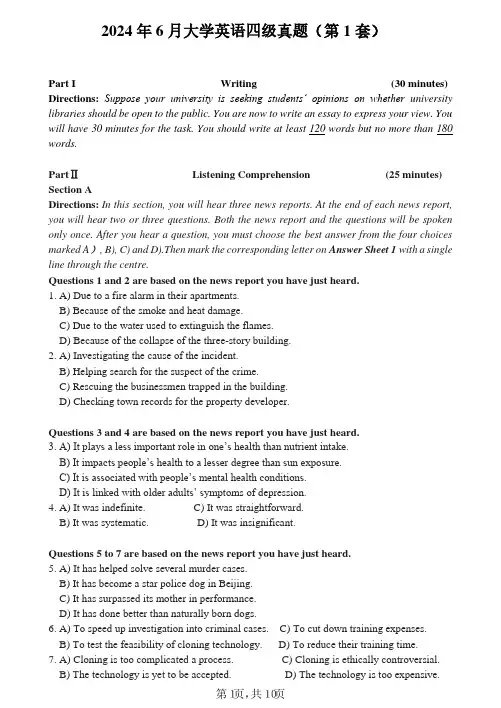
2024年6月大学英语四级真题(第1套)Part I Writing (30 minutes) Directions: Suppose your university is seeking students’ opinions on whether university libraries should be open to the public. You are now to write an essay to express your view. You will have 30 minutes for the task. You should write at least 120 words but no more than 180 words.PartⅡListening Comprehension (25 minutes) Section ADirections: In this section, you will hear three news reports. At the end of each news report, you will hear two or three questions. Both the news report and the questions will be spoken only once. After you hear a question, you must choose the best answer from the four choices marked A), B), C) and D).Then mark the corresponding letter on Answer Sheet 1 with a single line through the centre.Questions 1 and 2 are based on the news report you have just heard.1. A) Due to a fire alarm in their apartments.B) Because of the smoke and heat damage.C) Due to the water used to extinguish the flames.D) Because of the collapse of the three-story building.2. A) Investigating the cause of the incident.B) Helping search for the suspect of the crime.C) Rescuing the businessmen trapped in the building.D) Checking town records for the property developer.Questions 3 and 4 are based on the news report you have just heard.3. A) It plays a less important role in one’s health than nutrient intake.B) It impacts people’s health to a lesser degree than sun exposure.C) It is associated with people’s mental health conditions.D) It is linked with older adults’ sympt oms of depression.4. A) It was indefinite. C) It was straightforward.B) It was systematic. D) It was insignificant.Questions 5 to 7 are based on the news report you have just heard.5. A) It has helped solve several murder cases.B) It has become a star police dog in Beijing.C) It has surpassed its mother in performance.D) It has done better than naturally born dogs.6. A) To speed up investigation into criminal cases. C) To cut down training expenses.B) To test the feasibility of cloning technology. D) To reduce their training time.7. A) Cloning is too complicated a process. C) Cloning is ethically controversial.B) The technology is yet to be accepted. D) The technology is too expensive.Section BDirections: In this section, you will hear two long conversations. At the end of each conversation, you will hear four questions. Both the conversation and the questions will be spoken only once. After you hear a question, you must choose the best answer from the four choices marked A),B),C)and D). Then mark the corresponding letter on Answer Sheet 1 with a single line through the centre.Questions 8 to 11 are based on the conversation you have just heard.8. A) He read it somewhere online. C) He read an article reviewing it.B) He heard about it from a coworker. D) He watched a TV series based on it.9. A) His publications. C) His address.B) His first book. D) His name.10. A) Collect a lot more data. C) Clarify many new concepts.B) Relax a bit less often. D) Read more reference books.11. A) Find out the show’s most interesting episodes. C) Get an e-copy of the book to read.B) Watch the series together with the woman. D) Check to see when the show starts.Questions 12 to 15 are based on the conversation you have just heard.12. A) To check the prices of his farm produce.B) To ask the way to the Newcastle City Hall.C) To inquire about the vegetarian food festival.D) To seek the man’s help with her work on the farm.13. A) Bakers. C) Vegetarians.B) Vendors. D) Organisers.14. A) The issuing of certificates to vendors. C) The festival they are organising.B) The completion of the baking task. D) The deadline for application.15. A) The closing date of submission. C) The details of the ceremony.B) The website of his company. D) The organiser’s address.Section CDirections:In this section, you will hear three passages. At the end of each passage, you will hear three or four questions. Both the passage and the questions will be spoken only once. After you hear a question, you must choose the best answer from the four choices marked A), B), C) and D). Then mark the corresponding letter on Answer Sheet 1 with a single line through the centre.Questions 16 to 18 are based on the passage you have just heard.16. A) Most scenic sites have been closed. C) Health experts advise going outdoors.B) Access to official campsites is limited. D) People have more time during the summer.17. A) It is strongly opposed by nearby residents. C) It has caused environmental concerns.B) It leads to much waste of public money. D) It has created conflicts among campers.18. A) Look for open land in Scotland. C) Avoid getting close to wilderness.B) Leave no trace of their camping. D) Ask for permission from authorities. Questions 19 to 21 are based on the passage you have just heard.19. A) They outcompete mythical creatures. C) They truly exist in the Amazon region.B) They usually mind their own business. D) They resemble alarmingly large snakes.20. A) Scar tissue from dolphins’ fighting. C) Unhealed wounds from snake bites.B) Skin infection from water pollution. D) Swimming along in seasonal floods.21. A) It has been shrinking at an astonishing pace.B) It has been placed under international protection.C) It has been appealing to both freshwater and sea dolphins.D) It has been abandoned as a battleground for male dolphins.Questions 22 to 25 are based on the passage you have just heard.22. A) About 58% of young adults call parental support the new normal.B) Most adult children enjoy increasing sources of financial support.C) A full 70% of the young adults cannot afford to buy a car by themselves.D) Most early adults cannot sustain their lifestyles without parental support.23. A) It renders them dependent. C) It makes them mentally immature.B) It causes them to lose dignity. D) It hinders them from getting ahead.24. A) It challenges one’s willpower. C) It calls for due assistance.B) It results from education. D) It defines adulthood.25. A) Current lifestyles. C) College loans.B) Poor budgeting. D) Emergency expenses.Part III Reading Comprehension (40 minutes) Section ADirections: In this section, there is a passage with ten blanks. You are required to select one word for each blank from a list of choices given in a word bank following the passage. Read the passage through carefully before making your choices. Each choice in the bank is identified by a letter. Please mark the corresponding letter for each item on Answer Sheet 2 with a single line through the centre. You may not use any of the words in the bank more than once.It’s well known that physical exercise is beneficial not just to physical health but also to mental health. Yet whereas most countries have 26 , evidence-backed guidelines on the type and intensity of exercise 27 for various physical health benefits, such guidelines do not yet exist for exercise and mood.This is 28 due to a lack of necessary evidence. However, a new systematic review brings us usefully up-to-date on the current findings in this area.Before 29 into some of the key take-aways, an important 30 made in the review is between aerobic exercise and anaerobic. The former 31 such things as walking, jogging and cycling and means exercising in such a way that your body is able to use oxygen to burn fat for energy. In contrast, anaerobic exercise—such as lifting heavy weights—is of such 32 intensity that your body does not have time to use oxygen to create energy and so instead it breaks down glucose (葡萄糖) in your blood or muscles.Beginning first with the influence of exercise intensity on the mood benefits of aerobic exercise, the researchers, led by John Chan at Shenzhen University, found 33 results from19 relevant studies. Some favoured higher intensity, others low, while seven studies found that intensity made no 34 to mood benefits.In relation to the intensity of anaerobic exercise, however, the results were far clearer—the optimum (最佳选择) for improving mood is 35 intensity, perhaps because low intensity is too dull while high intensity is too unpleasant.Section BDirections:In this section, you are going to read a passage with ten statements attached to it. Each statement contains information given in one of the paragraphs. Identify the paragraph from which the information is derived. You may choose a paragraph more than once. Each paragraph is marked with a letter. Answer the questions by marking the corresponding letter on Answer Sheet 2.Why Do Americans Work So Much?A)How will we all keep busy when we only have to work 15 hours a week? That was thequestion that worried the British economist John Maynard Keynes when he wrote his short essay “Economic Possibilities for Our Grandchildren” in 1930. Over the next century, h e predicted, the economy would become so productive that people would barely need to work at all. For a while, it looked like Keynes was right. In 1930 the average working week was47 hours in the United States. But by 1970, the number of hours Americans worked onaverage had fallen to slightly less than 39.B)But then something changed. Instead of continuing to decline, the duration of the workingweek remained stable. It has stayed at just below 40 hours for nearly five decades. So what happened? Why are people working just as much today as in 1970?C)There would be no mystery in this if Keynes had been wrong about the power of technologyto increase the economy’s productivity, which he thought would lead to a standard of living “between four and eight times as high as it is today.” But Keynes got that right: Technology has made the economy massively more productive. According to Benjamin M. Friedman, an economist at Harvard, the U.S. economy is right on track to reach Keynes’s eight-fold (八倍) multiple by 2029. That is a century after the last data Keynes would have had access to.D)In a new paper, Friedman tries to figure out why that increased productivity has nottranslated into increased leisure time. Perhaps people just never feel materially satisfied, always wanting more money to buy the next new thing. This is a theory that appeals tomany economists. “This argument is, at best, far from sufficient,” he writes. If that were the case, why did the duration of the working week decline in the first place?E)Another theory Friedman considers is that, in an era of ever fewer settings that provideeffective opportunities for personal connections and relationships, people may place more value on the socializing that happens at work. There is support for this theory. Many people today consider colleagues as friends. But Friedman argues that the evidence for this theory is far from conclusive. Many workers report that they would like to spend more time with family, rather than at work. Furthermore, this theory cannot explain the change in trend in the U.S. working week in the 1970s.F) A third possibility proves more convincing for Friedman. That is: American inequalitymeans that the gains of increasing productivity are not widely shared by everyone. In other words, most Americans are too poor to work less. Unlike the other two explanations Friedman considers, this one fits chronologically (按年代). Inequality declined in America during the period following World War II, along with the duration of the working week.But since the early 1970s it has risen dramatically.G)Keynes’s prediction of a shorter working week rests on the idea that the standard of livingwould continue rising for everyone. But Friedman says that this is not what has happened.Although Keynes’s eight-fold figure holds up for the economy as a whole, it is not at all the case for the median (中位数的) American worker. For them, output by 2029 is likely to be around 3.5 times what it was when Keynes was writing. This is a bit below his four- to eight-fold predicted range.H)This can be seen in the median worker’s income over this time period, complete with a shiftin 1973 that fits in precisely with when the working week stopped shrinking. According to Friedman, between 1947 and 1973 the average hourly wage for normal workers (those who were not in management roles) in private industries other than agriculture nearly doubled in terms of what their money could buy. But by 2013 the average hourly wage for ordinary workers had fallen 5 percent from the 1973 level in terms of actual purchasing power. Thus, though American incomes may have gone up since 1973, the amount that American workers can actually buy with their money has gone down. For most Americans, then, the magic of increasing productivity stopped working around 1973. Thus, they had to keep working just as much in order to maintain their standard of living.I)What Keynes predicted was a very optimistic version of what economists call technologicalunemployment. This is the idea that less labor will be necessary because machines can do so much. In Keynes’s vision, the resulting unemployment would be distributed more or less evenly across society in the form of increased leisure. But Friedman says that, for Americans, reality is much darker. Americans now have a labor market in which millions of people—those with fewer skills and less education—are seeking whatever poorly paid work they can get. This is confirmed by a recent poll that found that, for half of hourly workers, their top concern is not that they work too much but that they work too little. This is most likely not because they like their jobs so much. Rather, we can assume it is because they need the money.J)This explanation leaves an important question. If the very rich—the workers who have reaped above-average gains from the increased productivity since Keynes’s time—can afford to work less, why do they continue to work so much? (Indeed, research has shownthat the highest earners in America tend to work the most.) Friedman believes that for many top earners, work is a labor of love. They are doing work they care about and are interested in, and doing more of it is not necessarily a burden. For them, it may even be a pleasure.These top earners derive meaning from their jobs and work is an important part of how they think of themselves. And, of course, they are compensated for it at a level that makes it worth their while.K)Friedman concludes that the prosperity(繁荣) Keynes predicted is here. After all, the economy as a whole has grown even more brilliantly than he expected. But for most Americans, that prosperity is nowhere to be seen. And, as a result, neither are those shorter working weeks.36. Some people view socializing at the workplace as a chance to develop personal relationships.37. As ordinary American workers’ average hourly pay had decreased despite increasing productivity, they had to work just as many hours as before to keep their living standards.38. American workers’ average weekly working time has not changed for nearly half a century.39. Friedman believes inequality in the U.S. largely explains why increasing productivity has not resulted in reduced working hours.40. Man y economists assume people’s thirst for material things has prevented them from enjoying more leisure time.41. An economist’s prediction about a shorter average working week seemed to be correct fora time in the 20th century.42. In the U.S. labor market, the primary concern of people with less schooling and fewer skills is to secure any employment even if it is low-paid.43. Keynes was right in predicting that technology would make the economy much more productive.44. Many of the highest earners have a keen interest in and love for what they are doing.45. According to Keynes, there would be a shorter working week with everyone’s standard of living continuing to rise.Section CDirections:There are 2 passages in this section. Each passage is followed by some questions or unfinished statements. For each of them there are four choices marked A), B), C) and D). You should decide on the best choice and mark the corresponding letter on Answer Sheet 2 with a single line through the centre.Passage OneQuestions 46 to 50 are based on the following passage.Lao Zi once said, “Care about what other people think and you will always be their prisoner.”People-pleasing, or seeking self-worth through oth ers’ approval, is unproductive and an exhausting way to go through life. Why do we allow what others think of us to have so much power over how we feel about ourselves? If it’s true that you can’t please all people all of the。
2024年6月大学英语四级考试听力样题
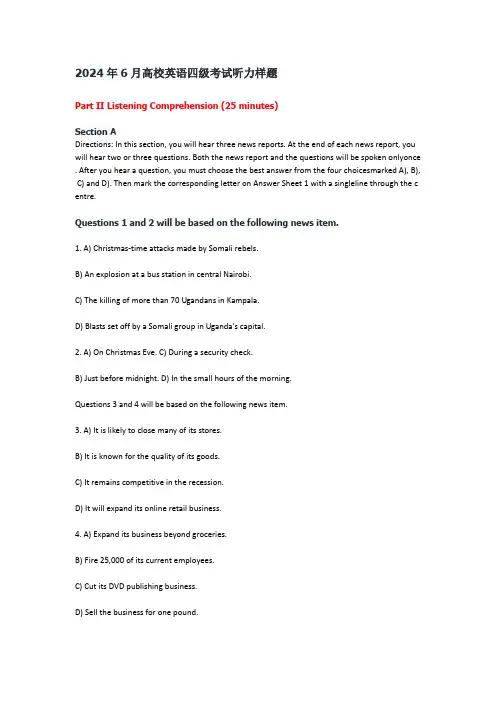
2024年6月高校英语四级考试听力样题Part II Listening Comprehension (25 minutes)Section ADirections: In this section, you will hear three news reports. At the end of each news report, you will hear two or three questions. Both the news report and the questions will be spoken onlyonce . After you hear a question, you must choose the best answer from the four choicesmarked A), B), C) and D). Then mark the corresponding letter on Answer Sheet 1 with a singleline through the c entre.Questions 1 and 2 will be based on the following news item.1. A) Christmas-time attacks made by Somali rebels.B) An explosion at a bus station in central Nairobi.C) The killing of more than 70 Ugandans in Kampala.D) Blasts set off by a Somali group in Uganda's capital.2. A) On Christmas Eve. C) During a security check.B) Just before midnight. D) In the small hours of the morning.Questions 3 and 4 will be based on the following news item.3. A) It is likely to close many of its stores.B) It is known for the quality of its goods.C) It remains competitive in the recession.D) It will expand its online retail business.4. A) Expand its business beyond groceries.B) Fire 25,000 of its current employees.C) Cut its DVD publishing business.D) Sell the business for one pound.Questions 5 to 7 will be based on the following news item.5. A) All taxis began to use meters.B) All taxis got air conditioning.C) Advertisements were allowed on taxis.D) Old taxis were replaced with new cabs.6. A) A low interest loan scheme. C) Taxi passengers' complaints.B) Environmentalists' protests. D) Permission for car advertising.7. A) There are no more irregular practices.B) All new cabs provide air-conditioning.C) New cabs are all equipped with meters.D) New legislation protects consumer rights.Section BDirections: In this section, you will hear two long conversations. At the end of each conversation,y ou will hear four questions. Both the conversation and the questions will be spoken only once.Aft er you hear a question, you must choose the best answer from the four choices marked A),B), C) and D). Then mark the corresponding letter on Answer Sheet 1 with a single line throughthe cent re.Conversation OneQuestions 8 to 11 are based on the conversation you have just heard.8. A) It has a partnership with LCP. C) It specializes in safety from leaks.B) It is headquartered in London. D) It has a chemical processing plant.9. A) He is a chemist. C) He is a safety inspector.B) He is a salesman. D) He is Mr. Grand's friend.10. A) The public relations officer. C) Director of the safety department.B) Mr. Grand's personal assistant. D) Head of the personnel department.11. A) Wait for Mr. Grand to call back.B) Leave a message for Mr. Grand.C) Provide details of their products and services.D) Send a comprehensive description of their work.Conversation TwoQuestions 12 to 15 are based on the conversation you have just heard.12. A) Teacher. C) Editor.B) Journalist. D) Typist.13. A) Some newly discovered scenic spot.B) Big changes in the Amazon valley.C) A new railway under construction.D) The beautiful Amazon rainforests.14. A) In news weeklies. C) In newspapers' Sunday editions.B) In a local evening paper. D) In overseas editions of U.S. magazines.15. A) To become a professional writer. C) To get her life story published soon.B) To be employed by a newspaper. D) To sell her articles to a news service.Section CDirections: In this section, you will hear three passages. At the end of each pa ssage,you will hear some questions. Both the passage and the questions will b e spokenonly once. After you hear a question, you must choose the best answ er from the fourchoices marked A), B), C) and D). Then mark the correspondin g letter on AnswerSheet 1 with a single line through the centre.Passage OneQuestions 16 to 18 are based on the passage you have just heard.16. A) She is both a popular and a highly respected author.B) She is the first writer to focus on the fate of slaves.C) She is the most loved African novelist of all times.D) She is the most influential author since the 1930's.17. A) The Book Critics Circle Award. C) The Pulitzer Prize for fiction.B) The Nobel Prize for literature. D) The National Book Award.18. A) She is a relative of Morrison's. C) She is a skilled storyteller.B) She is a slave from Africa. D) She is a black woman.Passage TwoQuestions 19 to 21 are based on the passage you have just heard.19. A) They are very generous in giving gifts.B) They refuse gifts when doing business.C) They regard gifts as a token of friendship.D) They give gifts only on special occasions.20. A) They enjoy giving gifts to other people.B) They spend a lot of time choosing gifts.C) They have to follow many specific rules.D) They pay attention to the quality of gifts.21. A) Gift-giving plays an important role in human relationships.B) We must be aware of cultural differences in giving gifts.C) We must learn how to give gifts before going abroad.D) Reading extensively can make one a better gift-giver.Passage ThreeQuestions 22 to 25 are based on the passage you have just heard.22. A) She tenderly looked after her sick mother.B) She developed a strong interest in finance.C) She learned to write for financial newspapers.D) She invested in stocks and shares on Wall Street.23. A) She inherited a big fortune from her father.B) She sold her restaurant with a substantial profit.C) She got 7.5 million dollars from her ex-husband.D) She made a wise investment in real estate.24. A) She was dishonest in business dealings.B) She frequently ill-treated her employees.C) She abused animals including her pet dog.D) She was extremely mean with her money.25. A) She carried on her family's tradition.B) She made huge donations to charities.C) She built a hospital with her mother's money.D) She made a big fortune from wise investments.Tape Script of Listening ComprehensionSection ADirections: In this section, you will hear three news reports. At the end of eac h newsreport, you will hear two or three questions. Both the news report andthe questionswill be spoken only once. After you hear a question, you must ch oose the bestanswer from the four choices marked A), B), C) and D). Then mar k the correspondingletter on Answer Sheet 1 with a single line through the ce ntre.Questions 1 and 2 will be based on the following news item.Kenyan police say one person was killed and 26 injured in an explosion at a bus station in central Nairobi. The blast hit a bus about to set off for the Ugandan capital Kampala. Last July, theSomali group al-Shabab said it was behind the blasts in the Ugandan capital which killed morethan 70 pe ople. Will Ross reports from the Kenyan capital.The explosion happened beside a bus which was about to set off for an overnight journey fromNa irobi to the Ugandan capital Kampala. Some eyewitnesses report that a bag was about to beloade d on board, but it exploded during a security check. Windows of the red bus were leftsmashed, a nd blood could be seen on the ground beside the vehicle. Just hours earlier,Uganda's police chief had warned of possible Christmas-time attacks by Somali rebels.1. What is the news report mainly about?2. When did the incident occur?Questions 3 and 4 will be based on the following news item.Woolworths is one of the best known names on the British High Street. It's been in businessnearl y a century. Many of its 800 stores are likely to close following the company's decision tocall in ad ministrators after an attempt to sell the business for a token £1 failed.The company has huge debts. The immediate cause for the collapse has been Britain's slidetowar d recession, which has cut into consumer spending. However, the business had been introuble for years.Known for low-priced general goods, Woolworths has struggled in the face of competition fromsu permarkets expanding beyond groceries and a new generation of internet retailers.Many of the store group's 25,000 employees are likely to lose their jobs. Some profitable areassu ch as the DVD publishing business will survive.3. What do we learn about Woolworths from the news report?4. What did Woolworths attempt to do recently?Questions 5 to 7 will be based on the following news item.Cairo is known for its overcrowded roads, irregular driving practices and shaky old vehicles, butals o for its air pollution. In recent months, though, environmental studies indicate there havebeen si gns of improvement. That's due in part to the removal of many of the capital's old-fashioned blac k and white taxis. Most of these dated back to the 1960s and 70s and were in apoor state of repai r.After new legislation demanded their removal from the roads, a low interest loan scheme was set up with three Egyptian banks so drivers could buy new cars. The government pays about $900for old ones to be discarded and advertising on the new vehicles helps cover repayments.The idea has proved popular with customers ― they can now travel in air-conditioned comfortan d because the new cabs are metered, they don't have to argue over fares. Banks and carmanufact urers are glad for the extra business in tough economic times. As for the taxi drivers,most are deli ghted to be behind the wheel of new cars, although there have been a fewcomplaints about switc hing from black and white to a plain white colour.5. What change took place in Cairo recently?6. What helped bring about the change?7. Why do customers no longer argue with new cab drivers?Section BDirections: In this section, you will hear two long conversations. At the end of eachconversation, you will hear four questions. Both the conversation and the questionswill be spoken only once. After you hear a question, you must choos e the bestanswer from the four choices marked A), B), C) and D). Then mark t he correspondingletter on Answer Sheet 1 with a single line through the centr e.Conversation OneW: Morning, this is TGC.M: Good morning. Walter Barry here, calling from London. Could I speak to Mr. Grand, please?W: Who's calling, please?M: Walter Barry, from London.W: What is it about, please?M: Well, I understand that your company has a chemical processing plant. My own company,LCP,Liquid Control Products, is a leader in safety from leaks in the field of chemical processing. Iwould like to speak to Mr. Grand to discuss ways in which we could help TGC protect itself fromsuch pro blems and save money at the same time.W: Yes, I see. Well, Mr. Grand is not available just now.M: Can you tell me when I could reach him?W: He's very busy for the next few days – then he'll be away in New York. So it's difficult to giveyo u a time.M: Could I speak to someone else, perhaps?W: Who in particular?M: A colleague for example?W: You're speaking to his personal assistant. I can deal with calls for Mr. Grand.M: Yes, well, could I ring him tomorrow?W: No, I'm sorry he won't be free tomorrow. Listen, let me suggest something. You send usdetails of your products and services, together with references from other companies and thenwe'll con tact you.M: Yes, that's very kind of you. I have your address.W: Very good, Mr….M: Barry. Walter Barry from LCP in London.W: Right, Mr. Barry. We look forward to hearing from you.M: Thank you. Goodbye.W: Bye.Questions 8 to 11 are based on the conversation you have just heard.8. What do we learn about the woman's company?9. What do we learn about the man?10. What is the woman's position in her company?11. What does the woman suggest the man do?Conversation TwoM: You're going to wear out the computer's keyboard!W: Oh, hi.M: Do you have any idea what time it is?W: About ten or ten-thirty?M: It's nearly midnight.W: Really? I didn't know it was so late.M: Don't you have an early class to teach tomorrow morning?W: Yes, at seven o'clock. My commuter class, the students who go to work right after theirlesson.M: Then you ought to go to bed. What are you writing, anyway?W: An article I hope I can sell.M: Oh, another of your newspaper pieces? What's this one about?W: Do you remember the trip I took last month?M: The one up to the Amazon?W: Well, that's what I'm writing about—the new highway and the changes it's making in theAmaz on valley.M: It should be interesting.W: It is. I guess that's why I forgot all about the time.M: How many articles have you sold now?W: About a dozen so far.M: What kind of newspapers buy them?W: The papers that carry a lot of foreign news. They usually appear in the big Sunday editionswhe re they need a lot of background stories to help fill up the space between the ads.M: Is there any future in it?W: I hope so. There's a chance I may sell this article to a news service.M: Then your story would be published in several papers, wouldn't it?W: That's the idea. And I might even be able to do other stories on a regular basis.M: That would be great.Questions 12 to 15 are based on the conversation you have just heard.12. What is the woman's occupation?13. What is the woman writing about?14. Where do the woman's articles usually appear?15. What does the woman expect?Section CDirections: In this section, you will hear three passages. At the end of each pa ssage,you will hear some questions. Both the passage and the questions will b e spokenonly once. After you hear a question, you must choose the best answ er from the fourchoices marked A), B), C) and D). Then mark the correspondin g letter on AnswerSheet 1 with a single line through the centre.Passage OneIn today's class, we'll discuss Toni Morrison's novel Beloved. As I'm sure you all know, Morrisonis both a popular and a highly respected author, and it's not easy to be both. Born in 1931,Morrison has written some of the most touching and intelligent works on the African-Americanexperience ever written by anyone, and yet to call her an “African-American writer” doesn'tseem to do her ju stice. In many ways, she's simply an American writer—and certainly one ofour best.Beloved is a truly remarkable work. It was recommended for nearly every major literary prize,incl uding the National Book Award and the National Book Critics Circle Award, and it in fact wonthe P ulitzer Prize for fiction in 1988. Morrison herself is distinguished for having won the NobelPrize fo r literature in 1993.What makes Beloved unique is the skillful, sure way in which Morrison blends intensely personals torytelling and American history, racial themes and gender themes, the experience of Blackswith the experience of all people everywhere, the down-to-earth reality of slavery with a sense ofmyst erious spirituality.We'll be paying special attention to these themes as we discuss this work. I'm particularlyinterest ed in your views on the relative importance of race and gender in this book. Is it moreimportant t hat Sethe, the main character, is black or that she's a woman? Which contributesmore to her bei ng? What does Morrison tell us about both?Questions 16 to 18 are based on the passage you have just heard.16. What do we learn about Toni Morrison?17. What honor did Toni Morrison receive in 1993?18. What does the speaker tell us about Sethe, the main character in Morrison's novel Beloved?Passage TwoThe topic of my talk today is gift-giving. Everybody likes to receive gifts, right? So you may thinkth at gift-giving is a universal custom. But actually, the rules of gift-giving vary quite a lot, and notkn owing them can result in great embarrassment. In North America, the rules are fairly simple.If yo u're invited to someone's home for dinner, bring wine or flowers or a small item from yourcountr y. Among friends, family, and business associates, we generally don't give gifts on otheroccasions except on someone's birthday and Christmas. The Japanese, on the other hand, givegifts quite fre quently, often to thank someone for their kindness. The tradition of gift-giving inJapan is very anc ient. There are many detailed rules for everything from the color of thewrapping paper to the tim e of the gift presentation. And while Europeans don't generallyexchange business gifts, they do fo llow some formal customs when visiting homes, such asbringing flowers. The type and color of flo wers, however, can carry special meaning.Today we have seen some broad differences in gift-giving. I could go on with additionalexamples. But let's not miss the main point here: If we are not aware of and sensitive to culturaldifferences, the possibilities for miscommunication and conflict are enormous. Whether we learnabout these differences by reading a book or by living abroad, our goal must be to respectdifferences among p eople in order to get along successfully with our global neighbors.Questions 19 to 21 are based on the passage you have just heard.19. What does the speaker say about gift-giving of North Americans?20. What do we learn about the Japanese concerning gift-giving?21. What point does the speaker make at the end of the talk?Passage ThreeHetty Green was a very spoilt, only child. She was born in Massachusetts, USA, in 1835. Herfather was a millionaire businessman. Her mother was often ill, and so from the age of two herfather to ok her with him to work and taught her about stocks and shares. At the age of six shestarted read ing the daily financial newspapers and opened her own bank account.Her father died when she was 21 and she inherited $7.5 million. She went to New York andinvest ed on Wall Street. Hetty saved every penny, eating in the cheapest restaurants for 15cents. She b ecame one of the richest and most hated women in the world. At 33 she marriedEdward Green, a multi-millionaire, and had two children, Ned and Sylvia.Hetty's meanness was well known. She always argued about prices in shops. She walked to theloc al grocery store to buy broken biscuits which were much cheaper, and to get a free bone forher m uch loved dog. Once she lost a two-cent stamp and spent the night looking for it. Shenever bough t clothes and always wore the same long, ragged black skirt. Worst of all, when herson Ned fell an d injured his knee, she refused to pay for a doctor and spent hours looking forfree medical help. I n the end Ned lost his leg.When she died in 1916 she left her children $100 million. Her daughter built a hospital with herm oney.Questions 22 to 25 are based on the passage you have just heard.22. What do we learn about Hetty Green as a child?23. How did Hetty Green become rich overnight?24. Why was Hetty Green much hated?25. What do we learn about Hetty's daughter?参考答案Part II Listening ComprehensionSection A1. B2. C3. A4. D5. D6. A7. CSection B8. D 9. B 10. B 11. C 12. A 13. B 14. C 15. DSection C16. A 17. B 18. D 19. D 20. C 21. B 22. B 23. A 24. D 25. C。
2024年 6月大学英语四级考试真题(第 1套)
2024年6月大学英语四级考试真题(第1套)Part I Writing(30minutes) Directions:Suppose your university is seeking students’opinions on whether university libraries should be open to the public.You are now to write an essay to express your view.You will have30minutes for the task.You should write at least120words but no more than180words.Part II Listening Comprehension (25minutes) Section ADirections:In this section,you will hear three news reports.At the end of each news report,you will hear two or three questions.Both the news report and the questions will be spoken only once.After you hear a question,you must choose the best answer from the four choices marked A),B),C)and D).Then mark the corresponding letter on Answer Sheet1with a single line through the centre.Questions1and2are based on the news report you have just heard.1. A.Its crew members went on strike.B.It hit a bird shortly after takeoff.C.Its captain got slightly injured during the forced landing.D.It narrowly escaped a plane crash when turning around.2. A.Panic.B.Nervous.C.Contented.D.Relieved.Questions3and4are based on the news report you have just heard.3. A.He is now kept in a secure area.B.He finally disappeared six days ago.C.He has escaped the zoo once again.D.He has been caught a second time.4. A.Squeezed.B.Frustrated.C.Disappointed.D.Threatened.Questions5to7are based on the news report you have just heard.5. A.It is giving rise to safety concerns.B.It is enriching the city’s night life.C.It is condemned as a crazy idea.D.It is questioned by local residents.6. A.Avoid entering one-way streets.B.Ensure the safety of pedestrians.C.Give way to automobiles at all times.D.Follow all the traffic rules drivers do.7. A.To bring new life into the city.B.To ease the city’s busy traffic.C.To add a new means of transport.D.To reduce the city’s air pollution.Section BDirections:In this section,you will hear two long conversations.At the end of each conversation,you will hear four questions.Both the conversation and the questions will be spoken only once.After you hear a question,you must choose the best answer from the four choices marked A),B),C)and D).Then mark the corresponding letter on Answer Sheet1with a single line through the centre.Questions8to11are based on the conversation you have just heard.8. A.Make it sound scary.B.Talk about it openly.C.Take it seriously.D.Discuss it regularly.9. A.By visiting discount stores.B.By making abstract sums relevant.C.By citing concrete examples.D.By shopping around for the best deals.10.A.Giving kids pocket money according to their needs.B.Urging kids to deposit some of their gift money.C.Setting kids a good example by sharing chores.D.Paying their kids to help with housework.11.A.The necessity of saving into a pension.B.The delight in seeing their savings grow.C.The importance of cutting down family expenses.D.The need to learn important lessons from her elders.Questions12to15are based on the conversation you have just heard.12.A.He is a successful businessman.B.He has published a new bestseller.C.He reviews books on political affairs.D.He has worked in several banks.13.A.The man’s academic background.B.The man’s ideas about education.C.The man’s attempts at drawing public attention.D.The man’s proposals to solve economic problems.14.A.To provide remedies for students’poor performance.B.To give students incentive to excel in economics.C.To motivate all students to be successful.D.To reduce students’financial burden.15.A.Raising taxes.B.Seeking donations.C.Increasing tuition fees.D.Improving school budgeting.Section CDirections:In this section,you will hear three passages.At the end of each passage,you will hear three or four questions.Both the passage and the questions will be spoken only once.After you hear a question,you must choose the best answer from the four choices marked A),B),C)and D).Then mark the corresponding letter on Answer Sheet1with a single line through the centre.Questions16to18are based on the passage you have just heard.16.A.To help busy people to sort out their priorities.B.To call on busy people to take care of themselves.C.To prevent people from complaining about being“busy”.D.To show his sympathy towards people always being busy.17.A.Respond as most busy people do.B.Reflect on their true purpose.C.Describe our schedule in detail.D.Avoid saying we are busy.18.A.To tell others a complete lie about their inability.B.To cover up their failure to achieve some purpose.C.To prove they stand out as accomplished professionals.D.To show their achievements resulted from great efforts.Questions19to21are based on the passage you have just heard.19.A.They should cover so many different types.B.They will be less challenging after a time.C.They should become so popular.D.They will help one reduce fear.20.A.To avoid dangerous mistakes.B.To enjoy the sports to the full.C.To break one’s ultimate limits.D.To stop being extremely afraid.21.A.By enabling us to get an all-over workout.B.By burning as many as300calories per hour.C.By stopping us hurting the same muscles repeatedly.D.By allowing our motivation to be at an all-time high. Questions22to25are based on the passage you have just heard.22.A.It is vital.B.It is instrumental.C.It is natural.D.It is personal.23.A.To guard against being perceived negatively.B.To maintain workplace harmony.C.To conceal personality preferences.D.To prevent themselves from being isolated.24.A.It helps to enhance team spirit.B.It helps to resolve problems.C.It stimulates innovative ideas.D.It facilitates policy-making.25.A.An innovative mind.B.A healthy mentality.C.Corporate culture.D.Mutual trust.Part III Reading Comprehension(40minutes) Section ADirections:In this section,there is a passage with ten blanks.You are required to select one word for each blank from a list of choices given in a word bank following the passage.Read the passage through carefully before making your choices.Each choice in the bank is identified by a letter.Please mark the corresponding letter for each item on Answer Sheet2with a single line through the centre.You may not use any of the words in the bank more than once.A team of researchers led by Priyanka Joshi examined the degree to which men and women relied on “communicative abstraction”to verbally convey their ideas and municative abstraction, according to the researchers,reflects the tendency of people to use“abstract speech that focuses on the broader picture and26 purpose of action rather than concrete speech focusing on details and the means of27 action.”Interestingly,they found that men were far more likely to speak in the abstract than were women.To arrive at this28 ,the researchers examined the linguistic(语言的)patterns of men and women in over600,000blog posts written on websites.To do this,the researchers computed abstractness ratings for 29 40,000commonly used words in the English language.Words considered to be concrete could be easily visualized,such as“table”or“chair”.Words that were more30 to visualize,for example,“justice”or “morality”were considered to be more abstract.They found that men used31 more abstract language in their blog posts.What is the32 of this effect?The researchers suggest that power differences between the genders —that is,men having more power in society—might be a key determinant(决定因素).For instance,in a follow-up study conducted with a sample of300students,the researchers33 power dynamics in an interpersonal setting to see if this would influence communicative abstraction.They found that participants in a high-power interviewer role were more likely to give abstract descriptions of behaviors than were participants in a low-power interviewee role.This suggests that communicating more abstractly does not reflect a34 tendency of men or women but rather35 within specific contexts.Section BDirections:In this section,you are going to read a passage with ten statements attached to it.Each statement contains information given in one of the paragraphs.Identify the paragraph from which the information is derived. You may choose a paragraph more than once.Each paragraph is marked with a letter.Answer the questions by marking the corresponding letter on Answer Sheet2.How to better work towards long-term goalsA.Hal Hershfield,a psychologist at the UCLA Anderson School of Management,wanted to know whypeople weren’t saving for retirement.Across the board,people are living longer.Logically,they’ll need more money to live comfortably in their post-work years.And yet,savings rates in the U.S.have gone down in recent decades,not up.B.To help explain this seemingly irrational behavior,Hershfield and his team scanned the brains of studyparticipants while asking them to what degree various traits(特征)—like“honorable”or“funny”—applied to their current self,their future self,a current other,or a future other.As participants answered, Hershfield’s team recorded which parts of their brains lit up.Unsurprisingly,people’s brains were most active when thinking about their current selves and least active when thinking about a current other.But the team found that participants’brain activity while considering their future selves more closely resembled their brain activity while thinking about a current other rather than the current self.C.Put in practical terms,when thinking of yourself in a month or a year or a decade,your brain registers thatperson in ways similar to how it would register Taylor Swift or the mailman.Understood in that way, saving for retirement is the equivalent of giving money away to someone else entirely.D.In light of Hershfield’s study,one simple question arises:Is it possible to make our present selves give adamn about our future selves?The answers are anything but simple.E.Seen through the lens of the present self versus the future self,our self-defeating actions—like choosingto watch television rather than go to the gym—suddenly make perfect sense.We get to enjoy the very concrete,immediate benefits of our actions while someone else(namely,our future selves)suffers the hypothetical(假设的),far-off consequences.As a result,the decisions we make for our present selves often look very different from our decisions for our future selves.We believe that tomorrow will be different.We believe that we will be different tomorrow;but in doing so,we prioritize our current mood over the consequences of our inaction for the future self.F.Understanding our procrastination(拖延)through the lens of the present and future selves,we’re left withthree possible solutions:The first is to force your future self to do whatever your present self doesn’t want to do.The second is to convince your present self that your future self is,in fact,still you.If the central problem is that we think of our future selves as other people,it follows that trying to identify more closely with our future selves will encourage us to make better long-term decisions.G.In a follow-up study,Hershfield wanted to explore ways to bridge the disconnect between the present andfuture selves and encourage people to save more for retirement.He and his team took photos of study participants,and then used image processing to visually age their faces.Participants were then placed in a virtual reality setting where they could look into a mirror and see their aged selves looking back at them.Participants who saw their aged selves said they would save30%more of their salary for retirement than the control group.H.Whatever your long-term goals may be—getting in better shape,launching your own business,writing abook—thinking about your deadline in terms of days rather than months or years can help you wrap your mind around how close the future really is.I.The third solution is to forget about your future self and use your present self’s love of instant gratification(满足感)to your advantage.While the two tactics(手段)above can be effective in making better long-term choices,in the end,you’re still struggling against human nature.Our brains are hard-wired for instant gratification.Instead of fighting your present self’s need for immediate rewards,why not use it to your advantage?When most of us set goals,we focus on long-term results we want to see—e.g.,losing weight, getting a promotion,retiring in comfort,etc.While those visions of our future selves can be inspiring, when it comes to actually doing the day-to-day work,it may be more effective to reframe activities in terms of their immediate,or at least very near-term,rewards.J.Take writing this article,for instance.It’s easy for me to imagine how amazing it will feel at the end of the workday to have this article done.This isn’t just my opinion.Research partners Kaitlin Woolley of Cornell University and Ayelet Fishbach of the University of Chicago have made a career out of studying the differences between the goals that people achieve and the ones that fall by the wayside.K.“In one study,we asked people online about the goals they set at the beginning of the year.Most people set goals to achieve delayed,long-term benefits,such as career advancement,debt repayment,or improved health.We asked these individuals how enjoyable it was to pursue their goal,as well as how important their goal was.We also asked whether they were still working on their goals two months after setting them.We found that enjoyment predicted people’s goal persistence two months after setting the goal far more than how important they rated their goal to be,”Woolley said.L.This pattern held true across a wide variety of goals from exercising to studying to eating healthier foods.For example,people ate50%more of a healthy food when directed to focus on the good taste rather than the long-term health benefits.Other studies have shown a greater uptake of exercise in people who were told to think of the enjoyment of doing the exercise now rather than future health gains.M.These findings suggest that when it comes to achieving your goals,enjoying the process itself is more important than wanting the long-term benefits.In other words,present self trumps(战胜)future self.Who says instant gratification has to be a bad thing?By all means,set ambitious long-term goals for your future self,but when it comes to actually following through day-to-day,make sure your present self knows what’s in it for her too.36.Our brains are genetically determined to satisfy immediate desires.37.Taken in a practical way,saving for post-work years is like giving money away to others.38.Research found that,as regards achievement of one’s goals,it is important to focus more on enjoying theprocess than the long-term benefits.39.Regarding our future selves as still being ourselves will help us make better long-term decisions.40.Savings rates in America have dropped in recent decades even though people’s life expectancy hasincreased.41.Researchers found that enjoyment rather than importance enabled people to persist in their goals.42.When making decisions,we give priority to our current frame of mind without thinking much of theconsequences.43.People ate more of a healthy food when they focused on its good taste instead of its long-term benefits.44.As was expected,when people thought of their present selves,their brains were observed to become moreactive.45.Researchers found that participants who saw the images of their aged selves would save more for theirlater years than those who didn’t.Section CDirections:There are2passages in this section.Each passage is followed by some questions or unfinished statements.For each of them there are four choices marked A),B),C)and D).You should decide on the best choice and mark the corresponding letter on Answer Sheet2with a single line through the centre.Passage OneQuestions46to50are based on the following passage.People often wonder why some entrepreneurs have greater success than others.Is it habits,connections, luck,work ethic or any other behavior?I believe the key to success is willpower.Willpower is the ability to control yourself.It is a strong determination that allows you to do something difficult.It is a behavior we are born with more than one we learn;however,it is possible to not only learn it,but also strengthen it with constant exercise.Willpower is just like a muscle;to keep it strong you need to constantly exercise it.People with a great amount of willpower have the discipline to develop positive,successful habits.Even with an incredible amount of talent,without the discipline and motivation to create positive habits,it can be difficult to achieve success.Willpower and habits go hand in hand.It is critical to create good habits and take the actions necessary to stick to those habits day in and day out for greater success.Almost half of our daily actions are part of our habits and not decisions,so once the correct habits are in place,you will automatically perform those tasks on a day-to-day basis.The best way to create and stick to a habit is to have strong motivation.It’s easier to change your habits to lose weight if you have a health issue and you want to be around longer for your kids,or if your business is something you’re passionate about.Having a valuable outcome associated with a habit will help you stick to that habit permanently.The art of self-control is one that most successful individuals have mastered.Self-control enables you to avoid behaviors that don’t contribute to your success and adopt those that do.Because there is a delayed satisfaction associated with self-control,it can be easy to get off track. However,if you work on sticking to those small positive habits one day at a time,it becomes easier to stay strong and achieve that delayed reward.Once a reward is achieved,it is much easier to continue sticking to your habits.46.What does the author say we need to do to strengthen our willpower?A.Keep it under control.B.Apply it continuously.C.Learn from entrepreneurs.D.Aim at success determinedly.47.How are almost half of our daily actions performed according to the passage?A.Out of habit.B.With determination.C.Like muscle building.D.By self-discipline.48.What will help people stick to doing something constructive automatically?A.Practising it on a day-to-day basis.B.Associating it with improving health.C.Possessing a reasonable amount of talent.D.Foreseeing the desired outcome it will yield.49.How does the art of self-control help us succeed?A.By allowing us to remain clear-headed permanently.B.By enabling us to alter our behaviors constantly.C.By enabling us to take positive actions.D.By allowing us to avoid taking risks.50.Why can it be difficult for us to maintain self-control?A.Most of us are not in the habit of exercising self-control.B.We may not get immediate rewards from self-control.C.Self-control tends to be associated with pains.D.Self-control only brings about small benefits.Passage TwoQuestions51to55are based on the following passage.Today,most scientific research is funded by government grants,companies doing research and development,and non-profit foundations.As a society,we reap the rewards from this science,but we also help pay for it.You indirectly support science through taxes you pay,products and services you purchase,and donations you make.Funding for science has changed with the times.Historically,science has been largely supported through private patronage(资助),church sponsorship,or simply paying for the research yourself.Today,researchers are likely to be funded by a mix of grants from various government agencies,institutions,and foundations. Other research is funded by private companies.Such corporate sponsorship is widespread in some fields. Almost75%of U.S.clinical trials in medicine are paid for by private companies.And,of course,some researchers today still fund small-scale studies out of their own pockets.Most of us can’t afford to do nuclear research as a private hobby,but birdwatchers,rock collectors,and others can do real research on a limited budget.In a perfect world,money wouldn’t matter—all scientific studies would be completely objective.But in the real world,funding may introduce biases.Drug research sponsored by the pharmaceutical(制药的) industry is more likely to end up favoring the drug under consideration than studies sponsored by government grants or charitable organizations.Similarly,nutrition research sponsored by the food industry is more likelyto end up favoring the food under consideration than independently funded research.So what should we make of all this?Should we ignore any research funded by companies or special interest groups?Certainly not.These groups provide invaluable funding for scientific research.Furthermore, science has many safeguards in place to catch instances of bias that affect research outcomes.Ultimately, misleading results will be corrected as science proceeds;however,this process takes time.Meanwhile,it pays to examine studies funded by industry or special interest groups with extra care.Are the results consistent with other independently funded studies?What do other scientists have to say about this research?A little examination can go a long way towards identifying bias associated with the funding source.51.What does the passage mainly discuss regarding scientific research?A.Its foundation.B.Its rewards.C.Its prospect.D.Its funding.52.What do we learn from the passage about researchers like birdwatchers and rock collectors?A.They have little access to government funding.B.They can do research with limited resources.C.They can do amateur work in their own fields.D.They have no means for large-scale research.53.What would scientific studies look like in a perfect world according to the author?A.They would be totally unbiased.B.They would be independently fundedC.They would be responsibly conducted.D.They would be strictly supervised.54.What does the author say about companies and special interest groups?A.They try hard to pull down the safeguards for research.B.They make extra efforts to research their own products.C.They provide valuable resources for scientific research.D.They reap the most benefits from scientific research.55.What does the author think of research funded by industry or special interest groups?A.Its recommendations should be examined for feasibility.B.Its misleading results should be corrected in time.C.Its validity should be checked with additional care.D.Its hidden biases should be identified independently.Part IV Translation(30minutes) Directions:For this part,you are allowed30minutes to translate a passage from Chinese into English.You should write your answer on Answer Sheet2.四合院(siheyuan)是中国一种传统的住宅建筑,其特点是房屋建造在一个院子的四周,将院子合围在中间。
2024年06月大学英语四级考试真题(第1套)
2024年06月大学英语四级考试真题(第1套)Part I Writing (30 minutes) Directions: Suppose your university is seeking students’ opinions on whether university libraries should be open to the public. You are now to write an essay to express your view. You will have 30 minutes for the task. You should write at least 120 words but no more than 180 words.PartⅡListening Comprehension (25 minutes) Section ADirections: In this section, you will hear three news reports. At the end of each news report, you will hear two or three questions. Both the news report and the questions will be spoken only once. After you hear a question, you must choose the best answer from the four choices marked A), B), C) and D).Then mark the corresponding letter on Answer Sheet 1 with a single line through the centre.Questions 1 and 2 are based on the news report you have just heard.1. A) Due to a fire alarm in their apartments.B) Because of the smoke and heat damage.C) Due to the water used to extinguish the flames.D) Because of the collapse of the three-story building.2. A) Investigating the cause of the incident.B) Helping search for the suspect of the crime.C) Rescuing the businessmen trapped in the building.D) Checking town records for the property developer.Questions 3 and 4 are based on the news report you have just heard.3. A) It plays a less important role in one’s health than nutrient intake.B) It impacts people’s health to a lesser degree than sun exposure.C) It is associated with people’s mental health conditions.D) It is linked with older adults’ sympt oms of depression.4. A) It was indefinite. C) It was straightforward.B) It was systematic. D) It was insignificant.Questions 5 to 7 are based on the news report you have just heard.5. A) It has helped solve several murder cases.B) It has become a star police dog in Beijing.C) It has surpassed its mother in performance.D) It has done better than naturally born dogs.6. A) To speed up investigation into criminal cases. C) To cut down training expenses.B) To test the feasibility of cloning technology. D) To reduce their training time.7. A) Cloning is too complicated a process. C) Cloning is ethically controversial.B) The technology is yet to be accepted. D) The technology is too expensive.Section BDirections: In this section, you will hear two long conversations. At the end of each conversation, you will hear four questions. Both the conversation and the questions will be spoken only once. After you hear a question, you must choose the best answer from the four choices marked A),B),C)and D). Then mark the corresponding letter on Answer Sheet 1 with a single line through the centre.Questions 8 to 11 are based on the conversation you have just heard.8. A) He read it somewhere online. C) He read an article reviewing it.B) He heard about it from a coworker. D) He watched a TV series based on it.9. A) His publications. C) His address.B) His first book. D) His name.10. A) Collect a lot more data. C) Clarify many new concepts.B) Relax a bit less often. D) Read more reference books.11. A) Find out the show’s most interesting episodes. C) Get an e-copy of the book to read.B) Watch the series together with the woman. D) Check to see when the show starts.Questions 12 to 15 are based on the conversation you have just heard.12. A) To check the prices of his farm produce.B) To ask the way to the Newcastle City Hall.C) To inquire about the vegetarian food festival.D) To seek the man’s help with her work on the farm.13. A) Bakers. C) Vegetarians.B) Vendors. D) Organisers.14. A) The issuing of certificates to vendors. C) The festival they are organising.B) The completion of the baking task. D) The deadline for application.15. A) The closing date of submission. C) The details of the ceremony.B) The website of his company. D) The organiser’s address.Section CDirections:In this section, you will hear three passages. At the end of each passage, you will hear three or four questions. Both the passage and the questions will be spoken only once. After you hear a question, you must choose the best answer from the four choices marked A), B), C) and D). Then mark the corresponding letter on Answer Sheet 1 with a single line through the centre.Questions 16 to 18 are based on the passage you have just heard.16. A) Most scenic sites have been closed. C) Health experts advise going outdoors.B) Access to official campsites is limited. D) People have more time during the summer.17. A) It is strongly opposed by nearby residents. C) It has caused environmental concerns.B) It leads to much waste of public money. D) It has created conflicts among campers.18. A) Look for open land in Scotland. C) Avoid getting close to wilderness.B) Leave no trace of their camping. D) Ask for permission from authorities. Questions 19 to 21 are based on the passage you have just heard.19. A) They outcompete mythical creatures. C) They truly exist in the Amazon region.B) They usually mind their own business. D) They resemble alarmingly large snakes.20. A) Scar tissue from dolphins’ fighting. C) Unhealed wounds from snake bites.B) Skin infection from water pollution. D) Swimming along in seasonal floods.21. A) It has been shrinking at an astonishing pace.B) It has been placed under international protection.C) It has been appealing to both freshwater and sea dolphins.D) It has been abandoned as a battleground for male dolphins.Questions 22 to 25 are based on the passage you have just heard.22. A) About 58% of young adults call parental support the new normal.B) Most adult children enjoy increasing sources of financial support.C) A full 70% of the young adults cannot afford to buy a car by themselves.D) Most early adults cannot sustain their lifestyles without parental support.23. A) It renders them dependent. C) It makes them mentally immature.B) It causes them to lose dignity. D) It hinders them from getting ahead.24. A) It challenges one’s willpower. C) It calls for due assistance.B) It results from education. D) It defines adulthood.25. A) Current lifestyles. C) College loans.B) Poor budgeting. D) Emergency expenses.Part III Reading Comprehension (40 minutes) Section ADirections: In this section, there is a passage with ten blanks. You are required to select one word for each blank from a list of choices given in a word bank following the passage. Read the passage through carefully before making your choices. Each choice in the bank is identified by a letter. Please mark the corresponding letter for each item on Answer Sheet 2 with a single line through the centre. You may not use any of the words in the bank more than once.It’s well known that physical exercise is beneficial not just to physical health but also to mental health. Yet whereas most countries have 26 , evidence-backed guidelines on the type and intensity of exercise 27 for various physical health benefits, such guidelines do not yet exist for exercise and mood.This is 28 due to a lack of necessary evidence. However, a new systematic review brings us usefully up-to-date on the current findings in this area.Before 29 into some of the key take-aways, an important 30 made in the review is between aerobic exercise and anaerobic. The former 31 such things as walking, jogging and cycling and means exercising in such a way that your body is able to use oxygen to burn fat for energy. In contrast, anaerobic exercise—such as lifting heavy weights—is of such 32 intensity that your body does not have time to use oxygen to create energy and so instead it breaks down glucose (葡萄糖) in your blood or muscles.Beginning first with the influence of exercise intensity on the mood benefits of aerobic exercise, the researchers, led by John Chan at Shenzhen University, found 33 results from19 relevant studies. Some favoured higher intensity, others low, while seven studies found that intensity made no 34 to mood benefits.In relation to the intensity of anaerobic exercise, however, the results were far clearer—the optimum (最佳选择) for improving mood is 35 intensity, perhaps because low intensity is too dull while high intensity is too unpleasant.Section BDirections:In this section, you are going to read a passage with ten statements attached to it. Each statement contains information given in one of the paragraphs. Identify the paragraph from which the information is derived. You may choose a paragraph more than once. Each paragraph is marked with a letter. Answer the questions by marking the corresponding letter on Answer Sheet 2.Why Do Americans Work So Much?A)How will we all keep busy when we only have to work 15 hours a week? That was thequestion that worried the British economist John Maynard Keynes when he wrote his short essay “Economic Possibilities for Our Grandchildren” in 1930. Over the next century, h e predicted, the economy would become so productive that people would barely need to work at all. For a while, it looked like Keynes was right. In 1930 the average working week was47 hours in the United States. But by 1970, the number of hours Americans worked onaverage had fallen to slightly less than 39.B)But then something changed. Instead of continuing to decline, the duration of the workingweek remained stable. It has stayed at just below 40 hours for nearly five decades. So what happened? Why are people working just as much today as in 1970?C)There would be no mystery in this if Keynes had been wrong about the power of technologyto increase the economy’s productivity, which he thought would lead to a standard of living “between four and eight times as high as it is today.” But Keynes got that right: Technology has made the economy massively more productive. According to Benjamin M. Friedman, an economist at Harvard, the U.S. economy is right on track to reach Keynes’s eight-fold (八倍) multiple by 2029. That is a century after the last data Keynes would have had access to.D)In a new paper, Friedman tries to figure out why that increased productivity has nottranslated into increased leisure time. Perhaps people just never feel materially satisfied, always wanting more money to buy the next new thing. This is a theory that appeals tomany economists. “This argument is, at best, far from sufficient,” he writes. If that were the case, why did the duration of the working week decline in the first place?E)Another theory Friedman considers is that, in an era of ever fewer settings that provideeffective opportunities for personal connections and relationships, people may place more value on the socializing that happens at work. There is support for this theory. Many people today consider colleagues as friends. But Friedman argues that the evidence for this theory is far from conclusive. Many workers report that they would like to spend more time with family, rather than at work. Furthermore, this theory cannot explain the change in trend in the U.S. working week in the 1970s.F) A third possibility proves more convincing for Friedman. That is: American inequalitymeans that the gains of increasing productivity are not widely shared by everyone. In other words, most Americans are too poor to work less. Unlike the other two explanations Friedman considers, this one fits chronologically (按年代). Inequality declined in America during the period following World War II, along with the duration of the working week.But since the early 1970s it has risen dramatically.G)Keynes’s prediction of a shorter working week rests on the idea that the standard of livingwould continue rising for everyone. But Friedman says that this is not what has happened.Although Keynes’s eight-fold figure holds up for the economy as a whole, it is not at all the case for the median (中位数的) American worker. For them, output by 2029 is likely to be around 3.5 times what it was when Keynes was writing. This is a bit below his four- to eight-fold predicted range.H)This can be seen in the median worker’s income over this time period, complete with a shiftin 1973 that fits in precisely with when the working week stopped shrinking. According to Friedman, between 1947 and 1973 the average hourly wage for normal workers (those who were not in management roles) in private industries other than agriculture nearly doubled in terms of what their money could buy. But by 2013 the average hourly wage for ordinary workers had fallen 5 percent from the 1973 level in terms of actual purchasing power. Thus, though American incomes may have gone up since 1973, the amount that American workers can actually buy with their money has gone down. For most Americans, then, the magic of increasing productivity stopped working around 1973. Thus, they had to keep working just as much in order to maintain their standard of living.I)What Keynes predicted was a very optimistic version of what economists call technologicalunemployment. This is the idea that less labor will be necessary because machines can do so much. In Keynes’s vision, the resulting unemployment would be distributed more or less evenly across society in the form of increased leisure. But Friedman says that, for Americans, reality is much darker. Americans now have a labor market in which millions of people—those with fewer skills and less education—are seeking whatever poorly paid work they can get. This is confirmed by a recent poll that found that, for half of hourly workers, their top concern is not that they work too much but that they work too little. This is most likely not because they like their jobs so much. Rather, we can assume it is because they need the money.J)This explanation leaves an important question. If the very rich—the workers who have reaped above-average gains from the increased productivity since Keynes’s time—can afford to work less, why do they continue to work so much? (Indeed, research has shownthat the highest earners in America tend to work the most.) Friedman believes that for many top earners, work is a labor of love. They are doing work they care about and are interested in, and doing more of it is not necessarily a burden. For them, it may even be a pleasure.These top earners derive meaning from their jobs and work is an important part of how they think of themselves. And, of course, they are compensated for it at a level that makes it worth their while.K)Friedman concludes that the prosperity(繁荣) Keynes predicted is here. After all, the economy as a whole has grown even more brilliantly than he expected. But for most Americans, that prosperity is nowhere to be seen. And, as a result, neither are those shorter working weeks.36. Some people view socializing at the workplace as a chance to develop personal relationships.37. As ordinary American workers’ average hourly pay had decreased despite increasing productivity, they had to work just as many hours as before to keep their living standards.38. American workers’ average weekly working time has not changed for nearly half a century.39. Friedman believes inequality in the U.S. largely explains why increasing productivity has not resulted in reduced working hours.40. Man y economists assume people’s thirst for material things has prevented them from enjoying more leisure time.41. An economist’s prediction about a shorter average working week seemed to be correct fora time in the 20th century.42. In the U.S. labor market, the primary concern of people with less schooling and fewer skills is to secure any employment even if it is low-paid.43. Keynes was right in predicting that technology would make the economy much more productive.44. Many of the highest earners have a keen interest in and love for what they are doing.45. According to Keynes, there would be a shorter working week with everyone’s standard of living continuing to rise.Section CDirections:There are 2 passages in this section. Each passage is followed by some questions or unfinished statements. For each of them there are four choices marked A), B), C) and D). You should decide on the best choice and mark the corresponding letter on Answer Sheet 2 with a single line through the centre.Passage OneQuestions 46 to 50 are based on the following passage.Lao Zi once said, “Care about what other people think and you will always be their prisoner.”People-pleasing, or seeking self-worth through oth ers’ approval, is unproductive and an exhausting way to go through life. Why do we allow what others think of us to have so much power over how we feel about ourselves? If it’s true that you can’t please all people all of the time, wouldn’t it make sense t o stop trying?Unfortunately, sense often isn’t driving our behavior. For social beings who desire love and belonging, wanting to be liked, and caring about the effect we have on others, is healthy and allows us to make connections. However, where we get into trouble is when our self-worth is dependent upon whether we win someone’s approval or not.This need to be liked can be traced back to when we were children and were completely dependent on others to take care of us: Small children are not just learning how to walk and communicate, they are also trying to learn how the world works. We learn about who we are and what is expected of us based on interactions with others, so, to a four-year-old, if Mommy or Daddy doesn’t like him or her, there is the danger that they will abandon them. We need to understand that when we desperately want someone to approve of us, it’s being driven by that little kid part of us that is still terrified of abandonment.As you become more capable of providing yourself with the approval you seek, your need for external validation will start to vanish, leaving you stronger, more confident, and yes, happier in your life. Imagine how much time we lose each moment we restrain our authentic selves in an effort to be liked.If we base our worth on the opinions of others, we cheat ourselves of the power to shape our experiences and embrace life not only for others but also for ourselves, because ultimately, there is no difference. So embrace the cliché (老话) and lo ve yourself as it’s highly doubtful that you’ll regret it.46. What can we conclude from Lao Zi’s quotation?A) We should see through other people’s attempt to make a prisoner of us.B) We can never really please other people even if we try as hard as we can.C) We can never be truly free if taking to heart others’ opinion of us.D) We should care about other people’s view as much as they care about our own.47. What will happen if we base our self-worth on other people’s approval?A) Our desire to be loved will be fulfilled.B) Our life will be unfruitful and exhausting.C) Our identity as social beings will be affected.D) Our sense of self will be sharpened and enhanced.48. What may account for our need to be liked or approved of?A) Our desperate longing for interactions with others.B) Our understanding of the workings of the world.C) Our knowledge about the pain of abandonment.D) Our early childhood fear of being deserted.49. What can we do when we become better able to provide ourselves with the desired approval?A) Enjoy a happier life. C) Receive more external validation.B) Exercise self-restraint. D) Strengthen our power of imagination.50. What does the author advise us to do in the last paragraph?A) Embrace life for ourselves and for others. C) See our experiences as assets.B) Base our worth on others’ opinions. D) Love ourselves as we are.Passage TwoQuestions 51 to 55 are based on the following passage.Some people have said aging is more a slide into forgetfulness than a journey towards wisdom. However, a growing body of research suggests that late-in-life learning is possible. In reality, education does an aging brain good.Throughout life, people’s bra ins constantly renovate themselves. In the late 1960s, British brain scientist Geoffrey Raisman spied growth in damaged brain regions of rats through an electron microscope; their brains were forging new connections. This meant brains may change every time a person learns something new.Of course, that doesn’t mean the brain isn’t affected by the effects of time. Just as height usually declines over the years, so does brain volume: Humans lose about 4 percent every decade starting in their 40s. But that re duction doesn’t necessarily make people think slower; as long as we are alive and functioning, we can alter our brains with new information and experiences.In fact, scientists now suspect accumulating novel experiences, facts, and skills can keep people’s minds more flexible. New pathways can strengthen our ever-changing mental structure, even as the brain shrinks.Conventional fixes like word puzzles and brain-training apps can contribute to mental durability. Even something as simple as taking a different route to the grocery store or going somewhere new on vacation can keep the brain healthy.A desire for new life challenges can further boost brainpower. Research about aging adults who take on new enterprises shows improved function and memory as well as a reduced risk of mental disease. Openness—a characteristic defined by curiosity and a desire for knowledge—may also help folks pass brain tests. Some folks are born with this take-in-the-world attitude, but those who aren’t as genetically gifted aren’t necessarily out of luck. While genes can encourage an interest in doing new things, a 2012 study in the journal Psychology and Aging found completing reasoning tasks like puzzles and number games can enhance that desire for novel experiences, which can, in turn, refresh the brain. That’s why brain scientist Richard Kennedy says “It’s not that old dogs can’t learn new tricks. It’s that maybe old dogs don’t realize why they should. ”51. What do some people think of aging adults?A) Their wisdom grows as time goes by. C) They can benefit from late-in-life learning.B) Their memory gradually deteriorates. D) They are likely to have mental health issues.52. What can we conclude from Geoffrey Raisman’s finding?A) Brain damage seriously hinders one’s learning.B) Brain power weakens slower than we imagine.C) Brains can refresh and improve with learning.D) Brains forge connections under new conditions.53. What is one thing that helps maintain the health of our brain even as it shrinks?A) Doing daily routines by conventional means.B) Avoiding worrying about our mental durability.C) Imitating old dogs’ way of learning new tricks.D) Approaching everyday tasks in novel ways.54. What does the author say can contribute to the improvement of brain function?A) Being curious and desiring knowledge.B) Being eager to pass brain tests at an old age.C) Rising to life’s challenges and avoiding risks.D) Boosting immunity to serious mental diseases.55. What is the finding of the 2012 study in the journal Psychology and Aging?A) Wishing to solve puzzles enhances one’s reasoning power.B) Playing number games unexpectedly stimulates one’s memory.C) Desiring new experiences can help to renovate the brain.D) Learning new tricks should not be confined to old dogs only.Part ⅣTranslation (30 minutes) Directions: For this part, you are allowed 30 minutes to translate a passage from Chinese into English. You should write your answer on Answer Sheet 2.四合院(siheyuan)是中国一种传统的住宅建筑,其特点是房屋建造在一个院子的四周,将院子合围在中间。
2024年6月第3套英语四级真题
大学英语四级考试2024年6月真题(第三套)Part I Writing (30minutes)Part I Directions :Suppose your university is seeking students'opinions on whethe university canteens should be open to the public.You are now to write an essay to express your view.You will have 30minutes for the task.You should write at least 120words but no more than 180words.I Listening Comprehension (25minutes)特别说明:由于多题多卷,官方第三套真题的听力试题与第二套真题的一致,只是选项顺序不同,因此,本套试卷不再提供听力部分。
Part ⅢReading Comprehension (40minutes)Section A Directions:In this section,thereis a passage with ten blanks.You are required to select one wordfor each blank from a list of choices given in a word bank following the passage.Read the passage through carefully before making your choices.Each choice in the bank is identified by a letter.Please mark the corresponding letter for each item on Answer Sheet 2with a single line through the centre.You may not use any of the words in the bank more than once.Over the coming decades,millions of jobs will be threatened by robotics and artificial intelligence.Despite intensive academic 26_on these developments,there has been little study on how workers 27_to being replaced through technologyTo find out,business researchers at TUM and Erasmus University Rotterdam conducted 11studies and surveys with over 2,000persons from several countries.The findings show:In principle,most people view it more 28when workers are replaced by other people than by robots or intelligent software.This preference 29_,however,when it refers to people's own jobs When that is the case,the majority of workers find it less upsetting to see their own jobs go to robots than to other employees.In the long term,however,the same people see machines as more threatening to their future role in the workforce.These effects can also be observed among people who have recently become unemployed.The researchers were able to identify the causes behind these 30paradoxica results,too:Peopletend to 31_themselves less with machines than with other people.Consequently,being replaced by a robotor so ftware 32less of a threat to their feeling of self-worth.This reduced self-threat could even be observedwhe n participants assumed that they were being replaced by other employees who relied on technological abilities such as artificial intelligence in their work.“Even when unemployment results from the 33of new technologies,people still judge it in a social context,”says Christoph Fuchs,one of the authors of the study.“It is important to understand these 34effects when trying to manage the massive changes in the working world to minimize 35in society.”19·2024年6月四级真题(第三套)·A)compareB)contradictsC)conventionalD)debateE)disruptionsF)drasticallyG)favorablyH)guarantee I)introduction J)modifications K)posesL)psychological M)reactN)reverses O)seeminglySection BDirections:In this section,you are going to read a passage with ten statements attached to it.Each statement contains information given in one of the paragraphs.Identify the paragraph from which the information is derived.You may choose a paragraph more than once.Each paragraph is marked with a letter.Answer the questions by marking the correspondingletter on Answer Sheet2.No escape as'snow day'becomes fe-learning day’A)Certain institutions,such as schools,are likely to close when bad weather,such as snow,flooding or extreme heat or cold,causes travel difficulties,power outages(断供),or otherwise endangers public safety.When snowy weather arrives in the US,it means the chance of school children benefiting from the long-standing tradition of the“snow day”,when schools are forced to close and students get an unexpected day off.B)The criterion for a snow day is primarily the inability of school buses to operate safely on their routes and danger to children who walk to school.Often,the school remains officially open even though buses do not run and classes arecanceled.Severe weather that causes cancellation or delayis more likely in regions that are less able to handle the situation.Snow days are less common in more northern areas of the United States that are used to heavy winter snowfall,because municipalities are well equipped to clear roads and remove snow.In areas less accustomed to snow even small snowfalls of an inch ortwo may render roads unsafe. C)Snow days are a familiar theme in American film and TV shows,with children getting the good news and then running outside for some seasonal snowman-building and snowball throwing,against a background ofjoyful pop music.But the tradition is now over for pupils in several US states such as South Carolina, Nevada,Georgia and Indiana.This academic year,many school boards have introduced policies which require students to work from home if the school is shut by snow or extreme weather.They are known as “e-learning days”,which certainly sounds less fun than a snow day.D)Teachers are also losing their snow days and instead will be expected to be on hand to take a virtual register and answer students'questions online.A pilot programme in a school district in Anderson County,South Carolina,has supplied students with electronic tablets loaded with assignments to complete in the event of a school closure.If it is successful,it could be rolled out across the state.E)But some parents object to the new policy if the vigorous debate on the Facebook page of Anderson County school district is anything to go by.“When it snows,let the kids enjoy it,”said one commenter.Another said the decision would“ruin school even more”,and someone else called snow days“a fun part of childhood”. But supporters of the policy say it means children will miss fewer days of school.It will also bring to an end a less popular US high school tradition:the“make-up day”,which requires students in many states to make up the time lost due to weatherby working during school holidays.·2024年6月四级真题(第三套)·20F)Students in North Carolina already have several make-up days scheduled because of school closures duringHurricane Florence,which struck in September.Tom Wilson,the superintendent(主管)of Anderson County school district,said the change away from snow days makes practical and financial sense.He said technology has changed every profession,so it makes sense to use it to“eliminate”make-up days.Adam Baker of the Department of Education in Indiana said e-learning days were proving a“great success”.He said most Indiana schools already use digital devices during lessons,so it was an“easy decision”to extend this to days when schools are closed.He denies the decision is depriving children of the chance to enjoy the snow.“Students are still able to enjoy snow days and outside time,”he said.“Many have PE and science assignments that have them out enjoying the weather.”But local school superintendents in Ohio are resisting proposals to adopt e-learning days.They fear that students without internet access at home will be disadvantaged by the policy,and superintendent Tom Roth is concerned that e-learning days will offer a lower quality of education.G)There are also so-called“blizzard bags”,with assignments that children take home ahead of an expected snowclosure.But Mr Roth says it is not sufficient as a replacement.“I think we still need the class time to give our kids the education that they deserve,”he said.“Youcan't get that with a blizzard bag or doing the work from home like that.It's not going to be as effective.”H)There is a long-running debate on whether missing days of school affects attainment.In England,there hasbeen a focus on tackling absenteeism(旷课)from school.The Department for Education(DFE)published research in2016arguing that missing any days at school could have a negative impact on results.Even a few days lost in a year could be enough to miss out on getting a good exam grade,the DFE's research concluded.This differed from the findings of a study from Harvard University in the US,which concluded that missing a few occasional days because of the weather did not damage learning.I)The Harvard study examined seven years of school results data and could not find any impact from snowclosures.What caused moredisruption was when schools tried to stay open in bad weather,even though many staff and pupils were absent.But weather can make a difference to school results,according to another piece of Harvard research published last summer.It's hot weather that has the negative impact.The results of 10million school students were examined over13years and researchers found a“significant”link between years with extremely hotweather and lower results.J)It's obvious that students should go to school every day to get the most out of education.In cases of extreme weather students don't always have that option.However,research shows that authorised absences from school such as during extreme weather are less problematic for students than absences that are not authorised.This is because unauthorised absences tend to reflect patterns and behaviours of student disengagement,or the possible negative attitudes of parents towards education that students adopt and carry with them through schooling.The level of impact on students'educational performance is all to do with the length of time that a student is absent from school and how regularly this occurs.36.There is opposition to the practice of giving children assignments to take home before extreme weather forcesa school closure.37.New policies adopted by many US schools require students to do online learning at home in case of a schoolclosure38.According to some research,extreme hot weather negatively affects students'performance.39.There is a time-honoured tradition in the US for school kids to stay at home on“snow days”.21·2024年6月四级真题(第三套)·40.Debates on social media show some parents are opposed to ending the“snowday”tradition.41.In more northern regions of the US,school is less likely to be affected by snowy weather.42.Research indicates absences from school with permission do not cause as many problems as those withoutpermission.43.There is objection to e-learning days owing to fear that students with no access to the Internet at home willsuffer44.In a pilot programme,students are given electronic devices to doassignments when schools areclosed.45.A long-standing debate is going on over the impact of school absences on students'academic performance.Section CDirections:There are2passages in this section.Each passage is followed by some questions or unfinished statements.For each of them there are four choices marked A),B),C)and D).You should decide on the best choice and mark the corresponding letter on Answer Sheet2with a single line through the centre.Passage OneQuestions46to50are based on the following passage.It may sound surprising,but you don't have to be interested in fashion,or even in history,to enjoy Dress Codes:How the Laws of Fashion Made History.I happen to be interested in both,and ended up enjoying the book for completely different reasons.Richard Thompson Ford is a law professor,and you probably won't forget that for even one page.His carefully reasoned arguments,packed with examples,sound almost like reading a court opinion,only maybe wordier.You will probably never think of fashion as a trifle again.Ford's thesis is that the best way to understand what particular fashions meant in any given era is to look at the restrictions placed on them.Through this lens,he shows us that the first laws passed in the1200s to ensure that only the nobility were allowed to wear certain fabrics,colors and ornaments reflected the rise of the middle class,who were now able to imitate some of these fashions.The status of the upper classes was threatened; fashion was a tool to preserve it.Ford takes the reader through the evolution of fashion while examining the underlying motivations of status sex,power,and personality,which,he assumes,influenced all innovations in fashion in the past and which continue to influence us today.His writing is more than alittle dense—dense with research,clauses,and precise adjectives and nouns.But there's also humor and enough interesting episodes to make the writing appealing.No one is spared his sharp analysis:not the easy targets of19th century women's crippling(伤害身体的)fashions nor the modern uniforms of Silicon Valley T-shirts.But the greatest strength of this book(on fashion!)is its intellectual profoundness.Ford asks us to question unconscious beliefs,to realize thatwe almost never do so,to understand that the simplest choices are charged with meaning,and yet that meaning can and does change all thetime.Consider the fact that a1918catalog insisted that boys and girls be dressed in the appropriate color.We believe our thinking today is evolved;Ford shows us it's not.46.What does the author think of the book Dress Codes:How the Laws of Fashion Made History?A)It is read by people for entirely different reasonsB)It is meant for those interested in fashion history·2024年6月四级真题(第三套)·22C)It makes enjoyable as well as informative reading.D)It converts fashion into something for deliberation.47.How can people best understand a particular fashion in an era,according to Ford?A)By examining the restraints imposed on it.C)By glancing at its fabrics,colors and ornaments.B)By looking at what the nobility were wearing.D)By doing a survey of the upper and middle classes.48.What was the aim of the first laws passed regarding fashion in the1200s?A)To facilitate the rise of the middle class C)To help initiate some novel fashions.B)To loosen restrictions on dress codes.D)To preserve the status of the nobles.49.What does the author think of Ford's writing?A)It uses comparison and contrast in describing fashions of different erasB)It makes heavy reading but is not lacking in humor or appealC)It is filled with interesting episodes to spare readers intolerable boredom.D)It is characteristic of academics in presenting arguments.50.What does the author say is the greatest strength of Ford's book?A)Plentiful information.B)Meaningful choices.C)Evolved thinkingD)Intellectual depthPassage TwoQuestions51to55are based on the followingpassage.The art of persuasion means convincing others to agree with your point of view or to follow your course of action.For some ofus,persuasion is an instinctive quality and the power of influencing comes naturally.For the rest of us,persuasion skills can be learned and developed over time.Employers place a great value on employees with persuasion skills because they can impact several aspects of job performance.Besides,teamwork and leadership rely heavily on the power of persuasion to get things done.Without persuasion skills,employees may not be as committed to or convinced of the importance of an organization's vision and long-term mission.Effective use of persuasion skills will not only help get your coworkers excited about your ideas,it'll also help you motivate them to achieve a common goal.In order to learn the art of persuasion at the workplace,you need to understand how to handle conflicts and reach agreements.Good communication is the first step in effective persuasion,but logic and reasoning are just as important.Before you can get somebody on-board with your goal,you should help them understand why they should pursue ing visual aids to back up your ideas can help communicate your ideas better and make compelling arguments so your listeners will come to a logical choice and become fully committed to your ideas and plans.Successful persuasion skills are based on your ability to have positive interactions and maintain meaningful relationships with people.In order to sustain thoserelationships,you must be able to work in their best interests as well.Your coworkers are more likely to agree with you when they succeed alongside you.The more they achieve and the greaterprogress they make,the more they trust your judgement and strength.We persuade and get persuaded every day—we're either convincing or being convinced.A vast majority of people prefer collaboration and teamwork over traditional organizational structures;no one likes to be told what to do or to be pushed around.Therefore,organizations and leaders should adopt powerful persuasion skills to bring about necessary changes.23·2024年6月四级真题(第三套)·51.What does the author say about the ability to be persuasive in the first paragraph?A)People may either be born with it or be able to cultivate it.B)It proves crucial in making others follow one's course of action.C)It refers to the natural and instinctive power of influencing one's coworkers.D)People may view it as both a means to convince others and an art of communication.52.Why are persuasion skills greatly valued in the workplace?A)They enable employees to be convinced oftheir long-term gains.B)They enable employees to trust their leaders unconditionally.C)They help motivate coworkers to strive for a common goal.D)They help an organization to broaden its vision effectively.53.What should people do to learn the art of persuasion atthe workplace?A)Acquire effective communication skills.C)Understand the reason for pursuing their goalsB)Avoid getting involved in conflicts with others.D)Commit themselves fully to their ideas and plans54.When are you more likely to succeed in persuading your coworkers?A)When they are convinced you work in their interests while sacrificing your own.B)When they become aware of the potential strength of the judgements you make.C)When they become aware of the meaningful relationships you keep with them.D)When they are convinced they will make achievements together with you.55.Why are organizations and leaders advised to adopt powerful persuasion skills to bring about necessarychanges?A)To convince employees of the value of collaboration.B)To allow for the preferences of most people of todayC)To improve on traditional organizational structuresD)To adapt to employees'ever-changing working styles.PartIV Translation(30minutes) Directions:For this part,you are allowed30minutes to translate a passage from Chinese into English.You should write your answer on Answer Sheet2.汉语中的“福”字(the character fu)表示幸福和好运,是中国传统文化中最常用的吉祥(auspicious符号之一。
2024年6月英语四级试题3
大学英语四级考试2024年6月真题(第三套)Part I Writing(30minutes) Directions:Suppose your university is seeking students'opinions on whether universitycanteens should be open to the public.You are now to write an essay to express your view.You will have30minutes for the task.You should write at least120words but no more than180words.Part II Listening Comprehension(25minutes)谈辰教育 特别说明:由于多题多卷,官方第三套真题的听力试题与第二套真题的一致,只是选项顺序不同,因此,本套试卷不再提供听力部分。
PartⅢReading Comprehension(40minutes) Section ADirections:In this section,thereis a passage with ten blanks.You are required to select one wordfor each blank from a list of choices given in a word bank following the passage.Read the passage through carefully before making your choices.Each choice in the bank is identified by a letter.Please mark the corresponding letter for each item on Answer Sheet2with a single line through the centre.You may not use any of the words in the bank more than once.Over the coming decades,millions of jobs will be threatened by robotics and artificial intelligence.Despite intensive academic26_on these developments,there has been little study on how workers27_to being replaced through technologyTo find out,business researchers at TUM and Erasmus University Rotterdam conducted11studies and surveys with over2,000persons from several countries.The findings show:In principle,most people view it more28when workers are replaced by other people than by robots or intelligent software.This preference29_,however,when it refers to people's own jobs When that is the case,the majority of workers find it less upsetting to see their own jobs go to robots than to other employees.In the long term,however,the same people see machines as more threatening to their future role in the workforce.These effects can also be observed among people who have recently become unemployed.The researchers were able to identify the causes behind these30paradoxica results,too:Peopletend to31_themselves less with machines than with other people.Consequently,being replaced by a robotor so ftware32less of a threat to their feeling of self-worth.This reduced self-threat could even be observedwhe n participants assumed that they were being replaced by other employees who relied on technological abilities such as artificial intelligence in their work.“Even when unemployment results from the33of new technologies,people still judge it in a social context,”says Christoph Fuchs,one of the authors of the study.“It is important to understand these34effects when trying to manage the massive changes in the working world to minimize35in society.”19·2024年6月四级真题(第三套)·A)compareB)contradictsC)conventionalD)debateE)disruptionsF)drasticallyG)favorablyH)guarantee I)introduction J)modifications K)posesL)psychological M)reactN)reverses O)seeminglySection BDirections:In this section,you are going to read a passage with ten statements attached to it.Each statement contains information given in one of the paragraphs.Identify the paragraph from which the information is derived.You may choose a paragraph more than once.Each paragraph is marked with a letter.Answer the questions by marking the correspondingletter on Answer Sheet2.No escape as'snow day'becomes fe-learning day’A)Certain institutions,such as schools,are likely to close when bad weather,such as snow,flooding or extreme heat or cold,causes travel difficulties,power outages(断供),or otherwise endangers public safety.When snowy weather arrives in the US,it means the chance of school children benefiting from the long-standing tradition of the“snow day”,when schools are forced to close and students get an unexpected day off.B)The criterion for a snow day is primarily the inability of school buses to operate safely on their routes and danger to children who walk to school.Often,the school remains officially open even though buses do not run and classes arecanceled.Severe weather that causes cancellation or delayis more likely in regions that are less able to handle the situation.Snow days are less common in more northern areas of the United States that are used to heavy winter snowfall,because municipalities are well equipped to clear roads and remove snow.In areas less accustomed to snow even small snowfalls of an inch ortwo may render roads unsafe. C)Snow days are a familiar theme in American film and TV shows,with children getting the good news and then running outside for some seasonal snowman-building and snowball throwing,against a background ofjoyful pop music.But the tradition is now over for pupils in several US states such as South Carolina, Nevada,Georgia and Indiana.This academic year,many school boards have introduced policies which require students to work from home if the school is shut by snow or extreme weather.They are known as “e-learning days”,which certainly sounds less fun than a snow day.D)Teachers are also losing their snow days and instead will be expected to be on hand to take a virtual register and answer students'questions online.A pilot programme in a school district in Anderson County,South Carolina,has supplied students with electronic tablets loaded with assignments to complete in the event of a school closure.If it is successful,it could be rolled out across the state.E)But some parents object to the new policy if the vigorous debate on the Facebook page of Anderson County school district is anything to go by.“When it snows,let the kids enjoy it,”said one commenter.Another said the decision would“ruin school even more”,and someone else called snow days“a fun part of childhood”. But supporters of the policy say it means children will miss fewer days of school.It will also bring to an end a less popular US high school tradition:the“make-up day”,which requires students in many states to make up the time lost due to weatherby working during school holidays.·2024年6月四级真题(第三套)·20F)Students in North Carolina already have several make-up days scheduled because of school closures duringHurricane Florence,which struck in September.Tom Wilson,the superintendent(主管)of Anderson County school district,said the change away from snow days makes practical and financial sense.He said technology has changed every profession,so it makes sense to use it to“eliminate”make-up days.Adam Baker of the Department of Education in Indiana said e-learning days were proving a“great success”.He said most Indiana schools already use digital devices during lessons,so it was an“easy decision”to extend this to days when schools are closed.He denies the decision is depriving children of the chance to enjoy the snow.“Students are still able to enjoy snow days and outside time,”he said.“Many have PE and science assignments that have them out enjoying the weather.”But local school superintendents in Ohio are resisting proposals to adopt e-learning days.They fear that students without internet access at home will be disadvantaged by the policy,and superintendent Tom Roth is concerned that e-learning days will offer a lower quality of education.G)There are also so-called“blizzard bags”,with assignments that children take home ahead of an expected snowclosure.But Mr Roth says it is not sufficient as a replacement.“I think we still need the class time to give our kids the education that they deserve,”he said.“Youcan't get that with a blizzard bag or doing the work from home like that.It's not going to be as effective.”H)There is a long-running debate on whether missing days of school affects attainment.In England,there hasbeen a focus on tackling absenteeism(旷课)from school.The Department for Education(DFE)published research in2016arguing that missing any days at school could have a negative impact on results.Even a few days lost in a year could be enough to miss out on getting a good exam grade,the DFE's research concluded.This differed from the findings of a study from Harvard University in the US,which concluded that missing a few occasional days because of the weather did not damage learning.I)The Harvard study examined seven years of school results data and could not find any impact from snowclosures.What caused moredisruption was when schools tried to stay open in bad weather,even though many staff and pupils were absent.But weather can make a difference to school results,according to another piece of Harvard research published last summer.It's hot weather that has the negative impact.The results of 10million school students were examined over13years and researchers found a“significant”link between years with extremely hotweather and lower results.J)It's obvious that students should go to school every day to get the most out of education.In cases of extreme weather students don't always have that option.However,research shows that authorised absences from school such as during extreme weather are less problematic for students than absences that are not authorised.This is because unauthorised absences tend to reflect patterns and behaviours of student disengagement,or the possible negative attitudes of parents towards education that students adopt and carry with them through schooling.The level of impact on students'educational performance is all to do with the length of time that a student is absent from school and how regularly this occurs.36.There is opposition to the practice of giving children assignments to take home before extreme weather forcesa school closure.37.New policies adopted by many US schools require students to do online learning at home in case of a schoolclosure38.According to some research,extreme hot weather negatively affects students'performance.39.There is a time-honoured tradition in the US for school kids to stay at home on“snow days”.21·2024年6月四级真题(第三套)·40.Debates on social media show some parents are opposed to ending the“snowday”tradition.41.In more northern regions of the US,school is less likely to be affected by snowy weather.42.Research indicates absences from school with permission do not cause as many problems as those withoutpermission.43.There is objection to e-learning days owing to fear that students with no access to the Internet at home willsuffer44.In a pilot programme,students are given electronic devices to doassignments when schools areclosed.45.A long-standing debate is going on over the impact of school absences on students'academic performance.Section CDirections:There are2passages in this section.Each passage is followed by some questions or unfinished statements.For each of them there are four choices marked A),B),C)and D).You should decide on the best choice and mark the corresponding letter on Answer Sheet2with a single line through the centre.Passage OneQuestions46to50are based on the following passage.It may sound surprising,but you don't have to be interested in fashion,or even in history,to enjoy Dress Codes:How the Laws of Fashion Made History.I happen to be interested in both,and ended up enjoying the book for completely different reasons.Richard Thompson Ford is a law professor,and you probably won't forget that for even one page.His carefully reasoned arguments,packed with examples,sound almost like reading a court opinion,only maybe wordier.You will probably never think of fashion as a trifle again.Ford's thesis is that the best way to understand what particular fashions meant in any given era is to look at the restrictions placed on them.Through this lens,he shows us that the first laws passed in the1200s to ensure that only the nobility were allowed to wear certain fabrics,colors and ornaments reflected the rise of the middle class,who were now able to imitate some of these fashions.The status of the upper classes was threatened; fashion was a tool to preserve it.Ford takes the reader through the evolution of fashion while examining the underlying motivations of status sex,power,and personality,which,he assumes,influenced all innovations in fashion in the past and which continue to influence us today.His writing is more than alittle dense—dense with research,clauses,and precise adjectives and nouns.But there's also humor and enough interesting episodes to make the writing appealing.No one is spared his sharp analysis:not the easy targets of19th century women's crippling(伤害身体的)fashions nor the modern uniforms of Silicon Valley T-shirts.But the greatest strength of this book(on fashion!)is its intellectual profoundness.Ford asks us to question unconscious beliefs,to realize thatwe almost never do so,to understand that the simplest choices are charged with meaning,and yet that meaning can and does change all thetime.Consider the fact that a1918catalog insisted that boys and girls be dressed in the appropriate color.We believe our thinking today is evolved;Ford shows us it's not.46.What does the author think of the book Dress Codes:How the Laws of Fashion Made History?A)It is read by people for entirely different reasonsB)It is meant for those interested in fashion history·2024年6月四级真题(第三套)·22C)It makes enjoyable as well as informative reading.D)It converts fashion into something for deliberation.47.How can people best understand a particular fashion in an era,according to Ford?A)By examining the restraints imposed on it.C)By glancing at its fabrics,colors and ornaments.B)By looking at what the nobility were wearing.D)By doing a survey of the upper and middle classes.48.What was the aim of the first laws passed regarding fashion in the1200s?A)To facilitate the rise of the middle class C)To help initiate some novel fashions.B)To loosen restrictions on dress codes.D)To preserve the status of the nobles.49.What does the author think of Ford's writing?A)It uses comparison and contrast in describing fashions of different erasB)It makes heavy reading but is not lacking in humor or appealC)It is filled with interesting episodes to spare readers intolerable boredom.D)It is characteristic of academics in presenting arguments.50.What does the author say is the greatest strength of Ford's book?A)Plentiful information.B)Meaningful choices.C)Evolved thinkingD)Intellectual depthPassage TwoQuestions51to55are based on the followingpassage.The art of persuasion means convincing others to agree with your point of view or to follow your course of action.For some ofus,persuasion is an instinctive quality and the power of influencing comes naturally.For the rest of us,persuasion skills can be learned and developed over time.Employers place a great value on employees with persuasion skills because they can impact several aspects of job performance.Besides,teamwork and leadership rely heavily on the power of persuasion to get things done.Without persuasion skills,employees may not be as committed to or convinced of the importance of an organization's vision and long-term mission.Effective use of persuasion skills will not only help get your coworkers excited about your ideas,it'll also help you motivate them to achieve a common goal.In order to learn the art of persuasion at the workplace,you need to understand how to handle conflicts and reach agreements.Good communication is the first step in effective persuasion,but logic and reasoning are just as important.Before you can get somebody on-board with your goal,you should help them understand why they should pursue ing visual aids to back up your ideas can help communicate your ideas better and make compelling arguments so your listeners will come to a logical choice and become fully committed to your ideas and plans.Successful persuasion skills are based on your ability to have positive interactions and maintain meaningful relationships with people.In order to sustain thoserelationships,you must be able to work in their best interests as well.Your coworkers are more likely to agree with you when they succeed alongside you.The more they achieve and the greaterprogress they make,the more they trust your judgement and strength.We persuade and get persuaded every day—we're either convincing or being convinced.A vast majority of people prefer collaboration and teamwork over traditional organizational structures;no one likes to be told what to do or to be pushed around.Therefore,organizations and leaders should adopt powerful persuasion skills to bring about necessary changes.23·2024年6月四级真题(第三套)·51.What does the author say about the ability to be persuasive in the first paragraph?A)People may either be born with it or be able to cultivate it.B)It proves crucial in making others follow one's course of action.C)It refers to the natural and instinctive power of influencing one's coworkers.D)People may view it as both a means to convince others and an art of communication.52.Why are persuasion skills greatly valued in the workplace?A)They enable employees to be convinced oftheir long-term gains.B)They enable employees to trust their leaders unconditionally.C)They help motivate coworkers to strive for a common goal.D)They help an organization to broaden its vision effectively.53.What should people do to learn the art of persuasion atthe workplace?A)Acquire effective communication skills.C)Understand the reason for pursuing their goalsB)Avoid getting involved in conflicts with others.D)Commit themselves fully to their ideas and plans54.When are you more likely to succeed in persuading your coworkers?A)When they are convinced you work in their interests while sacrificing your own.B)When they become aware of the potential strength of the judgements you make.C)When they become aware of the meaningful relationships you keep with them.D)When they are convinced they will make achievements together with you.55.Why are organizations and leaders advised to adopt powerful persuasion skills to bring about necessarychanges?A)To convince employees of the value of collaboration.B)To allow for the preferences of most people of todayC)To improve on traditional organizational structuresD)To adapt to employees'ever-changing working styles.PartIV Translation(30minutes) Directions:For this part,you are allowed30minutes to translate a passage from Chinese into English.You should write your answer on Answer Sheet2.汉语中的“福”字(the character fu)表示幸福和好运,是中国传统文化中最常用的吉祥(auspicious符号之一。