
科普版小学六年级英语上册全册教案
in in for
第二课时(let’s learn newLet′ssingLet′spractise)
一、教学目标
1.掌握本课主题句型,并进行替换练习。
2.运用新句型编排对话。
3.培养学生创造性思维。
二、教学重难点
1.掌握本课句型。并进行替换练习。
never _____ the floor.
A. mop B. mopping C.mops
always _____ breakfast at 7:00.
A. make B. makes C.making
she always _____ sports at 9:00.
A. does B. do第三 Nhomakorabea时(Read)
Explain difficult sentences:
I usually have lunch at eleven thirty. Sometimes I have lunch at twelve.
What do you usually have for lunch
(为学生解决难点后再练读可提高学生阅读兴趣及能力)
科普版英语六年级(上)(5)
修改栏
主备栏
反思栏
Lesson 1 Do you alwayes have lunch at twelve
第一课时(Learn new wordsLet′s talk)
一、教学目标
1、复习What time is it/It’s time for....
2、通过音标认读本课新单词.
3. Practice(read the word cards)
Step4 Presentation(Let’s talk)
1.Guiding
Take out a clock and ask : what time is it
The student will answer: It’s twelve. Then the teacher say:Oh, yes it’s time for teacher ask:Do you always have lunch at twelve Help the students anawer:Yes, I do.
三、课堂导引
up (free talk)
What time is it
Do you always have breakfast at seven
What do you usually have for lunch
Do you always get to school at seven
Are you always late for school
(带着问题去读,促使学生在阅读的同时加以理解,培养学生的阅读理解能力)
Questions:
1.What time is it when John wakes up
2.Does John do morning exercises every day
3.Does John do morning exercises today
2.Show the topic
OK,today we will learn lesson one: Do you always have lunch at twelve
(Write the topic on the blackboard,以旧引新,循序渐进的导入,减低学习难度)
3.Let’talk__new dialogue
四、词汇沙龙
(1)There be某处存在某物
(2)常见的频度副词有:
always(100%的频度),表“总是,常常”,侧重时间的连续性;
usually(80%--90%的频度),表“通常”,强调习惯性,经常如此;
often(50%--70%的频度),表“经常,”指有规律的经常出现‘
sometimes(30%--50%的频度),表“有时候”,指偶尔出现;
2.让学生创造性的学习新知。
三、课堂导引
Step1. Revision
1.Read the “let’s talk”of this lesson
2.Free talk about dayly life.
What time is it
It’s time for...
Do you always ...
Step2. Presentation
the dialogue by themslves for one time
at the books and listen to the tape
C. Listen to the tape and repeat for twice.
(学生先自渎可发现自己不会的地方,便会有目的的去听,然后再重点跟度自己不会的句子,有目的的去听会很有效的提高学生的听力。)
一、教学目标
1.Read and understand “Read ”
2.Answer some questions about “Read ”
3.Grasp some phrases
4.Improve the reading and comprehention ablity.
二、教学重难点
Improve the reading and comprehention ablity
Step4 Practice
Reading
[在操练时可采用多种形式,如跟读、分组读、分角色读,通过朗读培养学生正确的语音、语调,而小组内的合作学习,更是新课标中要求培养学生合作精神的具体体现]
Step 5 Consolidation and Creation(巩固与创新)
the dialogue on the book
4.Check
Ask some students to stand up and act their dialogues.
Talk about the same topic about yourself.
(通过本环节来拓展学生思维,同时有可把话题引入现实生活,使得学有所用)
Step4 Writing
new words of lesson one
Read all the words of lesson one according to the phonetic symbles by themselves.
(让学生根据音标自学单词,培养学生自学意识)
2. Learn black words.(Read and spelling)
T: What do you have for breakfast
Ss: I usually hve milk and bread.
3.Practice
Ask and answer questions about the other two pictures,as same as last step, in their groups
never(0%的频度),表“从来不”,表示一种习惯。
5、巩固练习
father always _____ him to school at 8:00.
A. takes B. to take C.take
Amy _____ TV in the evening.
A. watch B. watching C. watching
Copy the model dialogue of let’s learn on the exercise books.
(在学生问答,听说操练到一定程度是,让学生练习一些句子的书写,进一步加强对该句子的理解和巩固,以真正达到听说为先,读写跟上。)
Finish off writing about let’s learn.
3、运用自由对话、表演等教学活动形式,培养学生学习英语积极的情感态度。
4、通过创设情境,导入与拓展本课书的话题和主题句,逐步培养学生用英语交流的习惯。
5、能够运用主题句型Do you always have lunch at twelve进行交际
二、教学重难点
1.运用新单词就本课句型进行替换练习.
2.通过音标认读新单词.
(学生再次了解课文)
3.Reading and comprehension
a. If you want to understand it well enough,you must read it by yourself
(进一步了解课文,同时训练学生的阅读能力)
b. Reading the quedtions at first then read the text again, then answer the questions.
2.Introduce
Ask the Ss look at thir books, the teacher intrduce “read for fun”,picture by picture.
(学生知道故事大概意思)
to the tape
If you don’t know the story so well now ,please listen to thr tape carefully.
, do exercise 7 on the exercises book.
4、词汇沙龙
1.It’s time to do sth. =It’s time for sth.该做。。。的时候到了
2.wake up醒来
3.have lunch吃午饭
4.do morning exercises做早操
5、巩固练习
4.Is his mother in the kitchen this morning
5.Who takes him to school every morning
六年级上册英语教案-Lesson 1《 Are you going to have a birthday party》|科普版(三起)

主备教师
授课教师
班级
五年级 备课时间
教材简析 本单元的教材是根据教育部制定的《国家英语课程标准》编写而成的,供小学五年
级的学生使用,教材的特点是:1.强调语言运用;2.注重能力培养;3. 突出兴趣激发;4. 重视双向交流;5.融合学科内容;6.重视灵活扩展;7.实现整体设计。
[来源:学*科*网]
学 情分析
源:Z&xx
观察、记忆、思维、想象和创造能力。教师在教学过程中应强调语言的综合运用,注意
&
] 学生能力的培养,突出对学生学习兴趣的激发,重视知识的灵活扩展,真正将英语教学
一 的目标落实到实处。在五年级的对话的基础上,增加了阅读的内容和难度。
[来源:学
科网]
单 元 单元目标
[来源:学
1.复习 What day is it today?/It’s ... .
(让学生根据音标自学单词,培养学生自学意识)
2. Learn black words.(Read and spelling)
3. Practice(read the word cards)
Step4 Presentation(Let’s talk)
1. Guiding
Take out a calendar and ask :What day is it today?
科普版小学英语六年级上册优秀教案
科普版小学英语六年级上册优秀教案科普版小学英语六年级上册优秀教案范文教材分析本课是科学普及出版社《小学英语》六年级上册第三课Where do you live ? 第一课时。
本课本书十二课的第三课,前面两课教的是第三人称单数在疑问句中的变化规则。
而本课在学习了新句型时,也以第三人称为主线进行句子的变化,如Where does she live ?学情分析学生分析主要包括学生已有的认知经验、学习兴趣、生活经验等。
这课是围绕你来自哪里?你居住在哪里来展开问话的。
这些句子比较容易,也符合学生心理,学生学起来比较容易和有兴趣,对于学生来说难度不大。
就是国家的一些单词学生可能不太认识,得进行重点教。
这里有一点就是学生都是来自中国,这个句型操练性不强,住在哪有一定的变动性。
因此为了让学生多操练,得用多媒体,让学生和电脑上的人进行问话,了解不同国家的人,这样也有利于教其它国家的单词。
教学目标1.能够在对话的过程中,感知、理解、学习交际用语和词汇:交际用语:Where do you come from ? I come from China.Where do you live ? I live in Beijing.词汇:Paris France London England Moscow Russia Hong Kong China2.学生能够利用这种对话进行简单的交流。
能知道一些朋友是来自哪个国家和居住在什么地方。
3.学生在知道了一些国家之后,还能学到一些国家的特殊标志性的建筑,知道一些国家的人情风俗,增加学生的知识面。
教学重点和难点一、交际用语的应用:Where do you come from ? I come from China.Where do you live ? I live in Beijing.二、词汇的听说读写: Paris France London England Moscow Russia Hong Kong China教学过程1.复习(1)让学生唱一首歌教师跟唱,学生全体唱,目的是为了让学生轻松的进入学习的气氛中。
科普版六年级上教案
(Main and Difficult
Point)
时差问题
教学准备(Teaching Aids)
Time cards, picture,word cards.radio.
Period
The third
基本教学过程(参考)
(Teaching Procedure)
个性设计
(Personality Design)
----Let’s talk
设计人(Designer)
张家堡学区 杨静
教学目标
(Teaching Aims)
掌握单词weekday
灵活应用语言When do you usually get up ?
I usually get up at ---
What time does she get up ?
She always gets up at----
give the studentsrightto make dialogues then show it.)
For example :
---How do you do?
--- How do you do?
---Where do you come from ?
---I come from ---
---Where do you live ?
4.Who calls Mr Brown ?
5.What does Lily doing ?
6.Why is Lily still having breakfast at lunch time ?
Ⅴ.Close and homework
教学后记
(Postscript)
Lesson 5 Howdo you go to school?
Lesson10RevisionReadMynewhome(教学设计)科普版英语六年级上册
科普版小学英语六年级上册Lesson 10 Revision Read My new home教学目标:1. 能正确理解课文内容,通过阅读课文,了解Liu Jun的新家,获取Liu Jun新家的相关信息。
2. 通过阅读文章,联系上下文,在情景中理解新单词,新短语bridge, window, bright, river, west, city ,star, drove along,…并能正确运用这些单词和短语。
学情分析:六年级的学生具备一定的阅读能力。
能够通过快速阅读、精读等形式,较好地把握文本内容。
在前几个课时的学习中,学生已经掌握一般将来时的用法。
在本节课中,我着力通过fast reading, close reading等形式,帮助学生理解文本内容,巩固语言知识,创设一定情境,提升语言能力。
重点难点1. 重点:通过回答问题理解课文,在情境中理解新词和词组。
2. 难点: 在阅读过程中,能根据关键词理解故事情节。
并能使用关键词复述课文。
教学过程:Step 1 Pre-reading1. PPT出示两幅图片,讨论图片。
2. Free talk What can you see in the picture?教师介绍自己的家,导入本课话题。
3.目的:通过讨论图片中老师的家导入课题:My new home.并在情景中理解和学习重点词汇:bridge, bright,window【设计思路】从教师家的图片导入话题,并解决重点词汇,为新课的学习做好准备。
Step 2 While-reading1. Fast reading Whose new home? 了解课文的主要内容【设计思路】通过快速阅读,给学生一定的阅读策略指导,训练学生捕捉信息的能力,帮助提升学生的阅读能力。
2. Close reading 通过课堂派的互动环节,运用简答,多选的形式回答问题,学生通过手中的移动设备回答问题,提交答案。
(设计意图:增加了孩子们的参与度,同时方便快捷的展示每个小组的阅读成果,提高课堂效率。
科普版六年级上册英语教案
科普版六年级上册英语教案主要是提供一些基础的英语学习方法和技巧,培养孩子对英语学习的兴趣和自信心。
教案内容:一、教学目标:通过本课学习,学生能够掌握以下知识点和能力:1. 学习26个字母及发音,并能正确拼读单词。
2. 培养学生听、说、读、写的能力,提高英语综合运用能力。
3. 运用所学知识进行简单的对话和交流。
二、教学重点和难点:1. 26个字母及其发音。
2. 初步学习单词的拼读和写作。
3. 进行简单的问答练习,提高学生的口语表达能力。
三、教学准备:1. 照片、图片等教具。
2. 教学课件。
四、教学过程:Step 1: Warm-up (热身)1. 打开课件,通过动画或者图片等方式引导学生回忆之前学过的英语知识。
2. 以课件中的图片为例,让学生用英语回答问句:“What'sthis?/What are these?”等。
Step 2: Presentation (呈现)1. 通过视频或者图片等方式学习26个字母的发音。
2. 同步学习每个字母的大写和小写形式。
Step 3: Practice (练习)1. 看图,听音选出正确的单词拼写,并进行评价。
2. 练习朗读单词,培养学生的语音语调。
Step 4: Listening and Speaking (听力和口语)1. 听录音,学习听写单词。
2. 通过问答练习,提高学生的口语表达能力。
Step 5: Reading and Writing (阅读和写作)1. 学生根据课件中的图片和单词,模仿老师进行朗读和写作练习。
2. 学生根据老师的要求,拼读和书写单词。
五、教学延伸:1. 鼓励学生使用所学的英语知识进行日常交流和实践。
2. 提供一些适合语言能力的阅读材料,让学生进行阅读理解练习。
六、课堂总结:通过本节课的学习,学生掌握了26个字母及其发音,并能正确拼读和书写单词。
同时,学生也在听、说、读、写等各方面得到了充分的训练,提高了英语综合运用能力。
七、课后作业:1. 教师可根据学生的学习情况,布置些关于字母和单词的书面作业。
科普版小学英语六年级上册 Lesson 1Read
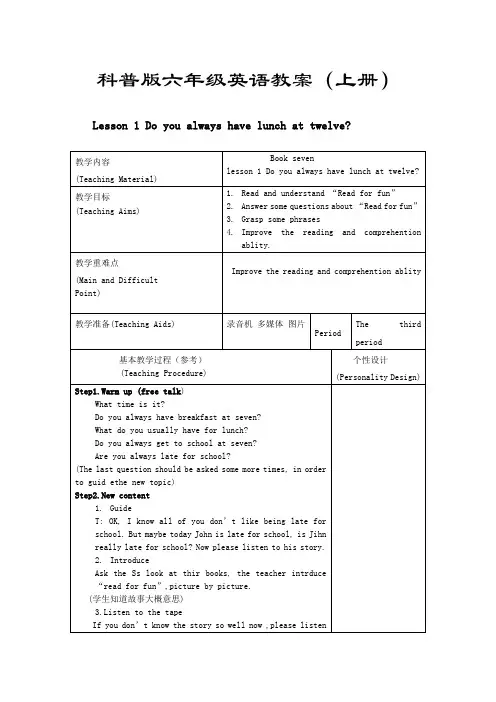
Lesson 1 Do you always have lunch at twelve?
教学内容
(Teaching Material)
Book seven
lesson 1 Do you always have lunch at twelve?
教学目标
(Teaching Aims)
2.Introduce
Ask the Ss look at thir books, the teacher intrduce“read for fun”,picture by picture.
(学生知道故事大概意思)
3.Listen to the tape
If you don’t know the story so well now ,please listen to thr tape carefully.
4.Is his mother in the kitchen this morning?
5.Who takes him to school every morning ?
6.What time is it when John gets to school?
7.Is he really late for school today? Why?
(Main and Difficult
Point)
Improve the reading and comprehention ablity
教学准备(Teaching Aids)
录音机 多媒体 图片
Period
The third period
基本教学过程(参考)
(Teaching Procedure)
(学生再次了解课文)
【教学设计】六年级上册英语-Lesson8MerryChristmas!科普版(三起)
【教学设计】六年级上册英语Lesson 8 Merry Christmas!科普版(三起)一、教学内容本节课主要学习《科普版小学英语六年级上册》中的Lesson 8 "Merry Christmas!"。
教学内容包括圣诞节的文化背景,圣诞节的传统习俗,以及与圣诞节相关的英语词汇和句型。
通过本节课的学习,学生能够了解圣诞节的基本知识,掌握相关词汇和句型,并能用英语进行简单的交流。
二、教学目标1. 知识目标:学生能够听懂、会说、会读本节课的重点词汇和句型,如:Christmas, Christmas tree, present, Santa Claus等。
2. 能力目标:学生能够运用所学知识,进行关于圣诞节的简单对话,提高英语口语表达能力。
3. 情感目标:通过学习圣诞节的文化,培养学生的跨文化意识,增进对英语学习的兴趣。
三、教学难点1. 学生对圣诞节文化的理解。
2. 学生对重点词汇和句型的掌握。
3. 学生能够用英语进行关于圣诞节的简单交流。
四、教具学具准备1. 教师准备:PPT课件、圣诞帽、圣诞歌曲、圣诞树装饰品等。
2. 学生准备:英语课本、练习本、彩笔等。
五、教学过程1. 导入新课:教师播放圣诞歌曲,引导学生说出歌曲名称,进而引出本节课的主题——圣诞节。
2. 学习词汇:教师展示PPT课件,呈现本节课的重点词汇,如:Christmas, Christmas tree, present, Santa Claus等。
学生跟读并模仿。
3. 学习句型:教师创设情境,引导学生运用所学词汇进行对话练习,如:“What do you do on Christmas Day?” “We decorate the Christmas tree.”等。
4. 小组活动:学生分组,每组设计一个关于圣诞节的对话,并进行表演。
5. 巩固拓展:教师设计一些关于圣诞节的练习题,让学生独立完成,巩固所学知识。
六、板书设计1. Merry Christmas!2. 重点词汇:Christmas, Christmas tree, present, Santa Claus等。
【英语教案】六年级英语上册教案(科普版)
【英语教案】六年级英语上册教案(科普版)lesson12mynewhome所容纳之物(teachingmaterial)book7减去12我的新家(1-4部分)设计人(designer)目标(teachingaims)1、词汇方面:readandsay:drivebridgesouthchinavestcitythroughelevatormorebedroommetrefamousv isitapartmenteighteenthtallestasia2.语言结构:复习一般现在时和形容词的比较级3、交际用语:hereweare.及7―11课的交际用语。
4.思想方面:对学生进行“爱我家乡”的思想教育。
教学重难点(主要困难)point)1.读单词。
2、会读课,理解大意,能回答与课有关的问题。
难度:复述课文(1_4)教学准备(teachingaids)taperecorder,第一个时期的图片基本教学过程(参考)(教学程序)个性化设计(personalitydesign)第一步。
热身和视觉1.trytoretellthetextoflesson11.firsttogetherthenthevolunteers.2.试着读和说这节课的生词3.区分辨音:i[ai]drivechina[i] 布里奇城4.revisetheoldwords:family,ride,over,street,stop,infrontof,building,floor,wayu phigh,muchbiggerthan,bright(卡片形式快速出现,读单词并说词义)步骤二新概念。
1.老师指着图片说:“我有一个朋友。
他的名字叫刘军。
他住在上海。
现在他有一个自己的名字。
它在浦东。
它非常漂亮。
让我们去看一看,好吗?”2.playthetape(1――4段)askthemtolistenandlookatthebooks.4.教师指向图片。
科普版小学英语六年级上册1-8课教案
小学英语六年级第七册英语教案Lesson 1 Do you alwayes have lunch at twelve?教学内容(Teaching Material)Book sevenLesson 1 Do you alwayes have lunch at twelve?设计人(Designer)Shiyanxiaoxue Shi Yongqin教学目标(Teaching Aims) 1、复习What time is it?/It’s time for....2、通过音标认读本课新单词.3、运用自由对话、表演等教学活动形式,培养学生学习英语积极的情感态度。
4、通过创设情境,导入与拓展本课书的话题和主题句,逐步培养学生用英语交流的习惯。
5、能够运用主题句型Do you always have lunch at twelve ? 进行交际教学重难点(Main and Difficult Point) 1.运用新单词就本课句型进行替换练习.2.通过音标认读新单词.3.培养学生语感,提高学习兴趣.教学准备(Teaching Aids) 录音机多媒体单词卡片Period First period基本教学过程(参考)(Teaching Procedure)个性设计(PersonalityDesign)Step1 Warm-upFree talk about personal informations (自由对话营造英语会话氛围,个人信息话题为本课主题句奠定下基础)Step2 RevisionReview summary of lesson1-6Step3 Presentation1.Learn new words of lesson oneRead all the words of lesson one according to the phonetic symbles by themselves.(让学生根据音标自学单词,培养学生自学意识)2. Learn black words.(Read and spelling)3. Practice(read the word cards)Step4 Presentation(Let’s talk)1.GuidingTake out a clock and ask : what time isit?The student will answer: It’s twelve. Then the teacher say:Oh, yes it’s time for lunch.The teacher ask:Do you always have lunch at twelve? Help the students anawer:Yes, I do.2.Show the topicOK,today we will learn lesson one: Do you always have lunch at twelve?(Write the topic on the blackboard,以旧引新,循序渐进的导入,减低学习难度)3.Let’talk__new dialoguea.Read the dialogue by themslves for one timeb.Look at the books and listen to the tape C. Listen to the tape and repeat for twice. (学生先自渎可发现自己不会的地方,便会有目的的去听,然后再重点跟度自己不会的句子,有目的的去听会很有效的提高学生的听力。
科普版小学英语六年级上册1-8课教案设计
小学英语六年级第七册英语教案Lesson 1 Do you alwayes have lunch at twelve?教学内容(Teaching Material)Book sevenLesson 1 Do you alwayes have lunch at twelve?设计人(Designer)Shiyanxiaoxue Shi Yongqin教学目标(Teaching Aims) 1、复习What time is it?/It’s time for....2、通过音标认读本课新单词.3、运用自由对话、表演等教学活动形式,培养学生学习英语积极的情感态度。
4、通过创设情境,导入与拓展本课书的话题和主题句,逐步培养学生用英语交流的习惯。
5、能够运用主题句型Do you always have lunch at twelve ? 进行交际教学重难点(Main and Difficult Point) 1.运用新单词就本课句型进行替换练习.2.通过音标认读新单词.3.培养学生语感,提高学习兴趣.教学准备(Teaching Aids) 录音机多媒体单词卡片Period First period基本教学过程(参考)(Teaching Procedure)个性设计(PersonalityDesign)Step1 Warm-upFree talk about personal informations (自由对话营造英语会话氛围,个人信息话题为本课主题句奠定下基础)Step2 RevisionReview summary of lesson1-6Step3 Presentation1.Learn new words of lesson oneRead all the words of lesson one according to the phonetic symbles by themselves.(让学生根据音标自学单词,培养学生自学意识)2. Learn black words.(Read and spelling)3. Practice(read the word cards)Step4 Presentation(Let’s talk)1.GuidingTake out a clock and ask : what time isit?The student will answer: It’s twelve. Then the teacher say:Oh, yes it’s time for lunch.The teacher ask:Do you always have lunch at twelve? Help the students anawer:Yes, I do.2.Show the topicOK,today we will learn lesson one: Do you always have lunch at twelve?(Write the topic on the blackboard,以旧引新,循序渐进的导入,减低学习难度)3.Let’talk__new dialoguea.Read the dialogue by themslves for one timeb.Look at the books and listen to the tape C. Listen to the tape and repeat for twice. (学生先自渎可发现自己不会的地方,便会有目的的去听,然后再重点跟度自己不会的句子,有目的的去听会很有效的提高学生的听力。