
OSAHS患者围术期管理快捷指南
OSAHS患者围术期管理快捷指南
中华医学会麻醉学分会2012
执笔:张炳熙
专家组:吴新民于布为薛张纲叶铁虎王俊科邓小明
目录
一、OSAHS概述
二、OSAHS的诊断标准
三、OSAHS患者的术前评估
四、OSAHS患者的术前准备
五、OSAHS患者的麻醉
六、OSAHS患者的术后恢复
参考文献
附录
一、概述
●阻塞性睡眠呼吸暂停低通气综合征(OSAHS)系指患者睡眠时周期性地出现部分或完全的上呼吸道梗阻,是一种具有严重危害及潜在的危险的高发性疾病。
●由于睡眠时发生低氧及高碳酸血症,最终所引起全身多系统,多器官的渐进性损害,被WHO列为严重潜在致死性疾病。
●由于此类患者围术期有发生上呼吸道醒阻的潜在危险,且多伴有高血压或心脏病,故不论所施行的手术是否与矫正OSAHS有关,均应列为麻醉的高危患者。
●为降低发生不良结局的可能性,提高OSAHS患者的围术期管理质量,特提出OSAHS患者麻醉和围术期管理快捷指南。
二、OSAHS的诊断标准
1、在睡眠过程中,间断的上呼吸道部分或完全阻塞,引起反复发生的睡眠觉醒和低氧血症、高碳酸血症,心血管功能率乱,白天嗜睡。
具体是指,成人于7h的夜间睡眠过程中,在有通气努力的情况下,如呼吸气流停止(较基线水平下降≥90%),持续时间≥10s/次;或者呼吸气流较基线水平下降≥30%并伴有脉搏血氧饱和度(SpO2)下降超过4%,且持续时间≥10s;当上呼吸道停止和低通气每小时发作5次以上,即可以诊断OSAHS。
2、儿童睡眠过程中阻塞性呼吸暂停指数(OAI)在于1次/h或呼吸暂停-低通气指数(AHI)大于5次/h ,每次持续时间≥2个呼吸周期;最低动脉血氧饱和度低于92%;儿童满足以上两者即可诊断OSAHS。
3、目前多以多导睡眠记录(PSG)的结果作为OSAHS的诊断标准,尤其是其中的指标:呼吸暂停-低通气指数(AHI)。
三、OSAHS患者的术前评估
(一)一般评估
1)全面的病史回顾。
2)术前麻醉科门诊。
向患者或家属了解病情,如打鼾、呼吸暂停事件、夜间觉醒的频率、晨起头痛和白天嗜睡等。
3)体格检查。
包括:气道、鼻咽部、颈围、扁桃体大小和舌体大小。
4)睡眠检查,如PSG。
5)头颅x-线检查。
6)电子鼻咽喉镜检查。
(二)如何判断是否是OSAHS
1)PSG是准确性很高的诊断主法,但是由于费时及增加卫生保健的负担,因此不能对每一个患者均进行此项检查。
2)能过病史和体格检查,结合STOP-Berlin,或ASA问卷调查是目前临床上常用的筛选方法,可以将患者分为OSAHS高危和低危(见附录)。
3)如果患者缺少术前PSG检查,则可根据以下指标大致判断是否为OSAHS。
(1)体重指数(BMI)增加,超过正常范围;
(2)颈围大(颈围>40cm);
(3)打鼾(鼾声超过讲话音);
(4)气道异常;
(5)白天嗜睡;
(6)张口不能明视软腭;
(7)扁桃体大
(8)被观察到夜间呼吸暂停。
(三)困难气道的评估
1、OSAHS 患者围术期的最主要危险是不能确保呼吸道通畅,麻醉诱导后插管困难、通气困难,甚至不能维持有效通气,或拔管后立即出现呼吸道部分或完全梗阻;术后给予镇痛药和/或镇静药后呼吸停止,导致缺氧、脑缺氧性损害,甚至死亡。
2、应详细了解患者有无以下情况
1)困难气道麻醉史;
2)颜面部畸形,如小下颌畸形、下颌后缩畸形、舌骨位置异常等;
3)上呼吸道解剖异常,如口咽腔狭小、扁桃体腺样体肥大、舌体肥大等;
4)颌下软组织肥厚,双下颌角触摸不清者;
5)结合Mallampati 试验、直接或间接喉镜检查、影像学检查等结果综合判断。
(四)重要脏器功能评估
1、OSAHS 患者病情越重,心、脑、肾等重要脏器的损害越大;
2、高血压、心律失常、右室肥厚、冠心病等;
3、呼吸系统储备功能下降,肺动脉高压等;
4、肾脏功能受损;
5、糖尿病并发症;
6、红细胞数量增加。
四、OSAHS患者的术前准备
1、减肥。
2、使用下颌前移矫正器中口腔矫治器。
3、术前呼吸机辅助治疗。
包括:持续道正压气(CPAG),经鼻翼无创正压通气(NIPPV),双水平正压通气(BiPAP)等。
通常经3个月的呼吸支持治疗能够缓解OSAHA导致的心血管功能率乱和代谢异常。
4、重要脏器疾患的治疗。
5、对于OSAHS低危患者,围术期无特殊处理。
6、对于高危和确诊的OSAHS患者,则需做好标示,以引起注意和重视。
五、OSA 患者的麻醉
1、客观评估气管插管的维易程度。
2、认真准备好完成困难插管的各种设备和技术手段。
3、备好麻醉机,呼气末二氧化碳分压、脉搏血氧饱和度、血压和心电的监测仪,备血气分析仪和转运呼吸机。
4、可选择清醒和充分表面麻醉下强行气管插管所导致的声门水肿和气道痉挛。
5、在有条件且技术熟练的单位,能够确保对患者意识消失后仍能进行有效通气时(包括置入口咽通气道或鼻咽通气道支持下)可行快速诱导气管内插管。
(二)术中管理
1、气道管理
(1)气管导管位置判断:体表触诊、听诊器、纤支镜检等;
(2)气管导管可靠的固定;
(3)呼吸功能监测:SpO2、PETCO2、动脉血气分析。
2、循环管理:
(1)心电图监测;
(2)动脉压监测:无创、有创。
(三)OSAHS 患者行非OSAHS 相关的矫治术
1、区域阻滞(包括局部浸润、外周神经阻滞或椎管内阻滞)如可满足手术需要,可为首选。
2、区域阻滞复合深度镇静对OSAHS 患者带来的危险远高于气管内插管全身麻醉。
3、对于手术创伤大、操作复杂、出血多、伴有大量体液丢失及转移的手术以及对患者呼吸、循环功能影响大的手术(如心、胸和神经外科手术),应选择气管内插管全身麻醉。
(四)OSAHS 患者行颚咽成形手术(UPPP)
1、应首选气管内插管全身麻醉。
2、不插管全麻和喉罩技术,对于此类患者具有高风险。
3、气管插管方法依设备与技术条件,可选择应用:
1)清醒镇静经鼻插管;
2)快速诱导经口插管;
3)快速诱导经鼻插管;
4、全身麻醉药物的选择
1)术前应慎用镇静剂或麻醉性镇痛药。
2)全身麻醉时可选用起效迅速、作用时间短的强效吸主性麻醉药如地氟烷、七氟烷,静脉麻醉药丙泊酚和麻醉性镇痛药瑞芬术尼,辅助短效的非去极化肌松剂。
六、OSAHS患者的术后恢复
(一)拔管指征:
1、意识:清醒,定向力完全恢复,对指令有明确的反应;
2、反射:呛咳反射恢复,吞咽反射活跃;
3、呼吸:自主呼吸平稳;
4、拔管前充分肌松拮抗;
5、循环:稳定;
6、半斜坡位(头高30度)用于拔管和恢复;
7、充分吸尽咽喉部的分泌物和残留血,确保术野无活动出血。
(二)此类患者应常规做好再次气管内插管准备。
因此,拔管前需进行如下准备:
1、合适的口咽或鼻咽通气道;
2、面罩;
3、拔管无把握时,应预先置气管插管引导管再行拔管;
4、处理困难气道的应急设备;
5、必要时使用CPAP辅助呼吸。
(三)带管送ICU指征
1、意识:嗜睡、苏醒延迟;
2、反射:弱;
3、呼吸:遗忘,反常;
4、循环:不稳定;
5、气道:插管困难,电子喉镜示咽腔重度狭窄,术后水肿影响气道开放。
6、PSG:中度以上、重度OSAHS。
(四)术后镇痛
目前一致认为应尽可能避免在无呼吸支持的OSAHS患者使用阿片类药物,尤其是接受上气道手术的OSAHS患者。
ASA推荐使用局部麻醉来减少全身使用阿片类药物的副作用。
不同级别、不用作用机制的镇痛药的联合使用是围术期疼痛治疗较为谨慎的方法。
1、此类患者使用阿片类药物后发生上呼吸道阻塞和呼吸抑制的危险性很大;
2、镇静药物与阿片类药物的联合使用更会使呼吸抑制和气道梗阻的风险增加。
3、应在切口周围注射长效局部麻醉药止痛;
4、非甾体类抗炎药镇痛为首选;
5、外周神经阻滞镇痛或硬膜外自控镇痛是较理想的镇痛方法;
6、患者自控镇痛应慎用,如使用需要严密监测。
(五)体位、供氧与监测
1、患者回病房后应改为侧卧位或半坐位,尽可能避免仰卧位。
2、充分供氧,保持气道通畅。
3、术后拔管在PACU平均停留3小时以上。
4、如发生呼吸道梗阻或低氧血症,则应延长监测时间至最后一个不良事件发生后7小时。
5、送回病房的患者应常规进行24h 时监测,包括心电图、SpO2和无创血压等,直到吸空气睡眠时SpO2持续高于90%。
6、送至ICU的患者常保留所管内导管至术后第1日,以保证患者的术后安全。
重度OSAHS行气管切开上气道扩容术围手术期的护理管理

作者: 吴兴云
作者机构: 安徽医科大学第一附属医院耳鼻咽喉-头颈外科,安徽合肥230031
出版物刊名: 中国农村卫生事业管理
页码: 1289-1291页
年卷期: 2014年 第10期
主题词: 阻塞性睡眠呼吸暂停低通气综合征 重症 气管切开 上气道扩容 护理
摘要:目的:探讨气管切开上气道扩容术治疗重度OSAHS的围手术期的护理,提高治疗和护理质量。
方法:回顾5例行气管切开上气道扩容术治疗重度OSAHS的临床资料,加强术前心理护理,完善术前准备,辅助治疗,健康宣教,术后密切观察生命体征的变化,体位与饮食的指导,疼痛的护理,口腔护理,保持呼吸道的通畅及潜在并发症的护理,总结临床护理经验。
结果:5例患者术后恢复良好,症状明显减轻,均顺利拔管,无大出血及护理并发症的发生。
结论:为患者提供优质的护理,可帮助患者顺利完成手术治疗,减轻患者术后痛苦,减少并发症的发生。
UPPP治疗OSAHS的围手术期护理

UPPP治疗OSAHS的围手术期护理发表时间:2012-08-22T09:43:41.280Z 来源:《中外健康文摘》2012年第21期作者:于凤伟周惠斌马力学[导读] 为使患者能积极配合手术,顺利渡过手术期,减少术后并发症的发生,做好围手术期护理非常重要。
于凤伟周惠斌马力学(解放军第313医院五官科辽宁葫芦岛 125000)【中图分类号】R473.6【文献标识码】B【文章编号】1672-5085(2012)21-0318-02【摘要】目的讨论阻塞性睡眠呼吸暂停综合征(OSAHS)行悬雍垂腭咽成形术的围手术(UPPP)期护理。
方法回顾57例OSAHS患者行UPPP 手术治疗的临床护理经验。
结果 57例悬雍垂腭咽成形术的患者在围手术期内均无并发症出现,术后经3个月的跟踪观察47例患者睡眠呼吸暂停症状消失,10例患者鼾声明显减轻、憋气症状消失。
结论做好充分术前准备工作,加强心理护理,术后注意各种并发症的预防和处理,加强营养,是使患者安全度过围手术期,早日康复出院的关键所在。
【关键词】鼾症悬雍垂腭咽成形术护理OSAHS是指夜间平均7小时睡眠中,口鼻气流暂停反复发作30次以上,每次暂停超过十秒钟或睡眠呼吸紊乱指数1h超过5次以上,其发病率占有关睡眠疾病的1/2-1/3。
是一种病态睡眠性疾病,不仅可造成睡眠质量下降,并且由于长期存在夜间低氧血症[1]高碳酸血症可引起多系统,多器官的慢性损伤,目前治疗包括多种方法,手术是主要方法之一。
因为此类患者多伴有高血压,肥胖,高血脂,隐性冠心病等情况。
为使患者能积极配合手术,顺利渡过手术期,减少术后并发症的发生,做好围手术期护理非常重要。
1 临床资料1.1 一般情况我科2007年1月-2011年10月共对57例OSAHS患者行UPPP手术。
男50例,女7例,年龄21-67,平均年龄41.58+11.63岁。
平时均有夜间睡眠时打鼾,憋气,夜眠,梦游,呼吸暂停,白天嗜睡,乏力,晨起头痛和记忆力下降,患者均在全麻下行悬雍垂腭咽成形术经围手术期护理,所有患者均痊愈出院。
OSAHS患者上呼吸道一期成形术围手术期处理及麻醉管理
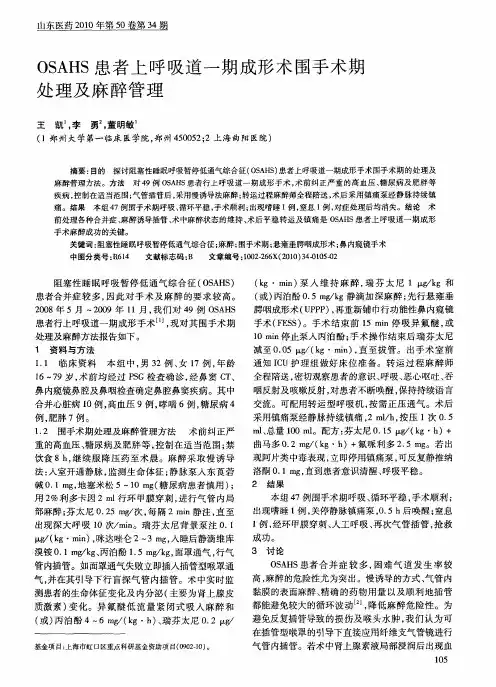
溴铵 0 1m / g丙泊酚 15m / g面罩通气 , . gk 、 . gk , 行气 管内插管。如面罩通气失败立即插入插管型喉罩通 气, 并在其引导下行盲探气管 内插管 。术 中实时监
测患者 的生命 体 征变 化及 内分 泌 ( 主要 为 肾上 腺 皮
OA S S H 患者合并 症较 多, 困难气 道发 生率较 高, 麻醉的危险性尤为突出。慢诱导的方式 、 气管内 黏膜的表面麻醉、 精确的药物用量以及顺利地插 管 都能避免较大的循环波动 , J降低麻醉危 险性。为 避免反复插管导致的损伤及喉头水肿 , 我们 认为 可 在插管型喉罩的引导下直接应用纤维支气管镜进行 气 管 内插管 。若术 中 肾上 腺 素液局部 浸 润后 出现血
碱 0 1m , . g 地塞 米松 5~1 ( 尿 病 患者 慎用 ) 0mg 糖 ; 用2 %利 多卡 因 2m 行 环 甲膜穿 刺 , 行 气 管 内局 l 进 部麻醉 ; 太 尼 0 2 g 次 , 隔 2 mi 注 , 至 芬 .5m / 每 n静 直
洛 酮 0 1m , 到患 者意 识清 醒 、 . g直 呼吸平稳 。
患者行 上 呼吸道 一 期成 形 手术 … , 现对 其 围手术 期
处理及 麻醉方 法 报告如 下 。
1 资料 与方法
11 f 资 料 . 晦床
本组 中, 3 男 2例 、 1 女 7例 , 龄 年
1 7 6— 9岁 , 前均 经 过 P G检 查确 诊 , 鼻 窦 C 、 术 S 经 T
前处理各种合并症 、 醉诱导插管 、 麻 术中麻 醉状态 的维持 、 术后平稳 转运及镇 痛是 O A S患者上呼 吸道~期成 形 SH 手术麻醉成功的关键。
关键词 : 阻塞性睡眠呼吸暂停低通气综合征 ; ; 麻醉 围手术期 ; 悬雍垂腭咽成形术 ; 内窥镜手术 鼻
睡眠综合征患者围术期管理

单击此处添加正文,文字是您思想的提炼,为了演示发布的良好效果,请言简意赅地阐述您的观点。
汇报人姓名
OSAHS患者围术期管理快捷指南
单击添加副标题
单击此处添加文本具体内容,简明扼要地阐述你的观点
阻塞性睡眠呼吸暂停低通气综合征(OSAHS)是指患者睡眠时周期性的出现部分或完全的上呼吸道阻塞,是一种具有严重危害及潜在危险的高发性疾病。
由于睡眠时发生低氧及高碳酸血症,最终所引起全身多系统、多器官的渐进性损害,被WHO所列为严重潜在致死性疾病。
半斜坡位(头高位30度)用于拔管和恢复
08
充分吸尽咽喉部的分泌物和残留血,确保术野无活动性出血。
六、OSAHS患者的术后恢复
01
此类患者应常规做好再次气管内插管的准备。因此,拔管需进行如下准备:
合适的口咽或鼻炎通气道
面罩
02
03
04
拔管无把握时,应预先放置气管插管引导导管再行拔管。
处理困难气道的应急设备
全身麻醉时可选用起效迅速、作用时间短的强效吸入麻醉药如地氟烷、七氟烷,静脉麻醉药丙泊酚和麻醉性镇痛药瑞芬太尼,辅助短效的非去极化肌松药。
01
拔管指征:
02
意识:清醒,定向力完全恢复,对指令有明确的反应。
03
反射:呛咳反射恢复,吞咽反射活跃
04
呼吸:自主呼吸平稳
05
拔管前充分肌松拮抗
06
循环:稳定
07
三 OSASH患者的术前评估
一般评估: 全面的病史回顾。 术前麻醉科门诊。向患者或家属了解病情,如打鼾、呼吸暂停事件、夜间觉醒的频率。晨起头痛和白天嗜睡等。 体格检查。包括:气道、鼻咽部、颈围、扁桃体大小和舌体大小。 睡眠检查,如PSG。 头颅X-线检查。 电子鼻咽喉镜检查。
阻塞性睡眠呼吸暂停低通气综合征患者围手术期管理的专家共识(全文)

阻塞性睡眠呼吸暂停低通气综合征患者围手术期管理的专家共识(全文)目录一、QSAHS的发病率二、OSAHS的病理生理三、OSAHS的诊断四、OSAHS患者的术前准备五、OSAHS患者的麻醉六、术后管理阻塞性睡眠呼吸暂停(OSA)系指患者睡眠时周期性地出现部分或完全的上呼吸道梗阻。
而部分的上少吸道梗阻导致低通气,所以此概念称为阻塞性睡眠呼吸暂停低通气综合征(obstruetive sleep apnea hypopnea syndrome,OSAHS)。
由于此类患者围手术期潜在有发生上呼吸道梗阻的危险,且多伴有肥胖、高血压或心脏病,故不论所施行的手术是否与矫正OSAHS有关,该类患者应被列为麻醉的高危患者。
因此,为降低发生不良结局的可能性,提高OSAHS 患者的围术期管理质量,特提出OSAHS患者麻醉和围手术期管理的专家共识。
一、OSAHS的发病率美国OSAHS 的发病率约为5%~25%。
我国尚缺乏大样本的流行病学资料,但根据已有数据估算,OSAHS 的发病率约为4%。
随着中国人口老龄化和肥胖化程度的不断提高,其发病率会大幅增加。
不幸的是,约有80%~95%的OSAHS 患者在手术前并没有能够被诊断出来。
因此,麻醉科医师必须掌握OSAHS 的诊断标准。
(见本共识第三部分:OSAHS 的诊断标准)二、OSAHS 的病理生理成人的上呼吸道是咽腔,其前壁和侧壁没有骨性组织支撑,仅靠咽腔壁上的肌肉张力保持其开放。
睡眠时由于肌肉松弛,舌后坠,可不同程度地使咽腔变窄。
如果咽腔显著变窄,则吸气时因气流迅速通过悬雍垂、舌根和会厌,而产生鼾声和低通气状态。
当咽腔壁肌肉完全失去张力时,咽腔塌陷,由于舌完全后坠,形成上呼吸道完全梗阻,出现虽用力通气、但无气流通过、无声音的窒息状态。
窒息时间如超过10s,就将引起低氧和高碳酸血症。
低氧和高碳酸血症会触发用力通气和气道负压进一步增加,并导致患者睡眠减浅和微觉醒,脑电呈现睡眠减浅的相应变化,出现肢体活动、翻身、憋醒,咽部肌肉张力增加、咽腔部分开放、伴有鼾声。
肥胖合并阻塞性睡眠呼吸暂停综合征患者围手术期护理(完整版)

肥胖合并阻塞性睡眠呼吸暂停综合征患者围手术期护理(完整版)阻塞性睡眠呼吸暂停综合征(obstructive sleep apnea,OSA)是指各种原因导致的睡眠状态下反复出现呼吸暂停、高碳酸血症和睡眠中断,使机体发生一系列病理生理改变的临床综合征。
OSA已被称为“梦中杀手”,严重者可导致全身多器官多系统的损害甚至死亡,而肥胖是OSA最重要的危险因素之一。
有研究表明,体质量指数(body mass index,BMI)每升高1%,OSA的发病率就增加1.14%[1]。
因病态肥胖拟行减重手术的外科患者中,OSA的发生率>70%[2],因此肥胖合并OSA患者的研究受更多人的关注。
在2013版美国《OSA规范诊疗指南》中明确指出,建议合并肥胖的OSA患者进行减重治疗[3]。
减重手术已成为肥胖症长期而有效的治疗方法,对合并OSA的治疗同样起着至关重要的作用。
为了确保手术安全及效果,围手术期全程护理管理对于患者康复显得尤为重要。
一、术前评估与检测(一)入院后护理风险评估患者入院后即刻进行入院评估,及时了解患者病情及生活习惯,包括OSA家族史、有无大量饮酒和服用镇静催眠类的药物、长期吸烟的习惯,同时仔细询问有无高血压史、冠心病史、2型糖尿病史及心律失常等合并症,便于及时发现及时对症治疗。
对于有饮酒、吸烟嗜好患者应立即告知戒烟戒酒;对于长期服用安眠药或扩血管降压药患者应做好特殊用药指导并加强安全措施教育,预防跌倒的意外发生。
(二)重视肥胖型OSA评估项目1. 对于围手术期的OSA患者的管理和不良事件的预防,筛查和识别高危患者是第一步。
因此寻找快速筛查睡眠呼吸暂停的量表,确定其与多导睡眠图(polysomnograph,PSG)的敏感性和特异性在临床工作中具有深远的意义。
现今没有被公认的测试或量表能全面识别OSA患者危险,目前在临床中比较常用的只有STOP-BANG量表和Epworth嗜睡量表(Epworth sleepiness scale,ESS)。
2006OSA病人围手术期管理指南
ⅥSPECIAL ARTICLESAnesthesiology2006;104:1081–93©2006American Society of Anesthesiologists,Inc.Lippincott Williams&Wilkins,Inc. Practice Guidelines for the Perioperative Management ofPatients with Obstructive Sleep ApneaA Report by the American Society of Anesthesiologists Task Force on Perioperative Management of Patients with Obstructive Sleep ApneaPRACTICE guidelines are systematically developed rec-ommendations that assist the practitioner and patient in making decisions about health care.These recommen-dations may be adopted,modified,or rejected according to clinical needs and constraints.Practice guidelines are not intended as standards or absolute requirements.The use of practice guidelines cannot guarantee any specific outcome.Practice guidelines are subject to revision as warranted by the evolution of medical knowledge,tech-nology,and practice.They provide basic recommenda-tions that are supported by analysis of the current liter-ature and by a synthesis of expert opinion,open forum commentary,and clinical feasibility data. MethodologyA.Definition of Obstructive Sleep Apnea Obstructive sleep apnea(OSA)is a syndrome charac-terized by periodic,partial,or complete obstruction of the upper airway during sleep.This,in turn,causes repetitive arousal from sleep to restore airway patency, which may result in daytime hypersomnolence or other daytime manifestations of disrupted sleep such as aggres-sive or distractible behavior in children.The airway obstruction may also cause episodic sleep-associated ox-ygen desaturation,episodic hypercarbia,and cardiovas-cular dysfunction.It is estimated that the adult preva-lence of sleep disordered breathing,as measured in a sleep laboratory,is9%in women and24%in men, whereas the prevalence of overt OSA has been estimated to be2%in women and4%in men.1Thesefigures are likely to increase as the population becomes older and more obese.In the perioperative period,both pediatric and adult patients with OSA,even if asymptomatic, present special challenges that must be systematically addressed to minimize the risk of perioperative morbid-ity or mortality.It is the opinion of the Task Force that the perioperative risk to patients increases in proportion to the severity of sleep apnea.Because procedures differ among laboratories,it is not possible to use specific values of indices(such as the apnea-hypopnea index[AHI])to define the severity of sleep apnea.Therefore,for the purposes of these Guide-lines,patients will be stratified using the terms mild, moderate,and severe as defined by the laboratory where the sleep study was performed.B.Purpose of the GuidelinesThe purpose of these Guidelines is to improve the peri-operative care and reduce the risk of adverse outcomes in patients with OSA who receive sedation,analgesia,or an-esthesia for diagnostic or therapeutic procedures under the care of an anesthesiologist.The Task Force recognizes that it is not possible to determine with100%accuracy whether a given patient will develop perioperative complications related to OSA.Therefore,these Guidelines should be im-plemented with the goal of reducing the likelihood of adverse outcomes in patients who are judged to be at theThis article is featured in“This Month in Anesthesiology.”Please see this issue of A NESTHESIOLOGY,page5A.᭛Additional material related to this article can be found on theA NESTHESIOLOGY Web site.Go to http://www.anesthesiology.org,click on Enhancements Index,and then scroll down tofind the appropriate article and link.Supplementary materialcan also be accessed on the Web by clicking on the“Arti-clePlus”link either in the Table of Contents or in the HTMLversion of the article.Developed by the American Society of Anesthesiologists Task Force on Peri-operative Management of Obstructive Sleep Apnea:Jeffrey B.Gross,M.D. (Chair),Farmington,Connecticut;Kenneth L.Bachenberg,M.D.,Bellingham, Washington;Jonathan L.Benumof,M.D.,San Diego,California;Robert A.Caplan, M.D.,Seattle,Washington;Richard T.Connis,Ph.D.,Woodinville,Washington; Charles J.Cote´,M.D.,Boston,Massachusetts;David G.Nickinovich,Ph.D., Bellevue,Washington;Vivek Prachand,M.D.,Chicago,Illinois;Denham S.Ward, M.D.,Rochester,New York;Edward M.Weaver,M.D.,M.P.H.,Seattle,Washing-ton;Lawrence Ydens,M.D.,Santa Fe,New Mexico;Song Yu,M.D.,Farmington, Connecticut.Submitted for publication November1,2005.Accepted for publication No-vember1,2005.Supported by the American Society of Anesthesiologists under the direction of James F.Arens,M.D.,Chair,Committee on Practice Parameters. Approved by the House of Delegates on October25,2005.A complete list of references used to develop these Guidelines is available by writing the American Society of Anesthesiologists.These Guidelines have been endorsed by the Amer-ican Academy of Sleep Medicine and the American Academy of Otolaryngology–Head and Neck Surgery.They have received an“Affirmation of Value”from the American Academy of Pediatrics.Address reprint requests to the American Society of Anesthesiologists:520 North Northwest Highway,Park Ridge,Illinois60068-2573.This Practice Guide-lines article,as well as all published ASA Practice Parameters,may be accessed at no charge through the Journal Web site,.greatest risk,with the understanding that it may be imprac-tical to eliminate OSA-related perioperative morbidity and mortality completely.However,it is hoped that the imple-mentation of these Guidelines will reduce the likelihood of adverse perioperative outcomes in patients with OSA. C.FocusThese Guidelines focus on the perioperative manage-ment of patients with OSA who may be at increased risk for perioperative morbidity and mortality because of potential difficulty in maintaining a patent airway.This population includes but is not limited to patients who have sleep apnea resulting from obesity,pregnancy,and other skeletal,cartilaginous,or soft tissue abnormalities causing upper airway obstruction.Excluded from the focus of these Guidelines are patients with the follow-ing:(1)pure central sleep apnea,(2)abnormalities of the upper or lower airway not associated with sleep apnea (e.g.,deviated nasal septum),(3)daytime hypersomno-lence from other causes,(4)patients younger than1yr, and(5)obesity in the absence of sleep apnea.D.ApplicationThese Guidelines apply to both inpatient and outpa-tient settings,and to procedures performed in an oper-ating room,as well as in other locations where sedation or anesthesia is administered.They are directly applica-ble to care administered by anesthesiologists and indi-viduals who deliver care under the medical direction or supervision of an anesthesiologist.They are also in-tended to serve as a resource for other physicians and patient care personnel who are involved in the care of these patients.In addition,these Guidelines may serve as a resource to provide an environment for safe patient care.E.Task Force Members and ConsultantsThe American Society of Anesthesiologists appointed a Task Force of12members to(1)review the published evidence,(2)obtain the opinion of a panel of consultants including anesthesiologists and nonanesthesiologist physi-cians and researchers who regularly care for patients with OSA,and(3)build consensus within the community of practitioners likely to be affected by the Guidelines.The Task Force included anesthesiologists in both private and academic practices from various geographic areas of the United States,a bariatric surgeon,an otolaryngologist,and two methodologists from the American Society of Anesthe-siologists Committee on Practice Parameters.The Task Force developed the Guidelines by means of a six-step process.First,they reached consensus on the cri-teria for evidence of effective perioperative management of patients with OSA.Second,original published research studies from peer-reviewed journals relevant to the periop-erative management of patients with OSA were evaluated. Third,the panel of expert consultants was asked to(1) participate in opinion surveys on the effectiveness of vari-ous perioperative management strategies for patients with OSA and(2)review and comment on a draft of the Guide-lines developed by the Task Force.Fourth,the Task Force held open forums at two major national meetings to solicit input on its draft recommendations.National organizations representing most of the specialties whose members typi-cally care for patients with OSA were invited to participate in the open forums.Fifth,the consultants were surveyed to assess their opinions on the feasibility andfinancial impli-cations of implementing the Guidelines.Sixth,all available information was used to build consensus within the Task Force tofinalize the Guidelines.Tables1and2are meant to serve as examples of how patients with OSA might be identified and stratified with respect to their perioperative risk.While they were devel-oped by the Task Force with input from the consultants and open forum participants,these tables are not evidence based and have not been clinically validated.F.Availability and Strength of Evidence Preparation of these Guidelines followed a rigorous methodologic process(appendix).To convey thefind-ings in a concise fashion,these Guidelines use several descriptive terms that are easier to understand than the technical terms used in the actual analyses.When sufficient numbers of studies are available for evaluation,the following terms describe the strength of thefindings.Supportive:Meta-analyses of a sufficient number of ade-quately designed studies indicate a statistically signifi-cant relationship(PϽ0.01)between a clinical inter-vention and a clinical outcome.Suggestive:Information from case reports and descrip-tive studies permits inference of a relationship be-tween an intervention and an outcome.This type of qualitative information does not permit a statistical assessment of significance.Equivocal:Qualitative data are not adequate to permit inference of a relationship between an intervention and an outcome and(1)there is insufficient quantita-tive information or(2)aggregated comparative studies have found no significant differences among groups or conditions.The lack of scientific evidence in the literature is described by the following terms.Silent:No identified studies address the specified rela-tionship between an intervention and outcome. Insufficient:There are too few published studies to in-vestigate a relationship between an intervention and an outcome.Inadequate:The available studies cannot be used to assess the relationship between an intervention and an outcome.These studies either do not meet the criteria for content as defined in the Focus of these Guide-lines,or do not permit a clear causal interpretation of findings due to methodologic concerns.The following terms describe survey responses from the consultants for any specified issue.Responses were solic-ited on afive-point scale;ranging from1(strongly disagree) to5(strongly agree),with a score of3being equivocal. Strongly agree:Median score of5.Agree:Median score of4.Equivocal:Median score of3.Disagree:Median score of2.Strongly disagree:Median score of1.GuidelinesI.Preoperative EvaluationPreoperative evaluation of a patient for potential iden-tification of OSA includes(1)medical record review,(2)Table1.Identification and Assessment of OSA:ExampleA.Clinical signs and symptoms suggesting the possibility of OSA1.Predisposing physical characteristicsa.BMI35kg/m2[95th percentile for age and gender]*b.Neck circumference17inches(men)or16inches(women)c.Craniofacial abnormalities affecting the airwayd.Anatomical nasal obstructione.Tonsils nearly touching or touching in the midline2.History of apparent airway obstruction during sleep(two or more ofthe following are present;if patient lives alone or sleep is not observed by another person,then only one of the following needs to be present)a.Snoring(loud enough to be heard through closed door)b.Frequent snoringc.Observed pauses in breathing during sleepd.Awakens from sleep with choking sensatione.Frequent arousals from sleepf.[Intermittent vocalization during sleep]*g.[Parental report of restless sleep,difficulty breathing,or strugglingrespiratory efforts during sleep]*3.Somnolence(one or more of the following is present)a.Frequent somnolence or fatigue despite adequate“sleep”b.Falls asleep easily in a nonstimulating environment(e.g.,watchingTV,reading,riding in or driving a car)despite adequate“sleep”c.[Parent or teacher comments that child appears sleepy during theday,is easily distracted,is overly aggressive,or has difficultyconcentrating]*d.[Child often difficult to arouse at usual awakening time]*If a patient has signs or symptoms in two or more of the above categories, there is a significant probability that he or she has OSA.The severity of OSA may be determined by sleep study(see below).If a sleep study is not available,such patients should be treated as though they havemoderate sleep apnea unless one or more of the signs or symptoms above is severely abnormal(e.g.,markedly increased BMI or neckcircumference,respiratory pauses that are frightening to the observer, patient regularly falls asleep within minutes after being left unstimulated), in which case they should be treated as though they have severe sleep apnea.B.If a sleep study has been done,the results should be used to determinethe perioperative anesthetic management of a patient.However,because sleep laboratories differ in their criteria for detecting episodes of apnea and hypopnea,the Task Force believes that the sleeplaboratory’s assessment(none,mild,moderate,or severe)should take precedence over the actual AHI(the number of episodes of sleep-disordered breathing per hour).If the overall severity is not indicated,it may be determined by using the table below:Severity of OSA Adult AHI Pediatric AHI None0–50Mild OSA6–201–5 Moderate OSA21–406–10Severe OSAϾ40Ͼ10*Items in brackets refer to pediatric patients.AHIϭapnea-hypopnea index;BMIϭbody mass index;OSAϭobstructive sleep apnea;TVϭtelevision.Table2.OSA Scoring System:ExamplePoints A.Severity of sleep apnea based on sleep study(orclinical indicators if sleep study not available).Point score_____(0–3)*†Severity of OSA(table1)None0Mild1Moderate2Severe3 B.Invasiveness of surgery and anesthesia.Point score_____(0–3)Type of surgery and anesthesiaSuperficial surgery under local or peripheral nerveblock anesthesia without sedation0 Superficial surgery with moderate sedation orgeneral anesthesia1 Peripheral surgery with spinal or epiduralanesthesia(with no more than moderatesedation)1Peripheral surgery with general anesthesia2Airway surgery with moderate sedation2Major surgery,general anesthesia3Airway surgery,general anesthesia3 C.Requirement for postoperative opioids.Point score_____(0–3)Opioid requirementNone0Low-dose oral opioids1High-dose oral opioids,parenteral or neuraxialopioids3D.Estimation of perioperative risk.Overall scoreϭthescore for A plus the greater of the score for eitherB or C.Point score_____(0–6)‡A scoring system similar to this table may be used to estimate whether a patient is at increased perioperative risk of complications from obstructive sleep apnea(OSA).This example,which has not been clinically validated,is meant only as a guide,and clinical judgment should be used to assess the risk of an individual patient.*One point may be subtracted if a patient has been on continuous positive airway pressure(CPAP)or noninvasive positive-pressure ventilation(NIPPV) before surgery and will be using his or her appliance consistently during the postoperative period.†One point should be added if a patient with mild or moderate OSA also has a resting arterial carbon dioxide tension(Pa CO2) greater than50mmHg.‡Patients with score of4may be at increased perioperative risk from OSA;patients with a score of5or6may be at significantly increased perioperative risk from OSA.patient or family interview,(3)physical examination,(4) sleep studies,and(5)preoperative x-rays for cephalo-metric measurement in selected cases.Although the comparative literature is insufficient to evaluate the im-pact of preprocedure identification of OSA status,it suggests that OSA is associated with airway characteris-tics that may predispose patients to difficulties in peri-operative airway management.*The literature identified certain patient characteristics that are associated with OSA.These characteristics include such features as a higher body mass index,hypertension,and abnormal cephalometric measurements.Additional literature,al-though insufficient for statistical analysis,suggests that an association may exist between OSA and a larger neck circumference,a history of snoring or respiratory pauses,lower oxygen saturation values during sleep, clinical signs of difficult airway management,and certain congenital conditions(e.g.,Down syndrome,craniofa-cial abnormality,muscular dystrophy)or disease states (e.g.,diabetes mellitus,cerebral palsy).The consultants agree that,in the absence of a sleep study,a presumptive diagnosis of OSA may be made based on consideration of the following criteria:in-creased body mass index,a weight or body mass index greater than95th percentile for age(pediatric patients), increased neck circumference,snoring,congenital air-way abnormalities,daytime hypersomnolence,inability to visualize the soft palate,and tonsillar hypertrophy. They strongly agree that observed apnea during sleep is an additional criterion.The consultants agree that pre-procedure identification of a patient’s OSA status im-proves perioperative outcomes,and they are equivocal regarding whether overall costs are decreased.The con-sultants agree that a patient’s perioperative risk depends on both the severity of the OSA and the invasiveness of the surgical procedure.Recommendations.Anesthesiologists should work with surgeons to develop a protocol whereby patients in whom the possibility of OSA is suspected on clinical grounds are evaluated long enough before the day of surgery to allow preparation of a perioperative manage-ment plan.This evaluation may be initiated in a prean-esthesia clinic(if available)or by direct consultation from the operating surgeon to the anesthesiologist.A preoperative evaluation should include a comprehensive review of previous medical records(if available),an interview with the patient and/or family,and conducting a physical examination.Medical records review should include(but not be limited to)checking for a history of airway difficulty with previous anesthetics,hypertension or other cardiovascular problems,and other congenital or acquired medical conditions.Review of sleep studies is encouraged.The patient and family interview should include focused questions related to snoring,apneic episodes,frequent arousals during sleep(vocalization, shifting position,extremity movements),morning head-aches,and daytime somnolence.A physical examination should include an evaluation of the airway,nasopharyn-geal characteristics,neck circumference,tonsil size,and tongue volume.If any of these characteristics suggest that the patient has OSA,the anesthesiologist and sur-geon should jointly decide whether to(1)manage the patient perioperatively based on clinical criteria alone or (2)obtain sleep studies,conduct a more extensive air-way examination,and initiate indicated OSA treatment in advance of surgery.If this evaluation does not occur until the day of surgery,the surgeon and anesthesiologist together may elect for presumptive management based on clinical criteria or a last-minute delay of surgery.For safety,clinical criteria(table1)should be designed to have a high degree of sensitivity(despite the resulting low specificity),meaning that some patients may be treated more aggressively than would be necessary if a sleep study were available.The severity of the patient’s OSA,the invasiveness of the diagnostic or therapeutic procedure,and the require-ment for postoperative analgesics should be taken into account in determining whether a patient is at increased perioperative risk from OSA(table2).The patient and his or her family as well as the surgeon should be in-formed of the potential implications of OSA on the patient’s perioperative course.II.Preoperative PreparationPreoperative preparation is intended to improve or optimize an OSA patient’s perioperative physical status and includes(1)preoperative continuous positive air-way pressure(CPAP)or noninvasive positive-pressure ventilation(NIPPV)or bilevel positive airway pressure (BiPAP®;Respironics,Murrysville,PA),(2)preoperative use of mandibular advancement or oral appliances,(3) preoperative medications,or(4)preoperative weight loss. There is insufficient literature to evaluate the impact of the preoperative use of CPAP,NIPPV,or mandibular advancement devices on perioperative outcomes.Simi-larly,there is insufficient literature to evaluate the effi-cacy of preoperative medications or weight loss.How-ever,the literature supports the efficacy of CPAP in improving AHI,respiratory disturbance index scores, and oxygen saturation levels in nonperioperative set-tings.Similarly,the literature supports the efficacy of mandibular advancement devices in reducing AHI scores in nonperioperative settings.The consultants agree that preoperative use of positive airway pressure(CPAP or NIPPV)may improve the preop-erative condition of patients who they believe are at in-creased perioperative risk from OSA,and they are equivo-cal regarding the efficacy of mandibular advancement devices for these patients.The consultants agree that a*Refer to the appendix for details of the literature review and data analyses.preoperative determination should be made regarding whether surgery in patients at increased perioperative risk from OSA should be performed on an inpatient basis. Recommendations.Preoperative initiation of CPAP should be considered,particularly if OSA is severe.For patients who do not respond adequately to CPAP,NIPPV should be considered.In addition,the preoperative use of mandibular advancement devices or oral appliances and preoperative weight loss should be considered when feasible.A patient who has had corrective airway surgery(e.g.,uvulopalatopharyngoplasty,surgical man-dibular advancement)should be assumed to remain at risk for OSA complications unless a normal sleep study has been obtained1and symptoms have not returned. Patients with known or suspected OSA may have diffi-cult airways and therefore should be managed according to the“Practice Guidelines for Management of the Difficult Airway.”2In patients at risk for perioperative complications from OSA,a preoperative determination must be made regarding whether surgery should be performed on an inpatient or outpatient basis(see section V below).III.Intraoperative ManagementIntraoperative concerns in patients at increased peri-operative risk from OSA include(1)choice of anesthetic technique,(2)airway management,and(3)patient mon-itoring.The literature is insufficient to evaluate the ef-fects of various anesthetic techniques on patients with OSA.Similarly,the literature is insufficient to evaluate the impact of specific intraoperative airway management (e.g.,awake extubation)or patient monitoring tech-niques for patients with OSA.The consultants agree that the use of local anesthesia or peripheral nerve blocks rather than general anesthesia im-proves outcomes in patients undergoing peripheral sur-gery.The consultants agree that the use of major conduc-tion anesthesia(i.e.,spinal or epidural)rather than general anesthesia improves outcomes for peripheral surgery.The consultants are equivocal regarding the utility of major conduction anesthesia rather than general anesthesia for intraabdominal surgery.The consultants are equivocal re-garding whether the use of combined regional and general anesthesia improves outcomes.The consultants agree that patients at increased peri-operative risk from OSA should be extubated when fully awake,and they strongly agree that full reversal of neu-romuscular blockade should be verified before extuba-tion.They agree that these patients should be placed in the semiupright position for extubation and recovery. The consultants agree that respiratory carbon diox-ide monitoring should be used during moderate or deep sedation in these patients.†The consultants agree that general anesthesia with a secured airway is preferable to deep sedation for superficial procedures, and they are equivocal regarding whether general an-esthesia with a secured airway is preferable to mod-erate sedation for superficial procedures.The consult-ants agree that general anesthesia with a secured airway is preferable to moderate or deep sedation for patients with OSA undergoing procedures involving the upper airway(e.g.,upper endoscopy,bronchoscopy, uvulopalatopharyngoplasty).Recommendations.Because of their propensity for airway collapse and sleep deprivation,patients at in-creased perioperative risk from OSA are especially sus-ceptible to the respiratory depressant and airway effects of sedatives,opioids,and inhaled anesthetics;therefore, in selecting intraoperative medications,the potential for postoperative respiratory compromise should be consid-ered.For superficial procedures,one should consider the use of local anesthesia or peripheral nerve blocks, with or without moderate sedation.If moderate sedation is used,ventilation should be continuously monitored by capnography or another automated method if feasible because of the increased risk of undetected airway ob-struction in these patients.One should consider admin-istering CPAP or using an oral appliance during sedation to patients previously treated with these modalities.Gen-eral anesthesia with a secure airway is preferable to deep sedation without a secure airway,particularly for proce-dures that may mechanically compromise the airway. Major conduction anesthesia(spinal/epidural)should be considered for peripheral procedures.Unless there is a medical or surgical contraindication,patients at in-creased perioperative risk from OSA should be extu-bated while awake.Full reversal of neuromuscular block should be verified before extubation.When possible, extubation and recovery should be carried out in the lateral,semiupright,or other nonsupine position.IV.Postoperative ManagementPostoperative concerns in the management of patients with OSA include(1)analgesia,(2)oxygenation,(3) patient positioning,and(4)monitoring.Risk factors for respiratory depression include the systemic and neuraxial administration of opioids,administration of sedatives,site and invasiveness of surgical procedure, and the underlying severity of the sleep apnea.In addi-tion,exacerbation of respiratory depression may occur on the third or fourth postoperative day as sleep patterns are reestablished and“REM rebound”occurs. Postoperative Analgesia.The literature is insuffi-cient to evaluate the effects of various postoperative analgesic techniques on patients with OSA.However, the literature is equivocal regarding the use of epidural opioids compared with intramuscular or intravenous opioids in reducing respiratory depression among uns-elected surgical patients.The literature is insufficient to†Continuum of Depth of Sedation:Definition of General Anesthesia and Levels of Sedation/Analgesia.American Society of Anesthesiologists Standards, Guidelines,and Statements,October27,2004.evaluate the effect of adding a basal infusion to systemic patient-controlled opioids on the oxygenation of pa-tients with OSA.However,the literature supports the observation that adding a basal infusion results in an increased incidence of hypoxemia in unselected surgical patients.The consultants agree that regional analgesic tech-niques rather than systemic opioids reduce the likeli-hood of adverse outcomes in patients at increased peri-operative risk from OSA.The consultants agree that the exclusion of opioids from neuraxial postoperative anal-gesia reduces risks as compared with neuraxial tech-niques which include opioids.The consultants agree that the use of nonsteroidal antiinflammatory agents, when acceptable,reduces adverse outcomes through their opioid-sparing effect.The consultants are equivocal regarding whether patient-controlled analgesia with sys-temic opioids reduces risks as compared with nurse-administered intramuscular or intravenous opioids.In addition,the consultants are equivocal regarding whether avoiding a basal infusion of opioids in patients at increased perioperative risk from OSA reduces the likelihood of adverse outcomes.Oxygenation.Although the literature is insufficient to evaluate the effects of postoperative supplemental oxy-gen administration in patients with OSA,it supports the use of postextubation supplemental oxygen to improve the oxygen saturation levels of unselected surgical patients.There is insufficient literature to evaluate the effect of CPAP or NIPPV on the postopera-tive respiratory status of patients with OSA.However, the literature supports the efficacy of CPAP in nonperi-operative settings.The consultants agree that supplemental oxygen should be administered as needed to maintain accept-able arterial oxygen saturation and that supplemental oxygen may be discontinued when patients are able to maintain their baseline oxygen saturation while breath-ing room air.The consultants strongly agree that CPAP or NIPPV should be administered as soon as feasible after surgery to patients with OSA who were receiving it preoperatively,but they are equivocal regarding the util-ity of instituting CPAP or NIPPV in patients who were not previously treated with these modalities.The con-sultants are equivocal regarding whether patients receiv-ing postoperative CPAP or NIPPV should have the appli-ance in place whenever the patients are not ambulating. Patient Positioning.The literature supports an im-provement in AHI scores when adult patients with OSA sleep in the lateral,prone,or sitting positions rather than the supine position in nonperioperative settings,but the literature is insufficient to provide guidance for the post-operative setting.The literature is insufficient to provide guidance for optimal positioning of pediatric patients with OSA.The consultants agree that the supine position should be avoided when possible during the recovery of adult and pediatric patients who they believe are at increased perioperative risk from OSA.Monitoring.The literature is insufficient to evaluate the efficacy of telemetry monitoring systems(e.g.,for pulse oximetry,electrocardiogram,or ventilation)in minimizing the risk of adverse perioperative events in patients with OSA.Similarly,the literature is insufficient to examine the impact of monitored postoperative set-tings(e.g.,stepdown or intensive care unit)versus rou-tine hospital wards for patients with known or sus-pected OSA.The literature is insufficient to offer guidance regarding the appropriate duration of postop-erative respiratory monitoring in patients with OSA. The consultants agree that continuous oximetry in a stepdown unit or by telemetry reduces the likelihood of perioperative complications among patients who they believe are at increased perioperative risk from OSA. They are equivocal regarding the efficacy of full moni-toring in an intensive care unit or continuous oximetry monitored by a dedicated observer in a patient’s room. The consultants disagree that intermittently monitored bedside oximetry reduces patient risks.The consultants agree that pulse oximetry should be continuously mon-itored while these patients are in bed.They are equivo-cal regarding whether pulse oximetry should be contin-uously monitored until these patients are no longer receiving parenteral narcotics.They agree that pulse oximetry should be applied until room air oxygen satu-ration remains above90%during sleep. Recommendations.Regional analgesic techniques should be considered to reduce or eliminate the require-ment for systemic opioids in patients at increased peri-operative risk from OSA.If neuraxial analgesia is planned,weigh the benefits(improved analgesia,de-creased need for systemic opioids)and risks(respiratory depression from rostral spread)of using an opioid or opioid–local anesthetic mixture as compared with a lo-cal anesthetic alone.If patient-controlled systemic opi-oids are used,continuous background infusions should be used with extreme caution or avoided entirely.Non-steroidal antiinflammatory agents and other modalities (e.g.,ice,transcutaneous electrical nerve stimulation) should be considered if appropriate to reduce opioid requirements.Clinicians are cautioned that the concur-rent administration of sedative agents(e.g.,benzodiaz-epines,barbiturates)increases the risk of respiratory depression and airway obstruction.Supplemental oxygen should be administered contin-uously to all patients who are at increased perioperative risk from OSA until they are able to maintain their base-line oxygen saturation while breathing room air.The Task Force cautions that supplemental oxygen may in-crease the duration of apneic episodes and may hinder detection of atelectasis,transient apnea,and hypoventi-lation by pulse oximetry.CPAP or NIPPV,with or with-out supplemental oxygen,should be continuously ad-。
OSA患者围术期的评估和麻醉管理
术前评估术前明确OSA诊断的评估包括:①病历回顾;②与患者或家属谈话;③体格检查;④睡眠监测;⑤选择性进行术前X线检查与头部测量。
明确OSA的相关特征包括:高体质指数(BMI)、高血压,头部测量异常,颈围增粗、鼾症或OSA病史、睡眠中低氧饱和度、困难气道先天性气道异常、日间嗜睡、软颚不可见、扁桃体肥大及睡眠中呼吸暂停、某些遗传疾病(如唐氏综合征、头面部异常、肌萎缩)、疾病状态(糖尿病、脑瘫)。
病史回顾应包括:既往麻醉史中有无困难气道,高血压或其他心血管疾病、其他先天性或获得性疾病。
鼓励进行睡眠监测回顾。
与患者及家属的谈话应集中于鼾症、呼吸暂停、频繁的睡眠停顿(打呼噜、体位变换和四肢运动)、晨起头痛及日间嗜睡。
体格检查应包括:气道评估、鼻咽部特征、颈围、扁桃腺和舌体大小。
术前准备是为了改善或优化OSA患者术前的生理状态.应包括:①术前CPAP或NIPPV或双向气道正压通气(BiPAP);②术前使用下颌前移矫正器或口腔矫治器;③术前用药;④减轻体重。
术中管理围术期风险增高的OSA患者应在完全清醒后拔管,且在拔管前应确认神经肌肉阻滞已完全恢复。
拔管及恢复过程患者应处于半坐卧位。
对于这些患者,中至深度镇静应使用呼气末二氧化碳监测。
对于浅表手术,全麻和保证气道优于深度镇静;但与中度镇静相比,全麻是否具有优势尚未可知。
在涉及上呼吸道手术(气管镜、支气管镜、悬雍垂腭咽成形术)时,全麻优于中或深度镇静。
除非存在药物或手术的禁忌证,围术期风险增高的OSA患者应清醒后拔管。
拔管前应确认神经肌肉阻滞效应已完全消失。
如果可能,拔管及恢复应在侧卧、半坐卧位或其他非仰卧位下进行。
OSA成年患者睡眠时采用侧卧、俯卧、或坐位时可改善其AHI评分术后管理(1)氧疗为了维持可接受的动脉氧饱和度,氧疗可能是必须的。
如患者吸空气可维持他们的基线氧饱和度,即可停止氧疗。
术前使用CPAP或NIPPV的OSA患者,术后应尽快恢复使用;但对术前未用CPAP或NIPPV治疗的患者,CPAP或NIPPV在术后的作用尚不明确。
阻塞性睡眠呼吸暂停患者围术期麻醉管理专家共识(2020修订版)快捷版
㊃专家共识㊃阻塞性睡眠呼吸暂停患者围术期麻醉管理专家共识(2020修订版)快捷版中华医学会麻醉学分会五官科麻醉学组㊀㊀DOI:10.12089/jca.2021.02.020基金项目:国家自然科学基金(81770076);山东第一医科大学学术提升计划(2019QL015)通信作者:王月兰,Email:wyldgf@163.com㊀㊀阻塞性睡眠呼吸暂停(obstructivesleepapnea,OSA)指患者睡眠时周期性地出现部分或完全的上呼吸道梗阻,以呼吸暂停和低通气为特征的疾病㊂我国成人OSA总患病率为3 93%,男性为女性的2 62倍[1],但临床诊断率较低㊂合并OSA的患者围术期并发症显著增多,死亡率显著增高,该类患者均应被列为麻醉的高危患者[2-3]㊂为此,在2014年ASA阻塞性睡眠呼吸暂停患者的围术期管理指南的基础上,参考国内外最新指南及文献,重点对OSA患者的术前筛查与诊断㊁危险因素㊁气道管理㊁麻醉用药等予以修订,以提高对OSA患者围术期麻醉安全管理㊂OSA相关定义呼吸事件的分类和定义㊀(1)睡眠呼吸暂停(sleepingapnea,SA)㊂指睡眠过程中口鼻呼吸气流消失或明显减弱(较基线幅度下降ȡ90%),持续时间ȡ10s㊂通常分为3个类型:①OSA,睡眠过程中反复出现的上呼吸道塌陷所致的呼吸暂停,但中枢神经系统呼吸驱动功能正常,继续发出呼吸运动指令兴奋呼吸肌,因此胸腹式呼吸运动仍存在㊂②中枢型睡眠呼吸暂停(centralsleepingapnea,CSA),呼吸中枢神经功能调节异常引起睡眠时呼吸暂停,口鼻气流与胸腹式呼吸同时消失㊂③混合型睡眠呼吸暂停(mixedsleepingap⁃nea,MSA),睡眠时1次呼吸暂停过程中,口鼻气流与胸腹式呼吸同时消失,数秒或数十秒后出现胸腹式呼吸运动,仍无口鼻气流㊂即先出现CSA,后出现OSA㊂其中,OSA的危险因素见表1㊂(2)低通气(hypopnea)㊂睡眠过程中口鼻气流较基线水平降低ȡ30%,同时伴SpO2下降ȡ3%或者伴有微觉醒,持续时间ȡ10s㊂呼吸暂停-低通气指数(apneahypopneaindex,AHI)㊀睡眠中平均每小时呼吸暂停与低通气的次数之和㊂阻塞型睡眠呼吸暂停低通气综合征(obstructivesleepapneahypopneasyndrome,OSAHS)㊀每晚7h睡眠过程中呼吸暂停及低通气反复发作30次以上,或AHIȡ5次/h㊂呼吸暂停事件以阻塞性为主,伴打鼾㊁睡眠呼吸暂停和白天嗜睡等症状[4-6]㊂表1㊀OSA相关危险因素类别因素一般情况男性年龄>50岁家族史吸烟史疾病相关因素肥胖(BMIȡ28kg/m2)高血压㊁糖尿病㊁慢性鼻腔阻塞㊁哮喘等体格检查大颈围(>40cm)小下颌㊁下颌后缩或其他颌面畸形上颌狭窄扁桃体㊁软颚㊁舌体增生(唐氏综合征等)气道肌肉无力(延髓麻痹)神经中枢疾病神经肌肉疾病(肌营养不良㊁脊髓灰质炎)继发的呼吸衰竭神经系统损害(脑出血㊁头部外伤)镇静药(苯二氮类,酒精)OSA筛查与诊断筛查方法㊀多导睡眠图(polysomnography,PSG)监测被公认为诊断OSA的金标准,但其应用受费用高与检查时间长的限制㊂STOP⁃Bang问卷是外科手术时最有效的筛查工具(表2),评分为5 8分时能高几率识别出中到重度的OSA[7-8]㊂诊断标准㊀(1)临床出现以下症状任何一项或以上:①晚上失眠㊁醒后精力未恢复㊁白天嗜睡㊂②夜间憋气㊁喘息或窒息而醒㊂③习惯性打鼾㊁呼吸中断㊂④高血压㊁冠心病㊁脑卒中㊁心力衰竭㊁心房颤动㊁2型糖尿病㊁情绪障碍㊁认知障碍㊂(2)PSG或PM监测AHIȡ5次/h,阻塞型事件为主㊂(3)无上述症状,PSG或PM监测AHIȡ15次/h,阻塞型事件为主㊂符合条件(1)和(2),或者只符合条件(3)者可以诊断为成人OSA[6,9]㊂(4)儿童睡眠过程中阻塞性呼吸暂停指数(obstructive表2㊀STOP⁃Bang问卷(中文版)问题否(0分)是(1分)S=打鼾:是否大声打鼾(比讲话声音大,或者关上门也可以听到)?T=疲劳:白天是否感觉累,困倦或者想睡觉?O=观察:是否有人观察到睡眠中呼吸暂停?P=血压:是否高血压?B=BMI:BMI是否大于35kg/m2?A=年龄:年龄是否超过50岁?N=颈围:颈围是否大于40cm?G=男性:是否男性?㊀㊀注:0 2分,低风险;3 4分,中度风险;5 8分,高风险apneaindex,OAI)ȡ1次/h或AHIȡ5次/h,每次持续时间ȡ2个呼吸周期;最低SpO2<92%;儿童满足以上两者即可诊断OSA[10](表3 4)㊂表3㊀成人OSA病情程度判断依据[4-6]程度AHI(次/h)a最低SpO2(%)b无<5>90轻度ȡ5且ɤ15ȡ85且ɤ90中度>15且ɤ30ȡ80且<85重度>30<80㊀㊀注:a,主要依据;b,辅助依据表4㊀儿童OSA病情程度判断依据[10]程度AHI或OAI(次/h)最低SpO2(%)无<5或0>91轻度5 10或1 585 91中度11 20或6 1075 84重度>20或>10<75OSA患者术前评估和准备术前评估㊀(1)OSA严重程度及围术期风险评估㊂OSA围术期风险评分系统见表5㊂需要注意的是,此系统未经临表5㊀OSA围术期风险评分系统[11]指标得分A:OSA严重程度(如无法进行睡眠研究则参考临床症状)(0 3分)㊀无0㊀轻度1㊀中度2㊀重度3B:手术和麻醉因素(0 3分)㊀局部或周围神经阻滞麻醉下的浅表手术,无镇静药0㊀中度镇静或全身麻醉浅表手术,椎管内麻醉(不超过中度镇静)外周手术1㊀全身麻醉外周手术,中度镇静的气道手术2㊀全身麻醉大手术或气道手术3C:术后阿片类药物使用(0 3分)㊀不需要0㊀低剂量口服阿片类药物1㊀大剂量口服㊁肠外或神经轴性阿片类药物3总分:A项目分值+B或C项目中较高分值者(0 6分)床验证,仅作为指导和临床判断,应用于评估个别患者的风险㊂如患者术前已有持续气道正压通气(CPAP)或无创正压通气(NIPPV),且在术后将继续使用,则可减去1分;如轻或中度OSA患者静息时PaCO2>50mmHg,则应增加1分;评分为4分的OSA患者引发围术期风险增加;评分为5分以上者则围术期风险显著增加㊂(2)困难气道评估㊂①详细询问气道方面的病史;②颜面部畸形,如小下颌畸形㊁下颌后缩畸形㊁舌骨位置异常等;③上呼吸道解剖异常,如口咽腔狭小㊁扁桃体腺样体肥大㊁舌体肥大等;④结合Mallampati分级㊁直接或间接喉镜检查㊁影像学检查等结果综合判断[12-13]㊂(3)重要器官功能评估㊂对心脑血管系统㊁呼吸系统和肾脏功能等受累的严重程度进行评估,同时进行相应的治疗,使受损器官达到较好的功能状态[11,14]㊂(4)日间与门诊手术评估㊂在计划进行手术之前,应评估患者是否适合日间或门诊手术,其评估因素包括:①睡眠呼吸暂停状态,②上呼吸道解剖和生理异常程度,③并存疾病状态,④手术种类,⑤麻醉类型,⑥术后阿片类药物的需要程度,⑦患者年龄,⑧出院后观察的可靠程度,⑨门诊设施是否具备呼吸管理及紧急气道处理条件[11]㊂术前准备㊀(1)患者准备㊂术前准备旨在改善或优化OSA患者围术期的身体状况,包括术前CPAP或NIPPV治疗,下颌前移矫正器或口腔矫治器及减肥等措施[14-15]㊂(2)麻醉物品与监测设备㊂术前必须准备好完成困难插管的各种导管与设备,备好麻醉机㊁具有SpO2㊁BP㊁ECG和PETCO2的监测仪,同时还应备有血气分析仪㊁转运呼吸机以及必要的血液动力学监测仪㊂OSA患者术中管理术中监测㊀主要包括呼吸功能㊁循环功能㊁麻醉深度及术中可能发生的并发症等,尤其在麻醉诱导和苏醒期㊂麻醉方法㊀如条件允许,区域阻滞可作为首选㊂区域阻滞包括局部麻醉㊁外周神经阻滞及椎管内麻醉㊂如需合并镇静,则镇静深度应控制在最小,且严密监测㊂对于手术创伤大㊁操作复杂㊁出血多㊁伴有大量体液丢失及转移的手术以及对患者呼吸㊁循环功能影响大的手术(如心㊁胸和神经外科手术),仍以选择气管内插管全身麻醉为宜,且全身麻醉复合神经阻滞可以改善预后[16-17]㊂气道管理㊀所有OSA患者均应考虑存在困难气道,实施麻醉诱导时,推荐患者取头高斜坡位,关于困难气道的处理请参阅困难气道管理指南[12-13]㊂(1)清醒镇静经鼻气管插管㊂主要包括患者准备㊁镇静镇痛和表面麻醉等几个环节:①需要充分的沟通取得患者积极配合;②评价鼻腔通畅情况,面罩吸氧,应选择患者感觉通气较好一侧的鼻腔施行此操作,如两侧通气相同则以左侧为首选;③静脉开放及用药,包括抗胆碱能药物(阿托品㊁盐酸戊乙奎醚等)㊁镇静药物(咪达唑仑㊁右美托咪定等)㊁镇痛药物(阿片类药物);④完善的表面麻醉(依次是鼻腔㊁口咽㊁声门和气管内)是顺利实施经鼻清醒气管插管的关键;⑤置入气管导管㊂(2)快速诱导经口/鼻气管插管㊂对行非OSA矫正手术㊁且无通气困难和插管困难的OSA患者,可行快速诱导经口或鼻腔气管插管㊂(3)快速诱导可视喉罩下气管插管㊂分预给氧㊁适度镇静和局部表麻后,可先置入可视喉罩,确保通气良好的情况下,再给予肌松药㊁镇痛药后经喉罩行气管插管[18]㊂(4)经鼻湿化快速吹氧通气交换技术(THRIVE)㊂THRIVE是在预充氧的基础上用于延长安全窒息时间的给氧方法,可显著改善氧合㊁延长安全窒息时间[19]㊂麻醉药物㊀麻醉药物如镇静药㊁安眠药㊁阿片类药物和肌松药加重气道的不稳定性,抑制中枢对低氧和高碳酸血症的敏感性,减弱呼吸肌功能,从而导致更频繁和严重的呼吸暂停,同时因手术应激㊁心血管反应等使接受大手术的患者面临较高风险㊂循环功能及内环境稳定管理㊀术中应控制一定麻醉深度㊁严密监测血压㊁心律㊁心电图ST-T改变等㊂定期检测动脉血气,了解有无CO2蓄积㊁电解质及酸碱平衡等变化,以确保组织氧合与灌注㊂OSA患者术后管理术后疼痛管理㊀采取不同作用机制的镇痛药物,多途径㊁多模式的镇痛方法更为安全可靠,主要包括非阿片类镇痛药㊁局麻药行区域性镇痛和使用长效局麻药或通过持续性外周神经阻滞㊂对需额外给予阿片类药物镇痛的患者,应使用最低有效剂量,并密切监测呼吸氧合变化㊂应尽量避免同时使用镇静剂,并备好各类拮抗药[20]㊂气道正压通气(PAP)治疗㊀对术前依从PAP治疗的OSA患者,建议术后采用PAP治疗㊂对未诊断为OSA或诊断为OSA但不依从或不耐受PAP的患者,建议在发生低氧血症㊁气道梗阻㊁呼吸暂停或通气不足时使用PAP治疗㊂PACU管理㊀OSA患者麻醉苏醒期管理重点为维持充足的氧合及气道通畅㊁合理判断拔管时机及防止相关并发症发生㊂多数患者在达到常规出PACU标准后还应再监测至少1h[21]㊂重症OSA患者,或轻中度OSA患者但具有明显困难气道表现㊁接受咽颚成型术或联合正颌外科手术以及手术过程不顺利的患者,术后可能出血或发生气道梗阻的患者,均需保留气管内导管㊂带管在ICU或PACU治疗,直至患者完全清醒,并确保无活动性出血㊁大量分泌物和上呼吸道水肿等情况,在侧卧位㊁半卧位或其他非仰卧位下拔管㊂拔管后若有可能,应保持半直立体位㊂病房管理㊀患者应持续监测SpO2和通气情况,尽可能脱离辅助供氧㊁避免仰卧位和镇痛药,并在睡眠期间维持PAP治疗㊂脱离高风险的标准:①对阿片类镇痛药和镇静药的需求低;②维持清晰的精神状态;③自由采取睡眠体位,睡眠时成功恢复PAP治疗或口腔矫正器治疗;④氧合充足,即在清醒和睡眠时,呼吸室内空气时SpO2>90%㊂专家组成人员名单负责人吴新民(北京大学第一医院麻醉科)王月兰[山东第一医科大学第一附属医院(山东省千佛山医院)麻醉与围术期医学科]执笔人王月兰[山东第一医科大学第一附属医院(山东省千佛山医院)麻醉与围术期医学科]孙永涛[山东第一医科大学第一附属医院(山东省千佛山医院)麻醉与围术期医学科]成员(按姓氏拼音顺序)于布为(上海交通大学医学院附属瑞金医院麻醉科)王古岩(首都医科大学附属北京同仁医院麻醉科)王焕亮(山东大学齐鲁医院麻醉科)邓小明(上海长海医院麻醉科)李天佐(首都医科大学附属北京世纪坛医院麻醉科)李文献(上海复旦大学附属眼耳鼻喉科医院麻醉科)黄宇光(北京协和医院麻醉科)薛张纲(上海复旦大学附属中山医院麻醉科)参考文献[1]㊀潘悦达,王东博,韩德民.我国成人阻塞性睡眠呼吸暂停低通气综合征患病率的Meta分析.医学信息,2019,32(7):73⁃77,81.[2]㊀CadbyG,McArdleN,BriffaT,etal.SeverityofOSAisanin⁃dependentpredictorofincidentatrialfibrillationhospitalizationinalargesleep⁃cliniccohort.Chest,2015,148(4):945⁃952.[3]㊀HirotsuC,Haba⁃RubioJ,TogeiroSM,etal.Obstructivesleepapnoeaasariskfactorforincidentmetabolicsyndrome:ajoinedEpisonoandHypnoLausprospectivecohortsstudy.EurRespirJ,2018,52(5):1801150.[4]㊀中华医学会呼吸病学分会睡眠呼吸障碍学组.阻塞性睡眠呼吸暂停低通气综合征诊治指南(2011年修订版).中华结核和呼吸杂志,2012,35(1):9⁃12.[5]㊀中国医师协会睡眠医学专业委员会.成人阻塞性睡眠呼吸暂停多学科诊疗指南.中华医学杂志,2018,98(24):1902⁃1914.[6]㊀中华医学会,中华医学会杂志社,中华医学会全科医学分会,等.成人阻塞性睡眠呼吸暂停基层诊疗指南(2018年).中华全科医师杂志,2019,18(1):21⁃29.[7]㊀ChungF,LiaoP,FarneyR.CorrelationbetweentheSTOP⁃Bangscoreandtheseverityofobstructivesleepapnea.Anesthesiology,2015,122(6):1436⁃1437.[8]㊀NagappaM,LiaoP,WongJ,etal.ValidationoftheSTOP⁃Bangquestionnaireasascreeningtoolforobstructivesleepapneaamongdifferentpopulations:asystematicreviewandmeta⁃analysis.PLoSOne,2015,10(12):e0143697.[9]㊀AmericanAcademyofSleepMedicine.Internationalclassificationofsleepdisordem.3rded.Darien:AmericanAcademyofSleepMedieine,2014.[10]㊀中华耳鼻咽喉头颈外科杂志编委会,中华医学会耳鼻咽喉科学分会.儿童阻塞性睡眠呼吸暂停低通气综合征诊疗指南草案(乌鲁木齐).中华耳鼻咽喉头颈外科杂志,2007,42(2):83⁃84.[11]㊀AmericanSocietyofAnesthesiologistsTaskForceonPerioperativeManagementofpatientswithobstructivesleepapnea.Practiceguidelinesfortheperioperativemanagementofpatientswithob⁃structivesleepapnea:anupdatedreportbytheAmericanSocietyofAnesthesiologistsTaskForceonPerioperativeManagementofpatientswithobstructivesleepapnea.Anesthesiology,2014,120(2):268⁃286.[12]㊀ApfelbaumJL,HagbergCA,CaplanRA,etal.Practiceguide⁃linesformanagementofthedifficultairway:anupdatedreportbytheAmericanSocietyofAnesthesiologistsTaskForceonManage⁃mentoftheDifficultAirway.Anesthesiology,2013,118(2):251⁃270.[13]㊀于布为,吴新民,左明章,等.困难气道管理指南.临床麻醉学杂志,2013,29(1):93⁃98.[14]㊀MutterTC,ChateauD,MoffattM,etal.Amatchedcohortstudyofpostoperativeoutcomesinobstructivesleepapnea:couldpre⁃operativediagnosisandtreatmentpreventcomplications.Anesthe⁃siology,2014,121(4):707⁃718.[15]㊀AbdelsattarZM,HendrenS,WongSL,etal.Theimpactofun⁃treatedobstructivesleepapneaoncardiopulmonarycomplicationsingeneralandvascularsurgery:acohortstudy.Sleep,2015,38(8):1205⁃1210.[16]㊀MemtsoudisSG,StundnerO,RasulR,etal.Sleepapneaandtotaljointarthroplastyundervarioustypesofanesthesia:apopu⁃lation⁃basedstudyofperioperativeoutcomes.RegAnesthPainMed,2013,38(4):274⁃281.[17]㊀NaqviSY,RabieiAH,MaltenfortMG,etal.Perioperativecom⁃plicationsinpatientswithsleepapneaundergoingtotaljointar⁃throplasty.JArthroplasty,2017,32(9):2680⁃2683.[18]㊀Gómez⁃RíosMÁ,Freire⁃VilaE,Casans⁃FrancésR,etal.TheTotaltrackTMvideolaryngealmask:anevaluationin300patients.Anaesthesia,2019,74(6):751⁃757.[19]㊀GustafssonIM,LodeniusÅ,TunelliJ,etal.Apnoeicoxygenationinadultsundergeneralanaesthesiausingtransnasalhumidifiedrapid⁃insufflationventilatoryexchange(THRIVE)⁃aphysiologicalstudy.BrJAnaesth,2017,118(4):610⁃617.[20]㊀ChungF,LiaoP,ElsaidH,etal.Factorsassociatedwithpost⁃operativeexacerbationofsleep⁃disorderedbreathing.Anesthesiol⁃ogy,2014,120(2):299⁃311.[21]㊀GaliB,WhalenFX,SchroederDR,etal.Identificationofpa⁃tientsatriskforpostoperativerespiratorycomplicationsusingapreoperativeobstructivesleepapneascreeningtoolandpostanes⁃thesiacareassessment.Anesthesiology,2009,110(4):869⁃877.(收稿日期:20200910)。
ASA更新阻塞性睡眠呼吸暂停患者围术期管理指南PPT学习幻灯片
3
2.睡眠时有明显的气道阻塞史 存在以下2个或2各以上因素:(若患者独自生活或睡眠未被其他人观
察, 则需满足一下1个因素) 打鼾声大(声大足以穿透关闭的门) 频繁打鼾 睡眠中有观察到的呼吸暂停 睡眠中因气哽觉醒 睡眠中频繁觉醒 儿科患者 睡眠中间歇发声 父母报告有无休息的睡眠、呼吸困难或睡眠时呼吸用力 患儿具有夜惊 患儿睡眠体位特殊 患儿新发遗尿症
0
轻度OSA
6~20
1~5
中度OSA
21~40
6~10
重度OSA
>40
>10
6
该指南建议如下: 术前评估 1. 麻醉医师应与外科医师合作制定草案,在术前对可疑OSA患者进行充分的评估,以为
制订围术期治疗方案做准备。 该评估可在麻醉前门诊进行(情况允许)或直接咨询手术医师和麻醉、与患者和家属沟通以及进行体
4
3.嗜睡(具有以下1个或1个以上特征) 日间嗜睡或“睡眠”充足仍感觉疲乏 尽管“睡眠”充足,在非刺激环境下仍能轻易入睡(例如:看电视、阅读、 搭乘或驾驶汽车时) 儿科患者:父母或教师告知,患儿在白天嗜睡,容易烦躁,具有过度攻击 性、急 躁、精神不容易集中 儿科患者:在通常的觉醒时间,患儿不容易被唤醒。
5
B.如果具有高级睡眠监护仪,监测结果应用来确定患者围术期麻醉管 理。然而,睡眠实验室监测呼吸暂停和低通气的参数不同,专家组 认为,睡眠实验室评估(无、轻度、中度、重度)应优于实际的呼 吸暂停—低通气指数(AHI),若所有的严重性无指征,应依据下 表进行确定: