
人教版英语新目标九年级全一册Unit 4讲义(带解析)
新目标九年级Unit 4 I used to be afraid of the dark. 讲义一、词性转换Section A1. humorous → (n.) humor2. silent → (n.) silence3. helpful → (n./v.) help4. private → (n.) privacy5. require → (n.) requirement6. European → (n.) Europe7. African → (n.) Africa8. British → (n.) BritainSection B9. absent → (n.) absence10. exactly→ (adj.) exact11. pride→ (adj.) proud12. general → (adv.) generally13. introduction→(v.) introduce二、短语归纳ed to 过去常常2. be afraid of害怕3. from time to time 时常;有时4. turn red 变红5. take up 开始做6. deal with 对付;应付7. not…anymore/ no longer不再8. tons of attention很多关注9. worry about 为…担忧10. be careful当心11. hang out闲逛12. give up放弃13. think about考虑14. a very small number of…极少数的…15. be alone独处16. give a speech作演讲17. in public当众18. all the time一直;总是19. on the soccer team在足球队20. be proud of/ take pride in为…骄傲21. be interested in 对…感兴趣22. make a decision做决定23. in person亲自24. to one’s surprise令某人吃惊的是25. change one’s life改变某人的生活26. even though尽管27. take care of/ look after照顾28. think of关心;想着29. pay attention to对…注意;留心30. in the last few years在过去的几年里三、句型集萃1. used to do sth. 过去常常做某事2. be afraid of doing sth. 害怕做某事3. have to do sth. 必须做某事4. make sb. do sth. 让某人做某事5. give up doing sth. 放弃做某事6. try to do sth. 尽力做某事7. adj. + enough to do sth. 足够…而能够做某事8. be prepared to do sth. 准备做某事9. see sb. doing sth. 看见某人在做某事10. take up doing sth. 开始做某事11. begin to do sth. 开始做某事12. require sb. to do sth. 要求某人做某事13. decide to do sth. 决定做某事14. make a decision to do sth.决定做某事15. It’s hard to believe that…很难相信…16. It has been + 一段时间+ since + 从句自从…以来已经有很长时间了17. dare to do sth. 敢于做某事18. It’s + adj. + for sb. + to do sth.对某人来说做某事是…的四、重点句子1. She was never brave enough to ask questions. 她从来不够勇敢而不敢问问题。
★①enough副词,意为“足够地;充分地”,用来修饰形容词或副词,一般置于被修饰词之后。
enough 形容词,意为“足够的;充分的”,在句中作定语修饰名词。
例句:他跑得足够快。
He runs quickly enough.我们有足够的时间做作业。
We have enough time to do our homework.【例题】【2017 广东梅州】The dining hall is _______ to hold 300 people.A. enough bigB. enough smallC. small enoughD. big enough②adj./ adv. + enough to do sth. 意为“足够…可以做某事”例句:那个男孩足够大,可以去上学了。
The boy is old enough to go to school.同义句转换:so…that, enough to与too…to在so…that句中,that从句为肯定句时,可与enough to转换。
汤姆如此聪明以至于他能做出那道数学题。
Tom is so clever that he can work out the math problem.Tom is clever enough to work out the math problem在so…that句中,that从句为否定句时,可与not…enough to或too…to转换。
那个人年纪很大了,不能去上班了。
The man is so old that he can’t go to work.The man isn’t young enough to go to work.The man is too old to go to work.【例题】【2017 杭州】She is not strong enough _______ walking up mountains.A. to goB. goingC. goD. went2. It’s been three years since we last saw our primary school classmates. 自从我们上次小学同学见面以来已经有三年的时间了。
★★①“It’s been + 一段时间+ since从句”意为“自从…以来已经有多长时间了”,还可以表示为“It is +一段时间+ since从句”。
自从我开始学英语已经有5年的时间了。
It has been five years since I began to learn English.= It is five years since I began to learn English.②since,连词,意为“自从;自…以来”。
主句常用完成时,且动词需用延续性动词。
since后接从句,该从句用一般过去时态。
自从我来到这所学校,她就教我们英语。
She has taught us English since I came to this school.【例题】【2017 辽宁鞍山】My uncle has been taught in this school _______ he was twenty years old.A. sinceB. forC. untilD. after3. I used to see him reading in the library every day. 我过去常常看见他每天都在图书室看书。
★see sb. doing sth. 意为“看见某人正在做某事”,表示动作正在进行。
see sb. do sth. 意为“看见某人做了某事”,指看见动作发生的全过程。
我那时看见他正在操场上踢足球。
I saw him playing football on the playground.我看见她跑进房间去了。
I saw her run into the room.【例题】【2017 山东莱芜】When I walked past the park, I saw some old people _______ Chinese Taiji.A. doB. didC. doingD. are doing4. Candy told me that she used to be really shy and took up singing to deal withher shyness.坎迪告诉我她过去非常害羞,于是开始唱歌来对付她的羞怯。
①take up doing sth.意为“开始做某事”,通常指开始某项工作、某个爱好等,尤其指以前从未做过的事或作为消遣的事。
他打算培养一个爱好,如绘画。
He is going to take up a hobby like painting.我的父亲在40岁时开始学英语。
My father took up learning English at the age of forty.②deal with意为“对付;应付”。
★★他已经学会了应对任何困难。
He has learnt to deal with all kinds of difficulties.辨析:deal with 与do with在特殊疑问句中,deal with与how连用,do with与what连用;不定式短语to deal with中,必须带宾语。
我不知道他们如何处理这个问题。
I don’t know how they deal with the problem.I don’t know what they do with the problem.我不知道如何处理这件事。
I don’t know how to deal with it.【南京中考】--- Many students don’t know how to _______ stress and become worried.--- I think they’d better ask their teachers for help.A. argue withB. deal withC. quarrel withD. come up with5. Many times I thought about giving up, but I fought on.许多次我考虑放弃,但我继续战斗。
★fight on 意为“继续战斗”。
其中on为副词,表示动作的继续。
on短语:go on 继续move on继续向前walk on继续走work on继续工作keep on 继续;坚持不懈6. being alone独处★alone,形容词,意为“单独的,独自的”例句:她父母不在家,她独自一人。
英语人教版新目标九年级第四单元辅导讲义

人教版新目标unit4辅导讲义Individual Teaching Design for EnglishA. walk; tellingB. entering; to speakC. enter; to tellD. walking; talking6.I interviewed 19-year-old Asian pop star Candy Wang. 我采访了19岁的亚洲流行歌星坎迪.王【解析】: 19-year-old adj.十九岁的作定语用(复合形容词)注意:复合形容词的特点:⑴各词之间有连字符号⑵名词用单数1. a 19 -year- old boy 19岁的男孩2. nineteen- year -olds 19 岁的人3. nineteen years old 19岁—Up to now the Chinese Communist Party(中国共产党)has nearly history.—Yes, it was founded ______ July 23rd, 1921.A. 90 years; atB. 90-year; inC. 90-years; ofD. 90-year; on7.Candy told me that she used to be really shy and took up singing to deal with her shyness.并且从事演唱来解决她的害羞问题。
【解析1】:take up 开始做.../占据. take up doing sth 开始做某事短语:take off _______ _________ take care of _________ take pride in ___________take out ____________ take away ______________ take over______________练习:When you are swimming, ________ your ears. You can use earplugs(耳塞) to stop water getting into your ears.A. take afterB. take part inC. take offD. take care of--- Do you want to eat here? --- No. Just fish and chips to ______, please. ( )A. get awayB. take awayC. send awayD. throw away8. As she got better, she dared to sing in front of her class, and then for the whole school.随着情况的好转,她敢在全班面前唱歌了,后来敢为全校的人唱歌。
2014人教新目标九年级英语unit4课文及详解
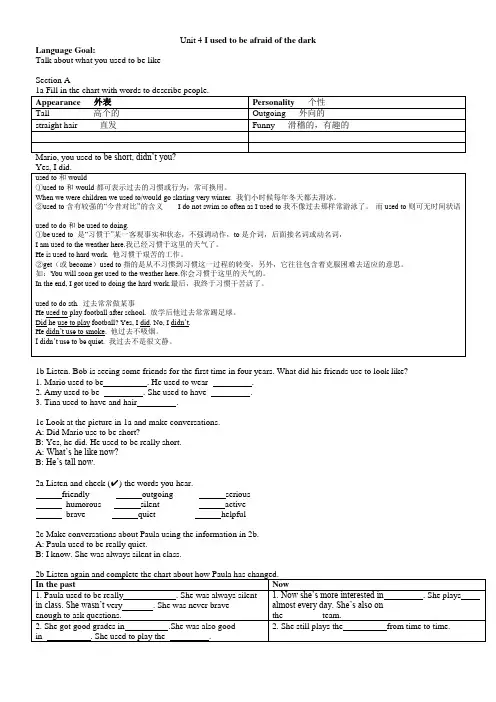
Unit 4 I used to be afraid of the darkLanguage Goal:Talk about what you used to be likeSection A1b Listen. Bob is seeing some friends for the first time in four years. What did his friends use to look like?1. Mario used to be . He used to wear .2. Amy used to be . She used to have .3. Tina used to have and hair .1c Look at the picture in 1a and make conversations.A: Did Mario use to be short?B: Yes, he did. He used to be really short.A: What’s he like now?B: He’s tall now.2a Listen and check (✔) the words you hear.friendly outgoing serioushumorous silent activebrave quiet helpful2c Make conversations about Paula using the information in 2b.A: Paula used to be really quiet.B: I know. She was always silent in class.2d Role-play the conversation.Alfred: This party is such a great idea!Gina: I agree. It’s been three years since we last saw our primary school classmates.Alfred: It’s interesting to see how people have changed.Gina: Billy has changed so much! He used to be so shy and quiet.Alfred: Yeah, his face always turned red when he talked to girls!Gina: I used to see him reading in the library every day.Alfred: That’s because he was a really good student. He studied hard and got good scores on his exams.Gina: Did he use to wear glasses?Alfred: Yes, and he used to be thin, too. But look how big and strong he is now!Gina: He’s so popular now. Look at all the girls around him!艾尔弗雷德:这次聚会是如此好的一个主意!吉娜:我同意。
Unit 4(单元解读课件)九年级英语全一册(人教版)
Section B 2a-2f
05
语篇介绍了一位乡村少年的成长故事,记叙了其在 面对家庭变化时的情绪、行为变化以及这些变化对 主人公和家庭产生的影响。
单元重点知识
主题词汇
appear, personality ,humor ,silence ,helpful,interview, deal ,shyness,require ,public,Asian,African,European, British ,absent ,fail,examination ,exactly ,pride ,proud, general,introduction
have an
节信息。
庭变化时的情绪、 proud
influence on sb. 2.让学生明
take pride
白事物是不
行为变化以及这些 变化对主人公和家 庭产生的影响。
in ...=be proud of, have
communication
断发展的, 珍惜自己现 在的生活, 珍惜父母的
with
爱和现在的
学习机会。
课时内容解读 第六课时Section B 3a-self check 课例展示
单元主题:人与自我(做人与做事)
教材
Section B 3a-self check 第6课时
语篇 形式
写作
语篇内容
审视自己的成长过 程,更深刻地认识 自己。
核心词汇
本单元与学习 相关的词汇。
核心句型
技能与策略 学习要点
0 3 单元目标与课时安排
制定单元目标
统筹课时安排
人教版新目标九年级全一册Revision of Unit4课件(共89张PPT)

CONTENTS
01 Words and Phrases 02 Grammar Focus 03 Language Points 04 Exercises 05 Writing
01
Words humorous silent helpful score
e.g. He got high scores in the examination. 考试中他得了高分。
4. She still play the piano from time to time. 她仍然时常弹钢琴。
(1)still 副词,意为“仍然”,用来说明某人或某物没有 变化。still 在句中通常放在实义动词前,助动词、情态动词、 连系动词后面。 ► The woman still lives in shanghai. ► He is still in the classroom. (2) From time to time 意为“时常;有时”相当于sometimes
四、疑问句
A)Did +主语 +use to +动词原形...? B)Used +主语+ to +动词原形...? 美式英语通常用A种形式,英式英语用B种形式 例如:
Did he use to go swimming in the river when he was young?
五、Used to 的反义疑问句
主语+used to do sth, didn’t +主语? He used to swim in this river, didn’t he? He used to watch a lot of TV, didn’t he?
Unit4讲义 人教版英语九年级全册
Unit4 I used to be afraid of the dark.1.What’s he like now?结构: What’s +sb./sth.+like? 某人/某物什么样?表示某人/某物什么样的句型:人:①What’s+人+like? 询问性格/外貌②What does/do +人+look like? 询问外貌③How+be +人? 询问身体状况物: ①What’s +物+like?②What does/do +物+look like?③How+be+物?以上都是询问属性、形状、大小或质量等Eg:-What’s your new bike like?=How’s your new bike?-Very good.2.This party is such a great idea!Such (adj)那么的;这样的辨析: such与soSuch是形容词,修饰名词/名词短语①such+a(n)+(形容词+)单数可数名词Eg: such a (good) holiday②(形容词+)复数可数名词Eg: such (beautiful) girls③(形容词+)不可数名词Eg: such (delicious) foodSo是副词,修饰形容词/副词Eg: so careful so carefully注意: 当名词前有many,much,few,little 等词修饰时,只能用so,不能用such.Eg: She will have so much housework to do tomorrow Such+a(n)+adj+可数名词单数=so+adj+a(n)+可数名词单数Eg:It is so interesting a book that I like it very much. It is such an interesting book that I like it very much.3.As she got better,she dared to sing in front of her class,and then for the whole school.dare (实义动词) 敢于;胆敢(可以有词形变化) Eg: I wonder how he dares to say such things.dare(情态动词) 敢(通常用于疑问句/否定句及if/whether之后,一般不用于肯定句)Eg:Dare you tell her the truth?I don’t know whether he dare try.“I dare say”习惯说法(用于肯定句) 所表示的是一种不确定的语气,常译为:很可能、大概、我想等Eg: I dare say you are right. 我想你是正确的4.Now she’s not shy anymore and loves singing in front of crowds.Not...anymore=not...any more 相当于no more(一般指行为/动作不再出现)辨析: not...any more 与not...any longernot...any more 相当于no more,表示数量和程度上的“不再”,通常修饰非延续性动词,一般指今后“不再”,故多用于将来时Eg: He will not go there any more.He will no more go there.not...any longer 相当于no longer 指时间上/距离上的“不再延长”,通常修饰延续性动词,多指现在的情况与过去相比,故常用于现在时态Eg: You can’t stay here any longer.You can no longer stay here.5.You really require a lot of talent and hard work to succeed.require (v) 需要;需求requirement (n)要求;规定用法如下:①require sb.to do sth. 要求某人做某事②require that+sb.(should) do sth. 要求某人做某事③sth. require doing /to be done.某事需要(被)做6.Only a very small number of people make it to the top.a very small number of 极少数后接复数名词(谓语动词用复数形式) a small number of 少数辨析: a number of 与the number ofa number of +复数名词许多the number of +复数名词...的数量(谓语用单数) 7.Sometimes he was absent from classes and failed his examinations.absent (adj) 缺席的;不在场的(常与from连用) be absent from 缺席absence (n) 缺席(反义词: presence )present(adj)出席的;在场的(后置定语)(adj)目前的;现在的(前置定语)fail (vt) 失败;不及格(vi) 失败;不及格~ to do sth. 未能/没能做成某事Eg: The boy didn’t fail (in) the exam.8.She advised them to talk with their son in person. advise sb. (not) to do sth. 建议某人(不)做某事advise的用法如下:①~doing sth. 建议做某事②~ that +从句建议... (that引导的从句应用虚拟语气,即:should+动原,should可以省略)advice(un) 建议;忠告 a piece of advice 一条建议9.So he became less interested in studying and missed classes.辨析: become,turn与getbecome:变得;成为(通常指身份、职位的变化,强调变化的过程已完成)Eg: She became an English teacher.turn: 变成(多用于在颜色或性质等方面的变化,强调变化的结果)Eg: The man turned blue with fear. (那个人吓得脸色发青)get:变得(多用于口语,表示一种变化过程,强调“渐渐变得”, 其后常接adj的比较级)Eg: In winter,the days get shorter.Used to的用法:used to+动原表示过去的习惯性动作或状态,现在已不再发生或不存在.否定句: used not to, usedn’t to, didn’t use toEg: She didn’t use to have long hair.She usedn’t to have long hair.一般疑问句: Did e to...? /Used sb.to...?Yes,sb.did. /Yes,ed to. No,edn’t 反意疑问句: 附加问句部分可用didn’t/usedn’t类似短语:be/get/become used to doing sth.习惯于做某事be used to do sth. 被用于做某事。
英语人教版新目标九年级第四单元辅导讲义

人教版新目标unit4指导讲义IndividualTeachingDesignforEnglishKnowledgeReviewofUnit4TeachingContentTeachingObjects StudentcanmasterthekeypointsfromthisclassImportantPoints StudentcanmasterthekeypointsfromthisclassDifficultPoints StudentcanmasterthekeypointsfromthisclassTeachingAids exercisesTeachingProceduresRevisionErrorsPresentationContentUnit4Iusedtobeafraidofthedark.一、短集edto__________________2.害怕黑暗___________________3.fromtimetotime_________________4.getgoodscores_________________5.,理______________________tonsofattention______________7benervousabout__________________8.⋯感觉傲__________/___________9.作一个演_________________10.缺席__________________11.下信心_____________12..talkwithsbinperson__________________ 13.使某人惊的是______________14.保持缄默.______________________15.不再__________________16.敢于做某事____________________三、知点梳理—Mario,youusedtobeshort,didn’tyou?里奥,你从前个子矮,?—Yes,Idid.是的。
人教版英语初三Unit4 讲义
重点短语1.keep silent=be in silence2.Take up doing 从事.../开始做...3.Make it成功的完成例句:I believe you can make it. 我相信你一定能取得成功。
4.Require sb. to do 需要某人去做某事5.Succeed in doing 成功做某事。
6.All the time辨析与time有关的短语1.on time准时(在规定的时间内完成某个动作)The train arrives on time. 火车准时到达2.in time及时If you run, you may be in time for the bus. 如果你跑的话,你也许还来得及赶上那辆公共汽车3.at times 有时,时常Mary goes to the zoo at times. 玛丽有时去动物园。
4.all the time 总是Look!The monkeys are running and jumping all the time.看!那些猴子总是蹦来蹦去。
5.in no time 立刻,很快The computer can easily work out the problem in no time. 计算机可以轻松自如地立刻解答这个问题。
6.at a/one time 一次,每一次Hand them to me, two at a/one time. 把他们交给我,每次两个。
7.at the same time 同时See you tomorrow at the same time. 明天同一时间见。
8. at this time of day 在一天中的这个时间The shop is open at this time of day. 这个商店在一天的这个时间开门营业。
9. once upon a time 从前,很久很久以前Once upon a time, there lived an old man named Yu Gong. 很久很久以前,有一位名叫愚公的老人。
Unit4+重点知识详解 人教版九年级英语全册+
Unit4 知识点详解一、silent(1) silent是形容词,意为“____________________”。
常用短语:______________ 保持沉默___________________沉默[拓展]①silent的名词形式是_______________,意为“沉默;寂静”。
常用短语:__________________沉默地,不语地②以-t结尾的形容词,变名词为-ce的有:confident(有信心的)-confidence(信心)different(不同的)-difference(差别)important(重要的)-importance(重要性)patient(有耐心的)-patience(耐心)二、It has been/is+一段时间+since+从句It has been/+一段时间+since+从句,意为“自从……以来已经有多长时间了”,还可表示为“It is+一段时间+since+从句”。
三、take uptake up的三种含义(1)take up意为“学着做;从事;开始做”,其后常跟名词或动词_________形式做宾语。
(2)take up还可意为“占据(空间);占用(时间)”。
[注意] take up如果后跟代词做宾语,代词必须放在take和up之间;如果后跟名词做宾语,名词既可放在up之后,也可放在take和up之间。
四、deal with(1) deal with意为“____________________”。
(2) deal with与do with用法辨析短语含义用法强调处理的方式、方法,常与____________连用deal with处理do with 强调处理的对象,常与________________连用五、daredare作实义动词时,常用短语:dare_____________ sth. 敢于做某事,有时态和人称的变化;六、require(1)require sth. 需要某物(2)require sb. ___________________sth. 要求某人做某事(3)require________sth. 需要做某事,其主语多是事物,用主动形式表被动意义。
人教版新目标九年级英语Unit4知识点
Unit 4 I used to be afraid of the dark. 重点知识归纳解析【重点词组】1. used to 过去曾经2. be afraid of the dark 惧怕黑暗3. from time to time 时常4. get good scores 取得好的分数5. deal with 对付,应付6. get tons of attention 取得大量的关注7. read books on European history 阅读有关欧洲历史的书8. African culture 非洲文化9. be alone 独处10. give a speech in public 作一个公布演讲11. paint pictures 画画12. be nervous about tests 对考试感到紧张13. influence his way of thinking 阻碍他的思维方式14. be proud of ./take pride in 为…感到自豪15. be absent from classes 逃课16. fail the examinations 考试不合格17. make a decision 下决心18. talk with sb in person 亲自找某人谈话19. to one’ surprise 使某人惊讶的是20. feel good about oneself 对自己充满信心21. a general self-introduction 一个简要的自我介绍22. in the last few years 在最近几年23. remain silent 维持沉默24. have a great influence on sb 对某人有专门大的阻碍【重点句式】1. ---You used to be short, didn’t you? ---Yes, I did.---你过去个子矮,是吗?---是的,我是。
人教新目标九年级全一册英语课件:Unit 4 Section A.pptx
人民教育出版社 九年级 | 全一册
Zhang yishan used to be short, but he is tall now.
Listening
人民教育出版社 九年级 | 全一册
Listen. Bob is seeing some friends for 1b
the first time in four years. What did his friends use to look like?
He’s tall now.
人民教育出版社 九年级 | 全一册
Did Amy use to Yes, she did. She used have short hair? to have short hair.
What’s she like now?
She has long hair now.
Did Tina use to have red hair?
help n. (帮助) + ful → helpful adj. 有帮助的
e.g. His explanation was more or less helpful. 他的解释多少是有帮助的。
Listening 2a
人民教育出版社 九年级 | 全一册
Listen and check (√) the words you hear.
2. silent adj. 不说话的;沉默的 silent adj. → silence n. 沉默
e.g. Peter seems silent today. What’s the matter? 彼特今天似乎很沉默,怎么了?
3. helpful adj. 有帮助的
人民教育出版社 九年级 | 全一册