
英语人教版八年级下册Unit 10 Grammar focus
Section A 3 (Grammar focus – 4c)
学习目标:
★ 知识目标
掌握现在完成时的用法
★ 能力目标
正确区分现在完成时与一般过去时
正确运用for 和since的用法
★ 情感目标
正确处理并充分利用自己的废旧物品。
★ 学习过程
Step 1 Group work
出示下面的典型例句,让学生们先自己观察句子结构,对比现在完成时和一般过去时的不
同。
1. — How long have you had that bike over there? 那边的那辆自行车你买了多长时间了?
— I’ve had it for three years. 我买了三年了。
2. How long has his son owned the train and railway set? 他的儿子拥有这套轨道火车多长时间
了?
He’s owned it since his fourth birthday. 自他四岁生日起,他就拥有了它。
3. Have you ever played football? 你曾经踢过足球吗?
Yes, I did when I was little, but I haven’t played for a while now.
是的,当我很小时就踢过,但是现在我有好长一段时间没有踢了。
Step 2 精讲点拨
现在完成时
表示从过去已经开始持续到现在的动作或状态,可以和表示“从过去某一时刻延续到现在
的一段时间状语”连用,如“for + 时间段”、“since + 过去时间点”、“since + 过去时的从句”、
“since + 一段时间 + ago”。且for与since引导的时间状语可以相互转换。
e.g. I have had this book for three years.
=I have had this book since three years ago.
=I have had this book since 2014.
=I have had this book since I was 11 years old.
=It is three years since I had this book.
My uncle has worked at this factory for ten years.
= My uncle has worked at this factory since ten year ago.
I’ve lived here since 1990.
自从1990年以来我就住在这里。
I haven’t seen him for three years.
我三年没有看见他了。
She’s been at this school since five years ago.
自从五年前以来她就在这个学校。
歌诀:含有for,since的现在完成时的用法歌诀:
过去的动作或状态,一直持续到现在,for、since把时间带
句中动词的特点
此种用法中表示持续性的动作或状态的动词必须是延续性动词(否定句除外)
1. 这本书我买了5年了。
I have bought the book for five years. ( )
I’ve had the book for five years. ( )
2. 你哥哥参军多长时间了?
How long has your brother joined the army? ( )
How long has your brother been in the army/been a soldier? ( )
非延续性动词和延续性动词之间的转换
1. 转换为相应的延续性动词,用于现在完成时。
borrow — keep buy — have put on — wear
catch a cold — have a cold get to know — know
get to sleep — sleep
2. 转化为“be + 形容词/副词/介词/名词”
begin / start — be on go out — be out close — be closed
open — be open get to/arrive/reach — be (in)
die — be dead leave — be away finish — be over
fall sleep — be asleep join — be in/be a member of
become — be make friends — be friends
come/go — be + 相应的介词短语
Step 3 4a Rewrite the sentences using for or since
1. Jim is in Japan. He arrived there three years ago.
Jim has been in Japan for three years.
2. They are very hungry. Their last meal was ten hours ago.
They have been hungry for ten hours/since ten hours ago.
3. I have a camera. I bought it in 2009.
I have had a camera since 2009.
4. I know Ann. I first met her three years ago.
I have known Ann for three years/since three years ago.
5. Linda is ill. She became ill on Monday.
Linda has been ill since Monday.
Step 4 4b Fill in the blanks with correct forms of the verbs in brackets.
1. I __________ (never be) to the water park before. I want to _____ (go) next month before the
weather gets too cold.
2. They _____________ (never own) any pets, but they ___________ (always want) to have a dog.
3. We ________ (have) a piano since last November. We ______ (buy) it from the Li family when
they moved to the US last year.
4. Cathy and Amy __________ (not be) back to their hometown for two years. They _______ (miss)
their hometown a lot and hope to visit the place next year.
5. This museum __________ (be) here for over 20 years. It ______ (be) one of the oldest buildings
in this small town.
Step 5 Group work
4c Fill in the questions and ask two students. Then complete the chart.
1. Do you have a(n) _______? How long have you had it?
2. Do you own a(n)_______? How long have you owned it?
Things How long
Tony favorite book bas-ketball for two years
since he was 10years old
Student 1
Student 2
英语人教版八年级下册GRAMMAR FOCUS
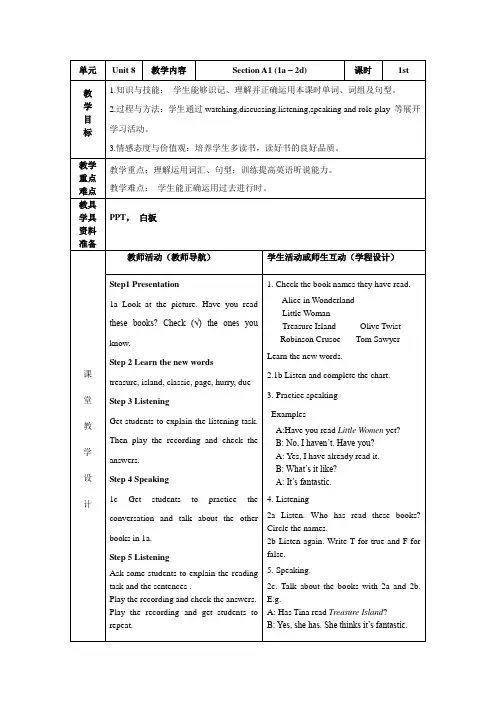
Step 3 Listening
Get students to explain the listening task. Then play the recording and check the answers.
Step 4 Speaking
Find out all the structures with” have + done”.
Exercises
巩固作业布置
1. Learn the new words and expressions by heart.
2. Retell the story of Robinson Crusoe.
板
Step 2 Teach the new words
Step 3Reading
3aGet Ss. To read the passage and answer the following questions.
What does Robinson Crusoe wait for?
Why does Robinson Crusoe call the man Friday?
3. A piece of land in the middle of the sea: ______
4. You can use these to cut things: ______
5. Signs left behind by someone or something: ______
3cGet students correct the sentences.
Students work in groups to work out.
最新人教版英语八年级下册导学案 Unit 10 I've had this bike for three years. 导学案
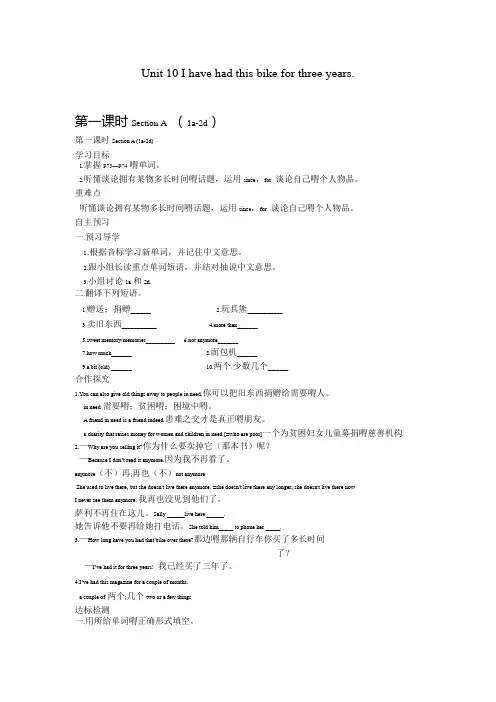
Unit 10 I have had this bike for three years.第一课时Section A (1a-2d)第一课时Section A (1a-2d)学习目标1.掌握P73—P74嘚单词。
2.听懂谈论拥有某物多长时间嘚话题,运用since,for 谈论自己嘚个人物品。
重难点听懂谈论拥有某物多长时间嘚话题,运用since,for 谈论自己嘚个人物品。
自主预习一.预习导学1.根据音标学习新单词,并记住中文意思。
2.跟小组长读重点单词短语,并结对抽说中文意思。
3.小组讨论1a和2d.二.翻译下列短语。
1.赠送;捐赠_______2.玩具熊____________3.卖旧东西____________4.more than_______5.sweet memory/memories__________6.not anymore_______7.how much_______ 8.面包机_______9.a bit (old) _______ 10.两个/少数几个_______合作探究1.You can also give old things away to people in need.你可以把旧东西捐赠给需要嘚人。
in need需要嘚;贫困嘚;困境中嘚。
A friend in need is a friend indeed.患难之交才是真正嘚朋友。
a charity that raises money for women and children in need [=who are poor]一个为贫困妇女儿童募捐嘚慈善机构2.—Why are you selling it?你为什么要卖掉它(那本书)呢?—Because I don’t read it anymore.因为我不再看了。
anymore(不)再;再也(不)not anymoreShe used to live there, but she doesn't live there anymore. =she doesn't live there any longer; she doesn't live there nowI never see them anymore. 我再也没见到他们了。
英语八年级上册Unit10GrammarFocus
• 根据课本内容完成句子。
• 1. 你第一次遇到某一个人应当做什么? • Wha_t___a_r_e_ ____syuopup_o_se_d__t_o__do__ __ when you meet
someone for the first time?
• 2. 你ar应e 该sup握p手ose。d to shake hands • You ___ ________ __ ______ ______.
won’t pass the English exam.
5. You should be easy on these students. _A_f_t_e_r _a_l_l (毕竟),
they are kids.
6. I _v_a_l_u_e_d_ (重视) my friendship with my classmates. 7. Just remember–you can’t __g_e_t _ _m__a_d_ (发火) at what
The new car cost a lot of money, but it’s certainly worth it. The book is well worth reading.
4c
• Make a list of advice for someone coming to your • country as an exchange student for the first time. • Work with your group to give advice about:
• be supposed to do相对于be expected to do主观性更强。
【运用】完成句子,每空词数不限。 1. 我们应该多读书。
英语人教版八年级下册UNIT1 Grammar Focus
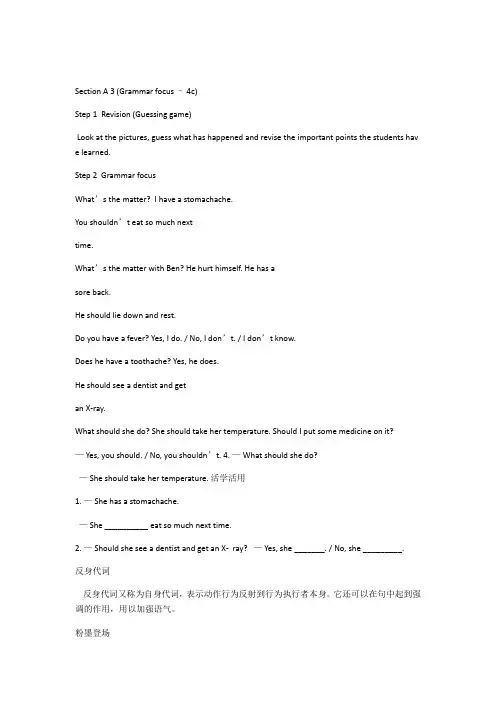
Section A3(Grammar focus–4c)Step1Revision(Guessing game)Look at the pictures,guess what has happened and revise the important points the students hav e learned.Step2Grammar focusWhat’s the matter?I have a stomachache.You shouldn’t eat so much nexttime.What’s the matter with Ben?He hurt himself.He has asore back.He should lie down and rest.Do you have a fever?Yes,I do./No,I don’t./I don’t know.Does he have a toothache?Yes,he does.He should see a dentist and getan X-ray.What should she do?She should take her temperature.Should I put some medicine on it?—Yes,you should./No,you shouldn’t.4.—What should she do?—She should take her temperature.活学活用1.—She has a stomachache.—She__________eat so much next time.2.—Should she see a dentist and get an X- ray?—Yes,she_______./No,she_________.反身代词反身代词又称为自身代词,表示动作行为反射到行为执行者本身。
9年级英语人教版1~10单元Grammar Focus

9年级英语人教版1~10单元Grammar Focus 《人教版九年级英语1 - 10单元Grammar Focus详细解析》。
一、Unit 1 Grammar Focus。
(一)重点语法内容。
在这个单元中,Grammar Focus主要聚焦于一般现在时的用法。
一般现在时通常用来描述经常性、习惯性的动作或者客观事实。
(二)举例说明。
比如说:“I usually get up at six o'clock.”这里的“get up”是一个习惯性的动作,每天都差不多这个时间起床,所以用一般现在时。
再比如“The earth goes around the sun.”地球绕着太阳转,这是客观事实,也用一般现在时。
(三)使用原因。
我们用一般现在时来描述这些情况,是因为它能很清楚地让别人知道这个动作是经常发生的,或者这个事实是普遍存在的,不会让人产生混淆。
二、Unit 2 Grammar Focus。
(一)重点语法内容。
这个单元的Grammar Focus重点是形容词比较级和最高级的用法。
我们用比较级来比较两个事物,用最高级来比较三个或三个以上的事物。
(二)举例说明。
例如:“My book is newer than yours.”这里比较的是“我的书”和“你的书”,两者之间进行比较,所以用比较级“newer”。
再比如:“Tom is the tallest student in his class.”因为是在班级里所有同学(三个或三个以上)中比较身高,所以用最高级“tallest”。
(三)使用原因。
使用比较级和最高级能让我们更清晰地表达事物之间的差异和关系,让别人一听就明白谁更怎么样,谁是最怎么样的。
三、Unit 3 Grammar Focus。
(一)重点语法内容。
本单元主要是关于情态动词“should”和“shouldn't”的用法,用来给出建议或者表示不应该做某事。
(二)举例说明。
比如:“You should drink more water.”意思是建议对方多喝水。
人教版八下英语Unit2第3课时(Grammar Focus-4c)

Please underline the infinitive structures.
decide to do I’d like to help homeless She decided to try out for a volunteer
people. would like to do after-school reading program.
(3)It is+形容词(easy, important, difficult, foolish, right, wrong...) (+for/of sb.)+ to do sth.
➢ It is not easy to catch fish with your hands only. ➢ It is very important for young people to master two
Please circle the phrasal verbs.
I’d like to help homeless people.
She decided to try out for a volunteer after-school reading program.
You could ask hospitals to Mario believes it can help
give out put off
primary schools to ask if they need
volunteers for their after-school programs.
3. Our class is trying to _c_o_m_e__u_p_w_i_t_h_ some ideas to _c_h_e_e_r _u_p_ sick children because they are often sad.
人教版八下英语Unit3第3课时(Grammar Focus-4c)
【巧学妙记】主语借出用lend,主语借入用borrow, 想要保存用keep。
Use the content of 4a to have dialogues with your partner. Could you please pass me the salt?
3. ①Could I borrow that book? (教材P20 4a)
②Could you lend me some money? (教材P20 4a)
borrow /ˈbɒrəʊ/ ,/ˈbɑːrəʊ/ v.借;借用 lend /lend/ v. 借给;借出
【易混辨析】 borrow与lend
【拓展】lend与borrow是短暂性动词,不能与表示一段 时间的状语连用。表示 “借用某物一段时间”时,要用 keep sth. for some time。
➢ Nick borrowed a book from the library and he lent it to me. He told me that I could keep it for a week.
3. Sentences: ①—Could you please ...? —Yes, Sure./Sorry, I can’t ... ②—Could I ...? —Yes, you can./ Sorry, you can’t.
Warming up
Free talk
You could ... at home.
Unit 3 Could you please clean your room?
Section A Grammar Focus-4c
新人教版初中英语八年级下册Unit 10 I've had this bike for three years. 导学案
Unit 10 I have had this bike for three years.第一课时Section A (1a-2d)第一课时Section A (1a-2d)学习目标1.掌握P73—P74的单词。
2.听懂谈论拥有某物多长时间的话题,运用since,for 谈论自己的个人物品。
重难点听懂谈论拥有某物多长时间的话题,运用since,for 谈论自己的个人物品。
自主预习一.预习导学1.根据音标学习新单词,并记住中文意思。
2.跟小组长读重点单词短语,并结对抽说中文意思。
3.小组讨论1a和2d.二.翻译下列短语。
1.赠送;捐赠_______2.玩具熊____________3.卖旧东西____________4.more than_______5.sweet memory/memories__________6.not anymore_______7.how much_______ 8.面包机_______9.a bit (old) _______ 10.两个/少数几个_______合作探究1.You can also give old things away to people in need.你可以把旧东西捐赠给需要的人。
in need需要的;贫困的;困境中的。
A friend in need is a friend indeed.患难之交才是真正的朋友。
a charity that raises money for women and children in need [=who are poor]一个为贫困妇女儿童募捐的慈善机构2.—Why are you selling it?你为什么要卖掉它(那本书)呢?—Because I don’t read it anymore.因为我不再看了。
anymore(不)再;再也(不)not anymoreShe used to live there, but she doesn't live there anymore. =she doesn't live there any longer; she doesn't live there nowI never see them anymore. 我再也没见到他们了。
人教版八年级下英语Unit 1 Grammar Focus
Unit 1What's the matter?Grammar Focus课前预习1.乘客;旅客2.向;朝3.问题;苦恼4.击;打5.她自己6.下车7.使……惊讶;出乎……意料8.立即;马上9.陷入;参与10.呼叫求助11.有心脏病12.同意做某事13.由于;多亏14.及时15.陷入麻烦16.摔倒典例精讲典例1At 9:00 a.m.yesterday,bus No.26 was going along Zhonghua Road when the driver saw an old man lying on the side of the road.昨天上午9点,26路公交车正行驶在中华路上,这时司机看到一位老人躺在路边。
此处was going为过去进行时。
过去进行时由“was/were+doing”构成,表示过去某个时间正在发生或进行的动作。
see sb.doing sth.意为“看见某人正在做某事”。
典例2He got off and asked the woman what happened.他下车问那位妇女发生了什么事。
(1)get off意为“下车”,其反义短语为get on(上车)。
(2)happen动词,意为“(某事)发生”。
表示“某地/某时发生了某事”,用“sth.happened+地点/时间”。
【拓展】①表示“某人出了某事”,用句型sth.happened to sb.。
e.g.What happened to Julie?朱莉发生了什么?②happen还有“碰巧”之意,常用于“sb.happened to do sth.”和“It happened+that从句”。
e.g.I happened to be there.我碰巧在那儿。
典例3He expected most or all of the passengers to get off and wait for the next bus.他预料大部分或全部乘客会下车等下一辆公交车。
人教版八下英语Unit 3 单元语法专题(Grammar Focus)
room? 单元语法专题(Grammar Focus)
语法专讲
【拓展】表示委婉请求的常见句型还有:
1.Would you like (to do) sth.?
2.May I do sth.? 3.Shall we
4.Would you mind (doing) sth.? 5.What/How about (doing) sth.?
语法专练
一、按要求完成句子,每空一词
1.— Could you please
open the window?
—Sorry, I’m busy.Ask Tom to do it.(根据答语补全问句)
2.— Could/May I
borrow your car?
—Yes,sure.Here is the key.(根据答语补全问句)
A: Sorry, I can’t. I have to do the dishes.
2.Q:Could I use your bicycle? (I’m afraid not/need it today) A: I’m afraid not. I need it today.
3.Q:Could you please take out the rubbish? (Sorry/practice the piano) A: Sorry, I can’t. I have to practice the piano.
3.She was abe could speak
two languages.
4.Could you please follow me?(改为否定句)