
八年级英语下册Unit9Haveyoueverbeentoamuseum短语语法知识点汇总
Unit 9 Have you ever been to a museum 一、必背短语【教材内容解析】Section A1.Me neither (P. 65)me neither意为“我也不……”,表示前者的否定情况也适用于我,反义词为me too。
---Susan can’t play the piano at all.---Me neither.2.Let’s go to one tomorrow. (P. 65)one是不定代词,用来代替前面出现过的可数名词单数,如果指代名词复数,用ones。
Here are my books. Which one do you want to read?---I don’t like these dresses.---How about those ones over there.3.Let’s go somewhere different today. (P. 65)somewhere用作副词,表示“在某处、到某处”,常用于肯定句中,在否定句和疑问句中用anywhere。
It’s cold here. Let’s go somewhere else.Did you go anywhere last Sunday?4.They are going to take the subway. (P. 66)take the subway意为“乘地铁”,take用作动词,可以表示“乘、坐(车、船等)”。
We take the subway to work every day.5.It’s a great way to spend a Saturday afternoon. (P. 66)(1) way表示“方法”时,后常接动词不定式或者of doing作定语。
Can you think out a way to open the door/of opening the door?(2) spend的用法① sb. spend+时间/金钱+on sth. “在某事上花费多长时间或者多少钱”The man spent the whole day on his speech.The family spent 10,000 dollars on their trip.② sb. spend+时间+(in) doing sth. “花费多长时间做某事”The boy has spent two hours playing the computer games.【拓展】辨析spend, pay, take和cost6.We put up a tent and cooked outside. (P. 66)put up意为“搭建”,还可以表示“举起、张贴”。
They put up many buildings last year.【拓展】动词put的相关短语put on 穿上put out 扑灭put off 推迟put down 放下7.I’ve never been camping. (P. 66)本句时态为现在完成进行时,结构为“have/has been doing”,表示某个动作从过去某个时间开始,一直延续到现在,并且还有可能持续下去。
翻译:我们已经等他有2个小时了。
___________________________________________________8.It’s unbelievable that technology has great progress in such a rapid way. (P. 67)progress用作名词,表示“进步、进展”,常见的搭配为“make progress in...”“在……方面取得进步”。
The student is showing rapid progress in his study.I have made much progress in English.9.It also encourages governments and social groups to think about ways to improve toilets in the future. (P. 67)encourage表示“鼓励”时,常用的结构为:encourage sb. to do sth.“鼓励某人做某事”。
The family members encouraged her to fight against the disease bravely.10.I’ve finally realized why my grandpa loves drinking tea and collecting tea sets. (P. 67) collect用作动词,表示“收集、采集”。
I like collecting stamps.11.Me. too. (P. 68)Me, too意为“我也是”,表示前面所描述的肯定情况也适用于后者“我”。
---I like spring best. ---Me, too.Section B1.For thousands of tourists from China, this small island in Southeast Asia is a wonderful and safe place to take a holiday. (P. 70)thousands of意为“成千上万的、数以万计的”,表示一个不具体的数字,前面不能用具体的数字修饰,后接可数名词复数形式。
They plant thousands of trees every year.2.On the one hand, more than three quarters of the population are Chinese...On the other hand, Singapore is an English-speaking country...(P. 70)on the one hand...on the other hand...意为“一方面……,另一方面……”,用于引出不同的或者对立的观点和看法。
On the one hand, Peter wants to make more money. On the other hand, he wants to have more time to enjoy life.3.Maybe you fear that you won’t be able to find anything good to eat when you travel. (P. 70) fear用作动词,意为“害怕、惧怕”。
She feared to tell him the truth.4.Whether you like Indian food, Western food or Japanese food, you’ll find it all in Singapore! (P. 70)whether用作连词,表示“不管……(还是);或者…(或者)”,常与or连用,引导让步状语从句。
Whether you like it or not, you’ll have to do it.5.However, if you go to see lions, tigers or foxes during the daytime, they’ll probably be asleep. (P. 70)however用作副词,表示“然而、不过”,表示转折,后常接逗号。
It rained suddenly. However, it became clear soon.6.One great thing about Singapore is that the temperature is almost the same all year around. (P.70)all year around表示“全年”,也可以说all the year around。
Some trees are green all year around.7.This is because the island is so close to the equator. (P. 70)be close to表示“靠近、接近、离……近”,close此处用作形容词,表示“接近的”。
The window is close to the door.My house is close to a supermarket.8.So you can choose to go whenever you like-spring, summer, autumn or winter. (P. 70) whenever用作连词,表示“在任何时候、无论何时”,在句中引导时间状语从句。
You can come back whenever you want to.【语法讲解】一 have/has been to 与have/has gone to(1)“have/ has been to +地点名词”表示“去过某地”,表示某人的一种经历,说话时已不在那个地方,常和once, twice, never, ever等连用。
当地点为副词时,则要省掉no。
---翻译:你去哪儿了?_____________________________________________________---翻译:我去邮局了。
(人已不在邮局)______________________________________---翻译:你曾去过上海吗?_________________________________________________---翻译:没有,我从来没有去过那儿。
_______________________________________(2)“have/has gone to+地点名词”表示“去了某地”,说话时某人已离开此地,在去某地的路上、已在某地或在回来的路上,所以此句型常用于第三人称,不能与时间状语once, twice, never, ever等连用,也不能和for以及since构成的短语连用。
---Where is Simon? 西蒙在哪儿?---翻译:他和家人一起去澳大利亚了。
(人已不在这儿,在去澳大利亚的路上、已在澳大利亚或从澳大利亚返回的途中)_____________________________________________________________助记 have/has been to, have/has gone to意不同,两者用法当分清。
人教pep版八年级英语下册 Unit9Haveyoueverbeentoamuseum短语语法知识点汇总
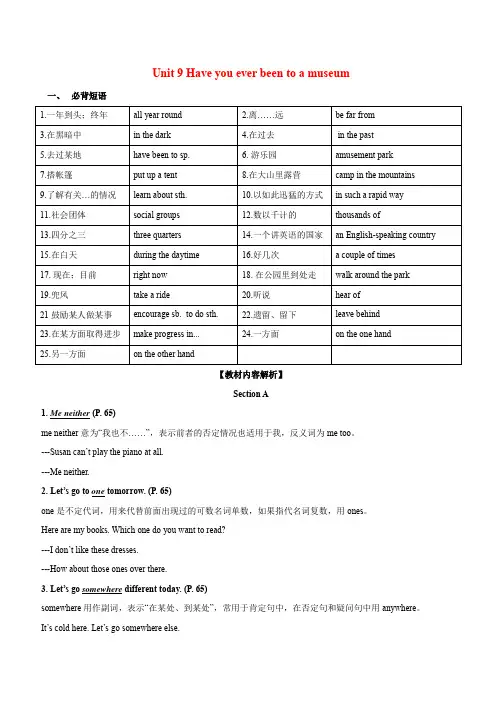
Unit 9 Have you ever been to a museum一、必背短语【教材内容解析】Section A1.Me neither (P. 65)me neither意为“我也不……”,表示前者的否定情况也适用于我,反义词为me too。
---Susan can’t play the piano at all.---Me neither.2.Let’s go to one tomorrow. (P. 65)one是不定代词,用来代替前面出现过的可数名词单数,如果指代名词复数,用ones。
Here are my books. Which one do you want to read?---I don’t like these dresses.---How about those ones over there.3.Let’s go somewhere different today. (P. 65)somewhere用作副词,表示“在某处、到某处”,常用于肯定句中,在否定句和疑问句中用anywhere。
It’s cold here. Let’s go somewhere else.Did you go anywhere last Sunday?4.They are going to take the subway. (P. 66)take the subway意为“乘地铁”,take用作动词,可以表示“乘、坐(车、船等)”。
We take the subway to work every day.5.It’s a great way to spend a Saturday afternoon. (P. 66)(1) way表示“方法”时,后常接动词不定式或者of doing作定语。
Can you think out a way to open the door/of opening the door?(2) spend的用法① sb. spend+时间/金钱+on sth. “在某事上花费多长时间或者多少钱”The man spent the whole day on his speech.The family spent 10,000 dollars on their trip.② sb. spend+时间+(in) doing sth. “花费多长时间做某事”The boy has spent two hours playing the computer games.【拓展】辨析spend, pay, take和cost6.We put up a tent and cooked outside. (P. 66)put up意为“搭建”,还可以表示“举起、张贴”。
英语八年级第九单元笔记

英语八年级第九单元笔记以下是八年级英语第九单元的笔记内容,涵盖了本单元的重要知识点和句型:Unit 9 Have you ever been to a museum?一、重点短语1. science museum 科学博物馆2. history museum 历史博物馆3. art museum 艺术博物馆4. natural history museum 自然历史博物馆5. space museum 宇航博物馆6. on weekends 在周末7. the Palace Museum 故宫博物院8. the British Museum 大英博物馆9. the Metropolitan Museum of Art 大都会艺术博物馆10. the National Gallery of Art 国家艺术馆二、重点句型1. Have you ever been to a science museum? 你曾经去过科学博物馆吗?2. Yes, I have. / No, I haven’t. 是的,我去过。
/ 不,我没去过。
3. What / Who have you ever been with? 你曾经和谁一起去过?4. I have been to the Great Wall many times. 我已经去过长城很多次了。
5. Have you ever been to an amusement park? 你曾经去过游乐园吗?6. Yes, we have. / No, we haven’t. 是的,我们去过。
/ 不,我们没去过。
7. Have you ever been to a water park? 你曾经去过水上公园吗?8. Yes, I’ve been there twice. 是的,我去过两次了。
9. Have you ever been to a zoo/aquarium/skating rink? 你曾经去过动物园/水族馆/滑冰场吗?10. It’s (not) the first time I have been here. 这是我第一次来这里。
八年级下册Unit9Haveyoueverbeentoamuseum重点短语句型汇总

八年级下册Unit 9 Have u ever been t a useu?重点短语句型汇总八年级下册Unit9Haveueverbeentauseu?重点短语句型汇总一、重点短语frananaatnight在夜晚2inarenaturalenvirnent在一个加倍自然的环境中3allearrund一年到头;终年4befarfr离……远inthedar在黑暗中6inthepast在过去7havebeentsp去过某地8sieneuseu科学博物馆9histruseu历史博物馆auseentpar游乐园1gseheredifferent去不同的地址2gsating去滑冰3taethesuba坐地铁4agreatatspendaSaturdaafternn一个过周六下午的好方式alltheldvieaeras所有的古老的电影摄影机6learnabutsth解有关。
的情形7ntheeeend在周末8apintheuntains在大山里露营9putupatent搭帐篷20insuharapida以如此迅猛的方式21differentindsf各类各样的22develpentftilets茅厕的进展23sialgrups社会集体24theteaartperfranes茶艺演出2aeaperfetupfteaithbeautifulteasets用漂亮的茶具沏一杯完美的茶26anieplaetentea一个品茶的好地址27thusandsf数以千计的28InternatinaluseufTilets国际茅厕博物馆29theTerrattaAr兵马俑30SutheastAsia东南亚31NightSafari夜间动物园32threequarters四分之三33anEnglish-speainguntr一个讲英语的国家34haveprbledingsth做某事很困难3duringthedatie在白天36auplefties好几回37rightn此刻;目前38anauseentparithaspeialthee一个有专门的主题的游乐园39alarundthepar在公园里处处走40hearf听说41taearide兜风42antherprvine另一个省43theBird’sNest鸟巢44enuragesbtdsth鼓舞某人做某事4nthenehandnthetherhand一方面,另一方面二、重点句型Haveueverbeent?Haveueverbeentasieneuseu?你曾经去过科学博物馆吗?2Let’s。
部编版八年级英语下册Unit9Haveyoueverbeentoamuseum笔记重点大全
(名师选题)部编版八年级英语下册Unit9Haveyoueverbeentoamuseum笔记重点大全单选题1、—I’ve never been to the new water park. How about you, Frank?—_________. Let’s go there together!A.Neither have IB.Me, tooC.That sounds funD.So have I答案:A句意:——我从未去过那个新的水上公园。
你呢,Frank?——我也没去过。
我们一起去吧!考查情景交际。
Neither have I“我也没有”;Me, too“我也是”;That sounds fun“那听起来很有趣”;So have I“我也一样”。
根据答语中的“Let’s go there together!”可知,空处表示“我也没去过”。
“Neither+助动词/情态动词/系动词+主语.”表示前面说的否定情况也适合于后面的情况。
故选A。
2、— Could you tell me _______ you’d like me to pay you?—You’d better use mobile payment. I don’t care _______ it is Ali Pay or WeChat Pay.A.how; whetherB.how; whyC.what; whetherD.what; why答案:A句意:——你能告诉我你要我怎样付给你钱吗?——你最好使用移动支付,我不在乎是支付宝还是微信支付。
考查特殊疑问词和连词辨析。
how如何;what什么;why为什么;whether是否。
根据“use mobile paym ent”可知,上句询问的是用什么方式付钱,因此第一空用 how;根据固定搭配“whether…or...:是……还是……”可知,whether符合句意。
故选A。
短语、语法知识汇总 人教版八年级英语下册Unit9Haveyoueverbeentoamuseum4 (2)

Unit 9 Have you ever been to a museum 一、必背短语【教材内容解析】Section A1.Me neither (P. 65)me neither意为“我也不……”,表示前者的否定情况也适用于我,反义词为me too。
---Susan can’t play the piano at all.---Me neither.2.Let’s go to one tomorrow. (P. 65)one是不定代词,用来代替前面出现过的可数名词单数,如果指代名词复数,用ones。
Here are my books. Which one do you want to read?---I don’t like these dresses.---How about those ones over there.3.Let’s go somewhere different today. (P. 65)somewhere用作副词,表示“在某处、到某处”,常用于肯定句中,在否定句和疑问句中用anywhere。
It’s cold here. Let’s go somewhere else.Did you go anywhere last Sunday?4.They are going to take the subway. (P. 66)take the subway意为“乘地铁”,take用作动词,可以表示“乘、坐(车、船等)”。
We take the subway to work every day.5.It’s a great way to spend a Saturday afternoon. (P. 66)(1) way表示“方法”时,后常接动词不定式或者of doing作定语。
Can you think out a way to open the door/of opening the door?(2) spend的用法① sb. spend+时间/金钱+on sth. “在某事上花费多长时间或者多少钱”The man spent the whole day on his speech.The family spent 10,000 dollars on their trip.② sb. spend+时间+(in) doing sth. “花费多长时间做某事”The boy has spent two hours playing the computer games.【拓展】辨析spend, pay, take和cost6.We put up a tent and cooked outside. (P. 66)put up意为“搭建”,还可以表示“举起、张贴”。
八年级英语下册 Unit 9 Have you ever been to a museum短语、语法
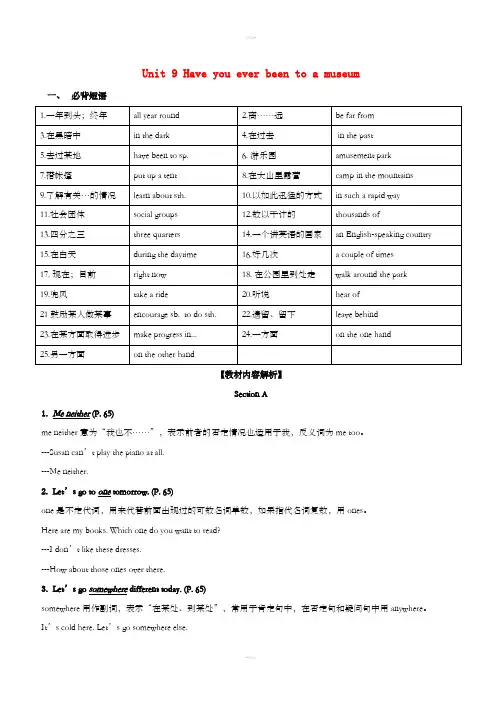
Unit 9 Have you ever been to a museum一、必背短语【教材内容解析】Section A1.Me neither (P. 65)me neither意为“我也不……”,表示前者的否定情况也适用于我,反义词为me too。
---Susan can’t play the piano at all.---Me neither.2.Let’s go to one tomorrow. (P. 65)one是不定代词,用来代替前面出现过的可数名词单数,如果指代名词复数,用ones。
Here are my books. Which one do you want to read?---I don’t like these dresses.---How about those ones over there.3.Let’s go somewhere different today. (P. 65)somewhere用作副词,表示“在某处、到某处”,常用于肯定句中,在否定句和疑问句中用anywhere。
It’s cold here. Let’s go somewhere else.Did you go anywhere last Sunday?4.They are going to take the subway. (P. 66)take the subway意为“乘地铁”,take用作动词,可以表示“乘、坐(车、船等)”。
We take the subway to work every day.5.It’s a great way to spend a Saturday afternoon. (P. 66)(1) way表示“方法”时,后常接动词不定式或者of doing作定语。
Can you think out a way to open the door/of opening the door?(2) spend的用法① sb. spend+时间/金钱+on sth. “在某事上花费多长时间或者多少钱”The man spent the whole day on his speech.The family spent 10,000 dollars on their trip.② sb. spend+时间+(in) doing sth. “花费多长时间做某事”The boy has spent two hours playing the computer games.【拓展】辨析spend, pay, take和cost6.We put up a tent and cooked outside. (P. 66)put up意为“搭建”,还可以表示“举起、张贴”。
人教版八年级英语下册Unit9 Have you ever been to a museum知识点梳理及单元复习
Unit 9知识点梳理和单元复习附参考答案1. 单元重点短语归纳:have/has been to曾经去某地;have/has been in+地点待在某地;me neither.我也没;have/has gone to去某地了;somewhere different不同的地方;close to贴近,邻近;encourage sb. to do sth.鼓励某人做某事;thousands of 数以千计的,许许多多的;on the one hand...on the other hand一方面......另一方面......;put up搭建,举起,张贴;take the subway乘地铁;three quarters四分之三;practice doing sth. 练习做某事;have problem doing sth. 做某事遇到困难;2. Have you ever been to a science museum? 你曾经去过科学博物馆吗?【重点】【辨析】have/has been to;have / has gone to ;have/ has been in;(1). have/ has been to 表示“某人曾经去过某地”强调现在已经回来了,不在那里了。
E.g.: We have been to Qingdao. 我们去过青岛。
(现在不在青岛)(2). have gone to表示“某人到某地去了”,强调现在还没有回来,可能在那里或途中。
E.g.: They have gone to Sydney. 他们去悉尼了。
(现在在悉尼或途中)(3). have been in +地点:表示“某人在某地待了很长时间”,常与时间段搭配。
E.g.: I have been in Nanchang for three years. 我在南昌待了3年了。
How long have you been in China? 你在中国待了多长时间?3. 一般过去时与现在完成时的用法比较【重点】&【难点】(1). 一般过去时表示过去某个时间发生的事、存在的状态或经常发生的动作。
大祥区十中八年级英语下册 Unit 9 Have you ever been to a museum
C. must know D. will know
7. Have you met Mr. Li ___C___?
A. just
B. ago
C. before
D. a moment ago
4a Put the correct forms of the verbs in the blanks.
1. A: Do you want _t_o__c_o_m__e_ (come) to the space museum? B: No, I’ve already __b_e_e_n__ (be) there three times.
—Yes , I have.I ________ there last summer.
A.ever ; go
B.never ; went
C.ever ; went
D.never ; go
5.—I have __A__ been to the Disneyland. How about you?
—Me neither.
C.Have ; been
D.Have ; gone
2.Because of my work, IB____ Shenzhen twice.
A.have gone to
B.have been to
C.have been in
D.have gone in
3.—Have you seen Dr. Qian recently?
现在完成时态可用于过去发生的动作対现在造成的影响或结果 , 和 ever, never 等标志词连用。 下面我们一起看看这两个词的用法:
ever 常用于现在完成时的一般疑问句 , 放在主语的后面 , 过去分词 的前面。 never 表示否定在助动词have / has 之后 , 过去分词之前。表示否定 的简短回答可使用neither。
部编版八年级英语下册Unit9Haveyoueverbeentoamuseum高频考点知识梳理
(名师选题)部编版八年级英语下册Unit9Haveyoueverbeentoamuseum高频考点知识梳理单选题1、He looks worried. I wonder _________ he has already known about the result. A.whereB.whetherC.why答案:B句意:他看起来很担心。
我想知道是否他已经知道结果了。
考查宾语从句。
where哪里;whether是否;why为什么。
动词“wonder”后是宾语从句,根据“he has already known about the result”可知表达“想知道是否他已经知道结果了”用引导词“whether”引导从句。
故选B。
2、—Do you still remember our primary school teacher, Mrs. Liu?—Yes. She always encouraged us and gave us support _________ we met difficulties. A.wheneverB.whateverC.howeverD.whoever答案:A句意:——你还记得我们小学的刘老师吗?——是的,无论何时我们遇到困难,她总是鼓励我们,给我们支持。
考查连词辨析。
whenever无论何时;whatever无论什么;however无论如何;whoever无论谁。
根据“we met difficulties”可知,主句主谓宾成分齐全,因此本句是让步状语从句,结合语境,应是无论何时我们遇到困难,故选A。
3、—Did you go _________ last summer holiday?—Yes. I went to Shanghai Disney.A.somewhere specialB.anywhere specialC.special somewhereD.special anywhere答案:B句意:——去年暑假你去了什么特别的地方吗?——是的。
八年级英语下册Unit9Haveyoueverbeentoamuseum短语语法知识点汇总新版人教新目标版20180827464
Unit 9 Have you ever been to a museum一、必背短语1.一年到头;终年all year round2.离……远be far from3.在黑暗中in the dark4.在过去 in the past5.去过某地have been to sp.6. 游乐园amusement park7.搭帐篷put up a tent 8.在大山里露营camp in the mountains9.了解有关…的情况learn about sth. 10.以如此迅猛的方式in such a rapid way11.社会团体social groups 12.数以千计的thousands of13.四分之三three quarters 14.一个讲英语的国家an English-speaking country15.在白天during the daytime 16.好几次 a couple of times17. 现在;目前right now 18. 在公园里到处走walk around the park19.兜风take a ride 20.听说hear of22.遗留、留下leave behind21鼓励某人做某事encourage sb. to do sth.23.在某方面取得进步make progress in... 24.一方面on the one hand25.另一方面on the other hand【教材内容解析】Section A1. Me neither (P. 65)me neither意为“我也不……”,表示前者的否定情况也适用于我,反义词为me too。
---Susan can’t play the piano at all.---Me neither.2. Let’s go to one tomorrow. (P. 65)one是不定代词,用来代替前面出现过的可数名词单数,如果指代名词复数,用ones。