
Unit2 travelling Grammar2教案 牛津译林版八年级下册
joinhave /has been in /a member of
die have /has been dead
get married have /has been married
come / gohave/has been in /at
begin / starthave /has been on
Step6Finishing exercises
Correct the mistakes in the following sentences.
Step7Doing homework
a. Go over what youhave learnt.
教
学
反
思
stophave/ has been over
Step5 Practising
Kittyand Millieare talking on the phone. Complete the conversation on page28.
Then read together, tryingto work in pairs to act it out.
课题
总备课
第5课时
课型
Grammar2
备课时间
2-26
主备人朱丽教学源自标To consolidate the present perfect tense
To understand the verbs with continuous time adverbials
重点难点
现在完成时与一般过去时在时间副词用法区别。
If you want to express a continuous state,youcan use another way like this:
Verbs Used for a continuous state
buyhave /has had
borrowhave /has kept
arrivehave /has been in /at
教学过程
复备
Step1 Having a revision
Make a dialogue like this:
A: Have you ever been toShanghai?
B: Yes, I have.
A: Where did you go there?
B: I went there two weeks ago.。。。。。。
Step2Presenting
To talk about an action that happened at a point in the past, we will have to use ‘ago’ and the simple past tense.
Step3 Practising
Step4Presenting
牛津译林版八年级下册Unit 2《Travelling》教学设计9
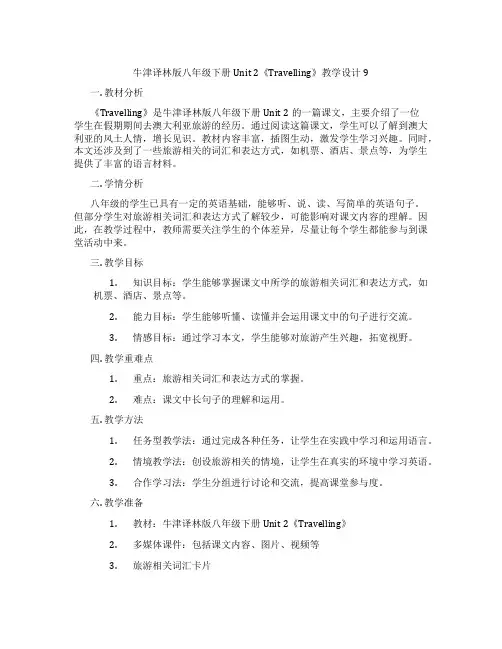
牛津译林版八年级下册Unit 2《Travelling》教学设计9一. 教材分析《Travelling》是牛津译林版八年级下册Unit 2的一篇课文,主要介绍了一位学生在假期期间去澳大利亚旅游的经历。
通过阅读这篇课文,学生可以了解到澳大利亚的风土人情,增长见识。
教材内容丰富,插图生动,激发学生学习兴趣。
同时,本文还涉及到了一些旅游相关的词汇和表达方式,如机票、酒店、景点等,为学生提供了丰富的语言材料。
二. 学情分析八年级的学生已具有一定的英语基础,能够听、说、读、写简单的英语句子。
但部分学生对旅游相关词汇和表达方式了解较少,可能影响对课文内容的理解。
因此,在教学过程中,教师需要关注学生的个体差异,尽量让每个学生都能参与到课堂活动中来。
三. 教学目标1.知识目标:学生能够掌握课文中所学的旅游相关词汇和表达方式,如机票、酒店、景点等。
2.能力目标:学生能够听懂、读懂并会运用课文中的句子进行交流。
3.情感目标:通过学习本文,学生能够对旅游产生兴趣,拓宽视野。
四. 教学重难点1.重点:旅游相关词汇和表达方式的掌握。
2.难点:课文中长句子的理解和运用。
五. 教学方法1.任务型教学法:通过完成各种任务,让学生在实践中学习和运用语言。
2.情境教学法:创设旅游相关的情境,让学生在真实的环境中学习英语。
3.合作学习法:学生分组进行讨论和交流,提高课堂参与度。
六. 教学准备1.教材:牛津译林版八年级下册Unit 2《Travelling》2.多媒体课件:包括课文内容、图片、视频等3.旅游相关词汇卡片七. 教学过程1.导入(5分钟)利用多媒体展示澳大利亚的风景图片,引导学生谈论旅游话题,激发学生学习兴趣。
2.呈现(10分钟)老师朗读课文,学生跟读。
然后展示课文中的旅游相关词汇,如机票、酒店、景点等,让学生进行认读。
3.操练(10分钟)学生分成小组,用英语讨论自己的旅游经历,鼓励学生用上节课学到的词汇和表达方式。
教师巡回指导,纠正发音和语法错误。
最新牛津译林版中学八年级英语下册 Unit 2 Travelling Grammar教案

课题:Unit 2 Travelling (Grammar)一、教学目标1.To further understand the use of the present perfect tense2.To distinguish ‘have/has been to’ and ‘have/has gone to’3.(Development goal):To understand specific information by rending二、教学重点:To distinguish ‘have/has been to’ and ‘have/has gone to’教学难点:To further understand the use o f the present perfect tense三、学习与交流小结: Have/has been to 表示(译为)____________________We use ‘have/has been to ‘ to express the idea that someone went to someplace and has already come back. Have/has gone to 表示(译为)_____________________ We use ‘have/has gone to ‘ to express the idea that someone went to someplace and is still there.四、典型例题用for 和since填空1.My family has owned a train__________1980.2.My has owned a train ___________many years.3.I hav e had a cold___________last Sunday.4.I have had a cold __________5 days.5.Mimi has lived in Beijing__________he was born.五、达标检测一,用’have/has been to ‘或‘have/has gone to ‘填空1. How many times______ you ______ Disneyland ?2. Mr Li ________ Hong Kong. And he'll come back in two days.3. My father ________Hong Kong twice.4. My father ________Hong Kong and he hasn't come back yet.5. Where's Lucy? —She ______ a restaurant for lunch.6. ?_______you _______to this park before.7. The Blacks aren't in Beijing, they _____ Shenzhen together.8. My aunt ______never _____ Russia, so she doesn't know where Russia is.二,单项选择( )1.Mr Smith to Tokyo and he will be back in a weekA. has beenB. has visitedC. has sentD. has gone( )2.-- How long have Mr and Mrs Green_____?--For more than twenty years.A. marriedB. had marriedC. got marriedD. been married( ) 3.-- Has your sister come back? --Yes, she has. She_____ back two days ago.A. cameB. has cameC. has comeD. has been( )4. Mary has been a League member three years.A. forB. sinceC. inD. On( )5.-What do you think of my answer to the questions?-Sorry. What’s that? I______ about something else.A. thoughtB. had thoughtC. am thinkingD. was thinking( )6.-I’m going on a trip to Japan after the exam.-Really? ___________!A. Have a nice timeB. CongratulationsC. OKD. It's nice of you( )7. ______ nice holiday the Turners have had!A. WhatB. HowC. What aD. How a( )8.The driver hurt the girl_____ badly_____ she had to see a doctor.A. so, thatB. either, orC. too, toD. neither, nor( )9.They_ China for two yearsA. have been toB. have been inC. have gone toD. hav e come to( )10.Mr Green isn't in the office ,He to the libraryA. has goneB. wentC. has beenD. will go三、句型转换1. He joined the army two years ago.He ____ _____ ______the army for two years.It is_______ ________since he _________the army.2. Amy bought the motorcycle two y ears ago.Amy _______ _______the motorcycle ________two years.3. The boy borrowed Harry Potter from the library three years ago.The boy ______ ________Harry Potter fro m the library _________three weeks.4. The parade began 2 hours ago.The parade_________ _______ ______ _______2 hours.5. The conference stopped last Saturday.The conference_______ _______ _________ __________last Saturday.6. My brother arrived here 2 days ago.My brother_______ _______here_______2 days.7. My cousin came to Beijing two weeks ago.My cousin_______ _____ ______Beijing _______two weeks.8. I have worked here since I came here .(对划线部分提问)9. They got marri ed ten years ago. (同义句)四、完成句子1. 我是三年前加入阅读兴趣小组的。
牛津译林版八年级英语下册Unit 2 Travelling Grammar课时教案
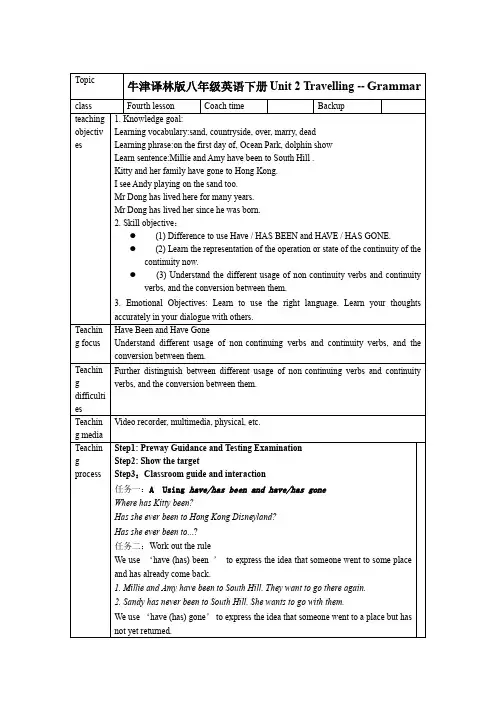
(3) Understand the different usage of non-continuity verbs and continuity verbs, and the conversion between them.
buy have/has had
get married /
marry have/has been married
die have/has been dead
open have/has been open
close have/has been closed
fall asleep have/has been asleep
任务一:A Usinghave/has been and have/has gone
Where has Kitty been?
Has she ever been to Hong Kong Disneyland?
Has she ever been to...?任务二:来自ork out the rule
4. Learn to talk about a trip.
Teachingreflection
Where have you been? Or: Where were you?
(Can you distinguish between Have Been and Have GONG? Group discussion, please help each other!)
任务五:BVerbs with for andsince
3牛津译林版英语八年级下册Unit2Travelling教学设计

(2)学习一般过去时描述旅行经历,如:I visited/went to/saw...
(3)学习目标句型,进行旅行经历的问答,如:Where did you go? What did you do? How was your trip?
2.教学方法:
(1)通过实物、图片等直观教具,帮助学生理解和记忆词汇。
(4)提高阅读和听力水平,获取与旅行相关的信息。
2.难点:
(1)在实际语境中灵活运用一般过去时描述旅行经历。
(2)正确使用旅行相关的词汇和表达方式进行口语交流。
(3)提高阅读和听力水平,快速获取关键信息。
(二)教学设想
1.词汇教学:
(1)通过图片、实物等直观教具,帮助学生形象地记忆旅行相关词汇。
(2)设计词汇接龙、头脑风暴等游戏,激发学生学习词汇的兴趣。
5.评价与反馈:
(1)采用多元化的评价方式,如自评、互评、教师评价等,全面评估学生的学习成果。
(2)关注学生的个体差异,给予针对性的指导和建议。
(3)及时反馈学生的学习情况,激发学生的学习兴趣和积极性。
四、教学内容与过程
(一)导入新课
1.教学活动:
(1)教师展示一组旅行照片,引导学生关注旅行话题。
(2)邀请学生分享自己的旅行经历,激发学生的学习兴趣。
2.培养学生的环保意识,让他们在旅行过程中关注环境保护,做到文明旅游。
八年级英语下册 Unit 2 Travelling Grammar知识点拨 译林牛津版 教案

Unit 2 Travelling一、教学内容:Unit 2 TravellingGrammar二、教学目标:掌握Unit2的词法结构和用法:1. so…that /such…that/enough to/too…to…2. have/has been in, have/has been to, have/has gone to3. 延续性与短暂性动词经典讲解Grammar 1:so…that /such…that/enough to/too…to…解释:如此……以至于……so+ adj. /adv. +that从句或such+单/复数名词+that从句例:It’s so hot in summer that we can’t do without the air conditioner.夏天的天气热的我们少不了空调。
The teacher spoke so fast that I couldn’t understand what he was saying.老师讲得太快以致于我听不懂他在说什么。
He is such a genius that he doesn’t have to study much for exams.他是个天才,所以他考试都不用怎么念书。
They are such good basketball players that everybody wants to watch their games.他们个个都是很棒的篮球员,所以每个人都想去看他们打球。
表示:足以做某事enough to… 如: He is old enough to do it.意思是太……而不能too...to… 例: He is too young to go to school.中考so…that, too…to和enough to都是初中英语教材中的重要结构,在一定条件下它们可以相互转换,并经常成为中考考查的热点之一。
6牛津译林版英语八年级下册Unit2Travelling教学设计

(1)与同学进行线上或线下交流,分享旅行经历,互相学习旅行相关的英语表达。
(2)参与班级旅行主题讨论,发表自己的看法,锻炼口语表达能力。
注意事项:
1.学生在完成作业时,要注意句子结构和语法,尽量避免错误。
2.教师在批改作业时,要关注学生的语言运用能力,给予针对性的评价和指导。
3.鼓励学生积极参与作业完成,培养他们主动学习的习惯。
(3)对于基础较差的学生,多给予关注和鼓励,提高他们的学习兴趣和自信心。
4.教学评价:
(1)过程评价:关注学生在课堂活动中的表现,鼓励他们积极参与,提高口语表达能力。
(2)书面评价:通过作业、测验等形式,评价学生的书面表达能力。
(3)综合评价:结合学生的课堂表现、作业和测验成绩,全面评价学生的学习成果。
在本章节的学习中,学生可能面临以下挑战:
1.旅行相关词汇、短语和句型的掌握程度不一,部分学生可能对新词汇的理解和运用感到吃力。
2.口语表达能力有限,部分学生可能在进行角色扮演、小组讨论等活动时表现紧张,不够自信。
3.书面表达能力有待提高,学生在描述旅行经历时可能存在语法错误、句子结构混乱等问题。
针对以上学情,教师应采取以下策略:
2.口语作业:
(1)与同学合作,进行角色扮演,模拟旅行中的场景进行对话,并录制视频。
(2)向家人或朋友介绍一次旅行的计划,尽量使用所学英语知识。
3.拓展作业:
(1)收集有关旅行目的地的资料,如景点介绍、风俗习惯等,用英语整理成一篇小报告。
(2)设计一份旅行攻略,包括行程安排、酒店住宿、美食推荐等,用英语进行描述。
4.导入新课:通过讨论,引出本节课的主题——Travelling,告诉学生我们将学习与旅行相关的英语知识。
最新牛津译林初中八年级英语下册 Unit 2 Travelling教案 (2)
Travelling课题8B Unit 2 Travelling Welcome to the unit课型新授授课日期月日第1课时教学目标1.To introduce well-known attractions in foreign cities and popular places of interest2.To activate general knowledge about the world .3.To identify activities which people do on holiday.教学重难点1. To learn some popular tourist attractions .2.To talk about traveling to some famous places.课前准备多媒体教学活动二次备课Check pre-exerciseStep1 Leading - inDiscussion:1. Each country has its places of interest.For example:(Show a picture of Great Wall)In China, there is Great Wall. At this time,write Great Wall and China on the Bb.2. Let the Ss tell more places of interestin foreign countries and write them on theBb.3. Ask them what people can do if they arein the famous places.Step2 Pre – task 11.Show the pictures of other five places ofinterest on the page 21. Ask Ss read thewords and do the exercise below.Lead them to read the names of places an dcountries.2. Show the picture of little Mermaid.T: It’s little Mermaid in D enmark . it’sfamous in the world.S1: Really ?.S2:That’s from the story by hans ChristianAndersen. .Step3 While - taskTask 1 .After reading the new words fluently, letSs match the three parts with lines ontheir exercise book.Task 2.Make dialogues. Show the picture of MountFuji.T: What’s this?Ss: It’s Mount Fuji in Japan.T: What can people do there?S1: They can climb hills/ take photos. Make dialogue about other five pictures in pairs.Step4Post - task1Practice the dialogue before the whole class.Step5 Pre - task 2T: Travelling is fun. Before your parents take you out to go on a trip, you should pack your things. Write the phrases on the Bb. Teach them the meaning and the pronunciation.Step6 Whole task 2T: Now Eddie is going on a trip. Let’s look at the pictures one by one.Task 1.Show Picture 1. Act as Hobo. Ask: Hey, Eddie. Where are you going?Ss: I’m going on a trip. ( help them answer.) Practise again.Task 2.Show Picture 2.T: You know, Eddie is going on a trip alone. But the trip must be fun. So Hobo asks: I have been there before. Can I join you ?Practise again.Task 3. Show Picture 3. Ask and answer with present continue tense.Ss: What are you doing, Hobo?T: I’m getting all my things .Task 4.Show Picture 4. Show the difference between P 2 and P4.Try to get their two thoughts. Present the dialogue between them.Step7 Homework:Preview the new words in Reading教后记8B Unit 2 Travelling教案课题8B Unit 2 Travelling Reading(1)课型新授授课日期月日第2课时教学目标1.To read a letter about a holiday in Hong Kong2.To expand vocabulary to talk about traveling3.To expand vocabulary to talk about traveling.4.To identify specific details by answering questions.教学重难点1.The understanding of the main idea of Reading.2.To analyze the sentences for the students to get a betterunderstanding.课前准备多媒体教学活动二次备课Check pre-exerciseStep1 Leading – in1.Show the pictures of places of interestsin different countries to review.2.The last place is Mount Fuji. Talk moreabout Hong Kong . Show a picture of HongKong.Describe Hello Kitty’s appearance.Step2 PresentationIf the students have been there .T: you have been to Hong Kong Disneyland.When did you go there ?Can you tell us something about it.if necessary , the students can use someChinese words in their description. or theteacher can give some key words.e.g. roller coaster, at high speed a paradeof Disney characters a 4-D film ,watch the fireworks ,fantasticIf the students haven’t been ,the teacher can show the picture of Disney and make a brief instruction. T: This is a picture of Hong Kong Disneyland.it’s a wonderful place for both children and adults. Space Mountain is exciting .The parade of Disney land character is fantastic . you can enjoy a 4-D film there. It’s like magic. there are many shops inside the park .you can do some shopping. You can also watch the fireworks in the evening ..They are very beautiful. Step3 Reading1 Students scan the reading materials and find the main 5 elements, and outline the reading.T: Today we’re going to learn about Hong Kong Disneyland from Kitty’s letter. Remember to find the five paints:when ,who, where , what, and how. Look at the questions in part B1 and find the answers as quickly as you can.The students finish t B1 after scanning para1,22 Teach the students how to find the details and finish B2.Now we’re found out that Kitty went to Hong Kong Disneyland with her parents by underground .They spent a whole day there and a fantastic time. But what did they do there? Let’s read the rest of the letter and complete partB2. check the answersStep4 ActivitiesT: Millie is still in Hainan and she hasn’t received Kitty’s letter yet . One day, Millie called Kitty and asked Kitty about her trip to Hong Kong Disneyland .Let’smake a conversat ion between Millie andKitty. It should have at least fivequestions.The students act it .Step5Homework1.Recite the new words2.Find out useful words and phrases inReading3.Do B3 and B4 on Page 25教后记课题8B Unit 2 Travelling Reading(2)课型新授授课日期第三课时教学目标1.To practise the main language points of the context2.To speak out the passage in their own words3.To understand and use the expressions in the text教学重难点2.To speak out the passage in their own words, following thestructure of the passages.课前准备多媒体教学活动二次备课Check pre-exerciseTranslate some phrases into English.1非常想念你 2 玩的开心3 快速行驶4 急忙去餐馆快速的吃饭5忍不住不停的拍照 6 买一对耳环Step1 RevisionT: Aak the following questions1) Where did Kitty go ?2)When did she go there ?3)Who did she go with ?4)How did she go there ?5)What did she do there ?6)How long did she spend there ?Step 2 Presentation1 Discussion in group of 4.Finish Kitty’s activity form with ten vocabulary that describe the time in the text 2 Find the time vocabulary and fill in the placeand activity.Step 3 Explaining the language pointsI am going to explain the important words, phrases and sentences in the passage.Step 4 Practising and Sum upAmy went to Kitty’s house for supper. Kitty showed Amy her photo album. Amy was very excited and asked a lot of questions. Finish Part B3 on page 25, and then work in pairs to make the similar conversation. For stronger class, students can add more questions.Ask the students to sum up the passage.Step 5当堂检测、及时反馈Kitty_____ (已经去) Hong Kong for two days. She and her parents had a great time there. They spent the whole day in Disneyland.It is _____ (世界文明的主题公园) and it’s reallyfantastic. It is one big park, but it actually hasfour parks.They got to Disneyland from their hotel _____ (乘地铁). They took photos _____(在鲸鱼喷泉前) atthe entrance, then they went to Space Mountain.They took the roller coaster, it _____ (高速移动). In the afternoon, there was a parade ofDisney characters. The _____ (演出者) all woredifferent costumes and waved to people while theymarched across the park. The children _____ (鼓掌) and screamed with joy.教后记课题8B Unit 2 Travelling Grammar课型新授授课日期课时第4/5课时教学目标1.To recognize contexts for the use of the present perfect tense.2.To understand the verbs with ‘for’, ‘since’ or ‘ago’3.To consolidate the present perfect tense4.To understand the verbs with continuous time adverbials教学重难点1.‘have/has been’ and ‘have/has gone’2. Verbs with ‘for’, ‘since’ or ‘ago’课前准备多媒体教学活动二次备课Check pre-exerciseStep1.Lead-inT: Now, I am teaching you. You are listeningto me carefully.Ask the students to give me more sentenceswritten in present continuous tense.Write the structure of present continuoustense on the Bb.T: But yesterday at this time, I was sittingin my office. (Write the structure of pastcontinuous tense on the blackboard).Underline the different verbs ‘BE’.Step2.PresentationWe use ‘have /has been to’ express theidea that someone went to someplace andhas already come back.I have been to England twice.(Where am I now/Am I still in England? )Millie, can you go to office to bring methe chair?Where’s Millie? She is on the way to theoffice, or maybe she is in the office.She has gone to the office. And she willcome back in a few minutes.We use ‘have /has gone to’ express theidea that someone went to someplace and isnot here.Step3.PractisingDaniel is asking Millie about traveling.Complete the conversation on page 27 withthe correct forms of the verbs inbrackets.Step4 PresentationWe use for when we talk about a period oftime, and we use since when we talk about atime point in the past.e.g. Mr Dong has lived here for many years.Mr Dong has lived her since he was born.Some verbs, such as come, go, buy and leave,can be used in the present perfect sense, butthey cannot be used with for or since inpositive statements.Step 5 since和for的区别If we want to express a continuous state, wecan use another way like this.Verb Used for a continuous stateExample : begin/start have/has been onThe film has been on for 20 minutes.finish/stop have/has been overThe parade has been over for hours.come/go/arrive have/has been in/atKitty has been in Hongkong for two days.Leave have/has been awayShe has been away from home since lastTuesday.borrow have/has keptShe has kept this book since last week.join have/has been in or have/has been amember ofSimon has been a member of the FootballClub since last year.marry have/has been marriedThey have been married for 15 years.die have/has been deadThe fish have been dead for some time.Step6 PracticeStep7 Homework1. 复习for和since的用法。
牛津译林版八年级下册Unit 2《Travelling》教学设计2
牛津译林版八年级下册Unit 2《Travelling》教学设计2一. 教材分析《Travelling》是牛津译林版八年级下册Unit 2的一篇课文,主题是旅行。
本文通过讲述作者一家在澳大利亚的旅行经历,介绍了澳大利亚的地理、文化和生活方式。
文章语言真实、生动,插图丰富,有助于学生理解课文内容。
教材内容与学生的生活实际相符,能够激发学生学习英语的兴趣。
二. 学情分析八年级的学生已经具备了一定的英语基础,能够听、说、读、写简单的英语句子。
但部分学生在阅读长篇文章时,可能会遇到生词和语法难点。
因此,在教学过程中,需要关注学生的个体差异,充分调动学生的积极性,引导他们主动参与课堂活动。
三. 教学目标1.知识目标:学生能够掌握课文中的生词和短语,理解文章大意,正确运用一般过去时描述过去的事情。
2.能力目标:学生能够流畅地朗读课文,提高阅读理解能力,学会用英语描述旅行经历。
3.情感目标:学生能够激发对旅行的兴趣,增进对不同国家和文化的了解,培养跨文化交际意识。
四. 教学重难点1.重点:课文的理解和朗读,一般过去时的运用。
2.难点:生词和短语的理解,复杂句子的翻译。
五. 教学方法1.任务型教学法:通过完成各种任务,让学生在实践中学习英语,提高语言运用能力。
2.情境教学法:创设真实的旅行情境,激发学生学习兴趣,提高课堂参与度。
3.交际式教学法:引导学生进行小组讨论和互动,培养他们的合作精神和交际能力。
六. 教学准备1.课文录音:用于听力训练和模仿朗读。
2.课文插图:用于辅助学生理解课文内容。
3.教学课件:包含生词、短语、语法点等,方便学生学习和复习。
4.作业布置:设计具有针对性的练习,巩固所学知识。
七. 教学过程1.导入(5分钟)利用旅行相关的图片或视频,引导学生谈论自己最喜欢的旅行目的地,激发学生对旅行的兴趣。
2.呈现(10分钟)展示课文插图,引导学生根据插图预测课文内容。
然后播放课文录音,让学生跟读并模仿语音语调。
译林版英语八年级下册Unit 2 Grammar教案
e.g. Mr Dong has lived here for many years.
Mr Dong has lived her since he was born.
Some verbs, such as come, go, buy and leave, can be used in the present perfect sense, but they cannot be used with for or since in positive statements.
4. My parents __________ to Xi’an and they’ll stay there for a week.
5. Daniel won’t be with us at the party. He _________ to Shanghai.
A2. Daniel and Millie are chatting. Complete their conversation. Use the correct forms of the verbs in brackets.
Example
begin/start
have/has been on
The film has been on for 20 minutes.
finish/stop
have/has been over
The parade has been over for hours.
come/go/arrive
牛津译林版英语八年级下册Unit2TravellingGrammar优秀教学案例
(一)导入新课
1.我通过展示不同国家的旅游景点图片,引发学生对旅游话题的兴趣和好奇心。图片中包含了各种自然风光、历史遗迹和文化特色,让学生对旅游目的地有直观的认识。
2.我提问学生:“你们最喜欢的旅游目的地是哪里?”让学生分享自己的旅游经历和喜好,激发他们对旅游话题的讨论和表达欲望。
在教学过程中,我注重引导学生通过观察、思考、交流和实践,发现语言规律,掌握语法知识,并将所学应用到实际生活中。通过本节课的学习,学生不仅提高了英语语言能力,还增强了对旅游文化的认识,(一)知识与技能
1.学生能够掌握一般现在时的被动语态结构,理解其含义并能够运用到实际情景中。通过观察、分析和实践,学生能够熟练运用一般现在时的被动语态进行准确的描述和表达。
在案例中,我首先通过展示不同国家的旅游景点图片,激发学生的学习兴趣,让他们在轻松愉快的氛围中进入学习状态。接着,我以一段旅行视频为素材,引导学生运用一般现在时的被动语态进行表达,帮助他们巩固所学语法知识。此外,我还设计了一个小组讨论活动,让学生结合旅行计划表格,用英语讨论并制定一个简单的旅行计划,从而提高他们的实际应用能力。
3.通过小组讨论,学生能够培养团队合作意识和沟通能力,提高口语表达能力和解决问题的能力。
(四)总结归纳
1.在学生小组讨论结束后,我邀请各小组代表分享他们的旅行计划和讨论成果。通过总结和归纳,学生能够巩固所学知识,并从他人的计划中学习和借鉴。
2.我引导学生总结一般现在时的被动语态的结构和用法,让他们对所学的语法知识有一个清晰的认识和记忆。
3.最后,我强调一般现在时的被动语态在旅游情景中的应用和重要性,让学生明白学习英语语法的实际意义和价值。
(五)作业小结
1.在课程结束前,我布置一项作业,要求学生根据所学的旅行计划制定一个个人的旅行计划。学生需要使用一般现在时的被动语态来描述他们的旅行目的地和活动安排。