
外研版英语八年级上册 Module 10 unit 1-教案
3.给出活动任务, 同学们完成。
4.练习对话。
5.讲解重要单词及短语。
6.讲解重要知 识点。
7.布置家庭作业
……
1.找出与天气有关的形容词,回答What’s the weather like?/ What the weather might /may be like?两个问题。
读懂并了解有关天气的对话。
教学难点
1.句子What’s the weather like?/What’s the temperature?
根据所学谈论天气。
学情分析
学生经过一年多的学习,有了一定的英语基础知识和听说能力,正逐渐向读、写过渡。经过一年的新课程理念的熏陶及实践,有了初步的自主、合作、探究、实验的能力。本单元采用了交际对话的形式来进一步练习学生们的听说能力,为下一单元的读写作铺垫。课前已安排学生了解和搜集有关天气的词语和句子。
2.Do activity5.
四、pair work two person in a group, read this dialogue loudly.
五、讲解重要单词及短语。
六、讲解重要知识点。
七、课堂达标练习。
八、布置家庭作业
……
1.提 问一些有关天气的形容词,待学生 了解后并提问What’s the weather like ?进一步提出What the weather might /may be like?引出本课。
Unit1 It might snow
教学目标
1.能掌握并准确运用本单元的重点单词和短语:cold snow storm cloudy rainy snowy windy skate probably
2.能读懂并了解有关天气的对话。
能根据所学谈论天气。
教学重点
1.掌握并准确运用本单元的重点单词和短语。
二、听对话,回答下列两个问题。
1.What’s the weather might be like in Beijing?
2.What’s the temperature?
三、读对话,完成课中所给任务。
1.Read the dialogue and check the true sentences.
2.听听力,回答问题。
3.读对话,完成活动任务。
4.练习对话 。小组合作。
5.勾出重要的知识点和短语。
6.完成课堂达标练习。
……
1.同学们能够掌握与天气有关的形容词 ,并能回答出一些简单的提问,但在描述气温时可能还不是很熟悉。
2.
……
1.增加对话的练读。
2.
……
板书设计
Module10 The weather
学法 指导
Listening, speaking and writing
教学过程
教学内容
教师活动
学生活动
效果预测(可能出现的问题)
补救
措施
一、Lead in.
说出一些有关天气的形容词,了解后并提问What’s the weather like?进一步提出What the weather might /may be like?引出本课。
Unit 1 It might snow.
一、Sentence:
What’s the weather like?
It is......
What the weather might be like?
It might......
What’s the temperature?
It is.......
二、听对话,回答下列两个问题。
1 .what’s the weather might be like in Beijing?
2.what’s the temperature?
三、pair work.
2022年外研版八年级上册《Module 10 Unit1》公开课教案

Module 10 The weather一、教学内容:Unit 1 It might snow.二、课型:Listening and speaking三、教学目标:1、能够正确使用以下单词和词组:cloud, shower, snow, storm, cloudy, rainy, snowy, sunny, windy, skate, thick,ice, joke, might, temperature, minus, degree, although, wet, terrible, wish, probably, come on.能正确使用以下句型:1.Are you joking?2. Sounds great!3. Me neither.e on, better get going!5. What’s the temperature?6. It’s probably sunny and hot there.7.Rainy weather is terrible!8.I like sunny weather ,and I like snow as well.9. W hat’s the weather like in America in winter?2、能够听懂谈论天气的谈话并完成相关的听力任务.4、能用有关天气的名词或形容词、情态动词及询问天气的句型谈论天气.5、通过对本单元的学习, 了解各种气象, 培养学生保护和保护环境良好品德.教学重难点:能够熟练运用有关天气的名词或形容词及情态动词谈论天气.四、教学准备:课堂整体运用任务型教学模式, 培养学生独立自主的学习能力. 本课指导学生通过听说获取信息, 培养学生的听说技能. 在教学过程中, 采用多媒体手段辅助教学, 利用各种图片、实物和习题任务贯穿整个教学过程. 因此, 本节课需准备:PPT课件、挂图、录音机、实物、课堂练习表格、奖品五、七、板书设计:Module10 The weatherUnit1 It might snow.1.Are you joking?2. Sounds great!3. Me neither.e on, better get going!5. What’s the temperature?6. It’s probably sunny and hot there.7.Rainy weather is terrible!8.I like sunny weather ,and I like snow as well.9. What’s the we ather like in America in winter?达标训练题一、根据句子意思, 用适当的词填空:1) It rains a lot in summer in Beijing. It’s often ________.2) There’re a lot of clouds. It’s _________.3) The weather is snowy and there’s a lot of __________ in the park.4) The sun is out. It’s very ____________ and hot today.5) The wind is very strong. It’s so __________ that it’s difficult to walk.二、选择正确的答案:( ) 1. - ________? It’s cold.A. What’s the weatherB.What’s the weather likeC. How’s weatherD. How’s the weather like( ) 2. - I don’t like rainy weather. -________.A. I don’t like, too.B. Are you joking?C. Me neither.D. Sounds great!( ) 3. It’s very cold and cloudy. It might _____tomorrow.A. snowB. snowedC. snowyD. snowing( )4. — Where are you going this weekend? .—I’m not sure. I ______go to the zoo.A. canB. mayC. needD. must( )5. She likes red and green _______.A. alsoB. eitherC. neitherD. as wellUnit 1 While the lights were changing to red,a car suddenly appeared.教学目标【知识目标】1、能掌握本单元的单词和短语:bite, climb, hide, throw, fridge, pain, worse, medicine.2. 掌握本单元中的常用句型.【能力目标】1、能根据图片预测下文;能理解作者通过故事要传达的信息;能够理解语篇中故事发生的顺序.2、能够仿照范文, 用过去进行时对发生在周围的事故进行描述或报道.【情感态度目标】学习遇到突发事件时应沉着冷静, 尽量想方法自救的平安意识.教学重难点【教学重点】过去进行时, when和while引导的时间状语从句.【教学难点】能运用过去进行时就意外事故这一话题进行讨论.教学过程Step 1 Lead-inSs look the pictures and fill in the blanks.Step 2 Consolidate new wordsLook and say. The teacher shows the pictures of new words and let the students to say the new words as quickly as possible.Step 3 Say the meaning of the phrases.Work in pairs. Let Ss say the meaning of the phrases as quickly as possible.Step 4 Look at the pictures and say what’s happeningLook at the picture and use the words from the box to say what’s happening at that time.Step 5 Listen to Activity 2 and read1. The driver was/was not going fast.2. The driver was/was not looking.3. The driver was/was not talking on his mobile phone.Step 6 Listen to the dialogue and answer the questionsLet Ss listen to the dialogue and answer the two questions. Then check in groups.Step 7 Read the dialogue and answer the questions1. What was the boy doing when he was riding his bike?2. When did a car suddenly appear round the corner?3. Did the boy fall off his bike?Step 8 Read Activity 3 and complete the following advice.When you are riding a bike, think about the risk of an accident!Pay ___________ and stop at the___________.Don’t ______ too fast.Don’t ride ____________ with your friends.Don’t ______________!Step 9 Complete the passage with the correct form of the words from the box.Let Ss read the passage first and choose the words and expressions from the box.Step 10 Everyday EnglishAre you all right? That’s very dangerous!That’s too bad.Anything else?Step 11 Language pointsLet Ss master the main points of the passage.Step 12 Listen and mark when the speaker pauses1. Listen and mark when the speaker pauses.1) While the lights were changing to red, a car suddenly appeared round the corner.2) When I was waiting to cross the road, the accident happened.2. Now listen again and repeat.Step 13 Work in groups of fourStudent A: You’re a policeman at an accide nt scene in the street. Ask people questions.Student B, C and D: You saw the accident. Answer the policeman’s questionsStep 14 Grammer掌握过去进行时的用法.Step 15 Summary重点短语in time fall off pay attention side by side 过去进行时Step 16 ExercisesDo some exercises about the main points.Step 17 中考链接Do the exercises in the entrance exam to senior high schools. 课堂作业编写一个对话,介绍你亲眼目睹的一次交通事故.教学反思。
外研版八年级上册Module 10 Unit1 It might be snow 教案
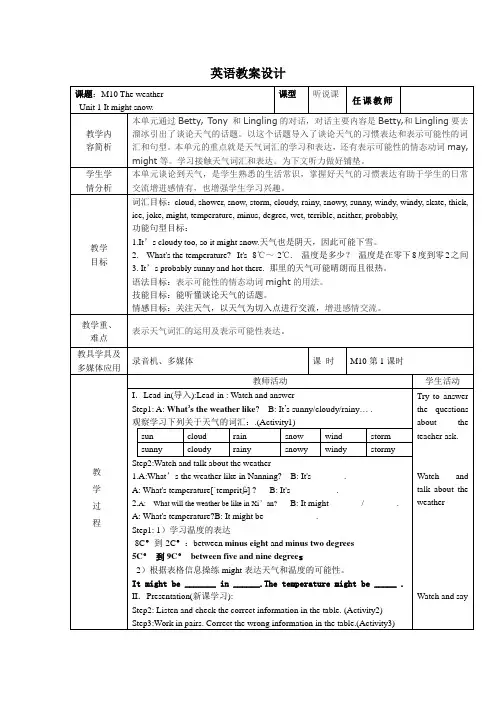
It might be _______ in ______.The temperature might be _____ .
II.Presentation(新课学习):
Step2: Listen and check the correct information in the table. (Activity2)
Step3:Work in pairs. Correct the wrong information in the table.(Activity3)
Step4:Listen and read.(Activity4)
Check (√) the true sentences.
1. Tony and Daming are going to skate.
IV .Summary:
1.Everyday English(日常用语)
1.Are you joking?你是在开玩笑的吧?2. Sounds great!听起来不错!
3. Me neither!我也不。4. I like sunny weather.我喜欢阳光明媚的天气。
2.Key sentences(核心句子):
6. Tony does not like windy weather.
Step5: Read theconversationloudly!
III.Exercises:
1.Fill in the blank(补全对话)
A:Betty and Lingling,Where are you going?
功能句型目标:
1.It’s cloudy too, so it might snow.天气也是阴天,因此可能下雪。
Module10Unit1Itmightsnow.教案-2020年秋外研版八年级英语上册

(三)实践活动(用时10分钟)
1.分组讨论:学生们将分成若干小组,每组讨论一个与天气预报相关的实际问题,如如何为周末的户外活动准备合适的衣物。
2.实验操作:为了加深理解,我们将进行一个简单的角色扮演活动。学生们将模拟天气预报员,使用一般将来时态和所学词汇来预报天气。
在课堂管理方面,我注意到在小组讨论时,部分学生可能会稍微偏离主题。为了提高讨论效率,我将在以后的课程中明确讨论规则,并提供更具体的讨论指导。
Module 10 Unit 1 It might snow.教案-2020年秋外研版八年级英语上册
一、教学内容
《Module 10 Unit 1 It might snow.》为本教案的核心内容,选自2020年秋外研版八年级英语上册。教学内容主要包括以下几部分:
1.本单元的核心词汇和短语:weather forecast, snow, rain, cloudy, sunny, windy, might, perhaps, definitely等。
(二)新课讲授(用时10分钟)
1.理论介绍:首先,我们要了解一般将来时态的基本概念。一般将来时态是用来描述未来发生的事情或预测未来状况的时态。它在日常交流中非常重要,尤其是在谈论天气、计划等话题时。
2.案例分析:接下来,我们来看一个具体的天气预报案例。这个案例展示了如何使用一般将来时态来描述未来天气,以及它如何帮助我们了解和规划日常活动。
本节课将围绕以上内容,结合实际教学活动,提高学生对英语天气表达和一般将来时态的理解和应用能力。
二、核心素养目标
外研版八年级英语上册教案Module 10 Unit 1
Module 10 The weatherUnit 1 It might snow.教材分析本课为Module10的第一单元,由贝蒂和玲玲要去滑冰引出了谈论天气的对话,借助这样一个常见的场景轻松地导入了谈论天气的习惯表达和表示可能性的词汇和句型。
教学目标1. Function: Describing the weather.2. Structure: may, might, probably (for possibility)3. Skills:1) Listening and understanding familiar topics (weather).2) Giving weather forecast based on clues; predicting about future weather using probably.3) Reading and finding specific information.4) Writing a short passage about the best time to visit your town, using because, so and but. 4. Around the world: The wettest place.5. Task: Preparing some advice on the best time to visit China.教学重难点1. Describing the weather.2. Grammar: The using of may, might, probably (for possibility)课前准备A tape recorder, multimedia and some pictures.教学过程Step1 Work in pairs. Talk about the weather.1. Warm -up. Show some pictures of the weather. Ask the students to talk about the weather.2. Introduce the new words.1) sun n. 太阳→sunny adj. 晴朗的2) rain n. 雨→rainy adj. 多雨的;下雨的3) cloud n.云→cloudy adj. 多云的4) snow n.雪;v. 下雪→snowy adj.多雪的;下雪的5) wind n.风→windy adj.多风的;刮大风的6) storm n. 暴风雨→stormy adj.有暴风雨的7) shower n. 阵雨;→showery adj.有雷阵雨的3. Learn the new words.4. Read the new words.【设计意图】本活动旨在激活学生头脑中有关天气的词汇,为以“天气”为话题展开的一系列听说活动作铺垫。
外研版英语八年级上册M 10 Unit 1 教案

Module 10 The weather一、学习目标:A. 单词和短语:cloud, shower, snow, storm, cloudy, rainy, snowy, sunny, windy, skate, thick, ice, joke, might, temperature, minus, degree, although, wet, terrible, wish, probably, come on, mile, northwest, umbrella, southeast, from time to timeB. 交际用语:1. You’re joking!2. Sounds great!3. Come on!4. When is the best time to visit your country?5. What clothes should she bring?6. What’s the temperature?7. Where are you going?8. It’ll probably be cold tomorrow.9. It might be rainy.10. It’s probably sunny and hot there.11. Bring a map because you may want to travel around.二、教学目标1. Function: Describing the weather.2. Structure: may, might, probably (for possibility)3. Skills:1) Listening and understanding familiar topics (weather).2) Giving weather forecast based on clues; predicting about future weatherusing probably.3) Reading and finding specific information.4) Writing a short passage about the best time to visit your town, usingbecause, so and but.4. Around the world: The wettest place5. Task: Preparing some advice on the best time to visit China三、重点及难点:1. Describing the weather.2. Grammar: The using of may, might, probably (for possibility)四、教学设计:Unit 1 It might snow.ⅠTeaching modelListening and speakingⅡTeaching methodInteractive approachⅢTeaching aims1. To understand conversations about the weather;2. To get specific information from the listening material;3. To talk about possibilitiesⅣTeaching Objectives1. Key vocabulary: cloud, shower, snow, storm, cloudy, rainy, snowy, sunny,windy, skate, thick, ice, joke, might, temperature, minus,degree, although, wet, terrible, wish, probably, come on2. Key structures: may, might, probably (for possibility)3. Key sentences:1) —What’s the temper ature?—It’s between minus five and minus two degrees!2) —What’s the weather like in …? = How is the weather in …?—It’s snowy (cloudy, rainy, sunny, windy ...).3) … although this year it snowed a lot.4) Come on, better get going!5) It’s probably sunny and hot there.It’ll probably be cold tomorrow.ⅤTeaching aidsTape recorder, OHP, videoⅥTeaching StepsStep 1 Warming upWeather report:1) Show some pictures of the weather.2) Ask and answer: What's the weather like in …?Step 2 Work in pairs.1. Show some pictures of the weather. Ask the students to talk about theweather.2. Introduce the new words.1) sun n.太阳→ sunny adj.晴朗的2) rain n.雨→ rainy adj. 多雨的;下雨的3) cloud n.云→ cloudy adj. 多云的4) snow n.雪;v. 下雪→ snowy adj.多雪的;下雪的5) wind n.风→ windy adj.多风的;刮大风的6) storm n. 暴风雨→ stormy adj.有暴风雨的7) shower n. 阵雨;→ showery adj.有雷阵雨的3. Learn the new words.4. Read the new words.5.及时练:根据句子意思,用适当的单词填空。
外研版英语八年级上册 Module 10 unit 1-教案
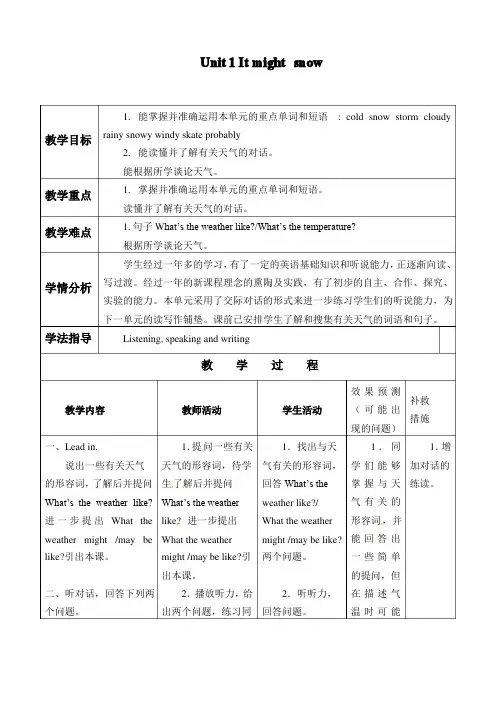
Unit 1 It might snow1.能掌握并准确运用本单元的重点单词和短语:cold snow storm cloudyrainy snowy windy skate probably2.能读懂并了解有关天气的对话。
能根据所学谈论天气。
教学目标教学重点教学难点1.掌握并准确运用本单元的重点单词和短语。
读懂并了解有关天气的对话。
1.句子W hat’s the weather like?/What’s the temperature?根据所学谈论天气。
学生经过一年多的学习,有了一定的英语基础知识和听说能力,正逐渐向读、学情分析写过渡。
经过一年的新课程理念的熏陶及实践,有了初步的自主、合作、探究、实验的能力。
本单元采用了交际对话的形式来进一步练习学生们的听说能力,为下一单元的读写作铺垫。
课前已安排学生了解和搜集有关天气的词语和句子。
学法指导Listening, speaking and writing教学过程效果预测教学内容教师活动学生活动(可能出现的问题)一、Lead in.1.提问一些有关1.找出与天1.同补救措施1.增说出一些有关天气天气的形容词,待学的形容词,了解后并提问生了解后并提问What’s the weather like?What’s the weather进一步提出What the like?进一步提出weather might/may be What the weatherlike?引出本课。
二、听对话,回答下列两个问题。
might /may be like?引出本课。
2.播放听力,给出两个问题,练习同气有关的形容词,学们能够加对话的回答What’s theweather like?/What the weather掌握与天练读。
气有关的形容词,并might /may be like?能回答出两个问题。
2.听听力,回答问题。
一些简单的提问,但在描述气温时可能1.What’s the 学们的听力。
Module10Unit1教学设计-2023-2024学年外研版英语八年级上册
在未来的教学中,我还将关注学生的个别差异,为不同水平的学生提供不同的支持和挑战。这可以帮助每个学生根据自己的学习速度和能力进行学习,提高他们的学习效果和自信心。
其次,我注意到学生在课堂上的参与度不高。虽然我设计了一些互动环节,如小组讨论和角色扮演,但学生的参与度仍然有限。这可能是因为学生对一般过去时的学习缺乏兴趣。为了提高学生的学习兴趣,我计划在未来的教学中引入更多与一般过去时相关的真实场景和案例,让学生能够看到一般过去时的实际应用,从而激发他们的学习兴趣和主动性。
4.教室布置:根据教学需要,对教室环境进行适当布置,以营造积极的学习氛围。可以将教室划分为分组讨论区和实验操作区,为学生提供充足的空间进行小组讨论和实验操作。同时,可以设置一些提示牌和指示标志,帮助学生快速找到对应的学习区域。
5.教学工具:准备多媒体投影仪、计算机、音响设备等教学工具,以确保教学过程中多媒体资源的正常播放和展示。同时,准备白板和记号笔,以便于教师在课堂上进行板书和重点知识的强调。
设计预习问题,激发学生思考,为课堂学习一般过去时内容做好准备。
教师备课:
深入研究教材,明确Module 10 Unit 1教学目标和一般过去时的重难点。
准备教学用具和多媒体资源,确保教学过程的顺利进行。
设计课堂互动环节,提高学生学习一般过去时的积极性。
(二)课堂导入(预计用时:3分钟)
激发兴趣:
提出问题或设置悬念,引发学生的好奇心和求知欲,引导学生进入学习状态。
(六)课堂小结(预计用时:2分钟)
外研版八年级上册英语《Module 10 The weather Unit 1》教学设计
外研版八年级上册英语《Module 10 The weather Unit 1》教学设计一. 教材分析外研版八年级上册英语《Module 10 The weather Unit 1》主要介绍了天气现象和相应的表达方式。
本单元包括介绍天气预报、谈论天气变化、表达对未来天气的预测等内容。
通过本单元的学习,学生能够掌握天气相关的词汇和表达方式,提高运用英语描述天气的能力。
二. 学情分析八年级的学生已经具备了一定的英语基础,能够听、说、读、写一些简单的英语句子。
但天气方面的词汇和表达对他们来说较为陌生,因此需要在教学中加以引导和拓展。
此外,学生对于实际生活中的天气现象可能了解不多,因此需要在课堂上进行补充讲解。
三. 教学目标1.知识目标:–能够听、说、读、写与天气相关的词汇和表达方式。
–能够用英语描述天气预报和天气变化。
–能够表达对未来天气的预测。
2.能力目标:–提高学生运用英语描述天气的能力。
–培养学生的团队合作意识和口语表达能力。
3.情感目标:–激发学生对天气现象的兴趣。
–培养学生关注天气变化,关爱生活的意识。
四. 教学重难点•掌握天气相关的词汇和表达方式。
•能够用英语描述天气预报和天气变化。
•正确运用 weather 相关的词汇和表达方式。
•表达对未来天气的预测。
五. 教学方法1.任务型教学法:通过完成各种任务,让学生在实际语境中运用所学知识。
2.情景教学法:创设各种天气情境,让学生在情境中学习、掌握相关词汇和表达方式。
3.小组合作学习:培养学生的团队合作意识和口语表达能力。
六. 教学准备1.教学材料:教材、课件、图片、天气预报视频等。
2.教学设备:投影仪、电脑、音响等。
七. 教学过程1.导入(5分钟)–教师展示各种天气现象的图片,引导学生谈论天气。
–学生分享自己喜欢的天气和原因。
2.呈现(10分钟)–教师通过课件呈现本课的生词和短语,如:sunny, cloudy, rny, windy等。
–学生跟读并模仿 weather 相关的词汇和表达方式。
外研版八年级英语上册教案 Moddule 10 Unit 1
Module 10 The weatherUnit 1 It might snow.一、教学目标1. 掌握词汇:cloud, shower, snow, storm, cloudy, rainy, snowy, sunny, windy, skate, thick, ice, joke, might, temperature, minus, degree, although, wet, neither, terrible, wish, probably, come on2. 掌握句型:(1) What’s the temperature?(2) It’s between minus eight and minus two degrees!(3) Most Decembers are wet and rainy.(4) Not usually, although this year it snowed quite a lot.3. 能够听懂谈论天气的对话。
4. 能够谈论,描述天气情况。
5. 能够了解语调在口语表达中的重要作用。
6. 能够正确运用表示可能性的单词和句型。
7. 能够通过了解天气情况,培养学生对学习地理知识的愿望和兴趣。
二、教学重点及难点重点:掌握表示天气的词汇的用法。
难点:掌握表示天气和可能性的句型。
三、教学准备1. 多媒体设备和课件;2. 设计课后巩固练习;3. 教学图片。
四、教学过程Step 1 Warming-upLook at the pictures and talk about the weather.T: Boys and girls, you know weather has an important effect on our lives. If we’re planning a trip or getting dressed in the morning, we always have to know what the weather will be like. Look at the pictures. What’s the weather like?S: It’s sunny.S: I t’s cloudy.S: It’s raining....【设计意图】通过多媒体屏幕向学生展示表示天气的单词,非常直观明了,易于帮助学生加深记忆。
外研版八年级英语上册:Module 10 unit 1 教案设计
教学重点
1.Understanding of the dialogue.
Make a weather report and give some advice.
Step 9 Summary
引导学生对本课知识简要总结。
Ask the students to make a summary.
Make a summary
Step 10 Homework
布置课后作业,检测和巩固知识。
2.Learning how to talk about the weather.
教学难点
How to talk about the weather.
教学设备
Tape recorder, PPT, blackboard
教学方法
Task-based approach
教
学
过
程
教
学
过
程
教学步骤
设计意图
教师活动
1.It is windy.There is a lot of wind.
2.It will be stormy, you’d better stay at home.
3.Beijing will be showery. The temperature will be between minus eight and minus two degrees. You’d better take an umbrella.