
人教版中考英语模拟试题及参考答案
人教版中考英语模拟试题及参考答案一、单项选择(共15分,每小1分)从各题的四个选项中选出一个最佳答案。
( )1. Mum, the phone is ringing, I guess either you or Dad ___________ on the phone.A. are wantedB. is wantedC. wantsD. want( )2. --Which would you like, tea or milk?--_______________is OK. I really don't mind.A. BothB. NeitherC. NoneD. Either ( )3. --Look! How fast he is running!--Hard to _______________his legs were once broken.A. knowB. realizeC. imagineD. find( )4. --Did you see a girl in red pass by just now?--No, sir. I _______________a newspaper.A. have readB. was readingC. would readD. am reading( )5. Try to guess its meaning when you meet a new word. Don't _____________ your dictionary all the time.A. work onB. try onC. keep onD. depend on ( )6. --Listen! Kate is playing the piano in the next room.--It _______________be Kate. She has gone to Hangzhou to visit the Cross-sea Bridge.A. needn'tB. mustn'tC. can'tD. shalln't( )7. Most of my classmates don't like to talk with their parents, but I am __________ them. I love to talk with my parents.A. the same asB. different fromC. interested inD. angry with( )8. --Have you ever seen “Home with Kids”?--Yes, I like it a lot. It's one of _______________TV plays I've ever seen.A. the most interestingB. more interestingC. the least interestingD. interesting( )9. _______________many children like sugar, I think they had better try not to eat it too often.A. BecauseB. WhenC. AlthoughD. If( )10. --I don't know _________ now.--Her mother says she is much better.A. what is sheB. where is sheC. who is sheD. how she is( )11. --My parents always tell me _________ others late at night.--They're right. It's not polite.A. callB. not callC. not to callD. to call( )12. Everyone likes Frank because he talks to others_______________.A. friendlyB. lovelyC. luckilyD. politely( )13. --What else do you want?--_______________else. I think I have got everything now.A. NothingB. EverythingC. SomethingD. Anything( )14. --Where is Mary? I'd like to have a talk with her.--She _______________the library. You can find her there.A. has been toB. has gone toC. has leftD. will leave( )15. --My parents and I will go to the library tomorrow.--_______________. Shall we go together?A. So am IB. So do IC. So I amD. So will I二、补全对话(共5分)从方框内选择恰当的句子完成下面的对话。
(共5分,每小题1分)Waiter: Good morning, madam.Gina: Good morning.Waiter: 16._____________Gina: Yes. Can we have table by the window?Waiter: OK. 17. _____________( At the table )Waiter: Here's the menu. 18.__________Gina: Yes. We'd like chicken with potatoes, beef with onions and some rice. Waiter: 19.__________Gina: Orange juice.Waiter: 20.________Gina: No, that's all. Thank you.( )21. A. On B. One C. All D. None( )22. A. buildings B. rooms C. steps D. floors ( )23. A. speak B. say C. shout D. laugh ( )24. A. saw B. heard C. came D. talked ( )25. A. until B. on C. by D. since ( )26. A. something B. nothing C. everything D. anything ( )27. A. and B. for C. or D. but( )28. A. wife B. teachers C. parents D. workmates ( )29. A. closed B. opened C. clean D. empty ( )30. A. hours B. days C. minutes D. weeks四、根据短文内容按要求完成任务。
(共20分,每小题1分)Passage ABasketball is still a young game. It's over a hundred years old. In the winter of 1891, a certain college was having some trouble with its boy students. The weather was bad and the students had to stay indoors. As they couldn't play outdoors, they were unhappy, and some even got into fights from time to time.Some of the teachers, at the college asked Dr. Naismith to invent a game so that the students might have something to play with. It was not easy to invent such a game because it had to be played indoors , and the court (球场) was not very large.Dr. Naismith thought for a few days and invented a kind of ball game. It was a fast, wonderful game with much moving and passing of the ball. It was played between two teams. To make a score , the ball had to be thrown into the basket ten feet(英尺) above the floor on the wall . At each end of the court there was such a basket. At first, Dr. Naismith wanted to throw the ball into a box. As he could not find boxes of the right size, he had to use fruit baskets instead. That is how the game got its name.( ) 1. How long is it since basketball was invented?A. 1000 yearsB. More than 100 yearsC. 1100 yearsD. Less than 100 years( ) 2. The students felt unhappy because _______.A. they had much homework to doB. they often got into fightsC. they couldn't play outdoorsD. they had little time to study( ) 3. Who asked Dr. Naismith to invent a game?A. Some studentsB. Some teachersC. Some students' parentsD. Some of his friends( ) 4. When a student ______ , he makes a score.A. receives the ball.B. throws the ball to another studentC. runs quickly with the ball in his handD. throws the ball into the basket( ) 5. Which sentence is right?A. Dr. Naismith had to use fruit to throw the ball.B. It was easy to invent the game.C. The students could go outdoors when the weather was bad.D. The ball had to be thrown into the basket five feet above the floor.Passage BMaybe everyone likes dogs, and almost everyone likes to read stories about dogs.I have a friend. He has a large police dog named Jack. Police dogs are very clever. Every Sunday afternoon my friend takes Jack for a long walk in the park. Jack likes these long walks very much.One Sunday afternoon a young man came to visit my friend. He stayed a long time. He talked and talked. Soon it was time for my friend to take Jack for his walk. But the visitor still stayed. Jack became very worried. He walked around the room several times and then sat down in front of the visitor and looked at him. But the visitor paid no attention to Jack. He went on talking. At last Jack got angry. He went out of the room and came back a few minutes later. He sat down again in front of the visitor, but this time he took the visitor's hat in his mouth. The visitor saw it and was surprised. He laughed and left.( ) 6.--The young visitor stayed a long time, didn't he?--_____.A. Yes, he didn'tB. No, he didn'tC. Yes, he didD. No, he did( ) 7. Jack became worried because _____.A. he wanted to go out for a walkB. he wanted to play with himC. he didn't know the young manD. he wanted to eat something( ) 8. Jack sat down in front of the visitor because _____.A. he wanted the visitor to talk to himB. he wanted to talk with the young manC. he wanted to show the visitor how clever he isD. he wanted the visitor to leave( ) 9. The visitor went on talking and _____.A. he paid no attention to his hatB. he paid no attention to JackC. he didn't know that his hat was taken away by JackD. he didn't like Jack( ) 10. Jack went out of the room, but came back with _____ in his mouth.A. foodB. nothingC. somethingD. the visitor's hatPassage C读下面两封信判断正误。
人教版中考英语模拟试卷(含答案)
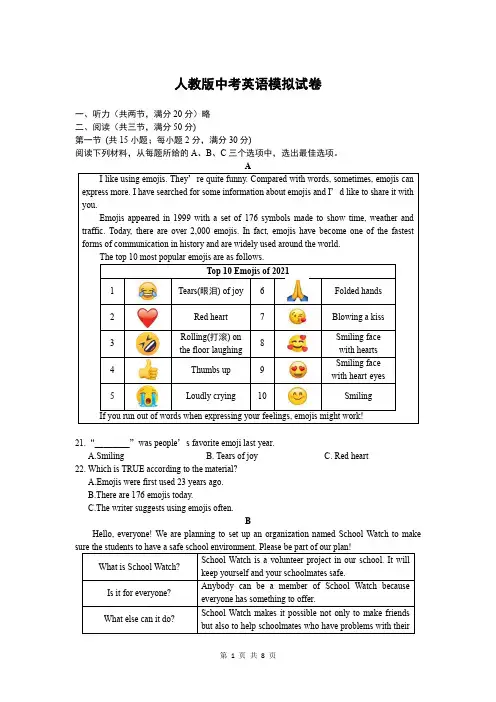
人教版中考英语模拟试卷一、听力(共两节,满分20分)略二、阅读(共三节,满分50分)第一节(共15小题;每小题2分,满分30分)阅读下列材料,从每题所给的A、B、C三个选项中,选出最佳选项。
Top 10 Emojis of 2021If you run out of words when expressing your feelings, emojis might work!21.“________”was people’s favorite emoji last year.A.SmilingB. Tears of joyC. Red heart22.Which is TRUE according to the material?A.Emojis were first used 23 years ago.B.There are 176 emojis today.C.The writer suggests using emojis often.BHello, everyone! We are planning to set up an organization named School Watch to make23.What is the purpose of setting up School Watch?A.To make students happier.B.To make sure students get good grades.C.To make sure students have a safe school environment.24. What can the School Watchers do?A.Help schoolmates with their homework.B.Give schoolmates lots of prizes.C.Talk to the director of the plan in their grade.25.The reading material(材料) above is most probably .A.a travel guideB. a science reportC. a school noticeCOnline art classes have opened up a convenient space for people to get a start in the world of art. Tang Yingshan, a professor from The Open University of China in Beijing, started an online fine art education program. He believes that everyone can create a masterpiece painting.Shan Lin, a woman from Guilin, has been learning fine art online for 17 months. She watches guide videos during lunch breaks and practices during her off-work hours. “There is a flexible(灵活的) learning timetable and the guide videos can be played repeatedly for us to have a better understanding,”Shan said. “The courses here don’t cost much and teachers from art schools are invited to give classes.”Bai Li, who had worked for more than 20 years, becomes a student of Tang’s class. She used to think it difficult to learn oil painting. After learning basic drawing for one year, Bai plans to attend an advanced(高级的) class.“Happiness is my biggest gain from learning oil painting,”said Bai, adding that painting gives her a chance to forget about her age and feel full of energy once again.By January 2022, more than 36,000 people from all walks of life had taken the online fine art education program. Although they have different jobs, they all find a way to express themselves in the world of art. Students at the beginner level are introduced into the world of art by copying world-famous paintings so that they can understand more about the artists’styles and skills. “I think everybody is a talented painter. What we do is help them learn to express themselves like painters do,”said Xiao Fei, an art teacher of the program.26.What does Shan Lin think of the guide videos?A.They are helpful.B. They are full of fun.C. They are challenging.27.What do we know about Bai Li?A.It’s difficult for her to learn oil painting now.B.She has learned oil panting for 20 years.C.Oil painting makes her feel young.28.The underlined phrase“all walks of life”means“______”in Chinese.A.世界各地B. 不同年龄C. 各行各业29.What can we infer from the passage?A.Xiao Fei used to be one of Tang Yingshan’s students.B.Bai Li will continue learning oil painting.C.Tang Yingshan gets along well with his students.30.What is the main idea of the passage?A.Online art education allows everyone to express themselves.B.More and more people are showing interest in painting.C.Online courses are becoming more and more popular.DAccording to a recent survey in the US, teenagers are heavily influenced by the media(媒体) these days. Many of them use thousands of hours of smartphones. That is more time than they spend with teachers at school. And we have not yet considered the hours they spend watching TV and reading newspapers.However, several studies have shown a serious problem: today’s teenagers don’t have media literacy(素养). In other words, they have difficulty critically(批判性的) thinking about the information they see. One study that was done on middle school students showed that more than 80 percent of them couldn’t tell the difference between real stories and ads that looked like news. Professor Kevin John teaches a class called Media Effects. He tries to help his students learn media literacy. The professor gave an example that shows why media literacy is important. In the example, two news stations report a snowstorm. One pays attention to the terrible road conditions. The other focuses(关注) on kids playing in the snow. “With a news story, news stations tell you what they feel are the important details(细节). These details mostly depend on the opinions of the news director.”said John.“A person who has media literacy would realize that each story is about one side at this time. There is more going on.”Some experts think school is the best place to teach media literacy. Others believe everyone —from parents to reporters——should help teenagers learn the skills.As for the best time to start learning media literacy, many experts suggest the age of 12. But some basic ideas can be taught even earlier. “It’s never too early to start learning media literacy.”John said.31.What can we learn from Paragraph One?A.Teenagers now spend more time using smartphones than studying at school.B.Teenagers usually make a lot of difference to the media these days.C.Teenagers nowadays have no interest in reading newspapers.32.What is a big problem for teenagers according to Paragraph Two?A.They have different media literacy.B.They could not tell serious stories.C.They could hardly think critically.33.The example in the third paragraph is used to .A.show the important of media literacyB.report the influence of a snowstormC.introduce the information of a class34.What does the underlined expression “going on”in the third paragraph mean?A.坚持B. 发生C. 前进35.The text is mainly about_________.A.media effectsB. media literacyC. news stories第二节(共5小题;每小题2分,满分10分)阅读下面短文内容,从短文后的选项中选出能填入空白处的最佳选项。
2023-2024学年初中英语人教版中考模拟习题及解析
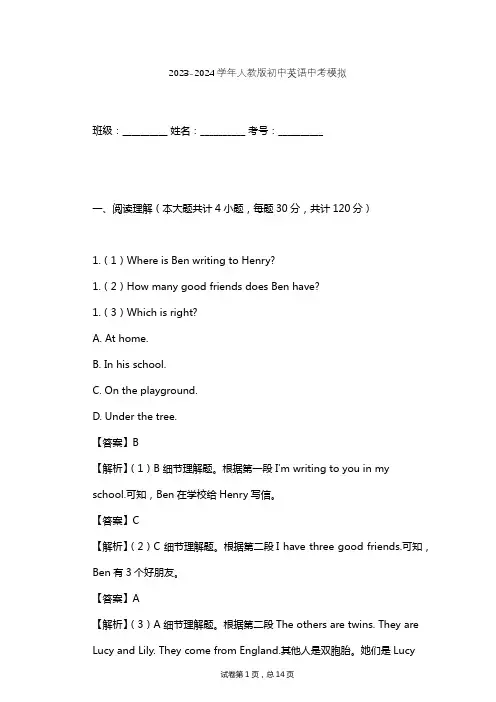
2023-2024学年人教版初中英语中考模拟班级:__________ 姓名:__________ 考号:__________一、阅读理解(本大题共计4小题,每题30分,共计120分)1.(1)Where is Ben writing to Henry?1.(2)How many good friends does Ben have?1.(3)Which is right?A. At home.B. In his school.C. On the playground.D. Under the tree.【答案】B【解析】(1)B 细节理解题。
根据第一段I'm writing to you in my school.可知,Ben在学校给Henry写信。
【答案】C【解析】(2)C 细节理解题。
根据第二段I have three good friends.可知,Ben有3个好朋友。
【答案】A【解析】(3)A 细节理解题。
根据第二段The others are twins. They are和Lily。
她们来自英国。
可知,双胞胎是英国人。
2.(1)画线单词“hobby”的汉语意思是“________”。
2.(2)We often _______ after school.2.(3)Frank gets the soccer ball from his _______.A. 习惯B. 爱好C. 愿望D. 工作【答案】B【解析】(1)B 词义猜测题。
根据第二段中Frank likes sports. And I like sports, too. After school in the afternoon, we often play sports.“弗兰克喜欢运动。
我也喜欢运动。
下午放学后,我们经常做运动。
”可推知,划线单词所在句应是表示:弗兰克和作者有着相同的爱好。
所以划线单词“hobby”的汉语意思是“爱好”。
2023-2024学年全国初三上英语人教版模拟试卷(含答案解析)
专业课原理概述部分一、选择题:5道(每题1分,共5分)1. The word "narrative" in English refers to:A. A story or an account of eventsB. A type of poetryC. A mathematical equationD. A scientific formula2. Which of the following is not a part of the fiveparagraph essay structure?A. IntroductionB. Body paragraphsC. ConclusionD. Abstract3. In English grammar, what is the difference between "affect" and "effect"?A. "Affect" is a verb, and "effect" is a noun.B. "Affect" is a noun, and "effect" is a verb.C. Both "affect" and "effect" are verbs.D. Both "affect" and "effect" are nouns.A. CommaB. PeriodC. Exclamation markD. Asterisk5. In English vocabulary, what does the prefix "un" usually mean?A. NotB. Opposite ofC. Same asD. Increase二、判断题5道(每题1分,共5分)1. T F The word "synonym" refers to words that have the same meaning.2. T F In English grammar, "lie" and "lay" are both past tense forms of the verb "to lie."3. T F The passive voice is used when the focus is on the action rather than the doer.4. T F In English writing, a thesis statement should be placed at the end of the introduction paragraph.5. T F The word "homophone" refers to words that soundthe same but have different meanings and spellings.三、填空题5道(每题1分,共5分)1. The study of the structure of words is called ________.2. In English grammar, the present perfect tense is used to talk about actions that started in the past and continue up to the present. The structure of the present perfect tense is ________.4. In English writing, a ________ is a short, clear statement that presents the main idea or argument of the essay.5. The process of revising and improving a piece of writing is called ________.四、简答题5道(每题2分,共10分)1. What are the three main parts of a paragraph in English writing?2. Explain the difference between "its" and "it's" in English grammar.3. What is the purpose of using transitional words and phrases in writing?4. How can you improve your vocabulary in English?五、应用题:5道(每题2分,共10分)1. Rewrite the following sentence in the passive voice: "The teacher corrected the students' homework."2. Fill in the blanks with the correct form of the verbin the present perfect tense: "I ________ (go) to the park yesterday."3. Choose the correct homophone for each word: "Write" (right/wright), "Sea" (see/saw), "Two" (too/to), "By" (buy/), "Weather" (whether/weather).4. Identify the parts of speech for each word in the following sentence: "The cat sat on the mat."5. Write a short paragraph about your favorite book using the fiveparagraph essay structure.六、分析题:2道(每题5分,共10分)1. Analyze the following sentence for its parts of speech, subjectverb agreement, and punctuation: "She is reading abook about history."2. Compare and contrast the active voice and the passive voice in English grammar. Provide examples for each.七、实践操作题:2道(每题5分,共10分)1. Write a short story in English using the narrative structure. The story should include a beginning, middle, and end.2. Proofread and edit the following paragraph for grammar, punctuation, and spelling errors: "The dog ran after the ball and caught it. He brought it back to his owner who threw it again. The dog jumped up and caught it again. They played for hours until it was time to go home."八、专业设计题:5道(每题2分,共10分)1. Design a lesson plan for teaching a new vocabularyword to a group of students. Include the word, its definition, and activities to help students remember and use the word.2. Create a short dialogue between two characters using past tense verbs to describe an event that happened yesterday.3. Write a summary of a news article you have read recently, focusing on the main points and key details.4. Design a poster for an English language event at your school. Include the event , date, time, location, and a catchy slogan.5. Create a set of flashcards with English idioms on one side and their meanings on the other side.九、概念解释题:5道(每题2分,共10分)1. Explain the concept of a "thesis statement" in English writing and provide an example.2. Define the term "homophone" and give two examples of homophones.3. Describe the difference between "affect" and "effect" in English grammar and provide examples of each.4. Explain the purpose of using transitional words and phrases in writing and provide examples.5. Define the term "narrative" and explain its importance in literature.十、思考题:5道(每题2分,共10分)1. How can you use your knowledge of English grammar to improve your writing skills?2. What are some strategies you can use to expand your vocabulary in English?3. How can you effectively revise and edit your writing?5. How can you apply the skills you have learned in English to other subjects or areas of your life?十一、社会扩展题:5道(每题3分,共15分)1. Research and write a short report on the importance of English as a global language.2. How can learning English help you in your future career?3. What are some cultural differences between Englishspeaking countries and your own country?5. What are some current events or issues that are relevant to the English language and how do they affect society?一、选择题答案:1. A2. D3. A4. D5. A二、判断题答案:1. T2. F3. T4. T5. T三、填空题答案:1. morphology2. have/has + past participle3. figure of speech4. thesis statement5. revision四、简答题答案:1. Topic sentence, supporting details, concluding sentence.2. "Its" is a possessive pronoun, while "it's" is a contraction of "it is" or "it has."3. Transitional words and phrases help to connect ideas and create coherence in writing.4. Read extensively, use a dictionary, and practice using new words in context.5. Common mistakes include subjectverb agreement, punctuation errors, and word choice.五、应用题答案:1. The students' homework was corrected the teacher.2. I have gone to the park yesterday.3. Write (right/wright), Sea (see/saw), Two (too/to), By (buy/), Weather (whether/weather).4. The (determiner), cat (noun), sat (verb), on (preposition), the (determiner), mat (noun).5. The book that I read last week was called "The Adventures of Tom Sawyer" Mark Twain. It is a classic American novel that tells the story of a young boy named Tom and his adventures with his friends. The book is set in the19th century in a small town along the Mississippi River. Tom is a mischievous and adventurous boy who often gets into trouble. He has a vivid imagination and a strong sense of curiosity. The novel explores themes of friendship, adventure, and growing up. Tom's adventures include running away from home, getting lost in a cave, and witnessing a murder. Throughout the story, Tom learns important lessons about responsibility and bravery. The book is written in a lively and engaging style, and it is full of humor and wit. It is a timeless classic that continues to be enjoyed readers of all ages.六、分析题答案:1. Subject: She (pronoun), Verb: is reading (verb phrase), Object: a book about history (noun phrase). The sentence isin the present continuous tense, and it uses correct subjectverb agreement. The punctuation is also correct.2. The active voice focuses on the doer of the action, while the passive voice focuses on the action itself. For example, in the active voice: "The cat caught the mouse." In the passive voice: "The mouse was caught the cat." Thepassive voice is often used when the doer of the action is unknown or unimportant.七、实践操作题答案:2. The dog ran after the ball and caught it. He broughtit back to his owner who threw it again. The dog jumped upand caught it again. They played for hours until it was timeto go home.一、选择题:考察学生对英语基础知识的掌握,包括词汇、语法、写作等。
人教版英语中考试题与参考答案(2024年)

2024年人教版英语中考复习试题与参考答案一、听力部分(本大题有20小题,每小题1分,共20分)1.Question: What time does the train leave for New York?Answer: B. 9:30 am.Explanation: The recording states, “The train to New York departs at 9:30 am from platform 5.” Therefore, the correct answer is B, as it matches the stated departure time.2.Question: Where is the woman going for her vacation?Answer: C. The beach.Explanation: The conversation between the two speakers goes something like this: “I can’t wait for my vacation next week. I’m going to the beach to relax and sunbathe.” The woman mentions going to the beach specifically, making C the correct answer.3、What does the man suggest the woman do about her broken phone?A. Buy a new one.B. Repair it.C. Borrow one from a friend.Answer: A. Buy a new one.Explanation: In the conversation, the man says, “Considering the age of your phone, it might be more economical to invest in a new model rather thanfixing the old one.” This indicates that he suggests buying a n ew phone rather than repairing the current broken one.4、According to the weather forecast, what is expected tomorrow?A. Snow.B. Rain.C. Sunshine.Answer: B. Rain.Explanation: The weather report mentioned, “Tomorrow we can expect cloudy skies with a hi gh chance of rain in the afternoon.” Therefore, the correct answer is that rain is expected tomorrow.5.Listen to the conversation and answer the question.M: Hi, how are you doing today, Mary?W: I’m fine, thank you. How about you?M: I’m doing well. I ju st came back from a trip to Paris. It was amazing! Q: Where did the man go on his trip?A. ParisB. LondonC. New YorkD. TokyoAnswer: A. ParisExplanation: The man said, “I just came back from a trip to Paris. It was amazing!” This indicates that he visi ted Paris.6.Listen to the dialogue and complete the sentence.W: I’m thinking of taking up a new hobby. Any suggestions?M: How about trying painting? It’s a relaxing and rewarding activity.W: That sounds interesting. I’ve always wanted to learn how to p aint.M: There are some great art classes in our neighborhood. You should check them out.W: I’ll do that. I think it would be fun to try something new.Q: What hobby does the man suggest the woman try?A. CookingB. PaintingC. GardeningD. PhotographyAnswer: B. PaintingExplanation: The man suggests painting by saying, “How about trying painting? It’s a relaxing and rewarding activity.” This indicates that he recommends painting as a hobby for the woman.7、Question: Listen to the dialogue and choose the best answer to complete the sentence.The man is asking the woman about ___________.A. the time of the next trainB. the price of the ticketC. the platform numberAnswer: AExplanation: In the dialogue, the man specifically asks, “Excuse me, when does the next train leave for London?” This indicates he is inquiring about the time of departure for the next train to London, thus the answer is A.8、Question: Listen to the short passage and select the missing word in the sentence.The scientist believes that the increase in___________pollution is a major cause of global warming.A. carbonB. waterC. noiseAnswer: AExplanation: The passage mentions that the scientist is concerned about the rising levels of a specific type of pollution that is a significant contributor to global warming. Carbon pollution, or carbon dioxide emissions, is commonly associated with this issue. Therefore, the missing word is “carbon,” makingA the correct answer.9、What time does the man decide to take the train?A. At 3:15 p.m.B. At 3:45 p.m.C. At 4:15 p.m.D. At 4:45 p.m.Answer: D. At 4:45 p.m.Explanation: In the conversation, the man decides to take the train that leaves at 4:45 p.m. because it has more available seats compared to the 3:15 p.m. train, which is quite full.Conversation 2:Script for Conversation 2 (not provided to students):Woman: Hi, Tom. Are you going to the cinema with us tonight?Tom: I’m not sure. What are you going to see?Woman: We’re thinking about seeing that new action movie, “The Last Adventure.”It got great reviews.Tom: Oh, I’ve heard about it. But I’m not really into action films. Is there anything else playing?Woman: Yes, there’s also a comedy and a documentary. Which one do you prefer? Tom: I’d rather watch the comedy. It’s been a long week, and I just want to laugh and relax.Woman: Okay, we can go for the comedy then. Let’s meet at the theater at 7:30 p.m.Tom: Sounds good. See you there!Question 10:10、Which type of movie does Tom prefer to watch tonight?A. An action movieB. A comedyC. A documentaryD. A thrillerAnswer: B. A comedyExplanation: Tom expresses that he is not really into action films and would rather watch a comedy to relax after a long week. Therefore, the correct answer is that Tom prefers to watch a comedy.11.Listen to the dialogue and choose the best answer to the question you hear.Question: What is the man’s opinion about the new school?A. He thinks it’s too far from his house.B. He believes it’s the best choice for his child.C. He doesn’t want to send his child there.Answer: BExplanation: In the dialogue, the man mentions that he has researched several schools and believes this one is the best choice for his child, which matches option B.12.Listen to the passage and answer the following question.Question: Why does the speaker think exercise is important for mental health?A. It helps to release stress.B. It improves cognitive function.C. It provides a sense of community.Answer: AExplanation: The speaker in the passage specifically mentions that exercise is important for mental health because it helps to release stress, which aligns with option A. While exercise can also improve cognitive function and provide a sense of community, these are not the primary reasons the speaker gives in the passage.13、Listen to the recording and choose the best answer to the question.Question: What time does the train leave for London?A. 8:15 amB. 9:00 amC. 9:45 amAnswer: AExplanation: The recording states that the train to London departs at 8:15 am. The speak er clearly mentions the time “eight fifteen” for the train leaving for London.14、Listen to the dialogue and fill in the missing word.Dialogue:John: Hey, have you seen the latest movie at the cinema?Lisa: No, I haven’t. What’s it called?John: It’s called “The_______Adventure”.Lisa: Oh, that one! I heard it’s really good.Answer: MysteriousExplanation: The dialogue implies that John is mentioning a movie title to Lisa, and he says it’s called “The_______Adventure”. From the context and the word “really good” that Lisa associates with the movie, it can be inferred that the missing word is “Mysterious” as it creates a sense of intrigue and excitement, which often leads to positive reviews for adventure movies.15、What does the woman suggest the man do?A. Go to the library.B. Watch the game with her.C. Go to the gym.Answer: B.Explanation: The woman suggests that instead of going to the library, they could watch the game together, implying she wants the man to choose watching the game over studying.16、Why did the man apologize?A. He forgot an appointment.B. He lost the woman’s notes.C. He was late for class.Answer: A.Explanation: The man apologized because he forgot about the meeting they had scheduled and thus missed it, causing inconvenience to the woman.17.You hear a conversation between two friends at a bookstore.A. What book is the man looking for?B. Why doesn’t the woman know where the book is?C. What does the man decide to do next?D. How does the woman suggest finding the book?Answer: CExplanation: The man mentions that he can’t find the book and the woman suggests they ask the librarian for help. Thus, the man decides to do that next.18.You hear a short speech about the importance of recycling.A. Why is recycling important?B. What are some common items that can be recycled?C. How can recycling help the environment?D. What is the speaker’s main point about recycling?Answer: DExplanation: The speaker concludes the speech by emphasizing that recycling is crucial for preserving natural resources and protecting the planet, making the main point about the importance of recycling.19、What does the man suggest the woman do?(A)Go to the cinema.(B)Stay at home.(C)Visit a friend.Answer: AExplanation: In the conversation, the man suggests that the woman should go out and enjoy herself, specifically recommending that they go to see a new movie that just came out. Hence, the correct answer is (A) Go to the cinema.20、Where does the conversation most likely take place?(A)In a restaurant.(B)At a train station.(C)In a library.Answer: BExplanation: The speakers discuss departure times and the platform number from which a train will leave. They also mention luggage and tickets. These details indicate that the setting is (B) At a train station.二、阅读理解(30分)Reading ComprehensionRead the following passage and answer the questions that follow.Passage:The Great Wall of China is one of the most famous landmarks in the world. It is a series of walls built to protect the Chinese Empire from invasions by nomadic tribes. Construction of the wall began in the 7th century BC and continued for centuries. The wall stretches over 13,000 miles and runs through the northern part of China. There are several sections of the wall, each with its own unique features. The wall is made of bricks, stones, and wood, and it is flanked by watchtowers and battlements. The Great Wall is not only a historical structure but also a symbol of Chinese strength and perseverance.Questions:1.What is the main purpose of the Great Wall of China?A) To protect the Chinese Empire from invasions.B) To connect cities and towns in China.C) To celebrate the victory of a war.D) To store food and water for travelers.2.When did the construction of the Great Wall of China begin?A) In the 7th century BCB) In the 1st century ADC) In the 5th century BCD) In the 2nd century AD3.Which of the following is NOT a material used to build the Great Wall of China?A) BricksB) StonesC) WoodD) IronAnswers:1.A) To protect the Chinese Empire from invasions.2.A) In the 7th century BC3.D) Iron三、完型填空(15分)Part III: Cloze Test (One Question)Directions: For each blank in the following passage there are four choices marked A, B, C and D. Choose the ONE answer that best fits into the passage.Passage:Last Sunday morning, I decided to go for a walk in the park near my house. It was a beautiful day with the sun shining brightly and birds singing (1)______. As I walked along the path, I noticed an elderly man sitting on a bench under a tree. He looked peaceful as he watched some children playing nearby. Suddenly, one of the children lost his (2)______, and it landed close to where the old man was sitting. The child looked upset but was too shy to ask for help. Seeing this, the old gentleman picked up the toy and waved it in the air with a big smile. This simple act of kindness made the child laugh and run over to get his toy back. The scene reminded me that sometimes it’s the smallest things that can bring us the most joy and that we should never (3)______ an opportunity to make someone else’s day better. After watching this heartwarming moment, I felt inspired to continue my walk with a lighter step and a (4)______ heart. That day, I realized that no matter what challenges we face in life, we can always f ind reasons to be grateful and to spread happiness wherever we go. So let’s all try to be like the kind old man and make the world a little brighter by being more (5)______ to others.(1)A. sadly B. happily C. loudly D. quietly(2)A. balloon B. kite C. toy D. bicycle(3)A. take B. miss C. create D. seize(4)A. heavier B. lighter C. sadder D. angrier(5)A. kind B. cold C. indifferent D. harshAnswer Key:1.B. happily2.C. toy3.B. miss4.B. lighter5.A. kind请根据上述题目尝试解答,并检查你的答案是否与提供的答案键相符。
人教版英语中考模拟测试试卷(含答案)

人教版中考模拟测试试卷英语时量:120分钟满分:120分一、听力 (共两节,满分 20分)第一节(共5小题;每小题1分,满分5分)听下面5段对话。
每段对话后有一个小题,从题中所给的A、B、C三个选项中员最佳选项。
1. What does Tina like best?A. Game shows.B. Talk shows.C. Talent shows.2. Where does the woman want to go?A. To the zoo.B. To the park.C. To the airport.3. What's the matter with Cindy?A. She has a fever.B. She has a headache.C. She has a toothache.4. What are the speakers talking about?A .The Spring Festival.B. The Dragon Boat Festival.C. The Mid-Autumn Festival.5. Who gave the watch to the boy?A. His father.B. His sister.C. His brother.第二节(共15小题;每小题1分,满分15分)听下面6段对话或独白。
每段对话或独白后有几个小题,从题中所给的A、B、C三个选项中选出最佳选项。
听第六段材料,回答第6、7题。
6. How is the weather today?A. Cloudy.B. Rainy.C. Sunny.7. What will the speakers probably do this weekend?A.Play chess.B.Go for a picnic.C. Play computer games.听第七段材料,回答第8、9题。
人教版中考英语模拟试卷及参考答案

中考英语模拟试卷一、听力(共两节,满分20分)第一节(共5小题;每小题1分,满分5分)听下面5段对话。
每段对话后有一个小题,从题中所给的A、B、C三个选项中选出最佳选项。
听完每段对话后,你都有10秒钟的时间来回答有关小题和阅读下一小题。
每段对话读两遍。
1. Which subject does the girl like best?A. Chinese.B. Physics.C. History.2. Who is the man wearing the suit in the photo?A. Jack's cousin.B. Jack's brother.C. Jack's friend.3. How much is the purple dress?A.15 dollars.B.50 dollars.C.55 dollars.4.When will the meeting begin?A.7:20.B.7:30.C.7:40.5. What would the man like to drink?A. Coke.B. Coffee.C. Juice.第二节(共15小题;每小题1分,满分15分)听下面6段对话或独白。
每段对话或独白后有几个小题,从题中所给的A、B、C三个选项中选出最佳选项。
听每段对话或独白前,你将有时间阅读各个小题,每小题5秒钟;听完后,各小题将给出5秒钟的作答时间。
每段对话或独白读两遍。
听第六段材料,回答第6、7题。
6. When did Steve last see Sara?A.3 years ago.B.4years ago.C.5 years ago.7. What was Steve like?A. He was shy,B. He was short.C. He wore glasses.听第七段材料,回答第8、9题。
8.What's wrong with Leo?A. He has a headache.B. He has a toothache.C. He had a stomachache.9. What is the woman's advice?A. To stay in hospital.B. To take some medicine.C. To have a good rest.听第八段材料,回答第10、11题。
中考英语模拟试卷人教版(含答案)
中考英语模拟试卷一、听力(共两节,满分20分)第一节(共5小题;每小题1分,满分5分)听下面5段对话。
每段对话后有一个小题,从题中所给的A.、B、C三个选项中选出最佳选项。
听完每段对话后,你都有10秒钟的时间来回答有关小题和阅读下一小题。
每段对话读两遍。
1. Where does Mike come from?A. China.B. England.C. The US.2. Which part of the festival does the girl like best?A. The story.B. The time.C. The food.3. How did Jason go to school this morning?A. By bus.B. On foot.C. By bike.4. What time is it now?A.8:15.B.8:30.C.8:45.5. What is the relationship between the speakers?A. Boss and secretary.B. Doctor and patient.C. Guide and tourist.第二节(共15小题;每小题1分,满分15分)听下面6段对话或独白。
每段对话或独白后有几个小题,从题中所给的A、B、C三个选项中选出最佳选项。
听每段对话或独白前,你将有时间阅读各个小题,每小题5秒钟;听完后,各小题将给出5秒钟的作答时间。
每段对话或独白读两遍。
听第六段材料,回答第6、7题。
6. What does the man like to do in spare time?A. Watch movies.B. Play basketball.C. Travel.7. What does the woman want to be in the future?A. A tour guide.B. A basketball player.C. A teacher.听第七段材料,回答第8、9题。
人教版2024年辽宁省中考英语最新模拟试题(九)(含答案)
2024年中考最新模拟试题(九)第一部分选择题 (共50分)一、阅读理解 (共20小题;每小题2分;满分40分)第一节阅读下面语言材料,从每题所给的A、B、C、D 四个选项中,选出最佳选项。
APodcast(播客) is a radio show you can enjoy on the air or on your phone. It is a good way to im-prove your English. Let's check out (withoutGoodbody, the language teacher, will tell a story adapted to(of English. The stories will be humorous and enjoyable.showexpressions.customs, and manners. Don't worry about not understanding. The languagewe use is easy.uses everyday English so you can understand it easily.stories into interesting radio plays. They are rich in sounds and music, andare perfect for teens. Each episode (about important things like honesty and courage. The language is never toodifficult.1. You can enjoy a new story on Easy Stories in English .A. every dayB. every two daysC. every weekD. every two weeks2. People can expect to learn from Express Yourself!A. grammar rulesB. English idiomsC. different opinionsD. travel stories3. Li Hua wants to learn about customs in the US. He can choose .A. Easy Stories in EnglishB. All Ears EnglishC. Express Yourself!D. Circle Round4. About Circle Round, which of the following statements (陈述) is TRUE?A. It is created by young children.B. You can enjoy plays with music.C. It is made for adult listeners.D. An episode lasts for over 20 minutes.BHave you ever heard Gaoshan Liushui, a Chinese traditional piece of music? Do you know why Gaoshan Liushui is often played in many occasions (场合)? It has something to do with“zh i yin”culture, which values close friendship. Do you know the story behind it? It’ s the story of Yu Boya and Zhong Ziqi in the Warring States Period.Boya was good at playing the guqin. One day, he was playing music on his way home on the boat,To Boya's surprise, Ziqi, a woodcutter who happened to pass by, could understand exactly what he wanted to express through his music. After a long talk, they became good friends. Since Boya had to return to his state, they agreed to meet again in the following year.Unluckily, when getting back to visit Ziqi, Boya heard that his friend had died from an illness.Boya was so sad. In front of Ziqi's tomb (墓), he played again the music he had played when they first met. The feeling of the music was so strong that it was as if the rivers and the mountains were crying.When finishing playing, Boya broke his guqin into pieces. From then on, Boya never played again. But the famous music piece Gaoshan Liushui he played for his friend has been passed down.“Zhiyin”culture has new development in the new period. And Gaoshan Liushui is performed in many important occasions. The musical performance not only shows the beauty of Chinese traditional culture, but also expresses China's willingness to develop its friendship with people from around the world.5. The writer starts the passage by .A. giving examplesB. listing numbersC. asking questionsD. comparing facts6. Boya and Ziqi became good friends because .A. they often went out on the boatB. they often cut wood togetherC. Ziqi could understand Boya's musicD. they often played music together7. From the passage, we can know that .A. Boya actually only met Ziqi onceB. Boya died because of an illnessC. Boya often played the guqin in memory of ZiqiD. Boya and Ziqi were both good at playing the guqin8. Gaoshan Liushui is often performed ,A. to express love to whom you loveB. to show willingness to develop friendshipC. to warn people of coming dangerD. to recall the deepest wounds from heartCParents and teachers know how difficult the teenage years can be. Teens have always been known to do wild, even dangerous things. This was thought to be because of the“foolishness of youth”. Now, the new technology allows scientists to study the physical development of the brain in more detail. Their discoveries have led to a new theory (理论) of why teens act this way.A Work in ProgressRecently, scientists discovered that though our brains are almost at their full size by the age of 6,they are far from fully developed. Only during youthhood our brains truly“grow up”. During this time,they go through great changes, like a computer system being upgraded (升级). Now, scientists have concluded(得出结论) that our brains continue to change until age 25. Such changes make us better at balancing(平衡) impulses (冲动) with the following rules. But a still-developing brain can't do it well. The result is the changeable behavior seen in teenagers.Pleasure Seekers (探索者)The studies say that teens probably take risks and behave badly. Luckily, as a brain scientist points out, the teen brain encourages such behavior in order to help teens prepare for adult life.One way the brain does this is by changing the way teens measure (衡量) risk and reward. Re-searchers found that when teens think about rewards, their brains produce more chemicals that create pleasure than an adult brain does. Researchers believe this makes the rewards seem more important than the risks, and makes teens feel more excited about new experiences than adults do.Research also found that it makes social connections (社会关系) seem especially useful. The brain encourages teens to have a wide circle of friends, which is believed to make us more successful in life. 1 1Unluckily, this hunt (搜索) for greater rewards can sometimes lead teensto make bad decisions.However, it also means that teens are more possible, andless afraid, to try new things or to be independent, which can help teens leavetheir parents’ care and live their own lives successfully.9. What can we know about our brains?A. They don't develop until age 25.B. They are fully developed by the age of 6.C. They grow bigger only during youthhood.D. It's not easy to act on impulse with developed brains.10. How does the teen brain help them prepare for adult life?A. By making teens keep off new people.B. By leading teens to make bad decisions.C. By making teens braver to try new things.D. By changing the way teens measure pleasure and reward.11. Which of the following best shows the structure of the passage?12. What can be the best title of this passage?A. The teensB. The teenage brainC. The pleasure seekersD. The work in progressDHoneybees have long been known to shake their bodies. It is their way of communicating. They dance to help each other find delicious flowers. They depend on flowers for food.Now a new study shows that honeybees don't have these skills at birth. Young bees learn them by watching the older bees dance. Scientists from the University of California made this discovery. In March2023, they published (出版) their findings.When a bee starts dancing, it steps forward. At the same time, it wiggles (摆动) side to side re-ally fast. It keeps doing this while it moves in a figure-eight pattern (“8”字形). Scientists call this “the waggle dance”. It helps other bees find flowers. The position of the middle of the figure-eight tells them which direction to find the flower. The more a bee wiggles, the farther away the flower is.The scientists recorded videos of European honeybees in a lab, and compared two groups of young bees. In one group, young bees could watch older ones dance. In the othergroup, they could not. After10 days, scientists studied both groups. They found that the first group had better dancers while in the other group, young bees could not dance.Today, though, people are getting in the way of bee communication with pesticides (杀虫剂).Pesticides kill insects that harm the plants, but they also affect (影响) bees. One study found that after touching the pesticides, the bees started making more mistakes while dancing.13. The main finding of the new study is that young honeybeesA. shake their bodiesB. communicate by dancingC. learn to danceD. depend on flowers for food14. Which picture describes“the waggle dance”?15. The scientists made the discovery by .A. recording videos in the wild in EuropeB. comparing two groups of honeybeesC. training the older honeybees to danceD. raising older honeybees for 10 days16. In the future, these scientists would probably studyA. whether pesticides could do harm to the plantsB. whether pesticides affect bee communicationC. how honeybees communicate with each otherD. how pesticides affect honeybee communication第二节阅读短文,从方框内所给的选项中选出可以填入空白处进最佳选项,其中有一个多余的选项。
人教版初中九年级英语模拟50题(答案及解析)
人教版初中九年级英语模拟50题(答案及解析)1.She is very smart ______ (because / so) she always gets good grades.2.Which of the following sentences is in the correct past tense?A. I will play soccer yesterday.B. I am playing soccer yesterday.C. I played soccer yesterday.D. I have played soccer yesterday.3.Choose the correct answer: The book _______ on the table right now.A. isB. areC. wasD. were4.By the time she ______ (arrive) at the station, the train ______ (leave).5.Which sentence is in the correct form of the present perfect tense?A. I have studied English for five years.B. I have been studied English for five years.C. I studied English for five years.D. I study English for five years.6.Which sentence uses the word "for" correctly?A. I have been living here for three years.B. I have been living here since three years.C. I have been living here for 2010.D. I have been living here for last year.7.Choose the correct word to complete the sentence: "My father __________ to the office every day."A. goB. goesC. is goD. are going8.She ______ (not/understand) the question in class, so she ______ (ask) the teacher for helpThe teacher ______ (explain) it to her again, and she ______ (finally/understand) the topicShe ______ (feel) very happy after that.9.Which of the following sentences correctly uses "since"?A. I have lived here for five years.B. I have lived here since five years.C. I have lived here since five years ago.D. I have lived here for five years ago.10.Which of the following is the correct question form?A. Do you likes coffee?B. Do you like coffee?C. Does you like coffee?D. Does you likes coffee?11.Which of the following sentences is correct?A. I can sings very well.B. I can sing very well.C. I can to sing very well.D. I can singing very well.12.Which of the following sentences is in the present perfect continuous tense?A. She has been studying for two hours.B. She has studied for two hours.C. She studied for two hours.D. She is studying for two hours.13.I __________ (not/see) you for a long time! How __________ (you/do)?14.My brother __________ (not, enjoy) playing sports, but he __________ (love) watching them on TVHe __________ (usually, watch) football matches on weekendsLast Saturday, he __________ (watch) a very exciting match between two great teamsHe__________ (say) it __________ (be) one of the best matches he __________ (ever, see).15.Which sentence correctly uses "much" with uncountable nouns?A. I don’t have much friends.B. I have much friends.C. I don’t have much money.D. I don’t have much apples.16.I __________ (eat) lunch when my friend __________ (call) me yesterdayWe__________ (talk) for a few minutes before I __________ (go) back to my mealI__________ (tell) her that I __________ (already, finish) my lunch by the time she__________ (call) me.17.By the time we __________ (arrive) at the airport, the flight __________ (already, take off)We __________ (miss) the plane and __________ (have) to wait for the next one.18.Which of the following is the correct comparative form of the adjective "good"?A. GooderB. GoodestC. BetterD. Best19.This exercise is __________ (difficult) than the last oneI think the exam was__________ (easy) than I expected.20.Which of the following is the correct negative sentence in the present simple tense?A. He don’t like coffee.B. He doesn’t likes coffee.C. He doesn’t like coffee.D. He don’t likes coffee.21.When I was a child, I ______ (always/go) to the park with my friends.22.Which sentence uses "too" correctly?A. This bag is too expensive for me.B. This bag is too much expensive for me.C. This bag is expensive too for me.D. This bag is much too expensive for me.23.What is the past tense of "eat"?A. EatB. AteC. EatenD. Eats24.If I __________ (be) you, I __________ (not do) it like that. You __________ (make) a mistake by choosing that option. If you __________ (take) a little more time to think, you __________ (realize) that there __________ (be) a better solution. However, it’s too late now. You __________ (have) to deal with the consequences.25.It ______ (rain) when we ______ (leave) the house this morning.26.I __________ (1. get) a new pet last week. It __________ (2. be) a small puppy. I __________ (3. name) it Max. Max __________ (4. be) very playful and energetic. Every morning, I __________ (5. take) him for a walk in the park. He __________ (6. like) to run and chase after balls. Sometimes, he __________ (7. bark) at other dogs, but he __________ (8. never) gets into fights. I __________ (9. feed) him twice a day, and he __________ (10. eat) his food quickly. He __________ (11. be) very friendly, and I__________ (12. enjoy) spending time with him.27.I __________ (try) to call you several times yesterday, but you __________(not/answer). I __________ (leave) a message for you, so I hope you __________ (get) it later. If you __________ (see) my message earlier, you __________ (be) able to call me back.28.Which of the following is the correct form of the adjective?A. He is more smarter than his brother.B. He is more smart than his brother.C. He is smarter than his brother.D. He is most smarter than his brother.29.I __________ (study) English for five years, but I still __________ (feel) that I__________ (need) to improve my speaking skillsRecently, I __________ (decide) to take an English speaking course, and I __________ (already, make) a lot of progressNow I __________ (practice) speaking every day, and I believe that I __________ (be) able to speak fluently in a few months.30.Choose the correct sentence:A. I have never to the zoo.B. I have been never to the zoo.C. I never have been to the zoo.D. I have never been to the zoo.31.Tom __________ (study) hard these days because his exams __________ (be) next weekHe __________ (want) to get good grades, so he __________ (spend) a lot of time reviewing his notes.32.Which sentence is correct?A. She have visited many countries.B. She has visit many countries.C. She visited many countries.D. She has visited many countries.33.Which sentence correctly uses the word "every"?A. I visit my grandmother every Sunday.B. I visit my grandmother every Sundays.C. I visit my grandmother every week.D. I visits my grandmother every Sunday.34.I __________ (1. see) Tom at the bus stop this morning. He __________ (2. tell) me that he __________ (3. have) a great time at the concert last night. He __________ (4. go) with his friends, and they __________ (5. enjoy) the music very much.35.Which sentence is in the future tense?A. I will go to the park tomorrow.B. I went to the park tomorrow.C. I am going to the park tomorrow.D. I goes to the park tomorrow.36.If I __________ (1) __________ (know) about the meeting, I __________ (2)__________ (attend) it. But I __________ (3) __________ (not hear) anything until it__________ (4) __________ (be) too late. Next time, I __________ (5) __________ (make) sure to check my email regularly.37.Which sentence uses "more" correctly?A. She is more smarter than him.B. She is more smart than him.C. She is more smarter than he.D. She is smarter than him.38.Choose the correct word to complete the sentence: He _______ to the school bus every morning.A. runB. runsC. runningD. is running39.They ______ (live) in New York for ten years before they ______ (move) to London.40.By the time I __________ (1) __________ (get) to the station, the train__________ (2) __________ (leave). I __________ (3) __________ (miss) it, so I__________ (4) __________ (decide) to take the bus instead. Fortunately, I __________ (5) __________ (catch) the next bus, and I __________ (6) __________ (arrive) on time.41.Which sentence correctly uses “who” or “whom”?A. This is the man who I met at the party.B. This is the man whom I met at the party.C. This is the man which I met at the party.D. This is the man that I met at the party.42.Which of the following sentences contains an error in the use of articles?A. She is a teacher.B. I saw an interesting movie.C. He is honest man.D. They are my friends.43.Choose the correct word to complete the sentence: She is not _______ to solve this problem.A. clever enoughB. enough cleverC. clever tooD. enough clever to44.Which sentence uses "too" correctly?A. The coffee is too hot to drink.B. The coffee is so too hot to drink.C. The coffee too hot to drink.D. The coffee hot too to drink.45.Which of the following sentences uses the correct past form of the verb "go"?A. I goed to the store.B. I go to the store.C. I went to the store.D. I will went to the store.46.What is the plural form of "child"?A. ChildsB. ChildrenC. ChildesD. Childrens47.Which sentence uses the correct superlative form of "tall"?A. She is the taller girl in the class.B. She is the tallest girl in the class.C. She is more tall than the others.D. She is the most tall girl in the class.48.Which sentence is correct for asking about someone’s preference?A. What do you prefer to do?B. What you prefer to do?C. Do you prefer what to do?D. You prefer what to do?49.The teacher ______ (give) us a quiz last weekI ______ (not/do) well on it because I ______ (forget) to study the materialBut I ______ (promise) to study harder next time. 50.It __________ (1) raining when we __________ (2) to the beach yesterday. We__________ (3) wait for the rain to stop before we __________ (4) start our picnic. By the time the rain __________ (5) stop, it was already evening.(答案及解释)。
人教版初中英语中考模拟试卷及参考答案
人教版初中学业水平考试模拟试卷英语时量:120分钟,满分120分一、听力(共两节, 满分20分)第一节(共5小题;每小题1分,满分5分)听下面5段对话。
每段对话后有个小题,从题中所给的A、B、C三个选项中选出最佳选项。
听完每段对话后,你都有10秒钟的时间来回答有关小题和阅读下一小题。
每段对话读两遍。
1. What did Jim do last night?A. He broke the TV.B. He watched a match.C. He lost a match.2. What's the man looking for?A. His key.B. His car.C. His home.3. Where may the woman be?A. In a theater.B. In a hospital.C. In a bank.4. How many bedrooms are there in the man's house?A.3.B.4.C.5.5. Why does the boy want to buy a house in the city center?A. His mother likes beautiful houses.B. His mother likes going shopping.C. His mother likes working hard.-第二节(共15小题;每小题1分,满分15分)听下面6段对话或独白。
每段对话或独白后有几个小题,从题中所给的A、B、C三个选项中选出最佳选项。
听每段对话或独白前,你将有时间阅读各个小题,每小题5秒钟;听完后,各小题将给出5秒钟的作答时间。
每段对话或独白读两遍。
听第六段材料,回答第6、7题。
6. Where is Bob's sister?A. In London.B. In Beijing.C. In Paris.7. What does Bob like?A.Music.B. Sports.C. Movies.听第七段材料,回答第8、9题。