
最新仁爱版 七年级上册英语 第三单元Unit3__Topic1 教学课件PPT
Unit1 Topic3 Section C教案 仁爱版七年级上册英语
Teaching designUnit 1, Topic 3(Book 7A)How Old Are You?Section C(1a-2)I.Teaching contents1a-2in Section C, Topic 3, Unit 1, Book 7A.II.Lesson typeReading.III.Analysis of the teaching materialsIt’s the fifth class of Topic 3, Unit 1. The purpose is to help the students master the first two changing rules of the plural forms of countable nouns and practice using the key sentence structures based on the language knowledge learned in Sections A and B.IV.Analysis of the studentsAs learners in the first stage, the students are very curious so they are interested in talking about something in English. And they have had the ability of asking and answering about the real objects after the learning of Sections A and B.V.Teaching aims1.Knowledge aims:Be able to use the new words and new sentence structures and know about the first two changing rules of the plural forms of countable nouns.2.Skill aims:Be able to talk about the real objects us ing the key structures.3.Emotional aims:Be able to be confident and active. Learn to work with others and help each other.VI.Key pointsMaster the key sentence structures:--What are these/those/they?--They’re....Difficult pointsConclude and master the first two changing rules of the plural forms of countable nouns.VII.Teaching and learning methodsCommunicative teaching method, real-object teaching method, audio-visual teaching method, task-based teaching method, autonomous learning method, inquiry learning method and cooperative learning method.VIII.Teaching strategies1.Warming up before the class can help students get ready for the class quickly and easily and presenting the objectives of this class can help the students learn with purpose.2.Learn new words using the old sentence patterns and learn new structures using the old words so that the students can master the new knowledge more quickly and easily.3.When learning new words, present the correct phonetic symbols in order to help the students pronounce correctly.4.Chanting while remembering words can not only help students memorize quickly but also make the class atmosphere lively.5.Different levels of reading can help students understand the use of the key structures better and improve their oral English level.6.Discussing, t alking and explaining in groups can not only help students practice their oral English but also inspire their potential in learning.7.The emotional teaching throughout the whole class which tells students to help each other can help the students know that they can not only master the English knowledge but also have the ability of being a useful man when learning English.8.Encouraging students in time by oral praise or a small object in time in class can be useful to the English beginner.9.End the class by a summary so that students can realize what they have mastered and consolidate the memory of numerals.10.Deal with the teaching material s suitably so as to make the teaching and learning clear.IX.Teaching procedures1.Warming up1)Greeting s.2)Sing The Apple Song together with the video in order to get the students to get ready for the class and make the atmosphere more lively.2.Lead-in1)Tell the students there are many apples in the video in order to lead to review the sentence pattern--What’s this/that? --It’s a/an...2)Show the objectives of this class to help the students know what they will do in this class so that they can learn with purpose. Then divide them into groups and announce the class rules--(A red paper apple will be given as a prize after finishing a task. The group which gets the most apples will be the winner.) in order to inspire them to compete or cooperate with their partners so that the class can be more efficient.At the same time, guide the students to help others when necessary and learn the new sentence--Let me help you.3.Pre-reading1)Review the sentence pattern“ --What’s this/that? --It’s a/an...”by showing some pictures in the ppt.2)Learn the new words while reviewing the sentence structures, presenting the phonetic symbols; Learn the new sentence structures“--What are these/those/they?--They are...”with the help of some more pictures or some real objects after mastering more words.The purpose is to help the students get the skill of English language step by step. At the same time, write down the key sentence structures and key words on the blackboard.3)Discuss in groups and c onclude the changing rules of the plural forms of countable nouns after observing the words written on the blackboard.Then share their opinions with other students in groups.4)Chant and remember in groups.4.While-reading1)Autonomous learningAsk the students to r ead 1a quickly to find out the plural forms of countable nouns.Then r ead 1a carefully to put the dialogues into a correct order.2)Cooperative learningDiscuss in groups to check the answers.Then r ead 1a in roles for acting it out.5.Post-reading1)Autonomous learningFinish 1b alone.2)Inquiry learningDiscuss in groups to check the answers. Ask the group leader of each group to explain in detail when someone meets problems.3)Cooperative learningMake up new conversations according to 1a, 1b and 2 by choosing two of the pictures in groups.Then share their conversations in the front.4)Summary and self-check.Sum up the key points learnt in this lesson and help the students to make a self-check in order to know their mastering situation.Then count the red paper apples in each group by practicing the sentence pattern “--What are these/those/they? --They are...”to find out the winner and encourage the students to help each other in their daily. At the same time,present “HELP EACH OTHER, DO BETTER”on the screen to achieve the e motional aims.X.Blackboard design:Unit 1, Topic 3(Book 7A)How Old Are You?Section C(1a-2)XI.Self reflectionTeaching activities are colorful, effective and useful. The students must be active and interested during the whole class and I think the effect must be good.。
仁爱版七年级英语上册Unit3Topic1DoeshespeakChineseB优质教案(2)

《Unit3GettingTogetherTopic1DoeshespeakChinese?SectionB》Ⅰ.Teachingaimsanddemands教学目标1.Learnsomenewwords:live,say,visit,great,wall2.Learnsomequestionsandanswerswith does:(1)—DoeshespeakChinese?—Yes,hedoes./No,hedoesn’t.HespeaksEnglish.(2)—Whatdoeshesayintheletter?—HewantstovisittheGreatWall.3.Learnsomeusefulsentences:(1)—Whoistheletterfrom?—It’sfrommypenpal,Sam.(2)—IstheletterinEnglish?—Yes,itis.(3)—Wheredoeshelive?—HelivesinEngland.(4)Kangkangknowsme.Ⅱ.Teachingaids教具图片/教学挂图/录音机/幻灯片/若干个装有信件的信封/小黑板Ⅲ.Five-fingerTeachingPlan五指教学方案Step1Review第一步复习(时间:10分钟)以问题为线索,引出单词和话题,培养学生的语言表达能力。
1.(检查作业。
教师请学生登台表演上节课的家庭作业。
)T:Now,I’llcheckyourhomework.S1、S2,please,cometothefrontandperformyourdialog.2.(师生对话。
引入并运用China和Chinese。
)T:IcomefromChina.IamChinese.Ss:WecomefromChina.We’reChinese.(教师提问一名学生。
)T: Wheredoyoucomefrom,S3?S3:IcomefromChina.T: DoyouspeakChinese?S3:Yes,Ido.(学生两人一组互相问答。
仁爱版七年级上册英语Unit 1 Topic 3 Section A教案

Unit 1 Making New FriendsTopic 3 How old are you?Section A【学习目标】1.学习并掌握本节课生词2.学习数字11--20。
3.学习询问他人的年龄、班级和年级。
【学习重难点】学习难点:询问他人的年龄、班级和年级。
学习重点:(1)-How old are you?- I’m…(2)-What class are you in?-I am in Class 13, Grade 7.(3)-What grade are you in?【课前预习】:Ⅰ.预习1a。
Ⅱ.读资料链接:(课前熟读)1.----How old are you ?你多大了?----I am twelve .我十二岁。
How old +be +主语?是询问某人年龄的句型,是由how old 引导的特殊疑问句。
其回答是“主语+be+数字+year old 。
如:----how old are you?----I am twenty.2、----What class are you in?你在哪个班级?----I am in Class Four,Grade Seven.我在七年级四班。
在该句中“what class哪个班”构成疑问词组。
在what class这个词组中,class用作普通名词,首字母要小写。
其回答是“主语+be+in Class+数字(大写),Grade +数字”。
如:----What class are Jim and John in ? 吉姆和约翰在哪个班?----They are in Class Three,Grade Seven.他们在七年级三班。
3、----What grade are you in ? 你在几年级?-----I am in Grade Seven.4、In是介词,表示位置,意思是“在...里”。
【教学过程】一、导入新课Well begun is half done! 良好的开端成功了一半!(3分钟)1、复习数字0-102、进入新课二.自主学习I believe you will try your best! 我相信你会尽力!(3分钟)你one现two发three规four + teen =律five了six + teen =吗seven + teen =?eightnine + teen =ten三、合作探究I’m not only a listener but also a speaker. 我不仅仅是个听众,我也敢发言。
七年级英语上册Unit1 Topic1语法精讲:be动词精品课件 最新仁爱版
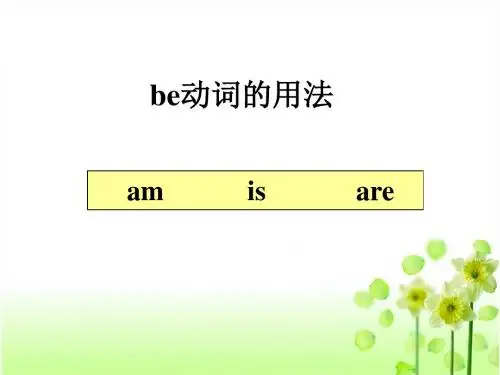
四、用be动词的正确形式(is, am, are)填空, 完成句子 Are 18. — __________ they from Japan? are — Yes, they __________. 19. You __________ are a teacher and I Is __________ a doctor. Is 20. — __________ Ronaldo from Brazil? is — Yes, he __________. 21. — Who __________ this? is — This __________ Kangkang. is Are 22. — __________ you a student? am — Yes, I __________. is 23. — Where __________ Beijing? — It__________ in China. is
She is a good girl. She is so cute. She is a teacher.
be动词的种类
人称复数 (we /you/they)配合are使用。 句型解析:We (You, They) are +……
We are in Class 5,Grade 7. They are my friends. You are good students.
第二人称(You)配合are使用。 句型解析:You are+…
Y a good person. You are beautiful.
be动词的种类
第三人称单数(He or She or It)配合is使用。 句型解析:She(He, It) is +……
二、用be动词的正确形式(is, am, are)填空, 完成句子 is 7. This __________ my teacher. 8. How __________ are you? Is 9. __________ she your mother? Is 10. __________ your mother fine? is 11. — How __________ he? is — He __________ fine. Are you Jane? 12. — __________ am am — No, I __________ not. I __________ Maria. is 13. My name __________ Kangkang. What __________ your name? is
Unit 1 Topic 2 Section B课文讲解课件仁爱版英语七年级上册

Deng Yaping
知识拓展
Stephen Hawking
family name
given name
姓
名
邓亚萍
given name
family name
名
姓
史蒂芬·霍金
15
Bye-bye
16
Unit 1 Making New Friends
Topic 2 Where are you from?
Section B 课文讲解
1
2
原文呈现
3
• look v. 看;看起来
重点精讲
Look! Who is she?
意为 “看”
Look! This is a cat.
意为 “看起来” You look happy.
Where is she from?
12
练一练
A: Look! _W__h_o_i_s_s_h_e__? B: She is Deng Yaping. A: Where is she from? B: __S_h_e_i_s_f_r_o_m__C_h_i_n_a____.
13
练一练
A: Look at the picture. Is he Stephen __. A: _W__h_e_r_e_i_s_h_e_f_r_o_m___? B: He is from England.
后接形容词
4
重点精讲
Look! Who is she?
注意
look用作不及物动词,后接宾 语,表示“看……”时要使用
look at。
e.g. 看这个女孩。
Look at this girl.
5
重点精讲
Unit 4 Topic 1【复习课件】 七年级英语上册单元复习(仁爱版)

(视频P81-1a)
Q: How much is the coat?
(视频P81-1a)
√ 1. Mother wants to buy _______ (shoes, clothes, gloves) for Maria.
√ 2. Maria likes _________ (the red coat, the yellow skirt, the yellow coat).
英
语
仁爱版 七年级 上册
Unit4 Having Fun 1.What can I do for you?
1.What can I do for you?
一、词汇
A. 数词
1. 三十 thirty
2. 四十 forty
3. 五十 fifty
4. 六十 sixty
7. 九十 ninety B. 计量单位的名词
No, I don’t want ___a_n_y______ oranges. 2. Do you have ____a_n_y_____ vegetables?
Yes, we have ____s_o_m__e_____. 3. My mother needs a few things, she needs ___s_o_m_e_____ milk and
How do you like the pants?
6. 你在开玩笑吗?
Are you kidding?
7. 无论如何谢谢你。 Thank you all the same.
8. 就这些?我想是的。 Is that all? I think so.
口语运用(复习购物) A: _W__h__a_t _c_a_n_I_d__o_f_o_r_y_o_u_?_________________ B: I want to buy a dress for my daughter. A: _W__h__a_t _c_o_lo_r__w_o_u_l_d_y_o_u__li_k_e_/_d_o__y_o_u_w__a_n_t?__ B: Pink. A: What do you think of this one? B: OK. __H_o_w__m__u_c_h_i_s_i_t_?____________________ A: One hundred yuan. B: That’s fine. __I’_l_l _ta_k__e_it_._________________
科普版七年级英语上册《Topic 3 What would you like to drink. Section A》公开课课件_27
vegetables / ́veʤtəb l/
bananas oranges
bread /bred/
juice
/ʤus
P71-3
a hot dog
apple an orange
eggs two
hamburgers
some bananas (可数名词 water
Would you like +some +名词?
你想要...吗?(提议或邀请) Yes,please./ No, thanks.
希望得到肯定 回答
What would you like to eat / drink?你 想要吃/喝什么?
I would like +some+名词/ I'd like...
①Would you like something to drink? Yes. A glass of apple juice, please. No, thanks.
②What would you like to eat/drink? I’d like some…
③Would you like some…? Yes, please. No, thanks.
some
juice
(不可数名词) rice
fish
chicken
你能把下面的 食物对号入座 吗?
名词
可数名词
只有可数名词有单复数的变化。
some + 可数名词复数
some
eggs vegetables rice
不可数名词 some + 不可数名词
不可数名词没有复数形式, 不能在它后面加-s。
I’d like a glass of juice.
仁爱版英语七年级上册 Unit 1 topic3 知识归纳
Unit 1Topic 3old/How old课文原句:So, how old are you, Alan?讲解:how old问年龄。
问年龄的两种方式可以互用:How old is ...? = What's sb's age?-How old is your grandfather?-He is 60 years old.old adj. 意为“旧的,陈旧的”,其反义词为new新的。
The story is very old.这个故事十分古老。
年老的,年迈的,其反义词为young年轻的。
Everyone grows old.每个人都会变老。
相识很久的,旧交的。
Bob is an old friend of mine.Bob是我的一位老朋友。
另有常见搭配,如the old days以前,旧日的时光。
与old相关的词汇:elder adj. 前辈的,年纪较长的,常用于兄弟姐妹之间的年龄比较,在句中只用作定语,不作表语。
Did you see her elder sister yesterday?你昨天见到了她的姐姐吗?elderly adj. 年老的;渐老的(委婉用法),其后常跟名词。
2 Spell课文原句:-What's this in English?-It's a map.-Spell it, please.-M-A-P.讲解:spell,实义动词,意为“拼写”。
常用的三种句型:1. How do you spell…?2. 祈使句:Spell it, please.3. Can you spell it please?grade/class1. class n. 班级;课如:-Which class are you in this year?-Class Three.—今年你在哪个班?—三班。
I have a history class at 9 o'clock.我9点钟有历史课。
Unit1教学设计2024-2025学年七年级英语上册教案新仁爱版2024
Unit 1 We are Friends.Exploring the Topic Theme Reading【教学目标】1.用思维导图提取描写人物的关键要素;2.绘制个人信息的思维导图并做自我介绍;3.体会到结交新朋友能促进良好人际关系的发展。
【教学重点】绘制个人信息的思维导图并做自我介绍。
【教学难点】绘制个人信息的思维导图并做自我介绍。
【教学方法】讲授法、情境教学法、合作学习法【教学准备】教案、课件【教学过程】Step 1 Lead-in复习导入:Look and predict the picture may be about Fangfang and her ________.在复习“预测”技能的基础上,引出人物Xiao Qiang,然后根据Xiao Qiang的思维导图用句子描述他的基本信息。
在此基础上,引导学生根据陈述句进行提问,学习特殊疑问句,为Activity 1做准备。
Step 2 Pre-readingActivity 1 Pair work. Ask and answer questions about your best friend.Step 3 While-reading1.Activity 2①Look at the picture and predict what the text may be about.②Read the text and check your prediction.2.Activity 3 Read the text and mark T (True) or F (False).3.Activity 4 Read the text again and draw thinking maps about Kangkang and his friends.Step 4 Post-readingGroup work : Activity 5Discuss the information about Kangkang and his friends based on Activity 4. Then introduce them to your group members.You may begin like this:Kangkang has three friends. They are...Xiao Ya is...Li Xiang is...【课堂小结】1. Words:who, best, also, quite, new, here.......2.学习了用思维导图提取描写人物的关键要素;3.学会了绘制个人信息的思维导图并做自我介绍;4.体会到结交新朋友能促进良好人际关系的发展。
仁爱英语七年上册Unit 3 Topic 1Section B说课稿
Unit 3 Topic 1 Do you like English? Section BGood morning, everyone! My name is Liu Lu. Today, I’d like to talk about my teaching idea about Section B, Topic 1 of Unit 3 in Grade Seven, Project English. The main content of this topic is “Does he/she …?〞I have decided to say the topic from four parts.Part One: Analysis of the Teaching Material1. Status and Function1)To attain “four skills〞request of listening, speaking, reading and writing.2)To help the student learn how to get a pen pals.3)To raise learning interests of students and to improve their spoken English.2. Teaching Aims and DemandsA.Knowledge objects1)Learn some new words and phrases:live, say, visit, great, wall, the Great Wall2)To learn and master the sentence patterns about the simple present tense.--- Does he/she …?--- Yes, he/she does. / No. he/she doesn’t.--- What does he/she say…?--- He/She wants to …B.Ability objects1)To improve the students` abilities of listening, speaking, reading and writing.2)To train the students` ability of working in pairs.3)To develop the students` abilities of communication by learning the usefulstructures.C.Moral objects1)Make the students have successful feeling and achievement.2)Make the students be interested in English study.3)Encourage the students to be more creative.3. Teaching Keys and Difficult Points1)Be able to express words, phrases and sentences in English.2)Let students learn the usage and pronunciation rules of the –(e)s form of verbs inthe simple present tense.3)Let students learn to use simple sentence patterns to talk about pen pals and therelevant information.4. Teaching AidsTape recorder, Power point, one letter, BlackboardPart Two: Teaching Methods and Studying Ways1. Teaching Methods1)Communicative teaching methods;2)Audio-visual teaching methods;3)Task-based teaching methods.Purpose of my designing: I want to make the students the real masters in class while the teacher acts as director. I also hope to combine the language structures with the language functions and let the students receive some moral education while they are learning the English language.2. Studying Ways1) Teach the students how to be successful language learners.2) Make situation and provide meaningful duty, encourage the students to study the text by themselves.Part Three: Teaching ProcedureTask1 Warm-up and Lead-in1. Write down some key words on the blackboard, and ask students to make a dialog out according to these words. If the student can do it well, I will offer him/her a little gift.Key words: could, come from, pen pal. helpPurpose of my designing: In order to review the words and sentence patterns in Section A, at the same time, it will raise learning interests of students.2. Take out a letter to lead to the new lesson. Learn and master the new word “live〞. T: This is a letter. It’s from my friend, Sam. He is my pen pal. Now he lives in England.Purpose of my designing: In order to make the real situation, it is good for the students absorb the new knowledge easily.Task2 Presentation1. Listen to 1a by tape recorder and answer the following questions:1) Does Sam speak Chinese?2) Does Sam live in China now?3) Where does Sam want to visit? (Help students to answer.)Purpose of my designing: To make the students’ get the general idea of the text and also cultivate their ability to study independently.2. Show the picture of the Great Wall and quotes the sentence from the letter by PPT. Learn and master the new words and phrase “say〞, “visit〞, “great〞, “wall〞and “the Great Wall〞. For example:T: Please look at PPT. In the letter, he says he wants to visit the Great Wall. Purpose of my designing: After seeing the photos about the new words, the students can learn them quickly and easily.Task3 Consolidation and Practice1. Listen to 1a again by tape recorder and follow the tape by imitating the pronunciation and intonation. And then ask some students to act it out in pairs. Finish 1a.Purpose of my designing: To help students to get the general idea of the text and practice their abilities of reading.2. Let students discuss with their partner, and complete the conversation in 1b and check the answers. Finish 1b.Purpose of my designing: To cultivate students’abilities of communicating withothers.3. Summarize the sentence patterns by PPT and ask students to master the usage of the –(e)s form of verbs in interrogatives sentences of the simple present tense.1) --- Does he speak Chinese?--- No, he doesn’t.2) --- Does he live in England?--- Yes, he does.3) --- What does he say in the letter?--- He wants to visit the Great Wall.Purpose of my designing: To help students get the main content of this lesson.4. Listen to 2 and ask some students to read the questions and answers aloud. Then check the answer.Purpose of my designing: Let the students have the chance to practice the reading and speaking ability.5. Let students listen to 3 and follow the tape. I will write down the following verbs on the blackboard and compare them with their original forms.speaks →speakknows →knowhelps →helpwants →wantlives →liveAnd then I divide all the students into some groups, and ask every group to make a dialog by using the verbs as follows in the simple present sentence like 4. Finish 3 and 4.“have〞“like〞“want〞“know〞“speak〞“visit〞“help〞and “live〞Purpose of my designing: To develop students’ abilities of communicating with others. And also let students master the usage and pronunciation rules of the –(e)s form of verb in the simple present tense.Task4 Project and Homework1. Make a survey. Ask students to complete a table on the screen about their good friends according their basic information.Purpose of my designing: To develop the students2. HomeworkWrite a passage about the friend with the new sentence learnt this lesson.Purpose of my designing: To improve students’ ability of writing.Part 4 Blackboard DesigningPurpose of my designing: It is good for the students to review the knowledge in this lesson.OK. That’s all. Thanks for your attention.。