
牛津译林版七下英语7下unit2grammar课件
Things that are sure to happen in the future
Eg.Her grandpa ___w_il_l _b_e_(be) ninety next week. 她祖父下周将90岁了。
Asking for help
Simon’s computer is broken. He is asking someone at the community centre for help. Complete their conversation with the simple future tense of the verbs in brackets.
It is so cloudy. I think it is going to rain.
‘be going to’各种句式
1.肯定句:
主语 + am/is/are going to +动词原形…
2.否定句:
主语 +am/is/are not going to +动词原形…
3.一般疑问句:
Am/Is/Are +主语 +going to + 动词原形…?
tomorrow.
3. How _w_i_ll_ they _v_is_i_t (visit) the Museum this Sunday? 4. We ___w_i_l_l/_sh__a_ll__le_a_v_e__(leave) school in 2016. 5. There ___w_i_ll_b__e__(be) a match on TV tonight. 6. Don’t worry . She __w__il_l_l_e_n_d__ (lend) some money. 7. She ___w_i_ll_c_o_m__e_ (come) to see me in a week. 8. We __w_i_ll_/s_h_a_l_l_g_o___(go) to the Summer Palace soon. 9. __W__il_l_/S_h_a_l_l_ we _h_a_v_e_ (have) a trip the coming Sunday?
(对划线部分提问)
What will Amy do tonight?
2. I shall eat noodles this evening. (1) What shall I eat this evening? (2) When shall I eat noodles?
3. My mother will carry all the food. (1) Who will carry all the food? (2) What will your mother carry?
Simon: All right. I (5) _w_i_ll_/_s_h_a_ll_w_a_i_t (wait) for your call. Thanks.
Mr Lin: You are welcome.
When can we use “be going to” structure?
What is he going to d Do you need any help?
Simon: Yes, Mr Lin. There’s something wrong with my computer.
Mr Lin: OK. We (1) _w__ill_/_s_h_a_l_l _a_sk_ (ask) an engineer to check it for you.
3. 一般疑问句: 将will/shall置于句首, 结尾变问号 Will the boy play football tomorrow? Shall I cook supper next Monday?
一般疑问句回答: 肯定: Yes, 人称代词 + will/shall. Yes, I shall. Yes, he will. 否定: No, 人称代词 + won’t/shan’t. No, I shan’t. No, he won’t.
STimhispevleenifnug,tIuwrilel wtaetcnh sTVe, cwleainthmywhiollus/e.s. hall
• What will you do this evening? • I will / shall_______ this evening. • We will / shall_______ this evening
Simon: When (2) _w_i_ll the engineer _b_e_ (be) free?
Mr Lin: Well, we (3) ___w_il_l _c_a_ll _ (call) him first. (4) _W__il_l you _w__a_it (wait) for us to call back?
The boy will play football tomorrow.
I shall cook supper next Monday.
2. 否定句: 在will/shall 的后面加not即可. will not = won’t shall not = shan’t
The boy will not /won’t play football tomorrow. I shall not /shan’t cook supper next Monday.
chat with my friend on the Internet do my homework take a shower read some books watch TV
Plans that we are
making now
call my friend
…
Simple Future with will and shall
4. 特殊疑问句: 特殊疑问词+will/shall +主语+动词原形+其他?
我们将玩什么? What will/shall we play? 我们将和谁玩? Who will we play with? 我们明天将在哪里玩?
Where will/shall we play tomorrow?
我们将什么时候玩? When will/shall we play?
一般将来时的含义:
表示将要发生的事情。
We use simple future tense to talk about things that _w_i_ll_ _h_a_p_p_e_n_.
Simple future tense. with will / shall
Are you sure ? • We will /shall not have lessons this evening.
9. 祈使句, + 句子 (可用将来时/进行时)
Hurry up , or we __w_i_ll_b__e_(be) late.
用正确的时态填空:
1. The twin brothers _w__il_l_g_o_ (go) fishing next Tuesday. 2. We _w__il_l/_s_h_a_ll_m__e_e_t (meet) outside the school gate
将来时的典型标志:
1. tomorrow/ tomorrow morning/afternoon… 2. the day after tomorrow 后天 3. next Tuesday/ /week/year/month/Sunday.. 4. the coming/following Sunday /weekend/Tuesday
What is the baby going to do next week? He is going to have a birthday party.
What is he going to do tomorrow evening ? He is going to do some washing.
1. something we decide to do e.g. I am going to visit our new neighbours.
She is going to watch the film next Friday. 2. things that will probably happen e.g. It is nine o’clock. We are going to be late.
空白演示
在此输入您的封面副标题
What are they doing? What will they do?
What will he do this Sunday? hewill …this Sunday.
Will you visit … this summer? Yes , I will / No, I won’t
句型转换:
1. Amy will do her homework tonight. (否定句) Amy won’t do her homework tonight.
(一般疑问句)
Will Amy do her homework tonight?
(肯定、否定回答)
Yes, she will.
No, she won’t.
be going to do = will/shall do
4. 特殊疑问句:
(1) 疑问词 + am/is/are + 主语 + going to + v.原形 你打算什么时候去踢足球? When are you going to play football? 你打算去哪里踢足球? Where are you going to play football? 他打算去哪里? Where is he going?
牛津译林版七年级英语上册课件:Unit 7 Grammar(2)(共14张PPT)

Finish the exercises on P86 of student book.
Kitty and Amy are hungry. They
are trying to find a place to buy
something to eat. Complete their
conversation with the words ‘ there is’ ‘ there are’ ‘ is there’ or ‘ are there’.
5. Can you see the tall building in the centre of the
city ? It __h_a_s___ 38 floors .T_h_e_r_e_a_r_emany companies and shops in it .
6. _T_h_e_r_e_a_r_e some chicken on the plate. The_r_e_____ any noodles in the bowl . a7r.e_n_’_D_to___ you ___h_a_ve__ much homework to do
There are + a plural noun
否定形式: BE + not
Do we use ‘ there be’ or ‘ have/has ’ h
1. He __h_a_s___ a new room. T__h_e_re__is_a new room in his house.
2. -How many doctors a_r_e_t_h_e_r_e in this hospital? -It __h_a_s__about 800 doctors.
Unit 1 Grammar 课件 2022-2023学年牛津译林版英语七年级下册
Help Millie write the numbers .
Cardinal numbers
1 = one 11 = eleven
2 = two
12 =twelve
3 = three 13 =thirteen 4 = four 19 = nineteen
1,000以上数目,从右向左每三位用“,”分开,
分别读为thousand , million, billion
and
5, 520 789, 631
,
billio n 十亿
million
thousan
d
hundre
d
How do we say them
4,056= four thousand and fifty-
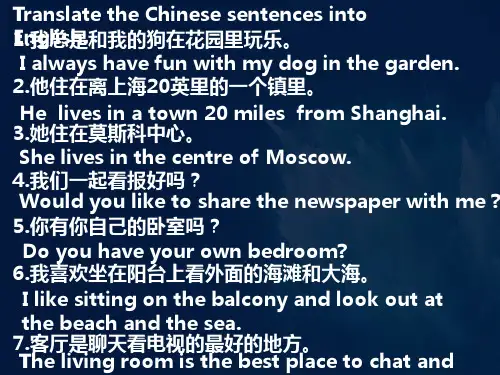
5.你有你自己的卧室吗? Do you have your own bedroom? 6.我喜欢坐在阳台上看外面的海滩和大海。
I like sitting on the balcony and look out at the beach and the sea. 7.客厅是聊天看电视的最好的地方。 The living room is the best place to chat and
Odinal numbers(序数词)
We use ordinal numbers to talk about dates, floors, positions, etc.
书上的第四幅图
the f_o__u_r_t_h_ picture on the book 序数词须与the / 物主代词或
名词所有格连用 Tom的第一个生日
Children’s Day is on _①__J_u__n_e__t_h__e. first ② the first of June
英语初一下译林牛津版unit2grammarⅰ导学案(含教师版作)

英语初一下译林牛津版unit2grammarⅰ导学案(含教师版作)初一英语导学案〔7BUnit2GrammarⅠ〕班级组别姓名【学习目标】1、学会用howmany和howmuch谈论数量。
2、识别形容词性物主代词和名词性物主代词的用法。
词汇:counthamchipcountforkplateprepareholdpostcardshallthenwillpacket词组:aloafofakiloofbeef句型:HowmuchBeijingDuckcanyoueat? HowmanyrestaurantsarethereinSunshineTown?预习导航1、参看词汇表〔P124〕,拼读并经历本部分词汇。
中文:英文:2、归纳出本部分重要的词或短语。
3、了解本部分的一些用法,查阅字典或参考书作一下记录,做好课堂展示的预备。
Each和every的区别:Else和other的区别:Possessiveadjective〔形容词性物主代词〕有哪些?: Possessivepronoun〔名词性无助代词〕有哪些?Its=it’s吗?Why?预习检测一、翻译以下词组组织一个欢迎会:列购物单:许多水;许多牛奶一些咖啡;一点儿果汁一听肉;一罐猪肉一块面包;一碗米饭一瓶牛奶;两瓶牛奶一袋盐;三袋盐【二】Use‘howmany’or‘howmuch’tocompletethesentences:1).__________applejuiceisthereinthecup?2).__________cartonsofmilkdoyouneed?3).__________breaddowehaveinthefridge?4).__________friendsdoyouhaveinyourclass?5).__________bottlesofwaterdoyouhave?6).__________mangoesarethereinthebox?7).__________cokeisthereinourbag?【三】用正确的物主代词填空1)Theyarenotmybooks.Theyare____.(his)2)PleasegivethistoSusan.Itis____(her)pen.3)Weareworkinghardon____(our)project.4)Myflatisonthethirdfloor.___(their)isonthetenthfloor.5)Ican’tfindmyruler.CanIborrow___(your)?.课堂活动单Period1Step1:Freetalks(aboutcountablenounsanduncountablenounsonP3 1A1,thepictures),Step2:Presentationofuncountablenouns(不可数名词的表达) Step3:Sumup(AccordingtoStep3,sumuptheuseofthe“howmuch”and “howmany”.1、关于可数名词的量提问,要用2、关于不可数名词的量进行提问时,分两种情况:1)关于不可数名词前表示数量的词整体进行提问时,要用Thereisaglassofjuiceinthefridge.2)对不可数名词前的数词提问,要用Thereisaloafofbreadinthebox.Step5:Askandanswerquestionsingroups:S1:Howmanypencilsdoyouhave?S2:Ihave…S3:Howmuchmilkdoyoudrinkeveryday?S4:IdrinkacartonofmilkeverydayPeriod2.Step:Presentation1、利用学生的物品向学生展示形容词性物主代词和名词性物主代词。
牛津译林版英语七年级下册Unit2 Neighbours短语整理
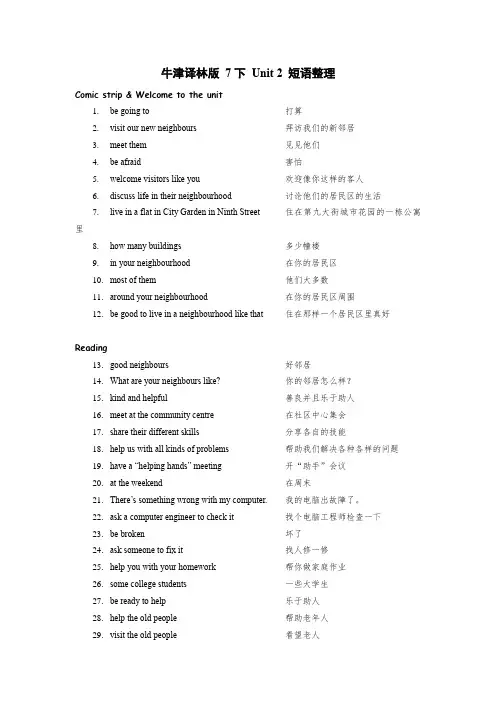
牛津译林版7下Unit 2 短语整理Comic strip & Welcome to the unit1.be going to 打算2.visit our new neighbours拜访我们的新邻居3.meet them见见他们4.be afraid害怕5.welcome visitors like you欢迎像你这样的客人6.discuss life in their neighbourhood讨论他们的居民区的生活7.live in a flat in City Garden in Ninth Street住在第九大街城市花园的一栋公寓里8.how many buildings多少幢楼9.in your neighbourhood在你的居民区10.most of them他们大多数11.around your neighbourhood在你的居民区周围12.be good to live in a neighbourhood like that住在那样一个居民区里真好Reading13.good neighbours好邻居14.What are your neighbours like?你的邻居怎么样?15.kind and helpful善良并且乐于助人16.meet at the community centre在社区中心集会17.share their different skills分享各自的技能18.help us with all kinds of problems帮助我们解决各种各样的问题19.have a “helping hands” meeting开“助手”会议20.at the weekend在周末21.There’s something wrong with my computer.我的电脑出故障了。
22.ask a computer engineer to check it找个电脑工程师检查一下23.be broken坏了24.ask someone to fix it找人修一修25.help you with your homework帮你做家庭作业26.some college students一些大学生27.be ready to help乐于助人28.help the old people帮助老年人29.visit the old people看望老人30.do some shopping for them为他们买东西31.help the people clean their flats帮助这些老人打扫公寓32.be lucky to live in a neighbourhood like that住在那样的居民区里太幸运了33.need help with their problems需要解决他们的问题的帮助34.fix things like broken bicycles修理像损坏的自行车那样的东西35.get help with their homework得到做家庭作业的帮助36.like a big family像一个大家庭Grammar37.take an umbrella with me随身带把伞38.be free空闲的39.wait for us to call back等我们回电话40.wait for your call等你们的电话41.You’re welcome.不用谢。
Unit2Grammar课件牛津译林版英语七年级上册
Answer the questions using the simple present tense
How do you go to school? We/ I go to school by car.
2. Does Millie like swimming? No,she doesn't_. 3. Does Amy enjoy reading?No,she doesn?t 4. Does Daniel like jogging? No,he doesn't. 5. Do Simon and Daniel love drawing?
you?
Millie:Yes,I do. But I don't likefootball.
Simon: Does your sister like football?
Millie:No,she doesn't likefootball. She likes
basketball too.
Simon: Do yourfamily often watch basketball
do not =don't
does
not=doesn't
Do
do.
Does heshelethey like sport? Yes,he/shelthy does.
do not.
Neence does not.
Conclusion
Remember that we add -s to the verb after he,she or it.However,there are some
牛津英语译林版七年级下册提优训练 Unit 2 Grammar
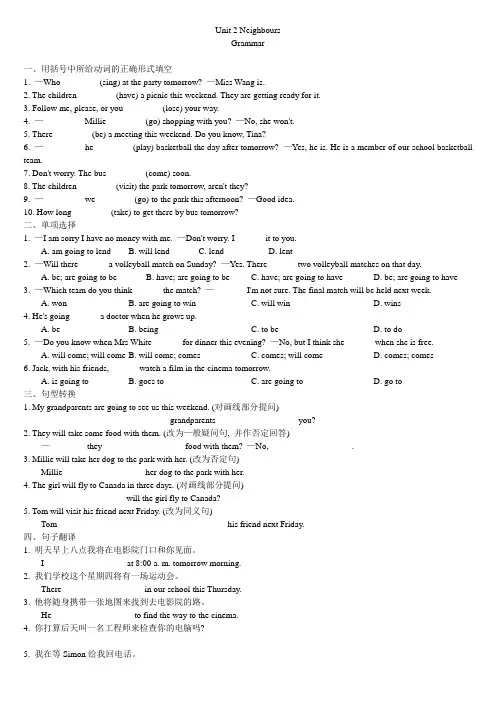
Unit 2 NeighboursGrammar一、用括号中所给动词的正确形式填空1. —Who ________ (sing) at the party tomorrow? —Miss Wang is.2. The children ________ (have) a picnic this weekend. They are getting ready for it.3. Follow me, please, or you ________ (lose) your way.4. —________ Millie ________ (go) shopping with you? —No, she won't.5. There ________ (be) a meeting this weekend. Do you know, Tina?6. —________ he ________ (play) basketball the day after tomorrow? —Yes, he is. He is a member of our school basketball team.7. Don't worry. The bus ________ (come) soon.8. The children ________ (visit) the park tomorrow, aren't they?9. —________ we ________ (go) to the park this afternoon? —Good idea.10. How long ________ (take) to get there by bus tomorrow?二、单项选择1. —I am sorry I have no money with me. —Don't worry. I ______ it to you.A. am going to lendB. will lendC. lendD. lent2. —Will there ______ a volleyball match on Sunday? —Yes. There ______ two volleyball matches on that day.A. be; are going to beB. have; are going to beC. have; are going to haveD. be; are going to have3. —Which team do you think ______ the match? —______ I'm not sure. The final match will be held next week.A. wonB. are going to winC. will winD. wins4. He's going ______ a doctor when he grows up.A. beB. beingC. to beD. to do5. —Do you know when Mrs White ______ for dinner this evening? —No, but I think she ______ when she is free.A. will come; will comeB. will come; comesC. comes; will comeD. comes; comes6. Jack, with his friends, ______ watch a film in the cinema tomorrow.A. is going toB. goes toC. are going toD. go to三、句型转换1. My grandparents are going to see us this weekend. (对画线部分提问)________ ________ ________ grandparents ________ ________ you?2. They will take some food with them. (改为—般疑问句, 并作否定回答)—________ they ________ ________ food with them? —No, ________ ________ .3. Millie will take her dog to the park with her. (改为否定句)Millie ________ ________ her dog to the park with her.4. The girl will fly to Canada in three days. (对画线部分提问)________ ________ will the girl fly to Canada?5. Tom will visit his friend next Friday. (改为同义句)Tom ________ ________ ________ ________ his friend next Friday.四、句子翻译1. 明天早上八点我将在电影院门口和你见面。
牛津译林版七下英语unit2neighbours知识点归纳
Unit2 Neighbours 知识点归纳Period 1 Welcome to the unit(p.18-19)一.词1.neighbour n. <英>邻居— neighbourhood n. <英>街区,居民区2.visit v.参观;拜访— visitor n.访问者;参观者3.wait v.等待— waiter n. 服务员二.短语1. visit our new neighbours 拜访我们的新邻居2. meet them 见见他们3. I’m afraid… 恐怕……4. be afraid to do sth/be afraid of doing sth 害怕做某事5. welcome visitors like you欢迎像你一样的拜访者6.in Ninth Street 在九号大街7.most of them 他们中的大多数人8.around your neighbourhood 在你的街区四周9.live in a neighbourhood like that 住在像那样的街区里三.句子1.Where are you going ? 你将要去哪里?注意:come, go ,leave, ,arrive等用现在进行时表将来时3.I’ll meet them too! 我将去见见他们。
I’ll = I will 我将…4.I’m afraid they won’t welcome visitors like you . 恐怕他们不欢迎想你这样的拜访者。
won’t= will not 将不5. It’s good to live in a neighbourhood like that. 住在像那样的街区里是好的。
Period 2 Reading (P. 20~22)一.词1.helpful adj. 乐于助人的— help n. & v.帮助 2.break v.打破— broken adj. 破损的3.meet v.遇见—meeting n. 会议 4. shop n. 商店—shopping 购物二.短语1.some of them 他们中的一些人2.meet at the community centre 在社区中心见面3.share their different skills 分享他们的不同技能4. help us with all kinds of problems 帮助我们解决各种的问题help sb. with sth. 帮助某人做某事5.have a “helping hands” meeting 举行“援助之手”见面会6.ask sb. (not) to do 要某人(不要)做某事7.ask someone to fix it 请某人修理它8. some college students 一些大学生9.be ready to help 乐意帮忙 be ready to do sth. 乐意做某事10.really nice 真好 11.help visit the old people 帮助看望老人12.do some shopping for them 为他们购物13.help the old people clean their flats 帮助老人打扫他们的公寓14.help the boy with his homework 帮助这个男孩做家庭作业15.fix things like broken bicycles 修理像坏了的自行车那样的物品16.need help with one’s problem 某人遇到问题需要帮助17.get help with one’s homework 某人作业得到帮助18.among the volunteers 在志愿者中二.句子1. What are your neighbours like? 你的邻居们怎么样? What be …like ? ...怎么样?2. They’re kind and helpful. 他们友好又乐于助人。
牛津译林版英语七下Unit1《Dreamhomes》(Vocabuaryandgrammar)说课稿
牛津译林版英语七下Unit 1《Dream homes》(Vocabuary and grammar)说课稿一. 教材分析《Dream homes》是牛津译林版英语七年级下册Unit 1的一篇课文,主要介绍了不同人的梦想家园以及与房子相关的词汇和短语。
通过本节课的学习,学生可以掌握与房子相关的词汇,如apartment, detached house, bungalow等,以及表达梦想家园的句型,如“My dream home is a… It is… and…”。
此外,本节课还涉及到一般现在时和一般过去时的用法。
二. 学情分析七年级的学生已经掌握了基本的英语语法和一定数量的词汇,具备一定的听说读写能力。
但是,对于一些与房子相关的专业词汇和短语,学生可能较为陌生。
此外,学生对于一般现在时和一般过去时的用法可能还不够熟练,需要在课堂上进行巩固和练习。
三. 说教学目标1.知识目标:学生能够掌握与房子相关的词汇和短语,如apartment,detached house, bungalow等,并能够运用这些词汇描述自己的梦想家园。
学生能够掌握一般现在时和一般过去时的用法,并能够运用这两种时态描述自己的梦想家园。
2.能力目标:学生能够听懂、会说、会读、会写与房子相关的词汇和短语,并能够运用这些词汇和短语进行简单的交流。
学生能够运用一般现在时和一般过去时描述自己的梦想家园,并能够进行简单的对话。
3.情感目标:通过学习本节课,学生能够激发对梦想家园的向往之情,培养对美好生活的追求和热爱。
四. 说教学重难点1.教学重点:学生能够掌握与房子相关的词汇和短语,并能够运用这些词汇描述自己的梦想家园。
学生能够掌握一般现在时和一般过去时的用法,并能够运用这两种时态描述自己的梦想家园。
2.教学难点:学生对于一些与房子相关的专业词汇和短语的理解和运用,以及一般现在时和一般过去时的用法在实际语境中的运用。
五. 说教学方法与手段1.教学方法:采用任务型教学法,让学生在完成任务的过程中学习新知识,提高语言运用能力。