
高二英语选修7 Unit1教案 Living well
Unit 1 Living well I. 单元教学目标 技能目标Goals ▲ Learn about Disability and Life of disabled people ▲ Talk about Disability and Life of disabled people ▲ Practise Introduction and Wishes &congratulations ▲ Revise the Infinitive ▲ Write a letter of suggestion
II. 目标语言
功 能 句 式
1. Introduction I’d like to introduce you to… I’d like you to meet… May I introduce…? Pleased to meet you. It’s nice to meet you. 2.Wishes &congratulations Congratulations. All the best. I’m proud of you. I wish you success. Good luck. Well done. I’m very impressed by your performances. You have my best wishes. I’m very pleased for you. I Hope it goes well for you. That’s wonderful/amazing. 词 汇 1. 四会词汇 disability, disabled, eyesight, drum, movie, ambition, beneficial, clumsy, adapt, motto, microscope, breath, absence, stupid, fellow, annoy, annoyed, industry, tank, independent, encouragement, conduct, politics, literature, resign, handkerchief, assistance, companion, latter, congratulate, graduation, certificate, architect, basement, elder, elderly, dignity, accessible, bare 2. 认读词汇 Rada, Barry, Sally, Marty, overhear, Killmanjaro, Qomolangma, admiration, remarkable, Sanders, earphone, impair, italic, community 3. 词组 in other words, out of breath, all in all, make fun of , all the best, in particular 4.重点词汇 disability, disabled, adapt, annoy, conduct, congratulate, accessible
结 构
Revise the Infinitive The infinitive can be used 1. as the subject 2. as the predicative, 3. as the object 4. as the object complement 5. as the adverbial 6. as the attribute 重 点 句 子
I have learned to adapt to my disability. Every time after a long absence from school, I feel really stupid because I am a bit behind the others. All in all, I have a good life. Just accept them for whom they are and give them encouragement to live as rich and full a life as you do. III. 教材分析与教材重组 1. 教材分析 本单元以残疾及残疾人生活为话题,介绍了一些残疾人凭借顽强的毅力和社会的关爱克服生活中的种种困难,以积极的态度面对人生的挑战。通过本单元的学习,可以帮助残疾学生树立生活的信心,激励残疾人实现自身价值;同时又能教育健康学生理解、尊重、关心、帮助残疾人,使残疾人与健全人一样共享美好生活。通过本单元的言语技能训练,要求学生学会使用正确得体的英语介绍他人和向他人表示祝贺。 1.1 WARMING UP 让学生了解残疾的种类,讨论各种残疾给人们的生活带来的种种不便,尽管如此仍然有许多残疾人在不同领域取得了非凡成就,为本单元的READING部分精彩故事做好了铺垫。 1.2 PRE-READING 通过介绍“Family village”,激发学生的阅读兴趣。 1.3 READING课文是一篇以第一人称表述Marty身残志坚,以积极的态度快乐生活的故事。课文以网页的形式展示,能够吸引学生的注意力,引起学生的极大兴趣。 1.4 COMPREHENSION共有4部分,这4部分的设置由表及里,由浅入深,非常科学。第1部分是浅层次的事实核对题,旨在让学生了解Marty生活中遇到的各种困难和他对待生活的乐观态度;第2部分是深层次的理解题,要求学生在正确的理解课文的基础上,通过讨论得出结论;第3部分要求学生总结课文6段的段落大意。第4部分要求用3-4句话分别表述1)Marty的积极向上的生活方式; 2)人们怎样帮助Marty和像Marty一样的残疾人过上幸福生活;3)他的同学为什么改变了对待Marty的态度。 1.5 LEARNING ABOUT LANGUAGE 分为两部分,Discovering useful words and expressions是本单元词汇练习题;Discovering useful structures是本单元语法练习题练习,通过本单元的学习,要求学生熟练掌握不定式的各种语法功能。 1.6 USING LANGUAGE分为两部分,Listening and speaking是关于对残疾人Barry Minto的采访录音,要求学生能够通过录音了解Barry Minto的身体残疾和他取得的成就。同时通过听这个采访,要求学生掌握表示祝贺的常用句型。Reading, speaking and writing 部分要求学生先讨论腿脚残疾的人在电影院有可能遇到的困难,然后引出残疾Alice Major写给the new Bankstown电影院的建筑设计师的一封信,在信中她给建筑设计师提出一些建议,要充分考虑残疾人的特殊需要。这封信后有说和写的练习题,通过不同的言语技能训练,完成本单元教学目标。通过读这份建议信,要求学生学会写建议信。 2. 教材重组 2.1 将WARMING UP 、PRE-READINGR、READING与COMPREHENDING放在一起上一节阅读课。 2.2 把LEARNING ABOUT LANGUAGE 和WORKBOOK 的Using words and expressions及Using structures整合在一起上一节“词汇语法课”。 2.3 根据USING LANGUAGE 内容上一节听说读写综合技能课。 2.4 将WORKBOOK 的Reading and listening 和Talking 结合在一起,上一节“听说课”。 2.5 将WORKBOOK的Reading and writing task 设计为一节阅读课写作课。
3. 课型设计与课时分配(经教材分析,本单元可以用5课时教完) 1st Period Reading 2nd Period Learning about language 3rd Period Using language 4th Period Reading and listening 5th Period Reading and writing task
IV. 分课时教案 The First Period Reading Teaching goals 教学目标 1. Target language目标语言: a. 重点词汇和短语 eyesight, drum, movie, ambition, disabled, beneficial, in other words, clumsy, motto, adapt, motto, microscope, out of breath, absence, stupid, fellow, annoyed, all in all, industry, tank, independent, make fun of, encouragement b. 重点句型 1. I have to adapt to my disability. 2. All in all, I have a good life. 3. Every time after a long absence from school, I feel really stupid because I am a bit behind the others. 4. Just accept them for whom they are and give them encouragement to live as rich and full a life as you do. 2. Ability goals能力目标 Help students to learn about disabilities and life of the disabled. Enable students to realize people with disabilities can also live well 3. Learning ability goals学能目标 By talking about disabilities and life of the disabled, students will learn some positive stories of the disabled. This will help students understand more about how challenging life can be for the disabled. Teaching important points教学重点 How positive stories about the people with disabilities inspire others. Teaching difficult points 教学难点 How to help student understand the difficulties the disable have to overcome. Teaching methods教学方法 Discussing, explaining, reading and practising Teaching aids教具准备 Multimedia computer Teaching procedures & ways教学过程与方式 Step I Leading in Deal with Warming up. Play some videos of people with disabilities for students to watch. Then ask them to discuss what the disabilities are and what difficulties they have to overcome in daily life. T: Good morning /afternoon, class! Ss: Good morning/ afternoon, Mr. /Ms…
高中英语选修七Unit1 Living well Period 2教案
Period 2Language Study设计者邵宁宁Teaching aims1.To learn the useful expressions a nd sentence structures in the reading.2.To enable students to use language points both orally and in written forms. 3.To further get students inspired by Marty Fielding.Teaching procedures1Learning words and phrases1.ambition n.雄心,野心Her ambition is to bee part of the national team for the next Paralympic Games.她的抱负是能够成为国家队的一员来参加下一届残奥会。
To be a good teacher has been her lifelong ambition.做一名好教师是她终生追求的目标。
[拓展]full of ambition野心勃勃achieve one's ambition实现某人的愿望have the ambition for sth.渴望得到某物2.suitable adj.适合的,适宜的Although some may think the cinema is noisy,it is suitable for Sally's condition. 尽管有人可能认为电影院里太吵了,但是它非常适合萨利的身体状况。
He has nothing suitable for a formal party.他没有适合这样正式晚会的任何东西。
3.beneficial adj.有益的be beneficial to对……有益处[拓展]benefit vt.使……受益n.益处,优势benefit sb./sth.对某人/物有益benefit from/by从……中获得益处be of benefit to...对……有益for sb.'s benefit=for the benefit of sb.为了某人的利益These birds are ben eficial to man.这些鸟对人类有益。
人教新课标高二英语选修七教案:Unit1 Living well Learning about language

Unit 1 Living WellPeriod 3 Learning about language 教案I.Teaching aims:1. Do the exercises on page4&5.2.Learn the new words and phrases in reading I.II. Procedures:Step1. Fill in the table below. You can use the dictionary to help you.Step 2.Do exercise for Ex.2 on page4Answer each question by using the correct new word in this unit:1. How do you measure the length of a race round a racetrack?lap2. How would you feel if someone kept talking when youwere trying to read? annoyed3. In what way can a teacher check if you have learned thenew words by heart? encouragement4. What do you call an item written in a diary or in adictionary? conduct5. What kind of instrument does a doctor need to examineviruses in blood? microscope6. How do you describe someone who is happy to meetnew people? fulfilling7. What do you call students in the same year group andthe same situation as you?fellow students8. What do you call the behaviour of one student to others?annoyanceStep3 Learn new words and expressions:1.beneficial adj. 有益的;受益的benefit n. 益处v. 得益对什么有益A benefit B---B benefits from/by AA be of benefit to B对…有益A be beneficial toB 对什么有益for the benefit of 为了… 的利益阳光对植物有益.Sunshine is of benefit to plants.Sunshine is beneficial to plants.Sunshine benefits plants.Plants benefit from sunshine.2.disability n. 伤残无力无能他的残疾使他无法做这项工作.His disabilityprevents him from doing the job.他未接受过培训,这是一个严重的的缺陷.His lack of training wasa serious disability.disabled adj. ablenon-disabled adj. unable3. adapt vt 使…适应,改编adapt to 适应adapt to a new situation=adapt yourself to itThe world will be different, and we will have to be prepared to adapt to the change.adapt somethingShelves were built to adapt the library for use as an office. adapt a book or playThe film has been adapted from a play of the same title.他无法改变他的生活方式来适应公司He could not adapt his way of life to the company .他能很快适应环境He is quick to adapt (himself) to new circumstances. adapt...from...从......选取/改编这部电视剧是为了青少年由小说改编而成的。
人教新课标高二英语选修七教案:Unit1+Living+well+grammar.doc
Unit 1 Living WellPeriod 4 Grammar 教案I.Teaching aims:• 1.Learn the infinitives forms and tenses• 2.Anylize its parts used in a sentence.• 3.Do some exercisesII. ProceduresStep1. Show a picture and a sentence:Do you believe I can fly like a bird?由此产生句子:•To see is to believe.•It’s impossible for humans to fly like a bird now.Step2. 叙述概念及结构不定式是动词的一种非限定形式,由“ to+动词原形” 构成,没有人称和数的变化,在句中不能独立作谓语.但不定式具有名词、形容词和副词的特征,在句中可以作主语、宾语、宾语补足语、表语、定语、状语等。
一.结构: to do;(否定) not to do二. 时态与语态形式一、不定式所作成分1. 作主语2. 作宾语3. 作宾语补足语4. 作定语5. 作状语6. 作表语7. 作独立成分8. 与疑问词等连用分述:(1).不定式作主语时,往往放在谓语之后,用it作形式主语.•To see is to believe.•It’s impossible for humans to fly like a bird now.(2).不定式作表语•My job is to protect the world.•Your task is to_____________ .(3) 不定式作宾语•He likes to______________.•I found it still necessaryto ___________ if he want to win.think/ consider/ find it + adj.+ to do常用动词不定式作宾语的动词有:hope, refuse, learn, set out choose, decide, agree, manage, pretend, plan.(4). 不定式作宾补The teacher told me to_________.I expect you to____________.warn, tell, allow, help, ask, force等五看watch;see;look at; observe;notice;一感: feel三使: let; make; have二听: listen to ; hearI made him do his work.------ He was made to do his work(by me).不定式用在介词but, except, besides后时,如果这些介词前有行为动词do的各种形式,那么介词后的不定式不带to,相反则带to.(1). She could do nothing but cry.(2). I have no choice but to go.(3).What do you like to do besides sleep.(5).不定式作定语I have something to say.But my brother has a lot of homework _____.So I am looking for someone __________.1. 作定语的不定式如果是不及物动词,或者不定式所修饰的名词或代词是不定式动作的地点工具等,不定式后面须有相应的介词。
人教新课标高二英语选修七教案:Unit1+Living+well+warming+up.doc
Unit 1 Living WellPeriod 1 warming up 教案I.Teaching aims:1. Guess some pictures and learn life of disabled people.2. To know what is called disability and sort the kinds of disabilities. some other disabled persons with great achievements.4. Know of some signs of disabilitiesII. Procedures1. Ask the ss to look at some pictures and make a judgement. Give two questions:What difficulty may he/she have in daily life?What is called disability?2. Sort the kinds of disabilitiesA. physical disabilitydeaf, dumb/mute, blind, lame, near-sighted, six fingers, color blindness, paralyzedB. mental disabilitydepression, learning difficulty, brain injury phobias (恐惧症) …3. warm up by defining the concept.disability: the state of being disabled / unable to use his body properly4. Talking task:In groups of four talking about what you know about disabilities. Look at the pictures and give some descriptions.Do you know any famous people who are disabled? What do they do? Have a discussion about what the disabilities are and what difficulties they have to overcome in daily life. Reference OneProfessor Steven Hawking is one of the disabled who has achieved success in his chosen field of work. In spite of his brain disease, he decides to continue with his research and writing, and his famous book “On History of Time” used to be a best seller. When he speaks, he has to use a computer and a voice box. When he answers questions, it takes about two minutes. Not only does he have to type out the answer on a computer but he also gets the computer to translate it into sounds.Reference TwoHelen Keller (1882—1968) , blind and dumb ,was a famous American writer. When she was only nineteen months old,she had a terrible disease. Then she became deaf and blind. In the next five years, she struggled in the dark and silent world. With the help of Anne Sullivan, she learnt to write and speak. She overcame the great difficulties and wrote a famous book “My life”, which became a best seller and sh e became a very well-known writer in the world.Reference ThreeZhang Haidi was born in September 1955 in Jinan, Shandong Province. When she was five years old, she got a serious disease and the lower part of her body lost the feeling and the functions. Since then, she has been confined to wheelchair but she has never stopped her pursue for knowledge and a happy life.She studied by herself all the courses from primary school to college and learned several foreign languages such as English and Japanese. In 1983, she began her career as a writer and a translator and her works have reached the total number of more than one million words. She has been active in social activities for public interests and she shows great care for the education of disabled children and village children. In 2001 she was entitled one of “the 20 most influencing women of the century around the world”.Her idea that true happiness lies in the hard pursue encourages people to work harder for the society.5. ThinkingWhat does these people’s stories tell us?As long as they don’t lose heart, the disabled can also make great contributions with their efforts. Some are even better than normal people.6. Game playingPlease act it out according to what you are required:1) Go around the class with one leg.2) Go back to your seat quickly with your eyes closed.3) Use your body language to express that you want to havelunch with your friend.7. Look at the four pictures and read what these people haveachieved. The students in the pictures each have a disability. With a partner, discuss what their disability might be. The following list might help you.mental disability learning difficulty hearing problemDifficulty with eyesight brain injury loss of an arm orlegsevere illness deafness walking difficulty III. Pre-readingAsk students to read the pre-reading carefully and find out the purpose of the website. Discuss with a partner what kind of things you think people write about.The purpose of the website:1) To give ordinary young people with a disability the chance to share their stories with others.2) To inspire other disabled people.3) To get non-disabled people to understand more about how challenging life can be for people with disabilities.Say True or False:1.The family village website gives successful young people the chance to tell their personal stories.2. Only disabled people find the website beneficial.IV. Homework:1.To look through the new words of the reading text2.Write two disabled persons with achievements around you.品味人生1、不管鸟的翅膀多么完美,如果不凭借空气,鸟就永远飞不到高空。
高二英语人教版选修7教案:Unit1LivingwellPeriod1.doc
Unit 1Living wellPeriod 1Warming Up,Pre-reading and Reading设计者邵宁宁教材分析Warming Up is made up of two parts:discussing and talking.The purpose is to get students interested in the topic “disabilities”.The teacher first asks students to talk about people with a mental or physical disability to see how much they know about disabilities.Next,ask students to look at the pictures and read what these people have achieved even though they each have a disability.Finally,find out what disability they might have according to each description below the picture.Meanwhile,make sure students learn some useful new words and expressions in this unit.Pre-reading provides a short passage about a website called “Family Village”.Ask students to read it and find out the purpose of the website.Make sure the students have a basic knowledge of the website for the disabled.The reading passage Marty's Story presents a story that although Marty is a disabled boy,he never feels sorry for himself and he leads a good and busy life.This is the key part of this unit.The teacher can first get students to skim for the main idea of each paragraph in the reading passage,and then scan for further understanding.In order to let students fully understand the passage while reading,the teacher should analyze the change of Marty's feeling over time and next guide students to write a mini biography for Marty.To consolidate the contents of the reading passage,the teacher will present some poems to students for appreciation.三维目标知识目标1.Get students to learn the useful words and expressions in this unit.eyesight,ambition,disabled,beneficial,in other words,clumsy,adapt,microscope,out of breath,absence,stupid,fellow,annoyed,all in all,industry,tank,make fun of,encouragement,adapt to2.Help students to learn about disabilities and life of the disabled.能力目标1.Let students read the passage Marty's Story to develop their reading ability.2.Enable students to know that people with disabilities can also live well.情感目标1.By talking about disabilities and life of the disabled,make sure students can learn some positive stories of the disabled.2.Help them understand more about how challenging life can be for the disabled.3.Develop students' sense of cooperative learning.教学重点Get students inspired by positive stories of the people with disabilities.教学难点1.Develop students' reading ability.2.Help students understand the difficulties the disabled have to overcome.教学方法1.Task-based teaching and learning.2.Cooperative learning.教学过程Warming up1.Warming up by discussingFirst ask students to talk about people with a mental or physical disability to see how much they know about disabilities.Then show some photos of people with disabilities.Students will be asked to discuss the following questions in small groups.Do you know any famous people who are disabled?What difficulties do they have to overcome in daily life?What have they achieved?Suggested answers:Steven Hawking has a muscle disease,but he makes great contributions in science and puts forward his theory about black holes.Beethoven was deaf in one ear when he was 26 and totally deaf at the age of 35,but he was a great composer.Helen Keller was deaf and blind,but she was a great writer.2.Warming up by talkingFirst,ask students to look at the pictures and read what these people have achieved even though they each have a disability.Next,work with partners to talk about what disability they might have according to each description below the picture.Suggested answers:Rosalyn is in a wheelchair.She has walking difficulty.Richard has difficulty with eyesight,so he can't read the questions or write the answers for his college entrance exams.Sally has hearing problems (though not deaf as she can still understand loud speech in the cinema).Gao Qiang was born with Down's Syndrome,which is a mental disability.Some Doun's Syndrome Down's Sufferers have made a good career as actors.Pre-readingAsk students to read the short paragraph in Pre-reading carefully and find out the purpose of the website “Family Village”.Suggested answers:1.To give ordinary young people with a disability a chance to share their stories with others.2.To inspire other disabled people.3.To get non-disabled people to understand more about how challenging life can be for people with disabilities.Reading1.SkimmingGive students 2 minutes;ask them to read the passage fast to fill in the blanks:Sum up the main idea of each paragraph:Paragraph 1:A(n)______ to Marty and his muscle disease.Paragraph 2:How the disease ______.Paragraph 3:Marty met a lot of ______ at school.Paragraph 4:How his life has become ______.Paragraph 5:The ______ of his disease.Suggested answers:Paragraph 1:An introduction_to Marty and his muscle disease.Paragraph 2:How the disease developed/started.Paragraph 3:Marty met a lot of difficulties at school.Paragraph 4:How his life has become easier.Paragraph 5:The advantages of his disease.2.Scanning for detailed informationAsk students to read the passage carefully to locate the detailed information.Suggested answers:Why did the doctors cut out a piece of muscle from Marty's leg?A.Because they could cure the disease by cutting it out.B.Because they wanted to use it as a specimen(标本).C.Because they would transplant(移植) the new muscle.D.Because they wanted to find out the cause of the disease.Key:D(3)Read paragraph four and answer the following questions:①What is Marty's ambition?②What is Marty's achievement?③What is Marty's hobby?Suggested answers:①Marty's ambition is to work for a firm that develops computer software when he grows up.②Marty invented a computer football game and a big company decided to buy it from him.③As well as going to the movies and football matches with his friends,he spends a lot of time with his pets.He has two rabbits,a parrot,a tank full of fish and a tortoise.(4)Ask students to find Marty's advice in paragraph five.Suggested answers:Don't feel sorry for the disabled.Don't make fun of them.Don't ignore them.Accept them for who they are.Encourage them to live as rich and full a life as healthy people do.Consolidation1.Ask students to read the whole passage and choose the best answers.(1)Which of the following is false?A .Although there are a few students who look down upon him ,Marty never gets annoyed.B .Marty leads a meaningful life and does not feel sorry for being disabled.C .Marty only spends time with his pets and never with his friends.D .Marty's disability has made him more independent.(2)From the passage we can infer that ______.A .Marty asks others to feel sorry for himB .Marty never loses heartC .Marty is afraid of being made fun ofD .Marty will not accept any encouragement because he has grown stronger psychologically Keys :(1)C (2)B23.Discuss in pairs to get the main idea of the passage by filling in the blanks.Though he is a ______ person ,Marty never feels ______ for himself and he ______ his life. Suggested answers :disabled ;sorry ;enjoysDiscussion1.Ask students to discuss the following questions in small groups.(1)How did Marty's feeling changed over time?(2)What kind of person do you think Marty is?Can you use adjective words to describe him?Suggested answers:(1)The change of Marty's feeling over time:hopeful→hopeless→stupid→not get annoyed→good/busy(2)We can see Marty is optimistic/brave/independent/strong-minded.2.Show a video of “Qianshou Guanyin” to the students and encourage them to reme mber the famous saying:“Where there is a will,there is a way.”AppreciationAsk students to read two poems for appreciation when facing obstacles in the future.Facing Obstacles (Two poems by Tom Krause)The Heart of the StrongStrong is the heart that knows not the wayof comfort and ease while living each day.Yet continues to believe from the depths of its soulthat the future is destined to silver and gold.Strong is the heart whose yearning is wanedby storms in life filled with heartache and pain.Yet still gives its all—everything that it canin search of a dream—God's ultimate plan.When there is a victory—when battles are wonwhen burdens are lifted and bright shines the sun—when struggling souls gather—where heroes belong—they find in themselves—the heart of the strong.Carry OnAt times when you feel troubledwhen your happiness is gonelook to the heart within youfor the strength to carry on.In your heart you will find special virtuessuch as faith and hope and love.These gifts have been sent down to youfrom a power up above.It is faith that keeps the soul searchingfor the joy the heart hopes for.It is love that heals the spiritmaking it stronger than before.And if your heart be brokenif your strength should fade awaythe power of these virtueswill still win out the day.So remember when you are troubledwhen your happiness is gonelook to the heart within youfor the strength to carry on.Homework1.Retell Marty's Story according to the mini biography.2.Surf the Internet to learn more about the life of disabled people.品味人生1、不管鸟的翅膀多么完美,如果不凭借空气,鸟就永远飞不到高空。
优质高中英语选修七教案:unit 1 living well
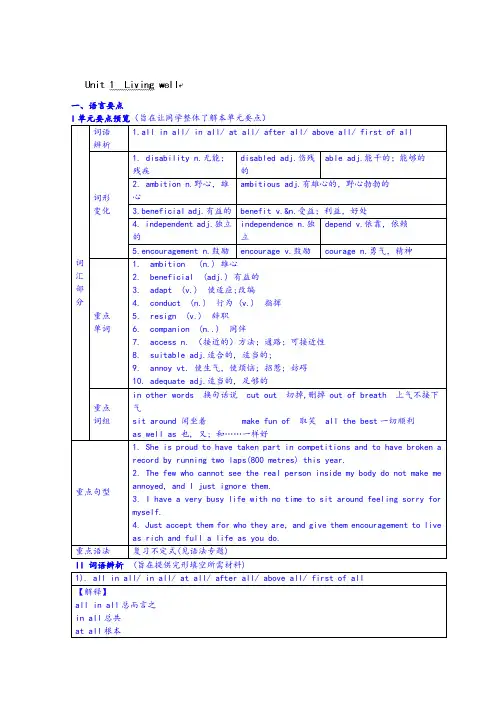
一、语言要点词汇部分词语辨析1.all in all/ in all/ at all/ after all/ above all/ first of all词形变化1. disability n.无能;残疾disabled adj.伤残的able adj.能干的;能够的2. ambition n.野心,雄心ambitious adj.有雄心的,野心勃勃的3.beneficial adj.有益的benefit v.&n.受益;利益,好处4. independent adj.独立的independence n.独立depend v.依靠,依赖5.encouragement n.鼓励encourage v.鼓励courage n.勇气,精神重点单词1.ambition (n.) 雄心2.beneficial (adj.) 有益的3.adapt (v.) 使适应;改编4.conduct (n.) 行为 (v.) 指挥5.resign (v.) 辞职panion (n..) 同伴7.access n. (接近的)方法;通路;可接近性8.suitable adj.适合的, 适当的;9.annoy vt. 使生气,使烦恼; 招惹; 妨碍10.adequate adj.适当的, 足够的重点词组in other words 换句话说 cut out 切掉,删掉 out of breath 上气不接下气sit around 闲坐着 make fun of 取笑 all the best一切顺利as well as 也, 又; 和……一样好重点句型1. She is proud to have taken part in competitions and to have broken a record by running two laps(800 metres) this year.2. The few who cannot see the real person inside my body do not make me annoyed, and I just ignore them.3. I have a very busy life with no time to sit around feeling sorry for myself.4. Just accept them for who they are, and give them encouragement to live as rich and full a life as you do.重点语法复习不定式(见语法专题)1). all in all/ in all/ at all/ after all/ above all/ first of all 【解释】all in all总而言之in all总共at all根本1. ambition (n.) 雄心ambitious adj. 志向远大的; 有雄心壮志的;有野心的be ambitious for 极欲获得be ambitious of success渴望成功be ambitious to serve the people一心想为人民服务1) Her ambition is the presidency. 她的抱负是成为一名总统2) After several hours’ work, she had no ambition to go dancing. 没有精力去跳舞了3) The prince was attracted by the girl’s beauty, and ambitious to marry her.王子为女孩的美貌打动了,渴望能娶到她。
高中英语 Unit1 Living well教案5 新人教版选修7-新人教版高二选修7英语教案
六、作业布置
Finish Ex3on Page 4.
板
书
设
计
1.Infinitive: verb + person + to-infinitive
adviseThey advise walking to town.
allowThey do not allow smoking h
2.verb+doing\to do
StopStop reading the text.Stop to read the text
forgetHe’ll never forget spending so much money on his first computer.Don’t forget to spend money on the tickets.
教材分析
重难点
The use of some key words and expressions and the infinitive.
教学设想
教法
Explaining and practicing
学法
To use learning tools
教具
Multi-media computer.
课堂设计
一、目标展示
My ambition is to work in the computer industry when I grow up. (predicative)
I don’t have time to sit around feeling sorry for myself. (attribuቤተ መጻሕፍቲ ባይዱe)
高中英语 Unit 1 Living well Period 1教案 新人教版选修7
Unit 1 Living wellPeriod 1 Warming Up,Pre-reading and Reading教材分析Warming Up is made up of two parts:discussing and talking.The purpose is to get students interested in the topic “disabilities”.The teacher first asks students to talk about people with a mental or physical disability to see how much they know about disabilities.Next,ask students to look at the pictures and read what these people have achieved even though they each have a disability.Finally,find out what disability they might have according to each description below the picture.Meanwhile,make sure students learn some useful new words and expressions in this unit.Pre-reading provides a short passage about a website called “Family Village”.Ask students to read it and find out the purpose of the website.Make sure the students have a basic knowledge of the website for the disabled.The reading passage Marty's Story presents a story that although Marty is a disabled boy,he never feels sorry for himself and he leads a good and busy life.This is the key part of this unit.The teacher can first get students to skim for the main idea of each paragraph in the reading passage,and then scan for further understanding.In order to let students fully understand the passage while reading,the teacher should analyze the change of Marty's feeling over time and next guide students to write a mini biography for Marty.To consolidate the contents of the reading passage,the teacher will present some poems to students for appreciation.三维目标知识目标1.Get students to learn the useful words and expressions in this unit.eyesight,ambition,disabled,beneficial,in other words,clumsy,adapt,microscope,out of breath,absence,stupid,fellow,annoyed,all in all,industry,tank,make fun of,encouragement,adapt to2.Help students to learn about disabilities and life of the disabled.能力目标1.Let students read the passage Marty's Story to develop their reading ability.2.Enable students to know that people with disabilities can also live well.情感目标1.By talking about disabilities and life of the disabled,make sure students can learn some positive stories of the disabled.2.Help them understand more about how challenging life can be for the disabled.3.Develop students' sense of cooperative learning.教学重点Get students inspired by positive stories of the people with disabilities.教学难点1.Develop students' reading ability.2.Help students understand the difficulties the disabled have to overcome.教学方法1.Task-based teaching and learning.2.Cooperative learning.教学过程Warming up1.Warming up by discussingFirst ask students to talk about people with a mental or physical disability to see how much they know about disabilities.Then show some photos of people with disabilities.Students will be asked to discuss the following questions in small groups.Do you know any famous people who are disabled?What difficulties do they have to overcome in daily life?What have they achieved?Suggested answers:Steven Hawking has a muscle disease,but he makes great contributions in science and puts forward his theory about black holes.Beethoven was deaf in one ear when he was 26 and totally deaf at the age of 35,but he was a great composer.Helen Keller was deaf and blind,but she was a great writer.2.Warming up by talkingFirst,ask students to look at the pictures and read what these people have achieved even though they each have a disability.Next,work with partners to talk about what disability they might have according to each description below the picture.Suggested answers:Rosalyn is in a wheelchair.She has walking difficulty.Richard has difficulty with eyesight,so he can't read the questions or write the answers for his college entrance exams.Sally has hearing problems (though not deaf as she can still understand loud speech in the cinema).Gao Qiang was born with Down's Syndrome,which is a mental disability.Some Doun's Syndrome Down's Sufferers have made a good career as actors.Pre-readingAsk students to read the short paragraph in Pre-reading carefully and find out the purpose of the website “Family Village”.Suggested answers:1.To give ordinary young people with a disability a chance to share their stories with others.2.To inspire other disabled people.3.To get non-disabled people to understand more about how challenging lifecan be for people with disabilities.Reading1.SkimmingGive students 2 minutes;ask them to read the passage fast to fill in the blanks:Sum up the main idea of each paragraph:Paragraph 1:A(n)______ to Marty and his muscle disease.Paragraph 2:How the disease ______.Paragraph 3:Marty met a lot of ______ at school.Paragraph 4:How his life has become ______.Paragraph 5:The ______ of his disease.Suggested answers:Paragraph 1:An introduction_to Marty and his muscle disease.Paragraph 2:How the disease developed/started.Paragraph 3:Marty met a lot of difficulties at school.Paragraph 4:How his life has become easier.Paragraph 5:The advantages of his disease.2.Scanning for detailed informationAsk students to read the passage carefully to locate the detailed information.(1)First ask students to read paragraph one and complete the chart below.(2)Next read paragraphs two and three and choose the best answer.Why did the doctors cut out a piece of muscle from Marty's leg?A.Because they could cure the disease by cutting it out.B.Because they wanted to use it as a specimen(标本).C.Because they would transplant(移植) the new muscle.D.Because they wanted to find out the cause of the disease.Key:D(3)Read paragraph four and answer the following questions:①What is Marty's ambition?②What is Marty's achievement?③What is Marty's hobby?Suggested answers:①Marty's ambition is to work for a firm that develops computer software when he grows up.②Marty invented a comp uter football game and a big company decided to buy it from him.③As well as going to the movies and football matches with his friends,he spendsa lot of time with his pets.He has two rabbits,a parrot,a tank full of fish anda tortoise.(4)Ask students to find Marty's advice in paragraph five.Suggested answers:Don't feel sorry for the disabled.Don't make fun of them.Don't ignore them.Accept them for who they are.Encourage them to live as rich and full a life as healthy people do.p 4Consolidation1.Ask students to read the whole passage and choose the best answers.(1)Which of the following is false?A.Although there are a few students who look down upon him,Marty never gets annoyed.B.Marty leads a meaningful life and does not feel sorry for being disabled.C.Marty only spends time with his pets and never with his friends.D.Marty's disability has made him more independent.(2)From the passage we can infer that ______.A.Marty asks others to feel sorry for himB.Marty never loses heartC.Marty is afraid of being made fun ofD.Marty will not accept any encouragement because he has grown stronger psychologicallyKeys:(1)C (2)B2.Ask students to work together to write a mini biography for Marty according3.Discuss in pairs to get the main idea of the passageby filling in the blanks. Though he is a ______ person ,Marty never feels ______ for himself and he ______ his life.Suggested answers :disabled ;sorry ;enjoysDiscussion1.Ask students to discuss the following questions in small groups.(1)How did Marty's feeling changed over time?(2)What kind of person do you think Marty is ?Can you use adjective words to describe him?Suggested answers :(1)The change of Marty's feeling over time :hopeful→hopeless→stupid→not get annoyed→good/busy(2)We can see Marty is optimistic/brave/independent/strong -minded.2.Show a video of “Qianshou Guanyin” to the students and encourage them to remember the famous saying :“Where there is a will,there is a way.”AppreciationAsk students to read two poems for appreciation when facing obstacles in the future.Facing Obstacles (Two poems by Tom Krause)The Heart of the StrongStrong is the heart that knows not the wayof comfort and ease while living each day.Yet continues to believe from the depths of its soulthat the future is destined to silver and gold.Strong is the heart whose yearning is wanedby storms in life filled with heartache and pain.Yet still gives its all —everything that it canin search of a dream —God's ultimate plan.When there is a victory —when battles are wonwhen burdens are lifted and bright shines the sun —when struggling souls gather —where heroes belong —they find in themselves —the heart of the strong.Carry OnAt times when you feel troubledwhen your happiness is gonelook to the heart within youfor the strength to carry on.In your heart you will find special virtuessuch as faith and hope and love.These gifts have been sent down to youfrom a power up above.It is faith that keeps the soul searchingfor the joy the heart hopes for.It is love that heals the spiritmaking it stronger than before.And if your heart be brokenif your strength should fade awaythe power of these virtueswill still win out the day.So remember when you are troubledwhen your happiness is gonelook to the heart within youfor the strength to carry on.Homework1.Retell Marty's Story according to the mini biography.2.Surf the Internet to learn more about the life of disabled people.。
高二英语人教版选修7教案:Unit1LivingwellPeriod4.doc
Period 4Reading,Speaking and Writing设计方案(一)设计者邵宁宁Teaching aims1.Enable students to learn some useful words and phrases.adequate,access,accessible,handy,row,basement,outwards,exit,meet with sb.'s approval,dignity,profit,community2.Enable students to express their ideas in a polite way.3.Enable students to write a letter of suggestion.Lead-inShow pictures of a cinema,including inside and outside facilities and ask students to discuss what problems that people with disabilities sometimes have in a cinema.(Divide students into different groups.Each member is encouraged to think actively and participate in the discussion.Make sure all students have their own opinions.)Reading1.Introduce Alice to the students.Alice is a warm-hearted girl.She cares for the disabled very much.When she learned a new cinema is going to be built,she wrote a letter to make suggestions.Here is the letter that gives suggestions to the architect who is to design the new Bankstown cinema.(See Student's Book Page 8)2.Skim the reading passage A Letter to an Architect to find out what suggestions Alice gives in the letter.(1)There should be adequate access for wheelchairs.(2)It would help to fit sets of earphones to all seats,not just to some of them.(3)The seats at the back should be placed higher than those at the front.(4)For disabled customers,it would be more convenient to place the toilets near the entrance to the cinema.(5)There are usually spaces specially reserved for disabled and elderly drivers.3.Careful reading—Help students to analyse the letter so that they will learn how to write a letter of suggestion.Ask students to read the text carefully and discuss the questions in groups in Exercise 3 on Page 8.1.What is the purpose of the first paragraph of the letter?2.Why do you think the writer numbered her suggestions and used italics?3.What is the purpose of the last paragraph of the letter?Suggested answers:1.To tell the reader the purpose of the letter.2.The writer has used numbers and a title in italics for each paragraph to organize the ideas and to make it easier for the reader to understand and remember the five suggestions.3.To finish the letter in a polite way and to put forward some reasons why the architect should consider the writer's suggestions.DiscussionDiscuss in groups and work together to write a format of a suggestion letter.Suggested answers:A letter of suggestion normally has five parts.1.The headingThis includes the address,line by line,with the last line being the date.Skip a line after the heading.2.The greetingThe greeting always ends with a comma.The greeting should be formal,beginning with the word “dear”.3.The bodyAlso known as the main text.Generally speaking,the body includes three parts.The first part (usually the first paragraph) tells the receiver that you are writing this letter to make suggestions on something,and the main part tells clearly what your suggestions are.The last part (usually the last paragraph) asks the receiver to consider your suggestions.4.The complimentary closeThis short expression is always a few words in a single line.The complimentary close begins with a capital letter and ends with a comma.5.The signature lineType or print your name.The handwritten signature goes above this line and below the close.The signature line and the handwritten signature are indented to the same column as the close.The signature should be written in blue or black ink.Skip one to three lines(two on a typewriter),and type in the signature line—the printed name of the person signing the letter.Sign the name in the space between the close and the signature line,starting at the left edge of the signature line.PracticeDeal with Exercises 4-6 on Page 9.Ask students to work in groups and discuss how accessible their community is for people with disabilities.Then discuss ways in which their community could be made more accessible for disabled people.(This discussion will lay a good foundation for the writing.)After the discussion,students are asked to write a letter of suggestion to the architect of a new building to be constructed in their area.In the letter they will suggest ways to make it more accessible for people with disabilities.While writing the letter,pay attention to the format of a suggestion letter.HomeworkWrite a letter of suggestion to the architect.A sample letter:Dear Mr Smith,I read in the newspaper that you are the architect who is to design the new supermarket in our suburb.I am writing to ask if you have considered the matter of easy use of the supermarket by people in wheelchairs.In particular,I wonder if you have considered the following things:1.Width of aisles.Can you please make sure that the aisles are wide enough to allow wheelchairs to pass through?In some supermarkets the aisles are so narrow that a person in a wheelchair cannot move along them easily.2.Height of shelves.Can you please design shelves that can be reached by people in wheelchairs?In some supermarkets people in wheelchairs have to ask other shoppers to helpthem.This takes away their independence.3.Lifts to other floors.Lifts could be in places that people in wheelchairs can get to easily.It is very difficult if lifts are right at the back of the shop and people have to go up and down the shelves before they get to it.4.Car parks.I hope you will leave some car spaces close to the front of the shop for people in wheelchairs.It is very difficult if they have to park a long way away from the shop and wheel themselves over rough ground to the entrance.Thank you for reading my letter.I hope you will consider my suggestions.Disabled people should have the same opportunities as able-bodied people to shop independently and they should be able to do so with dignity.I am sure many people will admire your supermarket if you design it with good access for disabled people.The supermarket owners will also be happy as more people will be able to shop there.Yours sincerely,…设计方案(二)设计者江敏教材分析本单元以残疾及残疾人的生活为话题,介绍了一些残疾人凭借顽强的毅力和社会的关爱克服生活中的种种困难,以积极的态度面对人生的挑战。
人教新课标高二英语选修七教案:Unit1+Living+well+reading.doc
Unit 1 Living WellPeriod Two Reading教案I. Teaching aims:1. To know some details about Marty.2. Learn the main idea of each paragraph.3. summarize Marty’s story according to the time orderII. Teaching procedure:Step 1: Fast Reading: Scanning the text and finish these exercises.1.Marty is a _________ person.2.Marty has a _________ disease.3 We can infer that _____.A.Marty will lose heartB.Marty feels sorry for being disabledC.Marty’s life is full of challengeD.Marty feels lonelyStep2: Skimming: Marty’s mini biographyStep3: Read Marty’s story and fill in the chart.Step4:Detailed-reading (1):In what order does Marty tell his story?He tells his story in order oftime.before 10: …;after 10 : …;at high school: …;now: …Step5: Deep readingSum up the main idea of each paragraph.Paragraph 1: This is an introduction to Martyand his muscle disease.Paragraph 2: How the disease developed/ startedParagraph 3:The difficulties Marty has in daily life.Paragraph 4: My fellow students have begun to accept me for who I am. My life is a lot easier at high school.Paragraph 5:All in all, I have a good life.Paragraph 6:My disability has made me growstronger and more independent .People with disabilities can also live well.Step6 : Discussion1. What kind of person do you think Marty is?We can see that Marty is a ____ person.optimistic, brave, independent, strong-minded…2. What do you think is the most difficult thing that Marty has to deal with in his life?Missing lots of school / Not being able to run around and playsports like other boys at his age/ People not understanding that he has a disability3. What kind of things does Marty do in order to make his life happy and satisfying?Marty keeps busy doing things like writing computer programming that do not requirephysical strength. He has friends with whom he can go to movie and football matchesand he has a lot of pets. He also studies hard.4. What can other people do to help Marty and others like him live a good life?They can accept people with disabilities for who they are rather than focus on theirdisability. They can encourage them to live rich and full lives.5. Why has his fellow students’ conduct changed towards Marty? Because they found that Marty was able to live as rich and full a life as everyone else.Step 7: Group workFrom Marty’s inspiring story, what have you learned ?1: We should be patient with people with disabilities. We shouldn’t get annoyed just because they are slow.2: We shouldn’t feel sorry for them. That might hurt them.3: We should help them in a clever way.4: We should encourage them when they feel down.5: Just having a disability doesn’t mean your life is not satisfying.6: Everyone can live well even if he has a disability.Step8.Consolidation: multiple choice1.Why did the doctors cut out a piece of muscle from Marty’s leg?A. Because they could cure the disease by cutting it out.B. Because they wanted to use it as a specimen(标本).C. Because they would transplant the new muscle.D. Because they wanted to find out the cause of the disease.2. From the passage we can infer that __.A. Marty asks others to feel sorry for him.B. Marty never loses heart.C. Marty is afraid of being made fun of.D. Marty will not accept any encouragement because he has grown stronger3. What’s Marty’s dream?A. Being a famous football player and representing his country in the World Cup.B. Being a doctor.C. Being a college student.D. Being a basketball player.4. Which of the following is false?A.Although there are a few students who look down upon him, Martynever getsannoyed.B. Marty leads a meaningful life and does not feel sorry for being disabled.C. Marty only spends time with his pets and never with his friends.D. Marty disability has made him more independent.Step9: HomeworkSuppose one of your friends has difficulty in his study, and he’s in low spirits. Please write him a letter giving him some encouragement and advice to help him gain confidence.精美句子1、善思则能“从无字句处读书”。