
名词性从句详细讲解
名词性从句宾语从句1、连接代词:who, whose, whom, what, which。
在从句中担任成分,如主语、表语、宾语、或定语等。
2、连接副词:when, where, why, how。
在从句中担任成分,作状语。
3、连词:that, whether, if, as if。
在从句中不担任成分,注意:引导词的作用:1 连词whether 和if(是否),as if(好象)只有连接的功能,而不在从句中充当句子成分。
that作连接词,本身无任何含义。
2. 连接代词和连接副词不但有连接的功能,同时还要在从句中充当一定的句子成分,如主语、宾语、表语、定语、状语宾语从句:从句在句中充当宾语的成分。
宾语从句可作谓语动词的宾语,也可作介词的宾语,还可作某些形容词的宾语从句。
一般由that, whether, if, who, whose, what, which, when, where, how, why 等连接Jenny thought (that) her teacher was unfair.I’d like to know which one is your husband.I am sure (that) he won’t mind.He said that he was doing his homework. (注意时态的对应)Mother told me that she would buy a bike for me.I don’t know when he will come.注意think, believe, suppose等的用法(反意疑问句一从二三主)I think that he will come, won’t he?She thinks that he will come, doesn’t she?I don’t think he will come, will he?I think that he will come (提问he) Who do you think will come?that引导宾语从句无意义,不充当句子成分常省略。
但下列情况除外:(1)介词宾语从句的that不省略(2)and连接的几个从句,第二个从句以后的从句的that不省略。
He told me that he had two sons and that they both had gone to college.(3)在动词+it+宾语补足语+宾语从句结构中,that不省略。
如果主句的谓语动词是make, find, feel, consider,等,往往可用it作形式宾语,而把宾语从句置于宾语补足语之后I heard it said that he had gone abroadWe found it impossible that he could finish it in such a short timeWe think it wrong that he told a lie to everyoneWe make it a school rule that students should wear school uniform.Whether ,if 引导宾语从句:两词可互换,但是下列情形除外:(1)whether从句中有or not(2)whether从句做介词宾语Everything depends on whether you agree with us宾语从句的语序要用陈述句语序She asked what second language I was studying then.介词之后的宾语从句,不可用which或if连接,要分别用what或whether。
介词之后的宾语从句一般由wh疑问词连接I’m interested in whether you’ve finished the work..I’m interested in what you’ve said.I was surprised at what he said.I am worried about whether he is safe.注意that 从句作宾语从句只用于except that 及in that 结构I know nothing about the man except that he is an Italian.充当一些形容词的宾语be + 形容词(sure, afraid, happy, glad, sorry)+ thatI am afraid that I have made a mistake.We are certain that we will win the game.主语从句主语从句1.一个主语从句的谓语动词用单数。
2.通常为了句子平衡用it做形式主语,而将主语从句放于句尾。
3.由that引导的从句,that虽然没有什么意思,但是却不能省略。
4.WH引导的从句,引导词放于句首,从句用陈述句语序。
5.放于句首时表示是否只用whether,连词that(无词意), whether(是否),who, what, which, when, where, how, whyThat you don’t like him has nothing to do with me.Whether John will do this experiment remains a question.Whoever wants this book may take it.When they will start hasn’t been decided yet.Where the hero went is not mentioned at the end of the story.在主语从句中我们常用it作形式主语,主语从句放在句末。
It doesn’t matter whether you will come or not.注意以it 开头的特殊主语从句(尤要注意其变形)It is certain that…It seems/ happens / appears that …It is said / reported/ estimated / believed…It is likely that…It’s possible/ important/ necessary/ clear/ strange/ natural that …. ,该句型从句的谓语动词使用虚拟语气形式:should+动词原形。
It is certain that he will win.It seems that he is an honest man.It is said that he will go abroad for further study.It is likely that he will leave for Beijing tomorrow.It is strange that he should fail in the exam.表语从句在复合句中作句子表语的从句, 一般位于系动词之后。
The question was who could go there.The trouble is that we know too little about it.That’s what he is worried about.That’s why I was late.That is where he was born.That is how he did it.the reason后面的表语从句只能用that引导,the reason why …. is that…我们学生易犯“the reason is because…”的错误The reason why he was late was that he was held up by a traffic accident.The reason why the little actress has been such a success is that she is both clever and hard-working.同位语从句同位语从句同位语从句在句中作某一名词的同位语,一般位于该名词(如:fact, news, message, doubt, possibility, idea, reason, belief, hope, thought, promise, suggestion, question 等)之后,说明该名词的具体内容。
对名词做进一步的解释说明其的内容The fact that he remained silent in the meeting surprised everybody.The news that our team has won the match is true.We must face the fact that we might lose the game.He can’t ans wer the question how he got the money.The question who should go abroad requires consideration.同位语从句与定语从句的区别:We expressed the hope (that) they had expressed.我们表达了他们曾经表达过的那种希望。
(定语从句)We expressed the hope that they would come to visit China again.我们表示希望他们再来中国访问。
(同位语从句)The news that he won the game surprised us.The news that he told me surprised us.从语法角度上看,引导同位语从句的that是连词,只起连接作用,在从句中不作任何句子成分;而引导定语从句的that是关系代词,除起连接作用外,还在从句中作主语或宾语等句子成分。
从语义角度上看,同位语从句与前面的名词hope是同位关系,表示hope的内容是they would come to visit China again。
因而同位语从句是名词性的,其功能是对名词作补充说明;而定语从句与它前面的名词是所属关系,表示“…的”(他们曾经表示过的),起修饰作用,因此定语从句是形容词性的,其功能是修饰先行词。
-同位语从句的连词that不能省略,而定语从句的关系代词that,当其在从句中作宾语中,可省略,作主语也不可省略。
【语法讲解】高中英语--名词性从句专题讲解(详细)

Manypeoplebelievethatrobotswilldo most of our work.
whether/if引导的宾语从句
1)可用whether/if的情况
whether/if常放在ask, care, wonder, find out等后引导宾语从句。whether/if在从句中不作成分,但是有“是否”含义,不可省略。
It occurred to me that we should get in touch with the manager.
whether/if引导的主语从句
whether引导的主语从句即可以放在句首,也可以放在句末,但if引导的主语从句只能放在句末,前面需用it作形式主语。whether,if只起连句中不作成分,且不可省略。
Iaskedthem whether/if they would win the match.
Do you care whether/if you win?
2)只用whether不用if的情况
引导介词后的宾语从句时。
Itdepends on whether it will snow tomorrow.
Wedoubt whether he will keep his promise.
宾语从句前置,置于句首时。
Whetherthey can come here on time, we don’t know.
连接代词或连接副词引导的主语从句
1)连接代词what, who, whom, , whose, which , whatever, whoever, whichever等在从句中作主语、宾语、表语、定语,不可以省略。
名词性从句难点讲解
A. whatever B. that C. which
D. whichever
4. Eat ___ cake you like and leave the others for ___ comes in
late.
cA. any; who
B. every; whoever
考点精析 2 、易混连词用法比较 (4) no matter what类词 与whatever类词
√
→ = Whatever √
4. No matter who leaves the room last ought to turn off the lights. × →≠ whoever √
规律五:(1) no matter what 类词(who/ which/ whom/ when/ where/
related sentence patterns)
导入名词性从句的认识Fra bibliotekTell the type of each Noun Clouse: SC(主语从句)、OC (宾语从句)、PC(表语从句)、AC(同位语从句)
1. What life will be like in the future is difficult to predSiCct. 2. It is certain that things will change. SC
A. If Bb. Whether C. That D. Where
考点精析 2、易混连词用法比较
(2) what与that
: 找出下列句子中的错误,并总结出规律
1. I had no idea what he had changed his mind. that
高中英语语法名词性从句专题讲解
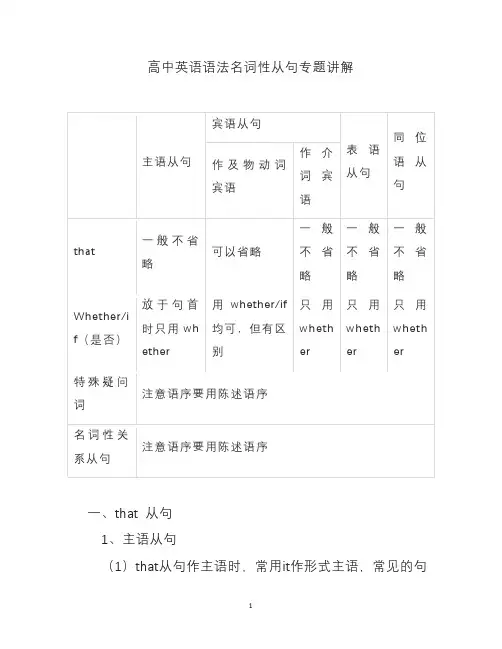
高中英语语法名词性从句专题讲解一、that 从句1、主语从句(1)that从句作主语时,常用it作形式主语,常见的句型有:It+be+形容词(obvious, true, natural,surprising,good,wonderful,funny,possible,likely,certain,prob able,etc.)+that从句It+be+名词词组(no wonder, an honor, a good thing, a pity, no surprise, etc.)+that从句It+be+过去分词(said, reported, thought, expected, decided, announced, arranged, etc.)+that从句(2)that可以省略,但that从句位于句首时,that不能省略。
2、宾语从句(1)常见的可以接that从句作宾语的动词有see, say, know, imagine, discover, believe, tell, show, think, consider, be sure, be afraid等。
在可以接复合宾语的动词之后,如think, make, consider等,可以用it作形式宾语。
(2)That从句一般不能充当介词宾语,偶尔可作except, in 的宾语。
3、表语从句(that不可省略)4、同位语从句连词that引导同位语从句时,应在某些抽象名词之后,如:fact, hope, desire, thought, suggestion, idea, news, problem, possibility等,对前面的名词起补充说明的作用,that在从句中不担当任何成分,不能省略。
二、whether/if从句1、在表语从句和同位语从句中只能用whether不能用if;当主语从句放于句首时,只能用whether不用if;当it作形式主语,主语从句放在句末时用whether或if均可;discuss后引导宾语从句时,必须用whether。
高考英语名词性从句讲解(最全版)

名词性从句引导词的用法(3):
“whoever”-- “-----的任何人”、作主语、 “whomever”-- “-----的任何人”、作宾语、 “whatever”-- “----的任何东西”、作主表宾语、 “whichever”--- “无论哪个或哪些---”、作定语、
连接代词
“whoever”-- “---的任何人”、作主语、起连接作用
(宾语从句)
“whichever”-- “--的哪些或哪个”、作主、表、宾语、
1、Whichever team win the game is possible .
(主语从句)
2、The fact is whichever teacher could help you learn English well . (表语从句) 3、You could choose whichever book you want .
certain (主语从句) .
2、The fact is that Beijing will hold 29th Olympic
Games this year. (表语从句)
3、I know that well begun is half done . (宾语从句) 4、He heard the news that Liuxiang set a new world record .(同位语从句)
“who”---“谁”、作主语、起连接作用 “whom”---“谁”、作宾语、起连接作用
连接代词
“what”---“事情”、作主表宾、起连接作用 “which”---“哪----”、作定语、起连接作用 “whose”---“谁的”、作定语、起连接作用
“who”---“谁”、作主语、起连接作用
名词性从句_语法讲解
单个的主语从句作主语时,谓 语动词用单数形式。如果是两 个或两个以上的主语从句作主 语,谓语动词则用复数形式。 Where and when he was born has not been found. When the person was murdered and why he was murdered are still unknown.
I
名词性从句的种类
• 1.When we will start is not clear.
主语从句
• 2.Mrs Black won’t believe that her son has become a thief. 宾语从句
• 3. My idea is that we should do it right now. 表语从句 • 4.I had no idea that you were her friend.
宾语从句
在复合句中作主句的宾语,放在实义动词或介词的后 面.引导词有连词that (that 常可省略),whether, if; 代词有who, whose, what ,which; 副词有when ,where, how, why 等.如:
We believe (that) he is honest.
(4)用if不用whether的情况:
意:在主语从句中用来表示惊奇、不 相信、惋惜、理应如此等语气时,谓 语动词要用虚拟语气 “ should +do”, 常用的句型有:
It is necessary \ essential that…. It’s important that…. It’s natural that…. It's strange that …
同位语从句
高中英语名词性从句语法讲解
This is how they overcome the difficulties.
My strongest memory is when I attended an
American wedding.
5. 其他连词as if, because, as, as though 引导的表语从句
C.表示某种状态的:remain, keep, prove, continue, stay等.
1. that 引导的表语从句 that 仅起连接作用,无意义,在句中不作任何成分, 通常不可省略。这种从句往往是对主句主语的内容起 进一步解释的作用。
e.g. The chance is that one smoker in four will die from
think等变为否定形式;
e.g. I don’t think you are right.
(5) 在think,believe,imagine,suppose,guess,hope
等动词以及 I’m afraid 等后,可用so代替一个一定的
宾语从句,还可用not代替一个否定的宾语从句:
e.g. 一Do you believe it will clear up你认为天气会转晴吗
连接副词:when, where, how, why 连接代词和连接副词一般做句子的某一成份
The Subject Clause
用作主语的从句叫主语从句。引导主语从句的 连接词有:
连词that, whether;
连接代词what, whatever, who, whoever, whom, whomever, whose, which,
高中英语名词性从句详细讲解
高中英语名词性从句详细讲解一.名词性从句考查的焦点主要有以下六方面1. 考查名词性从句的语序问题2. 考查引导词that与what的区别3. 考查it在名词性从句中作形式主语和形式宾语的用法4. 考查whether与if的区别5. 考查名词性从句中的疑问词+ever引导的名词性从句与no matter+疑问词引导的状语从句的区别6. 考查名词性从句的虚拟语气问题二.名词性从句的含义及连接词名词性从句的含义:在复合句中起名词作用的从句叫做名词性从句。
它包括主语从句、宾语从句、表语从句和同位语从句。
引导名词性从句的连接词可分为四类:1. that(无含义,不充当成分)2. whether, if(有“是否”的含义,但不充当成分)3. 连接代词:what, whatever, who, whoever, whom, whomever,whose, which,whichever.(在从句中做主语、宾语、表语和定语)连接副词:when, whenever,where,wherever, how, however,why(在从句中做状语)4. as if,as though,because(不充当成分,在名词性从句中只引导表语从句)三. 四类名词性从句语法要点1.主语从句在整个句子中用作主语的从句叫主语从句。
What he wants to tell us is not clear.他要跟我们说什么,还不清楚。
It is known to us how he became a writer.我们都知道他是如何成为一名作家的。
Where the English evening will be held has not yet been announced.英语晚会将在哪里举行,还没有宣布。
it作形式主语:有时为避免句子头重脚轻,常用形式主语it代替主语从句作形式主语放于句首,而把主语从句置于句末。
It is clear that he is innocent in the accident.很明显,他在这场事故中是无辜的。
高中英语语法复习之名词性从句详细讲解
( 2) .
当主句动词是过去时态(could, would 除外),从句则要用相应的过去时态, 如一般过去时,过去进行时,过去将来 时等;当从句表示的是客观真理,科学 原理,自然现象,则从句仍用现在时态。 例如: The teacher told us that Tom _________ had left us (leave) for America. travels He said that light ______(travel) much faster than sound.
【高考链接】 C struck me most in the 1.(2013· 重庆)____ movie was the father’s love for his son. A. That B. It C. What D. Which 2.(2012· 课标全国)It is by no means clear D the president can do to end the ____ strike. A. how B. which C. that D. what
名词性从句讲解
名词性从句名词性从句是在句子中起名词作用的句子。
名词性从句的功能相当于名词词组,它在复合句中能担任主语、宾语、表语、同位语、介词宾语等,因此根据它在句中不同的语法功能,名词性从句又可分别称为主语从句、宾语从句、表语从句和同位语从句。
连接词引导名词性从句的连接词可分为三类:1.连词:that (本身无意义。
引导单一的宾语从句时that常可省略,但引导主语从句、表语从句、同位语从句时that通常不被省略)whether,if (均表示“是否”)as if ,as though (均表示“好像”,“似乎”)◆以上在从句中均不充当任何成分2. 连接代词:what/ whatever, who/ whoever, whom/ whomever, whose/whosever,which/ whichever.有词意,在从句中充当主语,宾语,表语,定语等。
3. 连接副词:when/ whenever, where/ wherever, how/ however, why.有词意,在从句中充当状语。
主语从句作句子主语的从句叫主语从句。
主语从句通常由连词that,whether,和连接代词what,who,which,whatever,whoever以及连接副词how,when,where,why等词引导。
that在句中无词义,只起连接作用;连接代词和连接副词在句中既保留自己的疑问含义、又起连接作用,在从句中充当一定的成分。
主语从句后的谓语动词一般用单数形式。
例如:What he wants to tell us is not clear. 他要跟我们说什么,还不清楚。
Who will win the match is still unknown. 谁能赢得这场比赛还不得而知。
It is known to us how he became a writer. 我们都知道他是如何成为一名作家的。
Where the English evening will be held has not yet been announced.英语晚会将在哪里举行,还没有宣布。
高中英语名词性从句详细讲解
名词性从句带有从句的复合句就是用连接词把主句和从句连接在一起。
高中英语中共有三大从句:形容词性从句(即定语从句);二、名词性从句;三、状语从句。
形容词性从句即定语从句,相当于一个形容词,作先行词的定语,用来修饰前面的名词或代词的。
名词性从句相当于名词,可分别作主句的主语、表语、宾语和同位语。
因此,名词性从句分为主语从句、表语从句、宾语从句和同位从句。
主语从句、表语从句、宾语从句只有在主句句子的成分残缺时才可以考虑使用这三大从句。
同位语则是对前面某一名词的展开,即对前一名词的具体说明,做进一步解释,两者是同等,并不是定语从句的修饰与被修饰关系。
名词性从句考得最多的是宾语从句,其次是主语从句,再次是表语从句,而同位语从句则很少考查。
名词性从句的连接词:1.从属连接词:that(无任何词义),whether/if(均表示“是否”表明从句内容的不确定性),as if /as though (均表示“好像”“似乎”)。
以上词在从句中均不充当任何成分,只起连接作用。
根据句意,如果连接代词、连接副词、whether/if 和as if/as though都用不上时,才用that作连接词(因为that本身无任何含义)。
2.连接代词:what,who, whom, whose,which,whatever, whoever,whichever,whomever。
有词义,在从句中担任成分,如主语、表语、宾语、或定语。
从句一定要用陈述语序。
\3.连接副词:when,where,why,how, how many,how much,how often。
有词义,在从句中担任成分,作状语。
【注意】连接代词与连接副词既保留自己的疑问含义,又起连接作用,在从句中充当成分。
4.不可省略的连词:(1)介词后的连词;(2)引导主语从句和同位语从句的连词不可省略。
That she was chosen made us very happy.We heard the news that our team had won.(一)主语从句…第一部分:常规主语从句,即从句在复合句中充当一个主语。