
usp美国药典结构梳理
vivi2010-10-02USP总目录:1 New Official Text修订文件加快修订过程包括勘误表,临时修订声明(IRAS),修订公告。
勘误表,临时修订声明,修订公告在USP网站上New Official Text部分刊出,勘误表,临时修订公告也会在PF上刊出2front matter前言药典与处方集增补删减情况,审核人员,辅料收录情况3凡例药典,1标题和修订2 药典地位和法律认可3标准复合性4专论和通则5 专论组成6 检验规范和检验方法7 测试结果8 术语和定义9 处方和配药10 包装存储与标签4通则章节列表一般检查和含量测定(章节编号小于1000)检查和含量分析的一般要求检查和含量分析的仪器,微生物检查,生物检查和含量测定,化学检查和含量测定,物理检查和测定一般信息(章节号大于1000)5食物补充剂通则6试剂(试剂,指示剂,溶液等)7参考表性状描述和溶解性查询表(按字母顺序)8食品补充剂各论(字母顺序)9NF各论(辅料标准)10 USP各论11术语附件:通则的章节中文目录(使用起来比较方便,直接找对应章节号即可)一、通用试验和检定(1)试验和检定的总要求1 注射剂11 参比标准物(2)试验和检定的装置16 自动分析方法21 测温仪31 容量装置,如容量瓶、移液管、滴定管,各种规格的误差限度41 砝码和天平(3)微生物学试验51 抗菌效力试验55 生物指示剂:耐受性能试验61 微生物限度试验61 非灭菌制品的微生物检查:计数试验62 非灭菌制品的特定菌检查,如大肠杆菌、金葡菌、沙门氏菌等71 无菌试验(4)生物学试验和检定81 抗生素微生物检定85 细菌内毒素试验87 体外生物反应性试验:检查合成橡胶、塑料、高聚物对哺乳类细胞培养的影响88 体内生物反应性试验:检查上述物质对小鼠、兔iv、ip或肌内植入的影响91 泛酸钙检定111 生物检定法的设计和分析115 右泛醇检定121 胰岛素检定141 蛋白质——生物适应试验,用缺蛋白饲料大鼠,观察水解蛋白注射液和氨基酸混合物的作用151 热原检查法161 输血、输液器及类似医疗装置的内毒素、热原、无菌检查171 维生素B12 活性检定(5)化学试验和检定A 鉴别试验181 有机含氮碱的鉴别191 一般鉴别试验193 四环素类鉴别197 分光光度法鉴别试验201 薄层色谱鉴别试验B 限量试验206 铝211 砷221 氯化物和硫酸盐223 二甲基苯胺226 4-差向脱水四环素231 重金属241 铁251 铅261 汞271 易炭化物试验281 炽灼残渣291 硒C 其他试验和检定301 中和酸能力311 藻酸盐检定331 苯丙胺检定341 多剂量容器注射剂中所加防腐剂含量的气相色谱或极谱法测定345 枸橼酸与其盐以及磷酸盐检定351 甾体检定361 巴比妥酸盐检定371 维生素B12放射示踪物检定381 注射剂橡胶塞检查391 肾上腺素检定401 脂肪和固定油检查411 叶酸检定425 抗生素碘量法检定429 微粒大小的光衍射测量431 甲氧基测定441 烟酸或烟酰胺检定451 亚硝酸盐滴定461 氮测定466 普通杂质的薄层色谱法检查467 有机挥发性杂质检查法467 残留溶剂测定471 氧瓶燃烧法481 核黄素检定501 有机含氮碱的盐511 单一甾醇检定521 磺胺类的色谱法检定531 硫胺检定541 滴定法554 α-生育酚检定561 植物来源物品的一般检查项目563 植物来源物品的各种鉴别项目(植物学部分、显微鉴别、化学鉴别)565 植物提取物的一般提取方法和要求571 维生素A检定:化学法、色谱法581 维生素D检定:色谱法、化学法、生物法591 锌测定(6)物理试验和测定601 气雾剂、鼻喷雾剂、计量吸入剂和干粉吸入剂的各项检测611 乙醇含量测定:蒸馏法、气一液色谱法616 固体的疏松密度和叩击密度测定621 色谱法631 色度检查和标准641 溶解的完全性检查643 总有机炭测定645 水导电性测定651 冻凝温度的测定661 药用容器的检测项目要求671 盛装胶囊和片剂容器加盖后对湿气的通透性试验691 棉花吸附性和纤维长度测定695 结晶性检查696 用溶液测热法测定结晶度698 装量检查699 固体密度(粉粒密度测定法)701 崩解试验711 溶出试验721 蒸馏温度范围(馏程)测定724 通过透皮转运系统药物的释放726 电泳727 毛细管电泳730 等离子体光谱化学检查法731 干燥失重733 炽灼失重736 质谱法741 熔点范围或温度的测定751 眼膏中的金属颗粒测定755 最低装量检查法761 核磁共振771 眼用软膏的要求776 光学显微镜微粒检查法781 旋光度检查785 渗透压摩尔浓度测定法786 用分析筛测量颗粒大小的分布788 注射液中微粒物质测定法789 眼用溶液中微粒物质测定法791 PH测定法795 非灭菌制剂的药物配制要求797 灭菌制剂的药物配制要求801 极谱法811 粉末细度测定821 放射活性药物823 正电子发射层析X线摄影(PET)所用放射性药物的配制831 折光指数测定841 比重测定846 粉末的比表面积测定851 分光光度法与光散射861 外科缝合线直径检查871 附有针的缝合线检查881 外科缝合线、纺织品与膜片的弹力强度检查891 热分析:温度变化、热解重量分析、易熔杂质分析等905 剂量单位的均匀性检查(含量均匀度、装量差异)911 黏度测定921 药品含水量的测定941 结晶型药物的X线衍射分析二、通用资料1010 数据分析方法1015 诊断用放射药的自动合成装置1031 药用容器、医用装置和植入物所用材料的生物相容性检查1035 灭菌用生物指示剂1041 生物制品的批签发1043 细胞、基因和组织工程产品的辅助材料1045 生物技术产品1046 细胞和基因治疗产品1047 生物技术产品的检验法1048 生物技术产品的质量——重组DNA蛋白质产品生产所用细胞表达构成的分析1049 生物技术产品的稳定性试验1050 人或动物来源的细胞系所得生物技术产品的病毒安全性评价1051 玻璃仪器清洗方法1061 颜色的仪器测量1065 离子色谱1072 消毒剂与防腐剂1074 赋形剂生物学安全性评价指导原则1075 复方药物配制质量规范1078 大批量药用赋形剂的生产质量规范1079 储存与运输的质量规范1081 明胶的凝胶强度1086 药品中的杂质来源1087 特性溶出1088 剂型的体外和体内评价1090 体内生物等效性试验指导原则1091 剂型中含有无活性组分的标示1092 溶出试验方法的发展和验证1101 药用滴管1111 非灭菌药品的微生物特征1111 非灭菌药品的微生物特征检查:药用原料和药物制剂的判定标准1112 非灭菌药品中的水活性测定,即在同一温度时,药品中水的蒸气压与纯水蒸气压之比,它等于药品在密闭系统中产生相对湿度的1%1116 清洁室和其他受控环境的微生物评价1117 微生物实验室的质量规范(GLP)1118 监控装置:时间、温度、湿度1119 近红外分光光度法1120 拉曼(Raman)分光光度法1121 药品命名法1136 药品包装:应用单元1146 口服固体药分装在单疗程剂量容器中的检查方法1150 药物剂型的稳定性1151 药物剂型1160 处方调配的药学计算1171 原料药的位相溶解度分析1174 粉末流动性测定1176 处方天平和容量装置1177 包装质量规范1178 分装质量规范1181 扫描电子显微镜1191 调剂工作中的药品稳定性保持1196 药典协调(指欧洲药典、美国药典、日本药局方三方机构讨论协调的原则和方法)1207 灭菌产品包装:完整性评价1208 灭菌试验:隔离系统的验证1209 灭菌:化学和物理化学的指示剂与积分仪1211 药典收载品种的灭菌和灭菌保证1216 片剂脆性检查1221 茶匙(家用标准为5 ml,可作为病人口服液体药物的量具,误差应小于10%)1222 药品灭菌终点的放行参数1223 微生物替代方法的验证1225 药典方法的验证1227 在抗菌效力、微生物限度、灭菌等试验中,微生物的恢复验证1230 血液透析用水1231 药用水的制备和要求1241 在制药系统中,水—固体的相互作用1251 用分析天平称量的要求1265 书写药物处方的指导原则三、饮食增补剂2021 营养和饮食增补剂的微生物计数试验2022 营养和饮食增补剂中不允许存在的微生物(如金葡菌、沙门氏菌、大肠杆菌、梭状芽胞杆菌属)检查法2023 非灭菌的营养和饮食增补剂中的微生物特征2030 植物来源物品的增补资料2040 饮食增补剂的崩解和溶出检查2091 饮食增补剂的重(装)量差异检查2750 饮食增补剂的生产条件与质量要求(与药品有别)。
200710 美国药典介绍资料
《药典论坛》介绍
临时修订声明
可供应的新USP 标准品一览表; 该声明是一种在两期增刊之间加速修订生效的机 制; 在药典论坛中发布,同时注明生效日期; 自动纳入下一期增刊;
《药典论坛》介绍
哪一个参考哪一个:
USP-NF USP-NF 增刊 临时修订说明
《药典论坛》介绍
员工职责
学术联系人; 出版物; 实验数据支持; 标准物质的评价和生产; 信息技术;
支持:客户服务、销售、推广、管理、协调、 分销、人事、法律和其它事务。
美国药典标准的制定和修订程序
标准制定程序是开放的,USP努力征求所有利益相 关人员的意见; 年度学术会议; 区域性药典团体; 利益关系人论坛; 制药工业论坛
标准品目录:当前标准品,意见意向表;
色谱试剂:本期相关产品的色谱柱信息。
《药典论坛》介绍
政策声明
关于影响标准制定、各论、章节的政策问题的一 般声明;这类声明可能会影响产品和程序; 提交意见的截至日期; 对提议发表意见的日程表; 基于预定正式生效日期的提交意见的日期; 出版物日程表,各种出版物,出版日期和生效日 期的列表,年刊,增刊,临时修订声明;
培训 美国药典委员会亲自讲授《USP-NF》:如何有效使用美 国药典标准;提供工具以确保您的产品持续符合USP-NF; 创造良好机会,让您与经验丰富的美国药典委员会专家探 讨法定检查中碰到的问题; 溶出度检测基本原理 分析方法验证;
微生物检测基本原理;
美国药典的历史和组织介绍
USP 是一个非盈利组织; 其主要收入来自于标准品PS和出版物的销售
公共标准通过开放系统制定;
标准由当选的专家批准; 医药行业FDA和USP 在标准物质标化及其他药典 相关技术方面进行合作。
美国药典USP气相色谱柱对照表

美国药典USP气相色谱柱对照表美国药典USP气相色谱柱对照表L62 C30硅胶键合于完全多孔球状硅胶,粒径3~15μm。
G48 Highly polar, partially cross-linked cyanopolysiloxane.Rt-2560G46 14% 氰丙基苯基- 86% 甲基聚硅氧烷CB-1701MXT?-1701Rtx?-1701VF-1701ms OV-1701CBX-1701DB-1701DB-1701P G43 6% 氰丙基苯基- 94% 二甲基聚硅氧烷MXT?-624DB-624MXT?-Volatiles CBX-1301 MXT?-1301OV-1301CB-624Rtx?-1301 VF-624ms/VF-1301ms Rtx?-624CB-1301CBX-624 G42 35% 苯基- 65% 二甲基乙烯聚硅氧烷DB-35Rtx?-35MXT?-35CBX-35HP-35DB-35MSG38 固定相G1 加减尾剂MXT-1Rtx?-1MS Rtx?-1G36 1% 乙烯基- 5% 苯基甲基聚硅氧烷Rtx?-5MS Rtx?-5CBX-5MXT?-5G35 聚乙二醇和硝基对苯二甲酸二乙二醇酯DB-FFAP HP-FFAP CB-FFAPG32 20% Phenylmethyl-80% dimethylpolysiloxane.MXT?-20G27 5% 苯基- 95% 甲基聚硅氧烷CB-5XTI?-5Rtx?-5SIL MS VF-5msRtx?-5PONA HP-5MS HP-5DB-5MSSE-52DB-5SE-54G25 聚乙二醇TPA(Carbowax 20M 对苯二酸)FFAP CBX-FFAPG19 25% 苯基- 25% 氰丙基甲基聚硅氧烷OV-225Rtx?-225VF-23ms CBX-225G17 75% 苯基- 25% 甲基聚硅氧烷MXT?-65G16 聚乙二醇(平均分子量15,000)DB-WAX CBX-Wax CB-WAX Stabilwax?PEG-20M Stabilwax?-DB Stabilwax?-DA MXT?-WAXG15 聚乙二醇(平均分子量3000-3700)Rtx?-WaxG14 聚乙二醇(平均分子量950-1050)VF-WAXmsG8 90%3氰基丙基-10%苯基甲基聚硅氧烷HP-88Rtx?-2330G7 50%-3-氰丙基聚硅氧烷-50%苯甲基硅氧烷DB-225CB-225G6 三氟丙基甲基聚硅氧烷MXT?-200Rtx?-200G5 3-氰丙基聚氧硅烷DB-23G3 50%苯基-50%甲基聚硅氧烷(50% Phenyl-50% methylpolysiloxane)DB-17HT Rtx?-50Rtx?-17VF-17msMXT?-50DB-17MS CBX-17HP-50+DB-17CB-17VF-Xms OV-17G2 二甲基聚硅烷胶(Dimethylpolysiloxane Gum)CB-1MXT?-1HT Sim Dist HP-1DB-1MSCB-101VF-1ms DB-1MXT?-1 Sim DistHP-PONAG1 二甲基聚硅氧烷油(Dimethylpolysiloxane oil)SE-30CBX-1CB-101CB-PONARtx?-1PONA OV-101OV-1CB-TVOC0 其他分类(气相填充柱色谱柱)L1 十八烷基硅烷化学键合到多孔硅胶或陶瓷微粒,粒径为1.5 到10 μmL10 腈基化学键合到多孔硅胶颗粒,粒径为3 到10 μmL11 苯基化学键合到多孔硅胶颗粒,粒径为1.5 到10 μmL14 具有化学键合的、强碱性季铵阴离子交换涂层的硅胶,粒径为10 μmL18 氨基和氰基化学键合到多孔硅胶颗粒,粒径为5 到10 μmL2 十八烷基硅烷化学键合到表面孔隙度可控制的多孔硅胶(已键合到固体球形核),粒径为3到50 μm L20 二羟基丙烷基化学键合到多孔硅胶颗粒,粒径为3 到10 μmL3 多孔硅胶颗粒,粒径为5 到10 μmL56 丙基硅烷化学键合到全多孔硅胶颗粒,粒径为3 到10 μmL7 辛基硅烷化学键合到全多孔微硅胶颗粒,粒径为1.5 到10 μm L8 氨丙基硅烷以单分子层形式化学键合到多孔硅胶载体上,粒径为10 μmS10 丙烯晴和二乙烯基苯高交联共聚物S1A 硅藻土S2 苯乙烯-二乙烯基苯共聚物:比表面小于50m2/g,平均孔径0.3-0.4umS3 苯乙烯-二乙烯基苯共聚物:比表面为50-6000m2/g,平均孔径0.0075umS4 苯乙烯-二乙烯基苯共聚物(含-O和-N):比表面为400-600m2/g,平均孔径0.0076umS6 苯乙烯-二乙烯基苯共聚物:比表面为250-350m2/g,平均孔径0.0091umS7 石墨化碳比表面12 m2/gS8 4-乙烯吡啶和苯乙烯二乙烯基苯共聚物G0 其他分类CB-AL2O3/S LZP-950CBX-Phenol PLOT GDX-102农残C农残A农残B CB-PLOT QLZP-920LZP-930LZP-940CB-Metal APLOT GDX-202PLOT GDX-501CB-PLOT U MXT?-500 Sim Dist VF-35ms Rtx?-VMS Rtx?-2887Rtx?-20Rtx?-VGC CB-PLOT Silica FAMEWAX CB-202PLOT GDX-502CBX PLOT-5A MXT?-BAC1CB-AL2O3/MRt-βDEXsa Rtx?-502.2PLOT TDX-01B PLOT TDX-03 PLOT GDX-403PLOT GDX-401MXT?-BAC2HP-PLOT QCB-204Rt-βDEXsp PLOT GDX-203CBX-Dexsil 300 HP-PLOT 氧化铝/S Rtx?-VRX PLOT GDX-103Rt-SPLOTPLOT GDX-201C-2000MXT?-2887PLOT TDX-02B PONA MXT?-502.2PLOT GDX-105苯甲酚专用柱CB-PLOT 5A Rtx?-CLPesticides2Rtx?-440PLOT GDX-303苯系物专用柱DB-608Rtx?-CLPesticides CB-Dexsil 300Rt-βDEXcst Rtx?-PCB MXT?-65TG Rt-βDEXseCB-201Rtx?-XLB Rt-βDEXsm Rt-QPLOTPLOT GDX-104CB-BasicWax PLOT GDX-101CB-PLOT SPLOT GDX-301VF-200ms。
美国药典简介

美国药典简介1. 标题和修订(Title and Revision). 92. 药典地位和法律认可(Official status and legal recognition)92.10 药典正文(Official Text) 92.20 药典物品(Official Articles). 92.30 法律认可(Legal Recognition). 103. 与标准的符合性(Conformance to standard). 103.10 标准的适用性(Applicability of standard) 103.10.10 制剂、原料药、辅料的标准的适用性(Applicability of Standards to Drug Products, Drug Substances, and Excipients). 103.10.20 医疗器械、营养补充剂、以及其组成成分的标准的适用性(Applicability of Standards to Medical Devices, Dietary Supplements, and Their Components and Ingredients)113.20 一致性的标示(Indicating Conformance). 114. 药典各论和通则(Monographs and general chapters)124.10 各论(Monographs) 124.10.10 检测程序的适用性(Applicability of Test Procedures) 124.10.20 接受标准(Acceptance Criteria) 124.20 附录(General Chapter). 125. 各论组成(Monograph Components). 135.10 分子式(Molecular formula). 135.20 附加物质、赋形剂、组分(Added Substances, Excipients, and Ingredients) 135.20.10官方原料药中附加的物质、赋形剂、组分(Added Substances, Excipients, and Ingredien ts in Official Substances). 135.20.20官方制剂中的附加物质、赋形剂、组分(Added Substances, Excipients, and Ingredients in Official Products). 135.30 性状和溶解性(Description and Solubility). 145.40 鉴定试验(Identification Test). 145.50 含量分析(Assay). 155.50.10 效价单位(生物效价)(Units of Potency (Biological)) 155.60 杂质和外来物质(Impurities and Foreign Substances). 155.60.10 USP和NF物品的其它杂质(Other Impurities in USP and NF Articles)155.60.20 USP和NF物品中的残留溶剂(Residual Solvents in USP and NF Articles)165.70性能检测(Performance Tests). 165.80 USP标准品(Residual Solvents in USP and NF Articles). 166. 检验规范和分析方法(Testing practices and procedures)166.10 安全的实验室规范(Safe Laboratory Practices). 166.20 自动化程序(Automated Procedures). 166.30 可选择的和谐的方法与程序(Alternative and Harmonized Methods and Procedures)166.40 干燥的、无水的、灼烧的、无溶剂的(Dried, Anhydrous, Ignited, or Solvent-Free Basis)176.40.10 灼烧至恒重(Ignite To Constant Weight). 176.40.20 干燥至恒重(Dried To Constant Weight). 176.50 溶液的制备(Preparation of Solutions). 186.50.10 过滤(Filtration). 186.50.20 溶液(Solutions). 186.60 完成一个实验所需多少单位(Units Necessary to Complete a Test). 186.60.10 片剂(Tablets). 186.60.20 胶囊(Capsules). 196.70 试剂(Reagents). 196.80 设备(Equipment). 196.80.10 测量仪器(Apparatus for Measurement). 196.80.20 仪器设备(Instrumental Apparatus). 197. 测试结果(Test Results). 207.10 质量要求的解释(Interpretation of Requirements) 207.10.10 滴定程序中的等效表述(Equivalence Statements in Titrimetric Procedures) 207.20 修约原则(Rounding Rules) 208. 术语和定义(Terms and Definitions) 218.10 缩写(Abbreviations) 218.20 大约(About) 218.30 乙醇含量(Alcohol Content) 218.40 原子量(Atomic Weights) 228.50 空白试验(Blank Determinations) 228.60伴随(Concomitantly) 228.70 干燥器(Desiccator) 228.80 对数(Logarithms). 228.90 微生物菌株(Microbial Strain) 228.100 可忽略的(Negligible). 228.110 NLT/NMT 228.120 气味(Odor) 228.130 百分比(Percent) 228.140 百分比浓度(Percentage Concentrations) 238.150 压力(Pressure) 238.160 反应时间(Reaction Time) 238.170 比重(Specific Gravity) 238.180 温度(Temperatures) 238.190 时间(Time) 238.200 转移(Transfer). 238.210 真空(Vacuum). 238.220 真空干燥器(Vacuum Desiccator). 238.230 水(Water). 248.230.10 水作为官方制剂中的组分(Water as an Ingredient in an Official Product)24 8.230.20 水用于官方原料药的生产(Water in the Manufacture of Official Substances)24 8.230.30 药典实验操作用水(Water in a Compendial Procedure). 248.240 称量和测量(Weights and Measures). 249. 开处方和配药(Prescribing and Dispending). 259.10 公制单位的使用(Use of Metric Units). 259.20 体积的改变(Changes in Volume). 2510. 保存、包装、储存、贴签(preservation,packaging,storage and labeling)2510.10 在非特定条件下储存(Storage Under Nonspecific Conditions). 2510.20 包装容器(Containers). 2510.20.10显窃启包装(Tamper-Evident Packaging). 2610.20.20 避光容器(Light-Resistant Container). 2610.20.30密闭良好的容器(Well-Closed Container). 2610.20.40密封的容器(Tight Container). 2610.20.50严封的容器(Hermetic Container). 2710.20.60单元包装(Single-Unit Container). 2710.20.70单剂量包装(Single-Dose Container). 2710.20.80单元剂量容器(Unit-Dose Container). 2710.20.90单元使用的容器(Unit-of-Use Container). 2710.20.100多单元容器(Multiple-Unit Container). 2710.20.110多剂量容器(Multiple-Dose Container). 2710.20.120毒物保护包装法案(Requirements under the Poison Prevention Packaging Act (PPPA))2710.30 储存温度和湿度(Storage Temperature and Humidity). 2810.30.10 冷冻(Freezer). 2810.30.20冷处(Cold). 2810.30.30 凉处(Cool). 2810.30.40 可控的凉爽温度(controlled cold temperature). 2810.30.50 室温(room temperature). 2910.30.60 可控的室温(Controlled Room Temperature). 2910.30.70 温暖(warm). 2910.30.80 过热(Excessive Heat). 2910.30.90 防冻(Protection From Freezing). 2910.30.100 干燥处(Dry Place). 2910.40 标签(Labeling). 2910.40.10每个剂量单元中组分的量(Amount of Ingredient Per Dosage Unit)3010.40.20 首位和末位零的使用(Use of Leading and Terminal Zeros). 3010.40.30药品中盐的标示(Labeling of Salts of Drugs). 3010.40.40含维生素产品的标示(Labeling Vitamin-Containing Products). 3010.40.50含植物药材的产品的标示(Labeling Botanical-Containing Products)3110.40.60非肠道和局部制剂的标示(Labeling Parenteral And Topical Preparations)3110.40.70电解液的标示(Labeling Electrolytes). 3110.40.80乙醇的标示(Labeling Alcohol). 3110.40.90特殊的胶囊和片剂(Special Capsules and Tablets). 3110.40.100有效期和失效期(expiration date and beyond-use date). 3110.50 USP-NF药典正文中关于包装和储存的指南(Guidelines for Packaging and Storage State ments in USP–NF Monographs). 32General Notices and Requirements(凡例和要求)Change to read:凡例部分为药典的解释和应用提出了基本的假定、定义、默认条件。
美国药典USP31无菌检查

美国药典USP31无菌检查简介美国药典(United States Pharmacopeia,简称USP)是美国公认的医药行业标准组织,负责制定和发布有关医药品质量的标准和方法。
无菌检查是USP31中的一个重要章节,它主要用于评估药品、医疗器械和其他与患者直接接触的产品的无菌状态。
本文将介绍无菌检查的定义、方法和注意事项。
无菌检查的定义无菌检查是指对药品或医疗器械进行的一系列检验,以确定其是否存在可繁殖的微生物,从而判断其无菌性。
无菌状态是指在没有任何活体微生物存在的情况下。
对于注射剂、眼药水等需要直接进入体内的产品,无菌状态非常重要,以防止微生物感染和其他不良反应的发生。
无菌检查方法无菌检查的方法有多种,常用的方法包括:厌氧培养方法这种方法用于检测生长于缺氧条件下的微生物。
样品通常放置在厌氧培养基中,然后在恒温条件下培养,观察是否有菌落的形成。
高压蒸气灭菌法这种方法通过将样品暴露在高温高压的环境中,使用蒸汽来灭活可能存在的微生物。
灭菌后,用无菌培养基接种样品,并在一段时间后观察是否有菌落的形成。
过滤方法这种方法通过使用无菌过滤器来过滤样品,将可能存在的微生物滤除。
过滤后,将过滤膜接种在无菌培养基上,观察是否有菌落的形成。
光谱学方法这种方法通过使用紫外线、红外线等光谱技术来检测微生物的存在。
由于微生物具有特有的光谱特征,因此可以通过光谱仪器来进行无菌检查。
注意事项在进行无菌检查时,需要注意以下事项:检测设备的无菌性检测设备(培养皿、培养基等)在使用前应进行无菌处理,以避免外源性微生物的干扰。
常用的处理方法包括高温蒸馏、紫外线照射等。
样品的收集和处理在收集样品时,应注意避免样品与外界环境的接触,以防止样品被外源性微生物污染。
在处理样品时,应采取无菌操作,避免微生物的传播。
结果的解读在进行无菌检查后,需要对结果进行解读。
有菌落的形成通常表示样品存在微生物污染,是不符合无菌要求的。
无菌检查的结果应与相应的标准进行比较,以确定样品是否合格。
美国药典-中英文对照(翻译资料)

美国药典-中英文对照译文美国药典中记载的辣椒碱资料辣椒碱(辣椒素)分子结构式:C18H27NO3,分子量:305.41,化学名:(反)-N-[(4-N-羟基-3-甲氧基苯基)-甲基]-8-甲基-6-壬烯基酰胺以干燥提取物计算,辣椒碱含辣椒二萜类化合物总量为标示量的90%-100%,其中辣椒素的含量达到50%以上,辣椒素和二氢辣椒素总量超过75%,其它辣椒素类化合物总量不足15%。
注意事项:小心处置辣椒碱,谨防吸入辣椒碱微粒,勿使身体接触辣椒碱。
包装贮藏:密封包装,置避光,阴凉处保存。
标示量:以辣椒二萜类化合物总百分含量表示。
美国药典参考标准:美国药典辣椒素标准规范,美国药典二氢辣椒素标准规范。
鉴别:配制1.0mg/ml辣椒碱甲醇溶液,配制符合美国药典标准的辣椒碱1.0mg/ml甲醇溶液作为对照液,分别点样于0.25mm厚硅胶、凝胶混合薄层板上,点样量为10礚,将薄层板放于乙醚-甲醇(19:1)展开剂中展开,待展开剂前沿至薄层板3/4处时将薄层板取出,晾干,用0.5% 2,6-二溴苯醌-氯化亚胺甲醇溶液喷雾显色,放于氨气中片刻,取出,鉴别色谱图:供试液主要斑点颜色(兰色)及R值与对照液主要斑点颜色(兰色)及R值一致。
熔点〈741〉: 57°-66°, 一般熔融起始温度至结束温度温差不超过5°。
干燥失重〈731〉: 置40°P2O5真空干燥器中干燥5小时,失重不超过1.0%。
灼烧残渣:≤1.0%。
辣椒素,二氢辣椒素及其它辣椒二萜类化合物含量测定:流动相:磷酸水溶液(l :1000,V/V):乙腈(600:400)混匀,0.5祄微孔滤膜滤过,脱气。
流动相视色谱行为可作适当调整。
辣椒素对照液:精密称取美国药典标准的辣椒碱适量溶于甲醇中,配制约0.1 mg/mL的辣椒甲醇溶液。
二氢辣椒素对照液:精密称取美国药典标准的辣椒碱适量溶于甲醇中,配制约0.025mg/mL的辣椒甲醇溶液。
USP美国药典,二甘醇、乙二醇及其他杂质
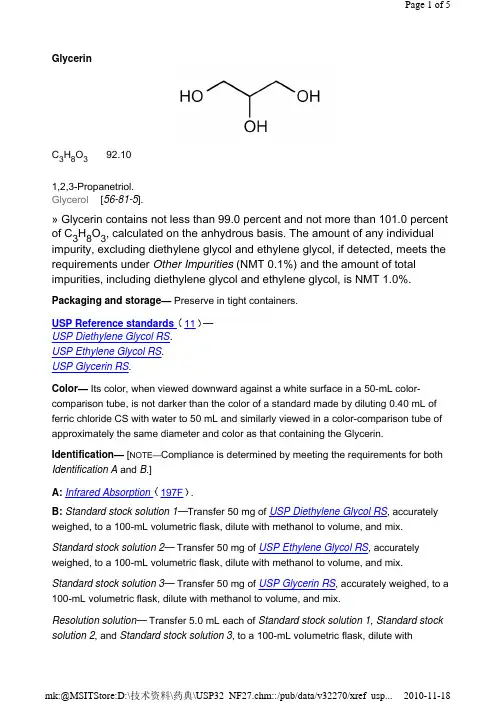
GlycerinC 3H 8O 3 92.101,2,3-Propanetriol.Glycerol [56-81-5].» Glycerin contains not less than 99.0 percent and not more than 101.0 percent of C 3H 8O 3, calculated on the anhydrous basis. The amount of any individual impurity, excluding diethylene glycol and ethylene glycol, if detected, meets the requirements under Other Impurities (NMT 0.1%) and the amount of total impurities, including diethylene glycol and ethylene glycol, is NMT 1.0%. Packaging and storage— Preserve in tight containers.USP Reference standards 11— USP Diethylene Glycol RS . USP Ethylene Glycol RS . USP Glycerin RS .Color— Its color, when viewed downward against a white surface in a 50-mL color-comparison tube, is not darker than the color of a standard made by diluting 0.40 mL of ferric chloride CS with water to 50 mL and similarly viewed in a color-comparison tube of approximately the same diameter and color as that containing the Glycerin.Identification— [NOTE—Compliance is determined by meeting the requirements for both Identification A and B .]A: Infrared Absorption 197F .B: Standard stock solution 1—Transfer 50 mg of USP Diethylene Glycol RS , accurately weighed, to a 100-mL volumetric flask, dilute with methanol to volume, and mix. Standard stock solution 2— Transfer 50 mg of USP Ethylene Glycol RS , accurately weighed, to a 100-mL volumetric flask, dilute with methanol to volume, and mix.Standard stock solution 3— Transfer 50 mg of USP Glycerin RS , accurately weighed, to a 100-mL volumetric flask, dilute with methanol to volume, and mix.Resolution solution— Transfer 5.0 mL each of Standard stock solution 1, Standard stock solution 2, and Standard stock solution 3, to a 100-mL volumetric flask, dilute withmethanol to volume, and mix.Test solution— Transfer about 5 g of Glycerin to a 100-mL volumetric flask, dilute with methanol to volume, and mix.Chromatographic system (see Chromatography 621)— The gas chromatograph is equipped with a flame-ionization detector, a 0.53-mm × 30-m fused-silica analytical column coated with 3.0-µm G43 stationary phase. The injection port temperature is maintained at 220 and the detector temperature is maintained at 250. The carrier gas is helium with a flow rate of about 4.5 mL per minute. The split flow ratio is about 10:1. The chromatograph is programmed as follows: Initially, the column temperature is equilibratedat 100 for 4 minutes, then increased at a rate of 50 per minute to 120, and is maintained at 120 for 10 minutes. It is then increased at a rate of 50 per minute to 220, and is maintained at 220 for 6 minutes. Chromatograph the Resolution solution, and record the peak responses and retention times as directed for Procedure: the relative retention times are about 0.3 for ethylene glycol, 0.8 for diethylene glycol, and 1.0 for glycerin; and the relative standard deviation for replicate injections for the diethylene glycol is not more than 10%.Procedure— Separately inject equal volumes (about 1 µL) of the Resolution solution and the Test solution into the chromatograph, and record the chromatograms. If a peak at the relative retention time for the diethylene glycol or ethylene glycol is present in the Test solution, the peak must be identifed and quantified as directed in the test for Diethylene glycol and ethylene glycol impurities.Specific gravity 841: not less than 1.249.Residue on ignition 281—Heat 50 g in an open, shallow 100-mL porcelain dish until it ignites, and allow it to burn without further application of heat in a place free from drafts. Cool, moisten the residue with 0.5 mL of sulfuric acid, and ignite to constant weight: the weight of the residue does not exceed 5 mg (0.01%).Water, Method I 921: not more than 5.0%.Chloride 221—A 7.0-g portion shows no more chloride than corresponds to 0.10 mL of 0.020 N hydrochloric acid (0.001%).Sulfate 221—A 10-g portion shows no more sulfate than corresponds to 0.20 mL of 0.020 N sulfuric acid (about 0.002%).Heavy metals 231—Mix 4.0 g with 2 mL of 0.1 N hydrochloric acid, and dilute with water to 25 mL: the limit is 5 µg per g.Limit of chlorinated compounds— Accurately weigh 5 g of Glycerin into a dry, round-bottom, 100-mL flask, add 15 mL of morpholine, and connect the flask by a ground joint to a reflux condenser. Reflux gently for 3 hours. Rinse the condenser with 10 mL of water,receiving the washing in the flask, and cautiously acidify with nitric acid. Transfer the solution to a suitable comparison tube, add 0.50 mL of silver nitrate TS, dilute with water to 50.0 mL, and mix: the turbidity is not greater than that of a blank to which 0.20 mL of 0.020 N hydrochloric acid has been added, the refluxing being omitted (0.003% of Cl).Fatty acids and esters— Mix 50 g of Glycerin with 50 mL of freshly boiled water and 5 mL of 0.5 N sodium hydroxide VS, boil the mixture for 5 minutes, cool, add phenolphthalein TS, and titrate the excess alkali with 0.5 N hydrochloric acid VS. Performa blank determination (see Residual Titrations under Titrimetry 541): not more than 1 mL of 0.5 N sodium hydroxide is consumed.Diethylene glycol and ethylene glycol impurities—Internal standard solution— Transfer 100 mg of 2,2,2-trichloroethanol (internal standard), accurately weighed, to a 100-mL volumetric flask, dilute with methanol to volume, and mix.Standard stock solution 1— Transfer 50 mg of USP Diethylene Glycol RS, accurately weighed, to a 100-mL volumetric flask, dilute with methanol to volume, and mix.Standard stock solution 2— Transfer 50 mg of USP Ethylene Glycol RS, accurately weighed, to a 100-mL volumetric flask, dilute with methanol to volume, and mix.Standard stock solution 3— Transfer 50 mg of USP Glycerin RS, accurately weighed, to a 100-mL volumetric flask, dilute with methanol to volume, and mix.Standard solution— Transfer 5.0 mL each of Standard stock solution 1, Standard stock solution 2, and the Internal standard solution to a 100-mL volumetric flask, and dilute with methanol to volume, and mix.Resolution solution— Transfer 500 mg of USP Glycerin RS to a 10-mL volumetric flask, add 0.5 mL each of Standard stock solution 1 and Standard stock solution 2, dilute with methanol to volume, and mix.Test solution— Transfer about 5 g of Glycerin to a 100-mL volumetric flask, add 5.0 mL of Internal standard solution, dilute with methanol to volume, and mix.Chromatographic system (see Chromatography 621)— The gas chromatograph is equipped with a flame-ionization detector, a 0.53-mm × 30-m fused-silica analytical column coated with 3.0-µm G43 stationary phase. The injection port temperature is maintained at 220 and the detector temperature is maintained at 250. The carrier gas is helium, flowing at a rate of about 4.5 mL per minute. The split flow ratio is about 10:1. The chromatograph is programmed as follows. Initially, the column temperature is equilibratedat 100 for 4 minutes, then increased at a rate of 50 per minute to 120, and is maintained at 120 for 10 minutes then increased at a rate of 50 per minute to 220, andis maintained at 220for 6 minutes. Chromatograph the Standard solution, and record thepeak response ratio and retention times as directed for Procedure: the relative retention times are about 0.3 for ethylene glycol, 0.8 for diethylene glycol, and 1.0 for glycerin; the relative standard deviation for replicate injections for the diethylene glycol is not more than 10%; and the limit of quantitation of diethylene glycol and ethylene glycol is not more than 0.025%.Procedure— Separately inject equal volumes (about 1 µL) of the Standard solution and the Test solution into the chromatograph, record the chromatograms, and measure the responses for the ethylene glycol and diethylene glycol peaks. Calculate the percentage of diethylene glycol and ethylene glycol in the portion of Glycerin taken by the formula:100(CS / CU)(RU/ RS)in which CSis the concentration, in mg per mL, of diethylene glycol (or ethylene glycol) inthe Standard solution; CUis the concentration, in mg per mL, of Glycerin in the Testsolution; and RU and RSare the peak response ratios for diethylene glycol (or ethyleneglycol) to the internal standard peak obtained from the Test solution and the Standard solution: NMT the limit of quantitation for each, is found (0.025%).Assay—Sodium periodate solution— Dissolve 60 g of sodium metaperiodate in sufficient water containing 120 mL of 0.1 N sulfuric acid to make 1000 mL. Do not heat to dissolve the periodate. If the solution is not clear, pass through a sintered-glass filter. Store the solution in a glass-stoppered, light-resistant container. Test the suitability of this solution as follows. Pipet 10 mL into a 250-mL volumetric flask, dilute with water to volume, and mix. To about 550 mg of Glycerin dissolved in 50 mL of water add 50 mL of the diluted periodate solution with a pipet. For a blank, pipet 50 mL of the solution into a flask containing 50 mL of water. Allow the solutions to stand for 30 minutes, then to each add 5 mL of hydrochloric acid and 10 mL of potassium iodide TS, and rotate to mix. Allow to stand for 5 minutes, add 100 mL of water, and titrate with 0.1 N sodium thiosulfate, shaking continuously and adding 3 mL of starch TS as the endpoint is approached. The ratio of the volume of 0.1 N sodium thiosulfate required for the glycerin–periodate mixture to that required for the blank should be between 0.750 and 0.765.Procedure— Transfer about 400 mg of Glycerin, accurately weighed, to a 600-mL beaker, dilute with 50 mL of water, add bromothymol blue TS, and acidify with 0.2 N sulfuric acid to a definite green or greenish yellow color. Neutralize with 0.05 N sodium hydroxide to a definite blue endpoint, free from green color. Prepare a blank containing 50 mL of water, and neutralize in the same manner. Pipet 50 mL of the Sodium periodate solution into each beaker, mix by swirling gently, cover with a watch glass, and allow to stand for 30minutes at room temperature (not exceeding 35) in the dark or in subdued light. Add 10 mL of a mixture of equal volumes of ethylene glycol and water, and allow to stand for 20 minutes. Dilute each solution with water to about 300 mL, and titrate with 0.1 N sodiumhydroxide VS to a pH of 8.1 ± 0.1 for the specimen under assay and 6.5 ± 0.1 for the blank, using a pH meter. Each mL of 0.1 N sodium hydroxide, after correction for the blank, is equivalent to 9.210 mg of C 3H 8O 3.Auxiliary Information— Please check for your question in the FAQs before contacting USP.USP32–NF27 Page 2513Pharmacopeial Forum : Volume No. 28(4) Page 1245Chromatographic Column— GLYCERINChromatographic columns text is not derived from, and not part of, USP 32 or NF 27. Topic/Question Contact Expert Committee Monograph Kevin T. Moore, Ph.D.Scientist1-301-816-8369(EM105) Excipient Monographs 1Reference StandardsLili Wang, Technical ServicesScientist1-301-816-8129RSTech@。
美国药典USP31无菌检查
美国药典USP31-NF26无菌检查法《71》.doc71 STERILITY TESTS 无菌检查法Portions of this general chapter have been harmonized with the corresponding texts of the European Pharmacopeia and/or the Japanese Pharmacopeia. Those portions that are not harmonized are marked with symbols () to specify this fact.此通则的各部分已经与欧洲药典和/或日本药典的对应部分做了协调。
不一致的部分用符号()来标明。
The following procedures are applicable for determining whether a Pharmacopeial article purporting to be sterile complies with the requirements set forth in the individual monograph with respect to the test for sterility. Pharmacopeial articles are to be tested by the Membrane Filtration method under Test for Sterility of the Product to be Examined where the nature of the product permits. If the membrane filtration technique is unsuitable, use the Direct Inoculation of the Culture Medium method under Test for Sterility of the Product to be Examined. All devices, with the exception of Devices with Pathways Labeled Sterile, are tested using the Direct Inoculation of the Culture Medium method. Provisions for retesting are included under Observation and Interpretation of Results.下面这些步骤适用于测定是否某个用于无菌用途的药品是否符合其具体的各论中关于无菌检查的要求。
溶出度检查法美国药典USP
溶出度检查法美国药典USP溶出度检查法USP711中英文对照711 DISSOLUTION溶出度(USP39-NF34 Page 540) General chapter Dissolution 711 is being harmonized with the corresponding texts of the European Pharmacopoeia and/or the Japanese Pharmacopoeia. These pharmacopeias have undertaken to not make any unilateral change to this harmonized chapter.通则 711 溶出度与欧盟药典和日本药典中的相应部分相统一。
这三部药典承诺不做单方面的修改。
Portions of the present general chapter text that are national USP text, and therefore not part of the harmonized text, are marked with symbols to specify this fact.本章中的部分文字为本国USP内容,并没有与其他药典统一。
此部分以()标注。
This test is provided to determine compliance with the dissolution requirements where stated in the individual monograph for dosage forms administered orally. In this general chapter, a dosage unit is defined as 1 tablet or 1 capsule or the amount specified. Of the types of apparatus designs described herein, use the one specified in the individual monograph. Where the label states that an article is enteric coated and a dissolution or disintegration test does not specifically state that it is to be applied to delayed-release articles and is included in the individual monograph, the procedure and interpretation given for Delayed-Release Dosage Forms are applied, unless otherwise specified in the individual monograph.本测试用于检测药品口服制剂的溶出度是否符合各论中的规定。
各国药典介绍
各国药典介绍欧洲药典(EP):/欧洲药典委员会1964年成立。
1977年出版第一版《欧洲药典》。
从1980年到1996年期间,每年将增修订的项目与新增品种出一本活页本,汇集为第二版《欧洲药典》各分册,未经修订的仍按照第一版执行。
1997年出版第三版《欧洲药典》合订本,并在随后的每一年出版一部增补本,由于欧洲一体化及国际间药品标准协调工作不断发展,增修订的内容显著增多。
时隔五年,第四版《欧洲药典》于2002年1月生效。
最新版为第五版,即EP5.0,主册EP5.0于2004年夏天出版;增补版EP5.1和EP5.2于2005年出版。
现已经出版到EP6.1。
美国药典(USP):/U.S. Pharmacopeia / National Formulary《美国药典/国家处方集》(简称USP/NF)。
由美国政府所属的美国药典委员会(The United States Pharmacopeial Convention)编辑出版。
USP于1820年出第一版,1950年以后每5年出一次修订版,到2005年已出至第28版。
NF1883年第一 版,1980年15版起并入USP,但仍分两部分,前面为USP,后面为NF。
美国药典是美国政府对药品质量标准和检定方法作出的技术规定,也是药品生产、使用、管理、检验的法律依据。
NF收载了美国药典(USP)尚未收入的新药和新制剂。
美国药典正文药品名录分别按法定药名字母顺序排列,各药品条目大都列有药名、结构式、分子式、CAS登记号、成分和含量说明、包装和贮藏规格、鉴定方法、 干燥失重、炽灼残渣、检测方法等常规项目,正文之后还有对各种药品进行测试的方法和要求的通用章节及对各种药物的一般要求的通则。
可根据书后所附的USP 和NF的联合索引查阅本书。
美国药典最新版为USP31-NF26。
英国药典(BP):/《英国药典》是英国药品委员会(British Pharmacopoeia Commission)的正式出版物,是英国制药标准的重要来源。
国外药典介绍
日本药典简介
简介
《日本药典》(The Jepanese Pharmacopoeia)的名称是《日本药局方 》,英文缩写JP 。由日本药局方编辑委 员会编制,厚生省颁布执行。1886年6月 25号颁布第一版,1887年7月1日开始实
施。日本药典有日文版和英文版。目前最
新版为2011年出版的第十六改正版(即JP16 )。
USP–NF 的不断 修订
修订公告 IRA拟议的修订 说明
勘误表
2019/12/16
美国药典的修订
USP–NF 不断进行修订。 修订包括 USP–NF 年度修订和每年两 次增补,以及 USP 网站上的加速修订。 USP 使用加速修订过程 加快修订美国药典–国家处方集 (USP–NF)。加速修订包括修订公 告、临时修订声明 (IRA) 和勘误表。 是 USP 最快的修订途径,可取代在 USP–NF 及其增补(印刷版 和在线版)中发布的标准。 在 USP 网站上发布的修订公告指示 其正式日期和纳入正式出版物中的日期。 IRA 在 PF 中发布,征求公众意见期为 90 天。 在意见(如果有) 通过审查并且 IRA 得到相关专家委员会的批准后,最终 IRA 将发 布在 USP 网站上。 与修订公告一样,IRA 可取代在印刷版和在线 版的 USP–NF 及其增补中发布的标准。 IRA 被纳入下一个可用的 USP–NF 或增补中。 是指在 USP–NF 或其增补中发布的文字有误,不能准确地反映专 家委员会批准的预期要求。 勘误表发布在网站上,并立即成为正 式版本。 勘误表被纳入下一个可用的正式出版物中。
2019/12/16
http://www.edqm.eu/
欧洲药典发展史
1977年出版第一版《欧洲药典》。 从1980年到1996年期间,每年将增修订的项目与新增品种出一本活页本, 汇集为第二版《欧洲药典》各分册,未经修订的仍按照第一版执行。 1997年出版第三版《欧洲药典》合订本,并在随后的每一年出版一部增补 本,由于欧洲一体化及国际间药品标准协调工作不断发展,增修订的内容显著 增多。 2001年7月,第四版《欧洲药典》出版,并于2002年1月生效。第四版《欧 洲药典》除了主册之外,还出版了8个增补版。 2004年7月,第五版《欧洲药典》出版,即Ph.Eur. 5.0,于2005年1月生效 2007年6月,第六版《欧洲药典》出版,即Ph.Eur. 6.0,于2008年1月生效 2010年6月,第七版《欧洲药典》出版,即Ph.Eur. 7.0,于2011年1月生效, 2013年6月30日, Ph.Eur. 7.0 将不再增补。 2013年7月,第八版《欧洲药典》出版,即Ph.Eur. 8.0 ,2014年1月生效。 Ph.Eur. 8.0为欧洲药典最新版本;