
牛津译林八年级上册英语Unit 8 Natural disasters Reading one课件
What kind of disaster is it?
What can you see or hear in the video?
I can see some houses ________. shaking
feel a slight shake
I can see pieces of glass and bricks falling down ___________.
the desk. 4. Don’t use the lift. 5. Save energy to survive. …
Homework
• Read the whole article and remember new words and phrases.(必做) • Finish Period 2 in your exercise book.(必做) • Recite the article if you can. (选做) • Search for more information about the earthquake on the Internet.(选做)
a.
×b.
×c. ×f.
protect the head
√
d.
√ e.
run in all directions
√
1. Don’t be too worried.
2. Don’t hurry to rush out wildly.
3. Hide in the washing room or under
e
rapped and felt n________. ervous He was t_______
A. 勇敢
B.冷静
C.安静
A. dead
B. ill
C. have life
B. (line 11) C. hopeless A.
Paragraph4
1. Did he shout for help?
What did Timmy do to save himself.
shout for help _______ pull himself slowly ______ dark through the _______
tell himself to ______ calm ______ down Timmy
coming down I can see walls ___________.
run in all directions
/di‘rekʃn/
I can see some people trapped under bricks and stones.
A.
I can hear…
a loud noise like a bomb
find his way _______ out
5 A
2
6 C
I screamed for help.
Some people ran I saw the bright out of building . day light.
B
1
4
3
The earth I was trapped. sTrue or false 1. Timmy was sleeping when the earthquake started. 2. When the earth started to shake, people screamed in fear. surprise. 3. Some people ran out of the building. triedout to run out but he couldn’t. 4. Timmy ran quickly with others. all directions 5. People ran in the same direction in the street.
D
E
F
The walls came down.
What to do in an earthquake
•It’s right/wrong to …
•We should/shouldn’t …
jump out of the window stay in bed
hide under the desk
stay in the corner
He saw
(4)____________________falling down. pieces of glass and bricks (5)________coming down. the walls
Read para.3 and match(连线) the left phrases with the right ones. anything at all. a 1 It was through my mind. b 2 I could not see dark and silent around 3 I did not know me. c 4 My heart was if anyone else was near A moment of fear went me. d 5 beating fast.
T F T F F
He felt
a slight shake at first. (1)______________
a loud noise like _______ thunder then. (2)__________ the real noise like _______________ bombs under the He heard (3)__________ ground soon. ______
screaming in fear I can hear some people ___________.
An earthquake in Taiwan
A. B.
7. Timmy did not try to run out to the street.
F
8. Timmy screamed, but no one heard F him.
Yes, he did. But no one came.
2. What did he start to do?
He started to pull himself slowly through the dark.
3. Was there enough room for him to move?
Yes, there was enough space for him to move.
牛津译林八年级英语上册Unit8 Natural disasters reading 课件
Tornado struck
Something terrible happened on the morning of 24 April. It was something that no one ever thought could take place in this city.
Down from the sky came a dark funnel-like cloud. It reached to the ground. This was a tornado-a wind that goes round and round, sometimes as fast as five hundred miles an hour. It picked up everything in its path: trees, cars, houses, and even people. On and on it moved, right through a part of the city where many people lived.
Hint 4
the result of the heavy rain
destroying the crops
making people leave home
flood
Hint 1
always coming with strong wind
Hint 2
in Beijing
Hint 3
Hint 4
making the air polluted
It happened so fast that no one knew what to do. Many people lay hurt inside destroyed buildings. Fire burned, telephone wires fell and roads were blocked.
8.译林版英语八年级上册第八单元总结
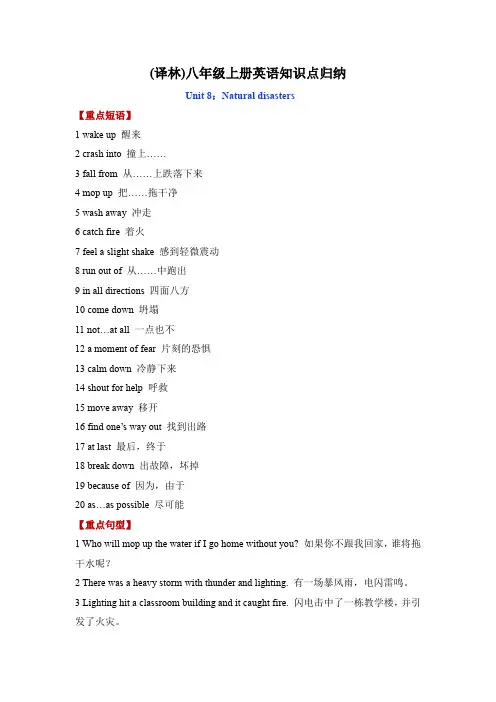
(译林)八年级上册英语知识点归纳Unit 8:Natural disasters【重点短语】1 wake up 醒来2 crash into 撞上……3 fall from 从……上跌落下来4 mop up 把……拖干净5 wash away 冲走6 catch fire 着火7 feel a slight shake 感到轻微震动8 run out of 从……中跑出9 in all directions 四面八方10 come down 坍塌11 not…at all 一点也不12 a moment of fear 片刻的恐惧13 calm down 冷静下来14 shout for help 呼救15 move away 移开16 find one’s way out 找到出路17 at last 最后,终于18 break down 出故障,坏掉19 because of 因为,由于20 as…as possible 尽可能【重点句型】1 Who will mop up the water if I go home without you? 如果你不跟我回家,谁将拖干水呢?2 There was a heavy storm with thunder and lighting. 有一场暴风雨,电闪雷鸣。
3 Lighting hit a classroom building and it caught fire. 闪电击中了一栋教学楼,并引发了火灾。
4 I was sleeping when the earthquake started. 地震发生时我正在睡觉。
5 Outside, people were running in all directions while pieces of glass and bricks were failing down. 外面,人们四处奔跑,成片的玻璃与砖头纷纷落下。
牛津译林版八年级英语上册Unit 8 Natural disasters Task示范公开课教学课件

Suddenly, a strong wind came from behind. I lost my (6) ________ in the wind and I nearly (7) ___ over. We had to walk slowly in the deep snow. When we arrived at the bus stop, we saw many people (8) ________ there. At last, we got on a bus to Millie's home. I stayed at Millie's home that night. I heard the noise of (9) ________ the next morning. People were trying to (10) _______ the snow from the streets.
Para. 3
How did Sandy feel about the wind from behind?What happened to them?What were many people doing?
Revision
Suddenly, a strong wind came from behind. I lost my umbrella in the wind and I nearly fell over. We had to walk slowly in the deep snow. When we arrived at the bus stop, we saw many people waiting there. At last, we got on a bus to Millie's home.
牛津译林初中八年级英语上册 Unit 8 Natural disasters reading 2课件
▪ start to shake
shake one’s head
v.
shake down the apples
shake v.& n.
shaking n.
shook
1) At first, the slight __s_h_a__k_e_/_s_h_a__k_in_gof the house made Timmy frightened.
11. … I told myself to calm down …(line12) calm down 冷静下来,平静下来
calm v. 使平静,使镇静 n. 平静,宁静 adj. 平静的,镇静的
e.g. Just calm down a bit! 你先静一静!
Can you translate the following sentences?
e.g. People screamed in fear. 人们害怕地尖叫起来。
e.g. They got lost in the forest. They had to try different ways in fear. 他们在森林里迷路了,他们不得不害 怕地尝试不同的路。
5. Some ran out of the building. (line5) run out of … 从……跑出 e.g. Some students run out of the classroom.
Fill in the blanks with the correct words or phrases:
shake fall down scream in fear in all directions
try one’s best to protect calm down
牛津译林版八年级上册Unit8《Naturaldisasters》(Grammar)说课稿
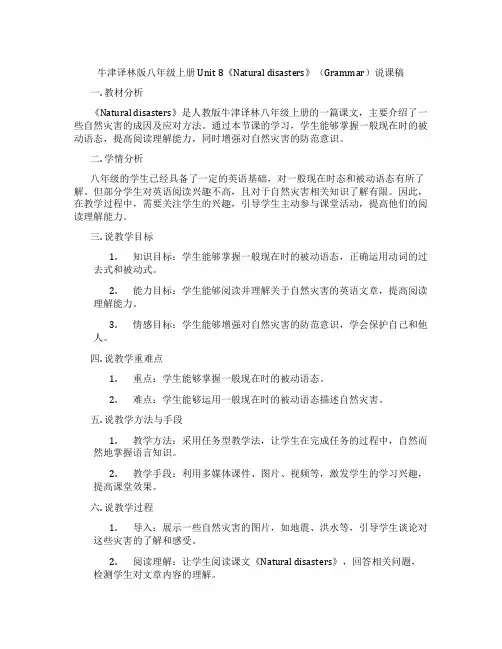
牛津译林版八年级上册Unit 8《Natural disasters》(Grammar)说课稿一. 教材分析《Natural disasters》是人教版牛津译林八年级上册的一篇课文,主要介绍了一些自然灾害的成因及应对方法。
通过本节课的学习,学生能够掌握一般现在时的被动语态,提高阅读理解能力,同时增强对自然灾害的防范意识。
二. 学情分析八年级的学生已经具备了一定的英语基础,对一般现在时态和被动语态有所了解。
但部分学生对英语阅读兴趣不高,且对于自然灾害相关知识了解有限。
因此,在教学过程中,需要关注学生的兴趣,引导学生主动参与课堂活动,提高他们的阅读理解能力。
三. 说教学目标1.知识目标:学生能够掌握一般现在时的被动语态,正确运用动词的过去式和被动式。
2.能力目标:学生能够阅读并理解关于自然灾害的英语文章,提高阅读理解能力。
3.情感目标:学生能够增强对自然灾害的防范意识,学会保护自己和他人。
四. 说教学重难点1.重点:学生能够掌握一般现在时的被动语态。
2.难点:学生能够运用一般现在时的被动语态描述自然灾害。
五. 说教学方法与手段1.教学方法:采用任务型教学法,让学生在完成任务的过程中,自然而然地掌握语言知识。
2.教学手段:利用多媒体课件、图片、视频等,激发学生的学习兴趣,提高课堂效果。
六. 说教学过程1.导入:展示一些自然灾害的图片,如地震、洪水等,引导学生谈论对这些灾害的了解和感受。
2.阅读理解:让学生阅读课文《Natural disasters》,回答相关问题,检测学生对文章内容的理解。
3.语法讲解:讲解一般现在时的被动语态,让学生通过例句和实践,掌握这一语法知识。
4.小组讨论:学生分成小组,讨论如何用英语描述一种自然灾害,以及如何防范。
5.展示与评价:每个小组选择一名代表,展示他们的讨论成果,其他同学和老师进行评价。
6.总结与反思:教师引导学生总结课堂所学,让学生反思自己在课堂上的表现,以及如何提高。
牛津译林版-英语-八上-8单元 Natural disasters pronunciation
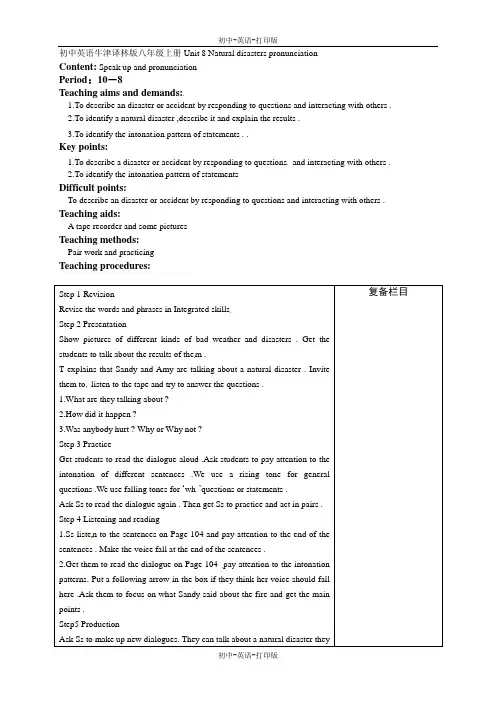
初中英语牛津译林版八年级上册Unit 8 Natural disasters pronunciationContent:Speak up and pronunciationPeriod:10-8Teaching aims and demands:1.To describe an disaster or accident by responding to questions and interacting with others .2.To identify a natural disaster ,describe it and explain the results .3.To identify the intonat ion pattern of statements . .Key points:1.To describe a disaster or accident by responding to questions and interacting with others .2.To identify the intonation pattern of statementsDifficult points:To describe an disaster or accident by responding to questions and interacting with others . Teaching aids:A tape recorder and some picturesTeaching methods:Pair work and practicingTeaching procedures:复备栏目Step 1 RevisionRevise the words and phrases in Integrated skillsStep 2 PresentationShow pictures of different kinds of bad weather and disasters . Get thestudents to talk about the results of the m .T explains that Sandy and Amy are talking about a natural disaster . Invitethem to listen to the tape and try to answer the questions .1.What are they talking about ?2.How did it happen ?3.Was anybody hurt ? Why or Why not ?Step 3 PracticeGet students to read the dialogue aloud .Ask students to pay attention to theintonation of different sentences .We use a rising tone for generalquestions .We use falling tones for ‘wh-’questions or statements .Ask Ss to read the dialogue again . Then get Ss to practice and act in pairs .Step 4 Listening and reading1.Ss liste n to the sentences on Page 104 and pay attention to the end of thesentences . Make the voice fall at the end of the sentences .2.Get them to read the dialogue on Page 104 pay attention to the intonationpatterns. Put a following arrow in the box if they think her voice should fallhere .Ask them to focus on what Sandy said about the fire and get the mainpoints .Step5 ProductionAsk Ss to make up new dialogues. They can talk about a natural disaster theykno w . Pay special attention to the intonation .Step 6 Homework1.Read the dialogues in correct intonation .2.Finish off more exercises.3.Preview Main task: find the new phrases and try to re member them.教学反思:达标检测Unit 6 Speak up and pronunciation (30’)一、用所给的汉语或英语单词的适当形式填空(9’)1.He felt cold and ___________ (frighten ), but he couldn’t move .2.They sent the __________ (受害者) to the hospital at once .3.The snowstorm started again in the afternoon and it got ______ (bad) later .4.Mrs Su hurt her leg but it was not _________ (严重的).5.The snow was heavy and it _______ (覆盖)everything .6.This morning I read a newspaper article about a car ________ (事故).7.I was surprised to see that my pet dog was still _____ (live) after the earthquake .8.The number of the _____________ (survive) of the Titanic was less than eight hundred .9.Pe ople ran in all _______ (direct) when they heard the sudden gun .二、用正确的语音和语调朗读下列句子(8’)1. Did you hear about the flood in Wuhan last month ?2. Were you alone in the car ?3.When will they arrive in Beijing ?4.How much does the baby mouse weigh ?5.Who is the busiest in your family ?6.There was water all round her house .7.He and his family moved his uncle’s house8.The whole road was covered with snow and we couldn’t get out .三、用所给动词的适当形式填空(13’)1.Who is ________ (mop) up the f loor ? It’s so clean .2.It’s unlucky ______ (lose)the game or get ______(lose) in a new city .3.We should try our best ________ (prevent) the sand from _______ (come) to the good farmland in the south .4.Timmy ________ (trap) in a dark place when the earthquake _______ (stop) .5.The radio says that the temperature __________ (drop)a little tomorrow .6.When they _______ (hear)the big noise like thunder ,they ______ (tell) themselves _______ (keep) calm .7.The firemen________ ( put) out the fire soon .8.Bad weather ________ (cause) natural disaster .。
Unit8NaturaldisastersReading课件牛津译林版英语八年级上册
We use the past continuous tense to talk about things that were happening at a particular time or in a period of time in the past.
I did my best to run out to the street too.
6. Outside, people were running in all directions while pieces of glass and bricks were falling down. 外面,人们正在四处逃散。此时,碎玻璃片和砖块 正在往下掉落。
last night.
2. At first, I felt a slight shake. (n) • The earth started to shake. (v.) • Finally, the noise and shaking ended.
shake (v.) — shook(过去式)
e.g. shake one’s head/shoulers shake hands with sb
Put them iI screamed for help.
2. S ome people ran out of the building.
6
6. I saw the bright daylight.
1
4
1sh. aTkhee. earth started to 4. I was trapped.
e.g.既然大家都已经知道了,我就不想再说什么了。 __S_i_n_c_e__ everyone has known about it, I
牛津译林英语八上Unit8Natural disasters Welcome to the unit
=hear of
hear from sb. 收到h1某.asp人tph来e.nh信av.p偶pe然ns发+时生间(或ha地pp点ened)
2.sth. happens to sb./sth. 某人/某
听说
物发生了某事(常指不好的事情)
一场电闪雷鸣的强暴风雨
着火(强调动作),过去时:caught; be on fire 着火(强调状态)。
Flood
What is a natural disaster ?
natural disaster 自然 灾害 /dɪˈzɑːstə / A natural disaster is an event with a natural, as opposed to human, cause that results in large-scale loss of life or damage to property.
猛撞,撞 /kræʃ/
A coach crashed into a house.
/kəutʃ/ 长途汽车;教练
/ˈæksɪdənt/ 事故
“Accidents” or “Disasters”?
The accidents are caused by_h_u_m__a_n_s___, while the natural disasters are caused by__n_at_u_r_e_.
3.Why doesn't Hobo want to go home alone?
Why doesn't Hobo want to go home alone?
Because he needs Eddie to mop up the water.
牛津译林版八年级上册Unit8《Naturaldisasters》(Studyskills)说课稿
牛津译林版八年级上册Unit 8《Natural disasters》(Study skills)说课稿一. 教材分析《牛津译林版八年级上册Unit 8 Natural disasters》是一篇关于自然灾害的文章,通过介绍地震、台风、洪水等自然灾害,让学生了解自然灾害的特点以及如何应对。
本课内容与学生的生活息息相关,能够激发学生的学习兴趣。
文章语言简练,图文并茂,有助于学生理解和掌握知识。
二. 学情分析八年级的学生已经具备了一定的英语基础,能够进行简单的阅读和交流。
但学生在阅读长篇文章时,可能会遇到生词和语法障碍,影响阅读理解。
因此,在教学过程中,教师需要帮助学生克服这些困难,提高阅读理解能力。
三. 说教学目标1.知识目标:让学生掌握与自然灾害相关的词汇和表达方式,如earthquake、typhoon、flood等。
2.能力目标:培养学生阅读长篇文章的能力,提高学生的阅读理解水平。
3.情感目标:培养学生关爱生命,关注自然的意识,增强学生应对自然灾害的能力。
四. 说教学重难点1.重点:让学生掌握与自然灾害相关的词汇和表达方式。
2.难点:理解文章中涉及的复杂句子结构和语法现象。
五. 说教学方法与手段1.教学方法:采用任务型教学法,让学生在完成任务的过程中,掌握知识,提高能力。
2.教学手段:利用多媒体课件、图片、视频等辅助教学,增强学生的学习兴趣。
六. 说教学过程1.导入:通过展示自然灾害的图片,引导学生谈论自然灾害,激发学生的学习兴趣。
2.阅读理解:让学生阅读文章,回答相关问题,提高学生的阅读理解能力。
3.词汇学习:讲解文章中出现的生词和短语,让学生掌握与自然灾害相关的词汇。
4.语法讲解:分析文章中的复杂句子结构和语法现象,帮助学生理解。
5.小组讨论:让学生分小组讨论如何应对自然灾害,培养学生的合作意识。
6.总结:对本节课的内容进行总结,强化学生的记忆。
7.作业布置:让学生课后写一篇关于自然灾害的短文,提高学生的写作能力。
Unit 8 Natural disasters Welcome-课件 八年级英语上册(牛津译林版)
Presentation
Listen and Answer
1. What happened to Vivien’s school last week?
There was a heavy storm with thunder and
lightning, and the school caught fire. 2. What caused the fire in Vivien’s school?
A: Did you hear about the…+时间?
B: No. What happened? A: It was in +地点.... (描述)
what
a flood
when
last month
where
Wuhan
consequence It washed away villages.
s(后果)
Presentation
Listen and imitate
Presentation
1. Pay attention to your tone and intonation (语调);
2. Use your body language.
Presentation
Let’s fill
一:此句是由when连接的复
typhoon
Sometimes bad weather may cause disasters.
Free Talk
A: What’s the weather like?
B: It’s…
foggy
windy
snowy
y