
八年级英语下册 Unit 4 Why don’t you talk to your parents
Unit4. why don’t you talk to your parents?Period2 SectionA3a-4c【学习目标】知识与技能(1)熟练掌握下列词汇:relation communication argue cloud elder instead whatever nervous offer proper secondly communicate explain clearcopy return anymore(2)熟练掌握下列短语:too much, too many, look through, give back, so that,spend…on, leave sth. at sp., be afraid of, not…anymore(3)掌握下列句型:1. My problem is that I can’t get on with my family.2. Instead he watches whatever he wants until late at night.3. If your parents are having problems, you should offer to help.4. Secondly, why don’t you sit down and communicate with your brother?5. Can you explain to me how to do this math problem?过程与方法阅读理解训练,语法总结与练习情感、态度与价值观遇到问题要主动地去和家人、朋友或亲近的人交流;如果遇到身边的人遇到问题,能主动提供帮助【教学重难点】重点:1.掌握7个单词 1个短语(relation, argue, cloud, instead, whatever, nervous, offer, get on with)2.能正确运用情态动词could, should掌握本部分出现的生词和词组,达到熟练运用的目标。
3. 阅读短文,获得相关的信息。
通过阅读练习,来提高阅读能力。
难点:熟练的把本书的语言知识运用于实践中,会建议别人如何处理麻烦。
【导学过程】一.新课预习英译汉1.get on with2.hang over3.talk aboutmunicate with,5.make sth clear6.get enough sleep7.not... any more汉译英1. _____________和睦相处;关系良好:2. _____________经常吵架/打架3. _____________ 一大片乌云4. _____________笼罩5. _____________ 拒绝做某事6. _______ 感到孤独、焦虑7. _____________主动提出做某事 8. _____________以便9. _____________ 介意某人做某事 10. _____________一直11. _____________ 使某事清楚易懂二. 情景导入1). RevisionSome Ss give some problems. Other Ss give advice.Problems and advice:1. I have to study too much so I don’t get enough sleep.Why don’t you go to sleep earlier this evening?2. I have too much homework so I don’t have any free time to do things I like. Why don’t you go camping with your friends this weekend?3. My parents don’t allow me to hang out with my friends.Why not read some interesting books at home?4. I have too many after-school classes.Why don’t you talk about it with your parents?5. I got into a fight with my best friend.Why not call him up?Role-play the conversation of 2d.2) .Present the new words1. relation n.关系;联系;交往e.g. Their relation seemed quite close. 他们的关系看起来很亲密。
2. argue v. 争吵;争论e.g. The couple began to argue about the child’s educat ion.那对夫妇开始就孩子的教育问题争吵。
3. proper adj.正确的;恰当的e.g. It’s not proper to visit a friend too late in the evening.太晚了,去看朋友不合适。
4. nervous adj. 焦虑的;担忧的e.g. Don’t be nervous. It is just a small test. 不要紧张。
就是个小测试而已。
5. clear adj.清楚易懂的;晴朗的e.g. The sun shone out of a clear sky. 天空晴朗,阳光灿烂。
3). Lead in通过问答一些有关家庭生活的问题来导入正题:1. Can you get on well with your family?2. Are the relations between your parents good?3. Do you have any brothers or sisters? Can you get on well with him/her?4. Who do you ask for help when you have problems?三.合作探究1. Reading.Work on 3a:Tell Ss to read the article in 3a quickly and try to find the answers to these questions:What’s Sad and Thirteen’s problem?How does he feel at home?Ss read the article again and fill in the chart.Ss read the article again and fill in the blanks.2.Work on 3b:让学生们讨论罗波特先生对问题的建议,并发表自己的看法。
学生们分小组讨论,发表自己的意见,由小组长汇总。
让小组长并汇总的意见和其他同学汇报。
3.Work on 3c告诉学生们本学习活动的要求:找出短文与下列词汇意思相同的句子。
让学生们先读3c中的词汇,理解其意思,然后再在短文找出与其意思相同的词汇或词组。
Check the answers。
让学生们用这些词汇或词组造句子。
4.Grammar Focus.学生阅读Grammar Focus中的句子,然后做填空练习。
① 你看上去很疲劳,怎么了?You ____ tired. What’s _____ _______?② 昨晚,我一直学习到午夜,因此我没有睡足觉。
I studied _____ _________ last night so I didn’t ___ ______ sleep.③我应该做什么? ________ ____I do?你为什么不忘掉此事呢?尽管她错了,但那不是一件大事。
_____ ____ you forget about it? ______ she’s wrong. It’s not _____ _____ ______.④他应当如何做?_______ _______ he do?⑤他应当和他的朋友交谈一下,以便于他能向他道谦。
He _____ _____ _____ his friends ____ ___ he can say he’s sorry.⑥ 或许你应当去他家。
_______ you ______ go to his house.⑦ 我想我可以,但是我不想让他吃惊。
I think I _______, but I don’t want to _______ _________.四.点拨总结1.argue verb ~ (with sb) (about/over sth) 争论;争吵;争辩•My brothers are always arguing.我的兄弟们总是争论不休。
•I don't want to argue with you—justdo it! 我不想和你争辩——请干吧!别和我争辩。
Don't ______ _____ me.我们总是为钱吵嘴。
We're always ______ _____ each other _____money.2.explain/ɪkˈspleɪn/ verb说明,解释~ sth (to sb)It was difficult to explain the problemto beginners. 对初学者解释这个问题很难。
First, I'll explain the rules of thegame. 首先我要说明一下游戏规则。
Before she ran away, she left a note explaining her actions.逃跑前,她留下一张便条解释原委。
—'Let me explain, sir.' — 'Don't tell me about it. I don't want to know.' “您听我解释,先生。
”——“别跟我说,我不想知道。
”你能说明一下电子邮件系统的工作原理吗?______ _____ ________how the email system works?‘It works like this,’ she _______.“它是这样工作的。
”她解释道。
3.elder adj. [only before noun]指人,尤指同一家庭里两个成员年纪较长的my elder brother我的哥哥his elder sister他的姐姐the elder of her two daughters.她两个女儿中年长的那个辨析 older ♦ elderold 的比较级通常为 older。
人教新目标八年级英语下册unit4知识点

⼈教新⽬标⼋年级英语下册unit4知识点Unit 4 Why don't you talk to your parents?重点短语hang out闲逛, too many太多, get into a fight争吵,go to sleep去睡觉, call sb up给某⼈打电话be good at擅长,talk about谈论, on the phone在电话中, have a fight打架,look through浏览, give back归还, be angry with sb⽣某⼈的⽓, big deal重要的事, thanks for因…⽽感谢, no problem没问题, work out成功的发展解决, get on with和睦相处, feel lonely感到孤独,sit down坐下. communicate with sb与某⼈交流, next time下次,make friends交朋友, be worried about担忧, study for a test为考试⽽学习, be afraid of害怕, in front of在…前⾯, not anymore不再,play sports做运动, watch movies看电影, so much/many那么多,do homework做作业, have lessons上课, do chores做家务,cut out删除, a few⼏个少许, all kinds of各种各样的, compare with把…与…⽐较, join after- school activities参加课外活动, in one's opinion依…看, turn down调⼩, be good for对…有好处动词短语allow sb to do sth允许某⼈做某事, why don't you do sth你为什么不做某事呢,want to do sth想要做某事, find sb doing sth发现某⼈正在做某事,tell sb to do sth告诉某⼈要做某事, refuse to do sth拒绝做某事,let sb do sth让某⼈做某事, offer to do sth 主动提出做某事,mind sb doing介意⼲某事, not …until直到……才,want sb to do想让某⼈做某事, it's time for sth该做某事了,it's adj to do做某事是…的, keep on doing继续做某事,why do you think of…?你认为…怎么样, what's wrong哪⼉不舒服.重点句⼦My parents don't allow me to hang out with my friend.I got into a fight with my best friend.What's wrong?I'm not good at writing letters.I don't want to talk about it on the phone.I found my sister looking through my thingings yesterday.I guess you could tell her to say sorry.Although she's wrong it's not a big deal.My problem is that I can't get on well with my family.Relations between my parents have become difficult.I don't know if I should say anything to them about this.When they argue, it's like a big black cloud, hanging over our home.Although my elder brother is not very nice to me.Instead he watches whatever he wants until late at night.At home I feel lonely and nervous.If your parents are having problems you should offer to help.Maybe you could do more jobs around the house, so that they have more time for proper communication. Secondly , why don't you sit down and communicate with your brother?You should explain that you don't mind him watching TV all the time.My cousin borrows my things without returning them.You left your homework at home.You're afraid of speaking in front of people.Your best friend, doesn't trust you anymore.The Taylors are a typical American family.Maybe I could cut out a few of their activities.I really want them to be successful.However the tired children don't get home until after 7:00 p.m.They have a quick dinner,then it's time for homework.In some families, competition starts very young and continues until the kids get older.And they are always comparing them with other children.It's crazy.People shouldn't push their kids so hard.Doctor says too much pressure is not good for a child's development.Doctor Alice Green says all these activities can cause a lot of stress for children.重点1.allow sb to do sth允许某⼈做某事allow sth允许某事allow doing sth 允许做某事be allowed to do sth被允许做某事The doctor allowed him to take a short walk every day.I don't think she will allow it.We don't allow smoking in our house.We are not allowed to throw rubbish everywhere.2.Get into a fight with sb=Have a fight with sb.=fight with sb.和某⼈打架We can't get into a fight with each other at school.3.What's wrong?=what's the matter?询问某⼈有什么问题,有什么不顺⼼的事,询问某物出了什么⽑病?What's wrong?I left my bag on the bus.What's wrong with your finger?There is something wrong with my bike.Your answer is wrong but hers is right.4.Be good at擅长⼲某事, be good for对…有益be good to对…好be good with善于应付…的.He is good at drawing.Drink more water is good for you.She is very good to her neighbors.He's very good with children.5.On the phone⽤电话交谈, on the Internet 通过互联⽹on the radio.通过收⾳机What did you say on the phone?He is chatting on the Internet.6、Look through查看,浏览, look after照顾. Look at看着, look for寻找,look out of向…外看, look forward to doing.盼望⼲某事The through the passage quickly and answer the questions.7.I guess +宾语从句(变否定句时,否定要前移)I guess that he's right.I don't guess that he is right.8.Say sorry /hello /thanks/ goodbye to sb.向某⼈抱歉/问候/感谢/道别。
八年级英语人教版下册Unit4Whydon'tyoutalktoyourparents教学设计

(4)巩固:通过听力、阅读练习,帮助学生巩固所学知识,提高听力和阅读能力。
(5)拓展:鼓励学生课后观察和思考家庭成员之间的沟通问题,尝试用英语与家人进行有效沟通,将所学知识运用到实际生活中。
3.教学评价设想:
5.引导学生树立正确的人生观和价值观,关注家庭和谐,为构建和谐社会贡献自己的力量。
二、学情分析
八年级的学生已经具备了一定的英语基础,他们在一、二年级的学习中,掌握了基本的语法、词汇和日常会话。在此基础上,他们对英语学习有了更深入的了解,具备了一定的自学能力和合作学习能力。然而,在语言实际运用方面,尤其是家庭成员之间的沟通问题,学生们的表达能力和解决问题的能力还有待提高。
5.教师在教学过程中关注学生的个体差异,给予个性化的指导和鼓励,提高学生的学习信心。
(三)情感态度与价值观
1.培养学生关爱家人、尊重家庭成员之间的差异,学会与家人沟通、解决问题的情感态度。
2.培养学生团结协作、互相帮助的精神,增强团队意识。
3.培养学生面对问题时,保持积极乐观的心态,勇于承担责任。
4.增进学生对家庭、亲情和友谊的认识,培养珍惜家人、朋友之间的感情。
(1)形成性评价:关注学生在课堂活动中的表现,鼓励学生积极参与,给予及时的反馈和指导。
(2)终结性评价:通过单元测试、口语表达等形式,全面评估学生的学习效果。
(3)个性化评价:针对学生的个体差异,给予个性化的评价和指导,激发学生的学习兴趣和自信心。
四、教学内容与过程
(一)导入新课
1.教师展示一幅家庭成员争吵的图片,引导学生观察并思考:“What is happening in this picture? Can you guess why they are arguing?”
人教版八年级英语下册Unit 4 Why don’t you talk to your parent
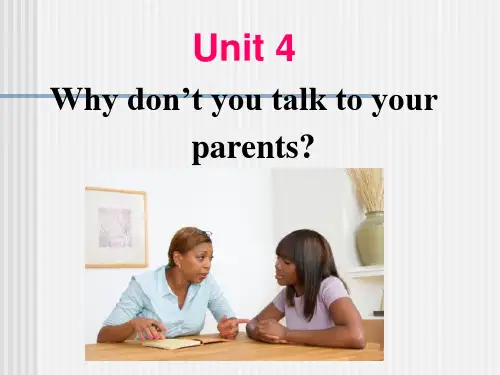
1. Why don’t you talk to your parents? 为什么不跟你的父母谈谈呢?
【自主领悟】(1)Why don’t you do sth. ? 这是一个否定疑问 句, “为什么不……? ”常用来征求意见和提出建议, 相当于 Why not do sth. ? 句式。例如: Why don’t you go with us? = Why not go with us? 为什么不同我们一起去呢? (2)talk to sb. 意为“同某人谈话”。例如: He talked to me about my study. 他跟我谈了关于我的学习的事情。
Unit 4 Why don’t you talk to your parents?
Section A (1a-2d)
Ⅰ. 短语互译 1. get enough sleep 2. have a fight with sb. 3. look through 4. hang out 5. 把……归还给…… 6. 允许某人干某事 7. 成功地发展; 解决 答案: 1. 有足够的睡眠 2. 跟某人打架 3. 浏览 4. 闲逛 5. give. . . back to. . . 6. allow sb. to do sth. 7. work out
【归纳拓展】allow的不同搭配 (1)allow sth. /doing sth. 允许(做)某事 例如: We don’t allow eating in the classroom. 我们不允许在教室里吃饭。 (2)allow sb. sth. (双宾语)给予某人某物 例如: He allows his son too much money. 他给他儿子太多的钱。
speak to sb. “跟某人讲话”
英语八年级下册Unit4-Why-don't-you-talk-to-your-parents-全单
with sb.
What’s the problem/the trouble? 并能讨论所给出的建议。
Do you have any problems in your daily life?
What problems do you have?
How do you solve them?Give some advice.
the ball game.
the phone.
Pair work
2c Role-play a conversation between Peter and his friend.
A: What’s the matter, Peter? B: I had a fight with my best friend.
so that you can say
surprise him.
you’re sorry.
d. I’m not good at
4.You could go to his
writing letters.
house.
e. I don’t want to
5.You could take him to
talk about it on
1. I have to study too much so I don’t get enough sleep.
2. I have too much homework so I don’t have any free time to do things I like.
3. My parents don’t allow me to hang out with my friends.
with sb.
What’s the problem/the trouble? 并能讨论所给出的建议。
人教新目标版英语八下Unit4《Whydon’tyoutalktoyourparents》说课稿

人教新目标版英语八下Unit 4《Why don’t you talk to your parents》说课稿一. 教材分析人教新目标版英语八下Unit 4主要讨论了如何与父母沟通的问题,通过本节课的学习,学生能够掌握一定的沟通技巧,提高与父母交流的能力。
本单元的主题贴近学生的生活,有利于激发学生的学习兴趣和积极性。
二. 学情分析根据我对学生的了解,他们在学习过程中已经掌握了基本的英语语法和词汇,具备一定的听说读写能力。
但部分学生在与父母沟通方面存在一定的困扰,可能因为害羞、害怕被批评等原因而不愿意与父母交流。
因此,本节课的教学目标在于帮助学生克服这些障碍,提高他们的沟通能力。
三. 说教学目标1.知识目标:学生能够掌握本节课的重点词汇和句型,如“Why don’tyou…?”,“Because…”等,并能够运用这些词汇和句型进行简单的交流。
2.能力目标:学生能够通过听力、口语、阅读和写作等多种方式,提高自己的英语应用能力。
3.情感目标:学生能够认识到与父母沟通的重要性,学会尊重和理解父母,提高与父母相处的质量。
四. 说教学重难点1.重点:本节课的重点是让学生掌握并运用句型“Why don’t you…?”和“Because…”进行交流。
2.难点:如何帮助学生克服害羞、害怕被批评等心理障碍,提高他们与父母沟通的勇气和信心。
五. 说教学方法与手段1.任务型教学法:通过设计各种真实的任务,让学生在完成任务的过程中运用所学知识,提高英语实际应用能力。
2.情境教学法:创设各种与父母沟通的情境,让学生在模拟实践中学会如何与父母交流。
3.小组合作学习:通过小组讨论、分享等方式,促进学生之间的互动,提高他们的合作能力和沟通能力。
六. 说教学过程1.导入:通过一个关于父子间沟通的小故事,引发学生对与父母沟通的思考,激发他们的学习兴趣。
2.呈现:介绍本节课的主题,展示相关的词汇和句型,让学生初步感知和学习。
3.实践:设计各种与父母沟通的情境,让学生在模拟实践中运用所学知识。
人教新目标八年级英语下册Unit4Whydon'tyoutalktoyourparents说课稿
人教新目标八年级英语下册Unit 4 Why don’t you talk to your parents说课稿一. 教材分析人教新目标八年级英语下册Unit 4 Why don’t you talk to your parents是一篇关于日常交流和沟通的文章。
本篇文章主要讲述了在遇到问题时,如何与父母沟通,寻求解决方案。
通过本节课的学习,学生能够掌握情态动词why not的用法,以及如何运用交际策略进行日常交流。
教材内容贴近学生生活,有利于激发学生的学习兴趣和积极性。
二. 学情分析八年级的学生已经掌握了基本的英语语法和词汇,具备一定的听说读写能力。
但在实际交流中,学生往往因为害羞、紧张等原因不敢开口说英语,本题正好可以引导学生学会如何与父母沟通,提高他们的交际能力。
同时,学生在这个年龄段开始关注家庭和社交问题,对本节课的内容会产生浓厚兴趣。
三. 说教学目标1.知识目标:学生能够掌握情态动词why not的用法,了解日常交际中的沟通策略。
2.能力目标:学生能够运用所学知识进行日常交流,提高口语表达能力。
3.情感目标:学生学会与父母沟通,增进家庭关系,培养良好的交际习惯。
四. 说教学重难点1.重点:情态动词why not的用法和日常交际策略。
2.难点:如何运用所学知识进行实际交流,克服羞涩、紧张等心理障碍。
五. 说教学方法与手段1.情景教学法:通过设定情景,让学生在实际语境中学习英语,提高交际能力。
2.任务型教学法:学生分组完成任务,激发学习兴趣,培养合作精神。
3.互动式教学法:教师与学生互动,引导学生积极参与课堂讨论,提高口语表达能力。
六. 说教学过程1.导入:用一段关于家庭沟通的短片引出本节课的主题,激发学生的学习兴趣。
2.新课呈现:教师展示文章,引导学生关注文章标题和关键词,预测文章内容。
3.课堂讲解:教师讲解情态动词why not的用法和日常交际策略,让学生通过例句理解并掌握。
4.实践环节:学生分组进行角色扮演,运用所学知识进行实际交流,教师巡回指导。
Unit-4-Why-don’t-you-talk-to-your-parents教材分析
Unit 4 Why don’t you talk to your parents?教材分析I.单元教材分析:本单元的话题(Topic)是“Interpersonal communication(人际交往)”。
功能项目(Functions)是“Talk about problems (谈论困难);Give advice (提出建议)。
本单元主要探讨当代中小学生所面临的种种压力和困境。
学会询问、陈述自己或他人的困难和麻烦;并针对别人的困境,使用情态动词could,should 以及Why don’t you...?句型提出解决的办法和建议;阅读文章Maybe You Should Learn to Relax,通过学习比较了东西方家长对子女教育的态度和做法,通过该部分学习,让学生学会换位思考,帮助他们逐步建立正确、积极的生活态度和价值观。
II.学情分析:本单元话题是人际交往,这个话题与学生实际生活紧密相关,主要探讨当代中小学生所面临的种种压力和困境,并针对针对这些问题给予合理地建议。
重点学习用What’s wrong?询问他人的麻烦;学习用What should I do?征求别人的建议;学习使用情态动词could,should以及Why don’t you...?句型提出解决的办法和建议;学习使用连词until,so that,although。
在Unit1已经学习力用What’s the matter with...?询问病情,其中也涉及了What’s wrong的学习,对于学生来说,已是比较熟悉的句型;而在前几个单元中,逐步学习了情态动词should,could表示建议,相信学生掌握起来也很容易;学习连词until,so that,although的用法,是本单元的重点也是难点,教师要多举例子,让学生真正明白状语从句的使用。
III.教学目标1.知识目标:A.掌握以下词汇:allow,wrong,midnight ,guess,deal,relation,communication,argue,cloud,elder,instead,whatever,nervous,offer,proper,secondly,communicate,explain,clear,copy,return,anymore,member,pressure,compete,opinion,skill,typical,football,quick,continue,compare,crazy,push,development,cause,usual,perhaps。
人教版八年级英语下册Unit4Whydon’tyoutalktoyourparents教学设计
1.教师呈现教材中的对话,引导学生跟读并理解对话内容,掌握核心词汇和短语。
2.教师对一般现在时和一般过去时进行讲解,结合实例句子,让学生观察、分析并总结语法规则。
3.学生跟随教师进行句型替换练习,巩固所学语法知识。
4.教师引导学生关注教材中的问题解决策略,帮助学生学会如何运用英语寻求合理的解决办法。
2.学生观看视频后,教师提出问题:“Do you have any problems communicating with your parents? How do you usually solve these problems?”让学生思考并分享自己的经历。
3.教师根据学生的回答,总结出本节课的主题:“Why don't you talk to your parents?”并板书。
4.通过听力、阅读、写作等实践活动,提升学生对英语语言的实际运用能力,培养学生解决问题的能力。
(二)过程与方法
1.通过小组合作、讨论等方式,让学生在互动中学习,提高学生的合作意识和沟通能力。
2.利用多媒体教学资源,如音频、视频等,激发学生的学习兴趣,提高学生的学习积极性。
3.引导学生通过观察、思考、总结等过程,掌握有效的学习方法和策略,培养学生自主学习的能力。
教学策略:运用角色扮演、小组讨论等形式,激发学生的参与热情,提高课堂互动性。
2.词汇教学:通过例句、图片、故事等多种方式,帮助学生理解和记忆本章节的核心词汇和短语。
教学策略:设计词汇接龙、单词卡片等游戏,让学生在轻松愉快的氛围中学习词汇。
3.语法教学:以问题为导向,引导学生发现和总结一般现在时和一般过去时在句子中的应用规律。
5.课堂延伸:学生观察和思考家庭中的沟通问题,尝试运用所学知识为家庭成员提供沟通建议。将观察到的实例和提出的建议整理成文字,下节课与同学分享。
人教八年级英语下册《Unit4 Why don't you talk to your parents
2.有毛病,错误的 4.午夜,子夜 6.猜测,估计 8.重要的事 10.和睦相处,关系良好 12.交流,沟通(n.) 14.云,云朵 16.代替,反而 18.焦虑的,担忧的 20.正确的,恰当的 22.交流,沟通(v.) 24.清楚易懂的,晴朗的 26.归还,回来
1.look through 浏览
He is looking through the books in the library.
look around 四处张望 look up 向上看;查找 look into 调查 look after 照顾;照看 look at 看看 look for 寻找
2 .Although she’s wrong , it’s not a big deal. 尽管她做得不对,但也没什么大不了的。 although 引导让步状语从句 虽然;尽管 big deal 重要的事情或状况 It is not a big deal.= It is no big deal. deal n. 协议;交易 n.大量 a good / great deal (of sth) vi.处理;应对 deal with
3 Hope things work out. 希望事情会好起来。 work out解决(问题)改善(状况)
Do you want to stay with us to see how things work out?
1.用功学习
2.得到足够的睡眠
人教版八年级英语下册集体备课教案:Unit4 Why don’t you talk to your
课题课时Period 1教学目标语言技能听:能听懂他人他人陈述困难和麻烦的简单对话的内容,并获取主要信息。
说:1.能询问、陈述自己或他人的困难和麻烦,如What’s wrong?I’m really tired because I studied until midnight last night.2.能针对别人的困境提出解决的办法和建议,如What should Ido?Well,you should call him so that you can say you’re sorry.语言知识语音:熟练把握邀请句的升调语调,同时,在口语交流时能做到语音、语调准确、自然、流畅。
词汇:1.熟练运用:allow,wrong,midnight,guess,de al.2.掌握:What’s wrong, look through,work out.语法:1.能正确使用情态动词could,should表达或劝告,如:Youcould go to his house.2.能正确使用Why don’t you...?句型表达建议。
功能:学会询问、陈述自己或他人的困难和麻烦。
话题:了解人际交往的相关知识。
情感态度1.培养学生用英语交际能力,学会与人进行流畅的沟通和交流;2.使学生在活动中学会真诚、坦然地与人交谈。
学习策略认知策略:能在具体的情境中询问、陈述自己或他人的困难和麻烦,从而进一步主动练习和实践。
调控策略:.能针对别人的困境提出解决的办法和建议,并与人进行交流。
交际策略:培养学生合作能力,不断完善知识点,加强对话练习,学会与人闲聊,进行交流。
资源策略:通过多媒体、录音机等教学辅助工具。
文化意识了解中西方家长对待孩子参加课外活动和课外学习班的态度与做法。
教学重难点教学重点1.能正确使用情态动词could,should表达或劝告。
2.能正确使用Why don’t you...?句型表达建议。
教学难点1.Talk about problems.2.Give advice.教学方法听说法,交际法,教学辅助手段PPT, recorder.板书设计Unit4 Why don’t you talk to your parents?Sectio n A 1a-2dallow What’s wrong?wrong Why don’t you...?midnightguessdeal教后反思本节课学会了提建议的方式有:Why don’t you...? /Why not…?等Teaching ProcedureStages/TimingStep 1. warming-upStep 2 PresentationStep3 DiscussionStep 4Pre sentationStep 5 ListeningTeach ers’ a ctivitiesAfter greeting, ask students :What day is it today?What’s the date today?What’s the weather like today?1. Show the picture of a girl:T: Please look at this girl,what isshe doing?T: Look at her face,she isworried.because she has a lotof homework to do.Do yo uhave too much homework todo?Do you think it is serious?1a.Get them to read the followingsentences and discuss wheatherthey are serious or not. And thenwrite them in the approprite boxT:Do you have theseproblems?What kind of problemsdo you have?Students’ activitiesStudents answer the questions。