
牛津译林英语七年级上册 Unit 4 My day Reading -- School life优质课件
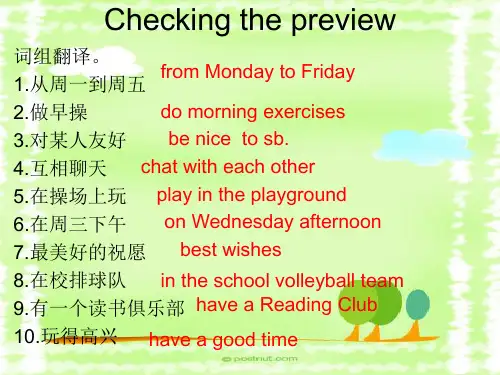
短语翻译
1.起床 2.上早读课 3.吃早饭 4.上课 5.做操 6.吃午饭 7.进行课外活动 8.回家 9.吃晚饭 10.看电视 11.做家庭作业 12.就寝 1.Get up 2.Have morning lessons 3.Have breakfast 4.Have lessons 5.Do morning exercises 6.Have lunch 7.Do after-school activities 8.Go home 9.Have dinner 10.Watch TV 11.Do homework 12.Go to bed
6.30p.m. Have dinner
7.00p.m. Watch TV
11.50a.m. Have lunch
7.30p.m. Do homework
9.30p.m. Go to bed
1.30p.m.
Have lessons
My day
Hi, I’m _______. I’m _____ years old.
1. wake up
醒来, 叫醒
把米莉叫醒 wake up Millie/wake Millie up 把我叫醒 wake me up wake up early 醒得早
What time does the clock _____ every morning?
A. wake to you B. wake up you
at her school
They do morning exercises
They have lessons.
adv. 首先,第一
They do morning exercises first, then they start /begin their lessons at 8 o’clock.
Does Eddie know how to have fun?
How to help him?
go to sleep=have a good rest
Post-comic: Task 5: Help Hobo fill in the blanks:
Hi, everyone! I am going to tell you something about my master Eddie. Eddie never ___________ wakes up early. So I ______ wake him______ every day. After breakfast, he up wants to ____________ go to sleep , then he has lunch _______. for Look! It’s 12:30 p.m. It’s time _____ lunch, but he is still sleeping. And I am sure, he _________ wants to go to sleep again after lunch. He just doesn’t know how to ________. have fun
C. wake you to
D. wake you up
2. Is it time for breakfast? 早餐时间到了吗? It’s time for sth. It’s time to do sth. It is time for sb to do sth. (1) It is time _______supper. A.to B.for C.with D.At to have (2) It is time for us ________(have) the meeting. (3) 你该擦黑板了。 for you to clean It’s time _______________the blackboard.
I study at _______________.
I have many things to do every day. I get up at…
I have lessons …
…
…
I do homework … I go to bed…
School life
Millie’s activities
3. Some dogs just don’t know how to have fun.
有些狗就是不知道如何找乐子。
(1)我知道如何做一个好孩子.
I know _________a how to be good child. (2)她不知道如何打网球。 She doesn’t know _____________tennis. how to play 4. After lunch, I always need a good rest. 午饭后,我总是需要好好休息。 need sth. need to do sth (1) 我搬不动这些书,我需要些帮助。 I can’t ______ need some help carry these books. I _________________. (2)冰箱里没有食物了,我需要买一些。 buy some There’s no food in the fridge and I need to _________.
6.30a.m.
பைடு நூலகம்
7.00a.m.
7.20a.m. 8.00a.m. 8.15a.m.
Get up Have breakfast Go to school Do morning exercises Have lessons
4.00p.m.
Do after-school activities
4.30p.m. Go home
Unit 4 My day
Reading -- School life
Is Eddie hardworking(勤奋的) or lazy?
I think he is a lazy dog.
Eddie’s Day
wake up have breakfast go to sleep have lunch
牛津译林英语七年级上册Unit4reading (共40张PPT)

What time is it? It’s eight fifteen.
It’s fifteen pass eight.
What time is it? It’s eleven fifty.
It’s ten to twelve.
What time is it? It’s one thirty.
Homework:
Tell your partners about your day.
What time do you have lunch?
I have lunch at 11:50.
At ten to twelve.
What time do you do after-school activities
At 4:00.
What time do you go home?
I go home at 4:30. At half pass four.
Aunt: Millie, when do you go to school every day?
Millie: I usually go to school at 7:20. I’m never late for it.
Aunt: Good. What time do you start lessons? Millie: At a quarter pass eight. Aunt: Do you enjoy school, Millie? Millie: Yes, I enjoy it very much.
Unit 4 My day.
A day at school.
教学目标:
• 介绍日常学习和生活的基本安排和活动。 • 对自己或他人的一天进行简单描述。
牛津译林版七年级上册(2024)Unit 4 School day 语言点和语法点整理
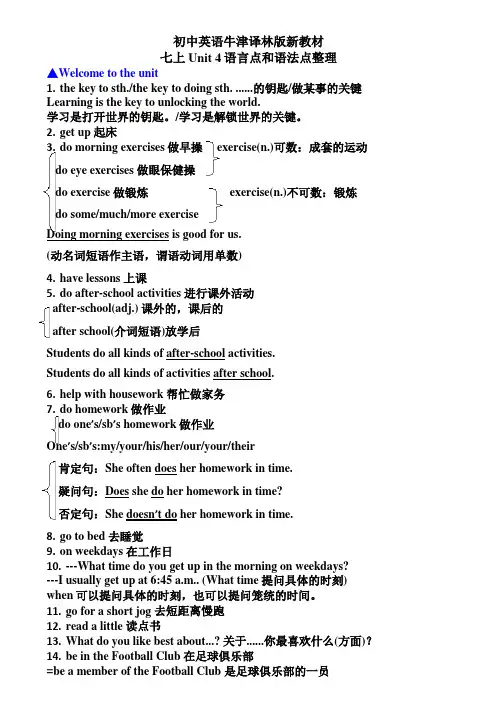
初中英语牛津译林版新教材七上Unit 4语言点和语法点整理▲Welcome to the unit1.the key to sth./the key to doing sth. ......的钥匙/做某事的关键Learning is the key to unlocking the world.学习是打开世界的钥匙。
/学习是解锁世界的关键。
2.get up 起床3.do morning exercises做早操 exercise(n.)可数:成套的运动 do eye exercises 做眼保健操do exercise 做锻炼 exercise(n.)不可数:锻炼do some/much/more exerciseDoing morning exercises is good for us.(动名词短语作主语,谓语动词用单数)4.have lessons 上课5.do after-school activities 进行课外活动after-school(adj.) 课外的,课后的after school(介词短语)放学后Students do all kinds of after-school activities.Students do all kinds of activities after school.6.help with housework 帮忙做家务7.do homework做作业do one’s/sb’s homework做作业One’s/sb’s:my/your/his/her/our/your/their肯定句:She often does her homework in time.疑问句:Does she do her homework in time?否定句:She doesn’t do her homework in time.8.go to bed 去睡觉9.on weekdays 在工作日10.---What time do you get up in the morning on weekdays?---I usually get up at 6:45 a.m.. (What time提问具体的时刻) when可以提问具体的时刻,也可以提问笼统的时间。
牛津译林版七年级英语上册Unit4 My day 重点短语和句子
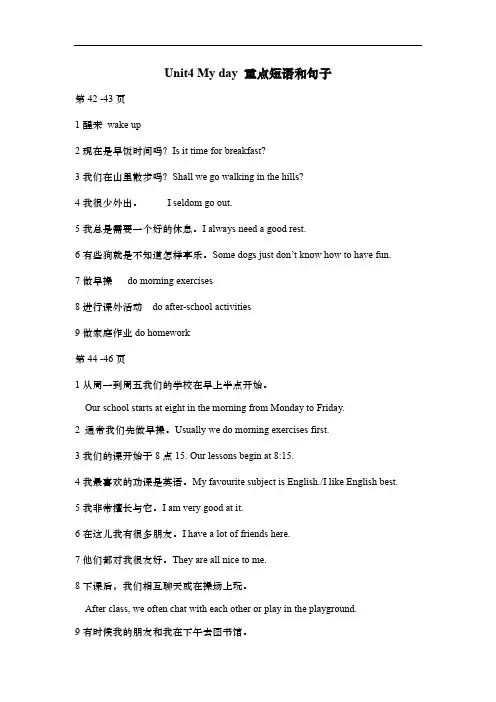
Unit4 My day 重点短语和句子第42 -43页1醒来wake up2现在是早饭时间吗?Is it time for breakfast?3我们在山里散步吗?Shall we go walking in the hills?4我很少外出。
I seldom go out.5我总是需要一个好的休息。
I always need a good rest.6有些狗就是不知道怎样享乐。
Some dogs just don’t know how to have fun. 7做早操do morning exercises8进行课外活动do after-school activities9做家庭作业do homework第44 -46页1从周一到周五我们的学校在早上半点开始。
Our school starts at eight in the morning from Monday to Friday.2 通常我们先做早操。
Usually we do morning exercises first.3我们的课开始于8点15. Our lessons begin at 8:15.4我最喜欢的功课是英语。
My favourite subject is English./I like English best. 5我非常擅长与它。
I am very good at it.6在这儿我有很多朋友。
I have a lot of friends here.7他们都对我很友好。
They are all nice to me.8下课后,我们相互聊天或在操场上玩。
After class, we often chat with each other or play in the playground.9有时候我的朋友和我在下午去图书馆。
Sometimes my friends and I go to the library in the afternoon.10我们有一个阅读俱乐部。
2016牛津英语新教材7A-Unit4 My day!-Reading
What about your school life?
Complete the sentences about your day and talk about it. P46 C
当堂测试
一、从方框中选择合适的词或词组,并用适当的形式填空。 chat with, practise, each other , in the playground , wish, be nice to, have a good time, after school
always ________ Millie ______ is ________ kind ______ to others.
4. 该做家庭作业了。 It’s time ________ for ____________. homework
It’s time _______ homework to ______ do _____________. 5. 你该做家庭作业了。
根据句意及汉语提示完成单词。(3 points) chats 聊天)with my 1. My mother often________( aunt. first 2. Please wash your hands_______( 首先). Then have lunch. practises 练习) speaking English 3. He ___________( every morning.
8.15 a.m.
have lessons
[fɜːst]
They do morning exercises first, then they start their lessons.
首先
play volleyball
read books
七年级上册英语Unit 4 My day Reading知识点梳理-译林版

Unit 4 My dayReadingually we do morning exercises first.通常我们先做早操。
【解析】first此处用作副词,意为“首先,最初”,用作状语。
例:You must finish your homework first.你必须先完成作业。
【拓展】first还可以构成短语at first,意为“首先,起初”。
表示顺序上的先后。
First of all,意为“首先,第一”。
常常放在句首,表示重要性上的先后。
例:At first, let me introduce my friend Mike to you. Then...首先,让我介绍我的朋友迈克给你。
其次...First of all,let me tell you the news.首先,让我告诉你这个消息。
2.They are all nice to me.他们都对我很好。
【解析】be nice to...意为“对(待)... ...好”,与be good to的意思相同。
to 是介词,后面一般接表示人的名词或代词的宾格。
例:The teachers are nice/good to us all.老师们对我们都很好。
【固定搭配】have a nice time玩得痛快;玩得高兴例:I hope you have a nice time in Spain next week.我希望你们下周在西班牙玩得开心。
3.After class, we often chat with each other or play in the playground.下课后,我们经常相互聊天或在操场上玩。
【解析】chat with...意为“和......聊天”,与talk with...(与......谈话)的意思相近。
例:Do you often chat with your friends?你经常和你的朋友们聊天吗?【解析】each other相当于代词,表示相互关系,意为“互相,彼此”。
牛津译林初中七年级上册英语 Unit 4《My day Reading 1》课件3

III. 根据所给汉语完成句子。 1. 人们说玛丽是个聪明伶俐的女孩。
People say Mary is a_c_le_v_e_r_ __g_ir_l__. 2. 我们学校的一天从八点开始。 Our _sc_h_o_o_lday_s_ta_r_t_s__a_t_8:00 every day. 3. 我们期待着在外面好好过一天。 We __w_i_sh__ to _h_a_v_e_ a great day outside.
( T ) 1. Millie likes her school very much. ( F ) 2. School starts at 8.15 at Millie’s
school.
( T ) 3. English is Millie’s favourite subject. ( F ) 4. Millie seldom chats with her friends
We read books
We practise volleyball.
Now let’s read the passage together and then finish B3 on P46
Complete the conversation between Joan and Tommy. Joan: I know your friend Millie is now at
every Saturday. 3. I __a_m__g_o_o_d__a_t_ English, for I go to
the English Club every Wednesday. 4. We must learn from ___e_a_c_h_o_t_h_e_r___. 5. The students always _h_a_v_e_a__g_o_o_d__ti_m_e_
Unit4MyDay(知识梳理)-七年级英语上册精品课堂(牛津译林版)
Unit 4 My day 一、重点词组二、重点语言点1. wake upwake 常作及物动词,意为“使醒来,唤醒” Please wake me up at seven o’clock.wake作不及物动词,意为“醒,醒来” He woke three times during the night.当wake up意为“叫醒”时,要注意宾语的位置。
如果宾语是人称代词,通常位于wake和up之间。
如果宾语是名词,则既可以位于wake和up之间,也可以位于wake up之后。
wake up your dad=wake your dad up wake me up2. It’s time for ...It’s time for sth = It’s time to do sth 该是做某事的时候了It’s time for lunch. = It’s time to have lunch. 该是吃午饭的时候了。
It’s time for sb to do sth 该是某人做某事的时候了。
It’s time for the children to go to bed. 该是孩子们上床睡觉的时候了。
3. Shall we go walking in the hills?【精讲】Shall we...?意为“我们……好吗?”,shall用于第一人称,表示提出或者征求建议,常用Good idea.或者Sounds great.来回答。
4. go outgo out 外出;出去;熄灭;过时Let's go out on Saturday night. 我们星期六晚上出去吧。
Let's go out for some fresh air. 咱们出去呼吸点新鲜空气。
The bedroom light went out after a moment. 卧室的灯片刻后熄灭了。
The fire seemed to be going out. 火看来快熄灭了。
2022七年级英语上册Unit4MydayPeriod2ReadingⅠ习题课件新版牛津版93
7. 通常我们先做早操。 Usually we ___d_o_m__o_r_n_i_n_g_e_x_e_r_c_is_e_s____ first.
8. 他们都对我友好。 They _a_r_e_a_l_l_n_ic_e__/ _k_in__d_/_g_o_o_d_/_f_r_i_en__d_ly__to__ me.
4. __E__a_c_h__(每个) of the houses is different.
5. Tom with his friends often __w_is_h_e_s__ (祝愿) their team
good luck.
【扬州仪征期中】
二、根据汉语提示完成句子, 并背记英语句子 6. 我们学校从周一到周五早晨八点开始上学。 Our school starts ____a_t___ eight ____in____ the morning __f_r_o_m___ Monday ____t_o___ Friday.
A. exercises; exercise
B. exercises; exercises
C. exercise; exercise
D. exercise; exercises
【点拨】exercise意为“运动,锻炼”时是不可数名词, 意为“体操,练习”时是可数名词。故选A。
3. January is the ___fi_r_st___ (第一) month of the year.
3. Please give my best _w__is_h_e_s__ (wish) to him. 4. Lily is good at playing volleyball. She can play it ___w_e_ll___
牛津译林版七年级英语上册unit4全单元教案
38 牛津译林版七年级英语上册牛津译林版七年级英语上册Periods :031Date : : Prepare – Oct.15th Title : Unit 4 My day Comic strip & Welcome to the unitTeaching aims: Students can master the following in this class.1.words :wake shall seldom activity quarter2.phrases :wake up, go out, do after-school activities, do homework, have fun,be late for , go to bed 3.sentences :I seldom go out .I’m never late for it .At a quarter past eight . Difficult points:Words about daily life .Students can use the words and sentences learned in this class to describe daily life .Procedures :Step1 Free talkLead-inT: What time does your school day begin ?S: It begins at 6:45.T: Oh, it starts at 6:45. You start our school day at 6:45. So you need to wake up very early. (teach wake up and start )Show some pictures of clock.T: It is six o ’clock in the morning. What does ….do? Can you guess ?(Teach have breakfast /have lunch /have dinner; need; rest ;go out ; have fun )Step2 PracticeT: Hobo wants to know something about you. He would like to ask the questions below. Please answer them.(1) What time do you wake up?(2) Do you often go out to play games /have dinner .have fun ?(3) Do you often have breakfast ?(4) Where do you have lunch ?(5) Do you always have a rest after lunch?According to the students ’ answers, present “seldom ”and “never ”at the right time.Step3 PresentationT: Do you remember our friend Eddie ? What does he do every day? Can you guess ?Now let’s listen to the conversation between Eddie and Hobo and check if you are right. (Teach hill )T: What does Hobo think of dogs like Eddie ?Step 4 PracticePractise the conversation and act it out.Step 5 ExtentionHere’s Hobo ’s diary. Please help him complete it.It is sunny today. I would like to go________. I like sports and I always go walking in the ____________. But my friend Eddie is lazy. He ___________does sports. He _________up very late.And then he wants to have __________. After it, he sleeps again. When he finishes his lunch, he says he ________a good _______ once more.Oh, my God ! His life is eating and sleeping. I think some dogs ________don’t know how to have____________.Step 6 PresentationT: Do you want to be lazy like Eddie? What time do you wake up every morning ? What time do you have breakfast / lunch / dinner /every day ? Why do you get up so early ?(Teach quarter, past, get up and be late for, have lessons/have classes. do after-school activities, do homework, go to bed …)Step 7 PractiseLook at the table of Millie’s day. Answer some questions.Look at the times on the blackboard. Please tell me your activities at these times.6:30 a.m 7:00 a.m 8:00 a.m 11:50 a.m4:30 p.m 6:00 p.m 8:00p.m 9:00 p.mMake sentences with “I _________________ at_____________.”Step 8 PresentationPart BT: Millie is busy every day. Now, she is telling her aunt about her school life. Let’s listen to their conversation and answer my question: Is Millie often late for school ?S: No. She is never late for school.T: Millie is a good student. She is never late for school. What about you? Are you often late for school? Are you never late for school?Step 9 PractiseRead Part B and practice it .T: Are your daily activities the same as Millie’s ? Now, you can complete the table on the right with your own information.…….T: Now time for you. I’d like you to work in groups of four to discuss your own day. You can use Millie and her aunt’s conversation as a model.Homework :1. Learn the new words by heart.2.Finish the exercisesAfterthoughts :Periods :032-033Date : : Prepare – Oct.15thTitle: Unit 4 My day ReadingTeaching aims:1. Students can master new words and expressions.2. Students can learn some new phrases: chat with best wishes have a good time3. Students can learn some new sentences:Our school starts at eight in the morning from Monday to Friday.Usually we do morning exercises first.Procedures :Step1 Free talk1.Do you have a full(充实的)充实的) and busy day?2.What do you usually do every day?Step2 PresentationListen to the passage and choose a title for this e-mail.Step3 ScaningRead the passage quickly and silently and do “T” or “F” questions in pairs.(partB2)Setp4 SkimmingRead the article again and do more exercises. (partB1)Step5 RetellingRetell Millie’s school life . Fill in the blanks.( partB3)Step6 Language pointsSome language points :a lot of = lots ofSometimes , some times , sometime , some timehave a good timeHomework :1. Learn the new words by heart.2.Finish off the exercises.Afterthoughts :Periods :034-035Date : : Prepare – Oct.18thTitle: Unit 4 My day GrammarTeaching aims:1. Students can use the prepositions correctly.2. Students can use the adverbs of frequency correctly.Difficult points: the usage of the prepositionsProcedures :Step1 Presentation1. Free talk .Use some questions to lead the usage of the prepositions .eg: What time do you go to school?When is your birthday?2. P47表格,教师归纳总结,领读例句。
牛津七年级上册英语7AUnit4 My Day知识点总结
7AU4 My Day 知识点一.知识点1. wake up 醒来,叫醒把米莉叫醒wake up Millie = wake Millie up 把我叫醒wake me up妈妈每天早早把我叫醒。
Mum wakes me up early every day.我不想叫醒你。
I don’t want to wake you up.不要叫醒那个婴儿,他要哭的。
Don’t wake up the baby. He will cry.2. Is it time for breakfast? 早餐时间到了吗?It’s time for sth.= It’s time to do sth.做……的时间到了。
上课/上学/睡觉/午饭/开会时间到了。
It’s time to have classes. = It’s time for class.It’s time to go to school.=It’s time for school.It’s time to go to sleep/bed.=It’s time for sleep.It’s time to have lunch. = It’s time for lunch. It’s time to have the meeting. = It’s time for the meeting. It’s time for sb. to do sth. 某人该干某事了。
我们该吃晚饭了。
It’s time for us to have supper.他们该上课了。
It’s time for them to have classes/lessons.你该擦黑板了。
It’s time for you to clean the blackboard.3. Shall we go walking in the hills? 我们去山上散步,好吗?Shall we + do …? (=Let’s do sth, shall we?) 是一个表示提出建议的句型(=What about doing sth?= How about doing sth?=Why not do sth?=Why don’t you do sth?)Shall we go to the cinema tomorrow? Shall we play basketball this afternoon?go shopping/swimming/running/fishing4. seldom 很少,不常(adv ) ,表示否定seldom : not (very) often Tom seldom goes to school. never 从不,绝不我上学从不迟到。