
人教版八年级英语下册Unit 3 Could you please clean your room? 教学设计
take out the trash
P
make thebed
P
fold the clothes
Pcleanຫໍສະໝຸດ theliving room
M
Listen to the tape and fill in the chart .
Check up the answers.
Listen and repeat.
(2) Make some conversations with the phrases above..
T: Can you do the dishes? Ss: Yes, I can .
T: Could you please do the dishes? Ss: ….
以这种句型练习多个短语,让学生体验情态动词can和could的用法区别。
2.有意义操练(Meaningful Drills)
1b Now let’s go to Peter’s house. And listen to what Peter and his mother do.
Chores
Peter’ mother
Peter
do the dishes
M
sweep the floor
—Yes, I do./No, I don’t.
可以带入这些短语:1 do the dishes, 2 sweep the floor ,3 take out the trash, 4 make your bed, 5 fold your clothes, 6 clean the living room
Last according to the chart describe the chores that Peter and Peter’s mother do.
1cPairwork
Look at the picture above. Ask your partner to do the chores that you see.
Remember the new words of1a-2d.
Finish off the exercises.
Preview the new words of3a-3c.
三、【板书设计】
Unit 3 Could you please clean your room?Section A1a—2d
四、【教后反思】
1)words 2)phrases 3) sentences
2.当堂检测(见学案):教师要随堂进行评价,批改可以由学习小组内互批、组间互批、集体订正等方法,批阅后教师要统计达标情况,收集反馈信息,当堂矫正补救。
VI. Assignment
作业
1.口头作业:听并跟读录音,编对话,背笔记。
2.书面作业:
2) Can you do the dishes?
3) —Could you please do them? —No problem.
4) I’m going to clean the living room.
5) —Could I use your computer? —Sorry. I’m going to work on it now.
T: This class we talk about the chores. What chores do you know?
竞赛游戏:学生四人一组讨论,一名代表回答,看那组的最多为胜者,加以鼓励。教师将所涉及到的短语展示在屏幕或黑板上,带领学生读两遍。如:
do the dishes; take out the rubbish; fold your clothes; sweep the floor; make your bed; clean the living room; get a ride.
八级英语(下)第3单元第1课时
Unit 3 Could you please clean your room?
Section A1a—2d
一、【教材分析】
教
学
目
标
知识
目标
1.学习并掌握下列单词:
rubbish; fold; sweep(swept); floor; mess
2.能正确使用以下常用表达:
Share their answers.
2. 2b
Give the students 20 seconds to prepare for listening.
Listen again. Why does Peter’s father say “no”? Draw lines to the reasons in the chart in2a.
Section A3a—4c
一、【教材分析】
教
学
目
标
知识
2)能正确使用以下常用表达:
do the dishes; take out the rubbish; fold your clothes; sweep the floor; make your bed; clean the living room; get a ride;
3)能熟练掌握并使用下列重点句式:
(8) Could I at least finish watching this show?
(9) Could you take out the rubbish, fold the clothes and do the dishes?
2. Leading-in“导入新课”
(1) Learn some words and expressions about the chores:
A: Could you please sweep the floor?
B: Yes, sure.
这时,在体验和练习的基础上,让学生看本单元的语言目标:礼貌的请求和申请许可,能有所理解。
3.交际性操练(Communicative Drills)
Make their own conversations about the chores, and then share their new conversations.
教学重点
谈论如何征求许可以及如何进行礼貌地请求
教学难点
正确使用本课常用表达;听力训练。
教学方法
情景教学法;任务型教学法。
二、【教学流程】
环节
师生活动
二次备课
I.Preparation
准备
1)课前3分钟检查单词预习情况,教师根据学生读的状况,适当领读,帮助学生正音。
2)找两名学生上台,听写本课所用到的单词和短语:chore dish sweep trash fold meeting,do the dishes, sweep the floor, take out the trash, work on the computer, stay out late, get a ride师生先共同批改黑板上的,然后小组内互批互改,组长报告结果。
3)Revision “复习检查”
Revise and learn some words:
通过检查“学案”中“新知预习”内容检查预习效果。
II.Presentation
呈现
1. Learning tasks“示标定向”出示这节课的三维学习目标。
1)学习并掌握下列单词:
rubbish; fold; sweep(swept); floor; mess
III. Practice
操练
1.机械操练(Mechanical Drills)
1)1aFirst read and translate the phrases. Then work in pairs. Discuss with your partner.
—Do you ______________at home?
(1) —Could you please sweep the floor? —Yes, sure.
(2) Can you do the dishes?
(3) —Could you please do them? — No problem.
(4) I’m going to clean the living room.
A: Could you please sweep the floor?
B: Yes, sure. Can you do the dishes?
A: Well, could you please do them? I’m going to clean the living room.
B: No problem.
do the dishes; take out the rubbish; fold your clothes; sweep the floor; make your bed; clean the living room; get a ride;
3.能熟练掌握并使用下列重点句式:
1) —Could you please sweep the floor? —Yes, sure.
9) Could you take out the rubbish, fold the clothes and do the dishes?
能力
目标
通过听说训练,学会谈论如何征求许可以及如何进行礼貌地请求。
情感
目标
通过本课的学习,能够谈论如何征求许可以及如何进行礼貌地请求的方式,学会关心社会,帮助他人。
Share their answers.
V.Examination
检测
1.引导学生小结梳理知识框架、规律、方法,并对合作小组当堂学习情况进行总结评价,巩固学生所获得的语言知识和经验,让学生在评价中反思,在反思中进步。
人教新目标版英语八下Unit3《Couldyoupleasecleanyourroom》说课稿1

人教新目标版英语八下Unit 3《Could you please clean your room》说课稿1一. 教材分析人教新目标版英语八下Unit 3的主题是“Could you please clean your room?”,主要讨论了如何请求别人做事以及如何表达感谢和道歉。
本节课的主要语言点包括情态动词could的用法,一般现在时的表达方式,以及一些日常生活中的交际用语。
通过学习本节课,学生能够更好地理解和运用情态动词和一般现在时,提高他们的口语交际能力。
二. 学情分析在进入八年级下学期,学生已经对人教新目标版英语有了初步的了解和掌握,具备一定的英语基础。
他们对于情态动词和一般现在时的概念已经有所了解,但在实际运用中还存在一定的困难。
此外,学生在口语交际方面还存在一定的障碍,需要通过大量的练习来提高。
三. 说教学目标1.知识目标:通过学习本节课,学生能够掌握情态动词could的用法,理解一般现在时的表达方式,并能够运用所学知识进行简单的口语交际。
2.能力目标:学生能够流利地朗读和背诵课文,提高他们的口语表达能力。
3.情感目标:通过学习本节课,学生能够培养良好的生活习惯,学会尊重和理解他人。
四. 说教学重难点1.重点:情态动词could的用法,一般现在时的表达方式。
2.难点:一般现在时的运用,特别是在实际交际中的运用。
五. 说教学方法与手段在本节课的教学中,我将采用任务型教学法,通过设置各种任务让学生在实际操作中学习和运用英语。
同时,我会运用多媒体教学手段,如课件、视频等,来增加课堂的趣味性和互动性。
六. 说教学过程1.导入:通过提问学生日常生活中请求别人做事的经历,激发学生的兴趣,引入本节课的主题。
2.呈现:通过课件展示课文内容,让学生初步感知和理解情态动词could和一般现在时的用法。
3.操练:通过小组活动和角色扮演,让学生在实际交际中运用所学知识。
4.扩展:通过设置任务,让学生在实际操作中进一步运用和巩固所学知识。
人教版八年级英语下册Unit 3 Could you please cleanyour room S
to provide a clean and comfortable environment
at home for their children. And anyway, I think
doing chores is not so difficult. I don’t mind
doing them.
It teaches them how to
stress from school. They have no time to study and
look after themselves. do housework.
It helps children to Their job now is to be students.
and his grades dropped. The earlier kids learn to be Conclusion
independent, the better it is for their future. Ms. Miller
(结论)
Which letter do you agree with? Why?
两,
件要
事么
。旅
。行
,
身
体
和
灵
魂
总
要
我们,还在路上……
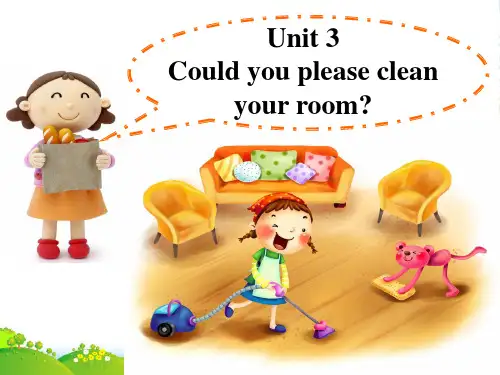
Unit 3 Could you please clean
your room?
What is the father asking his daughter doing?
Do you think you should help out with chores at home?
Which one agrees that young people should do chores at home?
人教版八年级英语下册Unit3Couldyoupleasecleanyourroom全单元教案

Unit 3 Could you please clean your room?Period 1 Section A (1a - 2c)Teaching aims:1.Words and expressions:Rubbish; fold; sweep; floor ;mess; throw; neither; shirt; pass; mess; do the dishes, make the bed, take out the rubbish, fold the clothes, sweep the floor, clean the living room2.Sentences:①--Could you please take out the rubbish?. --Sure. / Sorry, I can ’ t. I have to finish homework first.②. Could I use your computer?Sorry. I'm going to work on it now.③. Well, could I watch TV?Yes, you can. But first you have to clean your room.Ability object:1.Make polite requests and ask for permission.2.improve speaking and listening skills.Moral objects:Learn to be polite, love doing housework and make requests and ask for permission politely. Teaching Important :Words and expressions, and sentences:Make polite requests and ask for permission.Teaching difficult points:Make polite requests and ask for permission.Teaching procedures:Step 1 Warming-upSing the song and dance to the musicStep 2 Preparation test.1.Watch the photos and talk about them “ Whatdoes he do every day? ’ and learn these phrases: dochores, do the dishes, make the bed, take out the rubbish, fold the clothes, do the laundry, clean the living room.2.M emory challenge. Let students know: Love your parents. Help do the chores.Step 3 work on 1a.1.Look at 1a , Do you do these chores at home?Discuss them with your partner.2.How do we make a request(要求)?Sweep the floor , Peter!Can you sweep the floor, Peter?Could you please sweep the floor?Which is the most polite(礼貌) ?3.Make polite requestsStep 4 Work on 1b.3.1 b Listen. Who will do these chores? Ch eck ( v^Peter ' s mother or Peter.2. Check the answers.Step 5 Group work .Group work: Family drama( 家庭短剧)1.Each group is a family.2.We need to clean the house.3.To make a similar conversation of listening material.Example:Mom : We need to clean the house. We are going to have a party.Dad : Could you please sweep the floor?Peter: No problem.Grandpa: Well, could you please do them? I ’ m going to clean the living room.Step 6 Listening 2a&2b1.Peter asks his father if he can do four thing s. What does his father say? Check ( V) yes ” or“ no” . Listen again. Draw lines to the reasons.2.Check the answers .Step 6 Pair work.Make conversations using the information in 2a and 2bA:Could I use your computer?B:Sorry. I ’ m going to work on it now.A: Well, could I watch TV?C:Yes, you can. But first you have to clean your room?Period 2 Section A (2d , grammar )Teaching aims:1.Words :Mess; borrow, invite, disagree, snack, teenager2.Sentences:Yes, because Mom will be back from shopping any minute now. And she won she sees this mess.t be happy if But the house is already pretty clean and tidy!Could you buy some drinks and snacks?Could I invite my friends to a party?Could I go out for dinner with my friends?OK/ Sure, that should be OK.No, you can ’ t. You have a basketball game tomorrow.Ability object:1.Make polite requests and ask for permission.2.improve speaking and reading skills.3.Master the structures of could .Moral objects:Learn to be polite, love doing housework and make requests and ask for permission politely.Teaching Important :Words and expressions, and sentences:Make polite requests and ask for permission.Teaching difficult points:Make polite requests and ask for permission.Teaching procedures:Step 1 Warming-up .1.Watch a video and answer:Who is the girl in the movie?Is the house clean or dirty?What did she do?2.Do some exercises.Step 2 Work on 2d.1.2d Read the conversation and answer:What chores will Tony have to do?2.2d Role - play the conversation.Step 3 Presentation.1.Read ,think the knowledge.2.Give some explainationsStep 4 Work on 4a.1.Write R for requests and P for permissions. Then match each one with the correct response.2.Check the answers.Step 5 Work on 4b.1.4b Fill in the blanks in the conversation.2.check the answers.Step 6 Work on 4c.4c Make a list of things your group needs to do for a camping trip. Then discuss who will do bring a tent them and complete the chart.Example:A:Could you please bring Liu Chang?B:Sure. And could you please •••?C:Sorry, I can ' t. I have to …Step 7 Homework.Period 3 Section A (3a-3c )Teaching aims:1.Words and expressions:throw, neither, shirt, all the time, as soon as.2.Sentences:①. He wanted a walk, but I was too tired. I threw down my bag and I went to the living room.②. “ No! ” she replied angrily. h TV“ayllothuewtaimtce and never help out around thehouse!I can ’ t work all day and do housework all evening. ”③. “ well, I work all day at school, too! I ’ m just as tired as yaocuka. re! ” I shouted b Ability object:1.Make polite requests and ask for permission.2.improve speaking and reading skills.Moral objects:Learn to be polite, love doing housework and make requests and ask for permission politely.Teaching Important :Words and expressions, and sentences:Make polite requests and ask for permission.Teaching difficult points:Make polite requests and ask for permission.Teaching procedures:Step 1 Warming-upStep 1 Lead in.1.T: We have leaned the phrases about chores. Look at the picture, what are they doing?Do you often do chores at home ?Show the title.Step 2 2b Reading.2.Look at the picture and answer :Does Nancy often do any housework?3.Read the passage carefully and answer.How does Nancy ’ s and her mother’ s feelings change?4.Read the sentences.5.Read the passage and answer the following questions.①Why was Nancy ' s mom angry with Nancy?② Did they solve the problem? How?③ Can you infer what Nancy ’ s mother will feel ?6.What do you learn from the message?We need to share the housework to have a clean and comfortable home .Can you infer what Nancy will do at home?Step 3 Work on 3b.Read the story again and read the sentences below. Underline the sentences from the readingthat mean the same thing.1.Neither of us did any housework for a week.2.My mom came over as soon as I sat down in front of the TV.3.You ’ re tired, but I ’ m tired, too.Step 4 Work on 3c.. Decide whether the underlined words in the sentences are verbs or nouns. Then write another sentence using the underlined word in the other form.1.Could you take the dog for a walk? (noun)2.Could I watch one show first?3.I can ’ t work all day.4.You watch TV all the time.5.“ What happened? ” she asked in surprise.Step 5 Homework.Period 4 Section B (1a-1e )Teaching aims:New words: snack teenager borrow invitePhrases: buy some drinks and snacks; borrow some money; invite sb. to a party/to do sth. Sentences :--Could you please clean your room?--Yes, sure. / Sorry, I can ' t. I have to do my homework.-- Could I invite my friends to aparty?--Of course/ Yes, you can /No, you can Ability object: t. You have to1.Make polite requests and ask for permission.2.improve speaking and listening skills.Moral objects:Learn to be polite, make requests and ask for permission politely; and love parents. Teaching Important :Words and expressions, and sentences:Make polite requests and ask for permission.Teaching difficult points:Make polite requests and ask for permission.Teaching procedures:Step 1 lead-in.1. Show the title.2. DiscussionQ: Do you help your parents do the chores at home?Q: Do your parents ask you to do a lot of things forthem?What do your parents ask you to do?What do you ask your parents Step 2 Work on 1a.1.What do teenagers ask their parents 'permission for?' permission for? What do parents ask their teenagers todo? Write parents or teenagers next to each phrase.2. Check the answers.Step 3 Finish 1b.Use the phrases in 1a to makeconversations.Example :Parents : Could you clean your room ?Child : Yes, I can.Child : Could I invite my friend to aparty ?Parents : No, you can't .Useful language:1.Parents: Could you please …?Child: Yes, sure. / Sorry, I can ' 2.Child: Could I •••? t. I have to ...Parents: Yes, you can. / No, you can t.You ...Step 4 Finish 1c and 1d.1.Listen to a conversation between Sandy and her mom. Check ( V ) Oh wdhings in 1a thhear.2.Listen again. Fill in the chart.Step 5 Finish 1e.You are having a party. Invite your partner to come your party and ask for help withthese things. So, talk about the following things with your partner.e.g. A: Would like to come to my birthday party?B: Yes, I ' d love to./Sorry, I can ' t. I have to …A:Could you please take out the rubbish?B:Yes, sure./No, I can ' t. I have to do …Step 6 Homework.Period 5 Section B (2a-2e)Teaching aims:1.Learn and review some important phrases and target languages.2.Review how to make polite requests how to ask permissions politely3.Read the letters carefully and surf the Internet, try to find out more reasons to supportyour idea, and then write a letter to th e person that you don ’ t agree with.Ability object:1.Learn how to debate and show your own opinions.2.Practice speaking, reading and writing skills.3.Interview your friends, your teachers or your parents about their opinions about kids doingchores and take notes.Moral objects:Discuss with your partners and show your own opinions.Teaching Important :Learn and review some important phrases and target languages.Teaching difficult points:1.Interview your friends, your teachers or your parents about their opinions about kids doingchores and take notes.2.Read the letters carefully and surf the Internet, try to find out more reasons to supportyour idea, and then write a letter to the person that you don ’ t agree with.Teaching procedures:Step 1 Warming-up1.Review.Step 2. 2a. pre-reading.2.Discuss the questions with your partner① What do you often do to help your parents at home?② Do you think kids should help out with chores at home?3.New words learning.Step 3. While reading1.What ’s “ Skimming “2.2b. The Sunday Mail magazine invited parents to write about whether they think young peopleshould do chores at home. Skim the following letters. Which one agrees and which onedisagrees?3.Reading.①. Read the examples, and guess the meanings of “ pro” and “ con” .②2c. According to Mr. Smith and Ms. Miller, what are the pros and cons about kids doingchoresStep 4 Post reading.1.Be a good debater. Let ’s have a debate.2.2d. Write one sentence with each phrase from the letters.3.2e Discuss the questions with a partner.Step 5 Homework.Period 6 Section B (3a-self check )Teaching aims:1. WordsFair; unfairnguage:help with housework and chores at home have enough stress from schoolspend the time on school work in order toThere is no need for them to …It is important for sb. to do sth.It ' s not enough to … develop children ' s independence The more •••, the more …Ability object:1.Learn how to show your own opinions.2.Practice speaking, and writing skills.Moral objects:Discuss with your partners and show your own opinions. Teaching Important :1.Learn how to show your own opinions.2.Practice speaking, and writing skills.Teaching difficult points:1.Learn how to show your own opinions.2.Practice speaking, and writing skills.Teaching procedures:Step 1 Warming-upSection B 2 (3a —Self check)Step 1 RevisionDiscuss the questions with a partner. And take notes.Do you think children should do some chores at home? Why or why not?1.信头:发信人地址和日期。
英语人教版八年级下册Unit-3-Could-you-please-clean-

Unit 3 Could you please clean your room?Unit 3SectionA1a-2d【学习目标】1.掌握1a-2d的词语2.学习提出礼貌的请求和请求允许;3.学会使用句型Could you please...?和Could I...?;【学习重点】掌握一些家务活动相关的动词短语。
掌握情态动词could的用法和助动词do的用法。
【学习难点】掌握情态动词could的用法和助动词do的用法【学习过程】【一】自主学习明确目标1 试读单词,解决语音问题,联系有关旧单词2 查阅下面的短语动词1) 出去吃饭_______________ 2)在外面待到很晚_______________3)去看电影_______________ 4)搭车_______________5)完成做某事_______________ 6)干净整洁_______________7)洗餐具_______________ 8)倒垃圾_______________9)叠衣服_______________ 10)扫地_______________3.观察以上词组的构成方式:【语言点】1. —Peter, could you please take out the trash?请你把垃极倒掉好吗?—Sure, Mom.可以,妈妈。
—Could you please do the dishes? 请洗盘子好吗?—Sorry, I can’t. I have to do my homework.抱歉,我不能。
我得做作业。
【3】合作探究展示提升1.小组讨论。
What kind of chores Peter and his mom will do?小组讨论怎样回答。
2.小组活动编对话3.听力:先阅读2a题中Peter的父亲拒绝的理由。
然后听2a, 2b。
完成练习并核对答案。
4.小组合作做2c。
5.分角色表演2d, 小组讨论解决疑难问题。
英语人教版八年级下册Unit3 could you please clean
Unit3 could you please clean your room ?Section A period1一.教学目标要求学生学会用句型“could you please…”来委婉地提出请求或征求别人的许可以及如何有礼貌的拒绝别人并表达自己的理由。
陈述自己的好恶,学会有礼貌的与人沟通。
二.学情分析Chores 这一话题非常贴近学生实际,学生会非常感兴趣。
因此,此课时应充分调动学生的积极性,鼓励学生大胆开口。
三.重点难点能够有礼貌的提出请求并作出适当的回答,学会有礼貌的与人沟通。
四.教学过程教学活动Step 1 Review the new words and phrasesRubbish take out the rubbish foldSweep (过去式swept) floorStep 2. Lead-in1.Dou you often help you parents do chores?Help students answer the question.2.Do yoy do these chores at home?Help students answer thequestion.(do the dishes . clean the room……)3.Show more pictures on the screen about doing the chores. Letstudents quess what chore it is. (do the dishes, sweep thefloor, take out the rubbish, clean the living room……)Step 3. Presentation1.Look and say “could you pless sweep the floor?” Guide studentsunderstand and make mentences. Then guide them answer thequestion. And give more situations.2.Sudents work in pairs. Help them to make polite requests byusing target language “could you please﹢动词原形”and answers“sure/of course/OK/certainly……or Sorry, I can’t ”Step 4. Group work.Make up ditferent conversations by themsdoes about doing the chores.HomeworkRole-play conversation (2d)。
英语人教版八年级下册Unit3 Could you please clean
Unit3 Could you please cleanyour room?教学目标知识技能1.Key words: chore, trash, fold, dish, living room, sweep, do the dishes, do chores, take out the trash.2.Target Language;Could you please sweep the floor? Yes, sure.过程方法According to designing some tasks, train students’ listening skill and speaking skill.情感态度Remember to be polite when you ask for help, and to be a good child. 教学重点1.Key words: chore, trash, fold, dish, living room, sweep, do the dishes, do chores, take out the trash.2. Target LanguageCould you please sweep the floor? Yes, sure.教学难点Target Language教学用具A tape recorder ,CAI教学内容Step 1 : Warm-up1. Greetings.2. Show students some pictures about chores, ask one student to help the teacher put them up on the blackboard. Then ask students if there is a more polite way to ask for help.Give students sample sentences, eg: Please help me put up the pictures on the blackboard.Step2.Presentation1 Show pictures to present new words.clean the room do the dishes sweep the floor make the bed take out the trash fold the clothes Write the phrases on the blackboard and ask students to guess the meaning of them. Then ask the students to read the new phrases and match them with the pictures.2 Ask students to do a memory game. Show students pictures quickly then cover them and ask students to say what chores they saw.3 Ask: Who does most of the chores at home? Your mother is tired after work every day. On Sunday she wants you to help her. What does she say to you ? What do you say ? A: Could you please clean the living room?B: Yes, sure./ All right/ OK./A: Could you please sweep the floor?B: Sorry , I can’t. I have to do my homework.Write the sentences on the blackboard and ask students to look at the pictures and ask their partner to do the chores that they see.4 Activity 1bAsk students to listen to a conversation, then answer: What chores does mom do? What chores does Peter do? And finish the chart.Check the answers with the students.Step3 Consolidation and extensionShow students more phrases about chores, such as: cook the dinner, clean the bedroom, help mother do some shopping, wash the car, ask students to make richer conversations according to Activity 1b.Step4 SummaryRemember the key words and the target language.作业设计Work in pairs use the target language.板书设计Unit 3 Could you please clean your room? Period 1clean the room do the dishes sweep the floormake the bed take out the trash fold the clothes Could you please sweep the floor? Yes,sure.。
人教版英语八年级下册Unit3《Couldyoupleasecleanyourroom》说课稿
人教版英语八年级下册Unit 3《Could you please clean your room》说课稿一. 教材分析人教版英语八年级下册Unit 3的主题是“Could you please clean your room?”,主要讨论了日常生活中的一些请求和回应。
通过本节课的学习,学生能够掌握情态动词could的用法,学会如何礼貌地提出请求和回应请求。
教材内容丰富,包括听力、口语、阅读和写作等多个方面,有助于全面提高学生的英语综合能力。
二. 学情分析根据我对学生的了解,他们已经掌握了情态动词can的用法,并具备了一定的听说读写能力。
然而,对于情态动词could的用法,他们还比较陌生。
此外,部分学生在表达请求时,还存在着语气生硬、不礼貌等问题。
因此,在教学过程中,我需要针对这些情况,采取适当的教学策略,帮助学生掌握情态动词could的用法,并培养他们礼貌表达请求的能力。
三. 说教学目标1.知识目标:学生能够掌握情态动词could的用法,了解其表示请求的礼貌性。
2.能力目标:学生能够熟练运用情态动词could提出请求和回应请求,提高日常英语交流能力。
3.情感目标:通过本节课的学习,学生能够学会尊重他人,培养礼貌待人的良好习惯。
四. 说教学重难点1.教学重点:情态动词could的用法,如何用could提出请求和回应请求。
2.教学难点:情态动词could与can的区别,以及在实际情景中灵活运用。
五. 说教学方法与手段1.教学方法:采用任务型教学法,情境教学法,交际法等,激发学生的学习兴趣,提高他们的参与度。
2.教学手段:利用多媒体课件、图片、实物等,创设真实情境,帮助学生更好地理解和学习。
六. 说教学过程1.导入:通过播放一段关于孩子们日常生活的视频,引出本节课的主题“Could you please clean your room?”。
2.新课呈现:介绍情态动词could的用法,并通过例句展示如何用could提出请求和回应请求。
人教新目标版英语八下Unit 3《Could you please clean your room》
人教新目标版英语八下Unit 3《Could you please clean your room》教学设计1一. 教材分析人教新目标版英语八下Unit 3主要讲述了日常生活中的一些请求和回应。
通过本节课的学习,学生能够掌握情态动词could的用法,以及如何用英语礼貌地提出请求和表达意见。
本课的主要场景是一个孩子在请求妈妈打扫房间,而妈妈则提出了一些意见。
教材通过这个场景,让学生学会如何使用情态动词could来提出请求和表达意见。
二. 学情分析在进入本节课的学习之前,学生已经学习了情态动词can的用法,对情态动词有一定的了解。
同时,学生也掌握了基本的日常英语交流用语。
因此,在教学过程中,教师可以借助学生已有的知识储备,引导学生更好地理解和掌握情态动词could的用法。
三. 教学目标1.学生能够掌握情态动词could的用法,并能够用其提出请求和表达意见。
2.学生能够听懂、会说、会读、会写与本节课相关的词汇和句子。
3.学生能够通过本节课的学习,提高英语口语表达能力和日常交流能力。
四. 教学重难点1.教学重点:情态动词could的用法,以及与之相关的词汇和句子。
2.教学难点:情态动词could在不同情境下的正确运用,以及英语礼貌表达请求和意见的方法。
五. 教学方法1.情境教学法:通过设定情境,让学生在实际语境中学习、理解和运用情态动词could。
2.交际法:通过学生之间的互动,引导学生运用情态动词could进行实际交流。
3.任务型教学法:通过完成具体任务,让学生在实践中掌握情态动词could的用法。
六. 教学准备1.教学课件:制作与本节课相关的课件,包括图片、视频、音频等素材。
2.教学道具:准备与本节课场景相关的道具,如玩具房间、清洁工具等。
3.练习题:准备与本节课内容相关的练习题,用于巩固所学知识。
七. 教学过程1.导入(5分钟)教师通过与学生进行简单的英语交流,引导学生进入学习状态。
然后,教师提出一个问题:“你们在家里有没有让爸爸妈妈帮忙做过事情?是如何请求他们的?”让学生思考并简要回答。
英语人教版八年级下册Unit3 Could you please clean
1. d 2. a 3. c 4. e 5. b
2. 4b
Fill in the blanks.
3. Make a list of things your group need to do for a camping trip. Then discuss who will do them and complete the chart.
3.学会使用以下句型:
1) Why wasNancy’s mom angry withNancy?
2) You watch TV all the time and never help out around the house.
3) I can’t work all day and do housework all evening.
(4) I’m just as tired as you.
(5) My mom did not say anything and walked away.
(6) Neither of us did any house work for a week.
(7) Could I borrow that book?
1)学习并掌握新词汇:
throw; all the time; neither; shirt; pass; borrow; lend; finger; hate; while
2)能正确使用以下常用表达:
throw down; come over; all the tome; help out; shout back; in surprise; neither of us; as soon as; pass sb. sth.=pass sth. to sb.; borrow sth. from sb.; lend sb. sth.; hate to do sth.
人教版八年级下英语Unit3Couldyoupleasecleanyourroom课件
例句
• 如:1.Could you please lend me your pen ?
• -----Yes , .
• 2.Could I use your phone ? • ------No problem ./ Oh, I ‘m afraid
not
Could 的其他几种用法:
1.Could 作为can的过去式,表示过去的能力。 2.表示惊讶,怀疑,不相信等态度,主要用 于否定句或者疑问句,此时could 与can无时 间上的区别,但语气比can缓和,情绪要弱。 3.表示可能性,只对将来,现在后者过去某 种可能的推测 4,用于虚拟语气。
=The minute I sat down in front of the TV,my mom came over.
3 You ‘re tired ,but I’m tired ,too.
= I’m just as tired as you are.
tired tiring
excited exciting interested interesting
1 Neither of us did any housework for a week.
=For one week,she didn’t do any housework and neither did I.
2 My mom came over as soon as I sat down in front of the TV.
dog? -- __C____. I’m too busy. A. Yes, you can B. Sure C. Sorry, I can’t
2. -- Could you please _C___ his bed? -- Certainly! A. makes B. making C. make