
1993(1)考研英语真题及解析
1993年试题与分析Section ⅠUse of EnglishAlthough interior design has existed since the beginning of architecture, its development into a specialized field is really quite recent. Interior designers have become important partly because of the many functions that might be ___1___in a single large building.The importance of interior design becomes 2 when we realize how much time we __3_ surrounded by four walls. Whenever we need to be indoors, we want our surroundings to be _ 4 attractive and comfortable as possible. We also expect 5 place to be appropriate to its use. You would be 6 if the inside of your bedroom were suddenly changed to look 7 the inside of a restaurant. And you wouldn’t feel 8 in a business office that has the appearance of a school.It soon becomes clear that the interior designer’s most important basic 9 is the function of the particular 10 . For example, a theater with poor sight lines, poor sound-shaping qualities, and 11 few entries and exits will not work for 12 purpose, no matter how beautifully it might be 13 . Nevertheless, for any kind of space, the designer has to make many of the same kind of 14 _. He or she must coordinate the shapes, lighting and decoration of everything from ceiling to floor. 15 _addition, the designer must usually select furniture or design built-in furniture, according to the functions that need to be served1. [A] consisted [B] contained [C] composed [D] comprised2. [A] obscure [B] attractive [C] appropriate [D] evident3. [A] spend [B] require [C] settle [D] retain4. [A] so [B] as [C] thus [D] such5. [A] some [B] any [C] this [D] each6. [A] amused [B] interested [C] shocked [D] frightened7. [A] like [B] for [C] at [D] into8. [A] correct [B] proper [C] right [D] suitable9. [A] care [B] concern [C] attention [D] intention10. [A] circumstance [B] environment [C] surroundings [D] space11. [A] too [B] quite [C] a [D] far12. [A] their [B] its [C] those [D] that13. [A] painted [B] covered [C] ornamented [D] decorated14. [A] solutions [B] conclusions [C] decisions [D] determinations15. [A] For [B] In [C] As [D] withSection ⅡReading ComprehensionPassage 1Is language, like food, a basic human need without which a child at a critical period of life can be starved and damaged? Judging from the drastic experiment of FrederickⅠin the thirteenth century, it may be. Hoping to discover what language a child would speak if he heard no mother tongue, he told the nurses to keep silent.All the infants died before the first year. But clearly there was more than lack of language here. What was missing was good mothering. Without good mothering, in the first year of life especially, the capacity to survive is seriously affected.Today no such severe lack exists as that ordered by Frederick. Nevertheless, some children are still backward in speaking. Most often the reason for this is that the mother is insensitive to the signals of the infant, whose brain is programmed to learn language rapidly. If these sensitive periods are neglected, the ideal time for acquiring skills passes and they might never be learned so easily again. A bird learns to sing and to fly rapidly at the right time, but the process is slow and hard once the critical stage has passed.Experts suggest that speech stages are reached in a fixed sequence and at a constant age, but there are cases where speech has started late in a child who eventually turns out to be of high IQ. At twelve weeks a baby smiles and makes vowel-like sounds; at twelve months he can speak simple words and understandsimple commands; at eighteen months he has a vocabulary of three to fifty words. At three he knows about l, 000 words which he can put into sentences, and at four his language differs from that of his parents in style rather than grammar.Recent evidence suggests that an infant is born with the capacity to speak. What is special about man’s brain, compared with that of the monkey, is the complex system which enables a child to connect the sight and feel of, say, a toy-bear with the sound pattern “toy-bear”. And even more incredible is the young brain’s ability to pick out an order in language from the mixture of sound around him, to analyze, to combine and recombine the parts of a language in new ways.But speech has to be induced, and this depends on interaction between the mother and the child , where the mother recognizes the signals in the child’ s babbling ( 咿呀学语) , grasping and smiling, and responds to them. Insensitivity of the mother to these signals dulls the interaction because the child gets discouraged and sends out only the obvious signals. Sensitivity to the child’s non-verbal signals is essential to the growth and development of language.16. The purpose of FrederickⅠ’s experiment was__[A] to prove that children are born with the ability to speak[B] to discover what language a child would speak without hearing any human speech[C] to find out what role careful nursing would play in teaching a child to speak[D] to prove that a child could be damaged without learning a language17. The reason some children are backward in speaking is most probably that__[A] they are incapable of learning language rapidly[B] they are exposed to too much language at once[C] their mothers respond inadequately to their attempts to speak[D] their mothers are not intelligent enough to help them18. What is exceptionally remarkable about a child is that[A] he is born with the capacity to speak[B] he has a brain more complex than an animal’s[C] he can produce his own sentences[D] he owes his speech ability to good nursing19. Which of the following can NOT be inferred from the passage?[A] The faculty of speech is inborn in man.[B] Encouragement is anything but essential to a child in language learning.[C] The child’ s brain is highly selective.[D] Most children learn their language in definite stages.20. If a child starts to speak later than others, he will[A] have a high IQ [B] be less intelligent[C] be insensitive to verbal signals [D] not necessarily be backwardPassage 2In general , our society is becoming one of giant enterprises directed by a bureaucratic ( 官僚主义的)management in which man becomes a small, well-oiled cog in the machinery. The oiling is done with higher wages, well-ventilated factories and piped music, and by psychologists and “human-relations”experts; yet all this oiling does not alter the fact that man has become powerless, that he does not wholeheartedly participate in his work and that he is bored with it. In fact, the blue-and the white-collar workers have become economic puppets who dance to the tune of automated machines and bureaucratic management.The worker and employee are anxious, not only because they might find themselves out of a job; they are anxious also because they are unable to acquire any real satisfaction or interest in life. They live and die without ever having confronted the fundamental realities of human existence as emotionally and intellectually independent and productive human beings.Those higher up on the social ladder are no less anxious. Their lives are no less empty than those oftheir subordinates. They are even more insecure in some respects. They are in a highly competitive race. To be promoted or to fall behind is not a matter of salary but even more a matter of self-respect. When they apply for their first job, they are tested for intelligence as well as for the tight mixture of submissiveness and independence. From that moment on they are tested again and again by the psychologists, for whom testing is a big business, and by their superiors, who judge their behavior, sociability, capacity to get along, etc. This constant need to prove that one is as good as or better than one’s fellow competitor creates constant anxiety and stress, the very causes of unhappiness and illness.Am I suggesting that we should return to the pre-industrial mode of production or to nineteenth-century “free enterprise” capitalism? Certainly not. Problems are never solved by returning to a stage which one has already outgrown. I suggest transforming our social system from a bureaucratically managed industrialism in which maximal production and consumption are ends in themselves into a humanist industrialism in which man and full development of his potentialitie s—those of love and of reaso n—are the aims of all social arrangements. Production and consumption should serve only as means to this end, and should be prevented from ruling man.21. By “a well-oiled cog in the machinery” the author intends to render the idea that man is[A] a necessary part of the society though each individual’s function is negligible[B] working in complete harmony with the rest of the society[C] an unimportant part in comparison with the rest of the society, though functioning smoothly[D] a humble component of the society, especially when working smoothly22. The real cause of the anxiety of the workers and employees is that[A] they are likely to lose their jobs[B] they have no genuine satisfaction or interest in life[C] they are faced with the fundamental realities of human existence[D] they are deprived of their individuality and independence23. From the passage we can infer that real happiness of life belongs to those[A] who are at the bottom of the society[B] who are higher up in their social status[C] who prove better than their fellow-competitors[D] who could keep far away from this competitive world24. To solve the present social problems the author suggests that we should[A] resort to the production mode of our ancestors[B] offer higher wages to the workers and employees[C] enable man to fully develop his potentialities[D] take the fundamental realities for granted25. The author’s attitude towards industrialism might best be summarized as one of __[A] approval [B] dissatisfaction [C] suspicion [D] tolerancePassage 3When an invention is made, the inventor has three possible courses of action open to him: he can give the invention to the world by publishing it, keep the idea secret, or patent it.A granted patent is the result of a bargain struck between an inventor and the state, by which the inventor gets a limited period of monopoly (垄断) and publishes full details of his invention to the public after that period terminates.Only in the most exceptional circumstances is the lifespan of a patent extended to alter this normal process of events.The longest extension ever granted was to Georges Valensi; his 1939 patent for color TV receiver circuitry was extended until 1971 because for most of the patent’s normal life there was no color TV to receive and thus no hope of reward for the invention.Because a patent remains permanently public after it has terminated, the shelves of the library attached to the patent office contain details of literally millions of ideas that are free for anyone to use and, if olderthan half a century, sometimes even re-patent. Indeed, patent experts often advise anyone wishing to avoid the high cost of conducting a search through live patents that the one sure way of avoiding violation of any other inventor’s right is to plagiarize a dead patent. Likewise, because publication of an idea in any other form permanently invalidates further patents on that idea, it is traditionally safe to take ideas from other areas of print. Much modern technological advance is based on these presumptions of legal security.Anyone closely involved in patents and inventions soon learns that most “new ideas” are, in fact, as old as the hills. It is their reduction to commercial practice, either through necessity or dedication, or through the availability of new technology, that makes news and money. The basic patent for the theory of magnetic recording dates back to 1886. Many of the original ideas behind television originate from the late 19th and early 20th century. Even the V olkswagen rear engine car was anticipated by a 1904 patent for a cart with the horse at the rear.26. The passage is mainly about[A] an approach to patents [B] the application for patents[C] the use of patents [D] the access to patents27. Which of the following is TRUE according to the passage?[A] When a patent becomes out of effect, it can be re-patented or extended if necessary.[B] It is necessary for an inventor to apply for a patent before he makes his invention publc.[C] A patent holder must publicize the details of his invention when its legal period is over.[D] One can get all the details of a patented invention from a library attached to the patent office.28. George Valensi’s patent lasted until 1971 because[A] nobody would offer any reward for his patent prior to that time[B] his patent could not be put to use for an unusually long time[C] there were not enough TV stations to provide color programmes[D] the color TV receiver was not available until that time29. The word “plagiarize”(line 8 , Para. 5) most probably means “_”.[A] steal and use [B] give reward to[C] make public [D] take and change30. From the passage we learn that[A] an invention will not benefit the inventor unless it is reduced to commercial practice[B] products are actually inventions which were made a long time ago[C] it is much cheaper to buy an old patent than a new one[D] patent experts often recommend patents to others by conducting a search through dead patentsPart ⅢEnglish-Chinese Translation(31) The method of scientific investigation is nothing but the expression of the necessary mode of working of the human mind; it is simply the mode by which all phenomena are reasoned about and given precise and exact explanation. There is no more difference, but there is just the same kind of difference, between the mental operations of a man of science and those of an ordinary person, as there is between the operations and methods of a baker or of a butcher weighing out his goods in common scales, and the operations of a chemist in performing a difficult and complex analysis by means of his balance and finely graded weights. (32) It is not that the scales in the one case, and the balance in the other, differ in the principles of their construction or manner of working; but that the latter is a much finer apparatus and of course much more accurate in its measurement than the former.You will understand this better, perhaps, if I give you some familiar examples. (33) You have all heard it repeated that men of science work by means of induction (归纳法) and deduction, that by the help of these operations, they, in a sort of sense, manage to extract from Nature certain natural laws, and that out of these, by some special skill of their own, they build up their theories. (34) And it is imagined by many that the operations of the common mind can be by no means compared with these processes, and that they have to beacquired by a sort of special training. To hear all these large words, you would think that the mind of a man of science must be constituted differently from that of his fellow men; but if you will not be frightened by terms, you will discover that you are quite wrong, and that all these terrible apparatus are being used by yourselves every day and every hour of your lives.There is a well-known incident in one of Motiere’s plays, where the author makes the hero express unbounded delight on being told that he had been talking prose (散文) during the whole of his life. In the same way, I trust that you will take comfort, and be delighted with yourselves, on the discovery that you have been acting on the principles of inductive and deductive philosophy during the same period.(35)Probably there is not one here who has not in the course of the day had occasion to set in motion a complex train of reasoning, of the very same kind, though differing in degree, as that which a scientific man goes through in tracing the causes of natural phenomena.。
2002年考研英语(一)答案及解析
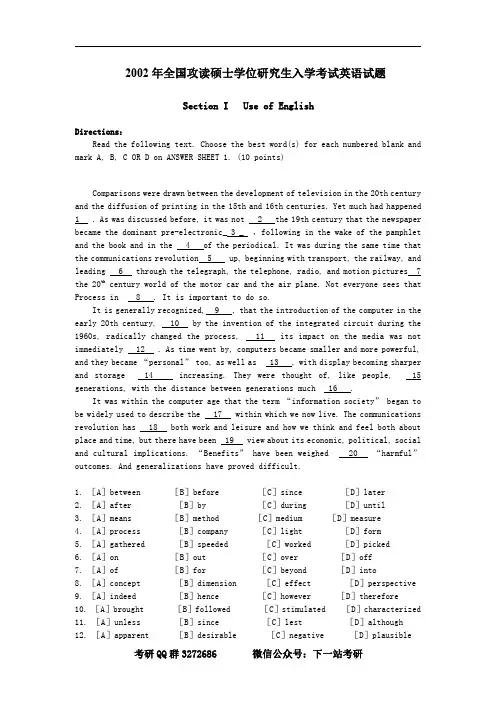
2002年全国攻读硕士学位研究生入学考试英语试题Section I Use of EnglishDirections:Read the following text.Choose the best word(s)for each numbered blank and mark A,B,C OR D on ANSWER SHEET1.(10points)Comparisons were drawn between the development of television in the20th century and the diffusion of printing in the15th and16th centuries.Yet much had happened 1.As was discussed before,it was not2the19th century that the newspaper became the dominant pre-electronic_3_,following in the wake of the pamphlet and the book and in the4of the periodical.It was during the same time that the communications revolution5up,beginning with transport,the railway,and leading6through the telegraph,the telephone,radio,and motion pictures7 the20th century world of the motor car and the air plane.Not everyone sees that Process in8.It is important to do so.It is generally recognized,9,that the introduction of the computer in the early20th century,10by the invention of the integrated circuit during the 1960s,radically changed the process,11its impact on the media was not immediately12.As time went by,computers became smaller and more powerful, and they became“personal”too,as well as13,with display becoming sharper and storage14increasing.They were thought of,like people,15 generations,with the distance between generations much16.It was within the computer age that the term“information society”began to be widely used to describe the17within which we now live.The communications revolution has18both work and leisure and how we think and feel both about place and time,but there have been19view about its economic,political,social and cultural implications.“Benefits”have been weighed20“harmful”outcomes.And generalizations have proved difficult.1.[A]between[B]before[C]since[D]later2.[A]after[B]by[C]during[D]until3.[A]means[B]method[C]medium[D]measure4.[A]process[B]company[C]light[D]form5.[A]gathered[B]speeded[C]worked[D]picked6.[A]on[B]out[C]over[D]off7.[A]of[B]for[C]beyond[D]into8.[A]concept[B]dimension[C]effect[D]perspective9.[A]indeed[B]hence[C]however[D]therefore10.[A]brought[B]followed[C]stimulated[D]characterized11.[A]unless[B]since[C]lest[D]although12.[A]apparent[B]desirable[C]negative[D]plausible13.[A]institutional[B]universal[C]fundamental[D]instrumental14.[A]ability[B]capability[C]capacity[D]faculty15.[A]by means of[B]in terms of[C]with regard to[D]in line with16.[A]deeper[B]fewer[C]nearer[D]smaller17.[A]context[B]range[C]scope[D]territory18.[A]regarded[B]impressed[C]influenced[D]effected19.[A]competitive[B]controversial[C]distracting[D]irrational20.[A]above[B]upon[C]against[D]withSection II Reading ComprehensionPart ADirections:Read the following four texts.Answer the questions below each text by choosing[A], [B],[C]or[D].Mark your answers on ANSWER SHEET1.(40points)Text1If you intend using humor in your talk to make people smile,you must know how to identify shared experiences and problems.Your humor must be relevant to the audience and should help to show them that you are one of them or that you understand their situation and are in sympathy with their point of view.Depending on whom you are addressing,the problems will be different.If you are talking to a group of managers,you may refer to the disorganized methods of their secretaries; alternatively if you are addressing secretaries,you may want to comment on their disorganized bosses.Here is an example,which I heard at a nurses’convention,of a story which works well because the audience all shared the same view of doctors.A man arrives in heaven and is being shown around by St.Peter.He sees wonderful accommodations, beautiful gardens,sunny weather,and so on.Everyone is very peaceful,polite and friendly until,waiting in a line for lunch,the new arrival is suddenly pushed aside by a man in a white coat,who rushes to the head of the line,grabs his food and stomps over to a table by himself.“Who is that?”the new arrival asked St.Peter.“Oh,that’s God,”came the reply,“but sometimes he thinks he’s a doctor.”If you are part of the group which you are addressing,you will be in a position to know the experiences and problems which are common to all of you and it’ll be appropriate for you to make a passing remark about the inedible canteen food or the chairman’s notorious bad taste in ties.With other audiences you mustn’t attempt to cut in with humor as they will resent an outsider making disparaging remarks about their canteen or their chairman.You will be on safer ground if you stick to scapegoats like the Post Office or the telephone system.If you feel awkward being humorous,you must practice so that it becomes more natural.Include a few casual and apparently off-the-cuff remarks which you can deliver in a relaxed and unforced manner.Often it’s the delivery which causes theaudience to smile,so speak slowly and remember that a raised eyebrow or an unbelieving look may help to show that you are making a light-hearted remark.Look for the humor.It often comes from the unexpected.A twist on a familiar quote“If at first you don’t succeed,give up”or a play on words or on a situation. Search for exaggeration and understatement.Look at your talk and pick out a few words or sentences which you can turn about and inject with humor.21.To make your humor work,you should.[A]take advantage of different kinds of audience[B]make fun of the disorganized people[C]address different problems to different people[D]show sympathy for your listeners22.The joke about doctors implies that,in the eyes of nurses,they are.[A]impolite to new arrivals[B]very conscious of their godlike role[C]entitled to some privileges[D]very busy even during lunch hours23.It can be inferred from the text that public services.[A]have benefited many people[B]are the focus of public attention[C]are an inappropriate subject for humor[D]have often been the laughing stock24.To achieve the desired result,humorous stories should be delivered.[A]in well-worded language[B]as awkwardly as possible[C]in exaggerated statements[D]as casually as possible25.The best title for the text may be.[A]Use Humor Effectively[B]Various Kinds of Humor[C]Add Humor to Speech[D]Different Humor StrategiesText2Since the dawn of human ingenuity,people have devised ever more cunning tools to cope with work that is dangerous,boring,burdensome,or just plain nasty.That compulsion has resulted in robotics—the science of conferring various human capabilities on machines.And if scientists have yet to create the mechanical version of science fiction,they have begun to come close.As a result,the modern world is increasingly populated by intelligent gizmos whose presence we barely notice but whose universal existence has removed much human labor.Our factories hum to the rhythm of robot assembly arms.Our banking is done at automated teller terminals that thank us with mechanical politeness for thetransaction.Our subway trains are controlled by tireless robot-drivers.And thanks to the continual miniaturization of electronics and micro-mechanics,there are already robot systems that can perform some kinds of brain and bone surgery with submillimeter accuracy—far greater precision than highly skilled physicians can achieve with their hands alone.But if robots are to reach the next stage of laborsaving utility,they will have to operate with less human supervision and be able to make at least a few decisions for themselves—goals that pose a real challenge.“While we know how to tell a robot to handle a specific error,"says Dave Lavery,manager of a robotics program at NASA,“we can't yet give a robot enough‘common sense’to reliably interact with a dynamic world.”Indeed the quest for true artificial intelligence has produced very mixed results.Despite a spell of initial optimism in the1960s and1970s when it appeared that transistor circuits and microprocessors might be able to copy the action of the human brain by the year2010,researchers lately have begun to extend that forecast by decades if not centuries.What they found,in attempting to model thought,is that the human brain's roughly one hundred billion nerve cells are much more talented—and human perception far more complicated—than previously imagined.They have built robots that can recognize the error of a machine panel by a fraction of a millimeter in a controlled factory environment.But the human mind can glimpse a rapidly changing scene and immediately disregard the98percent that is irrelevant,instantaneously focusing on the monkey at the side of a winding forest road or the single suspicious face in a big crowd.The most advanced computer systems on Earth can't approach that kind of ability,and neuroscientists still don’t know quite how we do it.26.Human ingenuity was initially demonstrated in.[A]the use of machines to produce science fiction.[B]the wide use of machines in manufacturing industry.[C]the invention of tools for difficult and dangerous work.[D]the elite’s cunning tackling of dangerous and boring work.27.The word“gizmos”(line1,paragraph2)most probably means.[A]programs[B]experts[C]devices[D]creatures28.According to the text,what is beyond man's ability now is to design a robotthat can.[A]fulfill delicate tasks like performing brain surgery.[B]interact with human beings verbally.[C]have a little common sense.[D]respond independently to a changing world.29.Besides reducing human labor,robots can also.[A]make a few decisions for themselves.[B]deal with some errors with human intervention.[C]improve factory environments.[D]cultivate human creativity.30.The author uses the example of a monkey to argue that robots are.[A]expected to copy human brain in internal structure.[B]able to perceive abnormalities immediately.[C]far less able than human brain in focusing on relevant information.[D]best used in a controlled environment.Text3Could the bad old days of economic decline be about to return?Since OPEC agreed to supply-cuts in March,the price of crude oil has jumped to almost$26a barrel, up from less than$10last December.This near-tripling of oil prices calls up scary memories of the1973oil shock,when prices quadrupled,and1979-1980,when they also almost tripled.Both previous shocks resulted in double-digit inflation and global economic decline.So where are the headlines warning of gloom and doom this time?The oil price was given another push up this week when Iraq suspended oil exports. Strengthening economic growth,at the same time as winter grips the northern hemisphere,could push the price higher still in the short term.Yet there are good reasons to expect the economic consequences now to be less severe than in the1970s.In most countries the cost of crude oil now accounts for a smaller share of the price of petrol than it did in the1970s.In Europe,taxes account for up to four-fifths of the retail price,so even quite big changes in the price of crude have a more muted effect on pump prices than in the past.Rich economies are also less dependent on oil than they were,and so less sensitive to swings in the oil price.Energy conservation,a shift to other fuels and a decline in the importance of heavy,energy-intensive industries have reduced oil consumption.Software,consultancy and mobile telephones use far less oil than steel or car production.For each dollar of GDP(in constant prices)rich economies now use nearly50%less oil than in1973.The OECD estimates in its latest Economic Outlook that,if oil prices averaged$22a barrel for a full year,compared with $13in1998,this would increase the oil import bill in rich economies by only 0.25-0.5%of GDP.That is less than one-quarter of the income loss in1974or1980. On the other hand,oil-importing emerging economies—to which heavy industry has shifted—have become more energy-intensive,and so could be more seriously squeezed.One more reason not to lose sleep over the rise in oil prices is that,unlike the rises in the1970s,it has not occurred against the background of general commodity-price inflation and global excess demand.A sizable portion of the world is only just emerging from economic decline.The Economist’s commodity price index is broadly unchanging from a year ago.In1973commodity prices jumped by70%,and in1979by almost30%.31.The main reason for the latest rise of oil price is_______[A]global inflation.[B]reduction in supply.[C]fast growth in economy.[D]Iraq’s suspension of exports.32.It can be inferred from the text that the retail price of petrol will go updramatically if______.[A]price of crude rises.[B]commodity prices rise.[C]consumption rises.[D]oil taxes rise.33.The estimates in Economic Outlook show that in rich countries_______.[A]heavy industry becomes more energy-intensive.[B]income loss mainly results from fluctuating crude oil prices.[C]manufacturing industry has been seriously squeezed.[D]oil price changes have no significant impact on GDP.34.We can draw a conclusion from the text that_______.[A]oil-price shocks are less shocking now.[B]inflation seems irrelevant to oil-price shocks.[C]energy conservation can keep down the oil prices.[D]the price rise of crude leads to the shrinking of heavy industry.35.From the text we can see that the writer seems__________.[A]optimistic.[B]sensitive.[C]gloomy.[D]scared.Text4The Supreme Court’s decisions on physician-assisted suicide carry important implications for how medicine seeks to relieve dying patients of pain and suffering.Although it ruled that there is no constitutional right to physician-assisted suicide,the Court in effect supported the medical principle of“double effect”, a centuries-old moral principle holding that an action having two effects—a good one that is intended and a harmful one that is foreseen—is permissible if the actor intends only the good effect.Doctors have used that principle in recent years to justify using high doses of morphine to control terminally ill patients’pain,even though increasing dosages will eventually kill the patient.Nancy Dubler,director of Montefiore Medical Center,contends that the principle will shield doctors who“until now have very,very strongly insisted that they could not give patients sufficient medication to control their pain if that might hasten death”.George Annas,chair of the health law department at Boston University,maintains that,as long as a doctor prescribes a drug for a legitimate medical purpose,the doctor has done nothing illegal even if the patient uses the drug to hasten death.“It’s like surgery,”he says.“We don’t call those deaths homicides because the doctors didn’t intend to kill their patients,although they risked their death. If you’re a physician,you can risk your patient’s suicide as long as you don’t intend their suicide.”On another level,many in the medical community acknowledge that the assisted-suicide debate has been fueled in part by the despair of patients for whom modern medicine has prolonged the physical agony of dying.Just three weeks before the Court’s ruling on physician-assisted suicide,the National Academy of Science(NAS)released a two-volume report,Approaching Death: Improving Care at the End of Life.It identifies the undertreatment of pain and the aggressive use of“ineffectual and forced medical procedures that may prolong andeven dishonor the period of dying”as the twin problems of end-of-life care.The profession is taking steps to require young doctors to train in hospices, to test knowledge of aggressive pain management therapies,to develop a Medicare billing code for hospital-based care,and to develop new standards for assessing and treating pain at the end of life.Annas says lawyers can play a key role in insisting that these well-meaning medical initiatives translate into better care.“Large numbers of physicians seem unconcerned with the pain their patients are needlessly and predictably suffering”, to the extent that it constitutes“systematic patient abuse”.He says medical licensing boards“must make it clear...that painful deaths are presumptively ones that are incompetently managed and should result in license suspension”.36.From the first three paragraphs,we learn that.[A]doctors used to increase drug dosages to control their patients’pain[B]it is still illegal for doctors to help the dying end their lives[C]the Supreme Court strongly opposes physician-assisted suicide[D]patients have no constitutional right to commit suicide37.Which of the following statements its true according to the text?[A]Doctors will be held guilty if they risk their patients’death.[B]Modern medicine has assisted terminally ill patients in painless recovery.[C]The Court ruled that high-dosage pain-relieving medication can beprescribed.[D]A doctor’s medication is no longer justified by his intentions.38.According to the NAS’s report,one of the problems in end-of-life care is.[A]prolonged medical procedures[B]inadequate treatment of pain[C]systematic drug abuse[D]insufficient hospital care39.Which of the following best defines the word“aggressive”(line4,paragraph7)?[A]Bold.[B]Harmful.[C]Careless.[D]Desperate40.George Annas would probably agree that doctors should be punished if they.[A]manage their patients incompetently[B]give patients more medicine than needed[C]reduce drug dosages for their patients[D]prolong the needless suffering of the patientsPart BDirections:Read the following text carefully and then translate the underlined segments into Chinese.Your translation should be written clearly on ANSWER SHEET 2.(10 points)Almost all our major problems involve human behavior,and they cannot be solved by physical and biological technology alone.What is needed is a technology of behavior,but we have been slow to develop the science from which such a technologymight be drawn.(41)One difficulty is that almost all of what is called behavioral science continues to trace behavior to states of mind,feelings,traits of character, human nature,and so on.Physics and biology once followed similar practices and advanced only when they discarded them.(42)The behavioral sciences have been slow to change partly because the explanatory items often seem to be directly observed and partly because other kinds of explanations have been hard to find.The environment is obviously important,but its role has remained obscure.It does not push or pull,it selects,and this function is difficult to discover and analyze.(43)The role of natural selection in evolution was formulated only a little more than a hundred years ago,and the selective role of the environment in shaping and maintaining the behavior of the individual is only beginning to be recognized and studied.As the interaction between organism and environment has come to be understood,however,effects once assigned to states of mind,feelings,and traits are beginning to be traced to accessible conditions,and a technology of behavior may therefore become available.It will not solve our problems,however,until it replaces traditional prescientific views,and these are strongly entrenched. Freedom and dignity illustrate the difficulty.(44)They are the possessions of the autonomous(self-governing)man of traditional theory,and they are essential to practices in which a person is held responsible for his conduct and given credit for his achievements.A scientific analysis shifts both the responsibility and the achievement to the environment.It also raises questions concerning“values”.Who will use a technology and to what ends?(45)Until these issues are resolved,a technology of behavior will continue to be rejected,and with it possibly the only way to solve our problems.Section III Writing46.Directions:Study the following picture carefully and write an essay entitled“Cultures National and International”.In the essay you should1.describe the picture and interpret its meaning,and2.give your comment on the phenomenon.You should write about200words neatly on ANSWER SHEET 2.(20points)An American girl in traditional Chinese costume(服装)下一站考研主要经营:【1】公共课全程视频【2】上百门专业课视频【3】各种考研书籍【4】全国500所院校专业课真题与解析(下一站考研网QQ号:311671180214510311)第一部分英语知识应用试题解析一、文章总体分析本文主要介绍了计算机的发展对通信革命及人们的生存方式产生的影响。
2003年考研英语真题及答案解析(高清版

2003年全国攻读硕士学位研究生入学考试英语试题Section I Use of EnglishDirections:Read the following text.Choose the best word(s)for each numbered blank and mark A,B,C OR D on ANSWER SHEET1.(10points)Teachers need to be aware of the emotional,intellectual,and physical changes that young adults experience.And they also need to give serious1to how they can best2such changes.Growing bodies need movement and3,but not just in ways that emphasize competition.4they are adjusting to their new bodies and a whole host of new intellectual and emotional challenges,teenagers are especially self-conscious and need the5that comes from achieving success and knowing that their accomplishments are6by others.However,the typical teenage lifestyle is already filled with so much competition that it would be7 to plan activities in which there are more winners than losers,8,publishing newsletters with many student-written book reviews,9student artwork,and sponsoring book discussion clubs.A variety of small clubs can provide10 opportunities for leadership,as well as for practice in successful11dynamics. Making friends is extremely important to teenagers,and many shy students need the 12of some kind of organization with a supportive adult13visible in the background.In these activities,it is important to remember that the young teens have14 attention spans.A variety of activities should be organized15participants can remain active as long as they want and then go on to16else without feeling guilty and without letting the other participants17.This does not mean that adults must accept irresponsibility.18they can help students acquire a sense of commitment by19for roles that are within their20and their attention spans and by having clearly stated rules.1.[A]thought[B]idea[C]opinion[D]advice2.[A]strengthen[B]accommodate[C]stimulate[D]enhance3.[A]care[B]nutrition[C]exercise[D]leisure4.[A]If[B]Although[C]Whereas[D]Because5.[A]assistance[B]guidance[C]confidence[D]tolerance6.[A]claimed[B]admired[C]ignored[D]surpassed7.[A]improper[B]risky[C]fair[D]wise8.[A]in effect[B]as a result[C]for example[D]in a sense9.[A]displaying[B]describing[C]creating[D] exchanging10.[A]durable[B]excessive[C]surplus[D]multiple11.[A]group[B]individual[C]personnel[D] corporation12.[A]consent[B]insurance[C]admission[D]security13.[A]particularly[B]barely[C]definitely[D]rarely14.[A]similar[B]long[C]different[D]short15.[A]if only[B]now that[C]so that[D]even if16.[A]everything[B]anything[C]nothing[D]something17.[A]off[B]down[C]out[D]alone18.[A]On the contrary[B]On the average[C]On the whole[D]On the other hand19.[A]making[B]standing[C]planning[D]taking20.[A]capability[B]responsibility[C]proficiency[D] efficiencySection II Reading ComprehensionPart ADirections:Read the following four texts.Answer the questions below each text by choosing [A],[B],[C]or[D].Mark your answers on ANSWER SHEET 1.(40points)Text1Wild Bill Donovan would have loved the Inter net.The American spymaster who built the Office of Strategic Services in the World WarⅡand later laid the roots for the CIA was fascinated with information.Donovan believed in using whatever tools came to hand in the“great game”of espionage—spying as a“profession.”These days the Net,which has already re-made such everyday pastimes as buying books and sending mail,is reshaping Donovan’s vocation as well.The latest revolution isn’t simply a matter of gentlemen reading other gentlemen’s e-mail.That kind of electronic spying has been going on for decades. In the past three or four years,the World Wide Web has given birth to a whole industry of point-and-click spying.The spooks call it“open source intelligence,”and as the Net grows,it is becoming increasingly influential.In1995the CIA held a contest to see who could compile the most data about Burundi.The winner,by a large margin, was a tiny Virginia company called Open-Source Solutions,whose clear advantage was its mastery of the electronic world.Among the firms making the biggest splash in the new world is Straitford,Inc., a private intelligence-analysis firm based in Austin,Texas.Straitford makes moneyby selling the results of spying(covering nations from Chile to Russia)to corporations like energy-services firm McDermott International.Many of its predictions are available online at .Straiford president George Friedman says he sees the online world as a kind of mutually reinforcing tool for both information collection and distribution,a spymaster’s st week his firm was busy vacuuming up data bits from the far corners of the world and predicting a crisis in Ukraine.“As soon as that report runs,we’ll suddenly get500new internet sign-ups from Ukraine,”says Friedman, a former political science professor.“And we’ll hear back from some of them.”Open-source spying does have its risks,of course,since it can be difficult to tell good information from bad.That’s where Straitford earns its keep.Friedman relies on a lean staff of20in Austin.Several of his staff members have military-intelligence backgrounds.He sees the firm’s outsider status as the key to its success.Straitford’s briefs don’t sound like the usual Washington back-and-forthing,whereby agencies avoid dramatic declarations on the chance they might be wrong.Straitford,says Friedman,takes pride in its independent voice.21.The emergence of the Net has.[A]received support from fans like Donovan[B]remolded the intelligence services[C]restored many common pastimes[D]revived spying as a profession22.Donovan’s story is mentioned in the text to.[A]introduce the topic of online spying[B]show how he fought for the US[C]give an episode of the information war[D]honor his unique services to the CIA23.The phrase“making the biggest splash”(line1,paragraph3)most probablymeans.[A]causing the biggest trouble[B]exerting the greatest effort[C]achieving the greatest success[D]enjoying the widest popularity24.It can be learned from paragraph4that.[A]straitford’s prediction about Ukraine has proved true[B]straitford guarantees the truthfulness of its information[C]straitford’s business is characterized by unpredictability[D]straitford is able to provide fairly reliable information25.Straitford is most proud of its.[A]official status[B]nonconformist image[C]efficient staff[D]military backgroundText2To paraphrase18th-century statesman Edmund Burke,“all that is needed for the triumph of a misguided cause is that good people do nothing.”One such cause now seeks to end biomedical research because of the theory that animals have rights ruling out their use in research.Scientists need to respond forcefully to animal rights advocates,whose arguments are confusing the public and thereby threatening advances in health knowledge and care.Leaders of the animal rights movement target biomedical research because it depends on public funding,and few people understand the process of health care research.Hearing allegations of cruelty to animals in research settings,many are perplexed that anyone would deliberately harm an animal.For example,a grandmotherly woman staffing an animal rights booth at a recent street fair was distributing a brochure that encouraged readers not to use anything that comes from or is tested in animals—no meat,no fur,no medicines.Asked if she opposed immunizations,she wanted to know if vaccines come from animal research. When assured that they do,she replied,“Then I would have to say yes.”Asked what will happen when epidemics return,she said,“Don’t worry,scientists will find some way of using computers.”Such well-meaning people just don’t understand.Scientists must communicate their message to the public in a compassionate, understandable way—in human terms,not in the language of molecular biology.We need to make clear the connection between animal research and a grandmother’s hip replacement,a father’s bypass operation,a baby’s vaccinations,and even a pet’s shots.To those who are unaware that animal research was needed to produce these treatments,as well as new treatments and vaccines,animal research seems wasteful at best and cruel at worst.Much can be done.Scientists could“adopt”middle school classes and present their own research.They should be quick to respond to letters to the editor,lest animal rights misinformation go unchallenged and acquire a deceptive appearance of truth.Research institutions could be opened to tours,to show that laboratory animals receive humane care.Finally,because the ultimate stakeholders are patients, the health research community should actively recruit to its cause not only well-known personalities such as Stephen Cooper,who has made courageous statements about the value of animal research,but all who receive medical treatment.If good people do nothing,there is a real possibility that an uninformed citizenry will extinguish the precious embers of medical progress.26.The author begins his article with Edmund Burke’s words to.[A]call on scientists to take some actions[B]criticize the misguided cause of animal rights[C]warn of the doom of biomedical research[D]show the triumph of the animal rights movement27.Misled people tend to think that using an animal in research is.[A]cruel but natural[B]inhuman and unacceptable[C]inevitable but vicious[D]pointless and wasteful28.The example of the grandmotherly woman is used to show the public’s.[A]discontent with animal research[B]ignorance about medical science[C]indifference to epidemics[D]anxiety about animal rights29.The author believes that,in face of the challenge from animal rights advocates,scientists should.[A]communicate more with the public[B]employ hi-tech means in research[C]feel no shame for their cause[D]strive to develop new cures30.From the text we learn that Stephen Cooper is.[A]a well-known humanist[B]a medical practitioner[C]an enthusiast in animal rights[D]a supporter of animal researchText3In recent years,railroads have been combining with each other,merging into supersystems,causing heightened concerns about monopoly.As recently as1995,the top four railroads accounted for under70percent of the total ton-miles moved by rails.Next year,after a series of mergers is completed,just four railroads will control well over90percent of all the freight moved by major rail carriers.Supporters of the new supersystems argue that these mergers will allow for substantial cost reductions and better coordinated service.Any threat of monopoly, they argue,is removed by fierce competition from trucks.But many shippers complain that for heavy bulk commodities traveling long distances,such as coal,chemicals, and grain,trucking is too costly and the railroads therefore have them by the throat.The vast consolidation within the rail industry means that most shippers are served by only one rail company.Railroads typically charge such“captive”shippers 20to30percent more than they do when another railroad is competing for the business. Shippers who feel they are being overcharged have the right to appeal to the federal government's Surface Transportation Board for rate relief,but the process is expensive,time consuming,and will work only in truly extreme cases.Railroads justify rate discrimination against captive shippers on the grounds that in the long run it reduces everyone's cost.If railroads charged all customers the same average rate,they argue,shippers who have the option of switching to trucks or other forms of transportation would do so,leaving remaining customers to shoulder the cost of keeping up the line.It's theory to which many economists subscribe, but in practice it often leaves railroads in the position of determining which companies will flourish and which will fail.“Do we really want railroads to be thearbiters of who wins and who loses in the marketplace?”asks Martin Bercovici,a Washington lawyer who frequently represents shipper.Many captive shippers also worry they will soon be hit with a round of huge rate increases.The railroad industry as a whole,despite its brightening fortuning fortunes,still does not earn enough to cover the cost of the capital it must invest to keep up with its surging traffic.Yet railroads continue to borrow billions to acquire one another,with Wall Street cheering them on.Consider the$10.2billion bid by Norfolk Southern and CSX to acquire Conrail this year.Conrail's net railway operating income in1996was just$427million,less than half of the carrying costs of the transaction.Who's going to pay for the rest of the bill?Many captive shippers fear that they will,as Norfolk Southern and CSX increase their grip on the market.31.According to those who support mergers,railway monopoly is unlikelybecause.[A]cost reduction is based on competition.[B]services call for cross-trade coordination.[C]outside competitors will continue to exist.[D]shippers will have the railway by the throat.32.What is many captive shippers'attitude towards the consolidation in the railindustry?[A]Indifferent.[B]Supportive.[C]Indignant.[D]Apprehensive.33.It can be inferred from paragraph3that.[A]shippers will be charged less without a rival railroad.[B]there will soon be only one railroad company nationwide.[C]overcharged shippers are unlikely to appeal for rate relief.[D]a government board ensures fair play in railway business.34.The word“arbiters”(line7,paragraph4)most probably refers to those.[A]who work as coordinators.[B]who function as judges.[C]who supervise transactions.[D]who determine the price.35.According to the text,the cost increase in the rail industry is mainly causedby.[A]the continuing acquisition.[B]the growing traffic.[C]the cheering Wall Street.[D]the shrinking market.Text4It is said that in England death is pressing,in Canada inevitable and inCalifornia optional.Small wonder.Americans’life expectancy has nearly doubled over the past century.Failing hips can be replaced,clinical depression controlled, cataracts removed in a30-minute surgical procedure.Such advances offer the aging population a quality of life that was unimaginable when I entered medicine50years ago.But not even a great health-care system can cure death—and our failure to confront that reality now threatens this greatness of ours.Death is normal;we are genetically programmed to disintegrate and perish,even under ideal conditions.We all understand that at some level,yet as medical consumers we treat death as a problem to be solved.Shielded by third-party payers from the cost of our care,we demand everything that can possibly be done for us, even if it’s useless.The most obvious example is late-stage cancer care.Physicians —frustrated by their inability to cure the disease and fearing loss of hope in the patient—too often offer aggressive treatment far beyond what is scientifically justified.In1950,the US spent$12.7billion on health care.In2002,the cost will be $1,540billion.Anyone can see this trend is unsustainable.Yet few seem willing to try to reverse it.Some scholars conclude that a government with finite resources should simply stop paying for medical care that sustains life beyond a certain age—say83or so.Former Colorado governor Richard Lamm has been quoted as saying that the old and infirm“have a duty to die and get out of the way”,so that younger, healthier people can realize their potential.I would not go that far.Energetic people now routinely work through their60s and beyond,and remain dazzlingly productive.At78,Viacom chairman Sumner Redstone jokingly claims to be53.Supreme Court Justice Sandra Day O’Connor is in her70s, and former surgeon general C.Everett Koop chairs an Internet start-up in his 80s.These leaders are living proof that prevention works and that we can manage the health problems that come naturally with age.As a mere68-year-old,I wish to age as productively as they have.Yet there are limits to what a society can spend in this pursuit.As a physician, I know the most costly and dramatic measures may be ineffective and painful.I also know that people in Japan and Sweden,countries that spend far less on medical care, have achieved longer,healthier lives than we have.As a nation,we may be overfunding the quest for unlikely cures while underfunding research on humbler therapies that could improve people’s lives.36.What is implied in the first sentence?[A]Americans are better prepared for death than other people.[B]Americans enjoy a higher life quality than ever before.[C]Americans are over-confident of their medical technology.[D]Americans take a vain pride in their long life expectancy.37.The author uses the example of caner patients to show that.[A]medical resources are often wasted[B]doctors are helpless against fatal diseases[C]some treatments are too aggressive[D]medical costs are becoming unaffordable38.The author’s attitude toward Richard Lamm’s remark is one of.[A]strong disapproval[B]reserved consent[C]slight contempt[D]enthusiastic support39.In contras to the US,Japan and Sweden are funding their medical care.[A]more flexibly[B]more extravagantly[C]more cautiously[D]more reasonably40.The text intends to express the idea that.[A]medicine will further prolong people’s lives[B]life beyond a certain limit is not worth living[C]death should be accepted as a fact of life[D]excessive demands increase the cost of health carePart BDirections:Read the following text carefully and then translate the underlined segments into Chinese.Your translation should be written clearly on ANSWER SHEET2.(10points)Human beings in all times and places think about their world and wonder at their place in it.Humans are thoughtful and creative,possessed of insatiable curiosity.(41)Furthermore,humans have the ability to modify the environment in which they live,thus subjecting all other life forms to their own peculiar ideas and fancies. Therefore,it is important to study humans in all their richness and diversity in a calm and systematic manner,with the hope that the knowledge resulting from such studies can lead humans to a more harmonious way of living with themselves and with all other life forms on this planet Earth.“Anthropology”derives from the Greek words anthropos“human”and logos “the study of.”By its very name,anthropology encompasses the study of all humankind.Anthropology is one of the social sciences.(42)Social science is that branch of intellectual enquiry which seeks to study humans and their endeavors in the same reasoned,orderly,systematic,and dispassioned manner that natural scientists use for the study of natural phenomena.Social science disciplines include geography,economics,political,science, psychology,and sociology.Each of these social sciences has a subfield or specialization which lies particularly close to anthropology.All the social sciences focus upon the study of humanity.Anthropology is a field-study oriented discipline which makes extensive use of the comparative method in analysis.(43)The emphasis on data gathered first-hand,combined with a cross-cultural perspective brought to the analysis of cultures past and present, makes this study a unique and distinctly important social science.Anthropological analyses rest heavily upon the concept of culture.Sir Edward Tylor’s formulation of the concept of culture was one of the great intellectual achievements of19th century science.(44)Tylor defined culture as“…that complex whole which includes belief,art,morals,law,custom,and any other capabilities and habits acquired by man as a member of society.”This insight,so profound in its simplicity,opened up an entirely new way of perceiving and understanding human life.Implicit within Tylor’s definition is the concept that culture is learned. shared,and patterned behavior.(45)Thus,the anthropological concept of“culture,”like the concept of “set”in mathematics,is an abstract concept which makes possible immense amounts of concrete research and understanding.Section III Writing46.Directions:Study the following set of drawings carefully and write an essay entitled in which you should1)describe the set of drawings,interpret its meaning,and2)point out its implications in our life.You should write about200words neatly on ANSWER SHEET 2.(20points)第一部分英语知识运用试题解析一、文章总体分析文章主要论述了教师们应该关注青少年在成长时期所经历的情感、心智和生理上的变化,并采取方法帮助他们适应这些变化,健康成长。
2021考研英语(一)真题及答案解析

2021年全国硕士研究生入学统一考试英语(一)真题及答案解析(完整版)SectionⅠUse of EnglishDirections:Read the following text.Choose the best word(s)for each numbered blank and mark A,B,C or D on the ANSWER SHEET.(10points)Fluid intelligence is the type of intelligence that has to do with short-term memory and the ability to think quickly,logically,and abstractly in order to solve new problems.It1in young adulthood,levels out for a period of time,and then2starts to slowly decline as we age.But3aging is inevitable,scientists are finding out that certain changes in brain function may not be.One study found that muscle1oss and the4of body fat around the abdomen are associated with a decline in fluid intelligence.This suggests the5that lifestyle factors might help prevent or6this type of decline.The researchers looked at data that7measurements of lean muscle and abdominal fat from more than4,000middle-to-older-aged men and women and8that data to reported changes in fluid intelligence over a six-year period.They found that middle-aged people9higher measures of abdominal fat10worse on measures of fluid intelligence as the years11.For women,the association may be12to changes in immunity that resulted from excess abdominal fat;in men,the immune system did not appear to be13.It is hoped that future studies could14these differences and perhaps lead to different15for men and women.16there are steps you can17to help reduce abdominal fat and maintain lean muscle mass as you age in order to protect both your physical and mental18.The two highly recommended lifestyle approaches are maintaining or increasing your19of aerobic exercise and following Mediterranean-style20that is high in fiber and eliminates highly processed foods.1.[A]pauses[B]return[C]peaks[D]fades2.[A]alternatively[B]formally[C]accidentally[D]generally3.[A]while[B]since[C]once[D]until4.[A]detection[B]accumulation[C]consumption[D]separation5.[A]possibility[B]decision[C]goal[D]requirement6.[A]delay[B]ensure[C]seek[D]utilize7.[A]modified[B]supported[C]included[D]predicted8.[A]devoted[B]compared[C]converted[D]applied9.[A]with[B]above[C]by[D]against10.[A]lived[B]managed[C]scored[D]played11.[A]ran out[B]set off[C]drew in[D]went by12.[A]superior[B]attributable[C]parallel[D]resistant13.[A]restored[B]isolated[C]involved[D]controlled14.[A]alter[B]spread[C]remove[D]explain15.[A]compensations[B]symptoms[C]demands[D]treatments16.[A]Likewise[B]Meanwhile[C]Therefore[D]Instead17.[A]change[B]watch[C]count[D]take18.[A]well-being[B]process[C]formation[D]coordination19.[A]level[B]love[C]knowledge[D]space20.[A]design[B]routine[C]diet[D]prescription1.【答案】C peaks【解析】此处考察词义辨析+句间逻辑关系。
1999年考研英语真题试卷(题后含答案及解析)

1999年考研英语真题试卷(题后含答案及解析) 题型有:1. Use of English 2. Reading ComprehensionSection I Use of EnglishDirections: Read the following text. Choose the best word(s) for each numbered blank and mark A, B, C or D. (10 points)Industrial safety does not just happen. Companies 【B1】low accident rates plan their safety programs, work hard to organize them, and continue working to keep them 【B2】and active. When the work is well done, a 【B3】of accident free operations is established 【B4】time lost due to injuries is kept at a minimum. Successful safety programs may 【B5】greatly in the emphasis placed on certain aspects of the program. Some place great emphasis on mechanical guarding. Others stress safe work practices by 【B6】rules or regulations. 【B7】others depend on an emotional appeal to the worker. But, there are certain basic ideas that must be used in every program if maxi mum results are to be obtained. There can be no question about the value of a safety program. From a financial stand-point alone, safety 【B8】. The fewer the injury 【B9】, the better the workman’s insurance rate. This may mean the difference between operating at 【B10】or at a loss.1.【B1】A.atB.inC.onD.with正确答案:D解析:本题考查对介词用法的掌握。
2003考研英语真题(英一二通用)答案+解析

2003年全国硕士研究生入学统一考试英语试题Section I Listening ComprehensionDirections:This section is designed to test your ability to understand spoken English.You will hear a selection of recorded materials and you must answer the questions that accompany them.There are three parts in this section,Part A,Part B,and Part C.Remember,while you should first put down your answers in your test booklet.At the end of the listening comprehension section,you will have five minutes to transfer all your answers from your test booklet to ANSWER SHEET1.Now look at Part A in your test booklet.Part ADirections:For Question1-5,you will hear a talk about Boston Museum of Fine Art.While you listen,fill out the table with the information you have heard.Some of the information has been given to you in the table.Write only1word or number in each numbered box.You will hear the recording twice.You now have25seconds to read the table below.(5points)Boston Museum of Fine ArtsFounded(year)1870Opened to the public(year)Question1Moved to the current location(year)1909The west wing completed(year)Question2Number of departments9The most remarkable department Question3Exhibition Space(m2)Question4Approximate number of visitors/year800,000Programs providedQuestion5classeslecturesPart BDirections:For Questions6-10,you will hear an interview with an expert on marriage problems.While you listen,complete the sentences or answer the e not more than3words for each answer.You will hear the recording twice.You now have25seconds to read the sentences and questions below.(5points)What should be the primary source of help for a troubled couple?________.Question6Writing down a list of problems in the marriage may help a troubled couple discuss them ________.Question7Who should a couple consider seriously turning to if they can’t talk with each other? ________.Question8Priests are usually unsuccessful in counseling troubled couples despite their________. Question9According to the old notion,what will make hearts grow fonder?________.Question10 Part CDirections:You will hear three pieces of recorded material.Before listening to each one,you will have time to read the questions related to it.While listening,answer each question by choosing[A],[B],[C] or[D].After listening,you will have time to check your answers you will hear each piece once only.(10points)Questions11-13are based on the following talk about napping,you now have15seconds to read questions11-13.11.Children under five have abundant energy partly because they________.[A]sleep in three distinct parts[B]have many five-minute naps[C]sleep in one long block[D]take one or two naps daily12.According to the speaker,the sleep pattern of a baby is determined by________.[A]its genes[B]its habit[C]its mental state[D]its physical condition13.The talk suggests that,if you feel sleepy through the day,you should________.[A]take some refreshment[B]go to bed early[C]have a long rest[D]give in to sleepQuestions14-16are based on the following interview with Sherman Alexie,an American Indian poet.You now have15seconds to read Questions14-16.14.Why did Sherman Alexie only take day jobs?[A]He could bring unfinished work home.[B]He might have time to pursue his interests.[C]He might do some evening teaching.[D]He could invest more emotion in his family.15.What was his original goal at college?[A]to teach in high school[B]to write his own books[C]to be a medical doctor[D]to be a mathematician16.Why did he take the poetry-writing class?[A]To follow his father.[B]For an easy grade.[C]To change his specialty.[D]For knowledge of poetry.Questions17-20are based on the following talk about public speaking.You now have20 seconds to read Questions17-20.17.What is the most important thing in public speaking?[A]Confidence.[B]Preparation.[C]Informativeness.[D]Organization.18.What does the speaker advise us to do to capture the audience’s attention?[A]Gather abundant data.[B]Organize the idea logically.[C]Develop a great opening.[D]Select appropriate materials.19.If you don’t start working for the presentation until the day before,you will feel________.[A]uneasy[B]uncertain[C]frustrated[D]depressed20.Who is this speech most probably meant for?[A]Those interested in the power of persuasion.[B]Those trying to improve their public images.[C]Those planning to take up some public work.[D]Those eager to become effective speakers.You now have5minutes to transfer all your answers from your test booklet to ANSWER SHEET1.Section II Use of EnglishDirections:Read the following text.Choose the best word(s)for each numbered blank and mark[A],[B], [C]or[D]on ANSWER SHEET1.(10points)Teachers need to be aware of the emotional,intellectual,and physical changes that young adults experience.And they also need to give serious大21家to how they can best 大22家such changes.Growing bodies need movement and大23家,but not just in waysthat emphasize competition.大24家they are adjusting to their new bodies and a whole host of new intellectual and emotional challenges,teenagers are especially self-conscious and needthe大25家that comes from achieving success and knowing that their accomplishments are大26家by others.However,the typical teenage lifestyle is already filled with so much competition that it would be大27家to plan activities in which there are more winners thanlosers,大28家,publishing newsletters with many student-written book reviews,大29家student artwork,and sponsoring book discussion clubs.A variety of small clubs can provide 大30家opportunities for leadership,as well as for practice in successful大31家dynamics.Making friends is extremely important to teenagers,and many shy students need the 大32家of some kind of organization with a supportive adult大33家visible in the background.In these activities,it is important to remember that the young teens have大34家attention spans.A variety of activities should be organized大35家participants can remain active as long as they want and then go on to大36家else without feeling guilty and without letting the other participants大37家.This does not mean that adults must accept irresponsibility.大38家,they can help students acquire a sense of commitment by大39家for roles that are within their大40家and their attention spans and by having clearly stated rules.21.[A]thought[B]idea[C]opinion[D]advice22.[A]strengthen[B]accommodate[C]stimulate[D]enhance23.[A]care[B]nutrition[C]exercise[D]leisure24.[A]If[B]Although[C]Whereas[D]Because25.[A]assistance[B]guidance[C]confidence26.[A]claimed[B]admired[C]ignored[D]surpassed27.[A]improper[B]risky[C]fair[D]wise28.[A]in effect[B]as a result[C]for example[D]in a sense29.[A]displaying[B]describing[C]creating[D]exchanging30.[A]durable[B]excessive[C]surplus[D]multiple31.[A]group[B]individual[C]personnel[D]corporation32.[A]consent[B]insurance[C]admission[D]security33.[A]particularly[B]barely[D]rarely34.[A]similar[B]long[C]different[D]short35.[A]if only[B]now that[C]so that[D]even if36.[A]everything[B]anything[C]nothing[D]something37.[A]off[B]down[C]out[D]alone38.[A]On the contrary[B]On the average[C]On the whole[D]On the other hand39.[A]making[B]standing[C]planning[D]taking40.[A]capabilities[B]responsibilities[C]proficiency[D]efficiencySection III Reading ComprehensionPart ADirections:Read the following four texts.Answer the questions below each text by choosing[A],[B],[C]or [D].Mark your answers on ANSWER SHEET1(40points)Text1Wild Bill Donovan would have loved the Internet.The American spymaster who built the Office of Strategic Services in the World War II and later laid the roots for the CIA was fascinated with information.Donovan believed in using whatever tools came to hand in the “great game”of espionage--spying as a“profession.”These days the Net,which has already re-made such everyday pastimes as buying books and sending mail,is reshaping Donovan’s vocation as well.The latest revolution isn’t simply a matter of gentlemen reading other gentlemen’s e-mail. That kind of electronic spying has been going on for decades.In the past three or four years,the World Wide Web has given birth to a whole industry of point-and-click spying.The spooks call it “open-source intelligence,”and as the Net grows,it is becoming increasingly influential.In1995 the CIA held a contest to see who could compile the most data about Burundi.The winner,by a large margin,was a tiny Virginia company called Open Source Solutions,whose clear advantage was its mastery of the electronic world.Among the firms making the biggest splash in this new world is Straitford,Inc.,a private intelligence-analysis firm based in Austin,Texas.Straitford makes money by selling the results of spying(covering nations from Chile to Russia)to corporations like energy-services firm McDermott International.Many of its predictions are available online at .Straitford president George Friedman says he sees the online world as a kind of mutually reinforcing tool for both information collection and distribution,a spymaster’s st week his firm was busy vacuuming up data bits from the far corners of the world and predicting a crisis in Ukraine.“As soon as that report runs,we’ll suddenly get500new Internet sign-ups from Ukraine,”says Friedman,a former political science professor.“And we’ll hear back from some of them.”Open-source spying does have its risks,of course,since it can be difficult to tell good information from bad.That’s where Straitford earns its keep.Friedman relies on a lean staff of20in Austin.Several of his staff members have military-intelligence backgrounds.He sees the firm’s outsider status as the key to its success. Straitford’s briefs don’t sound like the usual Washington back-and-forthing,whereby agencies avoid dramatic declarations on the chance they might be wrong.Straitford,says Friedman,takes pride in its independent voice.41.The emergence of the Net has________.[A]received support from fans like Donovan[B]remolded the intelligence services[C]restored many common pastimes[D]revived spying as a profession42.Donovan’s story is mentioned in the text to________.[A]introduce the topic of online spying[B]show how he fought for the U.S.[C]give an episode of the information war[D]honor his unique services to the CIA43.The phrase“making the biggest splash”(Line1,Paragraph3)most probably means________.[A]causing the biggest trouble[B]exerting the greatest effort[C]achieving the greatest success[D]enjoying the widest popularity44.It can be learned from Paragraph4that________.[A]Straitford’s prediction about Ukraine has proved true[B]Straitford guarantees the truthfulness of its information[C]Straitford’s business is characterized by unpredictability[D]Straitford is able to provide fairly reliable information45.Straitford is most proud of its________.[A]official status[B]nonconformist image[C]efficient staff[D]military backgroundText2To paraphrase18th-century statesman Edmund Burke,“all that is needed for the triumph of a misguided cause is that good people do nothing.”One such cause now seeks to end biomedical research because of the theory that animals have rights ruling out their use in research.Scientists need to respond forcefully to animal rights advocates,whose arguments are confusing the public and thereby threatening advances in health knowledge and care.Leaders of the animal rights movement target biomedical research because it depends on public funding,and few people understand the process of health care research.Hearing allegations of cruelty to animals in research settings,many are perplexed that anyone would deliberately harm an animal.For example,a grandmotherly woman staffing an animal rights booth at a recent street fair was distributing a brochure that encouraged readers not to use anything that comes from or is tested in animals—no meat,no fur,no medicines.Asked if she opposed immunizations,she wanted to know if vaccines come from animal research.When assured that they do,she replied,“Then I would have to say yes.”Asked what will happen when epidemics return,she said,“Don’t worry,scientists will find some way of using computers.”Such well-meaning people just don’t understand.Scientists must communicate their message to the public in a compassionate, understandable way--in human terms,not in the language of molecular biology.We need to make clear the connection between animal research and a grandmother’s hip replacement,a father’s bypass operation,a baby’s vaccinations,and even a pet’s shots.To those who are unaware that animal research was needed to produce these treatments,as well as new treatments and vaccines,animal research seems wasteful at best and cruel at worst.Much can be done.Scientists could“adopt”middle school classes and present their own research.They should be quick to respond to letters to the editor,lest animal rights misinformation go unchallenged and acquire a deceptive appearance of truth.Research institutions could be opened to tours,to show that laboratory animals receive humane care. Finally,because the ultimate stakeholders are patients,the health research community should actively recruit to its cause not only well-known personalities such as Stephen Cooper,who has made courageous statements about the value of animal research,but all who receive medical treatment.If good people do nothing,there is a real possibility that an uninformed citizenry will extinguish the precious embers of medical progress.46.The author begins his article with Edmund Burke’s words to________.[A]call on scientists to take some actions[B]criticize the misguided cause of animal rights[C]warn of the doom of biomedical research[D]show the triumph of the animal rights movement47.Misled people tend to think that using an animal in research is________.[A]cruel but natural[B]inhuman and unacceptable[C]inevitable but vicious[D]pointless and wasteful48.The example of the grandmotherly woman is used to show the public’s________.[A]discontent with animal research[B]ignorance about medical science[C]indifference to epidemics[D]anxiety about animal rights49.The author believes that,in face of the challenge from animal rights advocates,scientistsshould________.[A]communicate more with the public[B]employ hi-tech means in research[C]feel no shame for their cause[D]strive to develop new cures50.From the text we learn that Stephen Cooper is________.[A]a well-known humanist[B]a medical practitioner[C]an enthusiast in animal rights[D]a supporter of animal researchText3In recent years,railroads have been combining with each other,merging into supersystems, causing heightened concerns about monopoly.As recently as1995,the top four railroads accounted for under70percent of the total ton-miles moved by rails.Next year,after a series of mergers is completed,just four railroads will control well over90percent of all the freight moved by major rail carriers.Supporters of the new supersystems argue that these mergers will allow for substantial cost reductions and better coordinated service.Any threat of monopoly,they argue,is removed by fierce competition from trucks.But many shippers complain that for heavy bulk commodities traveling long distances,such as coal,chemicals,and grain,trucking is too costly and the railroads therefore have them by the throat.The vast consolidation within the rail industry means that most shippers are served by only one rail company.Railroads typically charge such“captive”shippers20to30percent more than they do when another railroad is competing for the business.Shippers who feel they are being overcharged have the right to appeal to the federal government’s Surface Transportation Board for rate relief,but the process is expensive,time-consuming,and will work only in truly extreme cases.Railroads justify rate discrimination against captive shippers on the grounds that in the long run it reduces everyone’s cost.If railroads charged all customers the same average rate,they argue,shippers who have the option of switching to trucks or other forms of transportation would do so,leaving remaining customers to shoulder the cost of keeping up the line.It’s a theory to which many economists subscribe,but in practice it often leaves railroads in the position of determining which companies will flourish and which will fail.“Do we really want railroads to be the arbiters of who wins and who loses in the marketplace?”asks Martin Bercovici,a Washington lawyer who frequently represents shippers.Many captive shippers also worry they will soon be hit with a round of huge rate increases. The railroad industry as a whole,despite its brightening fortunes,still does not earn enough to cover the cost of the capital it must invest to keep up with its surging traffic.Yet railroads continue to borrow billions to acquire one another,with Wall Street cheering them on.Consider the$10.2billion bid by Norfolk Southern and CSX to acquire Conrail this year.Conrail’s netrailway operating income in1996was just$427million,less than half of the carrying costs of the transaction.Who’s going to pay for the rest of the bill?Many captive shippers fear that they will,as Norfolk Southern and CSX increase their grip on the market.51.According to those who support mergers,railway monopoly is unlikely because________.[A]cost reduction is based on competition[B]services call for cross-trade coordination[C]outside competitors will continue to exist[D]shippers will have the railway by the throat52.What is many captive shippers’attitude towards the consolidation in the rail industry?[A]Indifferent.[B]Supportive.[C]Indignant.[D]Apprehensive.53.It can be inferred from Paragraph3that________.[A]shippers will be charged less without a rival railroad[B]there will soon be only one railroad company nationwide[C]overcharged shippers are unlikely to appeal for rate relief[D]a government board ensures fair play in railway business54.The word“arbiters”(Line7,Paragraph4)most probably refers to those________.[A]who work as coordinators[B]who function as judges[C]who supervise transactions[D]who determine the price55.According to the text,the cost increase in the rail industry is mainly caused by________.[A]the continuing acquisition[B]the growing traffic[C]the cheering Wall Street[D]the shrinking marketText4It is said that in England death is pressing,in Canada inevitable and in California optional. Small wonder.Americans’life expectancy has nearly doubled over the past century.Failing hips can be replaced,clinical depression controlled,cataracts removed in a30-minute surgical procedure.Such advances offer the aging population a quality of life that was unimaginablewhen I entered medicine50years ago.But not even a great health-care system can cure death--and our failure to confront that reality now threatens this greatness of ours.Death is normal;we are genetically programmed to disintegrate and perish,even under ideal conditions.We all understand that at some level,yet as medical consumers we treat death as a problem to be solved.Shielded by third-party payers from the cost of our care,we demand everything that can possibly be done for us,even if it’s useless.The most obvious example is late-stage cancer care.Physicians--frustrated by their inability to cure the disease and fearing loss of hope in the patient--too often offer aggressive treatment far beyond what is scientifically justified.In1950,the U.S.spent$12.7billion on health care.In2002,the cost will be$1,540billion. Anyone can see this trend is unsustainable.Yet few seem willing to try to reverse it.Some scholars conclude that a government with finite resources should simply stop paying for medical care that sustains life beyond a certain age--say83or so.Former Colorado governor Richard Lamm has been quoted as saying that the old and infirm“have a duty to die and get out of the way,”so that younger,healthier people can realize their potential.I would not go that far.Energetic people now routinely work through their60s and beyond, and remain dazzlingly productive.At78,Viacom chairman Sumner Redstone jokingly claims to be53.Supreme Court Justice Sandra Day O’Connor is in her70s,and former surgeon general C. Everett Koop chairs an Internet start-up in his80s.These leaders are living proof that prevention works and that we can manage the health problems that come naturally with age.As a mere 68-year-old,I wish to age as productively as they have.Yet there are limits to what a society can spend in this pursuit.As a physician,I know the most costly and dramatic measures may be ineffective and painful.I also know that people in Japan and Sweden,countries that spend far less on medical care,have achieved longer,healthier lives than we have.As a nation,we may be overfunding the quest for unlikely cures while underfunding research on humbler therapies that could improve people’s lives.56.What is implied in the first sentence?[A]Americans are better prepared for death than other people.[B]Americans enjoy a higher life quality than ever before.[C]Americans are over-confident of their medical technology.[D]Americans take a vain pride in their long life expectancy.57.The author uses the example of cancer patients to show that________.[A]medical resources are often wasted[B]doctors are helpless against fatal diseases[C]some treatments are too aggressive[D]medical costs are becoming unaffordable58.The author’s attitude toward Richard Lamm’s remark is one of________.[A]strong disapproval[B]reserved consent[C]slight contempt[D]enthusiastic support59.In contrast to the U.S.,Japan and Sweden are funding their medical care________.[A]more flexibly[B]more extravagantly[C]more cautiously[D]more reasonably60.The text intends to express the idea that________.[A]medicine will further prolong people’s lives[B]life beyond a certain limit is not worth living[C]death should be accepted as a fact of life[D]excessive demands increase the cost of health carePart BDirections:Read the following text carefully and then translate the underlined segments into Chinese.Your translation should be written clearly on ANSWER SHEET2.(10points)Human beings in all times and places think about their world and wonder at their place in it. Humans are thoughtful and creative,possessed of insatiable curiosity.61)Furthermore,humans have the ability to modify the environment in which they live,thus subjecting all other life forms to their own peculiar ideas and fancies.Therefore,it is important to study humans in all their richness and diversity in a calm and systematic manner,with the hope that the knowledge resulting from such studies can lead humans to a more harmonious way of living with themselves and with all other life forms on this planet Earth.“Anthropology”derives from the Greek words anthropos:“human”and logos“the study of.”By its very name,anthropology encompasses the study of all humankind.Anthropology is one of the social sciences.62)Social science is that branch of intellectual enquiry which seeks to study humans and their endeavors in the same reasoned,orderly, systematic,and dispassioned manner that natural scientists use for the study of natural phenomena.Social science disciplines include geography,economics,political science,psychology,and sociology.Each of these social sciences has a subfield or specialization which lies particularly close to anthropology.All the social sciences focus upon the study of humanity.Anthropology is a field-study oriented discipline which makes extensive use of the comparative method in analysis.63)The emphasis on data gathered first-hand,combined with a cross-cultural perspective brought to theanalysis of cultures past and present,makes this study a unique and distinctly important social science.Anthropological analyses rest heavily upon the concept of culture.Sir Edward Tylor’s formulation of the concept of culture was one of the great intellectual achievements of19th century science.64)Tylor defined culture as“…that complex whole which includes belief,art, morals,law,custom,and any other capabilities and habits acquired by man as a member of society.”This insight,so profound in its simplicity,opened up an entirely new way of perceiving and understanding human life.Implicit within Tylor’s definition is the concept that culture is learned,shared,and patterned behavior.65)Thus,the anthropological concept of“culture,”like the concept of“set”in mathematics, is an abstract concept which makes possible immense amounts of concrete research and understanding.Section IV Writing66.Directions:Study the following set of drawings carefully and write an essay in which you should1)describe the set of drawings,interpret its meaning,and2)point out its implications in our life.You should write about200words neatly on ANSWER SHEET2.(20points)2003年考研英语真题答案解析Section I:Listening Comprehension(20points)Part A(5points)1.18762.19813.textiles4.19,1375.concerts Part B(5points)6.(the couple)themselves7.constructively8.a qualified psychologist9.good intentions10.absencePart C(10points)11.[D]12.[A]13.[D]14.[B]15.[C]16.[B]17.[B]18.[C]19.[A]20.[D]Section II:Use of English(10points)一、文章总体分析文章主要论述了教师们应该关注青少年在成长时期所经历的情感、心智和生理上的变化,并采取方法帮助他们适应这些变化,健康成长。
2011年考研英语(一)答案及真题解析

2011年考研英语(一)试题Section I Use of EnglishDirections:Read the following text. Choose the best word(s) for each numbered blank and mark A], B], C] or D] on ANSWER SHEET 1. (10 points)Ancient Greek philosopher Aristotle viewed laughter as “a bodily exercise precious to health.” But __1___some claims to the contrary, laughing probably has little influence on physical fitness Laughter does __2___short-term changes in the function of the heart and its blood vessels, ___3_ heart rate and oxygen consumption But because hard laughter is difficult to __4__, a good laugh is unlikely to have __5___ benefits the way, say, walking or jogging does.__6__, instead of straining muscles to build them, as exercise does, laughter apparently accomplishes the __7__, studies dating back to the 1930’s indicate that laughter__8___ muscles, decreasing muscle tone for up to 45 minutes after the laugh dies down.Such bodily reaction might conceivably help _9__the effects of psychological stress. Anyway, the act of laughing probably does produce other types of ___10___ feedback, that improve an individual’s emotional state. __11____one classical theory of emotion, our feelings are partially rooted ____12___ physical reactions. It was argued at the end of the 19th century that humans do not cry ___13___they are sad but they become sad when the tears begin to flow.Although sadness also ____14___ tears, evidence suggests that emotions can flow __15___ muscular responses. In an experiment published in 1988,social psychologist Fritz Strack of the University of würzburg in Germany asked volunteers to __16___a pen either with their teeth-thereby creating an artificial smile – or with their lips, which would produce a(n) __17___ expression. Those forced to exercise their enthusiastically to funny catoons than did those whose months were contracted in a frown, ____19___ that expressions may influence emotions rather than just the other way around __20__ , the physical act of laughter could improve mood.1.A]among B]except C]despite D]like2.A]reflect B]demand C]indicate D]produce3.A]stabilizing B]boosting C]impairing D]determining4.A]transmit B]sustain C]evaluate D]observe5.A]measurable B]manageable C]affordable D]renewable6.A]In turn B]In fact C]In addition D]In brief7.A]opposite B]impossible C]average D]expected8.A]hardens B]weakens C]tightens D]relaxes9.A]aggravate B]generate C]moderate D]enhance10.A]physical B]mental C]subconscious D]internal11.A]Except for B]According to C]Due to D]As for12.A]with B]on C]in D]at13.A]unless B]until C]if D]because14.A]exhausts B]follows C]precedes D]suppresses15.A]into B]from C]towards D]beyond16.A]fetch B]bite C]pick D]hold17.A]disappointed B]excited C]joyful D]indifferent18.A]adapted B]catered C]turned D]reacted19.A]suggesting B]requiring C]mentioning D]supposing20.A]Eventually B]Consequently C]Similarly D]ConverselySection II Reading ComprehensionPart ADirections:Read the following four texts. Answer the questions below each text by choosing A], B], C] or D]. Mark your answers on ANSWER SHEET 1. (40 points)Text 1The decision of the New York Philharmonic to hire Alan Gilbert as its next music director has been the talk of the classical-music world ever since the sudden announcement of his appointment in 2009. For the most part, the response has been favorable, to say the least. “Hooray! At last!” wrote Anthony Tommasini, a sober-sided classical-music critic.One of the reasons why the appointment came as such a surprise, however, is that Gilbert is comparatively little known. Even Tommasini, who had advocated Gilbert’s appointment in the Times, calls him “an unpretentious musician with no air of the formidable conductor about him.” As a description of the next music director of an orchestra that has hitherto been led by musicians like Gustav Mahler and Pierre Boulez, that seems likely to have struck at least some Times readers as faint praise. For my part, I have no idea whether Gilbert is a great conductor or even a good one. To be sure, he performs an impressive variety of interesting compositions, but itis not necessary for me to visit Avery Fisher Hall, or anywhere else, to hear interesting orchestral music. All I have to do is to go to my CD shelf, or boot up my computer and download still more recorded music from iTunes.Devoted concertgoers who reply that recordings are no substitute for live performance are missing the point. For the time, attention, and money of theart-loving public, classical instrumentalists must compete not only with opera houses, dance troupes, theater companies, and museums, but also with the recorded performances of the great classical musicians of the 20th century. There recordings are cheap, available everywhere, and very often much higher in artistic quality than today’s live performances; moreover, they can be “consumed” at a time and place of the listener’s choosing. The widespread availability of such recordings has thus brought about a crisis in the institution of the traditional classical concert. One possible response is for classical performers to program attractive new music that is not yet available on record. Gilbert’s own interest in new music has been widely noted: Alex Ross, a classical-music critic, has described him as a man who is capable of turning the Philharmonic into “a markedly different, more vibrant organization.” But what will be the nature of that difference? Merely expanding the orchestra’s repertoire will not be enough. If Gilbert and the Philharmonic are to succeed, they must first change the relationship between America’s oldest orchestra and the new audience it hops to attract.21. We learn from Para.1 that Gilbert’s appointment hasA]incurred criticism.B]raised suspicion.C]received acclaim.D]aroused curiosity.22. Tommasini regards Gilbert as an artist who isA]influential.B]modest.C]respectable.D]talented.23. The author believes that the devoted concertgoersA]ignore the expenses of live performances.B]reject most kinds of recorded performances.C]exaggerate the variety of live performances.D]overestimate the value of live performances.24. According to the text, which of the following is true of recordings?A]They are often inferior to live concerts in quality.B]They are easily accessible to the general public.C]They help improve the quality of music.D]They have only covered masterpieces.25. Regarding Gilbert’s role in revitalizing the Philharmonic, the author feelsA]doubtful.B]enthusiastic.C]confident.D]puzzled.Text 2When Liam McGee departed as president of Bank of America in August, his explanation was surprisingly straight up. Rather than cloaking his exit in the usual vague excuses, he came right out and said he was leaving “to pursue my goal of running a company.” Broadcasting his ambition was “very much my decision,” McGee says. Within two weeks, he was talking for the first time with the board of Hartford Financial Services Group, which named him CEO and chairman on September 29. McGee says leaving without a position lined up gave him time to reflect on what kind of company he wanted to run. It also sent a clear message to the outside world about his aspirations. And McGee isn’t alone. In recent weeks the No.2 executives at Avon and American Express quit with the explanation that they were looking for a CEO post. As boards scrutinize succession plans in response to shareholder pressure, executives who don’t get the nod also may wish to move on. A turbulent business environment also has senior managers cautious of letting vague pronouncements cloud their reputations.As the first signs of recovery begin to take hold, deputy chiefs may be more willing to make the jump without a net. In the third quarter, CEO turnover was down 23% from a year ago as nervous boards stuck with the leaders they had, according to Liberum Research. As the economy picks up, opportunities will abound for aspiring leaders. The decision to quit a senior position to look for a better one is unconventional. For years executives and headhunters have adhered to the rule that the most attractive CEO candidates are the ones who must be poached. Says Korn/Ferry senior partner Dennis Carey:”I can’t think of a single search I’ve done where a board has not instructed me to look at sitting CEOs first.”Those who jumped without a job haven’t always landed in top positions quickly. Ellen Marram quit as chief of Tropicana a decade age, saying she wanted to be a CEO. It was a year before she became head of a tiny Internet-based commodities exchange. Robert Willumstad left Citigroup in 2005 with ambitions to be a CEO. He finally took that post at a major financial institution three years later.Many recruiters say the old disgrace is fading for top performers. The financial crisis has made it more acceptable to be between jobs or to leave a bad one. “The traditional rule was it’s safer to stay where you are, but that’s been fundamentally inverted,” says one headhunter. “The people who’ve been hurt the worst are those who’ve stayed too long.”26. When McGee announced his departure, his manner can best be described as beingA]arrogant.B]frank.C]self-centered.D]impulsive.27. According to Paragraph 2, senior executives’ quitting may be spurred byA]their expectation of better financial status.B]their need to reflect on their private life.C]their strained relations with the boards.D]their pursuit of new career goals.28. The word “poached” (Line 3, Paragraph 4) most probably meansA]approved of.B]attended to.C]hunted for.D]guarded against.29. It can be inferred from the last paragraph thatA]top performers used to cling to their posts.B]loyalty of top performers is getting out-dated.C]top performers care more about reputations.D]it’s safer to stick to the traditional rules.30. Which of the following is the best title for the text?A]CEOs: Where to Go?B]CEOs: All the Way Up?C]Top Managers Jump without a NetD]The Only Way Out for Top PerformersText 3The rough guide to marketing success used to be that you got what you paid for. No longer. While traditional “paid” media – such as television commercials and print advertisements – still play a major role, companies today can exploit many alternative forms of media. Consumers passionate about a product may create “owned”media by sending e-mail alerts about products and sales to customers registered with its Web site. The way consumers now approach the broad range of factors beyond conventional paid media.Paid and owned media are controlled by marketers promoting their own products. For earned media , such marketers act as the initiator for users’ responses. But in some cases, one marketer’s owned media become another marketer’s paid media –for instance, when an e-commerce retailer sells ad space on its Web site. We define such sold media as owned media whose traffic is so strong that other organizations place their content or e-commerce engines within that environment. This trend ,which we believe is still in its infancy, effectively began with retailers and travel providers such as airlines and hotels and will no doubt go further. Johnson & Johnson, for example, has created BabyCenter, a stand-alone media property that promotes complementary and even competitive products. Besides generating income, the presence of other marketers makes the site seem objective, gives companies opportunities to learn valuable information about the appeal of other companies’marketing, and may help expand user traffic for all companies concerned.The same dramatic technological changes that have provided marketers with more (and more diverse) communications choices have also increased the risk that passionate consumers will voice their opinions in quicker, more visible, and much more damaging ways. Such hijacked media are the opposite of earned media: an asset or campaign becomes hostage to consumers, other stakeholders, or activists who make negative allegations about a brand or product. Members of social networks, for instance, are learning that they can hijack media to apply pressure on the businesses that originally created them.If that happens, passionate consumers would try to persuade others to boycott products, putting the reputation of the target company at risk. In such a case, the company’s response may not be sufficiently quick or thoughtful, and the learning curve has been steep. Toyota Motor, for example, alleviated some of the damage fromits recall crisis earlier this year with a relatively quick and well-orchestrated social-media response campaign, which included efforts to engage with consumers directly on sites such as Twitter and the social-news site Digg.31.Consumers may create “earned” media when they areA] obscssed with online shopping at certain Web sites.B] inspired by product-promoting e-mails sent to them.C] eager to help their friends promote quality products.D] enthusiastic about recommending their favorite products.32. According to Paragraph 2,sold media featureA] a safe business environment.B] random competition.C] strong user traffic.D] flexibility in organization.33. The author indicates in Paragraph 3 that earned mediaA] invite constant conflicts with passionate consumers.B] can be used to produce negative effects in marketing.C] may be responsible for fiercer competition.D] deserve all the negative comments about them.34. Toyota Motor’s experience is cited as an example ofA] responding effectively to hijacked media.B] persuading customers into boycotting products.C] cooperating with supportive consumers.D] taking advantage of hijacked media.35. Which of the following is the text mainly about ?A] Alternatives to conventional paid media.B] Conflict between hijacked and earned media.C] Dominance of hijacked media.D] Popularity of owned media.Text 4It’s no surprise that Jennifer Senior’s insightful, provocative magazine cover story, “I love My Children, I Hate My Life,” is arousing much chatter – nothing gets people talking like the suggestion that child rearing is anything less than a completely fulfilling, life-enriching experience. Rather than concluding that children make parents either happy or miserable, Senior suggests we need to redefine happiness: instead of thinking of it as something that can be measured by moment-to-moment joy, we should consider being happy as a past-tense condition. Even though the day-to-day experience of raising kids can be soul-crushingly hard, Senior writes that “the very things that in the moment dampen our moods can later be sources of intense gratification and delight.”The magazine cover showing an attractive mother holding a cute baby is hardly the only Madonna-and-child image on newsstands this week. There are also stories about newly adoptive – and newly single – mom Sandra Bullock, as well as the usual “Jennifer Aniston is pregnant” news. Practically every week features at least one celebrity mom, or mom-to-be, smiling on the newsstands.In a society that so persistently celebrates procreation, is it any wonder that admitting you regret having children is equivalent to admitting you support kitten-killing ? It doesn’t seem quite fair, then, to compare the regrets of parents to the regrets of the children. Unhappy parents rarely are provoked to wonder if they shouldn’t have had kids, but unhappy childless folks are bothered with the message that children are the single most important thing in the world: obviously their misery must be a direct result of the gaping baby-size holes in their lives. Of course, the image of parenthood that celebrity magazines like Us Weekly and People present is hugely unrealistic, especially when the parents are single mothers like Bullock. According to several studies concluding that parents are less happy than childless couples, single parents are the least happy of all. No shock there, considering how much work it is to raise a kid without a partner to lean on; yet to hear Sandra and Britney tell it, raising a kid on their “own” (read: with round-the-clock help) is a piece of cake.It’s hard to imagine that many people are dumb enough to want children just because Reese and Angelina make it look so glamorous: most adults understand that a baby is not a haircut. But it’s interesting to wonder if the images we see every week of stress-free, happiness-enhancing parenthood aren’t in some small, subconscious way contributing to our own dissatisfactions with the actual experience, in the same way that a small part of us hoped getting “ the Rachel” might make us look justa little bit like Jennifer Aniston.36.Jennifer Senior suggests in her article that raising a child can bring Atemporary delightB]enjoyment in progressC]happiness in retrospectD]lasting reward37.We learn from Paragraph 2 thatA]celebrity moms are a permanent source for gossip.B]single mothers with babies deserve greater attention.C]news about pregnant celebrities is entertaining.D]having children is highly valued by the public.38.It is suggested in Paragraph 3 that childless folksA]are constantly exposed to criticism.B]are largely ignored by the media.C]fail to fulfill their social responsibilities.D]are less likely to be satisfied with their life.39.According to Paragraph 4, the message conveyed by celebrity magazines isA]soothing.B]ambiguous.C]compensatory.D]misleading.40.Which of the following can be inferred from the last paragraph?A]Having children contributes little to the glamour of celebrity moms.B]Celebrity moms have influenced our attitude towards child rearing.C]Having children intensifies our dissatisfaction with life.D]We sometimes neglect the happiness from child rearing.Part BDirections:The following paragraph are given in a wrong order. For Questions 41-45, you are required to reorganize these paragraphs into a coherent text by choosing from the list A-G to filling them into the numbered boxes. Paragraphs E and G have been correctly placed. Mark your answers on ANSWER SHEET 1. (10 points)A] No disciplines have seized on professionalism with as much enthusiasm as the humanities. You can, Mr Menand points out, became a lawyer in three years and a medical doctor in four. But the regular time it takes to get a doctoral degree in the humanities is nine years. Not surprisingly, up to half of all doctoral students in English drop out before getting their degrees.B] His concern is mainly with the humanities: Literature, languages, philosophy and so on. These are disciplines that are going out of style: 22% of American college graduates now major in business compared with only 2% in history and 4% in English. However, many leading American universities want their undergraduates to have a grounding in the basic canon of ideas that every educated person should posses. But most find it difficult to agree on what a “general education” should look like. At Harvard, Mr Menand notes, “the great books are read because they have been read”-they form a sort of social glue.C] Equally unsurprisingly, only about half end up with professorships for which they entered graduate school. There are simply too few posts. This is partly because universities continue to produce ever more PhDs. But fewer students want to studyhumanities subjects: English departments awarded more bachelor’s degrees in 1970-71 than they did 20 years later. Fewer students requires fewer teachers. So, at the end of a decade of theses-writing, many humanities students leave the profession to do something for which they have not been trained.D] One reason why it is hard to design and teach such courses is that they can cut across the insistence by top American universities that liberal-arts educations and professional education should be kept separate, taught in different schools. Many students experience both varieties. Although more than half of Harvard undergraduates end up in law, medicine or business, future doctors and lawyers must study a non-specialist liberal-arts degree before embarking on a professional qualification.E] Besides professionalizing the professions by this separation, top American universities have professionalised the professor. The growth in public money for academic research has speeded the process: federal research grants rose fourfold between 1960and 1990, but faculty teaching hours fell by half as research took its toll. Professionalism has turned the acquisition of a doctoral degree into a prerequisite for a successful academic career: as late as 1969a third of American professors did not possess one. But the key idea behind professionalisation, argues Mr Menand, is that “the knowledge and skills needed for a particular specialization are transmissible but not transferable.”So disciplines acquire a monopoly not just over the production of knowledge, but also over the production of the producers of knowledge.F] The key to reforming higher education, concludes Mr Menand, is to alter the way in which “the producers of knowledge are produced.”Otherwise, academics will continue to think dangerously alike, increasingly detached from the societies whichthey study, investigate and criticize.”Academic inquiry, at least in some fields, may need to become less exclusionary and more holistic.”Yet quite how that happens, Mr Menand dose not say.G] The subtle and intelligent little book The Marketplace of Ideas: Reform and Resistance in the American University should be read by every student thinking of applying to take a doctoral degree. They may then decide to go elsewhere. For something curious has been happening in American Universities, and Louis Menand, a professor of English at Harvard University, captured it skillfully.G → 41. →42. → E →43. →44. →45.Part CDirections:Read the following text carefully and then translate the underlined segments into Chinese. Your translation should be written carefully on ANSWER SHEET 2. (10 points) With its theme that “Mind is the master weaver,” creating our inner character and outer circumstances, the book As a Man Thinking by James Allen is an in-depth exploration of the central idea of self-help writing.(46) Allen’s contribution was to take an assumption we all share-that because we are not robots we therefore control our thoughts-and reveal its erroneous nature. Because most of us believe that mind is separate from matter, we think that thoughts can be hidden and made powerless; this allows us to think one way and act another. However, Allen believed that the unconscious mind generates as much action as the conscious mind, and (47) while we may be able to sustain the illusion of control through the conscious mind alone, in reality we are continually faced with a question: “Why cannot I make myself do this or achieve that? ”Since desire and will are damaged by the presence of thoughts that do not accord with desire, Allen concluded : “ We do not attract what we want, but what we are.”Achievement happens because you as a person embody the external achievement; you don’t “ get” success but become it. There is no gap between mind and matter. \Part of the fame of Allen’s book is its contention that “Circumstances do not make a person, they reveal him.” (48) This seems a justification for neglect of those in need, and a rationalization of exploitation, of the superiority of those at the top and the inferiority of those at the bottom.This ,however, would be a knee-jerk reaction to a subtle argument. Each set of circumstances, however bad, offers a unique opportunity for growth. If circumstances always determined the life and prospects of people, then humanity would never have progressed. In fat, (49)circumstances seem to be designed to bring out the best in us and if we feel that we have been “wronged” then we are unlikely to begin a conscious effort to escape from our situation .Nevertheless, as any biographer knows, a person’s early life and its conditions are often the greatest gift to an individual. The sobering aspect of Allen’s book is that we have no one else to blame for our present condition except ourselves. (50) The upside is the possibilities contained in knowing that everything is up to us; where before we were experts in the array of limitations, now we become authorities of what is possible.Section Ⅲ WritingPart A51. Directions:Write a letter to a friend of yours to1) recommend one of your favorite movies and2) give reasons for your recommendationYour should write about 100 words on ANSWER SHEET 2Do not sign your own name at the end of the leter. User “LI MING” instead.Do not writer the address.(10 points)Part B52. Directions:Write an essay of 160---200 words based on the following drawing. In your essay, you should1) describe the drawing briefly,2) explain it’s intended meaning, and3) give your comments.Your should write neatly on ANSWER SHEET 2. (20 points)2011年考研英语(一)真题参考答案客观题Section I Use of EnglishCDBBA BADCA BCDCB DADACSection II Reading ComprehensionPart ADBDBA BDCAC DCBAA CCDDBPart B41.B 42.D 43.A 44.C 45.F翻译题:46、艾伦的贡献在于提供了我们能分担和揭示错误性质的假设--因为我们不是机器人,因此我们能够控制我们的理想。
考研英语阅读-试卷139_真题(含答案与解析)-交互
考研英语(阅读)-试卷139(总分40, 做题时间90分钟)2. Reading ComprehensionSection II Reading ComprehensionPart ADirections: Read the following four texts. Answer thequestions below each text by choosing A, B, C or D.In theory, a government bailout should provide a short-term" infusion of cash to give a struggling company the chance to right itself. But in its aggressive dealings with U.S. automakers, most recently General Motors, the Obama administration is coming dangerously close to engaging in financial engineering that ignores basic principles of fairness and economic realities toachieve political goals. It is now clear that there is no real difference between the government and GM. For all intents and purposes, the government, which is set to assume a 50 percent equity stake in the company, is GM, and it has been calling the shots in negotiations with creditors. While the Obama administration has been playing hardball with bondholders, it has been more than happy to play nice with the United Auto Workers (UAW). How else to explain why a retiree health-care fund controlled by the UAW is going to get a 39 percent equity stake in GM for its remaining $10 billion in claims while bondholders are being pressured to take a 10 percent stake for their $27 billion? It"s highlyunlikely that the auto industry professionals at GM would have reached such a deal if the government had not been watching them—or providing the money needed to keep the factory doors open. GM is widely expected to file for bankruptcy before the end of this month. If this were a typical bankruptcy, the company would be allowed bylaw to tear up its UAW collective bargaining agreement and negotiate for drastically reduced wages and benefits. Surely, the government won"t let that happen. Still, the threat of a contract abolition probably played a role in the union"s agreement to cost-cutting measures last week. It"s never easy for unions to make concessions, but the sting of handing back money is being softened by the government"s desire to give the union a huge ownership stake in GM. The administration argues that it could not risk alienating the union for fear of triggering a strike that could permanently cripple GM. It also assumes that it had to agree to protect suppliers and fund warranties in order to preserve jobs and reassure potential buyersthat their cars would be serviced. These are legitimate concerns. But it"s too bad that the Obama administration has not thought moredeeply about how its bullying of bondholders could convince future investors that the last thing they want to do is put money into any company that the government has—or could—become involved in.In its dealings with U.S. automakers, the Obama administration hasA been hard on shareholders and auto industry labor force.B helped struggling automakers to right themselves with a short-term cash-infusion.C narrowly avoided ignorance of basic principles of fairness and economic realities.D successfully saved the automaker-giants while striving for political goals.该题您未回答:х该问题分值: 2答案:C解析:事实细节题。
2009考研英语(一)真题及答案解析
2009考研英语(一)真题及答案解析Section I Use of EnglishRead the following text. Choose the best word(s) for each numbered blank and mark A, B, C or D on ANSWER SHEET 1. (10 points)Research on animal intelligence always makes me wonder just how smart humans are. 1 the fruit-fly experiments described in Carl Zimmer’s piece in the Science Times on Tuesday. Fruit flies who were taught to be smarter than the average fruit fly 2 to live shorter lives. This suggests that 3 bulbs burn longer, that there is an 4 in not being too terrifically bright.Intelligence, it 5 out, is a high-priced option. It takes more upkeep, burns more fuel and is slow 6 the starting line because it depends on learning —a gradual 7 —instead of instinct. Plenty of other species are able to learn, and one of the things they’ve apparently learned is when to 8 .Is there an adaptive value to 9 intelligence? That’s the question behind this new research. I like it. Instead of casting a wistful glance 10 at all the species we’ve left in the dust I.Q.-wise, it implicitly asks what the real 11 of our own intelligence might be. This is 12 the mind of every animal I’ve ever met.Research on animal intelligence also makes me wonder what experiments animals would 13 on humans if they had the chance. Every cat with an owner, 14 , is running a small-scale study in operant conditioning. we believe that 15 animals ran the labs, they would test us to 16 the limits of our patience, our faithfulness, our memory for terrain. They would try to decide what intelligence in humans is really 17 , not merely how much of it there is. 18 , they would hope to study a 19 question: Are humans actually aware of the world they live in? 20 the results are inconclusive.1. [A] Suppose [B] Consider [C] Observe [D] Imagine2. [A] tended [B] feared [C] happened [D] threatened3. [A] thinner [B] stabler [C] lighter [D] dimmer4. [A] tendency [B] advantage [C] inclination [D] priority5. [A] insists on [B] sums up [C] turns out [D] puts forward6. [A] off [B] behind [C] over [D] along7. [A] incredible [B] spontaneous [C]inevitable [D] gradual8. [A] fight [B] doubt [C] stop [D] think9. [A] invisible [B] limited [C] indefinite [D] different10. [A] upward [B] forward [C] afterward [D] backward11. [A] features [B] influences [C] results [D] costs12. [A] outside [B] on [C] by [D] across13. [A] deliver [B] carry [C] perform [D] apply14. [A] by chance [B] in contrast [C] as usual [D] for instance15. [A] if [B] unless [C] as [D] lest16. [A] moderate [B] overcome [C] determine [D] reach17. [A] at [B] for [C] after [D] with18. [A] Above all [B] After all [C] However [D] Otherwise19. [A] fundamental [B] comprehensive [C] equivalent [D] hostile20. [A] By accident [B] In time [C] So far [D] Better stillSection II Reading ComprehensionPart ADirections:Read the following four texts. Answer the questions below each text by choosing A, B, C or D. Mark your answers on ANSWER SHEET 1. (40 points)Text1Habits are a funny thing. We reach for them mindlessly, setting our brains on auto-pilot and relaxing into the unconscious comfort of familiar routine. “Not choice, but habit rules the unreflecting herd,”William Wordsworth said in the 19th century. In the ever-changing 21st century, even the word “habit”carries a negative connotation.So it seems antithetical to talk about habits in the same context as creativity and innovation. But brain researchers have discovered that when we consciously develop new habits, we create parallel synaptic paths, and even entirely new brain cells, that can jump our trains of thought onto new, innovative tracks.But don’t bother trying to kill off old habits; once those ruts of procedure are worn into the hippocampus, they’re there to stay. Instead, the new habits we deliberately ingrain into ourselves create parallel pathways that can bypass those old roads.“The first thing needed for innovation is a fascination with wonder,”says Dawna Markova, author of “The Open Mind”and an executive change consultant for Professional Thinking Partners. “But we are taught instead to ‘decide,’just as our president calls himself ‘the Decider.’”She adds, however, that “to decide is to kill off all possibilities but one. A good innovational thinker is always exploring the many other possibilities.”All of us work through problems in ways of which we’re unaware, she says. Researchers in the late 1960 covered that humans are born with the capacity to approach challenges in four primary ways: analytically, procedurally, relationally (or collaboratively) and innovatively. At puberty, however, the brain shuts down half of that capacity, preserving only those modes of thought that have seemed most valuable during the first decade or so of life.The current emphasis on standardized testing highlights analysis and procedure, meaning that few of us inherently use our innovative and collaborative modes of thought. “This breaks the major rule in the American belief system —that anyone can do anything,”explains M. J. Ryan, author of the 2006 book “This Year I Will...”and Ms. Markova’s business partner. “That’s a lie that we have perpetuated, and it fosters commonness. Knowing what you’re good at and doing even more of it creates excellence.”This is where developing new habits comes in.21. The view of Wordsworth habit is claimed by beingA. casualB. familiarC. mechanicalD. changeable.22. The researchers have discovered that the formation of habit can beA. predictedB. regulatedC. tracedD. guided23.”ruts”(in line one, paragraph 3) has closest meaning toA. tracksB. seriesC. characteristicsD. connections24. Ms. Markova’s comments suggest that the practice of standard testing ?A, prevents new habits form being formedB, no longer emphasizes commonnessC, maintains the inherent American thinking modelD, complies with the American belief system25. Ryan most probably agree thatA. ideas are born of a relaxing mindB. innovativeness could be taughtC. decisiveness derives from fantastic ideasD. curiosity activates creative mindsText 2It is a wise father that knows his own child, but today a man can boost his paternal (fatherly) wisdom –or at least confirm that he’s the kid’s dad. All he needs to do is shell our $30 for paternity testing kit (PTK) at his local drugstore –and another $120 to get the results.More than 60,000 people have purchased the PTKs since they first become available without prescriptions last years, according to Doug Fog, chief operating officer of Identigene, which makes the over-the-counter kits. More than two dozen companies sell DNA tests Directly to the public , ranging in price from a few hundred dollars to more than $2500.Among the most popular : paternity and kinship testing , which adopted children can use to find their biological relatives and latest rage a many passionate genealogists-and supports businesses that offer to search for a family’s geographic roots .Most tests require collecting cells by webbing saliva in the mouth and sending it to the company for testing. All tests require a potential candidate with whom to compare DNA.But some observers are skeptical, “There is a kind of false precision being hawked by people claiming they are doing ancestry testing,”says Trey Duster, a New York University sociologist. He notes that each individual has many ancestors-numbering in the hundreds just a few centuries back. Yet most ancestry testing only considers a single lineage, either the Y chromosome inherited through men in a father’s line or mitochondrial DNA, which a passed down only from mothers. This DNA can reveal genetic information about only one or two ancestors, even though, for example, just three generations back people also have six other great-grandparents or, four generations back, 14 other great-great-grandparents.Critics also argue that commercial genetic testing is only as good as the reference collections to which a sample is compared. Databases used by some companies don’t rely on data collected systematically but rather lump together information from different research projects. This means that a DNA database may differ depending on the company that processes the results. In addition, the computer programs a company uses to estimate relationships may be patented and not subject to peer review or outside evaluation.26.In paragraphs 1 and 2 , the text shows PTK’s ___________.[A]easy availability[B]flexibility in pricing[C] successful promotion[D] popularity with households27. PTK is used to __________.[A]locate one’s birth place[B]promote genetic research[C] identify parent-child kinship[D] choose children for adoption28. Skeptical observers believe that ancestry testing fails to__________.[A]trace distant ancestors[B] rebuild reliable bloodlines[C] fully use genetic information[D] achieve the claimed accuracy29. In the last paragraph ,a problem commercial genetic testing faces is __________.[A]disorganized data collection[B] overlapping database building30. An appropriate title for the text is most likely to be__________.[A]Fors and Againsts of DNA testing[B] DNA testing and It’s problems[C]DNA testing outside the lab[D] lies behind DNA testingText 3The relationship between formal education and economic growth in poor countries is widely misunderstood by economists and politicians alike progress in both area is undoubtedly necessary for the social, political and intellectual development of these and all other societies; however, the conventional view that education should be one of the very highest priorities for promoting rapid economic development in poor countries is wrong. We are fortunate that is it, because new educational systems there and putting enough people through them to improve economic performance would require two or three generations. The findings of a research institution have consistently shown that workers in all countries can be trained on the job to achieve radical higher productivity and, as a result, radically higher standards of living.Ironically, the first evidence for this idea appeared in the United States. Not long ago, with the country entering a recessing and Japan at its pre-bubble peak. The U.S. workforce was derided as poorly educated and one of primary cause of the poor U.S. economic performance. Japan was, and remains, the global leader in automotive-assembly productivity. Yet the research revealed that the U.S. factories of Honda Nissan, and Toyota achieved about 95 percent of the productivity of their Japanese countere pants a result of the training that U.S. workers received on the job.More recently, while examing housing construction, the researchers discovered that illiterate, non-English- speaking Mexican workers in Houston, Texas, consistently met best-practice labor productivity standards despite the complexity of the building industry’s work.What is the real relationship between education and economic development? We have to suspect that continuing economic growth promotes the development of education even when governments don’t force it. After all, that’s how education got started. When our ancestors were hunters and gatherers 10,000 years ago, they didn’t have time to wonder much about anything besides finding food. Only when humanity began to get its food in a more productive way was there time for other things.As education improved, humanity’s productivity potential, they could in turn afford more education. This increasingly high level of education is probably a necessary, but not a sufficient, condition for the complex political systems required by advanced economic performance. Thus poor countries might not be able to escape their poverty traps without political changes that maybe possible only with broader formal education. A lack of formal education, however, doesn’t constrain the ability of the developing world’s workforce to substantially improve productivity for the forested future. On the contrary, constraints on improving productivity explain why education isn’t developing more quickly there than it is.31. The author holds in paragraph 1 that the important of education in poor countries ___________.[A] is subject groundless doubts[B] has fallen victim of bias[C] is conventional downgraded[D] has been overestimated32. It is stated in paragraph 1 that construction of a new education system __________.[A]challenges economists and politicians[B]takes efforts of generations[C] demands priority from the government[D] requires sufficient labor force33.A major difference between the Japanese and U.S workforces is that __________.[A] the Japanese workforce is better disciplined[B] the Japanese workforce is more productive[C]the U.S workforce has a better education[D] ]the U.S workforce is more organize34. The author quotes the example of our ancestors to show that education emerged __________.[A] when people had enough time[B] prior to better ways of finding food[C] when people on longer went hung[D] as a result of pressure on government35. According to the last paragraph , development of education __________.[A] results directly from competitive environments[B] does not depend on economic performance[C] follows improved productivity[D] cannot afford political changesText 4The most thoroughly studied in the history of the new world are the ministers and political leaders of seventeenth-century New England. According to the standard history of American philosophy, nowhere else in colonial America was “So much important attached to intellectual pursuits ”According to many books and articles, New England’s leaders established the basic themes and preoccupations of an unfolding, dominant Puritan tradition in American intellectual life.To take this approach to the New Englanders normally mean to start with the Puritans’theological innovations and their distinctive ideas about the church-important subjects that we may not neglect. But in keeping with our examination of southern intellectual life, we may consider the original Puritans as carriers of European culture adjusting to New world circumstances. The New England colonies were the scenes of important episodes in the pursuit of widely understood ideals of civility and virtuosity.The early settlers of Massachusetts Bay included men of impressive education and influence in England. `Besides the ninety or so learned ministers who came to Massachusetts church in the decade after 1629,There were political leaders like John Winthrop, an educated gentleman, lawyer, and official of the Crown before he journeyed to Boston. There men wrote and published extensively, reaching both New World and Old World audiences, and giving New England an atmosphere of intellectual earnestness.We should not forget , however, that most New Englanders were less well educated. While few crafts men or farmers, let alone dependents and servants, left literary compositions to be analyzed, The in thinking often had a traditional superstitions quality. A tailor named John Dane, who emigrated in the late 1630s, left an account of his reasons for leaving England that is filled with signs. sexual confusion, economic frustrations , and religious hope-all name together in a decisive moment when he opened the Bible, told his father the first line he saw would settle his fate, and read the magical words: “come out from among them, touch no unclean thing , and I will be your God and you shall be my people.”One wonders what Dane thought of the careful sermons explaining the Bible that he heard in puritan churched.Mean while , many settles had slighter religious commitments than Dane’s, as one clergyman learned in confronting folk along the coast who mocked that they had not come to the New world for religion . “Our main end was to catch fish. ”36. The author notes that in the seventeenth-century New England___________.[A] Puritan tradition dominated political life.[B] intellectual interests were encouraged.[C] Politics benefited much from intellectual endeavors.[D] intellectual pursuits enjoyed a liberal environment.37. It is suggested in paragraph 2 that New Englanders__________.[A] experienced a comparatively peaceful early history.[B] brought with them the culture of the Old World[C] paid little attention to southern intellectual life[D] were obsessed with religious innovations38. The early ministers and political leaders in Massachusetts Bay__________.[A] were famous in the New World for their writings[B] gained increasing importance in religious affairs[C] abandoned high positions before coming to the New World[D] created a new intellectual atmosphere in New England39. The story of John Dane shows that less well-educated New Englanders were often __________.[A] influenced by superstitions[B] troubled with religious beliefs[C] puzzled by church sermons[D] frustrated with family earnings40. The text suggests that early settlers in New England__________.[A] were mostly engaged in political activities[B] were motivated by an illusory prospect[C] came from different backgrounds.[D] left few formal records for later referencePart BDirections:Directions: In the following text, some sentences have been removed. For Questions (41-45), choose the most suitable one from the list A-G to fit into each of the numbered blank. There are two extra choices, which do not fit in any of the gaps.Mark your answers on ANSWER SHEET 1. (10 points)Coinciding with the groundbreaking theory of biological evolution proposed by British naturalist Charles Darwin in the 1860s, British social philosopher Herbert Spencer put forward his own theory of biological and cultural evolution. Spencer argued that all worldly phenomena, including human societies, changed over time, advancing toward perfection. 41.____________.American social scientist Lewis Henry Morgan introduced another theory of cultural evolution in the late 1800s. Morgan, along with Tylor, was one of the founders of modern anthropology. In his work, he attempted to show how all aspects of culture changed together in the evolution of societies.42._____________.In the early 1900s in North America, German-born American anthropologist Franz Boas developed a new theory of culture known as historical particularism. Historical particularism, which emphasized the uniqueness of all cultures, gave new direction to anthropology.43._____________ .Boas felt that the culture of any society must be understood as the result of a unique history and not as one of many cultures belonging to a broader evolutionary stage or type of culture.44._______________.Historical particularism became a dominant approach to the study of culture in American anthropology, largely through the influence of many students of Boas. But a number of anthropologists in the early 1900s also rejected the particularist theory of culture in favor of diffusionism. Some attributed virtually every important cultural achievement to the inventions of a few, especially gifted peoples that, according to diffusionists, then spread to other cultures.45.________________.Also in the early 1900s, French sociologist ?mile Durkheim developed a theory of culture that would greatly influence anthropology. Durkheim proposed that religious beliefs functioned to reinforce social solidarity. An interest in the relationship between the function of society and culture—known as functionalism—became a major theme in European, and especially British, anthropology.[A] Other anthropologists believed that cultural innovations, such as inventions, had a single origin and passed from society to society. This theory was known as diffusionism.[B] In order to study particular cultures as completely as possible, Boas became skilled in linguistics, the study of languages, and in physical anthropology, the study of human biology and anatomy.[C] He argued that human evolution was characterized by a struggle he called the “survival of the fittest,”in which weaker races and societies must eventually be replaced by stronger, more advanced races and societies.[D] They also focused on important rituals that appeared to preserve a people’s social structure, such as initiation ceremonies that formally signify children’s entrance into adulthood.[E] Thus, in his view, diverse aspects of culture, such as the structure of families, forms of marriage, categories of kinship, ownership of property, forms of government, technology, andsystems of food production, all changed as societies evolved.[F]Supporters of the theory viewed as a collection of integrated parts that work together to keep a society functioning.[G] For example, British anthropologists Grafton Elliot Smith and W. J. Perry incorrectly suggested, on the basis of inadequate information, that farming, pottery making, and metallurgy all originated in ancient Egypt and diffused throughout the world. In fact, all of these cultural developments occurred separately at different times in many parts of the world.Part CDirections:Read the following text carefully and then translate the underlined segments into Chinese. Your translation should be written carefully on ANSWER SHEET 2. (10 points) There is a marked difference between the education which every one gets from living with others, and the deliberate educating of the young. In the former case the education is incidental; it is natural and important, but it is not the express reason of the association.46It may be said that the measure of the worth of any social institution is its effect in enlarging and improving experience; but this effect is not a part of its original motive. Religious associations began, for example, in the desire to secure the favor of overruling powers and to ward off evil influences; family life in the desire to gratify appetites and secure family perpetuity; systematic labor, for the most part, because of enslavement to others, etc. 47Only gradually was the by-product of the institution noted, and only more gradually still was this effect considered as a directive factor in the conduct of the institution. Even today, in our industrial life, apart from certain values of industriousness and thrift, the intellectual and emotional reaction of the forms of human association under which the world's work is carried on receives little attention as compared with physical output.But in dealing with the young, the fact of association itself as an immediate human fact, gains in importance.48 While it is easy to ignore in our contact with them the effect of our acts upon their disposition, it is not so easy as in dealing with adults. The need of training is too evident; the pressure to accomplish a change in their attitude and habits is too urgent to leave these consequences wholly out of account. 49Since our chief business with them is to enable them to share in a common life we cannot help considering whether or no we are forming the powers which will secure this ability.If humanity has made some headway in realizing that the ultimate value of every institution is its distinctively human effect we may well believe that this lesson has been learned largely through dealings with the young.50 We are thus led to distinguish, within the broad educational process which we have been so far considering, a more formal kind of education -- that of direct tuition or schooling. In undeveloped social groups, we find very little formal teaching and training. These groups mainly rely for instilling needed dispositions into the young upon the same sort of association which keeps the adults loyal to their group.Section ⅢWritingPart A51. Directions:Restrictions on the use of plastic bags have not been so successful in some regions. “White pollution ”is still going on. Write a letter to the editor(s) of your local newspaper to1) give your opinions briefly and2) make two or three suggestionsYou should write about 100 words. Do not sign your own name at the end of the letter. Use "Li Ming" instead. You do not need to write the address.Part B52. Directions:In your essay, you should1) describe the drawing briefly,2) explain its intended meaning, and then3) give your comments.You should write neatly on ANSHWER SHEET 2. (20 points)Section I Use of English答案解析:1. B.本题考查动词,后面的宾语是“the fruit-fly experiments described…”,suppose表示“假设”,observe表示“观察”,image表示“想象”,Consider“考虑”,代入文中表示“考虑已经被描述出来的实验”,符合语境。
1990考研英语一真题(含答案解析)
1990年全国硕士研究生入学统一考试英语试题Section I Close TestFor each numbered blank in the following passage there are four choices labeled[A],[B],[C],and[D]. Choose the best one and put your choice in the ANSWER SHEET.Read the whole passage before making your choice.(10points)①No one knows for sure what the world would be like in the year2001.②Many books have been written 1the future.③But the19th-century French novelist Jules Verne may be called a futurologist in the fullest2 of the word.④In his fantastic novels“A Trip to the Moon”and“80Days Around the World,”he described with detail the aeroplane and even the helicopter.⑤These novels still have a great attraction3young readers of today because of their bold imagination and scientific accuracy.⑥Below is a description of what our life will be in the year2001as predicted by a4writer.⑦In2001,in the home,cookers will be set so that you can cook a complete meal at the touch of a switch.⑧Television will provide information on prices at the5shops as well as news and entertainment.⑨Videophones will bring pictures as well as6to telephone conversations.⑩Machines will control temperature,lighting,entertainment,security alarms,laundry and gardening.○11Lighting will provide decoration as well as wallpaper.○12At work,robots will take7most jobs in the manufacturing industries.○13Working hours will fall to under30hours a week.○14Holidays will get longer;six weeks will be the normal annual holiday.○15Men and women will retire at the same age.○16Our leisure will be different too.○17The home will become the center of entertainment through television and electronic games.○18More people will eat out in restaurants8they do today;also they will have a much wider variety of food available.○19There will be a change of taste towards a more savoury-flavored menu.○20New synthetic foods will form a9part of people’s diets.○21Foreign travel will10;winter holidays will become more popular than summer ones.○22Also non-stop flights from Britain to Australia and New Zealand will be easily available and much cheaper.○23Education will become increasingly more important than ever before.(321words)1.[A]in[B]of[C]about[D]for2.[A]sense[B]meaning[C]detail[D]implication3.[A]for[B]of[C]on[D]towards4.[A]today[B]nowadays[C]present-day[D]present5.[A]near[B]nearby[C]nearly[D]nearer6.[A]noise[B]sound[C]tone[D]tune7.[A]to[B]away[C]off[D]over8.[A]than[B]as[C]when[D]while9.[A]usual[B]popular[C]daily[D]regular10.[A]add[B]increase[C]raise[D]ariseSection II Reading ComprehensionEach of the two passages below is followed by five questions.For each question there are four answers.Read the passages carefully and choose the best answer to each of the questions.Put your choice in the brackets on the left.(10points)Text1①In May1989,space shuttle“Atlantis”released in outer space the space probe“Megallan,”which is now on her15-month and one-billion-kilometer flight to Venus.②A new phase in space exploration has begun.①The planet Venus is only slightly smaller than Earth;it is the only other object in the solar system,in fact, that even comes close to earth’s size.②Venus has a similar density,so it is probably made of approximately the same stuff,and it has an atmosphere,complete with clouds.③It is also the closest planet to earth,and thus the most similar in distance from the sun.④In short,Venus seems to justify its long-held nickname of“earth’s twin.”①The surface temperature of Venus reaches some900F.②Added to that is an atmospheric pressure about90 times Earth’s:High overhead in the carbon dioxide(CO2)that passes for air is a layer of clouds,perhaps10to20 miles thick,whose little drops consist mostly of sulfuric acid(H2SO4).③Water is all but nonexistent.①Born with so many fundamental similarities to earth,how did Venus get to be so radically different:It is not just an academic matter.②For all its extremes,Venus is a valuable laboratory for researchers studying the weather and climate of earth.③It has no earth’s oceans,so the heat transport and other mechanisms are greatly simplified.④In addition,the planet Venus takes243earth-days to turn once on its axis,so incoming heat from the sun is added and distributed at a more leisurely,observable pace.11.Venus is similar to Earth in________.[A]size and density[B]distance from the sun[C]having atmosphere[D]all of the above12.The greatest value in studying Venusshould be to________.[A]allow us to visit there[B]understand Earth better[C]find a new source of energy[D]promote a new space program13.The main idea of this passage is about________.[A]problems of space travel[B]scientific methods in space exploration[C]the importance of Venus to Earth[D]conditions on VenusText2①Tourists were surprised to see a woman driving a huge orange tractor down one of Rome’s main avenues.②Italy’s political leaders and some of its male union chiefs are said to have been even more puzzled to see that the tractor was followed by about200,000women in a parading procession that took more than three hours to snakethrough central Rome.①Shouting slogans,waving flags and dancing to drumbeats,the women had come to the capital from all over Italy to demonstrate for“a job for each of us,a different type of job,and a society without violence.”②So far, action to improve women’s opportunities in employment has been the province of collective industrial bargaining.③“But there is a growing awareness that this is not enough,”says a researcher on female labor at the government-funded Institute for the Development of Professional Training for Workers.①Women,who constitute52per cent of Italy’s population,today represent only35per cent of Italy’s total workforce and33per cent of the total number of Italians with jobs.②However,their presence in the workplace is growing.③The employment of women is expanding considerably in services,next to the public administration and commerce as their principal workplace.④Official statistics also show that women have also made significant strides in self-employment.⑤More and more women are going into business for themselves.⑥Many young women are turning to business because of the growing overall in employment.⑦It is also a fact that today many prejudices have disappeared,so that banks and other financial institutes make judgments on purely business considerations without caring if it is a man or a woman.①Such changes are occurring in the professions too.②The number of women doctors,dentists,lawyers, engineers and university professors increased two to three fold.③Some of the changes are immediately visible.④For example,women have appeared on the scene for the first time as state police,railway workers and street cleaners.①However,the present situation is far from satisfactory though some progress has been made.②A breakthrough in equal opportunities for women is now demanded.14.The expression“snake through centralRome”probably means“to move________.[A]quietly through central Rome.”[B]violently through central Rome.”[C]in a long winding line through centralRome.”[D]at a leisurely pace through central Rome.”15.Which of the following statements is NOTtrue?[A]There are more women than men in Italy.[B]In Italy,women are chiefly employed inservices.[C]In Italy,women are still at a disadvantagein employment.[D]In Italy,about two-thirds of the jobs areheld by men.16.About200,000women in Romedemonstrated for________.[A]more job opportunities[B]a greater variety of jobs[C]“equal job,equal pay”[D]both A and B17.The best title for this passage would be________.[A]The Role of Women in Society[B]Women Demonstrate for Equality inEmployment[C]Women as Self-employed Professionals[D]Women and the Jobs MarketText3①The old idea that talented children“burn themselves out”in the early years,and,therefore,are subjected to failure and at worst,mental illness is unfounded.②As a matter of fact,the outstanding thing that happens to bright kids is that they are very likely to grow into bright adults.To find this out,l,500gifted persons were followed up to their thirty-fifth year with these results:①On adult intelligence tests,they scored as high as they had as children.②They were,as a group,in good health,physically and mentally.③84per cent of their group were married and seemed content with their lives.①About70per cent had graduated from college,though only30per cent had graduated with honors.②A few had even dropped out,but nearly half of these had returned to graduate.③Of the men,80per cent were in one of the professions or in business management or semiprofessional jobs.④The women who had remained single had office,business,or professional occupations.The group had published90books and1,500articles in scientific,scholarly,and literary magazines and had collected more than100patents.①In a material way they did not do badly either.②Average income was considerably higher among the gifted people,especially the men,than for the country as a whole,despite their comparative youth.In fact,far from being strange,most of the gifted were turning their early promise into practical reality.18.The old idea that talented children“burnthemselves out”in the early years is________.[A]true in all senses[B]refuted by the author[C]medically proven[D]a belief of the author19.The survey of bright children was made to________.[A]find out what had happened to talentedchildren when they became adults[B]prove that talented children“burnthemselves out”in the early years[C]discover the percentage of those mentallyill among the gifted[D]prove that talented children never burnthemselves out20.Intelligence tests showed that________.[A]bright children were unlikely to be mentallyhealthy[B]between childhood and adulthood there wasa considerable loss of intelligence[C]talented children were most likely tobecome gifted adults[D]when talented children grew into adults,they made low scoresSection III English-Chinese TranslationRead the following passage carefully and then translate the sentences underlined into Chinese.(20points) People have wondered for a long time how their personalities and behaviors are formed.It is not easy toexplain why one person is intelligent and another is not,or why one is cooperative and another is competitive.Social scientists are,of course,extremely interested in these types of questions.(21)They want to explain why we possess certain characteristics and exhibit certain behaviors.There are no clear answers yet,but two distinct schools of thought on the matter have developed.As one might expect,the two approaches are very different from each other.The controversy is often conveniently referred to as“nature vs.nurture.”(22)Those who support the“nature”side of the conflict believe that our personalities and behavior patterns are largely determined by biological factors.(23)That our environment has little,if anything,to do with our abilities,characteristics and behavior is central to this theory.Taken to an extreme,this theory maintains that our behavior is pre-determined to such a great degree that we are almost completely governed by our instincts.Those who support the“nurture”theory,that is,they advocate education,are often called behaviorists.They claim that our environment is more important than our biologically based instincts in determining how we will act.A behaviorist,B.F.Skinner,sees humans as beings whose behavior is almost completely shaped by their surroundings.(24)The behaviorists maintain that,like machines,humans respond to environmental stimuli as the basis of their behavior.Let us examine the different explanations about one human characteristic,intelligence,offered by the two theories.(25)Supporters of the“nature”theory insist that we are born with a certain capacity for learning that is biologically determined.Needless to say:They don’t believe that factors in the environment have much influence on what is basically a predetermined characteristic.On the other hand,behaviorists argue that our intelligence levels are the product of our experiences.(26)Behaviorists suggest that the child who is raised in an environment where there are many stimuli which develop his or her capacity for appropriate responses will experience greater intellectual development.The social and political implications of these two theories are profound.(27)In the United States,blacks often score below whites on standardized intelligence tests.This leads some“nature”proponents to conclude that blacks are biologically inferior to whites.(28)Behaviorists,in contrast,say that differences in scores are due to the fact that blacks are often deprived of many of the educational and other environmental advantages that whites enjoy.Most people think neither of these theories can yet fully explain human behavior.。
2005年考研英语真题及解析(1)
[C] missing
[D] tracking
5.[A] anyway
[B] though
[C] instead
[D] therefore
6.[A] even if
[B] if only
[C] only if
[D] as if
7.[A]distinguishing [B] discovering [C] determining [D] detecting
ANSWER SHEET 1 (10 points)
The human nose is an underrated tool. Humans are often thought to be insensitive smellers compared with
animals, 1 this is largely because, 2animalis means that our noses are 3 to perceiving
Text 1
Everybody loves a fat pay rise. Yet pleasure at your own can vanish if you learn that a colleague has been given a bigger one. Indeed, if he has a reputation for slacking, you might even be outraged. Such behaviour is regarded as “all too human”, with the underlying assumption that other animals would not be capable of this finely developed sense of grievance. But a study by Sarah Brosnan and Frans de Waal of Emory University in Atlanta, Georgia, which has just been published in Nature, suggests that it is all too monkey, as well.