
(完整版)初中英语教案模板
Teaching Plan
Student: The students of Grade 7学生:七年级
Teaching Content: Go for it ,students’ book of grade 7. Unit 5, the title
is Why do you like pandas? 教学内容:人教版 七年级 第五单元,标
题:你为什么喜欢熊猫?
Teaching hour: 20-30mins上课时间:20-30分钟
Teaching plan: 教学计划
I. Teaching Aims:教学目标
1. Learn and master new words, sentence patterns.
1.学习并掌握新单词,重点句型.
2. Enable the students to talk in English about describing the character of
animals and the reason of love.学生会英语描述动物的特点及喜爱的
原因。
3. Develop the students speaking ability.锻炼学生的口语。
II. Teaching Main Points:
1. Improve the students’ speaking ability.提高学生的口语。
2. Master some difficult words and some sentence patterns.掌握一些难
点单词和重点句型。
III. Teaching Difficult Points:
1. adjective:
first of all, later on, laugh at, take notes
2. Sentence Patterns:
Sb. be afraid to do sth.
Sb. realize that –clause
IV. Teaching Methods:
1. Fast reading to find out the general information about the passage.
2. Question-and-answer activities to help the students to go through the
whole passage.
3. Individual, pair and group work to make every student work in class.
V. Teaching Aids:
The blackboard
VI. Teaching Procedures:
Procerdures contents
Step 1 Greeting
Step 2 Revision and lead-in Ask some questions: 1. Can you speak English?
2. How long have learned English?
3. Are you enjoying learning English?
4. Do you have good ways to study English well?
Step 3 Presentation for reading Ask a question:
Would you like to learn English well?
Step 4 1. Give 2 minutes to read passage quickly.
Fast reading 2. Answer my question:How does she learn English
well?
3. Repeat the right answer and write them on the
blackboard.
Step 5
Careful reading
1. Explain some main phrases and sentence patterns.
2. Give 4 minutes to read passage carefully and do
the exercises in pairs.
3. Check the answer: Ask a team students do it one
by one.
Step 6 practice 1. Summarize the good ways to learn English. 2. Divide students to groups to discuss how to become a better language learner. Then write a
complete letter.
3. Make a competition: Invite the leader to read the
complete letter.
Step 7 Consolidation and summary 1. Emphasis the phrases and sentence patterns.
2. Retell some useful experiences to improve
English ability.
Step 8 Homework
The Blackboard Design:
How I Learned to Learn English
How does she learn English well? sb. be afraid to do sth. first of all
1. watching English-language TV sb. realize that … later on
2. doing some listening practice laugh at
3. using grammar in original sentences take notes
4. taking grammar notes
初中词汇教案模板英语(3篇)
第1篇一、教学目标1. 知识目标:学生能够正确拼写和运用所学词汇。
2. 能力目标:学生能够通过多种方式理解和运用所学词汇。
3. 情感目标:培养学生对英语学习的兴趣,提高学生的英语学习自信心。
二、教学重难点1. 教学重点:掌握所学词汇的拼写、意义和用法。
2. 教学难点:正确运用所学词汇进行交流。
三、教学准备1. 教师准备:PPT课件、词汇卡片、单词卡片游戏、单词接龙游戏等。
2. 学生准备:预习新课内容,复习旧知识。
四、教学过程1. 导入新课(1)复习旧知识:教师引导学生复习上节课所学内容,巩固旧知识。
(2)引入新课:教师简要介绍新课内容,激发学生学习兴趣。
2. 词汇学习(1)讲解新词汇:教师用PPT展示新词汇,讲解其拼写、意义和用法。
(2)词汇卡片:教师分发词汇卡片,让学生自主学习,加深对词汇的理解。
(3)游戏互动:组织单词卡片游戏、单词接龙游戏等,让学生在游戏中运用所学词汇。
3. 词汇练习(1)完成课后练习:教师布置课后练习题,让学生巩固所学词汇。
(2)小组讨论:教师组织学生进行小组讨论,让学生运用所学词汇进行交流。
4. 总结与拓展(1)总结本节课所学内容:教师引导学生总结本节课所学词汇和知识点。
(2)拓展延伸:教师布置拓展练习,提高学生的词汇运用能力。
五、教学反思1. 教学效果:观察学生在课堂上的学习状态,了解学生对所学词汇的掌握程度。
2. 教学方法:根据学生的反馈,调整教学方法和手段,提高教学效果。
3. 教学资源:收集和整理相关教学资源,丰富教学内容。
六、教学评价1. 课堂表现:观察学生在课堂上的学习态度、参与度和表现。
2. 课后作业:检查学生的课后作业,了解学生对所学知识的掌握情况。
3. 考试成绩:通过期中、期末考试,评估学生对所学词汇的掌握程度。
注:以上模板仅供参考,具体教学过程可根据实际情况进行调整。
第2篇一、教学目标1. 知识目标:掌握本节课的词汇,理解并运用相关短语。
2. 能力目标:提高学生的词汇记忆能力、运用能力和口语表达能力。
初中课外英语活动教案模板(3篇)
第1篇一、活动背景随着我国英语教育的不断发展,课外英语活动在提高学生英语学习兴趣、拓展英语学习渠道、培养学生英语综合运用能力等方面发挥着重要作用。
为了更好地开展初中课外英语活动,以下提供一份初中课外英语活动教案模板,供教师参考。
二、活动目标1. 激发学生对英语学习的兴趣,提高英语学习积极性。
2. 培养学生英语口语表达能力,增强英语交际能力。
3. 拓展学生英语知识面,提高英语文化素养。
4. 培养学生团队合作精神,提高学生组织协调能力。
三、活动准备1. 教师准备:活动主题、活动材料、活动场地布置等。
2. 学生准备:提前了解活动主题,准备好相关资料。
四、活动流程1. 开场白(5分钟)- 教师简要介绍活动主题和目的。
- 学生自由交流,分享对活动主题的看法。
2. 主题活动(30分钟)- 分组讨论:将学生分成若干小组,围绕活动主题进行讨论,各小组派代表发言。
- 角色扮演:根据活动主题,让学生分组进行角色扮演,提高英语口语表达能力。
- 游戏环节:设计与活动主题相关的英语游戏,让学生在游戏中学习英语。
- 情景模拟:模拟实际生活场景,让学生运用所学英语进行情景对话。
3. 互动环节(15分钟)- 教师与学生互动,解答学生在活动过程中遇到的问题。
- 学生之间互相交流,分享活动心得。
4. 总结与反思(10分钟)- 教师总结活动成果,肯定学生的表现。
- 学生反思自己在活动中的不足,提出改进措施。
五、活动评价1. 学生参与度:观察学生在活动中的表现,了解他们对活动的兴趣和积极性。
2. 英语口语表达能力:评估学生在角色扮演、情景模拟等环节中的英语口语表达能力。
3. 团队合作精神:观察学生在小组讨论、游戏环节中的团队合作情况。
4. 活动成果:根据活动主题,评估学生在活动中的表现和成果。
六、活动教案示例活动主题:My Dream Job一、活动目标1. 学生能够用英语描述自己的梦想职业。
2. 学生能够了解不同职业的特点和职责。
3. 培养学生英语口语表达能力和团队合作精神。
初中英语详细教案详案模板
课程名称:八年级英语 Unit 1 My family 教学目标: 1. 知识目标:学生能够掌握本单元的词汇和句型,如family members、introduce、be/feel like等。
2. 能力目标:学生能够运用所学词汇和句型进行简单的对话,介绍自己的家庭成员。
3. 情感目标:培养学生关爱家人、珍惜家庭生活的情感。 教学重点: 1. 词汇:family members、introduce、be/feel like等。 2. 句型:How many people are there in your family? There are… in my family. I have… in my family.
教学难点: 1. 词汇的正确使用。 2. 句型的灵活运用。 教学准备: 1. 多媒体课件。 2. 家庭照片或图片。 3. 英文卡片。 教学过程: 一、导入 1. 播放一首关于家庭的英文歌曲,让学生感受家庭的温暖。 2. 引导学生思考:What do you know about your family? 二、新课导入 1. 展示家庭照片或图片,引导学生用英语描述家庭成员。 2. 教师带领学生复习已学词汇和句型,如family members、introduce、be/feel like等。
三、词汇教学 1. 教师展示家庭成员的图片,如father、mother、brother、sister等,让学生认读并拼写。
2. 学生跟读,教师纠正发音。 3. 教师提问:Can you introduce your family members? 四、句型教学 1. 教师展示句子:How many people are there in your family? There are… in my family.
2. 学生跟读并尝试模仿。 3. 教师提问:What do you have in your family? 五、对话练习 1. 教师出示情景图,如家庭成员在一起吃饭、看电视等,让学生用所学句型进行对话。
教案简案模板英语初中(3篇)

第1篇课程名称:______(如:英语八年级上册Unit 1 My family)教学目标:1. 知识与技能:a. 学生能够听懂并正确使用本单元出现的核心词汇和句型。
b. 学生能够运用所学词汇和句型进行简单的日常交流。
c. 学生能够阅读并理解与本单元主题相关的阅读材料。
2. 过程与方法:a. 通过听、说、读、写等多种活动,提高学生的英语综合运用能力。
b. 通过小组合作学习,培养学生的团队合作精神和沟通能力。
3. 情感态度与价值观:a. 培养学生对家庭关系的认识和尊重。
b. 增强学生的文化意识,了解西方国家的家庭文化。
教学重点:1. 本单元核心词汇和句型的掌握。
2. 家庭成员关系的表达。
教学难点:1. 家庭成员关系的描述方式。
2. 家庭文化差异的理解。
教学准备:1. 多媒体课件或实物教具。
2. 英语教材和练习册。
3. 学生准备:预习本单元内容,准备相关话题的讨论。
一、导入(5分钟)1. 通过图片或视频展示家庭成员,激发学生的兴趣。
2. 引导学生思考:What's your family like? 引导学生用英语描述自己的家庭。
二、新课学习(25分钟)1. 词汇学习:a. 展示本单元核心词汇,如:father, mother, brother, sister, etc.b. 通过游戏、练习等方式,让学生学会使用这些词汇。
2. 句型学习:a. 引导学生学习本单元核心句型,如:My father is a teacher. My mother is a doctor.b. 通过情景模拟、对话练习等方式,让学生熟练运用这些句型。
3. 阅读理解:a. 提供与本单元主题相关的阅读材料。
b. 引导学生阅读,并回答相关问题。
三、巩固练习(15分钟)1. 完成教材中的练习题,巩固所学知识。
2. 小组合作,进行角色扮演,模拟家庭场景。
四、总结与反思(5分钟)1. 回顾本节课所学内容,强调重点和难点。
2. 引导学生反思自己的学习过程,提出改进意见。
初中英语教案设计模板全英文版
初中英语教案设计模板全英文版Unit 1 How can we become good learners?Section A 1 (1a-2d)一.Teaching aims:Language goals1.Talk about how to study.2.Find out your suitable learning methods. Ability goals1.Words and phrases:aloud pronunciation work with friends ask the teacher for help, read aloud , look up , practice pronunciation 2.Sentence patternsHow do you study English?I learn by working with a group.Do you learn English by reading aloud?Yes, I do.It helps my pronunciation.How can I read faster?You can read faster by reading word groups.二.Emotion and attidute: Developing students’ability of learning English三.Key points and difficulties1.Key words and phrases2.Questions intrduced by “how”and the sentence pattern: “by +doing ”四.Teaching procedures: Step 1 Warming upT: How do you study English? Do you study English by the following ways? (Show some pictures and present the important phrases.)T: How do you study English? S: I study English by ______.by working with friends.by making word cards.by asking the teacher for help.by reading the textbook.by working with a group.by listening tapes.Step 2 1a Check the ways you study English.Then add other ways you sometimes study.___ a.by working with friends.___ b.by making word card.___ c.by reading the textbook.___ d.by listening to tapes ___ e.by asking the teacher for help.…Step 3 Listening1) Listen.How do these students study for a test? Write letters from 1a above.2) Check the answers: b (Meiping); e (Peter); d (Tony) Step 4 Gue Show some pictures.Gue: How does he/she study English? He/She studies English by…How do they study English? They study English by… Step 5 Pairwork1c Make conversations about how you study for a test.A: How do you study for a test?B: I study by working with a group.A: How do you study for a test?B: I study by… Step 6 Listening2a Listen and check the questions you hear.1 ____ Does anyone learn English by watching videos? 2 ____ Do you have conversations with friends in English? 3 ____ What about listening to tapes? 4 ____ What about reading aloud to practice pronunciation? 5 ____ Have you ever studied with a group?Answers: 1, 2, 4, 5 2b Listen again.Match each answer below with a question above.a.Yes, I have.I’ve learned a lot that way.b.Oh, yes.It really improves my speaking skills.c.I do that sometimes.I think it helps.d.No.It’s too hard to understand spoken English.Answers: d, b, c, a Step 7 Pairwork 1.2c Make conversations using the information in 2a and 2bA: Have you ever studied with a group?B: Yes, I have.I’ve learned a lot that way.Show some pictures.1) A: Do you learn English by watching movies?B: Yes, it’s a very interesting way.C: No, it’s too hard to understand spoken English.2) A: What about writing letters to a pen pal in America?B: Yes, it helps to improve my writing skills and know a lot aboutAmerica.3) A: Do you have conversations with friends in English?B: Of course, we can talk about plenty of things like school, pets,movies, and our parents.Step 8 SummaryHow do you study English?1.by working with friends2.by watching English movies.3.by making word cards.4.by reading the textbook.5.by listening to tapes.6.by asking the teacher for help.7.by reading aloud.Step9 Homework How do you study English? What about physics and Chinese? Make a list.Oral Presentation of Leon Plan for Unit 12 My favorite subject is science Go for it Grade 7(注:本说课稿根据“2007年首届全国中学英语教师教学基本功大赛暨教学观摩研讨会(初中)”)[Presenting the 1st PPT about the introduction.] Well,good afternoon ladies and gentlemen, I am very happy to meet you all here.Today,I am going to present Unit 12 Writing.Well, please look at the teaching material together.Well, this is a letter in the book.Students are required to read it through, have a look at it, try to write a letter to Zhao Jie, a boy who doesn’t like any subjects at all.[Presenting the 2nd PPT about the given letter.]Well, I think my teaching aims should include the proper form of English letter, and second, how to write a letter in an idiomatic way.[Presenting the 3rd PPT about the teaching aims.]Well, to achieve these goals, I am going to arrange my teaching step by step [Presenting the 4th PPT about the teaching procedures].Well, these are the steps, since so many, let me make it simple, actually, they are words, sentences and paragraphs.As we know that articles consist of words and sentences.So first, I would like to talk about the words.That is also the first step---revision.Well, you know, students have learned the names of the subjects in the former leons.So, I am going to review the words by playing games with them.Here comes the first game: who can write more? [Presenting the 5th PPT about the 1st game]I am going to divide the students into two groups, for example boys and girls.They are given twominutes to rush to the blackboard and write down the subjects they know.The group which can write more will be the winner.Imagine how excited the students are, and at the same time, they are also reviewing the words.Well, what’s more, you may have noticed these two subjects, Physics and Chemistry.[Presenting the 6th PPT about the result of the game] Actually, these two subjects are not in this book.So, in this way, we can know that some students are showing us how much they know and all the students can also enlarge their vocabulary at the same time.Well, after words, I would like to turn to sentences.Here comes the second game, who can make it longer? [Presenting the 7th PPT about the 2nd game] I am going to give students a word, for example subject.Which students can make it longer? Well, you please.Favorite subject.Good.A phrase appears.Longer? You please.My favorite subject is English.Well, a sentence appears.Even longer? My favorite subject is English, I like it very much, it is so interesting.[Presenting the 8th PPT about the answers of the game]Well, you can see students are constructing words into sentences step by step.Well, this is the revision part.After that, it is time to read.From now, I am going to show students the given material so soon.Actually, instead, I am going toshow them those separated pieces.They should put them into the correct order[Presenting the 9th PPT about the reordering task].You know before the leon, I divided the whole letter into these four parts, why do I bother to do this? Well, you can see, in this way, students can put more attention to how to begin and how to end a letter.Then, they have a time, can have a chance to read through the whole article[Presenting the 10 th PPT about the reading material].Well, at the same time, they should also pick out those well used words and sentences, and share them with the whole cla.Then, they have a discuion “what information can we use? [Presenting the 11th PPT about the discuion task]Why talking about subjects? Of course, it is easy for them to find these information like these three ones ( time Additional material(The new Star Wars movie, Be Careful with Numbers) Teaching Objectives: Knowledge objectives: To enable students to listen and complete some exercises Ability Objectives: To encourage the students to have basic skills of listening.Emotion objectives: To cultivate the cooperation through peer interaction Teaching aids: Multi-media Teaching and learning method: Guiding for learning Teaching Procedures: I.Presentation Today we¡¯ll ha ve a cla on listening practice ¡°Be careful with numbers inlistening¡±: First we¡¯ll play a game.Then, we¡¯ll practice.Lead-in A game on number II.Performance: Quick and accurate response to numbers is very important in daily communication.Telephone numbers, addrees, prices, temperatures, time and dates all closely linked with the use of numbers .Besides, numbers also play a very important part in broadcast programmes such as reports Now let¡¯s listen to some advice from experts.Task 1 Be Careful with Numbers (Play the recorder Twice) Individual work¡úpair work(check the answer with your partner)¡úGroup work(Underline the important sentences.e.g.The differences between million and billion, ¡°-teen¡¯s¡± and ¡°-ty¡¯s¡± are ¡-..¡°Seventeen point five million.¡±¡-)Whole cla read the key sentences. Well-done! Numbers are all around us.Let us practice with numbers and learn to be good at numbers.(First read out the following numbers¡- Watch the screen) T ask 2 Listen to some statements about the brief history of films and TV.First check the answers in groups.If you have different opinion , please raise your hands.Judgement: (First students give themselves a judge.Then teacher does it) It seems no challenge.Now, We¡¯ll do challenge exercise.So pay special attention to the numbers in the paage and select the correct answer from the choiceslisted below.First teach the students new words in listening material.Then ask students to read out the numbers in Star Wars.III.Promotion: Challenge exercise Star Wars Listen to the tape twice ¡úCheck the answers IV.Conclusion: What we learned today is ¡°Be careful with numbers in numbers.¡± Remember the following points when you are doing listening tasks: 1.Take great care with the spelling of names and with addrees and phones numbers, prices, time and dates...2.To find the right answer, you may need to do simple calculations or combine two sets of data.3.Listen carefully for words and phrases such as these: half / twice as expensive as¡- it¡¯s shorter / cheaper / quicker than¡- the lightest / heaviest / newest not as long / cheap / good as¡- Some useful abbreviations and symbols for note taking( See PPt.) V.Aignment: 1.Review P6-7 ¨CFilling in forms P43¨C Working with numbers 2.Collect some information on listening skills Teaching Plan Be Careful with Numbers in Listening Cla: Cla 12, Senior Two Date: May 16,2007 Teacher: Ni Yazhen School: Zhi Yuan Senior High School Teaching Material: P75 S2B Oxford English; Additional material(The new Star Wars movie, Be Careful with Numbers) Teaching Objectives: Knowledge objectives: To enable students to listen andcomplete some exercises Ability Objectives: To encourage the students to have basic skills of listening.Emotion objectives: To cultivate the cooperation through peer interaction Teaching aids: Multi-media Teaching and learning method: Guiding for learning Teaching Procedures: I.Presentation Today we¡¯ll have a cla on listening practice ¡°Be careful with numbers in listening¡±: First we¡¯ll play a game.Then, we¡¯ll practice.Lead-in A game on number II.Performance: Quick and accurate response to numbers is very important in daily communication.Telephone numbers, addrees, prices, temperatures, time and dates all closely linked with the use of numbers .Besides, numbers also play a very important part in broadcast programmes such as reports Now let¡¯s listen to some advice from experts.Task 1 Be Careful with Numbers (Play the recorder Twice) Individual work¡úpair work(check the answer with your partner)¡úGroup work(Underline the important sentences.e.g.The differences between million and billion, ¡°-teen¡¯s¡± and ¡°-ty¡¯s¡± are ¡-..¡°Seventeen point five million.¡±¡-)Whole cla read the key sentences. Well-done! Numbers are all around us.Let us practice with numbers and learn to be good at numbers.(First read out the following numbers¡- Watch the screen) T ask 2 Listen to some statementsabout the brief history of films and TV.First check the answers in groups.If you have different opinion , please raise your hands.Judgement: (First students give themselves a judge.Then teacher does it) It seems no challenge.Now, We¡¯ll do challenge exercise.So pay special attention to the numbers in the paage and select the correct answer from the choices listed below.First teach the students new words in listening material.Then ask students to read out the numbers in Star Wars.III.Promotion: Challenge exercise Star Wars Listen to the tape twice ¡úCheck the answers IV.Conclusion: What we learned today is ¡°Be careful with numbers in numbers.¡± Remember the following points when you are doing listening tasks: 1.Take great care with the spelling of names and with addrees and phones numbers, prices, time and dates...2.To find the right answer, you may need to do simple calculations or combine two sets of data.3.Listen carefully for words and phrases such as these: half / twice as expensive as¡- it¡¯s shorter / cheaper / quicker than¡- the lightest / heaviest / newest not as long / cheap / good as¡- Some useful abbreviations and symbols for note taking( See PPt.) V.Aignment: 1.Review P6-7 ¨CFilling in forms P43¨C Working with numbers 2.Collect some information on listening skillsTeaching Plan ----Yang Xuefen Content: Unit 4 He said I was hardworking.>, Grade 8(¢ò) Time: March 12th, the 1st period, Place: Cla 6, Grade 8Teaching goals: 11.Knowledge goal: 1.Vocabulary: hard-working, be mad at, not---anymore 2.Patterns: What did Marcia say? She said she was she was having a party for Lanna.22.Ability goal: Learn to report what someone said correctly 33.Moral goal: To teach students not to report wrong meage or they may cause trouble.To be an honest and good kid, report what someone said correctly.Teaching aids: multi-mediaTeaching procedures: Step 1: Leading in by free talking with the students: Ask several Ss what they are going to do after school .Write their sentences on the Bb.How are you? How is your mother? What are you doing? What is your mother doing? What do you do in the morning? What about your mother? What are you going to do after school? What is your mother going to do after work? I¡¯m fine.My mother is fine.I¡¯m having a cla.My mother is working.I have leons in the morning? My mother works in the morning.I am going to play sports after school My mother is going to cook after work.Step 2: Pre-task T: Now I¡¯m going to report what xx saidto you: xx said he was fine.And he said his mother was fine, too.He said he was having a cla and his mother was working.He said he had leons in the morning and his mother worked in the morning.He said he was going to play sports after school.He said his mother was going to cook after work.Step 3: While-task 1.Observe the sentences on the blackboard, find out what is different in my report He/ She said--------.4.SBp26/1a: Write the words soap opera on the board.Point to the picture and ask students what they think a soap opera is.Point out the TV screens in the picture.Ask one student to read what the person says in the first picture .Then ask another student: What did she/he say? Help to answer: She/He said she/he was having a surprise party for Lana on Friday night.6.Repeat with the other pictures.SB Page 26 , 1b .Listen and Number the pictures.SB Page 27 , 2a students try to find out the right picture and say the name in English.Step 2 Lead-in 1.Free talk: (1) What is your star sign? (2) Can you tell me something about yourself? ( abilities, special qualities, characteristics) (3) How many students are under the same star sign as you? (Yesterday¡¯s homework) (4) What are they like? (clever, kind, generous, hard-working, brave, patient, polite¡-.) (5) Do you share similar characteristics? (Letstudents speak out as many adjectives about characters as poible.) 2.Do you know these words? They are also used to describe people.(T each the new words, and finish Exercise B on P10.) 3.Read the new words after the teacher.Then let students read the sentences by themselves.4.Do some more exercises to see if students have known all the words¡¯ meanings.Step 3 Reading 1.T: It¡¯s said that star signs can represent a person¡¯s characteristics.Let¡¯s check if it is true.Please listen to the tape and learn something about them.2.Reading task 1: After listening to the tape, do ¡°T¡± or ¡°F¡± questions.3.Reading task 2: Ask students some questions to check if they have known the main idea, with the books open.(1) Is Aries lazy? (2) Which star sign likes saving money? (3) Does Sagittarius like telling jokes? (4) Which star sign has the best imagination? (5) If your birthday is on 13th September, what is your star sign?4.Make students read the article paage by paage and try to find out the adjectives to describe people¡¯s characteristics with the picture of each star sign.(Esp.their own star sign) T: Whose star sign is Aries? When is your birthday? What characteristics do you have/ do this star sign have?Aries: energetic, active, impatient, selfish Taurus: stubborn, hard-working, patient Gemini: curious, clever, outgoing Cancer:kind Leo: strong, confident, generous Virgo: modest, practical Libra: polite, fair, elegant Scorpio: powerful, silly Sagittarius: humorous, lucky Capricorn: succeful, patient Aquarius: kind, wise, strange Pisces: generous, kind, gentle, easy-going, creative, imaginative5.Discuion: What is your star sign? Do you have the same characteristics as the star sign says? Do you think what the star signs say about people are facts? -- So we can have a conclusion: What the star signs say about people are not facts.We can just learn about star signs for fun.Step 4 Some More Exercises 1.What are your characteristics? Write a short description of your own characteristics.2.Then show your description to your partner.3.Discu with your partner whether or not you agree with each other.Step 5 Homework 1.Read the paage three times.2.Remember all the adjectives which describe a person¡¯s characteristics.Step 1 Revision 1.Ask students some questions while showing Picture 1.(1) How many star signs are there in a year?(2) How do you know your star sign? What decides your star sign? (3) Do the people under the same star sign share similar characteristics? (4) What characteristics do the people under your star sign have? 2.Explain the language points whileanswering the above questions.1) A year is divided into 12 different star signs.2) Your date of birth decides your star sign.3) People born under the same star sign share similar characteristics.3.Ask more questions about Reading 1) Which star sign doesn¡¯t give up easily? 2) Which star sign loves peace and doesn¡¯t like to argue with others? 3) Whic h star sign is suggested to forgive others for their mistakes? 4) Which star sign likes to dream about everything? 4.T each the language points by answering the above questions.(1) You are patient and do not give up easily.(2) You love peace and do not like to argue with others.(3) Sometimes it is silly of you not to forgive others for their mistakes.(4) You like to dream about everything.Step2 Group work 1.Show students some pictures and paages about some famous people.Let students gue what star signs they are? 2.Finish Part C2 on Page11, and then check the answers.3.Discuion: What kind of friend do you like to make? (Why?) What is his/her star sign? (Let students talk about his or her own characteristics and his or her friend¡¯s.)4.What star signs are suitable for these jobs? Why? Step 4 Conclusion What star signs say about people are not facts.We should work hard to make our dream come true.Step 5 Homework 1.Read the paage again and again.2.Do someexercises.初中英语教案设计Unit 1 Have you ever eneterd a competition? 教学内容:1.让学生学习和掌握现在完成时的用法 2.教学生学习新词汇,句型和语法3.解释并举例说明现在完成进行时主要形式【have/has V-ed】教学目标1.词汇和短语experience,ever,competition,airport,capta-in ,country,take off,come true,more than e.g.2.关键句: Has she visited China before? -No,she hasn’t.But I sent her a DVD and she’s watchd it.Have you ever entered a competition? -No,I haven’t.What do you reakon? It sounds brilliant! 3.学习和掌握语法;The present perfect tense 教学重点1.Words:cabin, stewad, reckon, brillnt2.Preposition:on ,in , 教学难点The present prefect tense[Have/has done] Has he visited China before?---No,he hasn’t.教学目标1.To learn new words2.Prectice listening and speaking3.Learning sentence 教学策划Listening,reading explaining and practicing 教学流程初中英语教学设计模板教案设计Food and drink教学内容分析饮食话题是学生们最感兴趣的话题之一。
(完整版)初中英语教案模板
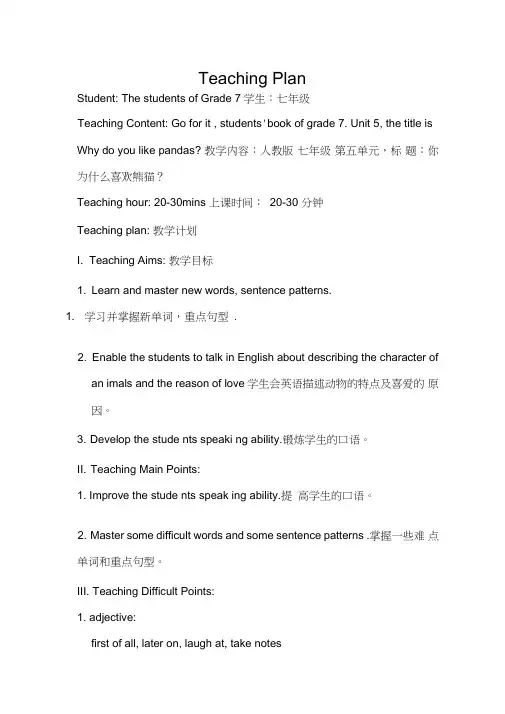
Teaching PlanStudent: The students of Grade 7学生:七年级Teaching Content: Go for it , students'book of grade 7. Unit 5, the title is Why do you like pandas? 教学内容:人教版七年级第五单元,标题:你为什么喜欢熊猫?Teaching hour: 20-30mins 上课时间:20-30 分钟Teaching plan: 教学计划I. Teaching Aims: 教学目标1. Learn and master new words, sentence patterns.1. 学习并掌握新单词,重点句型.2. Enable the students to talk in English about describing the character ofan imals and the reason of love学生会英语描述动物的特点及喜爱的原因。
3. Develop the stude nts speaki ng ability.锻炼学生的口语。
II. Teaching Main Points:1. Improve the stude nts speak ing ability.提高学生的口语。
2. Master some difficult words and some sentence patterns .掌握一些难点单词和重点句型。
III. Teaching Difficult Points:1. adjective:first of all, later on, laugh at, take notes2. Sentence Patterns:Sb. be afraid to do sth.Sb. realize that -clauseIV. Teaching Methods:1. Fast reading to find out the general information about the passage.2. Questi on-an d-a nswer activities to help the stude nts to go through thewhole passage.3. In dividual, pair and group work to make every stude nt work in class. V. Teachi ng Aids:The blackboardVI. Teach ing Procedures:The Blackboard Desig n:。
初中英语教案【优秀4篇】
初中英语教案【优秀4篇】初中英语教案篇一一.教材分析SectionB的第四部分为写作板块,主题围绕假期计划(vacationdreams)。
题目要求学生设想一个理想中的假期并写下打算做什么,什么时候去,打算呆多久等信息。
这部分左边配有一幅插图,右边为示例范文的节选,给出了句型和语法。
教材要求学生完成一篇描写假期安排的小作文。
[分析缺乏条理性]二.学情分析本节课面向初二学生,年龄处于13,14岁之间,学生学习热情高,自信心强。
经过初一的学习,学生已经具备较好的语言基础,有一定的词汇量和语法知识,能够进行简单的写作。
在上完本课SectionA的内容后,能正确拼写本课有关的词汇并掌握了现在进行时表将来的时态。
面临的主要问题是部分学生一见到英语写作就产生恐慌心理,特别是当看到有些情境难以用英语表达出来时。
再次,学生容易轻视谋篇。
认为书面表达构思简单,只要没有语言、语法错误再加上几个”漂亮”的句子就能拿高分。
其次,一些学生不知道写作的主旨意图,以为写作就是要完成教师布置的任务。
很多学生基本功很差,学习比较懒散,不愿积累。
三.教学目标分析1.语言知识目标2.语言技能目标能运用本课的词汇与句型写调查报告,介绍自己以及小组同学的。
度假安排;3.情感态度目标能在描述自己的计划和打算时,激起学生更加热爱祖国的美好河山。
4.学习策略目标:1.在学习中集中注意力;积极思考;善于记要点;2.学会科学安排自己的假期活动,能和合作伙伴互相交流,充分交换信息。
3.能在小组活动中积极与他人合作,相互帮助,共同完成学习任务;4.在使用英语中,能意识到错误并进行适当的纠正;5.文化意识目标了解英美国家的人们在工作之余是如何轻松度假的。
四。
教学重点和难点学会科学安排自己的假期活动并能灵活运用于生活中。
提高写作能力。
五、设计思路本节课开始创设一个与学生生活相关的情境,引起学生的学习兴趣和引出本课主题—谈论一下过去发生的事情,由此引出一种新的时态:过去完成时。
初中英语教案模板
1 初中英语教案模板 初中英语教案模板(5篇) 规划师生之间的互动形式,如提问、回答、讨论等,以促进学生的参与和思考。同时,明确评价学生学习成果的方法和标准。下面给大家分享初中英语教案模板,欢迎阅读! 初中英语教案模板精选篇1 教材分析 教材内容:新目标初中英语七上Unit1My name is Gina page 1-2 教材处理:本单元的重点在于如何在一个新的场合下介绍自己和认识他人。让刚入学不久的初中新生用英语搭建起他们友谊的桥梁。学会用“What’s your name? / What’s her name? / What’s his name?”以及复习Starter U1-3 所学过的一些common English Greetings 来结识朋友。本课生词量不大,重点在于对学生的口语操练以及常用人名的熟悉。 学情分析 本单元的主题是熟识新伙伴,同时引导学生采用Practicing, Listening for specific information和Role playing的学习策略,学习一些新词汇,掌握一些重点句型,在小组合作学习的过程中,进一步促进学生之间的相互了解。 教学目标 知识与能力 采用Practicing, Listening for specific information和Role playing的学习策略,使学生学会打招呼和介绍自己、询问他人姓名的基本句型What’s your/his/her name?My/His/Her name is…。”培养学生结交新朋友的能力。 过程与方法 采用Practicing, Listening for specific information和Role playing的学习策略,利用教学图片或制作多媒体课件展开课堂Pair work; Group work的口语交际活动,询问他人姓名、查询电话号码,了解有关姓名的文化知识并制作个性名片。 情感态度价值观 2
初中英语教案模板范文
初中英语教案模板范文 初中英语教案模板内容(5篇) 教师需要建立完善的教学评价体系,及时了解学生的学习情况,及时调整教学策略,提高教学质量。下面是作者为大家整理的初中英语教案模板内容,如果大家喜欢可以分享给身边的朋友。 初中英语教案模板内容篇1 教学目标: 1.语音和句子的重读。 2.了解有关超市的知识。 3.初步认识美元。 4. 初步学习美英人士购物时所用的度量衡。 5.学会谈谈自家附近的超市。 教学用具: 录音机,实物投影仪,图片或实物等。 如有条件搞一份麦当劳或肯德基的菜单。 教学步骤: Step 1 Revision 听录音并跟读第116课第一部分和第二部分。让几个同学在全班示范,看谁模仿的最好。可给一些生词让学生试着读一读,看看他们本课语音掌握的如何。 值日生Duty Report。 让值日生事先准备一有关超市的短文,在Duty时在全班讲,为新课做好铺垫。 Step 2 Presentation 引出今日新单词:all day The shopkeepers in this shop work hard all day. a lot of The supermarket has a lot of things. This shop sells a lot of things. open: not close This supermarket is open from 9 . to 9 . This shop is open at 9 . and is closed at 9 . market On Saturdays and Sundays the markets are full ofpeople. 教单词过程中,尽量把课文中的句子重复几遍。为下一步听课文做好铺垫。 Step 3 Read and answer 1. 老师可先复述课文,让学生们了解main ideas,然后让学生们听录音,提醒他们不看书。 2.也可让学生们先看书一分钟,然后听录音。 3.听完第一遍时,可让学生先做几道判断题,一下几题供参考。 如: () 1. A big supermarket is near my home. A. YesB. NoC. The text doesn’t tell us () 2. It has no name. A. YesB. NoC. The text doesn’t tell us () 3. It sells a lot of things, almost everything. A. YesB. NoC. The text doesn’t tell us () 4. If you want to buy “house”, does the supermarket sell? A. YesB. NoC. The text doesn’t tell us () 5. All things in the supermarket are not expensive. A. YesB. NoC. The text doesn’t tell us () 6. The supermarket is open 12 hours a day. A. YesB. NoC. The text doesn’t tell us () 7. All the shopkeepers are friendly. A. YesB. NoC. The text doesn’t tell us 用投影仪打出,供学生们练习。 4.听第二遍,回答书上的问题。 5.听第三遍,复述,可把书上问题的答案连起来,成为一篇复述的短文。 6.编对话。 给出一情景:同学A,B去逛超市,想买些小礼品送给美国的笔友。 7.读课文。 8.谈谈自家附近的超市或农贸市场(Free Market),并写成书面的文字。 老师可根据班上同学的水平,酌情增减内容。 Step 4 Read and write 1.学习116第四部分。 2.新单词:dollar one dollar is equal about yuan. cent pound 镑,(重量单位) 如有条件,可那一张真的美元或英镑让学生可看一看。 步骤同Step 3。 3.把对话写成书面文字。 Step 5 Practice 用麦当劳肯德基的菜单或Workbook P147 Menu编一对话。 你只有15元如何吃一顿物美价廉的午餐。 初中英语教案模板内容篇2 1、写课题(Topic)和课型(LessonType) 课题相当于文章的标题,讲课时要首先告诉学生,并写在黑板上。因此要写得准确。课型是指该节课的讲授类型。初中英语的主要课型有::新授课(Newlesson)、巩固课(ReinforcementLesson)、复习课(RevisionLesson)、语音课(PhoneticLesson)、听力课(ListeningLesson)、听说课(Aural—OralLesson)、阅读课(ReadingLesson)、语法课(GrammarLesson)等。不同的课型应用不同的授课方式或方法,只有确定了课型,才能选择有效的素质教育教学方法。 2、写教学目标(TeachingObjective) 教学目标是教案的核心内容,是教师施教的准绳。教学目标要符合大纲对教材的要求。由于教学目标要在课堂上展示给学生,让学生明确,所以写素质教育目标时,要力求简明扼要,浅显易懂,便于操作和检测,一般3~4个目标为宜。 3、写教学的重点(Main)、难点(DifficultPoints)和关键点(KeyPoints) 教学重点是课堂教学的主要任务;教学难点是师生顺利完成教学任务的障碍;素质教学关键是攻克教学难点的突破口。在教案中写清一节课的教学重点、难点和关键点,能提醒教师在讲课时注意突出重点、突破难点、抓住关键。 4、写教具(TeachingTools) 课堂上需要什么教具要写清楚,如录音机、教材录音带、教学挂图、卡片、实物(或模型)、小黑板、刻印好的练习题、彩色粉笔、幻灯片等。 5、写教学过程(TeachingProcedure) 教学过程是教案的主要部分。写教学过程主要写以下几方面的内容: a、写教学环节。教学环节即教学任务是什么要写清楚,做到心中有数。目前有些教师采用三阶段六环节教学模式,即:准备阶段(自由交流、复习检查)、讲练阶段(导入课程、分层操练)和发展阶段(巩固发展、布置作业)。 b、写知识点和所用时间。写好知识点,教师使用教案时能一目了然,有的放矢。写好所用时间,能使教师从容掌握教学速度,合理安排每个教学环节所需的时间,充分利用课堂时间。 c、写教师活动。不仅要写教师教什么,还要写出教师怎样教,即写清楚教师要教的内容,写出讲授这些内容的方法。写出课堂用语和各环节的过渡语。课堂用语要求简练、口语化,用学生已经学过的熟悉的、听得懂的英语来解释或表达新的教学内容。各环节之间的过渡语要自然流畅。写出使用教具的时机和方法,写板书内容等。 d、写学生活动。写出学生学习的内容和学习方法,特别是怎样学应写清楚。不能简单地把学生活动写成听、读、思考、操练、做题等。 初中英语教案与其他科目的教案写法大致是一样的,知识牵涉到英语的表述,对部分考生来说可能相对陌生一些,不过没关系,只要勤加练习一定能顺利通过教师资格证考试。 初中英语教案模板内容篇3 教学目标 1.会使用可数名词和不可数名词开购物单。为后两课学习购物做准备。 2. 学会讨论吃什么饭,买什么东西。 3.复习一些礼貌用语和习惯表达,如:How about…? What about…? Can you e with me? What do you have for dinner this evening? Let me and have a look.等。 4.新单词:chicken, tofu, fridge, list, shopping list, buy, kilo 句型:What do we have for dinner this evening? Fish is my favourite. What else do you want to have? Don’t we have any eggs? Let me make a shopping list. You can help me carry the things. 教学用具 PPT教学演示课件 教学步骤 Step 1 Revision [课件展示]教师在课堂上提问题,引导学生回答 What do you have for breakfast today? Shall we go and buy something to eat? What’s in the pictures? Let me see. What do we have for lunch today? How about…? What about…? What else do you want to have? Can you go and buy the things? Let’s go.等。老师也可以同样的方式提问全班同学。 教师展示课件中Revision的食物图片,复习一些食品的名称。 Step 2 Presentation [课件展示]教师在复习食品名称基础上,引出购物的话题。教授有关食品新单词chicken, tofu, fridge, tomato, onion, carrot, pork 教师可以点击 播放单词录音让学生跟读,掌握好单词的标准发音。然后教师教单词list, shopping list, buy, buy things, kilo, one kilo of chicken legs 引导根据所学习的新单词,学生回答句子:What do you have for lunch today? What else do you want to have? What do we have in the fridge? Can you go and buy the things? Step 3 Read and say [课件展示]教师点击图片可以播放影片让学生观看,播放课文对话录音 让学生跟读课文对话,尽可能的模仿录音中的语音语调,教师再点击鼠标出现以下有关问题:
英语教案全英文模板初中
Subject: EnglishGrade Level: Junior High School (Grade 7-9)Unit: [Unit Title]Topic: [Topic Title]Duration: [Number of lessons/Total time required]Learning Objectives:- Students will be able to understand and use the target language in different contexts.- Students will improve their listening, speaking, reading, and writing skills.- Students will develop their cultural awareness and appreciation of English-speaking cultures.Materials Needed:- Textbook and workbook for the unit- Handouts or worksheets- Whiteboard and markers- Computers or tablets for multimedia resources- Flashcards or pictures for vocabulary practice- Audio or video clips for listening exercises- Writing materials (pens, pencils, paper)Lesson Outline:1. Introduction (5 minutes)- Greet the students and review the previous lesson.- Introduce the new unit and topic.- Explain the learning objectives for the lesson.2. Warm-Up (10 minutes)- Engage the students with a brief activity or game related to the topic.- Example: A quick quiz on previously learned vocabulary or a discussion about a related current event.3. Vocabulary (15 minutes)- Introduce new vocabulary through visual aids, such as flashcards or pictures.- Use a TPR (Total Physical Response) activity to reinforce vocabulary.- Have students practice forming sentences using the new vocabulary.4. Reading (15 minutes)- Present a short passage or article related to the topic.- Guide students through reading comprehension questions.- Discuss the content and main ideas of the passage.5. Listening (10 minutes)- Play an audio clip or watch a short video related to the topic.- Have students answer questions about the listening material.- Discuss the content and key points of the listening activity.6. Speaking (15 minutes)- Conduct a role-play or group discussion based on the topic.- Use prompts or scenarios to encourage students to use the target language.- Circulate and provide feedback and support to students.7. Writing (15 minutes)- Assign a writing task related to the topic.- Provide a sample or model to guide students.- Circulate and assist students with their writing.8. Review and Closure (10 minutes)- Summarize the key points of the lesson.- Review any homework assignments or upcoming tests.- Encourage students to ask questions or share their thoughts.Assessment:- Formative Assessment:- Participation in class activities and discussions.- Completion of in-class exercises and activities.- Peer and self-assessment.- Summative Assessment:- Quizzes and tests on the unit's vocabulary and grammar.- A written assignment or project related to the topic.- An oral presentation or performance task.Homework:- Assign a relevant reading or listening activity from the textbook or other resources.- Provide writing prompts or practice exercises to reinforce the lesson's content.- Encourage students to review the vocabulary and prepare for the next lesson.Notes:- Adjust the lesson plan as needed based on student responses and progress.- Incorporate technology and multimedia resources to enhance student engagement.- Differentiate instruction to meet the needs of all learners.- Maintain a positive and supportive learning environment.Teacher Reflection:- After the lesson, reflect on what worked well and what could be improved.- Consider how to adapt the lesson for future classes or different learning levels.- Document any observations or insights for professional development purposes.。