
外研版高中英语必修二Module4-PeriodⅢ
The girl finally
of becoming an actress.
②直到第二天他才意识到他的错误。
He didn't
until the next day.
【答案】 ①realised her dream ②realise his mistake
• 单项填空
• ③After several years of hard work,his
定 式 作 宾 语 , 常 见 的 动 词 有 : suggest , finish , practice , avoid , miss , delay , like(enjoy) , imagine , deny , admit , consider(考虑),escape,risk,mind等。
• (2)一些动词词组后也跟动词-ing形式作宾 语
• 【解析】 考查介词短语辨析。句意:人 们试图通过开私家车以避免公共交通延误
• 5.What do you make of (it)?(P38) • 你是怎么理解的? • 句 中 make of... 意 为 “ 理 解 / 懂 得 / 领 会
……”常用于what引导的疑问句或否定句 中。表示“你认为……怎么样”。
• What do you make of the high housing price?
• 你对高房价怎么看?
• 你认为……怎么样? • What do you think of...? • How do you like...? • How do you find...? • What's your opinion of...? • What do you think of the film?=How do
put away. • 夏天过去了,扇子都收起来了。
• 【对接高考】
• (2011·辽宁高考)The exam results will be
on Friday afternoon.
• A.put down
B . put
off
• C.put up
D.put away
• 【解析】 考查动词短语辨析。句意:考
• 她脸上的表情很友好。 • Freedom of expression is a basic human
right.
• ①beyond expression无法形容,表达不出 • without expression 毫无表情地 • ②express vt.表达,表示;n.快车,快递 • express oneself 表达自己(的思想或观点) • When she was traveling on an express
because of the
bad weather. ④Put
your hand if you have any questions to
ask.
【答案】 ①on ②down ③off ④up
• 2.expression n.表现;表达;表情;词 语
• The expression on her face is very friendly.(P36)
句型转换
①How do you find his painting style?
→
his painting style?
→
his painting style?
→
his painting style?
【答案】 ①What do you make of;What do you think of;What's your opinion of
• ①Pop art was an important modern art movement that aimed to show ordinary twentieth-century city life.
• ③I'm studying art at school,and I enjoy it a lot , although I can get tired of looking at pictures all the time.
• ●新课导入建议 • 通过对学生作业的检查导入本堂新课。
●教学流程设计
演示结束
• 1.put off 推迟;延期 • She put off visiting the art gallery next
week.(P35) • 她推迟至下周参观美术馆。 • They put off the meeting because of power
wish to be a successful violinist finally .
• A.came true
B.realised
• C.turned into reality D.recognised
• 【解析】 come true意为“实现”,无 被动语态,其主语是“理想、梦想、目标
等”;B、C两项都应用被动语态;
• 4.take turns轮流 • Take turns to ask your questions.(P37)轮流
提问题。 • On our way to Beijing,we took turns to
drive. • 在去北京的路上我们轮流开车。
• take turns to do/(at)doingsth.轮流做某事 • do sth. by turns 轮流做某事 • It is one's turn to do sth. 该轮到某人做某
• 要求学生懂得动词的-ing形式和to do形式 能作宾语的语法功能,并通过练习,学会 在句子中正确使用。语法2处理“动词的 -ing形式作主语”。Activity 1列出了例句 ,Activity 2为巩固性练习。该部分听力配 有一篇对话形式的听力材料。在听力活动 之前,先有一个词汇练习(Activity 1),为 听力活动做好铺垫。Activity 3为听后活动
• be used to,can't stand(无法忍受),give up,feel like,keep on,insist on,look forward to,put off,devote to,stick to ,object to,thank you for,be busy,get down to等。
• 单项填空
• ④ People try to avoid public
transportation delays by using their own cars,and this causes further problems.
• A.in short
B.in case
• C.in doubt
D.in turn
something that you didn't notice or understand before. (P36)当你意识到某些 东西时,也就是你注意到了你以前没有注 意到或没有理解的某些东西。
• He didn't realize that he was in deep trouble.
• realise one's dream/goal实现某人的梦想/目 标
试结果将在星期五下午张贴。put up有“
用适当的介词或副词填空
①We put
a song and dance performance to
welcome the guests.
②After he finished his exercise,he put
his
pen. ③The sports meeting was put
事了 • in turn依次;轮流;反过来
We did the work by turns.我们轮流做这项工作。 I think it's our turn to drive the kids to school this week. 我认为这周该轮到我们驾车送孩子们去上学了。
He asked each of us in turn to describe how computers had influenced our lives.他让我们依次描述电脑是如何影响 我们生活的。
train,the scene before her is beautiful beyond expression.Her expressions
完成句子
①When he heard the bad news,there was
(失
望的表情)on his face.
②He can
(表达自己)clearly in English.
完成句子
①Their mother is ill in hospital,so they
(轮
流照看她).
②The shop assistants had to have their days off
(轮流).
③
(轮到你)read the text now.
【答案】 ①take turns (at) looking after her/ to look after her ②by turns ③It's your turn to
• ④My parents are fond of going on art galleries and often take me with them,so I've developed an interest in art.
• [自我总结] • 1.v.-ing形式是有动词加-ing得来,兼有
• (3)听懂课文中所给出的听力材料。 • (4)通过对语法的教学让学生能够理解并
能够正确运用动词的-ing形式和to do形式 作宾语以及动词的-ing形式作主语。 • ●教学地位 • 该部分列出了交际中“表达意见”(giving opinions)的语句,要求学生组成两人小组 ,就自己喜欢的和不喜欢的艺术作品发表
英语必修II外研版Module4课件(46张)
own and adopted an orphan.After a few months,the orphan came to adapt to his new
life.
• 这对年轻夫妇没有亲生孩子,领养了 一名孤儿。几个月过后,这个孤儿渐渐适 应了新生活。
• stand v.站立,直立;忍受;经受,承 担;n.看台,摊子;立场
• ④We missed the first few scenes of the movie. • 电影的开始几个场景我们没看到。
• alive adj.活着的,充满活力的,仍然存在的 • stay alive活下去 • keep sth.alive使继续有效、存在 • come alive变得有趣(有生气、逼真),活跃起 来
• ④We are talking about the adoption of a new plan for the picnic.
•
注意不要将adopt和adapt混淆。
adapt意为“使……适应;改编,改写”。
• The young couple had no children of their
• ①Our school has adopted a new teaching method. • 我们学校采用了新的教学方法。 • ②All the suggestions put forward at the meeting were adopted. • 会上提的所有的建议都被采纳了。 • ③Having no children of their own,they decided to adopt an orphan.因为他们没有亲 生儿女,所以决定领养一个孤儿。
• ①He is thought to be the greatest man alive. • 他被认为是当今最伟大的人。 • ②We’d better keep the old customs alive. • 我们应该保持这个古老的风俗。 • ③The discussion came alive when it came to an interesting topic. • 当引入有趣的话题后,讨论变得热烈了。
高中英语外研版必修2教案Module4(15页)
Module 4 Fine Art— Western, Chinese and Pop ArtsTeaching aims :Aimed at carrying out quality education, based onstudents’ development,letting students grasp the vocabulary,grammar, function in this module, strengthening students’ language skills in listening, speaking, reading and writing set in this module, developingstudents learning strategies.Through learning this module,students are expected to learn about the artists and their painting styles,be capable of introducing their favorite artists and their works, be interested in art, improve theiraesthetic consciousness,love life and develop their sense of cooperation. Aimed to cultivate students’ integrated language capability in various student-centered tasks or activities.Periods 1 : Introduction,Reading andvocabulary, FunctionTeaching aims :(multimedia courseware)Language objectives:To enable the students to grasp the new works, phrases and the structures to give opinions about likes and dislikesSkill objectives:To enable the students to match descriptions with paintings, choosingthe correct answers and filling in the form in the aspect of readingTo enable the students to give opinions about certain paintingsCulture awareness, emotions and attitudes objectives:Teaching important points:To enable the students to speak out opinions about some paintings with some expressionsTo enable the students to grasp the new works and phrases in thispart Teaching procedures: PWP Teaching ModelStep1. leading-in activityUseby daonnew brush, ink.the paintings The Smile of Mona Lisa Vinci and the works by Zheng Banqiao the screen to lead in the topic. Meanwhile, I will introduce the key words: artist, paint, traditional,Step 2.While —reading1)ScanningDuring the start of the period, let the students scan the passage tofind out the answers to the questions on Page32, which are about the topics.⑴M atch paintings 1-4 with descriptions in paragraphs A-D.⑵Say which paintings are mentioned in paragraph E and F.2)Detailed readingDuring this period, I’ll allow students enough time to read the textand then I let them work in groups to do the following two tasks:⑴Do the multiple choices on the screen.⑵F ill in the form on the screen, which is mainly about thefamous artists.3)Language points⑴c onsider 以为①T his is a painting by the Spanish artist, Pablo Picasso, and he isconsidered to be the greatest western artist of the twentieth century.This is a painting by the Spanish artist,Pablo Picasso,____ ____ ____ the greatest western artist of the twentieth century.②We consider that his advice is helpful.We consider his advice ____ ____ helpful.③She __________________(被以为是个可爱的孩子).⑵w ith 复合构造①C ubist artists painted objects and people, and different aspectsof the object or person showed at the same time.Cubist artists painted objects and people, ___ different aspects of the object or person ____ at the same time.②He had so much work to do, he was kept as busy as a bee.____ so much work ____ ____, he was kept as busy as a bee.③I felt a bit nervous because so many people were watching meso closely.I felt a bit nervous, ____ so many people ____ me so closely.④Because his homework had been finished, he went out to play.____ his homework ____, he went out to play.⑤He went to sleep, with the door open.He went to sleep, and ____ ____ ____ ____.⑥Tom came in, and there was a baseball bat in his hand.Tom came in, with a baseball ____ ____ ____.⑶aim 以⋯目;意欲;打算①Pop art (from the word“popular”) was an important modern art movement that attempted to show ordinary twentieth-century city life.Pop art (from the word “popular ”) was an important modern art movement that ____ ____ show ordinary twentieth-century city life.②Our aim is to start and run our own pany.We ____ ____ start and run our own pany.③I’m aiming at losing 4 kg before the summer holidays.I ____ ____ ____ lose 4 kg before the summer holidays.⑷stand 忍耐①I don ’ t like that picture of a golden-haired girl.I can ’t ____ that picture of a golden-haired girl.②We have to put up with her bad temper.We have to ____ her bad temper.③I can ’ t stand working in the extreme heat for several hours.(英)_________________________________________________⑸I got bored of looking at pictures all the time.I ____ ____ ____ looking at pictures all the time.⑹Tom gradually became interested in art.Tom ____ ____ ____ ____ art.Step3. Post—readingDuring this period, I’ ll let the students do the following tasks.⑴Find out the structures that can be used to giving opinions about likes and dislikes from the paragraphs E and F individually.⑵And then, along with the students, I’ll look through the sentences giving opinions, provided in the first part of Function, making sure that they know how to express likes and dislikes. Show the students a seriesof paintings on the screen, letting them in groups talk about the pictures they like and dislike, and why or why not, using the information learnedfrom the reading material(or in the form of interviewing—group work). Step4. HomeworkTry to find more paintings and artists you like through the Internet.Prepare to introduce a painting in English to your classmates nextclass.(The day students are assigned to the first task; and the rest ofthe students to the second.)Blackboard design:Module 4 Fine arts —Western, Chinese and Pop Arts Period Oneconsider: consider sb./sth. to be adj./n.with 复合构 : with+ +( adj./adv./prep. Phrase/-ing/-ed/inf. ) aim v./n. aim to do sth. aim at doing sth.stand+n./doing sth.get tired of/get bored of“ ⋯⋯”develop an interest in“养成⋯⋯的趣”Teaching reflection: In the process of leading in, students arefamiliar with the paintings and the artists, so the pictures can easilyarouse their interest and desire to participate.In the process of while-reading,pay attention to the developing of students reading strategies.In the process dealing with language points,setting the new words in a context helps the students learn and prehend the meaning andthe usage of them. In the discussion about their favorite paintings,some students are reluctant to speak, partly because of their lack of knowledge of painting; most students can municate with their partners or groupmembers after learning the reading materials. The task of assignment isset for the sake of the second period,that is,Listening and vocabulary, to some extent.Periods 2 : Listening and vocabulary,Everyday English, Speaking Teaching aims :To enable the students to grasp the new words in the listening material.To enable the students to prehend and put to use the everydayEnglish in the listening material.Skill objectives:To enable the students to follow the listening material about artistsand art works, which has similar difficulty to the reading material, and identify opinions.To enable the students to pay attention to the weak sound andread correctly.Teaching important points:To enable the students to follow the listening material about artistsand art works, which has similar difficulty to the reading material, and identify opinions.To enable the students to pay attention to the weak sound andread correctly.To enable the students to give opinions about certainpaintings Teaching procedures: PWP Teaching ModelStep1. Pre-listening⑴ Show some pictures on the screen;:that is, a watercolor, an oil painting, a portrait, a landscape, an art gallery.Through showing the pictures, I, together with the students study thenew words,( watercolor, oil painting, portrait,landscape, art gallery ), letting them pay attention to the pronunciation and the weak sounds/unstressed syllables of the words.⑵Then I ’ll let the students in pairs learn the meaning of the new words in the contexts, in the form of pleting the sentences with them (Part1,Page36), after reading after me.Step2. While-listening⑴B efore listening, ask the students to look at the two pictures onPage36 and find out some similarities and differences. Listen forthe first time, and answer the following questions:①What are the boy and girl are discussing?②Which picture is the boy painting, Picture1 or Picture2? Say how you know this.③Why does the girl say sorry at the end of the conversation?⑵D etailed listening/Pair workListen to the conversation again, and plete the following sentences.First let the students check their answers with their partners; thenI ’ll play the recording again for them to check; and then I ’ll check theanswers with the class.Then I’ll show the following sentences on the screen:①You’ve got it right.②Don’t change a thing.③I’m not half as good as you.④What do you make of it?⑤There’ s (an exhibition) on.⑥T hanks for the pliment.This time I ask the students to think about the meaning of the sentences after listening to the recording again, and then do the exercise on Page38 (Part1) in pairs. Then collect the answers from the whole class.Step3. Post-listening⑴L et the students describe the Picture2 on Page36 in pairs.⑵A ct the dialogue out in pairs.⑶Make up dialogues using the everyday English learned from the listening material.Step4. Homework⑴Look through the Cultural Corner and collect some works ofPablo Picasso or information about him on the Internet.⑵ Look through the Cultural Corner and tell which picture below belongsto the “ pink period ” , Which one do you like best? Which do you like least? And give your opinions about the pictures.12 3GuernicaThe day students are assigned to the first task; and the rest ofthe students to the second task.Teaching reflection:At the start of the period,using the picturesto introduce the someof the new words in the listening material can arouse students ’ interest and reduce the difficulty students have in listeningto the material.Similarly,letting students look at the two pictures on Page36 and find out some similarities and differences can arouse theircuriosity and reduce the difficulty of Question--Which picture is theboy painting,Picture1 or Picture2?Say how you know this.In the processof while-listening,After showing the six sentences taken from therecording on the screen, then let students listen to the recording while listening to the recording, which helps students prehend the everydayEnglish according to the context. In the process of post-listening, thetask of making up dialogues in pairs strengthen students’ cooperationin one aspect; meanwhile, students can grasp the usage of the everyday English. The task of assignment is set to make students learn more about art and artists and provides more chances for students to practice giving opinions. On the other hand, it is for the transition to the grammatical learning in the next period.Periods3 :Grammar1 & Grammar 2and VocabularyTeaching aims :To enable the students to grasp the usage of–ing form acting as subjects and objects and the infinitive acting as objects.To enable the students to grasp the usage of the new words and phrases. Skill objectives:To enable the students to understand the grammatical function of – ing form and the infinitive.Teaching important points:To enable the students to grasp the usage of–ing form acting as subjects and objects and the infinitive acting as objects.To enable the students to grasp the usage of the new words andphrases Teaching procedures: PWP Teaching ModelStep1. RevisionI’ ll let some volunteers show their works about of Pablo Picasso or information about him on the Internet.Step2. Leading-in/PresentingI’ ll show a series of sentences containing–ing form or the infinitive acting as subjects or objects on the students learning plan. And then let the students in groups discuss similarities and differences between thesentences and classify them according to their characteristics.Group One(verbs/verbal phrase + the infinitive as objects):1)attempt;2)promise; 9)aim; 10)pretend; 11)happen; 12)agreeGroup Two(verbs/ phrase + –ing form as objects): 4) suggest;7)stand;13)put off; 14).give up;3)be fond of; 8)get tired ofGroup Three(verbs/verbal phrase + –ing form as objects/ the infinitiveas objects): 15),16) go on; 17),18)mean; 19),20)likeGroup Four (-ing form as subjects): 5)painting; 6)copying a picture;17)being lateThen let the students continue discussing in groups and then give them a listing task, that is, adding as many verbs or phrases as they can toGroups1-3.Group One只好用不定式作的:refuse, promise, pretend, wish,hope, agree, ask, decide, expect, manage, offer,afford,agree, ask ,beg, care, choose, dare, desire, determine , fail, learn , prepare, plan, long, happen, seem⋯Group Two 只能用v-ing形式作的或短:admit,avoid, appreciate, keep, consider, delay, enjoy, escape, excuse, finish,imagine, mention, mind, miss, practice, permit, risk ,suggest,advise, allow, permit⋯feel like, give up, put off , can’t help (忍不住), can’ t stand (无法忍耐 ) , be busy in, be worth, lead to, look forward to,devote...to, stick to, be used to, get down to, object to, pay attention to⋯Group Three1) 能用不定式又能用v-ing形式,而且意差别不大的:prefer,continue, like, hate, love2)既可接不定式又可接 v-ing 形式,但含不一样的有: remember, forget,try, go on, mean, regret⋯Step3. Practice1.— You were brave enough to raise objections at the meeting .— Well , now I regret _____ that .A. to doB. to be doingC. to have doneD. doing2.The squirrel was so lucky that it just missed ____.A. catchingB. being caughtC. to be caughtD. to catch3.The teacher doesn’t permit ____ in class.A. shoutingB.shoutC.to shoutD.having shouted4.—What makes you so happy?— ____.A. Passing the driving testB.Because I ’ ve passed the driving testC. For passing the driving testD. Pass the driving test5.I forgot _____ (buy) the book, so I have to borrow one.6.Please remember____ (turn off) the light when you leave.7.Try _____ (knock) at the back door and see whether he is in or not.8.We must try ____ (e) here as early as possible.9.What do you mean ___ ( do) with it?10. I won ’t stay if it means ____(list en) to another dull talk.【速记口诀】赞同提出学会的打算,要求答应来帮忙。
Module 4 Fine Arts—Western,Chinese and Pop Arts Period 3 Grammar 课件(外研版必修2)
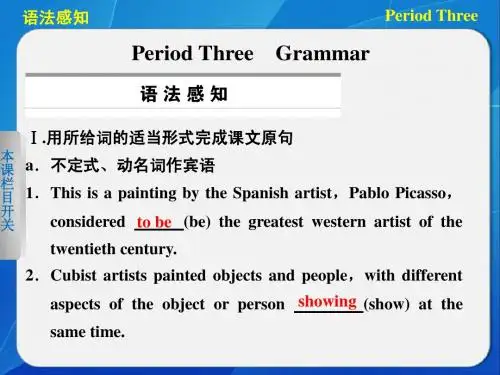
going (go) to art galleries.பைடு நூலகம்
语法感知
Period Three
b.动名词作主语
本 课 栏 目 开 关
1. Painting (paint) is difficult for me. 2.I think drawing (draw) is a lot easier. 3.Learning(learn) to paint well takes a long time.
to give
(practise) practising (speak)
知识储备
Period Three
动词不定式和动名词作宾语&动名词作主语 一、动词不定式和动名词作宾语
本 课 栏 目 开 关
动词不定式和动名词句法功能比较一览表 功能 主语 不定式 动名词 √ √ 表语 √ √ 宾语 定语 状语 √ √ √ √ √ ×
助记 三个希望两答应,两个要求莫拒绝; 设法学会做决定,不要假装在选择。
知识储备
Period Three
3.有些动词既跟 v.ing 形式又跟动词不定式作宾语,意 思几乎是一样的,没什么差别。 begin,start,continue 等词后,既可以跟不定式,又可以 本 课 栏 跟动名词作宾语。但其后如是 see,understand,realize 等时, 目 开 一般用不定式。 关 He continued to borrow/borrowing money from his boss. 他接二连三地向老板借钱。
语法感知
Period Three
Ⅱ.用所给单词的适当形式填空 1.He failed to pass (pass) the driving test. 2.I can’t afford
高一英语外研版必修二 课件 Module 4 Section Ⅲ Other Parts of the Module
actor.
他当演员的梦想终于实现了。
返回
(二)归纳拓展全析考点 realise an ambition/hope/goal实现抱负/愿望/目标
realistic adj. reality n. in reality 现实主义的;写实主义的 真实;现实;逼真 实际上
返回
①Be realistic — you can’t expect a big salary at eighteen. 实际一点吧——你别指望十八岁就能挣高薪。 ②The house looks very old, but in reality it’s quite new. 这所房子看起来很旧,实际上很新。
(鲜活例句)Failure was slowly destroying him.
失败渐渐地把他毁了。
返回
(二)明辨易混失误防范 比较 destroy, damage, ruin
“破坏;摧毁;毁灭”,指完全彻底的破坏,
destroy 常指不能修复了
damage 部分“损坏,破坏;损毁(使失去价值)” 不像destroy那样毁灭某物,而是强调致使该 ruin 物的使用价值发生了问题;还可表示“使破产;
返回
(二)归纳拓展全析考点 sb.happen(s)/happened to do sth. 某人碰巧做某事
It happens/happened that+从句
sth.happens/happened to sb./sth.
碰巧„„
某人/某物发生了某种
情况
返回
①I don’t know whether you happen to have heard that I’m considering going abroad. 我不知道你是否碰巧已经听说了我正考虑出国这件事。
高一英语外研版必修4教案:Module2 Period3 含解析 精
Period 3Vocabulary;Pronunciation;GrammarThe General Idea of This PeriodSome compound words used to describe urban transportation are introduced in this section.It is suggested that more compound words should be introduced.The teacher may first list the compound words and then ask the students to read aloud the words after himself or herself.To make the students more familiar with the structure of these compound words,the teacher might as well elicit the word formation in the students.And if necessary,the teacher may add some.The pronunciation in this period is liaison.The teacher may play the tape for the students and ask them to follow.After that the students may practice saying the sentences while their partners are monitoring.In grammar we will meet Imperatives.The teacher should try to acquaint the students with the definition of Imperatives.The Teaching Procedures are as follows:first the teacher may list the meanings of each sign on the blackboard and then make the students to match the signs with the meanings.To make them aware of definitions you’d better choose the functions from the sentences listed.Activity 2 is an applied activity.To deal with it the teacher may prepare some pictures beforehand for the students to talk about the meanings of some traffic signs.Activity 3 is a combination of speaking and grammar.Through this part not only will the students’ speaking skills be trained,but also they will have a better understanding of the positive form and the negative form of imperatives.To make the students clear about it the teacher had better give the students some exercises for a consolidation.Teaching Important PointsEncourage the students to sum up grammatical rules.To make the students understand liaison.Teaching Difficult PointsTo make them know more about the Imperatives.To train the students pronunciation.Teaching MethodsIndividual work and pair work to make every student work in class.Teaching AidsMultimedia,tape-recorder & a blackboardThree Dimensional Teaching AimsKnowledge and SkillsMake the students learn to sum up grammatical rules themselves.Make sure the students master the grammatical items.Train the students’ pronunciation.Process and StrategiesMotivate the students’ enthusiasm in taking part in the class.Feelings and ValueThrough the study of this period the students will surely know more about the Imperatives.Teaching ProceduresStep 1 Revision(The teacher ask the individual students to report to the class the expressions in giving advice.)1.You should...2.Why not...?3.You’d better...4.It’s a good idea to...5.Make sure...Step 2 VocabularyT:Good job!Next step we will learn some compound nouns.Now look at the blackboard.What are they called?(Write the following two words on the blackboard.)traffic jam road workSs:They are compound nouns.T:You’re quite right.Now match the words from Box A with those from Box B to make compound nouns.(Show the following on the screen.)A bicycle city ring rush trafficB centre hour lane lights roadSuggested answers:1.bicycle lane2.city centre3.ring road4.rush hour5.traffic lightsT:More exercises are as follows:(Show the following sentences on the screen.)Match the words and definitionsExample:Lots of traffic which isn’t moving. traffic jam1.a road which goes around the city __________2.a read one means “stop”;a green one means “go”__________3.the busiest time of the day __________4.a part of the road reserved for bicycles __________5.work in progress on the road __________6.the centre of the city __________(Give the students a few minutes and then call back their answers.)Suggested answers:1.ring road2.traffic lights3.rush hour4.bicycle lane5.road works6.city centreStep 3 PronunciationT:So much for the vocabulary.Now let’s come to the next part—pronunciation.(The teacher play the tape for the students.)Now listen to the underlined sounds in the following sentences.(Show the following sentence on the screen.)1.I got stuck again in the traffic.2.They seemed to know each other.3. ...and we still couldn’t move.4.It was just ridiculous.5.They don’t wait for the green light to pass.T:You must remember:Good pronunciation needs a lot of training,imitation and practice.Listening is as important as imitation.You should not only listen to the teacher’s and your classmates’ pronunciation,but also to tapes record your own reading after doing some repetition and imitation,and see how they are different and where you are wrong.Go on practicing until youget it.T:Now say these sentences aloud.Make sure you pronounce the underlined sounds correctly.(Show the following on the screen.)1.They seemed to know each other.2. ...and we still couldn’t move.3.It was just ridiculous.4.They don’t wait for the green light to pass.5.Why not build more underground lines?6....which then came to a complete stop.(The teacher divide the students into a few groups and then make them practice the sentences individually.)Step 4 GrammarT:Just now we practiced our pronunciation.The rest of the time let’s learn some grammar:Imperatives.Look at the signs and complete the meanings of the other three signs.Suggested answers:3.Don’t turn left.(no left turn.)4.Don’t stop (no parking).5.Don’t walk (no pedestrians).T:Do you know what they have in common?You may decide what they do from the following list of 4 possibilities.(Show the following list on the screen.)1.They give advice.2.They give instructions.3.They give information.4.They give permission.Suggested answers:2T:Good job!As we all know,traffic jams are usually very annoying.Look at the picture.What is the man doing?S:From the picture we can guess maybe he is worried about the road condition.He is very angry.T:You’ve got it!Now read the following dos and don’ts for motorists stuck in a traffic jam.Tick the ones you agree with.Dos:1.Switch off the motor.2.Turn on the car radio.3.Speak to your passengers.4.Follow the rules of the road.5.Keep cool.Don’ts1.Leave the motor on.2.Blow your horn.3.React when others drive badly.4.Break the rules of the road.5.Get angry.(The teacher may ask the students to have a discussion and then make some representatives to report to the class.)Step 4 Summary and homeworkT:Today we have learned some compound words as well as the expressions in giving advice.Besides,we have practiced block+release.After class please practice more and finish Exercises 2 & 3.So much for today.Good-bye,everyone!Ss:Good-bye,sir!The Design of the Writing on the BlackboardModule 2Traffic JamThe third periodtraffic jam road worksRecord after Teaching_____________________________________________________________________________________________________________________________________________________________________________________________Activities and Research1.Try to choose a paragraph to practice your pronunciation.2.Find more compound nouns to analyse.Reference for TeachingGrammar由一道高考题谈祈使句2003年高考英语第24小题:—Sorry,Joe,I didn’t mean to...—Don’t call me “Joe”.I’m Mr.Parker to you,and __________you forget it.A.doB.didn’tC.didD.don’t说明:本题正确答案是D,题干中don’t you forget it是一个祈使句。
高中英语Module 4 Section 3 Words and expressions of the unit外研版必修二
Module Four Fine Arts—Western, Chinese and Pop Arts第二部分教学资源Part Two: Teaching ResourcesSection 3: Words and Expressions of Unit 4Part 1: Some key words to learn●aliveadj. ① living and not dead: Is he still alive? We want to keep the debate alive. ② active and full of life: She is so alive! ③alive to sth.: He was alive to the dangers of the work. ④alive with: The place was alive with people. ⑤come alive: The atmosphere has come alive.●delightadj. delightful very pleasing and attractiveadv. delightfullyv. He delighted them with his witty performance.n. take delight in something●expressionn. ① the act of saying or showing what you think or feel ②the ability to show feeling when you are acting or performing music: She does not sing with much expression. ③"Fly off the handle' is an expression which means "lose your temper' ④ a look on one's face: He is wearing a good expression.v. express ①I can't express how grateful I am. ②The figure is expressed as a percentage.③ express yourself: He express himself well in English.●imitatev. to copy one's behavior, appearance ,or speech: James can imitate his father perfectly.n. imitatoradj. imitative imitative behaviorn. imitation: He does a good imitation of the President. They say that imitation is the sincerest form of flattery.●observev. ① to watch carefully, often to learn or understand something: They observed the stars. ② to see and notice: Did you observe where they went?③ to obey or follow a law or custom ④to make remark about sth. you havenoticed: He observed that she looked rather upset.n. observatory: a place to watch the sky●ordinaryadj. ①not unusual or special in any way: I've got an ordinary sort of car, nothing special.②our of ordinary ③ordinary degreeopposite: extraordinary: He is an extraordinary boy.●realisticadj. ①sensible and reasonable ②life-likeopposite: unrealisticn. realityin reality●impressvt. ① press (one thing on or with another); make (a mark, etc) by doing this: The worker impressed a special figure on the coat. ② have a stronginfluence on; fix deeply (on the mind, memory): His words are strongly impressed on my memory. The book did not impress me at all, I did not think it good or useful. I impressed him with the importance of his work.He impressed me unfavorably, I formed an unfavorable opinion of him. n. impression: The speech made a strong impression on the House. What were your first impressions of Shanghai?adj. impressive: This is an impressive ceremony.Part 2: Some expressions and patterns to learn:1. aim to(目的要……)I think the first painter painted a horse aiming to show his dream in thebroad world.They aimed to finish the task on time.2. be known for(因。
新教材外研版高中英语必修第二册 Unit4 Stage and screen 精品教学课件
追溯到 以……开始 解释清楚,传达 把……转变成…… 极为激动 事情发展如人所愿, 一切顺利
1.until 引导时间状语从句:Having seen quite a few
productions of Hamlet and read the play many times, I was full of confidence—_u_n_t_il_t_h_e_P__e_k_in_g__O_p__er_a__c_a_m_e__to__t_o_w_n__
电影是一门视觉和听觉的现代艺术,也是一门可以容纳戏 剧、摄影、绘画、音乐、舞蹈、文字、雕塑、建筑等多种艺术 的现代科技与艺术的综合体。而武侠电影就是这种文化的一种 最好的体现。
History of Martial Arts Films The first martial arts film began in Hong Kong, China, in the early 1900s. During this time in China, western culture’s influence caused a decline( 减 少 ) in traditional values and practices. As a result, early martial arts films were artificial(虚假的) and held unreal elements(要素) describing sword sorcerers as characters used magical abilities such as flying through the air. However, they have changed greatly over the years, expressing a better quality of acting with the traditional martial arts, and the addition of sound.
高中英语外研版必修二《Module4Fine Arts-Western,Chinese and Po
6) stop to do 停止(正在做的事)去做另一件 stop doing 停止正在做的事
7) try to do 努力做某事 try doing 尝试着做某事
8) want to do 想要做某事 want doing 需要被
your eyes tired.
翻译下面句子。 1. 图书馆制止喧哗。
Making noises in the library is baned. 2. 他跳下水是为了挽救那个女孩。
He was diving into the water to save the girl.
3. 和你交流就是一种时间的浪费。
虽然他很忙,还是参加了那个婚礼。
Hale Waihona Puke (2) 有些动词后只能接ing情势作宾语, 常见此类动词有: admit, advise, appreciate, avoid, can’t help, consider(推敲), delay, deny, endure, enjoy, excuse, escape, face, fancy, finish, forgive, give up, imagine, keep, keep on, mind, miss, mention, pardon, permit, practise, put off, risk, resist, suggest, understand等。
Presentation
例如:To learn English well is difficult. = Learning English well is difficult. 学好英语比较困难。
(1) -ing情势和不定式都可在句中用作主语。一样情形下可以互换。
外研版必修2:Unit+4+Section+Ⅲ Using+Language+Word版含答案
Section ⅢUsing LanguageⅠ.单词拼写根据汉语或首字母提示,写出下列单词。
1.I am grateful(感激的) to you for your kind offer.2.It was an extremely (极其,极度)difficult and dangerous task.3.All the students that work hard can definitely (确切地,肯定地)pass the exam.4.I was told that Spain is a romantic (浪漫的)nation.5.I consider it absolutely (完全地,绝对地)necessary.6.We can and must overcome our shortcomings.7.This arrangement is agreeable to both sides.8.Don't be so rude to your parents!9.This world is always so interesting and appealing.10.Will was so absorbed in reading that he went without his dinner.Ⅱ. 拓展词汇根据词性和汉语提示,写出下列单词。
1.grateful adj.感激的→gratitude n.感激2.arrange v.安排;排列;整理→arrangement n.安排,筹划3.appeal v.呼吁;有吸引力;求助;诉请n.恳求;呼吁;上诉;吸引力→appealing adj.有吸引力的,有趣的4. absorb v.吸收;吸引……的注意→absorbed adj.专心致志的→absorption n.吸收,全神贯注,专心致志Ⅲ. 补全短语根据提示补全下列短语。
外研版英语必修二Module 4
成才之路 ·高中新课程 ·学习指导 ·外研版 ·英语 ·必修2
背景e站链接
Module 4 Fine Arts—Western, Chinese and Pop Arts
成才之路 ·高中新课程 ·学习指导 ·外研版 ·英语 ·必修2
中国艺术源远流长,从古至今中国的艺术文化在世界上都 享有盛名。《早春图》是北宋艺人郭熙的作品,这篇文章就告 诉我们关于中国古代艺术的知识。
Module 4 Fine Arts—Western, Chinese and Pop Arts
成才之路 ·高中新课程 ·学习指导 ·外研版 ·英语 ·必修2
Chinese Landscape Paintings For at least a thousand years, the Chinese have been painting their landscapes. Historically, it is believed that the love of nature is inherent①, or a part of the soul of a Chinese artist. Guo Xi, a famous 11th century Chinese painter of landscapes stated,an artist should identify himself with the landscape and watch it until its significance② is revealed③ to him.
知识点击 ①固有的 ②意义 ③显示 ④从字面意思 ⑤象征
Module 4 Fine Arts—Western, Chinese and Pop Arts
成才之路 ·高中新课程 ·学习指导 ·外研版 ·英语 ·必修2