
八年级下册英语Unit3知识点总结
Unit3 Could you please clean your room?
一.情态动词could 的用法
1.提出礼貌的要求 Could you please (not) do sth ?请你(做)......好吗?
用于提出请求,希望得到对方的肯定回答,说话的语气比较客气委婉。Could 不是can
的过去式,是委婉、礼貌的说法。回答用can. 肯定回答:Yes,sure./ Yes, I can./Of
course,I can./ Certainly./No problem./ With pleasure .
否定回答: Sorry , I can’t / I’m afraid I can’t. I have to …,I’
m going to…(说明理由)
2.表示请求许可 Could I do a sth? 我可以做......吗?
肯定回答:Yes, you can ./ Yes ,please / Of course / Certainly./ No problem.
否定回答:Sorry , you can’t / I’m afraid you can’t.
3.could 为can的过去式,表示过去的能力。= was / were able to
Section A
1. take out the rubbish把垃圾带出去
2. do the dishes = wash the dishes 洗碗碟
3. fold your clothes折衣服
4. sweep the floor扫地
5. make your bed整理床铺
6. clean the living room打扫起居室
7. do some washing/ shopping/ cleaning洗衣服/ 购物/ 做清洁
8. go out for dinner出去吃晚饭
9. go to the movies去看电影
10. stay out late/ until nine呆到很晚/ 呆到9点钟
11. get a ride撘车
12. give sb a ride to town开车送sb到镇上
13. need to do something需要做……
14. have to do something不得不做……
15. help out with a few things帮助做些事情
16. at least 至少,多指数量或程度上的最低限度。(反) at most 至多,不超过
17. finish doing something完成做……
18. two hours of TV 两个小时的电视 表示时间、距离、金额、度量等词语作主语时,
被视作整体,谓动用单数。
19. be/ come back from shopping购物回来
20. any minute/ second/ moment now随时
21. be angry with…对……生气
22. solve the problem解决问题
23. throw down扔下,随手丢下。throw at 向…扔去(恶意)throw to …扔给 throw
away 扔掉
24. the minute……/ as soon as… / the moment …一…….就……(引导时间状语从句,
主将从现)
25.come over 过来 ,顺便来访
26. take the dog for a walk= take a walk with … 遛狗
27. reply angrily生气地回答
28. all the time一直 all day一整天 all evening整晚
29. shout back吼回去 talk back 顶嘴
30 neither / nor +助动词/be动词/情态动词 +主语 “某人也不”
neither两者都不 neither …nor… 既不…也不…(就近原则) neither of us
我们两个都不
31 in surprise惊讶地
32 find +宾语+ adj / n. / prep 短语 find sb. doing sth 发现某人做
某事
find it + adj. + to do sth 发现做某事很……◆find it difficult/ hard to do sth 发
现做某事很困难
33. share the housework分担家务 share sth with sb .和某人分享某物
34. hang out with sb 和某人一起闲逛 hang up 把......悬挂/挂起
35. pass sb sth= pass sth to sb把某物递给某人 Pass on 传递
36. borrow s from sb 从某人那里借某物
37. lend sth to sb = lend sb sth 把某物借给某人 keep……for +一段时间:借…
一段时间
38. hate to do / doing sth讨厌做……
39.try (not) to do sth努力(不)做某事。try one’s best to do sth= do one’s best
to do sth 尽某人最大努力做某事
try on 试穿 try to do sth 努力做某事 【侧重尽力做】 try doing sth 试图做某
事 【侧重尝试做】
40. while conj. “在……期间; 当……的时候” While 引导的时间状语从句的谓语动词
只能是延续动词.(进行时)
Section B
1.invite v → invitation n邀请 (1) invite sb. to do sth 邀请某人做某事 (2)
invite sb. to +地点 邀请某人去某地
2. enough stress from school来自于学校的足够的压力 under the stress of …在…
的压力之下
3. a waste of time浪费时间 waste v “浪费” waste time/money on sth / (in)
doing sth 在。。。浪费时间/金钱
4. 人:spend…… on sth 人:pay ……for sth 物 :sth cost sb +
金钱
(in) doing sth It takes sb +时间 to do sth.
5. in order (not) to do sth为了做……
6. get into a good university进入好大学
7. there is no need for sb to do sth 对于某人来说没必要做……
8.provide sth. for sb.= provide sb. with sth.为某人提供某物(为应急等做好准备而“提
供; 供给” )
offer sb. sth. = offer sth to sb. 侧重表示“愿意给予”
offer to do sth 主动提出干某事
Supply sb. with sth=supply sth. to sb. 定期 “ 供应 ” , 强调替代或补充所需物
品
9. depend on …依靠……依赖,由…而决定
10. develop children’s independence 养成孩子的独立(习惯)→development →
developed / developing
11. the idea of fairness公平意识
12. have no idea = don’t know 不知道
13. fall ill生病
14. grades drop成绩下降
15. as a result因此,结果 as a result of …由于……作为……的结果
16. It’s fair/ unfair for sb to do sth 对于某人来说,做……是(不)公平的。
17. get something to drink买饮料
18. be careful with… 小心对待……
19. a few other things另处几件事
20.Do one’s part (in) doing sth .尽自己的职责做某事
21.the earlier...the better…越早……越好…….
人教版初中八年级教学下册--英语Unit3知识总结点总结
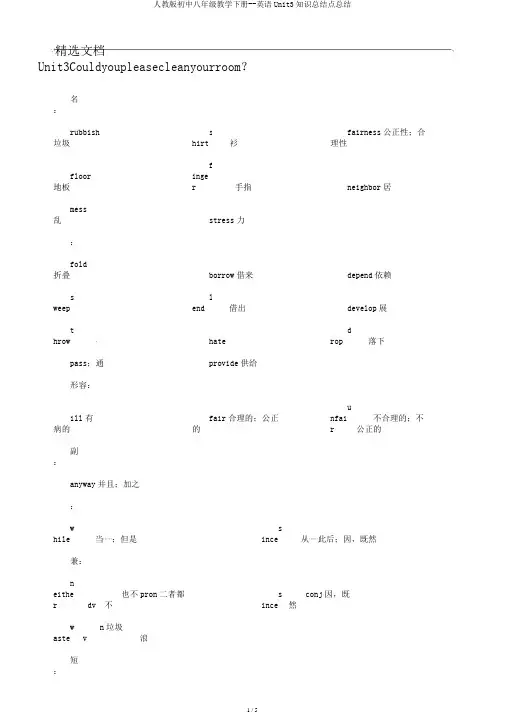
精选文档Unit3Couldyoupleasecleanyourroom?名:rubbish 垃圾shirt衫fairness公正性;合理性floor 地板finger手指neighbor居mess乱stress力:fold折叠borrow借来depend依赖sweep打lend借出develop展throw扔hatedrop落下pass;通provide供给形容:ill有病的fair合理的;公正的unfair不合理的;不公正的副:anyway并且;加之:while当⋯⋯;但是since从⋯⋯此后;因,既然兼:neithe radv也不pron二者都不sinceconj因,既然w asten垃圾v浪短:takeouttherubbish倒垃圾dependon依赖allthe time向来;繁takecareof照assoonas一⋯⋯就⋯⋯sweepthefloor地inorderto了知点:1、rubbish垃圾;物不可以数名=garbage=trash2、floor地板;楼thefirstfloor第一thesecondfloor第二the+序数+floor第几3、atleast起码atmost至多.精选文档Theticketwillcostatleast200yuan.票起码花200元。
Itwilltake2hoursatmosttogetthere. 最多花两小便可抵达那边。
4、finishdoingsth 达成做某事HefinishedwritingtheEnglishpaper. 他写完了那篇英文。
喜介怀;enjoy/miss/minddoingsth达成快乐勤;finish/havefun/practicedoing sth忙得忍不住想放弃;bebusy/can'thelp/giveupdoingsth5、invitesbtodosth 邀某人做某事invitesbto+ 地址邀某人去某地Heinvitedmetotheparty. 他邀我去个聚会。
新人教版八年级英语(下册)第三单元知识点总结归纳
新人教版八年级英语(下册)第三单元知识点总结归纳Unit 3: Could you please clean your room?One: "Peter。
could you please take out the rubbish?" - "Sure。
Mom."Could you please do something?" is used to make a request in a polite and indirect manner。
hoping for a positive response。
"Could" is not the past tense of "can," but a more polite way of speaking。
The answer should use "can."Common affirmative responses: "Sure," "Of course," "Certainly," "No problem." Negative responses: "Sorry。
I can't."Two: "Take out" means to remove something (v+adv)。
When using a pronoun as the object。
it goes in the middle。
Witha noun。
it can go in the middle or at the end.Phrases using "take":Take out" means to bring something out or remove it.Please take out a piece of paper."Please take it out."Take。
八年级人教版英语下册unit3知识点
八年级人教版英语下册unit3知识点Unit 3 Language in use一、句型结构1. What did you do…?A: What did you do yesterday?B: I cleaned my room.2. What was …like?A: What was the weather like yesterday?B: It was warm and sunny.3. When did …?A: When did you finish your homework?B: I finished it at nine o’clock last night.4. How was …?A: How was your weekend?B: It was great! I went to the park and played basketball with my friends.二、动词时态1. 一般过去时:表示过去经历或已经完成的动作或状态。
I walked to school yesterday.She watched a movie last night.2. 过去进行时:表示过去某一时刻正在进行的动作。
We were playing basketball at six o’clock yesterday evening.They were studying English when the teacher came in.3. 过去完成时:表示过去的某个时间或动作之前已经完成的动作。
He had finished his homework before he went to bed.I had never been to Shanghai before last year.三、被动语态被动语态的构成:be动词(am、is、are、was、were)+过去分词。
1. 一般现在时被动语态:The apples are picked by the farmers.2. 一般过去时被动语态:The book was written by Li Bai.3. 现在进行时被动语态:The dishes are being washed by my sister.四、语态转换主动语态变被动语态,被动语态变主动语态。
人教版八年级下册英语Unit3知识点总结

精品基础教育教学资料,仅供参考,需要可下载使用!Unit3 Could you please clean your room? 一.情态动词could 的用法1.提出礼貌的要求Could you please (not) do sth ?请你(做)......好吗?用于提出请求,希望得到对方的肯定回答,说话的语气比较客气委婉。
Could 不是can 的过去式,是委婉、礼貌的说法。
回答用can.肯定回答:Yes,sure./ Yes, I can./Of course,I can./ Certainly./No problem./ With pleasure .否定回答:Sorry , I can’t / I’m afraid I can’t. I have to (I)m going to…(说明理由)2.表示请求许可Could I do a sth? 我可以做......吗?肯定回答:Yes, you can ./ Yes ,please / Of course / Certainly./ No problem.否定回答:Sorry , you can’t / I’m afraid you can’t.3.could 为can的过去式,表示过去的能力。
= was / were able toSection A1. take out the rubbish把垃圾带出去2. do the dishes = wash the dishes洗碗碟3. fold your clothes折衣服4. sweep the floor扫地5. make your bed整理床铺6. clean the living room打扫起居室7. do some washing/ shopping/ cleaning洗衣服/ 购物/ 做清洁8. go out for dinner出去吃晚饭9. go to the movies去看电影10. stay out late/ until nine呆到很晚/ 呆到9点钟11. get a ride撘车12. give sb a ride to town开车送sb到镇上13. need to do something需要做……14. have to do something不得不做……15. help out with a few things帮助做些事情16. at least至少,多指数量或程度上的最低限度。
最全面人教版八年级下册英语第三单元知识点归纳总结
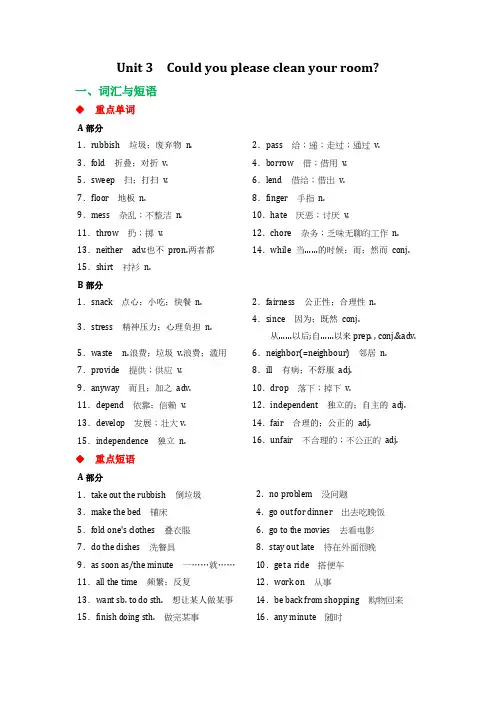
Unit 3 Could you please clean your room?一、词汇与短语◆重点单词A部分1.rubbish 垃圾;废弃物n.2.pass 给;递;走过;通过v. 3.fold 折叠;对折v.4.borrow 借;借用v.5.sweep 扫;打扫v.6.lend 借给;借出v.7.floor 地板n.8.finger 手指n.9.mess 杂乱;不整洁n.10.hate 厌恶;讨厌v.11.throw 扔;掷v.12.chore 杂务;乏味无聊的工作n. 13.neither adv.也不pron.两者都14.while 当……的时候;而;然而conj. 15.shirt 衬衫n.B部分1.snack 点心;小吃;快餐n.2.fairness 公正性;合理性n.3.stress 精神压力;心理负担n.4.since 因为;既然conj.从……以后;自……以来prep. , conj.&adv.5.waste n.浪费;垃圾v.浪费;滥用6.neighbor(=neighbour) 邻居n. 7.provide 提供;供应v.8.ill 有病;不舒服adj. 9.anyway 而且;加之adv.10.drop 落下;掉下v. 11.depend 依靠;信赖v.12.independent 独立的;自主的adj. 13.develop 发展;壮大v.14.fair 合理的;公正的adj. 15.independence 独立n.16.unfair 不合理的;不公正的adj.◆重点短语A部分1.take out the rubbish 倒垃圾2.no problem 没问题3.make the bed 铺床4.go out for dinner 出去吃晚饭5.fold one's clothes 叠衣服6.go to the movies 去看电影7.do the dishes 洗餐具8.stay out late 待在外面很晚9.as soon as/the minute 一……就……10.get a ride 搭便车11.all the time 频繁;反复12.work on 从事13.want sb. to do sth. 想让某人做某事14.be back from shopping 购物回来15.finish doing sth. 做完某事16.any minute 随时17.help out with sth. 帮忙做某事18.pretty clean and tidy 很干净整洁19.all day 整天20.shout back 顶嘴21.take sb. for a walk 带某人去散步22.walk away 走开23.in front of 在……前面24.in surprise 吃惊地25.throw down 扔下26.hang out with sb. 和某人闲逛27.come home from school 放学回家28.borrow sth. from sb. 向某人借某物29.solve the problem 解决问题30.lend sth. to sb. 把某物借给某人31.be angry with sb. 生某人的气32.come home from work 下班回家33.hate to do sth. 讨厌做某事B部分1.in order to 目的是;为了2.mind doing sth. 介意做某事3.depend on 依靠;信赖4.get sth. for sb. 为某人买某物5.help with sth. 帮忙做某事6.the idea of fairness 公平的想法7.make sb. do sth. 使/让某人做某事8.do one's part in 尽某人的责任9.have a test 进行测验10.have no idea 不知道11.invite sb. to sp. 邀请某人去某地12.as a result 结果13.take care of 照顾;处理14.look after/care for 照看;照顾15.have enough stress from school 有足够的学习压力16.spend one's time on/doing sth.花费某人的时间做某事17.a waste of time 浪费时间18.fall ill 生病19.provide sth. for sb.=provide sb. with sth.给某人提供某物20.develop children's independence 发展孩子的独立性21.get into a good university上一所好大学22.agree with sb. 同意某人◆重点句子A部分1.— Could you please clean your room? — No problem.— 你能整理一下你的房间吗?— 没问题。
八年级英语下册Unit3-课文讲解+知识点+练习

Unit3 Could you please clean your room?Section A重点短语go out for dinner 出去吃饭stay out late 在外面待到很晚go to the movies 去看电影get a ride 搭车work on 从事finish doing sth. 完成做某事clean and tidy 干净整洁do the dishes 洗餐具take out the rubbish 倒垃圾fold your/the clothes 叠衣服sweep the floor 扫地make your/the bed 整理床铺clean the living room 打扫客厅no problem 没问题welcome sb. 欢迎某人come home fro m school/ work 放学/ 下班回家throw down 扔下sit down 坐下come over 过来take sb. for a walk 带某人去散步all the time 一直;总是all day/evening 整曰/夜do housework 做家务shout back 大声回应a comfortable home 一个舒适的家in surprise 惊讶地get something to drink 拿点喝的东西watch one show 观看一个节目hang out 闲逛pass sb. sth. 把某物传给某人lend sb. sth. 把某物借给某人get sth. wet 使某物弄湿hateto do sth. 讨厌做某事do chores 做杂务help sb. (to ) d o /with sth 帮助某人干某事bring a tent 带顶帐篷来buy some snacks 买些小吃go to the store 去商店invite sb. to a party 邀请某人参加聚会make sb. do sth. 使某人做某事enough stress 足够的压力waste of time 浪费时间in order to 为了get good grades 取得好成绩mind doing sth. 介意做某事depend on 依赖;依靠develop children ’in s dependence 发展孩子的独立性look after/take care of 照顾;照看walk away 走开.share the housework 分担家务do one ’s part in (doing ) sth做.内的事某人分二、重点句型1. Could you please ..do sth. ? Could you please clean your room? 你能整理一下你的房间吗?2. I have to do some work. 我必须干些活。
英语八年级下册unit3知识点
英语八年级下册unit3知识点英语八年级下册Unit3主要是涉及到旅游及热门景点相关内容。
在这一单元中,我们学习了许多关于出行的单词和词组,同时也学习了旅游方面的文化知识。
下面,本文将围绕这些知识点,总结归纳出本单元的核心知识点。
第一部分:旅游方面的单词和词组1. sightseeing:观光2. destination:目的地3. travel,journey:旅行4. tour:游览5. accommodation:住宿6. transportation:交通7. ticket:票8. guide:导游9. excursion:短途旅游我们应该注意这些单词的正确发音和用法,使自己的英语更加准确清晰。
第二部分:旅游方面的文化知识1. 美食文化:在旅游中品尝当地的美食也是很重要的一部分。
比如在中国,烤鸭和火锅就是很受外国人欢迎的美食。
在日本,则是寿司和生鱼片。
2. 交通文化:在不同国家,交通方式也是各不相同的。
比如在欧洲,大多数人选择步行或骑行,而在中国城市,公共交通比较发达,人们通常乘坐地铁、公交车等。
3. 饮食礼仪:在不同国家,饮食礼仪也是有所不同的。
比如在中国,用餐时要招待客人,避免用筷子顶餐盘等等礼仪问题。
在日本,则更注重吃饭时的细节和仪式感。
第三部分:热门景点在这个单元中我们还学习了关于热门景点的话题。
下面介绍一些世界著名热门景点。
1. 埃菲尔铁塔:法国巴黎的标志性建筑。
2. 自由女神像:位于美国纽约港口,是法国人向美国人赠送的礼物。
3. 金门大桥:连接美国旧金山和马林县,是世界上最著名的桥梁之一。
4. 罗马斗兽场:意大利罗马的古代竞技场,是世界历史上最著名的文化遗产之一。
5. 万里长城:中国的镇国之宝,是目前世界上保存最完好、规模最宏大的古代筑墙工程。
总结:英语八年级下册Unit3,主要涉及旅游方面的单词和词组、旅游方面的文化知识和世界著名热门景点。
我们可以通过学习这些知识点,提高我们的英语交流能力,也可以更好地了解和欣赏不同国家的风土人情。
人教版八年级下册英语Unit3重点知识汇总
人教版八年级下册英语Unit3重点知识汇总Unit 3 in the People's Education Press edition of the 8th grade English textbook covers various topics related to free time activities. Here is a summary of the key knowledge points in this unit:1. Vocabulary:- Free time activities: such as playing sports, playing musical instruments, reading books, watching movies, listening to music, shopping, and so on.- Verbs related to activities: play, go, do, watch, listen to, read, go shopping, etc. - Adjectives to describe activities: fun, interesting, relaxing, exciting, etc.- Adverbs of frequency: always, usually, often, sometimes, rarely, never, etc.- Expressing preferences: like, love, enjoy, don't mind, dislike, hate, etc.2. Grammar:- The present simple tense: used to talk about general truths, habits, routines, and permanent situations.- The present simple tense with adverbs of frequency: used to talk about how often something happens.- Questions and short answers with the present simple tense: used to ask about habits, routines, and preferences.- Imperatives: used to give instructions or commands.- Comparatives and superlatives: used to compare two or more things.3. Sentence structure:- Sentence patterns for talking about free time activities: subject + verb + object. - Sentences with adverbs of frequency: subject + adverb of frequency + verb + object.- Questions with the present simple tense: Auxiliary verb + subject + infinitive verb + object?- Imperatives: Just verb + object.- Comparatives and superlatives: Subject + verb + (adjective/adverb) + than + object.4. Listening and speaking skills:- Listening for specific information: listening for details about someone's free time activities.- Speaking about preferences: expressing likes and dislikes about free time activities.5. Reading skills:- Reading for main ideas: skimming a text to understand the overall topic.- Reading for details: scanning a text to find specific information.It's important to review and practice these key knowledge points through various activities, such as completing exercises, having conversations, and reading and listening to texts in order to reinforce understanding and improve language skills.。
人教版八年级英语下册unit3知识点总结
人教版八年级英语下册unit3知识点总结全文共6篇示例,供读者参考篇1Unit 3 - What an Interesting WorldHi everyone! I'm going to tell you all about the cool things I learned in Unit 3 of my English textbook. Get ready, because there's a lot!First up, we covered some really useful vocabulary about the world around us. Words like "environment", "pollute", "protect" and "conservation". It's so important to take care of our planet and not pollute the air, water and land with rubbish and chemicals. Conservation means protecting animals, plants and natural resources. I try my best to recycle, save energy and water at home.Then we learned how to describe locations using prepositions like "near", "opposite", "behind" and "between". For example, my school is near the park and opposite the supermarket. The library is between the bank and the post office. Using prepositions correctly really helps make your meaning clear.Next, we studied the grammar for the present continuous tense. This is for talking about actions happening right now, at this very moment. You form it with "be" + the present participle ending in "-ing". Like "I am reading a book" or "They are playing soccer". Easy peasy!There were also lessons on quantifiers to express quantities, like "a few", "a little", "many", "much". A few apples, a little milk, many friends, much homework! I have much homework almost every night. Using the right quantifiers is mad important for super clear communication.One of my favorite sections was on describing people's personalities and behaviours. Words like "patient", "optimistic", "pessimistic", "selfish" and "generous". My best friend is really patient and generous, always sharing her snacks! But my little brother can be pretty selfish sometimes. I try to be an optimistic person overall.Then we covered making suggestions using"let's..." or "why don't we..." Like "Let's go to the park!" or "Why don't we watch a movie?" Sometimes my parents make suggestions to me, and sometimes I cheekily make a suggestion to them! You have to be careful with your tone.Another grammar point was the future tense with "will" for predictions about the future. Like "It will rain this afternoon" or "We will go on vacation next month". I'm really hoping it will be sunny this weekend so I can play outside! Using "will" helps us talk about what's going to happen.There was also a unit on describing locations and asking for directions. You have to use prepositions plus words like "turn", "go straight", "cross" etc. For example: "Go straight ahead, then turn left at the traffic lights and cross the bridge". Sort of like when you're giving instructions to a robot!Wow, that's really most of the key grammar and vocabulary from the unit! We also read some interesting articles and did cool activities to practice everything.Like this one article about a teenager who started an organization to protect sea turtles. It talked about how human activity like pollution and illegal hunting was threatening their survival. But this kid helped raise awareness and even got new laws passed! It was really motivating.Another reading was about ecotourism - tourism that supports conservation and sustainability efforts. It described an amazing rainforest resort that uses solar power, composts waste,and employs local people. They also take guests on hiking and wildlife watching tours. I'd love to visit a place like that someday!There were lots of fun pair work activities too. Like describing the location and position of things in pictures using prepositions. Or discussing what someone was currently doing using the present continuous. Role plays were cool for practicing functional language like making suggestions.Oh, and we did a really neat project at the end about designing our own eco-friendly student club! We had to come up with sustainability ideas and present our proposal to the class. My group wanted to start a recycling program and beach clean-ups. I really hope our teacher actually lets us do it.Phew, that was a lot of information! I don't know about you, but I feel like my English skills have really leveled up after this unit. Looking at the world through an environmentally-conscious lens was so interesting and important. MaybeI'll be an ecotourist or conservationist when I grow up? For now, I'm just going to appreciate this amazing planet and do my part. Thanks for reading, speak to you later!篇2Unit 3 Summary: Exploring the RainforestHi there, friends! It's me, your pal Emily, back with another exciting adventure in our English textbook. This time, we're diving deep into the mysterious and fascinating world of rainforests! Get ready to embark on a journey filled with incredible discoveries, fascinating creatures, and mind-boggling facts that will leave you in awe.First things first, let's talk about what a rainforest actually is. Imagine a place where trees stretch up so high that they seem to touch the clouds, and the air is thick with the sounds of chirping birds and buzzing insects. That's a rainforest for you – a dense, lush forest that receives an absolute ton of rainfall every year!Now, let's talk about where these amazing places are located. Rainforests can be found in various parts of the world, but the largest and most well-known ones are the Amazon Rainforest in South America and the tropical rainforests of Southeast Asia and Africa. These verdant wonderlands are home to an astonishing array of plant and animal life, and they play a crucial role in maintaining the Earth's delicate ecosystem.Speaking of plants and animals, get ready to be blown away by the sheer diversity of species that call the rainforest home. From towering trees with buttress roots (seriously, they look like they're wearing wooden pants!) to colorful parrots, playfulmonkeys, and slithering snakes, the rainforest is a true treasure trove of biodiversity.One of the coolest things about rainforests is the intricate way that different plants and animals depend on each other for survival. It's like a giant, interconnected web of life, where every species plays a vital role. For example, some plants rely on animals to spread their seeds, while other animals depend on specific plants for food or shelter. It's mind-boggling, but also incredibly fascinating!Now, let's talk about the indigenous people who have called the rainforest home for centuries. These amazing communities have a deep connection with the land and have developed unique traditions and ways of life that are intimately tied to the rainforest. From hunting and gathering techniques to medicinal plant knowledge, the wisdom of these indigenous peoples is truly remarkable.Unfortunately, rainforests around the world are facing serious threats from deforestation, logging, and other human activities. This not only puts the incredible biodiversity of these ecosystems at risk but also has far-reaching consequences for the entire planet. That's why it's so important for all of us to learnabout and appreciate the value of rainforests, and to do our part to protect them.Throughout this unit, we'll explore fascinating topics like the different layers of the rainforest (did you know there are four distinct layers?), the amazing adaptations of rainforest animals, and the incredible ways that indigenous communities have learned to live in harmony with their environment.We'll also dive into some exciting stories and folktales that have emerged from rainforest cultures, giving us a glimpse into the rich traditions and beliefs of these remarkable people.But that's not all, folks! We'll also learn about the incredible products an篇3Unit 3 - A Brighter FutureHello friends! In this unit, we learned lots of cool stuff about science, technology, and how they can help make our world better. Let me tell you all about it!First up, we read a really neat article called "Nuclear Technology for a Brighter Future." It talked about how nuclear power can give us electricity without burning coal or gas, whichis much cleaner for the environment. Nuclear plants don't release carbon dioxide or other greenhouse gases that cause global warming.But nuclear power also has some risks if not properly controlled. The article mentioned accidents like the ones at Chernobyl and Fukushima where radiation leaked out. That's why nuclear plants need very strong safety systems. Scientists are working hard to make new, even safer nuclear reactor designs.We also learned about other future energy sources like solar, wind, and hydrogen power. Solar uses sunlight to make electricity from panels on houses or in huge solar farms. Wind turbines spin and generate electricity from the wind's motion. And hydrogen fuel cells use hydrogen gas to produce electricity with just water vapor as waste! Awesome right?In the next part, we read all about gene technology and genetically modified (GM) foods. Scientists can actually insert good genes into crops to help them grow better, resist disease, or provide more nutrients. Some people worry that GM foods might be unsafe, but so far studies show they are just as safe and healthy as regular foods.Gene tech can also be used for gene therapy - inserting good genes to cure diseases like cystic fibrosis or hemophilia. Itmay even let us reverse genetic defects before babies are born one day. This could prevent many disabilities and illnesses. So cool!There were some great discussions about the ethics of using this powerful technology responsibly. We need to carefully study the benefits and risks. But gene editing holds huge potential for improving lives if used properly.Switching gears, we learned about two other cutting-edge fields - nanotechnology and artificial intelligence (AI). Nanotech deals with engineering incredibly tiny materials and machines, even smaller than a strand of hair! Potential uses include better computers, unbelievably strong materials, powerful new medicines, and more.As for AI, we're talking about computer systems that can actually learn, reason, and solve problems just like humans. AIs may soon be able to diagnose diseases, control robots, write software, and help with all sorts of cognitive tasks. The possibilities seem endless if we can create safe, ethical AI systems.Throughout the unit, we practiced vocabulary, grammar points like noun clauses and inversions, writing persuasive letters, and spoke about advantages/disadvantages of technology.Those skills will really help us discuss and understand these complex scientific topics.In the end, I realized that while emerging technologies have risks, they also have tremendous potential benefits for humanity if developed responsibly. We just need to be smart about using them ethically and sustainably. An exciting, brighter future powered by science and technology awaits!So what did you think was the most fascinating part? Nuclear power? GM foods? Nanotechnology? Let me know! I can't wait to see what other incredible breakthroughs scientists come up with next. Our future is going to be amazing!篇4Unit 3 - An Ecotour to the RainforestHi guys! Today I want to share with you what I learned from Unit 3 in my English textbook. It was all about an ecotour to the rainforest, and I thought it was super cool!First up, we learned some new vocabulary words related to the rainforest and ecotourism. Words like "canopy", "understorey", "ecotour", and "biodiversity". The canopy is the top layer of the rainforest where the tallest trees are, and theunderstorey is the layer below with smaller trees and plants. An ecotour is a tour that focuses on experiencing and learning about the natural environment in an eco-friendly way. Biodiversity means the variety of different plants and animals in an area.Then we read this really interesting text about two students, Lucy and David, who went on an ecotour to the Amazon rainforest in Brazil with their class. They learned so many cool things from their guide, like how the rainforest is often called the "lungs of the Earth" because it produces a lot of the world's oxygen. They also saw amazing animals like toucans, sloths, and even a jaguar!One part that stuck with me was when Lucy and David's guide explained why the rainforest is so important for biodiversity. He said that even though rainforests only cover about 6% of the Earth's land surface, they are home to over half of all the plant and animal species on our planet! That's because the warm, wet climate and nutrient-rich soil create the perfect environment for so many different lifeforms to thrive.The guide also talked about how indigenous communities have lived in harmony with the rainforest for thousands of years, using its resources sustainably. But sadly, large areas of therainforest are being cleared for things like logging, mining, and farming. This is really bad because it destroys the habitats of so many amazing creatures and also releases tons of carbon dioxide into the atmosphere, contributing to climate change.After learning all this, Lucy and David felt inspired to help protect the rainforest. Their guide gave them some tips, like reducing their use of paper and wood products, supporting organizations that work to conserve rainforests, and spreading awareness about the importance of these incredible ecosystems.There was also a section in the unit about ecotourism and how it can actually help protect natural areas like rainforests. When ecotours are well-managed, they can provide jobs for local communities and give them an economic incentive to preserve their environment. The money from ecotourism can fund conservation efforts and sustainable development projects. But of course, the ecotours have to be carefully controlled so that too many tourists don't end up damaging the very places they came to see.We practiced lots of useful language in this unit too, like how to describe ecosystems and environments, express opinions about environmental issues, and discuss solutions for protectingnature. There were some cool pictures and videos that really brought the rainforest to life in our classroom.My favorite activity was when we had to design our own ecotour package for a rainforest destination. We had to plan an itinerary, decide what activities and attractions to include, and come up with ways to minimize the environmental impact. It was a lot of fun imagining what it would be like to actually visit the rainforest!Overall, I thought Unit 3 was really fascinating and it made me appreciate how important and amazing rainforests are. I hope that more people will learn about ecotourism and pitch in to protect these incredible places. After all, the rainforest is sometimes called the "jewel of the Earth", and it would be a terrible shame to lose its brilliant biodiversity.Well, that's my summary of the key points we covered in this unit! Let me know if you have any other questions. Thanks for reading, and don't forget to reduce, reuse, and recycle to help save the rainforests!篇5Unit 3 - Wonders of the WorldHi there! In this unit, we learned all about some of the most amazing wonders our world has to offer. These wonders are spread across different countries and continents, and each one is truly spectacular in its own way. Let me tell you about them!The Great Pyramids of GizaLet's start with the pyramids in Egypt! These massive stone structures were built thousands of years ago as tombs for powerful pharaohs. The biggest one, called the Great Pyramid of Khufu, is made of over 2 million stone blocks and stands nearly 500 feet tall! Can you imagine how long it took to build something so huge, without any modern machines? The pyramids are a testament to the incredible skills and hard work of the ancient Egyptians.The Great Wall of ChinaHeading over to Asia, we can't miss the iconic Great Wall of China. This massive wall stretches for thousands of miles across northern China and was built to protect the country from invaders. It's so long that if you tried to walk its entire length, it would take you over a year! The wall winds through beautiful landscapes like mountains, deserts and grasslands. Some of the oldest parts were built over 2,000 years ago using just basic tools and manpower. Isn't that mind-blowing?The Taj MahalIn India, there's an absolutely breathtaking structure called the Taj Mahal. It was built as a grand mausoleum (a type of tomb) by an emperor in memory of his beloved wife. The entire building is made of white marble that almost seems to glow. On top, there's a massive dome surrounded by four smaller domes. Inside and out, the Taj Mahal is covered in intricate carvings and precious gemstones. It's no wonder it's considered one of the most beautiful buildings ever created!The ColosseumLet's hop over to Italy and check out the mighty Colosseum in Rome. This gigantic amphitheatre was built by the Romans nearly 2,000 years ago. It could seat over 50,000 people who would gather to watch spectacular events like gladiator battles, animal hunts, plays and more. The Colosseum is an engineering marvel – it even had clever systems to collect rainwater and provide shade for the spectators. Although parts of it are now in ruins, it's still an iconic symbol of ancient Roman architecture and culture.The Moai StatuesWay out in the Pacific Ocean, we find the remote Easter Island which is home to hundreds of massive stone statues called Moai. These towering figures, carved from volcanic rock, can be up to 30 feet tall and weigh over 80 tons! The Moai were created by the island's earliest inhabitants, the Rapa Nui people, sometime between 1200-1500 AD. To this day, no one knows for sure how they moved and erected such heavy statues using just basic tools and manpower. The Moai remain shrouded in mystery and their existence continues to fascinate people.Machu PicchuLet's head to South America to visit Machu Picchu, an ancient Incan city nestled high in the Andes mountains of Peru. Despite being hidden away from the outside world for centuries, this "Lost City" is incredibly well-preserved. Its dry-stone walls, plazas, temples and living quarters show remarkable architectural and engineering skills. The Incas constructed Machu Picchu without using any modern tools or wheeled transport, and without even knowing about iron tools or the wheel! Wandering through its ruins, you can't help but feel amazed by this magnificent creation.So those are some of the world's greatest man-made wonders that we studied. Each one represents the creativity, hardwork and ingenuity of ancient civilizations. When you think about how they were built with such basic tools and no modern technology, it's truly mind-boggling! I hope learning about these wonders has inspired you to dream big and work hard to achieve great things, just like the people who created them. Our world is full of amazing sights, so keep exploring!篇6Unit 3 - Wonders of the WorldHey there friends! Today I'm going to tell you all about Unit 3 from our 8th grade English book. It's all about some amazing Wonders of the World. Get ready to learn some cool new words and phrases!The unit starts off by introducing us to the Seven Wonders of the Ancient World. These were seven incredible structures built way back in ancient times that people thought were the most amazing human constructions ever made. Things like the Great Pyramid of Giza in Egypt, the Hanging Gardens of Babylon, and the Colossus of Rhodes statue. Can you imagine seeing those in person? They sound unbelievable!Next up, we learn about some more recent Wonders of the Modern World. In 2007, people voted on a new list of sevenmodern marvels that they thought deserved to be called "Wonders." This new list includes awesome places like the Great Wall of China, Petra in Jordan, Christ the Redeemer statue in Brazil, and Machu Picchu in Peru. I'd love to go visit them all one day!An important word we learn is "marvel." When you marvel at something, it means you're amazed and wonder how it's possible. Like when you watch a magic trick and marvel "How did they do that?!" The Wonders of the World make people marvel in amazement.We also learn the phrase "man-made." This means something was constructed or built by humans, not naturally formed. All of the Wonders we study are incredible man-made structures. Humans had to design and build them which is just mind-blowing when you think about it.Okay, get ready for some new vocabulary! We learn words like "remnant" which means a remaining trace or fragment of something from the past. And "intact" which describes something that hasn't been damaged and remains whole and complete. Some Wonders are just remnants now while others are still intact.Another key word is "criteria." These are the requirements or standards that are used to determine if something qualifies for a group or list. The people choosing the Modern Wonders had to decide on specific criteria that a structure had to meet in order to make the cut.We read about how some Wonders were constructed using "intricate" methods, which means extremely complex with lots of delicate details and craftsmanship. The Ancient Wonders especially had incredibly intricate designs that seem impossible with the limited technology they had back then.Oh, and we can't forget the word "manpower!" This refers to the human physical labor and workforce required for huge construction projects like the Wonders. Thousands and thousands of workers providing manpower were needed to build these massive structures by hand.Learning about all the different Wonders really makes me appreciate the amazing skills and perseverance of the people who created them so long ago. Even with all our advanced modern technology, I'm not sure we could recreate some of those Ancient Wonders today!Towards the end of the unit, we discuss how some Wonders have sadly been partially or completely destroyed over time bynatural effects like erosion and weathering from wind, rain, and aging. It's tragic to think that some of these incredibleman-made marvels have been lost forever.That's why it's so important that we work hard to protect and preserve the remaining Wonders for future generations. They're such important parts of human history and cultures that we can't let them disappear. Maybe you'll even get to visit some in person one day!Well, that's the main highlights from Unit 3 in a nutshell. We learned about the most marvelous man-made Wonders from ancient times all the way to the modern day. We expanded our vocabulary with cool new words to describe these amazing feats of human construction and engineering. And we marveled at the ingenuity and determination it took to create such lasting icons.I don't know about you, but learning about the Wonders of the World has me feeling inspired. If ancient peoples without modern tools could build such incredible things, just imagine what's possible for us today. The world is full of wonders and the only limit is our own drive and creativity! Now let's get out there and explore!。
人教版英语八年级下册单元Unit 3 知识点+测试卷+思维导图
Unit 3 Could you please clean your room?1.重点词汇:floor, mess, neighbor, rubbish, shirt, waste, stress, fold ,seep, throw, pass, borrow, lend, hate, depend, develop, provide, drop...2. 短语归纳:1. take out the rubbish 倒垃圾2. all the time 频繁,反复3. in order to 目的是,为了4. depend on 依靠,依赖5. take care of 照顾,处理3. 必背典句:1. -Could I go out for dinner with my friends? 我可以和朋友们出去吃晚餐吗?-Sure, that should be OK. 当然,应该可以。
2. -Could we get something to drink after the movie? 电影结束后我们可以喝点东西吗?-No, you can’t. You have a basketball game tomorrow. 不,你不可以。
你明天有一场篮球比赛。
3. -Could you please take the dog for a walk? 能请你出去遛遛狗吗?-OK, but I want to watch one show first. 可以,但我想先看个节目。
4.语法知识:情态动词could1. 用于有礼貌地向对方提出要求或请求。
例如:-Could you please sweep the floor? 你能扫地吗?-Yes, sure. 好的,当然。
2. 用于请求许可。
例如:-Could I borrow that book? 我可以借那本书吗?-Of course. Here you are. 当然。