
外研版七年级英语上册课件Module5Unit2
Presentation
Post-reading:
Presentation
Find out these sentences from the passage.
1. I get up at half past seven in the morning, and then have breakfast.
weekdays
F
nine o'clock F
T
Presentation
•Read paragraph 4-6 and answer the questions. •1、Where do we have lunch?
We have lunch in the dining hall.
•2、When do we start lessons in the afWteernsotaornt ?lessons in the afternoon at
7:30 8:30 9:00 11:0 102:30 1:30 3:30
in the evening
10:00
get up go to school start work have a break have stalurnt clehssons go home
watch TV
do my homework and go to bed
have breakfast
For example:
I get up at half past six. I ....... at .......
Lead-in
7:30 go to school
8:00 start lessons
11:00 have lunch
12:00 have a break
Presentation
Summary: 短语
Chinese
English
起床
get up
吃早餐 上学 上课 休息
have breakfast go to school have lessons have a break
Presentation
活动 吃午餐
回家 做作业 吃晚餐
睡觉
(英文)
have lunch go home
eight o’clock.
2. My brother started playing / to play
_________________ (play) football
when he was ten years old.
Presentation
Post-reading: Speaking activity--Retelling
Lead-in
4:00 go home
5:30 have dinner
9:00 7:30
do homework
go to bed
Presentation
Presentation
Pre-reading: Match the pictures.
slee go have have
have play
p home lunch breakfast lesson football
I’m Alex. I go to school on weekdays. I get up at half past seven…….
Presentation
1.Write some sentences about yourself. I get up at…
2.Work in pairs. Use the sentences to talk about your school day.
do homework have dinner go to bed
Presentation
Get to know about "have" For example: I get up at half past seven in the morning, and then have breakfast.
Presentation
Now join these sentences with and then. 1. In the morning, we get up. We go to school.
In the morning, we get up, and then go to school.
2. In the afternoon, we have lessons. We play football in the playground.
1 I get up / start work at half past seven. 2 We have a break / have lunch at half past twelve. 3 I go home / watch TV in the evening. 4 I do my homework / see my friends in the evening. 5 I go home / go to sleep at ten
I get up at half past seven. We start work at nine o’clock. We have lunch at half past twelve.
Presentation
Look at the sentences:
1. I get up at seven o’clock. I go to school at eight o’clock. I get up at seven o’clock, and then go to school at eight o’clock.
外研版
七年级(上)
学练优七年级英语上(WY) 教学课件
Module 5 My school day
Unit 2 We start work at nine o'clock.
Lead-in
Look at the time and talk about the pictures.
6:30
7:00
get up
go home是一个固定搭配,意为“回家”。 因为home在这里作副词, 故home的前面不能 加介词to。 关于 go的短语:
go to school “去上学” go to work “去上班” go to bed表示“去睡觉”
Presentation
3. We start lessons in the afternoon at half past one. start, 意为"开始;着手", start + sth. start+ to do sth. start+doing sth.
Presentation
Activity 4
• Read paragraph 1-3 and finish the task.
• 判断正误 (T,F)
• 1、I go to school on Saturday and Sunday.( )
• 2、We start lessons at half past eight.( ) • 3、We have a break at eleven o’clock.( )
吃早餐
Presentation
have lessons
上课
have dinner
吃饭
have a rest
休息
have a good time 玩的愉快
have a look
看一看
Homework
Write a passage about Chinese school days, write sentences like: I/We get up at … I/We go home at … I/We homework at …
start也可用作名词, 意为“开始;开端”。如: The start of the film is very interesting. 电影的开头非常有趣。
Presentation
[Practice]
用所给单词的适当形式填空。
1. The first class _________(start) at starts
get up:“起床” 。如:
What time do you__g_e_t _u_p____?
你几点起床?e.g.
have breakfast. 吃早餐
have lessons have dinner have a look
上课 吃饭 看一看
Presentation
2. Then we go home at half past three.
a
b
c
d
e
f
7:30 am _e___ 10:00 pm _c___ 11:00 am _d___ 12:30 pm _a___ 3:30 pm _b___ 9:00 am _f___
Presentation
Activity 3-Underline the correct expressions.
In the afternoon, we have lessons, and then we play football in the playground.
Presentation
3. In the evening, I have dinner. I do my homework.
I the evening, I have dinner, and then do my homework. 4. In the evening, I do my homework. I go to bed. In the evening, I do my homework, and then go to bed.
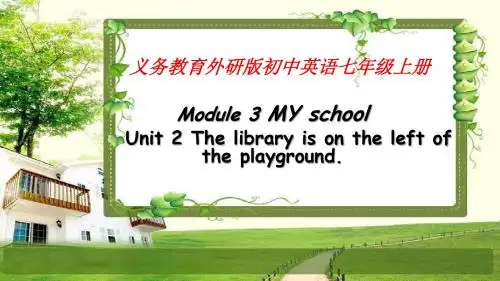
外研版七年级英语上册《 Unit 2 The library is on the left of the playground.》优质课课件_25
behind
classroom building
Office building
on the left of library
in front of
sports hall middle
playground science building
1. The library is ___o_n__th__e_le_f_t_o_f_____ the playground.
4. There's a gate in fr_o_n__t of the library. 5. I like playing basketball on the _p_l_a_y_g_r_o_u_n. d
6. Betty is on the ri_g_h_t_ of Daming. 7. Mike is b_e_h_i_n_dLucy.
hall.
5. The dining hall is _o_n__t_h_e_r_i_g_h_t_o_f__ the classroom building.
6. The school offices are __b_e_h_in_d____ the library. 7. The sport hall is ___b_e_t_w_e_e_n__ the science
B. between
C. in front of
D. on the right
( D ) 3. What’s on the ____ of the building?
A. front
B. between
C. near
D. right
( D ) 4. This is the classroom building
Module5Unit2+We+start+work+课件2022-2023学年人教版英语七年级上册
10 watch v. 看,观看 辨析watch,look,see和 read
常指看电视、 I often watch football matches on watch 电影、比赛等。 TV.我经常在电视上看足球赛。
look 强调“看”的动作。 They looked , but they saw nothing.他们看了,但什么也没
课文呈现
Reading and vocabulary Read the passage and put the pictures in order.
My school day
Hi! I’m Alex Greenall. I’m thirteen and I go to Park School in Oxford, England. I go to school❶ on weekdays,but not on Saturday and Sunday. This is my school day. I get up ❷at half past seven in the morning,and then ❸have breakfast❹.
Writing Write about yourself. Use the expressions in Activity 3 to help you.
I get up at...
Work in pairs. Talk about your school day. I get up at half past seven. We start work at nine o'clock. We have lunch at half past twelve.
have a break意为“休息一会儿”。have+a+名词=take a+ 名词,表示进行与该名词相关的事情或活动。 eg:Let's go and have a drink.咱们去喝一杯吧。
外研版七年级英语上册ModuleUnit教学课件

外研版七年级英语上册课件ModuleUni t
some的用法:some意为“一些”,可作形
容词和代词。它常修饰可数名词复数。
如:some books 一些书 some boys 一些男孩
some 常用 在肯定句中。
也可修饰不可数名词:
some water 一些水 some tea 一些茶叶
外研版七年级英语上册课件ModuleUni t
外研版七年级英语上册课件ModuleUni t
A Western breakfast
In the West, for breakfast, people usually eat bread and eggs and drink coffee or tea, milk and fruit juice.
➢ 以s, x, ch,sh结尾的名词后加-es box boxes 盒子 watch watches 手表
外研版七年级英语上册课件ModuleUni t
➢ 以f 或fe 结尾的名词,多数变f 或fe 为v 再加-es leaf leaves 树叶 knife knives 小刀
➢ 以“辅音字母+-y”结尾的名词,变 y为 i再加-es party parties 聚会 story stories 故事
外研版七年级英语上册课件ModuleUni t
外研版七年级英语上册课件ModuleUni t
但在表示建议,反问,请求的疑问句中,或 期望得到肯定回答时,多用some而不用any。 如:Would you like some coffee?
你要不要来点咖啡? How about some fruit juice? 来点水果汁如何?
外研版英语七年级上册Module 5 Unit 2 课件
Listen and fill in the blanks
At eleven o’ clock, we _h_a_v_e__a_b_r_e_a_k___ in the playground and I __ta_l_k_t_o______ my friends. They go to the playground and ___p_la_y__f_o_o_tb_a_l_l__, but I don’t like football.
Activity 6
Look at the sentences.
I get up at seven o’clock. I go to school at eight o’clock.
I get up at seven o’clock, and then go to school at eight o’clock.
1.Alex gets up at_h_a_lf_p_a_s_t_s_ev_e_n____. 2. Alex’s favourite subject is__ar_t_______. 3.There are ___f_iv_e____ lessons one day. 4.Alex goes to bed at_te_n__o’_c_lo_c_k__.
A:When is your…lesson? B: We have …lesson at…
初中英语外研版七年级上册《Module 2 what's your number》课件PPT
Betty: It’s seven two six, eight one five. Daming: What’s your number, Tony? Tony: It’s seven nine one, four five six. Daming: My number is nine four two,
’s名词所有格:表示名词之间的所有关系。
构成: 1.单数名词后+’s Mary’ s pen 2.以s结尾的复数名词+’ the students’ book 3.不以s结尾的复数名词+’ s Children’s Day 4.若表示两个人共同所有,最后一个名词+’s,若表示两个人各自拥 有,两个名词后面都+’s Tom and Mike’s room Tom’s and Mike’s rooms
I can say
一年级一班 七年级二班 八年级三班 九年级四班
Class One
Grade One
Class Two
Grade Seven
+ Class Three
Class Four
Grade Eight Grade Nine
先说班级再说年级,注意首字母都要大写。
Let’s learn
123 45
上21世纪教育网 下精品教学资源
Let’s count
__o_n_e___ cat __f_i_ve___ books _t_h_re_e__ cups __f_o_u_r__ pencils __t_w_o__ erasers __te_n__ students e_i_g_h_t_ soccers __s_ix__ pens
初中英语外研版七年级上册《Unit 2 What’s your number》课件PPT
1
2
3
one two three
4
5
four
five
6
7
six
seven
8
9
10
eight
nine ten
Game 1 用英语快速大声读出你所见到的数字
1
8
3
9
zero
6
2
0
7
5
4
10
02 新知讲解
新的 学生 这里 在…里面 电话 号码
new student here in number
telephone
Unit 2 What’s your number?
Module 2 My English lesson
外研版初中英语七年级上册课件
CONTENT
复习巩固
教学重点
新知讲解
拓展练习
01 复习巩固
课前回顾
1.C_lo_s_e_your book. 2.O_p_e_n_your book. 3.S_it__down. 4.L_is_t_e_n_to your teacher. 5.P_u_t_up your hand. 6.S_ta_n_d__up. 7.D_r_a_w__a picture.
04 拓展练习
Make a survey about your classmates' phone number.
Names 1 2 3 4
Student numbers
Unit 2 What’s your number?
Module 2 My English lesson
外研版初中英语七年级பைடு நூலகம்册课件
课文导航 1 one 2 two 3 three 4 nine
外研版七年级上册英语Unit 2 Can you help me, please 优秀课件
课堂小结
归纳
• Structure —Can you help me?—Yes; —Can you see that again?—Yes; —Thank you.—You are welcome. • Key Words help, of course, classroom, know, say, that, again, welcome • Key sentences —Can you help me,please,Lingling? —Yes,of course— Can you say that again,please? —Yes. It's C-L-A-S-S-R-O-O-M. • Expressions
A:How do you spell it? B:... A:Thank you. B:You're welcome.
新课讲解 6 Write.
A: Can
you help me,please?
B:Yes, of
course
.
A:How do
you spell “
B:It's DESK.
desk ”?
—You're welcome.不用谢。
新课讲解
例
欢迎来北京。
_W__e_l_c_o_m_e__ ____t_o___Beijing.
【解析】“欢迎到……”用 “Welcome to ...”。
新课讲解 2 Listen and point.
新课讲解
3 Read and match.
1. Can you help me,please? 2. How do you spell “desk”? 3. Can you say that again, please? 4. Thank you. Now listen and check.
Module 5 Unit 2【课件】七年级英语下册(外研版)
Retell
How to shop online
Advantages
Disadvantages
Changing our way of life
➢ First, you choose something, such as…, and pay for it. ➢ Then you receive ...
Pre-reading Do you like shopping? Where do you often go shopping?
How many ways of shopping do you know?
window shopping
TV shopping
Which shopping way do you like best? Why?
Adv.后来, 以后
总有一天
几乎;差不多
He is studying over the One day ,your dream We can buyalmostanything
Internet. 通过;超过 will come true.
on the Internet.
Let’s come to the passage.
3. Read carefully and check the sentences. 1. Online shopping is a new way of shopping. 2. You pay for online shopping before you receive it. 3. Online shopping is very dieffaicsuylt. 4. It's ivsenr'yt safe to shop over the Internet. 5. Our way of life is changing because of online shopping.
外研版七年级英语上册Module 5 My school day Unit 2 We start work at nine o’clock.教案
Module 5 My School DayUnit 2 We start work at nine o’clock.一、学习目标:1. 重点单词:2. 重点短语:go to school,get up, have breakfast, have lunch, go home, have dinner, go to bed, go to sleep3.重点句子:1) I love history.2) It’s twelve o’clock .3) We have Chinese at eight o’clock.4) We don’t have maths.5) —Do you like maths?—Yes, I do.6) In the evening, I watch TV and have dinner with my family.7) I get up at half past seven in the morning and have breakfast.8) I drink Cola or water.9) We start work at nin e o’clock.二、重点及难点:1.时间的表达方式。
2.用在时间前的介词(at , in , on)的用法。
3.一般现在时的陈述句形式(主语为I, they, we, you)。
4.And 连接的两个简单句。
三、教学设计:Unit 2 We start work at nine o’clock.ⅠTeaching modelReading and writing .ⅡTeaching methodInteractive approachⅢTeaching aims1. To get information from a description of a school day .2. To be able to put pictures in order according to the reading material .3. To write about one’s school day .4. To learn to join simple sentences with and .ⅣTeaching ObjectivesKey vocabulary: week, house, start, work, break, evening, watch, homework, bed, sleepKey phrase: go to school,get up, have breakfast, have lunch, go home, have dinner, go to bed, go to sleepKey structures: This is my school day . I get up at …Lessons start at …We have a break and talk to our friends.ⅤTeaching aidsRecorder , OHP , videoⅥTeaching StepsStep 1 Warming-up1. Review the text of Unit 1 .2. Show some pictures, ask the students to look at the pictures , then talk something about the pictures.3. Introduce the new words .4. Read the new words .Step 2 Read the passage and match the times with the pictures in Activity 1.1. Read through the passage and order it individually.2. Check with a partner .3. Call back the answers from the whole class .Keys: 1. e 2. f 3. d 4. a 5. b 6. cStep 3 Match the times with the pictures in Activity 1 .1. Read out the times and have the students repeat them after you .2. Ask them to match the times and the pictures individually.3. Check with a partner .4. Call back the answers from th e whole class .Keys: 7:30 e 10:00 c 11:00 d 12:30 a 3:30 b 9:00 fStep 4 Check (√) the true sentences.1. Read the passage again.2. Ask the students to choose the correct answers .1) I get up / start work at half past seven.2) We have a break / have lunch at half past twelve.3) I go home / watch TV in the evening.4) I do my homework / see my friends in the evening.5) I go home / go to sleep at ten o’clock.3. Ask the students to check with a partner.4. Play the recording again .Check the answers:Keys:1. get up2. have lunch3. watch TV4. do my homework5. go to sleepStep 5 Do exercises:I’m Alex Greenall. I (1)_______ at half past seven (2)________ the morning. I go to school at (3)________ and lessons (4)________ at nine o’clock. We have (5)________ lessons in the morning. I (6)_________ at eleven o’clock. I don’t like (7)________. We have lunch at (8)__________. Lessons start in the afternoon at (9)__________ . We have (10)_______ lessons in the afternoon . We (11)_________ at half past three. I go to bed at (12)________ o’clock.Keys: 1.get up 2.in 3. half past eight 4. start 5. four 6. have a break 7. football 8. half past twelve 9. half past one 10. two 11. go home 12. ten Step 6 Writing and speaking.A. Talk about your school day .1. Read through the phrases and have the students repeat them .2. Ask them to talk about their school days .B. Look at these sentences .I get up at seven o’clock . I go to school at eight o’clock .I get up at seven o’clock, and then go to school at eight o’clock .C. Now join these sentences with and then .1) In the morning, we get up. We go to school.2) In th e afternoon, we have lessons. We play football in the playground.3) In the evening, I have dinner. I do my homework.4) In the evening, I do my homework. I go to bed.D. Call back the answers from the whole class .Keys:1. In the morning, we get up, and then go to school.2. In the afternoon, we have lessons, and then we play football in the playground.3. In the evening, I have dinner, and then do my homework.4. In the evening, I do my homework, and then go to bed .Step 7 Grammar一般现在时:表示现阶段经常发生的动作或存在的状态。
外研版七年级英语上册Unit 2 Can you help me,please(教学课件)
kite
bike
clock
crayon
car
desk
5.Work in pairs. Ask and answer.
A: Can you help me, please? B: Yes, of course. A: What’s this in English? B: It’s a _c_ra_y_o_n__. A: How do you spell it? B: _C_-_R_-_A_-_Y_-O__-N__, _c_ra_y_o_n_. A: Thank you. B: You’re welcome.
Can you spell it, please? Yes, P-A-N-D-A.
Can you say that again, please? Yes. It’s P-A-N-D-A. 请你能再说一遍吗?
What’s this in English? It’s …a c. hicken
Can you spell it, please? Yes, C-H-I-C-K-E-N.
( A ) 4. ——What’s this in English? —— _________.
A. It’s a book B. This is a book C. That’s OK
( C)5. ——Thank you, Lucy? —— __________.
A. I am sorry B. Of course C. You’re welcome
a ) You’ re welcome. b) Yes, D-E-S-K. c) It’s D-E-S-K. d) Yes. Of course.
Now listen and check.