
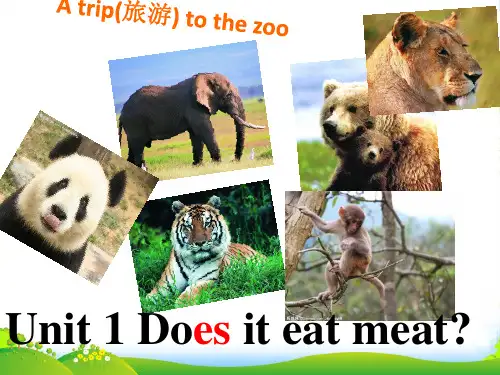
初中英语七年级上册Module6Unit1Doesiteatmeat
外研版七年 Module 6 Unit1 Does it eat meat 课件(共60张ppt)
Review 现在把行为动词第三人称单数的各种 句式总结如下:
肯定句:主语+动词的第三人称单数形式+其它 否定句:主语+doesn’t +动词原形+其它 疑问句:Does+主语+动词原形+其它? 肯定回答:Yes, 主语+does. 否定回答:No, 主语+ doesn’t.
肯定句:The tiger eats meat.
/programs/view/i_gLHYlSpcg
What animals do you know?
Let’s guess what they are.
monkey
It is very funny(有趣的).
---Does it eat meat? ---No, it doesn’t. It eats fruit.
How many animals do you remember?
Listen and circle the words you hear.
bear elephant giraffe lion monkey panda tiger zebra zoo
Watch and read
Now complete the table.
4. They’re dangerous! dangerous adj. 危险的;不安全的
反义词safe,安全的 It is dangerous to walk on the road. 在这条路上上行走是很危险的。
His dog looks dangerous. 他的狗看上去很危险。
danger n.危险 in danger处于危险境地 out of danger 脱离危险
外研版七上英语《Module 6Unit 1 does it eat meat?》教学设计
外研版七上英语《Module 6Unit 1 does it eat meat?》教学设计一. 教材分析《Module 6 Unit 1 Does it eat meat?》是人教版初中英语七年级上册的一个单元,本节课主要讨论动物的特点。
教材包括一个引入部分、三个对话和一个任务部分。
引入部分通过图片和问题引导学生思考动物的饮食习性;对话部分展示了动物的特点,如猫、熊猫和鸟;任务部分要求学生运用所学知识完成相关任务。
二. 学情分析七年级的学生已经掌握了基本的英语语法和词汇,具备一定的听、说、读、写能力。
但对于动物的特点和饮食习性的了解可能不够全面,因此需要在教学中进行补充。
此外,学生可能对某些动物的特点感兴趣,可以利用这一点激发学生的学习兴趣。
三. 教学目标1.知识目标:学生能够掌握表示动物特点的词汇和短语,如furry, eatmeat, omnivore等;能够运用一般现在时描述动物的特点和饮食习性。
2.能力目标:学生能够在图片和情景的帮助下,用英语进行简单的交流和描述。
3.情感目标:培养学生热爱动物,关注生态环境的意识。
四. 教学重难点1.重点:学生能够掌握表示动物特点的词汇和短语,能够用英语描述动物的特点和饮食习性。
2.难点:一般现在时的运用,以及如何准确表达动物的饮食习性。
五. 教学方法1.任务型教学法:通过完成各种任务,让学生在实践中学习和运用英语。
2.情境教学法:通过图片、动画和实物等创设情境,激发学生的学习兴趣。
3.交际法:引导学生运用英语进行交流,提高学生的口语表达能力。
六. 教学准备1.教学课件:制作课件,包括图片、动画、视频等素材。
2.教学道具:准备与动物相关的实物道具,如熊猫玩偶等。
3.作业布置:提前布置预习任务,让学生了解自己喜欢的动物的特点。
七. 教学过程1.导入(5分钟)利用课件展示各种动物的图片,引导学生谈论自己喜欢的动物。
同时,提问学生:“What animals do you like? Why?”,激发学生的学习兴趣。
Module6Unit1Doesiteatmeat课件英语七年级上册

for example 作为插入语,一般用逗号将其与其他成分隔开; 位置比较灵活,可位于句首、句中或句末
【习题演练】 1.这里有许多种花。 There are ___m__a_n_y_k_i_n_d_s__o_f ____ flowers here. 2.玛丽有很多爱好,比如运动、唱歌和跳舞。 Mary has many hobbies, ___s_u_c_h_a_s___ doing sports, singing and dancing.
那些信在这儿。 __H_e_r_e_a_r_e__th_e__le_t_t_e_rs_._________________
那边那位是我爸爸。 _T__h_a_t'_s__m_y__d_a_d__o_v_er__th__er_e_.____________________
我喜欢那个叫香香的大熊猫。 __I_l_ik_e__th_e__p_a_n_d_a__c_a_ll_e_d_X__ia_n_g_x_i_a_n_g_.____________
重点 单词
22.高的 __t_a_ll__ •(反义词) __s_h_o_r_t _ 23.可爱的 __c_u_t_e_ 形容词 •(同义词) __l_o_v_el_y__ 24.有趣的 __f_u_n_n_y_ 25.其他的 __o_th_e_r__ •(短语)相互 ___ea_c_h__o_t_h_e_r___
/ˈfʌnɪ/ /kɔːl/
funny call
有趣的 adj.
把……叫做 v.
学以致用 根据语境或提示,完成填空。 lephant iraffe black and white
初中英语外研版七年级上册《 Module 6 Unit 1 Does it eat meat》课件
Work in pairs. Ask and answer questions about animals.
A: Does the bear eat meat? B: Yes, it does. A: Does the tiger eat bamboo? B:No, it doesn’t. It eats meat.
New words Guess what it is?
It has a long tail. It’s naughty(淘气的).
monkey
New words Guess what it is?
It lives in China and it eats bamboo. panda
New words Guess what it is?
It's the king of the forest and it’s scared. tiger
New words Guess what it is?
It's white and black. zebra
New words Guess what it is?
You can see many kinds of animals here zoo
Complete the table
Animals Lions Bears Elephants Pandas
Things they eat meat, other animals meat and plants plants bamboo, plants and leaves
Activity 7ห้องสมุดไป่ตู้
such as 表示举例, 意为“例如,像……那样的”,相当于 like或for example。 I have lots of friends, such as John, Peter, and Tom.
Module 6 Unit 1 Does it eat meat?教案 外研版七年级英语上册

Module 6 Unit 1 Does it eat meat?教案外研版七年级英语上册外研版七年级上册教案:M6 Unit 1 Does it eat meat?Objectives:To introduce and practice vocabulary related to animal diets.To learn and use the question structure “Does it eat… ” to ask about animal diets.To develop listening, speaking, and critical thinking skills.Materials:Textbook: FLTRP 7th Grade, Module 6 Unit 1Flashcards or pictures of different animalsChart or whiteboard to record students’ responsesHandouts with comprehension questions or a worksheetProcedure:Warm-up :Begin the lesson by asking students about their favorite animals and what they think those animals eat.Engage the students in a brief discussion about different animal diets and their reasons for their answers.Vocabulary Introduction :Introduce new vocabulary related to animal diets, such as “carnivore,”“herbivore,” “omnivore,” etc.Show flashcards or pictures of different animals and ask the students to identify each animal’s diet.Practice the pronunciation of each vocabulary word together as a class, and have students repeat the words after you.Vocabulary Practice:Distribute vocabulary handouts or display them on the board.Ask students to fill in the blanks with the correct animal diet vocabulary word.Review the answers as a class, discussing the meaning and characteristics of each diet type.Question Structure Introduction:Introduce the question structure “Does it eat… ” to ask about animal diets.Build sentences using the new vocabulary and the question structure, e.g., “Does a lion eat plants ”Explain the use of the auxiliary verb “does” for the third person singular (he, she, it) and the base form of the verb.Provide examples and discuss the importance of subject-verb agreement in questions.Listening Comprehension :Play an audio recording or read aloud a passage describing differentanimals.Ask students to listen carefully and identify the animals’ diets.Provide handouts with comprehension questions or use a worksheet to assess their understanding of the passage.Group Activity :Divide the class into small groups.Assign each group a few different animal pictures or flashcards.In their groups, students discuss and ask each other questions using the question structure “Does it eat… ” to guess the animals’ diets. Encourage them to use the vocabulary and sentence structure they have learned.Group Presentation:Ask each group to present their animals and their guesses about their diets.Record the responses on a chart or whiteboard to create a visual representation of different animal diets.Wrap-up and Reflection :Summarize the main points discussed during the lesson, focusing on animal diets and the question structure “Does it eat… ”Allow students to share their thoughts and reflections on the lesson. Provide feedback and encouragement, highlighting their engagement and creativity in using the vocabulary and question structure.Homewrk (optional):Assign a homework task, such as writing a short paragraph describing an animal’s diet using the question structure “Does it eat… ”Encourage students to research and discover more examples of animals with different diets and share their findings in the next class.。
Module6Unit1Doesiteatmeat教案-2020年秋外研版七年级英语上册
1.语言能力:通过学习动物名词和一般疑问句,使学生能够运用英语描述动物及其饮食特点,培养准确、流利、得体的英语表达能力。
2.思维品质:培养学生观察、分析动物习性的能力,激发对动物保护的思考,提高逻辑思维和批判性思维能力。
(2)熟练运用一般疑问句及其回答:“Does it eat meat?” “Yes, it does.” “No, it doesn't.”,进行询问和回答动物饮食习性。
(3)运用一般现在时描述动物饮食特点,如:“The tiger eats meat.” “The panda doesn't eat meat, it eats bamboo.”
4.学生小组讨论:在小组讨论环节,我鼓励学生积极发表自己的观点,并注意观察他们的讨论过程。我发现,学生在讨论中能够主动思考、互相学习,达到了良好的教学效果。
5.教学反馈:在总结回顾环节,我对学生们的学习成果给予了充分肯定,同时也提醒他们要关注自己在学习过程中的不足之处。此外,我还鼓励学生在课后继续关注动物保护等相关话题,将所学知识运用到实际生活中。
然而,本次教学也暴露出了一些问题,值得我反思:
1.部分学生对一般疑问句的构成与回答掌握不够熟练,需要在今后的教学中加强针对性训练。
2.在实践活动环节,部分学生表现过于紧张,影响了他们的表达效果。今后,我应加强对学生的鼓励和指导,提高他们的自信心。
3.学生小组讨论过程中,我发现部分学生参与度不高,可能是因为他们对讨论主题不够感兴趣。为此,我将在设计讨论主题时,更加关注学生的兴趣和需求。
2.教学难点
(1)动物名词的拼写与发音:部分动物名词拼写较为复杂,如turtle,koala等,学生容易拼写错误;同时,部分动物名词的发音对学生来说有一定难度,如turtle的/tʃ/音。
外研版七年级上册英语《Module 6Unit 1 does it eat meat?》教学设计
外研版七年级上册英语《Module 6Unit 1 does it eat meat?》教学设计一. 教材分析《Module 6 Unit 1 Does it eat meat?》是人教版初中英语七年级上册的一篇课文。
本节课主要讨论动物的饮食习性,通过引入不同动物的饮食习性,让学生掌握一般现在时的一般疑问句和回答。
教材内容丰富,插图生动有趣,有利于激发学生的学习兴趣。
二. 学情分析七年级的学生已经掌握了部分英语基础知识,具备一定的听、说、读、写能力。
但部分学生在口语表达方面仍有困难,对本节课的内容可能存在一定的陌生感。
因此,在教学过程中,教师需要关注学生的个体差异,尽量让每个学生都能参与到课堂活动中来。
三. 教学目标1.知识目标:学生能够听懂、会说、会读、会写关于动物饮食习性的词汇和短语,如“monkey”, “eat”, “meat”, “fruit”, “bird”, “eat”, “seed”等。
2.能力目标:学生能够运用一般现在时的一般疑问句和回答进行日常交流。
3.情感目标:培养学生关爱动物、保护生态环境的意识。
四. 教学重难点1.重点:学生能够听懂、会说、会读、会写关于动物饮食习性的词汇和短语。
2.难点:学生能够运用一般现在时的一般疑问句和回答进行日常交流。
五. 教学方法1.任务型教学法:通过小组合作、角色扮演等任务型活动,让学生在实践中学习、运用英语。
2.情境教学法:创设生动、有趣的情境,激发学生的学习兴趣。
3.游戏教学法:运用游戏,让学生在轻松愉快的氛围中学习英语。
六. 教学准备1.教材:《Module 6 Unit 1 Does it eat meat?》2.多媒体教学设备:用于展示图片、视频等教学资源。
3.教学卡片:用于单词和短语的学习。
4.任务单:用于小组合作和讨论。
七. 教学过程1.导入(5分钟)教师通过向学生展示不同动物的图片,引导学生谈论动物,为新课的学习营造轻松愉快的学习氛围。
七年级英语上册Module6Unit1Doesiteatmeat说课稿(新版)外研版
七年级英语上册 Module 6 Unit 1 Does it eat meat说课稿(新版)外研版一. 教材分析《七年级英语上册 Module 6 Unit 1 Does it eat meat》是人教版初中英语教材七年级上册的一个单元,本单元主要围绕动物展开,让学生学会询问动物的习性,如:吃肉、吃植物等。
通过本单元的学习,学生能够掌握一般现在时态的疑问句和回答,以及一些关于动物的词汇和短语。
二. 学情分析七年级的学生已经初步掌握了英语学习的基本语法和词汇,但是对于一般现在时态的疑问句和回答还比较陌生。
此外,学生的阅读和写作能力还有待提高,需要通过大量的练习来加强。
在教学过程中,教师需要关注学生的学习兴趣,激发他们的学习积极性,帮助他们建立自信心。
三. 说教学目标1.知识目标:学生能够掌握一般现在时态的疑问句和回答,学会询问和描述动物的习性。
2.能力目标:学生能够用英语进行简单的对话,提高他们的口语表达能力。
3.情感目标:学生能够培养对动物的热爱和保护意识,增强他们的环保意识。
四. 说教学重难点1.重点:学生能够掌握一般现在时态的疑问句和回答,学会询问和描述动物的习性。
2.难点:学生能够用英语进行简单的对话,特别是运用一般现在时态进行问答。
五. 说教学方法与手段1.教学方法:采用任务型教学法,让学生在完成任务的过程中学习英语,提高他们的实践能力。
2.教学手段:利用多媒体课件、图片、卡片等教学辅助工具,激发学生的学习兴趣,帮助他们更好地理解和记忆。
六. 说教学过程1.引入:教师通过展示一些动物的图片,引导学生谈论他们喜欢的动物,激发他们的学习兴趣。
2.新课呈现:教师通过课件展示本节课的主要内容,让学生初步了解一般现在时态的疑问句和回答,以及关于动物的词汇和短语。
3.实践环节:教师学生进行小组活动,让他们用英语询问和描述动物的习性,练习一般现在时态的问答。
4.巩固环节:教师通过游戏、练习等方式,让学生进一步巩固本节课所学内容。
Module6Unit1Doesiteatmeat?教案英语七年级上册
外研版七年级上册Module 6 Unit1 Does it eat meat?教案Objectives:➢Language Skills: Enhance students’listening, speaking, reading, and writing skills, focusing on animal diets and characteristics.➢Vocabulary: Introduce and practice words and phrases related to animals, their diets, and habitats.➢Grammar: Practice using present simple tense in questions and negative forms (e.g., "Does it...?", "It doesn’t...").➢Cultural Awareness: Encourage understanding and appreciation of animal diversity and their different habitats.➢Critical Thinking: Develop the ability to classify animals based on their dietary habits and characteristics.Materials:✓Textbook: Foreign Research Version, Module 6 Unit 1✓Multimedia: Pictures and videos of various animals, audio clips✓Flashcards with new vocabulary (e.g., carnivore, herbivore, omnivore)✓Whiteboard and markers✓Worksheets for exercises✓Realia or models of different animals (if available)Procedure:WarmUp(1)Show pictures of different animals and ask students generalquestions about them.(2)Introduce the unit theme: animal diets and characteristics. Presentation1)Present new vocabulary related to animal diets (carnivore, herbivore,omnivore) using flashcards.2)Use pictures and videos to show examples of different animals andtheir diets.3)Introduce the grammatical structure for asking and answeringquestions about animal diets (e.g., "Does it eat meat? It eats meat/It doesn’t eat meat").Practice(1)Distribute worksheets with exercises focusing on vocabulary,grammar, and prehension.(2)Group activity: Classify animals based on their diet using providedpictures or models.Production1)In pairs, students ask and answer questions about different animalsusing the target language structures.2)Each pair presents their findings about one animal to the class. Interactive Activity(1)Play a guessing game: one student describes an animal’s diet, andothers guess the animal.(2)This activity encourages the practical use of vocabulary and grammarin a fun, engaging way.Conclusion and Homework1)Summarize key vocabulary and grammar points of the lesson.2)Assign homework: Research and write a short paragraph about achosen animal, including information about its diet and habitat.3)Address any final questions or clarifications.Assessment:(1)Observe and assess students' participation in discussions, groupactivities, and presentations.(2)Evaluate worksheets and written assignments for understanding ofvocabulary, grammar, and prehension.Reflection:❖Reflect on the effectiveness of the teaching methods and materials.❖Note any areas that might need more attention or different approaches, particularly in understanding animal classification and dietrelated vocabulary.。
Module6Unit1Doesiteatmeat?.教案2023-2024学年七年级英语上册
外研版七年级上册Module 6 unit1 Does it eat meat?.教案Objectives:➢Language Aim: To introduce and practice vocabulary related to animals and their diets.➢Practical Aim: To enable students to discuss and ask questions about animal diets and characteristics.➢Skills: Listening, Speaking, Reading, and Writing.Materials:✓Textbook: Module 6 Unit 1✓Multimedia projector✓Whiteboard and markers✓Handouts with exercises✓Pictures of different animalsProcedure:1. Warmup1)Begin with a discussion: “What is your favorite animal and what doesit eat?”2)Show pictures of different animals and encourage students to talkabout them.2. Vocabulary Introduction(1)Introduce new vocabulary: carnivore, herbivore, omnivore, diet, etc.(2)Use animal pictures to illustrate vocabulary.(3)Matching exercise: match animals with their diet types.3. Listening Activity1)Play an audio recording from the textbook discussing animal diets.2)Students plete a worksheet based on the recording.3)Review answers and discuss new words or challenging concepts.4. Reading prehension(1)Students read a passage in the textbook about different animals'diets.(2)Conduct a Q&A to test prehension.(3)Group activity: Identify the diet of each animal in the passage.5. Speaking Practice1)In pairs, students ask and answer questions about animals' diets.2)Use structures like “Does it eat...?”and “What does it eat?”6. Writing Exercise(1)Students write a short paragraph about their favorite animal and itsdiet.(2)Select volunteers to read their paragraphs aloud.7. Wrapup1)Recap key vocabulary and sentence structures.2)Assign homework: Write five sentences about different animals andtheir diets.8. Evaluation:◆Assess student participation and understanding during the activities.◆Check written assignments for correct vocabulary and grammarusage.Homework:❖Write five sentences about different animals, describing their diets using the newly learned vocabulary.Additional Notes:✧Ensure that the lesson is interactive and that students have plenty ofopportunities to practice speaking.✧Adjust the plexity of tasks according to the students' levels.✧Maintain a supportive and encouraging learning environment.。