
新版PEP四年级英语下册教案
新版PEP四年级英语下册教案 第一单元教案 一、单元教学内容分析 1、单元教学内容:本单元重点学习学校科室及功能室的名称、分布和不同的功能。要求学生能够听说认读这些课室的单词.说出每个科室的不同功用.并简单介绍学校校舍的分布情况。重点学习的句型是:This is …….. That is ………. Is this …….? .Is that …….? Yes.it is ./No, it isn’t.同时渗透了序数词的运用以及字母组合er在单词中的最基本的发音。 2、单元教学重点:掌握学校中的一些功能室。例如:playground, garden, teacher’… 及 Is this /that the…? Yes.it is./No, it isn’t.在实际情境中的运用。 3、单元教学难点:字母组合er在单词中的发音;序数词和基数词的区分及如何正确使用序数词。 二、单元教学目标:认读PartA and Part B 中的单词;实际情景中灵活运用 Let’s talk 中的重要句型This/That is the(a)… Is this/that the(a)…? Yes, it is. No, it isn’t. 三、单元教学准备: 1、教师准备教学过程中所需要的图片、声音、课件.以及本单元的单词卡。 2、准备一些教师的照片或图片。 3、教师准备录音机及录音带。 四、单元教学措施: 1、在教学过程中.对于学习困难的学生.可通过请学生复述老师的话或是复述同学的回答.让学生对老师和同学的发言引起注意.让学生意识到要仔细听别人的说话。 2、对于学习还不错.但是不愿或害怕发言的学生.课堂中教师主动请他们表达其意见.培养他们良好的学习英语的习惯。 3、充分运用英语名、英文歌、儿歌、绕口令、顺口溜、谜语等.给予小学生语言感染的机会。还可开展各种活动.鼓励学生交际。 五、单元教学反思:
第一课时 教学目标: 1、能听懂、会说:“Where is the teachers’ office? Is this the teachers' office? The teachers' office is next to the library.”并能在实际情景中进行运用。 2、了解英美国家关于楼层的不同表达方式。 教具准备:教学光盘、单词卡片。 教学重点:本课对话及其在实际情景中的运用。 教学难点:认读对话。 教学过程: 一、复习引题 1、教师播放本单元歌曲“Our school”.先让学生听然后鼓励学生跟唱。 2、教师慢慢出示teachers’ office等词的图卡.让学生猜出该单词。 二、教学新课 1、教师和学生进行free talk.话题是Why do you like our school? 鼓励学生用简单的句子做出回答.即使只能说出只言片语.教师也要给予表扬。 2、播放本课课件Let’s talk 部分。教师可以就对话内容提一些问题.如:How many American friends are there? What do you do in the playground? 在提问与回答的过程中.将难点各个击破。 3、进行模仿或跟读练习.注意提醒学生this和that中“th”的发音要咬舌头。 4、first和second的操练可以在排列卡片、复习单词的过程中渗透.如:T: What’s in the first/second picture? Ss: It’s a library/ a teacher’s office. 也可以让学生听指令排列卡片.如:T: The first card, playground; the second card, … 然后引导学生仔细观察挂图.正确理解和运用短语on the first floor 和on the second floor。 5、分角色朗读与表演:教师先与一些学习程度较好的学生进行示范性表演.以降低完全由学生自己表演的难度。然后请学生小组练习和表演。 三、巩固练习 1、一学生手举起图片背对其他学生面向黑板站立.另一学生依照图的提示做出动作.其余的学生猜测图上表示的是什么课室或学校场馆.用句型“Is this...? Yes, it is./No, it isn't.”作答。 2、做本单元A Let’s talk 部分的作业本练习。 四、布置作业 1、听Let’s talk 部分的录音.读给同伴、朋友或家长听。 五、板书设计 六、教学反思
第二课时 教学目标: 1、能够听、说、认读本课时的主要单词。 2、听懂指示语.并按要求做出相应的动作.如:Go to the garden . Water the flowers. 教具准备: 1、与教材内容相关的课件、声音、图片等媒体素材。 2、教师准备一幅本单元的校园分布图。 3、教师准备本课时的单词卡。 教学重点:掌握有关学校设施的四个单词.并了解它们的功能。 教学难点:单词library中辅音连缀的发音。 教学过程: 一、复习引题 1、教师播放本单元歌曲“Our school”.先让学生听然后鼓励学生跟唱。 2、播放第三册第一单元课件Let’s learn A .回顾句型:“What’s in the classroom? A board, two lights, many desks and chairs.”自然过度到学习学校各课室的名称。 二、教学新课 1、教师指着教室问学生:This is our new classroom. Do you like our classroom? What’s in the classroom? 学生做出相应的回答。教师接着问:How many classrooms are there in our school? Do you like our school? What else can you see in the school? Look! This is a map of our school. 2、播放本课的声音Let’s learn A, 教读生词。教师可引入句型“It’s on the first floor..为下一课时进一步学习序数词做铺垫。通过教师领读和听音跟读.让学生掌握本课时五个生词的正确读音。在练习library的发音时.可复习已学过的含辅音连缀的单词.如ice-cream, brother, friend, hungry。 三、巩固练习 1、小组比赛。教师出示一张词卡.如garden.组内学生依次说出与该词有关的其它单词.如:flowers.red.colour.trees等.这样既复习了学过的单词.也为继续学习Let’s do打下基础。 2、看Let’s do的图片(没有文字).让学生仔细看动作.然后跟着声音做动作。播放声音.教师指导学生做出正确的动作。然后分组进行练习.采用组与组竞赛的方式.可以是做动作猜句子并说出单词.也可以是听声音.做动作。让其他的组的学生进行评价。评价包括动作是否准确、到位、优雅等。 四、布置作业 1、读课文第5页并背诵 Let's do。 五、板书设计
六、教学反思
第三课时 教学目标: 1、让学生掌握含有字母组合er的单词发音和认读书写。
教具准备:教学光盘、单词卡片。
教学过程: 一、复习引题 1、师生做日常口语练习: A: Where is the teachers' office? B: It's ... A: Is this ...? B: Yes, it is./No, it isn't. 2、请学生表演A部分Let’s talk的对话。 二、教学新课 1、播放Read, listen and chant的录音.让学生听歌谣。 2、让学生跟着动画学说歌谣.同时可用手打节奏。 3、播放Read, underline and say 的录音,让学生划出字母组合er。 4、听音后反复读五个单词.在此基础上进行描红.达到书写格式正确的目的。 三、巩固练习 1、完成Look, listen and write部分的练习。 四、布置作业 1、抄本课单词4+1模式 五、板书设计 六、教学反思
第四课时 教学目标:能够识别句型“Is this the …?和Is that the…”的不同用法并在真实情景中正确使用。 教具准备:教学光盘、单词卡片。 教学重点:“Is this…?/ Is that…?”的用法。教师在真实的情景中对this和that在距离上的区别进行比较以加深学生的印象。 教学难点:“Is this…?/ Is that…?”的用法。教师在真实的情景中对this和that在距离上的区别进行比较以加深学生的印象。 教学过程: 一、复习引题 1、学生表演A部分Let’s do的内容。 2、教师和学生进行主题讨论:What’s in our school? 鼓励学生用新学的单词来交谈。 二、教学新课 1、教师和学生进行free talk.话题是Why do you like our school? 鼓励学生用简单的句子做出回答.即使只能说出只言片语.教师也要给予表扬。顺着这一话题。教师说:“’s watch. 由此导入新课。
2、学生观看课件后.回答教师提出的理解性问题。在问答的过程中重点理解与操练句型:Is this the…?和Is that the …? 3、学生听录音跟读对话。 4、学生分角色朗读对话。 三、巩固练习 1、做本单元B部分作业本上Let’s talk的练习。 四、布置作业
人教PEP版四年级下英语Unit2第4课《What time is it》教案
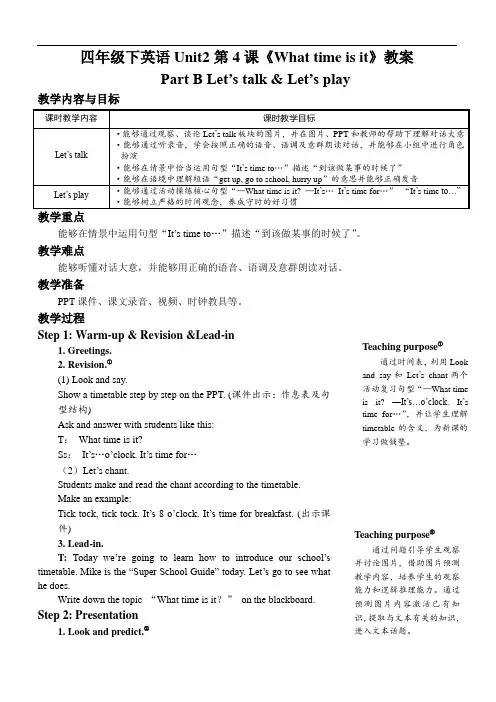
四年级下英语Unit2第4课《What time is it》教案Part B Let’s talk & Let’s play教学内容与目标教学重点能够在情景中运用句型“It’s time to…”描述“到该做某事的时候了”。
教学难点能够听懂对话大意,并能够用正确的语音、语调及意群朗读对话。
教学准备PPT课件、课文录音、视频、时钟教具等。
教学过程Step 1: Warm-up & Revision &Lead-in1. Greetings.2. Revision.①(1) Look and say.Show a timetable step by step on the PPT. (课件出示:作息表及句型结构)Ask and answer with students like this:T:What time is it?Ss:It’s…o’clock. It’s time for…(2)Let’s chant.Students make and read the chant according to the timetable.Make an example:Tick tock, tick tock. It’s 8 o’clock. It’s time for breakfast. (出示课件)3. Lead-in.T:Today we’re going to learn how to introduce our school’s timetable. Mike is the “Super School Guide” today. Let’s go to see what he does.Write down the topic “What time is it?”on the blackboard. Step 2: Presentation1.Look and predict.②Teaching purpose①通过时间表,利用Look and say和Let’s chant两个活动复习句型“—What time is it? —It’s…o’clock.It’s time for…”,并让学生理解timetable的含义,为新课的学习做铺垫。
新版PEP小学四年级下册英语第二单元教案
新版PEP小学四年级下册英语第二单元教案单元教学内容分析;1.单元教学内容;本单元重点学习时间的表达以及描述不同时间进行的日常活动。
主要句型是;What time is it? It's ... It's time for .... / It's time to ... A.B部分的Let's talk 渗透了这几个新的句型.应作为本单元的教学难点;学生们日常生活丰富多采.同时也是很有规律的。
建议教师在教授新知识时紧密结合学生的生活实际.引导他们用英文表述自己的日常活动。
2.单元教学重点;能够询问时间并做出正确的回答.如;What time is it? It's nineo'clock.能够结合学过的语言描述自己的日常活动.如;It's time for Englishclass.It's time to go to school.3.单元教学难点;字母组合ur在单词中的发音。
单元教学目标;认读Part A and Part B 中的单词;实际情景中灵活运用 Let’s talk 中的重要句型。
单元教学准备;1.教师准备教学过程中所需要的图片.声音.课件.以及本单元的单词卡。
2.准备一些教师的照片或图片。
3.教师准备点读机。
单元教学措施;1.在教学过程中.对于学习困难的学生.可通过请学生复述老师的话或是复述同学的回答.让学生对老师和同学的发言引起注意.让学生意识到要仔细听别人的说话。
2.对于学习还不错.但是不愿或害怕发言的学生.课堂中教师主动请他们表达其意见.培养他们良好的学习英语的习惯。
3.充分运用英语名.英文歌.儿歌.绕口令.顺口溜.谜语等.给予小学生语言感染的机会。
还可开展各种活动.鼓励学生交际。
课时安排;6课时第一课时教学目标;1.能听懂.会说“What time is it ?It’s time for …”并能在情景中进行运用。
人教PEP版英语四年级下册Unit 6《Shopping》(let’s talk PartB)教案
人教PEP版英语四年级下册Unit 6《Shopping》(let’s talk PartB)教案一. 教材分析《人教PEP版英语四年级下册Unit 6 Shopping》主要让学生学会在购物场景中进行简单的交流。
通过学习,学生能够听懂、会说、会读关于购物的话题,并能够运用所学知识进行简单的购物交流。
本课的主要内容是学习如何询问价格和回答价格,以及如何表达喜好和选择。
二. 学情分析四年级的学生已经具备了一定的英语基础,对于日常生活中的基本交流已经有了一定的掌握。
但是,学生在语言表达的准确性和语言运用的灵活性方面还存在一定的困难。
因此,在教学过程中,需要注重学生的语言输入和输出的准确性,以及培养学生运用英语进行交流的能力。
三. 教学目标1.知识目标:学生能够听懂、会说、会读关于购物的话题,掌握询问价格和回答价格的句型,以及表达喜好和选择的句型。
2.能力目标:学生能够在购物场景中进行简单的交流,能够运用所学知识进行购物活动。
3.情感目标:培养学生热爱生活,乐于交流的态度。
四. 教学重难点1.重点:学生能够听懂、会说、会读关于购物的话题,掌握询问价格和回答价格的句型,以及表达喜好和选择的句型。
2.难点:学生能够在购物场景中进行自由的交流,能够运用所学知识进行购物活动。
五. 教学方法采用情境教学法、交际法和生活教学法。
情境教学法可以帮助学生更好地理解和学习语言,交际法可以提高学生的语言运用能力,生活教学法可以激发学生的学习兴趣。
六. 教学准备1.教师准备:准备好相关的教学材料,如PPT、图片、实物等。
2.学生准备:学生需要预习相关的内容,熟悉基本的购物词汇。
七. 教学过程1.导入(5分钟)教师通过播放一首关于购物的歌曲,引起学生的兴趣,然后向学生提问:“你们喜欢购物吗?为什么?”让学生发表自己的看法,从而引出本课的主题。
2.呈现(10分钟)教师通过PPT展示本课的主要内容,包括词汇、句型等,同时进行讲解和示范。
新版PEP小学英语四年级下册第二单元教材解读(教案设计)
四下Unit 2 What time is it? A Let’s talk 教材解读教学目标:1、能够在图片和教师的帮助下理解对话大意。
2、能够按照正确的读音、语调及意群朗读对话,并能进行角色表演。
3、能够在情景中运用以下句型:What time is it? I t’s…问答时间,并能在情景中恰当句型It’s time for … Time to …描述“到该做某事的时候了”。
4、能够在语境中理解生词和词组:over, now, go home, kid, o’clock, dinner的意思,并能正确发音。
5、能够在Le t’s play活动中运用所学句句型What time is it? I t’s…It’s time for /to …问答时间并表述“到该做某事的时候了”。
6、了解地球上的时间在不同时区是不同的。
教学重点:能够在情景中运用以下句型:What time is it? I t’s…问答时间,并能在情景中恰当句型It’s time for … Time to …描述“到该做某事的时候了”。
;教学难点:对话中的习惯表达法和生词over, now, go home, kid, o’clock, dinner的理解和认读。
教学方法指导:一、导入:1、Let’s sing.唱一首关于数字的歌曲,让学生在欢快的歌曲中入课堂,并为后面时间中需要的数字进行复习。
2、利用与学生打招呼突破kids,利用教具clock,突破生词:clock和o’clock.3、Show the main scene and ask some questions (利用对话教材板块插图,介绍对话背景,教师提问引导学生预测对话文本内容):T:Look at the picture. Who can you see ? Where are they? What are they talking about?二、对话文本处理:1、T: School is over. What do you do? 学生自由回答。
人教版(PEP)Recycle 2(教案) 英语四年级下册
Book4 Recycle2Read and number &Read , write and say 设计思路:本部分是复习类课型,创设去野餐的情境,列购物清单复习单词,去超市购物复习How much is it ?/How much are these?等四至六单元重点句型。
最后讨论所购买的衣服、食物等物品,帮助学生了解物主代词的使用方法。
通过微课、趣味活动等形式帮助学生梳理知识,巩固应用所学内容,培养学生的综合语言应用能力。
一、教学内容分析:本课选自PEP新版教材Recycle2的内容。
Recycle2是对课本4-6单元有关农场、服装及购物等知识点的归纳和提升。
由于容量较大,本课节选其中的一部分进行教学。
二、学情分析:,四年级学生经过将近两年的英语学习,已经掌握水果、食物、蔬菜、饮料类单词。
通过本册教材5-6两个单元的学习,他们已基本掌握教材中关于服装这一话题的语言知识,但这些知识大多还处于零散状态,本节课中将通过情景的创设,引导学生在运用语言的过程中学会归纳、总结,重新建构自己对于购物这一话题所涉及的语言知识的网络。
三、教学目标:1.知识目标:学生能够说出并写下有关服装、水果、蔬菜、饮料类的单词。
了解物主代词mine, my, your ,yours 的用法;并完成Read and number练习。
2. 语言能力目标:(1) 学生能在情境中综合运用句型Can I help you? I’ll take it/them.How much …?That’s expensive/cheap.模拟购物;(2) 学生能根据服装单复数在情境中正确使用“-How much is…? –It’s ....”“-How much are…? –They’re ....”等购物用语。
(3)能够用mine、my, your 、yours 表达自己或别人的物品。
3. 情感态度学习策略目标:学生通过列购物清单,去超市购物,讨论所购物品等活动,锻炼了大胆开口表达、小组合作的能力,增强了交流分享的意识。
四年级(PEP)英语下册电子版教案

四年级(PEP)英语下册电子版教案教案教学内容Unit 1 My schoolA 部分Let’s talk Look , ask and answer)课时第一课时教材分析1、单元教学内容:本单元重点学习学校科室及功能室的名称、分布和不同的功能。
要求学生能够听说认读这些课室的单词,说出每个科室的不同功能,并简单介绍学校校舍的分布情况。
重点学习的句型是:Thisis ……..2、,it is ./No, it isn’t.同时渗透了序数词的运用以及字母组合er在单词中的最基本的发音。
3、单元教学重点:掌握学校中的一些功能室。
例如:playground, garden, teachers’office, library, canteen, art room, computer room, washroom, music room, gym, and TV room.掌握句型This /That is the…及Is this /that th e…? Yes,it is./No, it isn’t.在实际情境中的运用。
3、单元教学难点:字母组合er在单词中的发音;序数词和基数词的区分及如何正确使用序数词。
新|课| 标|第|一| 网知识目标能够运用句型Where’s the ···It’s on the ···floor.Is thisthe····No, it isn’t. The ··· is next to the···并能够在真实的语言情景中灵活运用。
能力目标正确理解与朗读Let’s talk 部分的对话内容,询问和介绍学校场所。
教学目标情感目标培养学生热爱学校的好品质。
教学重点1、能够运用句型Where’s the teachers ‘office? It’s on the second floor. Is th the teacher’s office? No,it isn’t. The teacher’s office is next to the library并能够在真实的语境中灵活运用。
新人教版版pep四年级英语下册教案(全册-51页)
新⼈教版版pep四年级英语下册教案(全册-51页)⼩学英语第四册学期教学计划⼀、教材分析1、教材结构分析本学期使⽤教材是《九年义务教育六年制⼩学教科书英语(第四册)》(PEP PRIMARY ENGLISH STUDENTS’ BOOK 4),本册教材分为六个单元,两个复习单元。
2、教学内容分析3、教学重难点分析进⾏简单的交流关于学校、时间、⾐服、天⽓、购物、农场动物、数字、颜⾊等⼏个话题,能⽤英语书写句⼦。
⼆、教学⽬标1、知识技能⽬标能听懂、会说12组会话,并能进⾏简单的交流;能听、说、认读60个单词和词组并能听、说、读、写61个单词和24个句⼦。
2、操作应⽤⽬标能⽤英语进⾏关于学校、时间、⾐服、天⽓、购物、农场动物、数字、颜⾊等⼏个话题的讨论,并简单运⽤。
3、情感态度价值观⽬标强调语⾔的运⽤,注重能⼒的培养,突出了兴趣的激发,重视双向交流,融合学科内容,重视灵活扩展,实现整体设计。
三、班级学⽣情况分析(包括基本情况、认知基础、情感态度、学习习惯以及活动、操作技能、后进⽣名单等)四年级分两个班,⼀班⼈,⼆班⼈,两班情况基本相同,后进⽣⽐较多,再加上新转来的⼏个同学,原来根本没有英语基础,这学期不但要掌握教材所学知识,还要转化后进⽣,所以在教学中要特别注意改进教学⽅法,提⾼课堂效率,争取使每个学⽣在原有的基础上都有所进步。
四、主要教学措施(除针对全班学⽣的教学措施外,还包括后进⽣辅导、转化措施等)1、融会话教学与情景表演之中2、巧⽤实物、头饰、卡⽚、chant 等来帮助进⾏单词教学。
3、利⽤读写课等时间对学⽣进⾏单词书写的指导五、教学进度安排教学进度表第⼀单元教学计划⼀、单元教学内容分析1、单元教学内容:本单元重点学习学校科室及功能室的名称、分布和不同的功能。
要求学⽣能够听说认读这些课室的单词,说出每个科室的不同功⽤,并简单介绍学校校舍的分布情况。
重点学习的句型是:This is …….. That is ………. Is this …….? .Is that …….? Yes,it is ./No, it isn’t.同时渗透了序数词的运⽤以及字母组合er在单词中的最基本的发⾳。
人教版PEP英语四年级下册全英文教案
人教版PEP英语四年级下册全英文教案Lesson 1: My BirthdayLearning Objectives:- Learn how to express birthday greetings in English.- Practice listening and speaking skills through conversations about birthdays.- Recognize and write the numbers 1-30 in English.Warm-up Activities:- Sing the "Happy Birthday" song together as a class.- Introduce the topic of birthdays and ask students if they know any English words related to birthdays.Lesson Activities:1. Vocabulary Introduction:- Present new vocabulary words related to birthdays, such as "cake," "gift," "party," "balloon," etc.- Practice pronunciation and spelling of the new words.2. Listening and Speaking Practice:- Play an audio recording of a birthday conversation between two people.- Divide the class into pairs and have them practice similar conversations in English.3. Number Recognition and Writing:- Introduce the numbers 1-30 in English.- Teach the correct pronunciation and writing of each number.- Conduct various activities to reinforce number recognition and writing skills.Assessment:- Have students participate in a role-play activity where they act out a birthday party scene using the vocabulary and numbers they have learned.- Assess students' ability to pronounce, recognize, and use the new vocabulary and numbers correctly.Extension Activities:- Encourage students to create birthday cards or posters using the new vocabulary and numbers.- Play interactive online games or worksheets related to birthdays and numbers.Lesson 2: At the ZooLearning Objectives:- Learn the names of different animals in English.- Practice listening and speaking skills through discussions about animals.- Develop reading skills by reading simple sentences about animals.Warm-up Activities:- Show pictures of different animals and ask students to name them in English.- Conduct a class discussion about animals, their habitats, and characteristics.Lesson Activities:1. Vocabulary Introduction:- Introduce new animal vocabulary words, such as "lion," "elephant," "giraffe," "monkey," etc.- Use flashcards, pictures, and gestures to help students understand and remember the new words.- Practice pronunciation and spelling of the new words.2. Listening and Speaking Practice:- Play an audio recording of a conversation about a visit to the zoo.- Divide the class into small groups and have them discuss their favorite animals in English.3. Reading Practice:- Provide simple sentences about different animals on the board or on worksheets.- Students practice reading the sentences aloud and identifying the corresponding animal.Assessment:- Have students participate in a group activity where they create a poster or presentation about their favorite animal.- Assess students' ability to pronounce, recognize, and use the new animal vocabulary correctly.Extension Activities:- Watch videos or listen to songs about animals in English.- Create a class zoo display where each student contributes a drawing and a sentence about their favorite animal.Lesson 3: My VacationLearning Objectives:- Learn how to talk about past vacation experiences in English.- Practice listening and speaking skills through conversations about vacations.Warm-up Activities:- Show pictures of different vacation destinations and ask students if they have ever been to any of them.- Conduct a class discussion about favorite vacation activities and experiences.Lesson Activities:1. Vocabulary Introduction:- Introduce new vocabulary words related to vacations, such as "beach," "mountain," "sightseeing," "swimming," etc.- Use visuals, gestures, and real objects to help students understand and remember the new words.- Practice pronunciation and spelling of the new words.2. Listening and Speaking Practice:- Play an audio recording of a conversation about a memorable vacation.- Divide the class into pairs and have them share their own vacation experiences in English.3. Writing Practice:- Provide a writing prompt asking students to write a short paragraph about their last vacation.- Guide students in organizing their ideas, using appropriate vocabulary, and forming grammatically correct sentences.- Provide feedback and encourage students to revise and improve their writing.Assessment:- Have students present their vacation paragraphs orally to the class.Extension Activities:- Create a class travel brochure showcasing different vacation destinations.- Have students interview each other about their dream vacations and report their findings to the class.Lesson 4: Healthy HabitsLearning Objectives:- Learn vocabulary related to healthy habits and personal hygiene in English.- Practice listening and speaking skills through conversations about healthy habits.- Develop critical thinking skills by discussing the importance of healthy habits.Warm-up Activities:- Show pictures of various healthy habits, such as brushing teeth, washing hands, exercising, etc.- Ask students to share their understanding of what it means to be healthy.Lesson Activities:1. Vocabulary Introduction:- Introduce new vocabulary words related to healthy habits, such as "brush," "wash," "eat fruits," "exercise," etc.- Use visuals, gestures, and real objects to aid understanding and retention.- Practice pronunciation and spelling of the new words.2. Listening and Speaking Practice:- Play an audio recording of a conversation about daily healthy habits.- Divide the class into small groups and have them discuss their own healthy habits in English.3. Critical Thinking Discussion:- Engage students in a class discussion about why it is important to have healthy habits.- Encourage students to express their opinions and provide reasons to support their views.- Guide the discussion towards creating an understanding of the benefits of healthy habits.Assessment:- Have students create a poster or video presentation promoting healthy habits.- Assess students' ability to use the new vocabulary and express their understanding of the importance of healthy habits.Extension Activities:- Conduct a physical activity session in the classroom, such as stretching exercises or a guided dance routine.- Assign students to research and present information about a specific healthy habit.。
新人教版版pep四年级英语下册教案(全册)_0
---------------------------------------------------------------最新资料推荐------------------------------------------------------ 新人教版版pep四年级英语下册教案(全册) 小学英语第四册学期教学计划一、教材分析 1、教材结构分析本学期使用教材是《九年义务教育六年制小学教科书英语(第四册)》(PEP PRIMARY ENGLISH STUDENTS BOOK 4) , 本册教材分为六个单元,两个复习单元。
2、教学内容分析单元题目 Unit 1 My school Unit 2 What time is it ?Unit 3 Weather Recycle 1 Unit 4 At a farm Unit 5 My clothes Unit 6 Shopping Recycle 23、教学重难点分析进行简单的交流关于学校、时间、衣服、天气、购物、农场动物、数字、颜色等几个话题,能用英语书写句子。
二、教学目标 1、知识技能目标能听懂、会说 12 组会话,并能进行简单的交流;能听、说、认读 60 个单词和词组并能听、说、读、写 61 个单词和 24 个句子。
2、操作应用目标能用英语进行关于学校、时间、衣服、天气、购物、农场动物、数字、颜色等几个话题的讨论,并简单运用。
3、情感态度价值观目标强调语言的运用,注重能力的培养,突出了兴趣的激发,重视双向交流,融合学科内容,重视灵活扩展,实现整体设计。
三、班级学生情况分析(包括基本情况、认知基础、情感态度、学习习惯以及活动、操作技能、后进生名单等)四1 / 3年级人,本班, 后进生比较多,再加上新转来的几个同学,原来根本没有英语基础,这学期不但要掌握教材所学知识,还要转化后进生,所以在教学中要特别注意改进教学方法,提高课堂效率,争取使每个学生在原有的基础上都有所进步。