
仁爱英语七年级下册导学案全册
课题: Unit 5 Our School LifeTopic 1 How do you usually come to schoolSection A第一课时【学习目标】1、Remember new words.2、Read the text and act out the dialog.3、How to transform the traffic tools.【知识链接】1、I usually come to school (步行).2、Jim usually comes to school (坐公共汽车).3、Do you always come home (骑自行车)【预习达标】1、A:Happy New Year!B: .2、Your bike (看起来)very nice!3、How do you (通常)come to school4、I come to school (坐地铁).5、It’s time (到上课的时间了).【学习流程】自学指导Step 1、Act out the dialog.Step 2、英汉互译1、新年快乐 4、Comeon!2、坐地铁 5、bytrain3、坐船 6、onfootStep 3、用所给词的适当形式填空1、I usually (come)to school by bus.2、Jane usually (come)to school by bike.3、Does Michael often (come)to school on foot4、Helen always (come)to school by subway.5、Kangkang (go)to school on foot.6、How does Jane usually (come)to school合作探究1、Jane (go)to school (坐地铁).2、Michael (come)home (坐公交).3、Helen (go)home (步行).4、Kangkang (go)shopping (骑自行车).5、I (go)for a picnic (坐船)展示提升Step 1、Make a similar dialog as 1a.Step 2、Act out the dialog group by group.Step 3、The teacher corrects their mistakes if needed.【盘点收获】1、我记住并能灵活运用的新单词有。
2、我能够正确恰当地运用所学句型和短语,询问和回答乘坐什么交通工具去做什么事情。
3、同学之间,师生之间及亲友之间要礼貌问候。
【当堂检测,点击中考】Step 1:1、I usually go to school (骑自行车).2、A: do you often go to schoolB: By bus.3、She (go)home by bike.4、The students usually drive to the park on Sundays.课题: Unit 5 Our School LifeTopic 1 How do you usually come to school Section B第二课时3、I usually (go)shopping (骑自行车).4、Does Helen often (go)to school (坐小汽车)【预习达标】1、T: What time do you usually get upS1: I usually get up .T: How do you usually come to schoolS1: I usually come to school .2、同义词组转换①go home by bike②come to school by bus③go to park on foot④go shopping by subway 【学习流程】自学指导Step 1、Read and act out the dialog.Step 2、英汉互译①take the subway②ride a bike③take a bus④有时候⑤很少⑥从不合作探究1、Jane (从不)go to school (步行).2、Michael (很少)go home (坐公交).3、We (经常)go shopping (骑自行车).4、They (有时候) home.(坐地铁)5、I (常常) to the Great Wall.(坐火车)展示提升1、Make a similar dialog as 1a.2、Act out the dialog.3、The teacher corrects their dialog after theirshowing.【盘点收获】1、我记住并能灵活运用的新单词有。
2、我能熟练掌握乘坐交通工具的两种表达方式:和。
3、我能正确运用表示频率的副词。
【当堂检测,点击中考】改为同义句①The old man usually walks to the shop.The old man usually goes to the shop _____ _____ .②Mike often goes to the zoo by bus.Mike often _____ a _____ to the zoo.③We often go shopping by subway.We often go shopping a .④Jane always go home by bike.Jane always home.⑤I sometimes go for a picnic by car.I sometimes go for a picnic .【点评检测结果】(随机点评,查漏补缺,发现问题及时解决。
)课题: Unit 5 Our School LifeTopic 1 How do you usually come to school Section C第三课时自学指导Step 1、Act out the dialog.Step 2、英汉互译1、have a short rest 6、放学2、eat out 7、去游泳3、on school days 8、一年四次4、in their free time 9、踢足球5、and so on 10、Nicetalking to you合作探究1、He usually (踢足球) in his free time.2、Li Ming never (打篮球)in the school days.3、Maria seldom (听音乐).4、We often (看电视)at home on the weekends.5、I sometimes (去游泳)in my free time.6、They always (做作业)after the class.展示提升1、以小组为单位讨论完成1b.2、按1c的要求写作并以小组为单位板书,及时准确的进行校正。
3、同伴互相问答完成2,着重练习动词短语。
4、师生互问完成3,练习How often 句型及频率副词和短语。
【盘点收获】1、掌握如何正确、恰当地运用各个动词短语,特别是play的用法。
2、识记表示频率的词或短语,并掌握How often句型的用法。
课题: Unit 5 Our School LifeTopic 1 How do you usually come to schoolSection D第四课时【知识链接】用所给词的适当形式填空:1、Jane writes to her father (two)a week.2、He usually goes (swim)in his free time.3、Betty sometimes (ride)a bike to school.4、Linda always (listen)to music in her free time.5、We often (go)to the park on foot.【预习达标】英汉互译1、6:202、7:303、5:154、睡觉5、踢足球6、get home7、a little while 8、a quarter to ten9、be different from 10、come to the library【学习流程】自学指导Step 1、Read the phonetic symbols and the words. Step 2、Read the passage at page 7 and then complete the table.Step 3、Make a dialog with the grammar focus and useful expressions.合作探究Step 1、Write down their dialogs on the blackboard. Step 2、英汉互译1、每天 6、havelunch2、一周两次 7、fourtimes a year3、两周一次 8、doone’s homework4、游泳 9、and soon5、去上学 10、haveclasses展示提升Step 1、Act out their dialogsStep 2、用所给词的适当形式填空1、Your new watch (look)very nice!2、Here (be)some news.3、Oh, come on! It’s time going to school.4、They usually go to school on (feet).5、In my class, forty of (we)go to school by bike.【盘点收获】1、通过学习更加熟识了本课的两个音标及其用法。
2、通过复习温习了时间的表达方法及一部分动词短语的用法。
3、通过复习及重组对话,加强了对本单元语法点和习惯用语的记忆,能更灵活运用。
4、通过学习养成良好的生活习惯,有规律的学习和活动。
【当堂检测,点击中考】( )⒈ It’s six o’clock now. It’s time ____ supper.A. haveB. hasC. havingD. to have( )⒉ Look! The children ____ games under the big tree.A. playB. to playC. playingD. are playing( )⒊ Mr. Yang usually goes to work ____.Topic 2 He is running on the playground .Section A(第一课时)备课人:孙贵英审核人:吕梅芳班级:课题: Unit 5 Our School LifeTopic 2 He is running on the playground .Section C(第二课时)备课人:孙贵英审核人:吕梅芳班级:学课题: Unit 5 Our School LifeTopic 2 He is running on the playground .Section D(第三课时)备课人:孙贵英审核人:吕梅芳班级:课题: Unit 5 Our School LifeTopic 2 He is running on the playground .Section B(第四课时)备课人:孙贵英审核人:吕梅芳班级:课题: Unit 6 Our local areaTopic 1 Is there a computer in your studySection A 备课人:邓文英审核人:吕梅芳班级:学【学习目标】1.学习There is/are 句型。
2021仁爱版七年级下册英语习题 Unit8 Topic1--3同步学案(无答案)
仁爱英语七年级下册Unit 8 Topic 1 导学案Section A一、学习目标:1.学习有关季节和天气的表达。
2.了解各季节适合做的活动。
3.让学生谈论自己最喜欢的季节及原因。
二、学习重点、难点:Words: season,weather,spring,summer,fall,winter,warm,hot,cold,rain,snow,ground.Phrase: climb hills, make snowmenSentences: (1) -What’s the weather like in spring?-It’s warm.(2)It’s a good season for flying kites.(3)It’s a good time to climb hills.(4)When it snows, the ground is all white and I can make snowmen.三、计划授课时间:第13周第1课时四、教法与学法:预习、讨论、表演、归纳五、学习过程:(一)自主学习:1. 翻译下列词组:(4)去游泳(5)堆雪人(6)爬山(7)学做某事2. 翻译下列句子:(1)-你最喜爱的季节是哪一个?-我最喜爱夏天。
因为我可以去游泳。
(2)在冬天我们可以堆雪人。
(3)那是放风筝的好季节。
(4)这是爬山的好时节。
(5)去年,我学会了游泳。
(二)合作交流与展示:1.两人一组谈论1a.2.和你的同伴练习2a.3.根据2b的图片,和你的同伴仿照例子演练对话.(三) 质疑探究:1.用来询问天气状况的句型是:=2. “这是做……的好季节/时间”的句型:翻译(1) 这是爬山的好季节。
(2)这很难说。
3.学做某事:翻译:她正在学跳迪斯科。
(四)反馈检测:1、用方框中所给的单词适当形式填空。
(1) It here last night, and the children mad e many snowmen this morning.(2) –Tom, it’s outside(在外面). Put on your coat when you go out.–OK, Mum.(3) There was a heavy snow last night and the was all white.(4) There are four in a year. They’re spring, summer, fall winter.(5) Don’t go out. It hard outside.2、句型转换。
仁爱英语七年级下册导学案全册共101页
仁爱英语七年级下册导学案全册共101页课题: Unit 5 Our School LifeTopic 1 How do you usually come to school? Section A第一课时备课人:审核人:班级:学生:【学习目标】1、Remember new words.2、Read the text and act out the dialog.3、How to transform the traffic tools.【知识链接】1、I usually come to school (步行).2、Jim usually comes to school (坐公共汽车).3、Do you always come home (骑自行车)?【预习达标】1、A:Happy New Year!B: .2、Your bike (看起来)very nice!3、How do you (通常)come to school?4、I come to school (坐地铁).5、It’s time (到上课的时间了).【学习流程】自学指导Step 1、Act out the dialog.Step 2、英汉互译1、新年快乐 4、Come on!2、坐地铁 5、by train3、坐船 6、on foot Step 3、用所给词的适当形式填空1、I usually (come)to school by bus.2、Jane usually (come)to school by bike.3、Does Michael often (come)to school on foot?4、Helen always (come)to school by subway.5、Kangkang (go)to school on foot.6、How does Jane usually (come)to school?教师复备栏/学生笔记栏●合作探究1、Jane (go)to school (坐地铁).2、Michael (come)home (坐公交).3、Helen (go)home (步行).4、Kangkang (go)shopping (骑自行车).5、I (go)for a picnic (坐船)●展示提升Step 1、Make a similar dialog as 1a.Step 2、Act out the dialog group by group.Step 3、The teacher corrects their mistakes if needed.【盘点收获】1、我记住并能灵活运用的新单词有。
仁爱科普版七年级英语下册导学案
仁爱科普版七年级英语下册导学案全文共5篇示例,供读者参考仁爱科普版七年级英语下册导学案篇1七年级学生学习英语的兴趣比较高,但是基础比较差,两级分化严重。
七年级的学生,由于年龄小,又加上生性活泼好动,喜欢直观形象思维,对游戏、竞赛、画画特别感兴趣。
在实际操作过程中,却有很多问题。
有的学生已经说得很好,有的学生可能说的不好,有的还不敢说,小学也对英语的重视程度不高且参差不齐,学生一开始对英语还有兴趣,但随着英语知识的深入,这种兴奋往往会很快地减退,还很容易产生厌学情绪。
因此最后能有一定英语基础的学生并不多。
老师针对学生现状,在课堂上尽量以鼓励表扬为主,注重培养学习英语的兴趣,营造学英语的氛围,鼓励学生开口说英语、特别是给差生创造机会,让他们尝试成功的喜悦。
另一方面,学生有一定的分化,但也不是全部都差,没基础。
麻烦的是,也有不少对语言学习接收较快的学生,对英语学习特别感兴趣的'学生,他们到六年级结束时,英语知识已经达到了一定的水平。
有些甚至已经把八年级要学的内容也掌握了一部分。
换句话说,现在七年级的学生的英语水平分化得更早,更大。
这对于七年级的教师的教学来说是相当困难的,并且这种困难从教学字母就开始了。
可想而知,面对那些连字母、你我他、be动词也理解不了的同学,老师不可能放弃他们,只能一遍又一遍的重复和练习,而此时那些已经具有大量英语基础知识的学生面对这样的同学和老师的教学,一开始或许还有一种自豪感,但很快便会十分无聊而影响课堂。
因此在初学阶段,教师大多希望这些孩子还不如全部都没有一点基础。
一、所以针对以上情况,采取以下措施:1、及时帮助,以防为主初中英语的教学重点是基础知识和基本技能,因此教学应面向全体同学,争取做到人人基本达标。
在教学过程中学生学习出现差距是不可避免的。
一旦出现,就应该及时找学生谈,分析他们掉队的原因,课下及时找她们谈话,了解她们的内心想法。
同时给予学习方法的指导,耐心帮助他们补习功课。
仁爱版七年级下册英语:Unit 6 Topic 1 Section ABCD学案(无答案)
Unit 6 Topic 1 Section A学习目标1. 学习本课中的新单词和词组。
2. 继续学习There be 句型并巩固运用。
3. 能够简单谈论自己的家。
自主学习一、预习Unit 6 Topic1 Section A 新单词(P127-128),然后根据所给中文写出对应的英文:1. 美丽的__________2. 花园____________3. 卧室____________4. 第二____________5. 楼层;地板_________6. 在(向)楼上_________7. 厨房___________ 8. 餐厅___________9. 客厅______________10. 浴室____________11. 第一_________ 12. 等等____________二、朗读1a,完成1b和1c。
根据所给中文,找出下列词组和短句,划线并翻译。
1.欢迎来到我的新家!_________________________2. 在二楼__________________________3. 挨着;在....旁边_________________4. 等等____________________________5. 上楼;到楼上去______________________6. 看一看________________________1a语法点拨1.--Where is your bedroom? --It’s on the second floor. There is a study next to my bedroom.你的卧室在哪儿?它在二楼,有一个书房紧挨着我的卧室。
(1)on the second floor “在二楼”,second 在此是序数词,意为“第二”,前面需要加定冠词the。
second 还可作名词,意为“秒”,表时间。
(2)study 在此是名词,意为“书房”,复数形式为studies。
仁爱英语七下教案

仁爱英语七下教案English:The teaching plan for Grade 7 English textbook "Ren'ai English" covers various topics to enhance students' language skills, such as reading, writing, listening, and speaking. The lesson plans are designed to engage students actively in their learning process and promote communication and collaboration. Each lesson begins with a warm-up activity to stimulate students' interest and activate their prior knowledge. The teacher then introduces new vocabulary and grammar structures through interactive activities and exercises. Reading comprehension tasks are incorporated to improve students' ability to understand and interpret texts. After that, students are encouraged to participate in speaking activities, such as role-plays and discussions, to practice using the language in real-life situations. Writing tasks are also included in the lesson plans to help students develop their writing skills and express their ideas fluently. In addition, listening activities are integrated into the lessons to improve students' listening comprehension and pronunciation. The teaching plan for Grade 7 English "Ren'ai English" textbook not onlyfocuses on language acquisition but also aims to cultivate students' critical thinking, creativity, and intercultural awareness. By the end of the course, students are expected to have improved their English proficiency and developed a deep appreciation for the English language and culture.中文翻译:《仁爱英语》七年级教材的教学计划涵盖了各种主题,旨在提高学生的语言技能,包括阅读、写作、听力和口语。
仁爱英语七年级下导学案unit6topic3
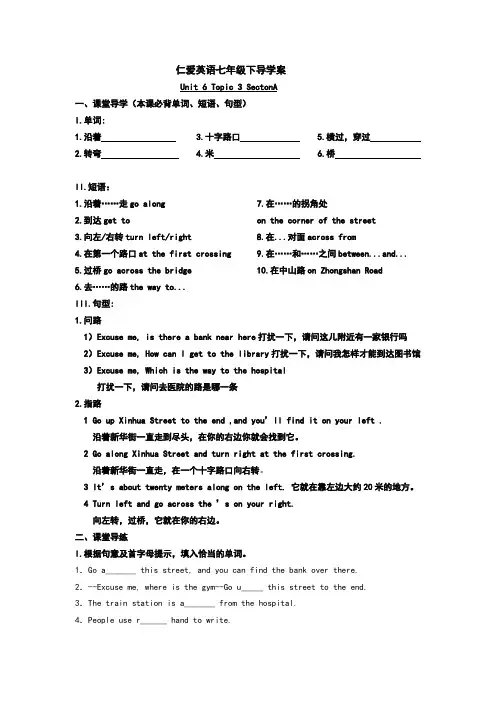
仁爱英语七年级下导学案Unit 6 Topic 3 SectonA一、课堂导学(本课必背单词、短语、句型)I.单词:1.沿着2.转弯3.十字路口4.米5.横过,穿过6.桥II.短语:1.沿着……走go along2.到达get to3.向左/右转turn left/right4.在第一个路口at the first crossing5.过桥go across the bridge6.去……的路the way to...7.在……的拐角处on the corner of the street8.在...对面across from9.在……和……之间between...and...10.在中山路on Zhongshan RoadIII.句型:1.问路1)Excuse me, is there a bank near here打扰一下,请问这儿附近有一家银行吗2)Excuse me, How can I get to the library打扰一下,请问我怎样才能到达图书馆 3)Excuse me, Which is the way to the hospital打扰一下,请问去医院的路是哪一条2.指路1 Go up Xinhua Street to the end ,and you’ll find it on your left .沿着新华街一直走到尽头,在你的右边你就会找到它。
2 Go along Xinhua Street and turn right at the first crossing.沿着新华街一直走,在一个十字路口向右转。
3 It’s about twenty meters along on the left. 它就在靠左边大约20米的地方。
4 Turn left and go across the ’s on your right.向左转,过桥,它就在你的右边。
二、课堂导练I.根据句意及首字母提示,填入恰当的单词。
仁爱版英语七年级下册Unit7 Topic3导学案
仁爱版英语七年级下册Unit 7 Topic 3 Section A课文1a重点短语与句型:at the party在聚会上play the piano弹钢琴perform magic tricks玩魔术(play tricks on sb捉弄某人)enjoy oneself玩得开心1. -How was Kangkang's birthday party? 康康的生日聚会怎么样?-It was very nice.非常好。
2. -Did you sing a song at the party? 你在聚会上唱了歌吗?-Yes, I did.是的,我唱了。
3. -What did Sally do? 莎莉做了什么?-She danced.她跳了舞。
4. -Did Kangkang enjoy himself?康康玩得高兴吗?-Of course. He was happy. 当然。
他非常高兴。
【知识点拨】(oneself反身代词—myself—yourself—himself—herself—ourselves—yourselves—themselves)上周我们玩得很开心。
eg: He enjoys playing basketball. 他喜欢打篮球。
2. 一般过去时:表示过去某个时间发生的动作或存在的状态。
动词的过去式的形式: 1). be动词(was/ were)2). 实义动词的过去式(规则变化和不规则变化)变化规则: A. 一般在动词原形末尾加-ed. 如: play-playedB. 结尾不发音字母e结尾加-d. 如: live- livedC. 末尾只有一个辅音字母的重读闭音节词,双写末尾辅音字母,再加-ed. 如: stop- stoppedD. 结尾是辅音字母+y结尾的动词,改y为i,再加-ed. 如: study- studied时间状语: yesterday 昨天,last year 去年,in 2000在2000年,three days ago 三天前,just now 刚刚,in those days 在那些日子里句式变化:1). A. 肯定句: 主语+ was/were + 其他。
()七年级英语下册Unit7TheBirthdayParty导学案(新版)仁爱版
Unit7 TheBirthdayPartyTopic1重点单词n.作者,作家n.小说v.是(过去式单)数v.出生n.七月n.迷,风扇n.三月n.四月n.五月n.六月n.八月n.九月n.十月n.十二月n.十一月n.一月v.是(过去式复)数num.千n.生日n.日期;约会n.日历v.n.方案词汇拓展→(名词) 庆祝,庆典→(序数词) 第五3..eight→(序数词)_________第八→(序数词) 第九短语荟萃born出生July,1965在1965年7月July13th,1965在1965年7月13日Wales,theUK在英国的威尔士bigfanofsb某人的超级粉丝afootballfan足球迷Sunday下周星期天lastSunday上周星期天todosth方案/打算做某事v.庆祝n.聚会,宴会;党派num.第四num.第五num.第六num.第七num.第八num.第九num.第十n.adj.第十num.第十二num.第二十n.礼物n.v.形状;使成...为形状n.球;舞会adj.担忧,害怕n.星,明星n.老鼠n.v.圈,圆圈;圈出42.n.正方形,平方,adj广.正场方形的n.太太,夫人n.蛋糕→(序数词)第十二→(序数词)第二十→(同义词)礼物→(pl.)__________abirthdayparty为for某sb人.举办生日宴会like...像...looklike看起来像...long/wide多长/多宽11.3meterslong/wide三米长/宽sthtodosth=usesthfordoingsth使用某物来做某事sthforsb为某人买某物句型集锦1.—Whenwassheborn?她出生在何时?—ShewasborninJuly,1965.她出生在1965年7月。
2.—Wherewassheborn?她出生在什么地方?—InWales,theUK.英国的威尔士。
注意:Whenandwherewassheborn?她出生在何时何地?ShewasborninWales,theUKinJuly,1965.她于1965年7月出生于英国的威尔士。
仁爱版英语七年级下册Unit7TheBirthdayParty全单元导学案附复习练习讲解
Topic 3 We had a wonderful party. ( 61 课时)Section B合作交流1. Kangkang had a birthday party last Saturday. At the party, Michael missed the chair and felldown.Now let 's listen to the tape and answer:① Did Michael hurt himself?Unit 7 The Birthday PartyTopic 3 We had a wonderful party.Section B60 课时)学习目标 1. 2. 3. 学习内容 继续学习行为动词的一般过去时 掌握有关责备和抱怨的句子 鼓励学生做一名诚实的孩子 1.生词和短语fall down wash washroom at once happen video game everyone tell the truth tell a lie time 2.句型 1.What 's the matter?I missed the chair and fell down. 2.Did yo u hurt yourself? Yes, I did. This way ,please.How can you lie to me?Why didn 'tyou tell me the truth 导学自主 stand up come back lie lie to angry have a good1. 2. 3. Translate the following phrases: fall down This way, please. ____ at that time ________ tell the truth ________ 给出下列动词的过去式: Fall__ Can_ Have Think hurt oneself ________ _______ come back lie to ______ tell a lie to sb. at once have a good time __ ___ make sb. angry miss_ come tell__ hurt__ play__ forget wash__ go___ make②Where did he want to go?2. Two students a group and act out 1a班级展示A、展示合作交流1B、展示合作交流23. 短文填空:At Kan gka ng ' birthday party, his frie nds played a game. Michael missed the chair and________ dow n. He couldntsta nd up. Did he hurt ______ ? No, he ______OK. Hishands got dirty. He had to wash them. He wan ted to go to the washroom. Kan gka ng____ him the way.C、Part 2 Listen and answe①Did Judy lie to her father?②Why did she come back late last night?质疑探究用所给动词的适当形式填空:1. Judy _____ (lie) to her father this mornin g. It ____ (make)her father very an gry.2. Michael ______ (fall)dow n but he ______ (not hurt) himself.3. Judy _____ (come) back late last ni ght. Her father ____ (th ink) she played video games.四、总结,生成新问题。
仁爱英语七年级下册导学案全集完整详细版
仁爱英语七年级下册导学案Unit5- Unit8合集一、学习目标:1、知识与技能:A:学习并掌握本节课生词:gate---group . 通过预习达到会读、识记要求,上课时默写,要求在听写本上做好准备,标清序号(15个),条理清晰,每行4个,成绩计入个人周成绩表。
只要你肯下决心并付诸行动,你一定会赢在起跑线上的!B:学习频度副词:如usually(通常),你在P1 还能够找到两个,试一试:____________(经常);______________(总是)C:学习交通方式的表达法:骑自行车:by bike ;你来试一试:乘火车_______________乘飞机_______________乘地铁_______________乘轮船_______________乘小船_______________乘公交_______________乘小轿车_______________特别注意!:步行_______________ (可以参考课本P2)以上词组要求熟背,课堂上个人,小组进行竞赛展示,期望你是最棒的!更期望你是小组的骄傲!D:能够用一般现在时谈论交通方式,尝试翻译:How do you usually come to school ____________________________I usually come to school by bus . _______________________________康康总是怎样回家的______________________________________2、过程与方法课前做好预习,预习中做好预测,标出不会的内容,寻求同桌、小组帮忙,聆听别人的见解,专注于老师的总结。
3、情感态度价值观:(1)随着社会经济的发展,人们的生活水平和生活质量越来越高,各种交通工具开始进入人们的日常生活,我们要学会珍惜,学会感恩,更要学会创造!(2)交通安全时时刻刻要牢记!二、重点难点他总是步行回家。