
Unit 4 Body language教案
Unit 4 Body language I.单元教学目标 技能目标 Skill Goals Talk about body language: cultural differences and intercultural communication Practise talking about prohibition & warning as well as obligation Learn to use the -ing form as the Attribute & Adverbial Learn to write a diary that showing the observation of how body language helps in communication II. 目标语言
功 能 句 式
Talk about body language What is the purpose of language? What do you think “body language” means? How can you tell if someone is sad or happy even if they do not speak? How can you communicate a feeling to someone who does not speak your language? Why do we need to study body language? Talk about cultural differences && intercultural communication What do British people often do when they meet strangers? What do French people often do when they meet people they know? Why should we be careful about our own body language? Why is it important to watch others as well as listen to them?
词 汇
1. 四会词汇 major, local, represent, curious, Columbia, introduce, approach, touch, cheek, stranger, spoken, express, action, Jordan, nod, general, avoid, comedy, misunderstand, similar, facial, expression, agreement, yawn, chest, gesture, adult, punish 2. 认读词汇 Garcia, Julia, learned, unspoken, posture, Ahmed Aziz, Coulon, Muslim, frown, threaten 3. 词组 be likely to, at ease, an exciting experience for, not all ..., introduce oneself to sb
语 法
4. 重点词汇 represent, introduce, approach, touch, express, nod, avoid, misunderstand, punish, general, curious, similar, expression, agreement, gesture, action The -ing form as the attribute && adverbial Finding out in the reading text sentences with present participle(s) used as the attribute or adverbial. 1. The -ing form as the attribute They are visitors coming from several other countries, ... His nose touches Mr. Cook’s moving hand, ... This is an exciting experience for you, ... 2. The -ing form as the adverbial ... so you stand watching and listening. Four people enter looking around in a curious way. You see her step back appearing surprised, and take a few steps away from Mr. Garcia. The visitor from Japan comes in smiling at the same time as George Cook from Canada.
重 点 句 子
1. They will be meeting at a major hotel with local business people and people who represent the Chinese government. P25 2. The first person who arrives is Mr. Garcia from Columbia, closely followed by Julia Smith from Britain. P26 3. You think that there may have been a mistake. P26 4. Not all cultures greet each other the same way, nor are they comfortable touching strangers or being too close or too far away. P26 5. In the same way that people communicate with spoken language, they also express their feelings using unspoken “language” through keeping physical distance, actions or posture. P26 6. People from places like Spain, Italy or ... others closely and are more likely to touch them. P26 7. ... nodding the head shows agreement, while shaking the head means that you do not agree, ... P30 Ⅲ. 教材分析和教材重组 1. 教材分析 本单元以Body Language——“体态语”为中心话题,具体涉及什么是“体态语”,如何理解“体态语”,以及“体态语”的跨文化性等。本单元的语言技能和语言知识也都是围绕“体态语”这一中心话题设计的,旨在通过单元教学,用听、说、读、写、做(表演)等多种形式,让学生正确认识和掌握“体态语”在交际中的作用和意义,使学生明确“体态语”在人类交际中的重要性,了解“体态语”在不同民族、不同文化交际中的多样性;使学生在今后的日常生活、学习、工作和交往中尽量减少或避免运用“体态语”时可能产生的误解,提高他们的“语言交际”能力和“非语言交际”能力。 1.1 WARMING UP 以列表对比(填充及增补)的形式,并通过WARMING UP的活动,让学生了解有声语言与“体态语”的对应关系,了解语言意义与行为意义(“体态语”)在交际中具有同等重要的作用。同时,学生在听、说、做(即表演“体态语”的动作)中能够增进对语言交际的感性认识,为他们在阅读过程中上升到对语言交际的理性认识打下基础。 1.2 PRE-READING 通过提供三个关于不同文化背景下“体态语”的问题,启发学生思考我们所学习的“语言”的目的、形式、功能。通过引导学生联系自己日常生活的实际,提高学生努力学习英语的积极性和自觉性;同时培养学生留心社会、关注生活的洞察力,为引导学生进一步“阅读”作好准备。 1.3 READING 是一篇介绍性(记叙文)体裁的文章,主要介绍了各种文化背景下的“体态语”的异同,为学生提供了来自不同国度、不同语言文化背景的“体态语”及其在交际中的异同和影响的具体例证。学生也可以结合自己在语言交际中所遇到的实际例子来进一步理解“交际,毫无问题可言吗?”这一主题。 1.4 COMPREHENDING 包括八个问题(前5个旨在检查学生对阅读材料细节的理解,6~7旨在引导学生对“体态语”的意义及文化差异的思考,第8个检查学生能否通过细节进行推理判断),通过对来自不同国度、不同语言文化背景的六个角色对待男女不同性别所使用的“体态语”异同的(学生在老师指导下的自我或小组讨论后的)归纳,进一步熟悉和掌握“体态语”在不同语言文化交际中的作用和意义。 1.5 LEARNING ABOUT LANGUAGE 分词汇和语法两部分。词汇部分由“本单元重点词汇英文释义”,“词语填空”和“词性变换”三项内容构成,语法部分由两大方面组成:一是让学生自己通过在课文中寻找相关语法的句子并按其语法功能分类,二是根据学生的认知规律安排该语法项目的练习让学生进行操练。整个项目通过三个练习和一个游戏,以及语法结构讲练,进一步巩固本单元所学词汇(尤其是课文中的黑体字),学习“现在分词”结构用作定语和状语,并通过操练,以收到“学以致用”、“熟练生巧”的效果。 1.6 USING LANGUAGE 通过增加阅读篇目“Showing Our Feelings”来拓展学生在“体态语”方面的知识视野,并通过“True” or “False”判断练习和问题讨论,使学生进一步明确“体态语”对人们在日常交际中了解对方情感、思想、态度等方面所起的作用。同时要让学生认真对待自己的“体态语”,并在日常交际中“听其言”(Listen to them)、“观其行”(Watch them)。此外,该部分还通过听、说、读、写四个方面来巩固本单元所学内容和语言交际项目。 1.7 SUMMING UP 师生从话题、词汇和结构三个方面来共同总结本单元所学的单词和短语,语言及语法项目,总结本单元所学的主要内容和收获。 1.8 LEARNING TIPS 建议学生关注实用交际技巧,学会“体态语”;建议学生在看英语电影时或与以英语为母语的人士交谈时,观察对方面部表情和体态姿势,观察对方的“言”、“行”,进而形成有效的口笔头语言及“体态语”的交际能力。
核心素养下教案Unit 4 Body language
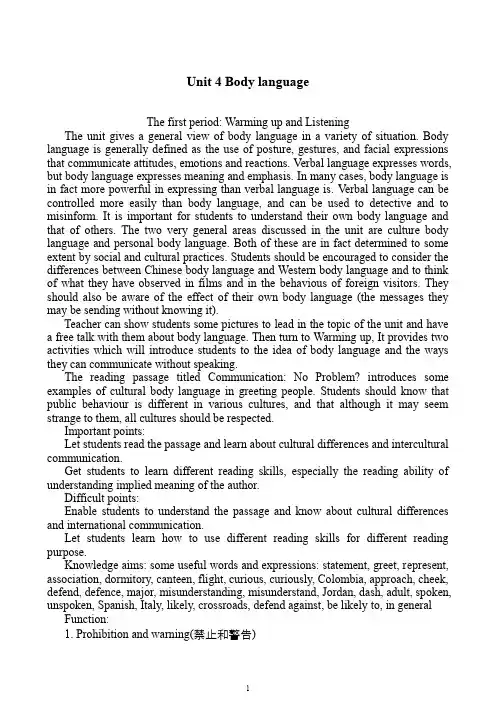
Unit 4 Body languageThe first period: Warming up and ListeningThe unit gives a general view of body language in a variety of situation. Body language is generally defined as the use of posture, gestures, and facial expressions that communicate attitudes, emotions and reactions. Verbal language expresses words, but body language expresses meaning and emphasis. In many cases, body language is in fact more powerful in expressing than verbal language is. V erbal language can be controlled more easily than body language, and can be used to detective and to misinform. It is important for students to understand their own body language and that of others. The two very general areas discussed in the unit are culture body language and personal body language. Both of these are in fact determined to some extent by social and cultural practices. Students should be encouraged to consider the differences between Chinese body language and Western body language and to think of what they have observed in films and in the behavious of foreign visitors. They should also be aware of the effect of their own body language (the messages they may be sending without knowing it).Teacher can show students some pictures to lead in the topic of the unit and have a free talk with them about body language. Then turn to Warming up, It provides two activities which will introduce students to the idea of body language and the ways they can communicate without speaking.The reading passage titled Communication: No Problem? introduces some examples of cultural body language in greeting people. Students should know that public behaviour is different in various cultures, and that although it may seem strange to them, all cultures should be respected.Important points:Let students read the passage and learn about cultural differences and intercultural communication.Get students to learn different reading skills, especially the reading ability of understanding implied meaning of the author.Difficult points:Enable students to understand the passage and know about cultural differences and international communication.Let students learn how to use different reading skills for different reading purpose.Knowledge aims: some useful words and expressions: statement, greet, represent, association, dormitory, canteen, flight, curious, curiously, Colombia, approach, cheek, defend, defence, major, misunderstanding, misunderstand, Jordan, dash, adult, spoken, unspoken, Spanish, Italy, likely, crossroads, defend against, be likely to, in general Function:1. Prohibition and warning(禁止和警告)Always stay…..Do not…….Stop!Keep away from……Go away. Don`t enter here.Watch out!Look out!Be careful!Be quiet!You may not…..You will be fined 2000 yuan.Don`t smoke here!Be careful! Don`t slip.2. Obligation (义务和责任)You must……You should never…….You will be……You will have to….You will need to…..Grammar:动词的-ing形式作定语和状语(the –ing form as the attribute and adverbial)Step 1 Leading inThe passage introduces some examples of cultural body language in greeting people. Students should know that public behaviour is different in various cultures, and that although some behavious may seem strange to them, all cultures should be respected. They should also know that there may be actions that they think are impolite or not respectful but are ordinary practices in other cultures.This unit is not a lesson in international courtesy but may help students understand that not all people express themselves the same way. The passage also introduces some grammatical structures which require attention.1. Play a song to students and ask them to act to the music.If you are happyIf you are happy and you know it, clap your hands.If you are happy and you know it, clap your hands.If you are happy and you know it, and you really want to show it.If you are happy and you know it, clap your hands.2. Introduce gestures.3. Introduce the facial expression.4. Introduce the postures.5. Introduce the eye contact.Ask students to use eyes to express their feelings in the following situations.Situation 1: Suppose today is your birthday, you receive a very big present. It is as big as you. So when you see the present, what is your response?Situation 2: Suppose you are walking on the street, some ugly guy comes to you and wants to talk to you to get your telephone number. What is your response?Situation 3: Suppose you are walking on the street, some handsome guy walks by you. What is your body language?6. Summarize what is body languageBody language is a form of communication without using any words and it can help us express our feeling. Ask students to look at the pictures and guess what the man means by his body language?Step 2 Skimming1. Ask students to read the text quickly and find the names of the personsStep 3 ScanningAsk students to read the text carefully and find out the action mentioned in the passage and then act them out in pairs. Show the following chart to help them find theStep 4 Intensive reading1. Ask students to look through all the questions in Exercise 2on page 27 and read the text silently to answer these questions by themselves.2. Ask students to read Paragraph 1-3 and find out the mistakes by using different body languages. How do the mistakes happen? (There are two mistakes: The first is Mr Garcia from Columbia approaches Ms Smith, touches her shoulder and kisses her on the cheek. Julia Smith from Britain steps back appearing surprised and takes a few steps away from Mr Garcia. The second mistake happens between a Japanese and a Canadian. Akira Nagata bows to Mr Cook and his nose touches Mr Cook`s moving hand, when Mr Cook from Canada reaches his hand out to the Japanese.)3. Ask students to read Paragraphs 4-5 and finish the following true or false.1). Englishmen often stand close to others or touch strangers as soon as they meet.2). Most people around the world now greet each other by kissing.3). Japanese will bow to others as greeting.4). People from Jordan will move very close to you as you introduce yourself to them.5). Some body languages in some countries are good while some countries` body languages are bad.(The answers: FFTTF)Step 5 Discuss and divide the passageAsk students to work in pairs to divide the passage into 4 parts and sum up the main idea of each part. Then get some of the groups to share their answers.Part 1(para 1): the main idea is that you are sent to Capital International Airport to meet students.Part 2(paras2-3): it mainly talks about the examples cultural “body language”.Part 3(para 4): it tells us that different people have different body language.Part 4(para 5): it is the summary of body language.Step 6 ConsolidationMy university has sent me to the Capital International Airport to meet some international students from many parts of the world, who are coming to study at Beijing University in China. The first one to arrive is Mr Garcia from Columbia with Julia Smith, a British lady, following behind closely. I introduced them to each other and I am surprised to see Mr Garcia comes up to Ms Smith. Just then, Akira Nagata from Japan, comes in and bows when the Conadian, Mr Cook reaches out his hand to him. It happens that Mr Cook`s hand touches Akira Nagata`s nose as he bows and they both apologize. So you see, people from different cultures may not greet others in the same way. English people usually do not stand very close to others or touch the strangers as people from Spain, Italy and South American countries do. Most people around the world shake hands when whey meet while Japanese people will bow. People from Jordan stand quite close to other men and shake hands and kiss others on the cheek. In a word, body language differs in different cultures and is widely used in communication.Body language is used by people for sending messages to one another. In many countries in the world, men kiss each other when they meet. In Britain, people usually shake hands when they need someone for the first time. They are not comfortable touching strangers. French people kiss each other hello and goodbye on the check more often than the British people. People from Arabian countries stand closer than people from Britain when they are talking. They might move very close to you as you introduce yourself to them. Body language is very general and not all members of all countries behave the same way. Using body language in a correct way will help you to better communication with other people.Step 7 HomeworkGo over the text and learn the useful new words and expressions by heart.Finish the exercises in Comprehending on page 27.Read the passage again and collect the information about body language in different cultures mentioned in the text.The second period: Learning about language: Important language pointsThe emphasis of this period will be put on the important new words, expressions and sentence patterns in the parts Warming up, pre-reading, Reading and Comprehending.Important points:Enable students to grasp the usage of such important new words and expressions as represent, approach, defend, be likely to, in general, etc.Get students to master the patterns “…. I saw several young people enter the waiting area looking around curiously.”And “Not all cultures greet each other thesame way, nor are they comfortable in the same way with touching or distance between people.”Difficult points:Let students learn the usage of the words: approach, be likely toGet students to understand some long and difficult sentences.Step 1 RevisionCheck the homework exercises.Ask some students to retell the passage Communication: No Problem?.Step 2 Practice for useful words and expressions1.represent: stand for or be a symbol or equivalent of sb. / sth. symbolize; be anexample of sth.We chose a committee to represent us.What does Y represent in this equation?This design represents a major new trend in modern art.2. approach: come nearer or nearer to sb. / sth. in space or timeWe approached the museum.It is not allowed to approach the forbidden area.Few writers even began to approach Skakespear`s greatness.I find him difficult to approach.The approach of winter brings cold weather.All approaches were blocked.2.defence: defending from attack; fighting against attackThe country`s defences are weak.They decided to defend their country against enemies.Defend …. against / from: protect …. from….3. introduce….to….He introduced his friend to me.Yao Ming is a person who needs no introduction.4. dash: move suddenly or quickly; rushThe secretary dashed into the room, grabbed the file and ran out again.5. not…nor…..For a whole week hr did not write to her nor give her a call.I don`t like the film. Nor does he.I am going to work today and nor is Maisie.6. likely;be likely to : that is expected; probableThe train is likely to be late.She is the most likely to win the prize.It is likely that….It is likely that she will ring me tonight.7. as well (as sb. / sth.): in additionAre they coming as well?He grows flowers as well as vegetables.8. in general: mainly; mostly; usuallyIn general, her work has been good, but this essay is dreadful.I like game in general, and especially football.I am glad to find myself in general accord with your opinions.9. avoid:I quickly walked to the other side of the street to avoid meeting her.To avoid car hitting the little boy, he had to make a sharp turn.Step 5 Using words, expressions and patternsDo exercises in Using words and expressions on page 63.Step 6 HomeworkFinish off the homework exercises.Learn the new words and expressions by heart.英语国家常见的体态语言1. 付帐(cash): 右手拇指, 食指和中指在空中捏在一起或在另一只手上作出写字的样子, 这是表示在饭馆要付帐的手势.2. 动脑筋(use your brains)或机敏一点: 用手指点点自己的太阳穴.3. 傻瓜(fool): 用拇指按住鼻尖摇动其他四指或十指分开. 也常常用十指对着太阳穴转动, 同时吐出舌头, 则表示所谈到的人是傻瓜, 痴呆.4. “讲的不是真话”(lying): 讲话时, 无意识的将一食指放在鼻子下面或鼻子边, 表示别人一定会理解为讲话人“讲的不是真话”令人难以置信.5. 自以为是(complacent assertion): 用食指往上摁鼻子, 还可以表示“不可一世”().6. 叫人安静(quietness): 闭住嘴, 拇指横掠过双唇.7. “别出声”(stop talking): 嘴唇合上, 将食指贴着嘴唇, 同时发出“”.8. 侮辱和蔑视(insulting and scorning): 用拇指顶住笔尖, 冲着被侮辱者摇动其他四指的手势.9. 赞同(agreement): 向上翘起拇指.10: 祝贺(congratulation): 双手在身前嘴部高度相搓的动作.11. 威胁(menace): 由于生气, 挥动一只拳头的动作似乎无处不有. 也可以是因受挫折而双手握着拳使劲摇动的动作.12. “绝对不行”(absolutely): 掌心向外, 两手臂在胸前交叉, 然后张开至相距一米左右.13. “完了”(that`s all): 两臂在腰部交叉, 然后再向下, 向身体两侧伸出.14. “害羞”(shame): 双臂伸直,向下交叉, 两掌反握, 同时脸转向一侧.15. 打招呼(greeting): 英语国家的人在路上打招呼, 常常要拿帽子表示致意.现在一般已经化为抬一下帽子, 甚至只是摸一下帽檐.16. 高兴或激动(happiness and excitement): 双手握拳向上举起, 前后频频用力摇动.17. 愤怒或急噪(anger and enxiousness): 双手臂在身体两侧张开, 双手握拳, 也常常头一扬, 嘴里咂咂有声, 同时还可以眨眨眼睛或者眼珠向上和向一侧转动, 也可以愤怒, 厌烦, 急噪.18. 怜悯, 同情(pity): 头摇来摇去, 同时嘴里还说That`s too bad. 或者Sorry to hear it.19. “太古怪了”(too queer): 在太阳穴处用食指画一圆圈.The third period: Learning about language: GrammarThis teaching period mainly deals with the grammar: the –ing form as the attributive and the adverbial.Important points: get students to learn the use of the –ing form as the attributive and adverbial.Difficult points: enable students to learn how to use the –ing form as the attributive and the adverbial.Step 1 Revision1. Check the homework exercises.2. Translate the following sentences:他们的责任就是为国抗敌. (defend ….against…)学校离商店不远. (close to)他把朋友介绍给我. (introduce)我今天不去上班, 玛丽也不去. (not …. nor)这趟火车很可能晚点. (likely)总的来说, 她的作品不错, 不过这篇文章糟透了. (in general)Step 2 Leading in1. Tell students to turn to page 26 and read the passage carefully to find out the sentences in which –ing form are used.1). Yesterday, another student and I, representing our university`s student association, went to the Capital International Airport to meet this year`s international students.2). After half an hour of waiting for their flight to arrive, I saw several young people enter the waiting area looking around curiously.3). I stood for a minute watching them and then went to greet him.4). She stepped back appearing surprised and put up her hands, as if in defence.5). Then Akira Nagata from Japan came smiling, together with George Cook from Canada.6). Just at that moment, however, Akira bowed so his nose touched George`s moving hand.7). When Darlene Coulon from France dashing through the door, she recognized Tony Garcia`s smiling face.8). In the same way that people communicate with spoken, they also express their feelings using unspoken “language”through physical distance, actions or posture.2. Let students read aloud the sentences they picked out, think over and discuss with a partner how each of these –ing form is being used in the situation. Have them try to sum up the rule of the –ing form as the attributive and the adverbial.Step 3 Grammar learning动词-ing形式作定语和状语的用法一.作定语如果动词-ing形式出现在名词前后, 并修饰该名词, 一般动词形式作定语. 此时, 该定语可变为一个介词短语(这是动名词作定语)或定语从句(这是现在分词作定语)A sleeping car = a car for sleepingHis nose touched George`s moving hand. (George`s moving hand = George `s hand, which was moving)1. 单独的动词-ing形式作定语, 一般放在被修饰名词的前面.He is a promising young man.It is a fascinating city.Wisconsin is the leading dairy state.They are visiting in a neighbouring town.2. 动词-ing形式可有自己的宾语或状语, 构成一个短语, 作定语, 放在所修饰的名词后面.There is someone knocking at the door.I know a man working in the factory.Do you know the man talking to her?The girl sitting beside me is my sister.二.作状语如果动词-ing形式用于修饰某动词或整个句子, 此时动词形式作状语, 一般即可变换为从句. 动词形式作状语可以表示时间, 原因, 条件, 结果, 以及行为方式或伴随等情况.1. 时间Hearing the news, we jumped with joy.Turning around, he saw a tiger running up.2. 原因Not knowing the way, he could not go there.Being excited, she could not go to sleep.3. 条件Working hard, you will succeed.Turning to the left, you will see the tower.4. 结果Unfortunately his father died, leaving the family even worse off.He was caught in the rain, thus making himself catch a cold.5. 行为方式或伴随情况A boy came running in.Following Tom, they started to climb over the wall.They stood there for an hour watching the game.She sat at the desk reading a newspaper.Step 4 Grammar practiceHave students underline the –ing form or its phrase in each sentence and tell whether it is used as the attributive or the adverbial. If it is used as the adverbial, tell what it is for.He was one of the leading composers of the time.Who is the girl standing on her hands?They built a road leading to the village.Who knows the missing words in the sentences?My aunt told us an amusing story.In our village live 350 families belonging to three nationalities.There is a car waiting at the door.Don not wake up the sleeping child.Traveling by jeep, we visited a number of cities.We couldn`t help them, being so poor ourselves.Coming down the mountain, we met Jim on the way.He worked the whole afternoon trying to repair the car.Not knowing the language, he couldn`t get a job.The manager came to us smiling.Having failed twice, they didn`t want to try again.Turning around, she saw a man following her.When leaving the airport, they waved to us again and again.While staying there, I learnt a lot from them.Turn to page 29. Ask students to do exercise 2 in Discovering useful structures.Turn to page 64. Ask students to do the exercises in Using structures.Step 5 Group workAsk students to work in groups of four to do the following.1. Add at least two more actions to these lists. Then combine the primary and secondary actions to make a sentence about a student in your group. That student must act out what you say.S: (the student`s name) walks around the desk jumping on one foot.S: the frowning girl, (the girl`s name), picked up her English textbook and threw it on the floor.2. After practicing with your group, make up a short act to perform for the class. One student describes what is happening while the other three act.Step 6 Closing down by a quiz1. The wild flowers looked like a soft orange blanket ----- the desert.A. coveringB. coveredC. coverD. to cover2. The secretary worked late into the night, ----- a long speech for the president.A. to prepareB. preparingC. preparedD. was preparing3. The visiting minister expressed his satisfaction with the talks, ---- that he had enjoyed his stay here.A. having addedB. to addC. addingD. added4. European football is played in 80 countries, ----- it the most popular sport inthe world.A. makingB. makesC. madeD. to make5. ------ up at his father, he asked what was the matter with him.A. having lookedB. lookingC. to lookD. look6. ------ from his clothes, he is not so poor.A. judgedB. judgingC. to judgeD. having judged7. ------ such heavy pollution already, it may now be too late to clean up the river.A. having sufferedB. sufferingC. to sufferD. suffered8. Would you tell us something about G3?Well, it is an international organization ---- the richest countries in the world, five of which are quite small and two of which are island states.A. is consisted ofB. consisting ofC. consists ofD. consisted of9. Hill often attends public lectures at the university of London chiefly ---- hisEnglish.A. to improveB. improvingC. to have improvedD. improved10. –Who brought these papers here on my table?--A student _____herself Joanna.A. callingB. callsC. calledD. being called11. ____ from what she said, I guessed Lily had not read the novel at all.A. To judgeB. JudgedC. JudgingD. Judge12. My uncle ____ in Australia sent me some presents, ____ a pair of shoes inA. lived; includedB. lives; had includedC. living; includingD. to live; to included13. The manager observed the goods, ____ that there was something wrong with some of them.A. having noticedB. noticingC. to noticeD. noticed14.The book, ____ the life of the teenagers born in the 1990s, was very popular among middle school students.A. showingB. being shownC. shownD. to show15. --- Do you know which one is our new headmaster, Jim.---- Yes. It is the man _____ in the armchair ___ a copy of China Daily.A. sits; readsB. sits; readingC. sitting; readsD. sitting; reading16. When ____ the differences between British English and American English. I find they mainly exist in spelling and pronunciation.A. compareB. being comparedC. comparedD. comparing17. ____ to arrive in Shanghai in one day, I had to take a plane.A. AskedB. Having askedC. To be askedD. Being asked18.____ to the right when you see a supermarket, and you will find the post office you are looking for.A. To turnB. TurnC. TurningD. Turned19. Another four skilled workers _____ it, the project was completed ahead of time.A. joinedB. had joinedC. joiningD. to join(The answers: ABCAB BABAA CCBAD DBBC)Step 7 HomeworkFinish off the workbook exercises.Preview the reading passage Showing our feelings on page 30, find the sentences in which the –ing form is used, and see if you can understand them.The forth period: Using language: Extensive reading We will deal with two passages: Showing our feelings in Using language on page 30 and The open hand—a universal sign in Reading task on page 66 to develop students` reading ability by reading extensively.Important points:Develop students` reading skills by extensive reading.Let students read and understand the passage Showing our feelings.Difficult points:Enable students to learn and use such strategies as skimming, scanning and so on to do their reading.Get students to learn to make a writing outline.Knowledge aims:Get students to learn the new words and expressions: unspoken, facial, function, ease, truly, false, anger, fist, yawn, subjective, hug, rank, at ease, lose face, turn one`sGet students to learn more about body language.Step 1 Revision1. Check the workbook exercises.2. Ask students to translate some sentences into English.1). 我们学校有一个游泳池.(There is a swimming pool in our school.)2). 这篇短文可用做听力材料.(This short passage can be used as listening material.)3). 中国是一个属于第三世界的发展中国家.(China is a developing country belonging to the third world.)4). 站在那边的哪个男孩是我的同学.(The boy standing over there is a classmate of mine.)5). 大家都认为他是个活字典.(He is regarded as a walking dictionary.)6). 回到家后, 他就开始做家庭作业.(Returning home, he began to do his homework.)7). 完成工作以后, 他就回家了.(Having finished his work, he went home.)8). 由于不知道他的电话号码, 我们无法与他取得联系.(Not knowing his phone number, we couldn`t get in touch with him.)9). 大雨滂沱, 造成了该地区洪水泛滥.(It rained heavily, causing severe flooding in that area.)10). 我踮着脚走近那扇小窗户.(Walking in tiptoe, I approached that little window.)Step 2 Warming upDescribe some situations and ask students to act them out.1). I am very happy.2). I am full.3). I am hungry.4). I want to sleep.5). You are great.Step 3 pre-reading1. Let students discuss the following questions:What is the function of body language?How do you think we show our feelings in our daily life?2.Ask students to turn to page 30 to prepare the new lesson.3.Topic sentences for SHOWING OUR FEELINGSParagraph 1: Of course, body language can e misread, but many gestures and actions are universal. Paragraph 2: The most universal facial expressions is,Paragraph 3: From the time we are babies, we show unhappiness or anger by frowning.Paragraph 4: There are many ways around the world to show agreement, but nodding the head up and down is used for agreement almost worldwide.Paragraph 5: How about showing that I am bored? Looking away from people or yawning will, in most cases, make me appear to be uninterested.Paragraph 6: Being respectful to people is subjective, based on each culture, but in general it is probably not a good idea to give a hug to a boss or teacher.Paragraph 7: With so many cultural differences between people, it is great to have some similarities in body language.Step 4 ReadingAsk students to read the passage fast to get the main idea and then finish the outline of the passage.1. The main idea:Different gestures stand for different feelings, wishes or attitudes. Body language has many universal gestures.2. Outline of the text:Para 1: showing happiness.Paras 2-5:Universal body language to show agreement and disagreement.Para 6: Universal body language to show boredom.Paras 7-8: Universal body language to show respect.3. T / F questions:Body language is never as important as spoken language.If you angry at a person, you might turn your back to him or her.You can threaten a person by refusing to speak.If you stand with your arms across your body, you are always protecting yourself from being physically attacked.If you sit looking away from a person, or with your back turned, you are saying you are not interested in that person.You should not greet your new boss by giving her or him a hug.Body language is the same all over the world.Most people can understand each other if they try.4. Let students to read the text carefully to get detailed information.1). Some questions:How can we know other`s feelings, even if they do not speak to us?Why should we be careful with our body language?Why is it important to watch as well as listen to others?What are some jobs in which using body language is extremely important?Step 5 Important language points1. ease: freedom from work, discomfort, pain or relaxedat ease: comfortable and unworried; completely relaxedtake one`s ease: stop working or worrying; relaxa life of easeease of mindHe handed her a cup of coffee to put her at ease.She felt completely at ease during the vocation.She sat down and took her ease by the fire.with ease: without difficultyHe passed the examination with ease.2. ease: relieve the pain from body, anxiety, discomfortTalking eased his anxiety.The relationship between the two countries has eased since the beginning of the talks on the border conflict.3. lose face: lose credit or reputationShe did not lose face though she lose her face.4.turn one`s back to:When she is angry, she always turns her back to me.5.turn one`s back on: avoid or reject sb. / sth.He turned his back on his family when he became famous.Step 6 Reading task1. Turn to page 66 to read the passage carefully to get some important detailedinformation.2. Let students organize the following information so that it can be used to writeStep 7 HomeworkLearn the useful new words and expressions by heart.Finish off the workbook exercises.The fifth period: Using language: Listening and speakingImportant points:Develop students` listening and speaking abilities.Enable students to master different listening skills.Difficult points:Get students to listen to and understand the listening materials.Let students learn the functional items for prohibition and warning as well as obligation.Knowledge aims:Get the students to learn some useful new words and expressions in the listening passages.Learn the following expressions:1). Prohibition and warning:You may not ……Always stay ……Keep away from …..Do not ……….Watch out …….Look out …..Be careful when …..You will be fined ………2). Obligation:You must …..You should never ….You will have to …..You will need to ….Step 1 Revision。
高中英语人教版()选择性必修一《Unit 4 Body language》课件ppt(30张PPT)
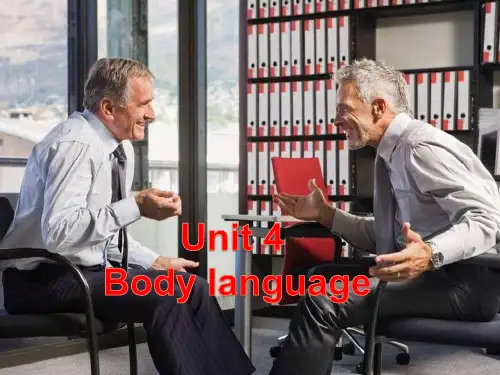
Body language varies from culture to culture.
Reading strategy
Make inferences
Sometimes a passage does not say something directly. However, you can figure it out by looking at the clues in the passage.
1.Who is the master being funny without saying a word? Surf on the internet and find him and write a letter to him to know more about body language. 2.Try to find them in the text and try to use them.
2. Can you think of an example of body language that is appropriate in China but might be misunderstood in another culture? In China, shaking one’s head means “no”, and nodding means “yes”. By comparison, in Bulgaria and southern Albania, the gestures have the opposite meaning.
高中英语 Unit 4《Body Language》教案(7) 新人教版必修4

Unit 4 Body language 教案示例(1)教学目的和要求(Teaching aims and demands)教学建议(Suggested teaching notes)一、教学内容分析本单元的中心话题是“身势语”。
身势语是非语言交际手段中非常重要的一个方面,它通过无声的语言表达一个人的内心自世界。
与有声语言一样身势语也是文化的载体,在跨文化交际中起着举足轻重的作用。
了解身势语的不同文化涵义并正确地加以运用,经常会在交际场合起到意想不到的好效果。
教师在教授本单元时,可以提醒学生注意自己和他人在日常交际中的体态、姿势、面目表情等等,正确地理解和运用身势语,以达到良好的交际效果。
“热身”(Warming Up)部分以列表对比的形式引导学生了解有声语言与身势语之间的对应关系,并建议学生把这些动作表演出来,既有趣味性,又有体验实践性。
“读前”(Pre-reading)部分首先引导学生对语言的目的、身势语的含义进行思考,随后引导学生联系自己日常生活的实际,想一想How can you tell if someone is sad even if they do not speak?最后一个问题,启发学生说出身势语在跨文化交际中的作用。
“阅读”(Reading)部分,以机场迎接客人为场景,讲述了几个不同国家的来宾由于文化背景的差异,初次见面时互相问候的方式迥然相异,而造成的一些小误会。
形象地表明了身势语与文化背景的密切关系,以及身势语在人们日常交际中的重要作用。
这部分的写作方式颇有特色,可以让学生在阅读过程中,很自然地以“你”的身份去观察、倾听在机场发生的一切。
“理解”(Comprehending)部分的前五个小题旨在检查学生对阅读篇章细节的理解,第六、七小题旨在引导学生对身势语的文化差异、身势语的意义进行积极的思考,第八小题则要求学生能够运用细节推断出主人公的性别。
“语言学习”(Learning about Language)部分要求学生根据英文释义填写本单元重点词汇,然后用课文中的词语填空和运用派生法变换词性。
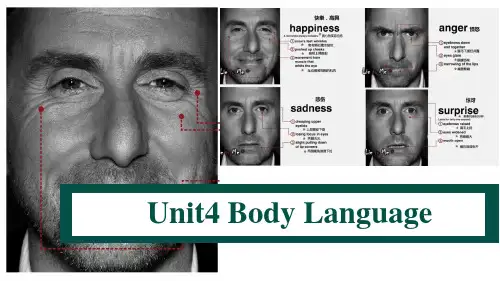
Unit 4 Body Language 单元教学课件
18.in other words换句话说;也就是说 P94 in a/one word总之;简而言之 keep one’s word遵守诺言 break one’s word失信;不守诺言 have a word with与……谈一谈 have words with与……拌嘴/争吵 beyond words无法用言语表达 Word comes/came that…有消息说……
11.make inferences推理;推断 infer v.推断 infer—inferred—inferred infer from从……推断出
12.break down分解;失败;(身体)垮掉;出故障 Pbr8e8ak away from脱离;打破 break in打断(谈话);插嘴;闯入 break into强行闯入;突然开始 break out(战争/火灾/疾病等)爆发 break up分手;(团队)解散;(学校)放假
7.identical adj.相同的 identically adv.相同地 identification n.识别;认同
8.differ vi.相异;不同于 P87 differ from与……不同/有区别 differ in在……方面不同 different adj.不同的 be different from与……不同 difference n.差异;不同 make a difference有影响;起作用;有作为 make no difference没有影响
26.anxiety n.焦虑;担心;害怕 P97 with anxiety=anxiously焦虑地 anxious adj.焦虑的;担忧的;渴望的;急切的
be anxious about=be worried about 为……担心/担忧 be anxious/eager to do sth. 渴望/急于做某事 be anxious that…(should) do sth.希望……
unit4 Body language period3教案

e.g. 1)The reason he gave was very convincing.
2)Perhaps the best example is smiling.
3.常考形式:
doing表示动作发生在谓语动词之后或几乎同时发生。
用it作形式宾语,真正的宾语是动词-ing形式。其结构是:
sb.+动词+it+adj.+动词-ing形式
常用动词有:think, like, hate, consider, find, feel, believe等
I feel it difficult trying again.
I found it useless/no use crying over the split milk.
e.g. 1)It was fortunate that Jack narrowly escaped being killed in a traffic accident
2)I am looking forward to seeing you again.
以下及物动词后既可接不定式又可接动词-ing作宾语,但两者意义上有区别
讲授新课
Step2 Conclusion
The verb-ing form as object and predicative
形式:一般式doing being done
完成式having done having been done
verb-ing的否定形式是在其前面加not
Step3 Study
1.The verb-ing form as object
shaking,bowing,nodding在句中作动词favour的宾语。
2021人教版高中英语必修四Unit4《Bodylanguage》word公开课教案

2021人教版高中英语必修四Unit4《Bodylanguage》word公开课教案Lead inMorning, class!I found you are busy preparing for the coming sports meet. I found I’m not in the list of the judge this year, which made me relaxed. I can enjoy your competition freely. What if it rains in the sports meet?What if our class wins the first place in the sport meet?We’re supposed to check some of the exercises, today. But unexpectedly, some teachers come to our class, so I made some adjustment. It becomes an “open class”. Let me introduce two of them to you.“This is Mrs. Ye. Hello! Mrs. Ye!”(shake hands)“This is Mrs. Li. Nice to see you! Mrs. Li!”(shake hands)What did I do to greet them just now? (Ss…)Hand-shaking is one of the most popular ways in the world to greet people.TitleI read about an article. The name is “The Open Hand – A Universal Sign”. I don’t quite understand the title at first sight. Who can explain it to me? (S1…S2…) What does “open” mean? Discuss with your partner and guess the meaning of the title.I make a fist, is it open? I hold a pen, is it open? If I close my hand, what can I hold? (weapon) Now, my hand is open, can I hold anything? Now, I approach you, do you feel safe? So, what does the open hand mean? The open hand is a sign of safety and friendliness.Structure of the passageTwo things are talked about in the text, they are:(1) Different ways of showing the open hand in different countries(2) The most popular way to show the open hand in the worldIf you are going to write the article with this title, which part will you write first? Why? (S1:…S2…)(1)(2): ways of greeting that are different from yours, more interesting, attract readers. Special to general.(2)(1): familiar and important things come first. General to special.Read the text fast and silently 3 minutes and find out which part is talked about first, and which, second.(Ss read silently and check)Para1Now close your books. Some questions are talked about in the first paragraph.Why do people smile?How do people shake hands?Smile and handshake – the two most popular ways of greetingWhy do people shake hands?Do not rely on your memory, but rely on the logical meaning, decide the order of the 4 questions in a text. Now think about it. (Ss think) Now exchange your ideas with your partner. (check the answer)The most popular way to show the open hand in the worldSmile and handshake – the two most popular ways of greetingWhy do people smile?Why do people shake hands?How do people shake hands?Now read paragraph1 carefully and silently for 2 minutes and find out 3 sentences to answer the three questions. One sentence for one question. (check the answers together)Some sentences have similar structures? Can you find them?What if…? What if…? What if…?We have to…, and we have to…It shows that…, and that…Repetition makes the meaning stronger, but they may not be the key sentence. And it is necessary to tell the key sentence from the supporting details.How do you understand some expressions in this paragraph?Stranger: someone we don’t knowUnfamiliar place: place we haven’t been to or know little aboutTrust: believe in, rely onBe armed (with): be equipped with weaponPractice explaining the meaning of the expressions. Aloud. (Ss practice. Cross out the explanation and practice together again)Para2Although handshake is widely used in the world, people in some Asian cultures do not always touch another person. So, how can they show their open hand? Please work together with your desk mate to find out how they greet people.ChineseJapaneseHinduMuslimYoung people in the west(Ask a group of Ss to demonstrate one by one. After one student’s demonstration, explain.) Chinese: Wrong! The textbook is not always correct. 作揖hand, mouse, earJapanese: slightly – a little, if the person is unfamiliar, if the person is important.Hindu: hands not too low, “bow” not “nod”Muslim: students more familiar, now only touch heartYoung people in the West: five fingers, Give me five!, support and victoryLet’s practice!Class, stand up! Turn around and face your desk mate. I’ll tell you where you are from, and you perform.1.both of you are from India2.both of you are Muslims3.both of you are young people in the West4.look at me, this one (left hand) is from china and this one is from JapanAre there any problems? If you are from different countries, maybe you’ll have to make adjustmentNow I’ll make the greetings and you explain how people from different cultures greet. Read out the sentences in the text aloud, please. (Do the movement, Ss explain)Although the body language is different, they have something in common. What do they have in common?If you look at the first sentence and the last sentence, you will find the first sentence tells the difference, and the last sentence tells the same meaning. (Opinion–supporting details-conclusion)Body language – differentCarried meaning – the sameDiscussionWhat can we do to avoid misunderstanding caused by ways of greeting between people from different cultures? (Discussion or S1…S2…)What can we do to avoid misunderstanding caused by waysof greeting between people from different cultures?Be friendly and understanding.Always wear a smile when greeting, for its something universal.Combine spoken language and unspoken language to communicate better.Learn more about cultural difference and make adjustment whenever necessary.My suggestion for leaning body language is thatWhen you see an English film or talk with native speakers,observe their facial expression and gestures. Keep a recordof what interests you most. Watch what people do as wellas what they say. You can learn more from actions than youcan from words.Bb designThe Open Hand – A Universal SignWhat if…? What if…? What if…? What if…?We have to…, and we have to…unexpectedlyIt shows that…, and that…make adjustmentopenweaponsafetyfriendliness。
Unit 4 Body Language 教学设计
Unit 4 Body LanguageTeaching Aims1. Learn some new words of this text.2. Learn some knowledge and differences about body language.3. Learn some ways to improve reading ability .4. Develop interest in reading .Teaching Important Points1. Enable the students to understand body language.2. Help the students to understand the text better.3. Improve the students’ reading ability.4. Master the new wordsTeaching Difficult Points1. How to help the students to understand body language.2. How to enable the students to understand the text better.3. How to develop students’ interest in reading.Teaching Methods1. Individual, pair or group work to make every student active in class.2. Asking and answering to make students focus on the class.3. Fast reading and careful reading to improve students’ reading skills.Teaching Aids1. the multimedia2. the blackboard3. a tape recorderTeaching Procedures:Step I Greetings (1ms)Greet the whole class as usual and present the teaching aims.Step II Lead-in (4ms)Use a short film to lead students in class. Ask students 2-3 questions after seeing the film.What did you see in the film? What is he doing? How is he directing traffic?So we call this gesture body language.Step III Pre-reading ( 7ms)In this part, we will do a guessing and discussing game. Give students 3 minutes to enjoy, guess and discuss what information they can get from the pictures. 3 minutes later, ask volunteer students to challenge this guess. After that, give students the question to discuss : Can people communicate with each other without speaking and writing? How?Step IV Learning new words ( 4 ms)Give students 2 minutes to guess and match the meaning. Then spend another 2 minutes explain how to remember the new words.Step V Fast reading ( 5 ms)Make students read the passage quickly and find the information. 3 minutes later, check the information one by one. Meanwhile, tell students the skills of fast reading.Step VI Careful reading ( 9mins)The students greet each other, do they use the same body language? In this part, give students 6 minutes to read the text carefully and fill in the blanks. After that, spend 4 minutes checking the answers one by one.Step VII Careful reading again (5mins)Give students 3 minutes to read and find detailed information about the ways to greet each other in different countries. Spend 2 minutes check the answers one by one.Step VIII Summary and homework (5mins)Give students 2 minutes to discuss What they have got from this class and then invite2-3 students to show their results. Assign students homework.Step Ⅸ Reflections after teaching。
Unit4 Body Language How Do I Know My Students?教案
新人教版(2019)英语选择性必修一Unit4 Body LanguagePeriod5 How Do I Know My Students?教学设计课题Period5 How Do I KnowMy Students?单元Unit4 学科English 年级SeniorGrade 2教材分析This part is a reading passage about body language.The writer is a educator. In his class, he often looks at the students’ body language to recognise whether they are interested in the class or not, thus inspiring us the importance of the body language.学习目标与核心素养Knowledge objectives: grasp and use new words and phrases about expressing body language.Skill objectives: master how to distinguish body language.Emotional objectives: learn to explore body language and improve the ability to assess body language.重点How to assist students to express himself with the related words and expression. 难点Some expressions related to body language .教学过程教学环节教师活动学生活动设计意图导入新课Step1 lead –inEnjoy a short video and find the different bodylanguage of different students when the teachersays that they will do a big cleaning and when theboy called Qian sanyi isn’t involved in.Discuss thevideo andfind thedifferentbodylanguage ofdifferentstudentswhen theteacher saysthat they willdo a bigcleaning andwhen the boycalled Qiansanyi isn’tinvolved in.The method canarouse students’interesting, andthey can comeinto the classactively.讲授新课Step2 SkimmingRead the passage quickly and fill in the form. Read thepassage byImprovestudents’Step 6 Group showDescribe the body language of your deskmatewith the following expressions:One possible version:The beautiful mother hugs her baby tightly andsoftly, grinning from ear to ear. It looks as if theynotice a funny thing or they may be takingphotos. Seeing the sight, you can feel a burst ofmother’s love.Exchange your draft with a partner.课堂小结Step5:Summary:These are what we’ve learned in this passage.S tep6 HomeworkUse what you have learned to write anintroduction about your class’s body language ina English class.(80-120词左右)板书Unit4 Body Language Period5cate v.教育education n. 教育educator n. 教育家,教育工作者educated adj. 受教育的2.tick v.打钩号;滴答声n. 钩号3. be confused 感到困惑4. tendency n. 趋势;倾向5.lower vt. 降低;减少adj. 下面的;较小的6. imply v. 意味着,暗示。
高中英语 Book4 Unit4body language 说课课件 新人教必修4(通用)
1). Analysis of the teaching material 教材分析
The type of this class is an extensive reading class, which plays an important part in developing students’ reading ability. So,during the teaching process, the teacher should focus on developing the students’s reading ability by extensive reading, and get them to learn some reading skills such as skimming, scanning and so on. Moreover, the students should receive some moral education, let them know more about body language in cultures in different countries.
课前探索(Pre-class Exploration):
Let students search for more information about body language which shows different meanings in different cultures and countries.
掌握该部分的重点词句
3.Let students read and understand the passage “Showing our feelings”.
让学生读懂本篇文章
Teaching difficult points (教学难点)
必修四Unit4BodylanguageWarmingup教学设计
新聘教师亮相课教案备课组:高一英语组授课班级:高一(4)班时间:2019年6 月27日授课班级:高一( 4)班授课时间:第十八周第三课时Unit 4 Body languageI Teaching aimsKnowledge aim :Make students to learn some words and expressions.Ability aim :Enable students to express themselves with body language.Moral aim :Enable students to use body language properly.n Important pointsEnable students to realize the importance of body language while communicate with others.皿Difficult poi ntsEnable students to understand how body language differs among people in different culture.IV Teachi ng methodsContent-based method第1页/共6页V Learning methodsIndividual work, par work and group work.W Teachi ng toolsTextbook, Lesson plan, PPTW Teachi ng proceduresStep 1 RevisionAsk students to dictate some important words and expressions.statement 陈述,说明represent 代表,象征 flight 飞行,航班 approach 接近,方法 defend 保护,保卫 Step 2 Lead inThink about the followingquestions.1.What ' s the purpose of language? Communication Express our ideas and thoughtsRecordation2.Besides spoken language, is there any other way to communicate our ideas or feelings with others? Three ways :spoken 口语的 likely 可能的 ease 安逸,舒适 fist 拳头 rank 等级,军衔Writte n Ian guage Spoke n Ian guageUn spoke n Ian guage:body Ian guage is a kind of non verbal com muni cati on ,how many parts is it bee n made up? ① eye con tact ② facial expressi ons③ gestures ④ posturesStep 3 Guess ingLook at these pictures and guess what they represe nt.Happy Fearful Sad An gryConfused Surprised Step 4 Performa neeGive performa nces with the help of postures:1」don' t know.2」am very an gry. (chimp)Step 5 ActivityLet' s try to find out more body Ianguageswith the mea ningsStep 6 Discussi onTask 1Is body Ianguage the same in different countries/cultures ? Why?No. Body Ianguage varies (变化)from culture to culture.Because cultures have developed in differe nt ways. Task 2“ Whe n in Rome, do as the Roma ns do” What do you think this famous say ing means?Whe n we are in a certain place, we should follow their customs, no t our own.Step 7 SummaryStep 8 HomeworkRecite the words and expressi onsReview the text.忸SummaryBody Ian guage is one form of non verbal com muni cati on, com muni cati on without using words. Eye con tact or facial expressi ons, gestures, and postures, or the ways you stand, are different kinds of body Ian guage.IX HomeworkRecite the new words and expressi onsReview the text.X Blackboard design Unit 4 Body language Period 1 Warming up。