
最新-七年级英语上册 Unit3(1)教学案人教新目标版 精品
矿产资源开发利用方案编写内容要求及审查大纲
矿产资源开发利用方案编写内容要求及《矿产资源开发利用方案》审查大纲一、概述
㈠矿区位置、隶属关系和企业性质。
如为改扩建矿山, 应说明矿山现状、
特点及存在的主要问题。
㈡编制依据
(1简述项目前期工作进展情况及与有关方面对项目的意向性协议情况。
(2 列出开发利用方案编制所依据的主要基础性资料的名称。
如经储量管理部门认定的矿区地质勘探报告、选矿试验报告、加工利用试验报告、工程地质初评资料、矿区水文资料和供水资料等。
对改、扩建矿山应有生产实际资料, 如矿山总平面现状图、矿床开拓系统图、采场现状图和主要采选设备清单等。
二、矿产品需求现状和预测
㈠该矿产在国内需求情况和市场供应情况
1、矿产品现状及加工利用趋向。
2、国内近、远期的需求量及主要销向预测。
㈡产品价格分析
1、国内矿产品价格现状。
2、矿产品价格稳定性及变化趋势。
三、矿产资源概况
㈠矿区总体概况
1、矿区总体规划情况。
2、矿区矿产资源概况。
3、该设计与矿区总体开发的关系。
㈡该设计项目的资源概况
1、矿床地质及构造特征。
2、矿床开采技术条件及水文地质条件。
2024年人教版七年级英语上册教学Unit 3 第一课时 Section A (1a-2f)
第一课时Section A(1a—2f)教学目标通过本课的学习,学生能够:1.获取和梳理本课语篇中涉及的what、why、how的关键信息;在语境中理解、识记并运用本课时词汇及短语。
如:hall、dining、in front of、building、across from、sports field、gym、office、large等。
(获取信息)2.利用阅读图片信息预测听力内容,对语篇信息进行梳理,并在语境中正确理解目标语言的运用。
(梳理整合)3.利用there be句型和方位介词描述教室布置和设施。
(内化应用)4.借助小组活动,合作探究描述自己的教室,树立热爱班级的意识。
(迁移创新)语篇研读What:本课语篇是四组对话,对话聚焦询问校园内的设施和教室内的陈设。
1b&1c分别为埃拉、彼得和埃玛询问他人教室、老师办公室、商店位置的对话;2a 的对话讲述了彼得回答布朗夫人关于自己教室陈设的问题。
Why:本课的四组对话均围绕“询问地点位置和教室陈设”这一话题展开,加深学生对班级和校园的了解和热爱。
How:语篇采用对话方式讲述,对话中均涉及与校内地点及方位有关的词汇和短语。
教学过程设计理念:以《义务教育英语课程标准(2022年版)》核心素养为导向,以单元主题为引领,基于语篇的育人理念,体现《义务教育英语课程标准(2022年版)》“学板书设计作业设计基础型作业:Read and retell the conversation in 2a.实践型作业:Write down a new conversation about your classroom. 拓展型作业:Introduce your classroom to your best friend.教学反思。
人教新目标英语七年级上册unit3全单元教案
人教新目标英语七年级上册Unit 3 Is this your pencil?The First PeriodSection A (1a—2d)I. Teaching aims1. Knowledge aims:⑴ Key words: pencil, book, eraser, box, schoolbag, dictionary⑵ Target language:A: Is this your pencil?B: Yes, it is. It’s mine. / No, it isn’t. It’s hers.A: Is that your schoolbag?B: Yes, it is. / No, it isn’t. It’s his.A: Are these your books?B: Yes, they are. / No, they aren’t. They’re hers.A: Are those her keys?B: Yes, they are. / No, they aren’t. They’re mine.2. Ability aims:Learn to identify ownership .3. Emotion aims: Learn to use English in their daily life .II . Main Points1. V ocabulary: his, mine, hers, excuse, me, thank, teacher, about,yours, for, help, welcome, thank you for ...2. Yes/No questions and short answersIII. Difficult pointsPossessive Pronouns: mine, yours, his, hersIV. Teaching MethodTask-based teaching method, consolidationV. Teaching aidsTape recording, CAIThe Second PeriodSection A (Grammar Focus – 3c )Ⅰ. Teaching aims1. Knowledge aims:⑴Key words: it’s = it is, isn’t = is not, aren’t = are not⑵Target language:A: Is this your pencil?B: Yes, it is. / No, it isn’t.A: Is that your schoolbag?B: Yes, it is. / No, it isn’t. It’s his.A: Are these your books?B: Yes, they are. / No, they aren’t. They’re hers.A: Are those her keys?B: Yes, they are. / No, they aren’t. They’re mine.2. Ability aims:Learn to talk about their school things .3. Emotion aims: Practict makes perfect .II. Main PointsTalk about school things.III. Difficult pointsLearn to say school things in English.IV.Teaching MethodTask-based teaching method , groupworkV. Teaching aidsTape recording, pictures.The Third PeriodSection B ( 1a –1e )I. Teaching aims1. Knowledge aims:⑴Key vocabulary: baseball, watch, computer, game, card, IDcard, notebook, ring, bag⑵Target language:--- What’s this?--- It’s a …--- How do you spell it?--- W-A-T-C-H.2. Ability aims:⑴ Get the students to talk the things in English freely.⑵ Get the students to learn to find the owners of the things.3. Emotion aims: Learn to know the meaning of some specialnumbers like 110, 121, etc.II . Main Points1 .Teach the new words.2. Have the students know the meaning of some things in dailylife.III. Difficult pointsGet the students to use the words freely.IV. Teaching MethodTask-based teaching methodV. Teaching aidsTape recording, CAI VI. Teaching proceduresThe Fourth PeriodSection B (2a – 2c )Ⅰ. Teaching aims1. Knowledge aims:⑴ Key words: in, library, ask, find, some, classroom, e-mail,at, call, lost, must⑵ Target language:--- Is it yours?--- Is this your watch?--- Call me at 685-6034.2. Ability aims: Train students’ reading and writing skills.3. Emotion aims: To be interested in taking part in activities inEnglish classes.II. Main Points1. Key vocabulary: ask…for…, call…at…III. Difficult pointsGet the students to write Lost and Found.IV. Teaching MethodTask-based teaching methodV. Teaching aidsTape recording, pictures.VI. Teaching ProceduresThe Fifth Period(3a--Self Check)I.Teaching aims1.Knowledge aims:⑴ Key words: set, a set of…⑵ Target language:----Please call me at ….----Are these yours?2.Ability aims:To train Ss’ writing skills .3. Emoyion aims:Please be a careful person and look after your things well. II. Main Points1. New words: set, a set of2. Write their own lost or found notes.III. Difficult pointsGet the students to read and write the notes. IV. Teaching MethodTask-based teaching methodV. Teaching aidsTape recording, pictures.。
七年级英语上册Unit 3 Period 1教案人教新目标版

精品基础教育教学资料,请参考使用,祝你取得好成绩!Unit 3 Is this your pencil目标1. 语言知识目标:1) 能掌握下列词汇: pencil, book, eraser, box, pencil box, schoolbag, dictionary, his, hers, mine, yours, teacher, excuse me, You're welcome.2) 能掌握以下句型:①— Excuse me. Is this/that…? — Yes, it is. / No, it isn’t.②— Excuse me. Are these/those…? — Yes, they are. / No, they aren't.③ What about …?3) 能初运用名词性物主代词mine, yours, his, hers;理解名词性物主代词和形容词性物主代词在用法上的区别。
2. 情感态度价值观目标:通过“识别物品的所属”的学习,让学生们学会爱惜自己的学习物品,养成照看好自己的物品的好习惯,发现不属于自己的物品,应及时归还物品的主人。
该部分学习内容贴近学生的生活,谈论的主题是学生最关心的问题,极易于激发学生的主动性和学习兴趣。
重点难点1. 教学重点:1)能口头应用以下句型:①— Excuse me. Is this/that …? — Yes, it is. / No, it isn’t.②— Excuse me. Are these/those …? — Yes, they are. / No, they aren’t.③ What about …?2)能初步运用名词性物主代词mine, yours, his, hers;理解名词性物主代词和形容词性物主代词在用法上的区别。
2. 教学难点:能初步运用名词性物主代词mine, yours, his, hers;理解名词性物主代词和形容词性物主代词在用法上的区别。
2024年秋新人教版七年级上册英语教学课件 Unit 3第1课时(Section A 1a-1d)
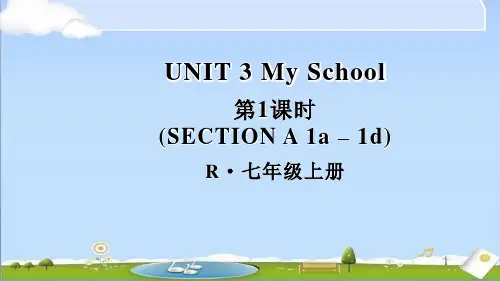
Conversation 3 Emma: Excuse me. Is there a student centre in
this school? Boy 2: Yes, there is. Emma: Oh, good. Where is it? Boy 2: It’s between the library and the gym. Emma: Ah, yes. I can see it. Thank you!
places, we can use some prepositions (介词)to make ourselves clear.
in front of
behind
next to
between
across from
What about your school? Can you talk about the places in your school?
This is the music hall. There are many instruments. We can sing
and dance here.
This is the school hall. It’s big. It’s across from the sports field.
Let’s conclude
across prep. & adv. 过;穿过 across from 在对面 office n. 办公室
This is the teachers’ building. It’s across from the classroom building.
There are 10 teachers’ offices.
A: Where’s the ____________? B: It’s ____________________.
人教版七年级英语上册Unit3单元教学设计
3.能够听懂并理解本单元的对话,掌握基本的听力技巧,如:预测、关键词捕捉、主旨大意理解等。
4.能够运用所学的句型和词汇进行简单的口语交流,如:介绍动物、描述动物的行为和特征等。
5.提高阅读能力,通过阅读短文,掌握寻找关键信息、理解文章大意、推断词义等阅读策略。
3.教学步骤:
a.教师展示新词汇,如:tiger, elephant, panda, lion等,让学生跟读并模仿。
b.教师通过动作和表情,引导学生理解一般现在时的动词形式,如:eat, sleep, run, jump等。
c.学生跟读并模仿,教师适时纠正发音。
d.教师通过示例句,让学生学会运用一般现在时描述动物的行为和特征。
5.家庭作业:布置适量的课后作业,包括词汇填空、选择题、改错题等,让学生巩固所学知识。
6.拓展任务:鼓励学生利用网络、书籍等资源,了解动物的生存现状和保护措施,提高学生的环保意识和社会责任感。
7.作业评价:教师应及时检查和评价学生的作业,给予反馈。对于学生在作业中遇到的问题,教师要耐心指导,帮助学生克服困难,提高作业质量。
2.口语练习:学生以小组为单位,选择一种动物,用一般现在时描述该动物的行为和特征。要求每个小组成员都参与其中,将对话录音,并在下节课前提交给教师。
3.阅读理解:教师推荐与本单元话题相关的英语文章,要求学生课后阅读,并完成相应的阅读理解练习。旨在提高学生的阅读能力,拓展知识面。
4.写作练习:要求学生运用本单元所学的词汇和句型,写一篇关于自己喜欢动物的短文。内容包括动物的外貌、行为、生活习性等,字数在80-100词左右。
5.读写结合,全面发展:在阅读教学中,引导学生运用阅读策略,提高阅读理解能力;在写作教学中,注重引导学生从模仿到创作的过程,逐步提高写作水平。
人教新目标英语七年级上册unit3(SectionB1a—2c)优秀教学案例
(一)知识与技能
1.学生能够掌握描述家庭成员外貌、性格和职业等特征的句型和词汇,如:tall, short, friendly, teacher, doctor等。
2.学生能够运用所学的句型和词汇,进行简单的对话交流,如:介绍自己的家庭成员,询问他人的家庭成员等。
3.学生能够听懂、会说、会读、会写与家庭成员相关的句型和词汇,提高他们的语言运用能力。
1.设计一系列问题,引导学生主动思考和探索家庭成员之间的关系和特征,激发他们的思维能力和解决问题的能力。
2.通过问题引导学生进行观察、分析和归纳,培养他们的逻辑思维和批判性思维能力。
3.鼓励学生提出自己的问题,培养他们的问题意识和自主学习能力。
(三)小组合作
1.将学生分成小组,鼓励他们合作完成任务,如:共同编写一个关于家庭成员的小故事,或者进行角色扮演活动。
3.定期进行课堂展示或小测验,让学生展示自己的学习成果,同时也可以作为教师对学生的评价依据。
四、教学内容与过程
(一)导入新课
1.利用多媒体展示一张家庭成员的图片,引导学生观察并猜测图片中的人物关系。
2.邀请学生分享他们自己的家庭成员照片,让大家一起欣赏并互相提问。
3.通过提问学生对家庭成员的了解,自然引入本节课的主题,激发学生的学习兴趣。
3.小组合作促进互动:将学生分成小组,鼓励他们合作完成任务,如编写小故事和角色扮演活动,通过小组讨论和展示,促进学生之间的互动和交流,培养他们的团队合作能力和交流能力。
4.反思与评价培养自我改进能力:设计评价表,让学生对自己的学习进行评价,鼓励他们自我反思,找出自己的不足,并提出改进的措施。同时,教师也要及时进行教学反思,调整教学策略,以满足学生的学习需求。
(三)学生小组讨论
七年级英语上册Unit 3(第1课时)教案人教新目标版
精品基础教育教学资料,请参考使用,祝你取得好成绩!Unit 3 Is this your pencil?一、教材分析本单元以school things为话题,设计了三个部分的内容。
旨在通过单元教学使学生学会辨认物品的所有者,学会根据场景询问物品的所属,以及英语中对应的表达法,学会写寻物启事和招领启事。
Section A学会询问物品的所属。
1a, 1b, 1c 重点学习一些表示学习用具的词,学会询问物品的所属。
二、三维目标语言目标Target language1. Words & expressions生词和短语this, pencil, pen, book, eraser, ruler, dictionary, that, yes, no, not, case, pencil case, pencil sharpener, isn’t=is not2. Key sentences重点句子(1) Is this your pencil? Yes, it is. It’s my pencil. No, it isn’t. It’s his backpack.(2) What’s this/that in English? This/That/It is… Ability goals能力目标 Enable the students to learn to identify ownership Learning ability goals 学能目标 Help the students learn how to identify ownership.三、教学重点How to identify ownership.四、教学难点How to identify ownership.五、教学策略1.对初学者应注重兴趣的培养,宜采用游戏、唱歌、竞赛、小组合作等多种活动方式。
2.注重因材施教,对基础不同的学生,在开始阶段应有不同层次的要求,多鼓励,少批评,甚至不批评,以充分调动每个学生学习英语的积极性。
Unit3SectionA(1a~1c)教学设计-2023-2024学年人教版七年级英语上册
-自主学习法:引导学生自主完成作业和拓展学习。
-反思总结法:引导学生对自己的学习过程和成果进行反思和总结。
作用与目的:
-巩固学生在课堂上学到的购物场景和相关词汇。
-通过拓展学习,拓宽学生的知识视野和思维方式。
-通过反思总结,帮助学生发现自己的不足并提出改进建议,促进自我提升。
教学资源拓展
6.总结与作业:对本节课所学内容进行总结,布置相关作业,巩固所学知识。
评价方式:课堂表现、小组活动、作业完成情况。
核心素养目标
本节课旨在提高学生的语言能力、文化意识、思维品质和学习能力,符合新课程标准中提出的英语学科核心素养目标。通过购物主题的学习,学生将能听懂、会说、会读本节课的核心词汇和句型,并在实际购物场景中运用所学知识,提高实际英语应用能力。在教学过程中,教师会引导学生了解西方购物文化,培养他们的文化意识,同时通过小组合作、游戏等活动,锻炼学生的思维品质和团队合作意识。此外,学生将在完成各种任务的过程中,提高自主学习能力,培养良好的学习习惯。
-提供拓展资源:提供与购物主题相关的拓展资源(如书籍、网站、视频等),供学生进一步学习。
-反馈作业情况:及时批改作业,给予学生反馈和指导。
学生活动:
-完成作业:认真完成老师布置的课后作业,巩固学习效果。
-拓展学习:利用老师提供的拓展资源,进行进一步的学习和思考。
-反思总结:对自己的学习过程和成果进行反思和总结,提出改进建议。
2.利用句型卡片,让学生进行分组练习,加深对购物场景句型的理解。
3.创设购物场景,让学生分组进行角色扮演,练习购物对话,提高实际应用能力。
4.设计一个购物小游戏,让学生在游戏中运用所学知识,增加学习的趣味性。
人教版新目标七年级英语初一上册Unit3单元教案设计
人教版新目标七年级英语初一上册Unit3单元教案设计Unit 3Is this your pencil?第一课时Section A (1a~1c) 教学设计知识目标课堂环节§自主学习案◎新词自查根据句意和汉语提示完成句子。
1.That is his pencil (铅笔).2.—Is this your schoolbag (书包)?—No,it isn't.3.It's my book (书).4.What color is the eraser (橡皮)?5.Is that his dictionary (字典)?§课堂导学案Step 1准备与热身(Preparation)Learn the chant.T:Let's sing the chant together.my 是我的,your是你的,男的他是his,女的她是her;名词前面常站岗,限定所属有功劳。
(This activity warms up the students as well as provides review of the possessive adjectives.)Step 2呈现与输入(Presentation)1.Present the new words.Teacher shows some real school things to students and asksome questions about them to help students to learn the new words.2.Practice the new words.T:Now,please look at the picture in your books.Can you put the words with the objects in the right pictures?Write the letters next to the words,please.(Give Ss about two minutes to finish 1a.)Then check the answers.Ss:…(This activity introduces the names of some common personal possessions.)Get students to practice conversations and communicate with each other using the following sentences:What't this/that in English? It's a/an…—Is this/that your…?—Yes,it is./No,it isn't.—Is this/that his/her…?—Yes,it is./No,it isn't.Step 3练习与体验(Practice)Play the tape of 1b,get students to listen and number the conversations,then finish the teaching task of 1b.Step 4运用与生成(Production)T:Let's read the conversations together,paying attention to the pronunciation and intonation.Then leave students several minutes for them to practice the conversations.Encourage them to make their own conversations using the school things in the classroom in pairs.Finally,invite some pairs to act out their conversations.Step 5巩固与提高(Progress)【探究点】Is that your schoolbag? 那是你的书包吗?Is this/that…?是一般疑问句,意为“这/那是……吗?”回答时要用yes(是) 或no(不是), 且答语中要用it 代替this 或that, 即Yes,it is./ No,it isn't.【针对训练】—Is this his pencil?—__C__.A.Yes,it's B.Yes,it's my pencil C.No,it isn't D.This is his pencil【探究点】—Are these your books? 这些是你的书吗?—No,they aren't.They're hers.不,不是。
人教新目标英语七年级上册unit3(SectionB1a—2c)教学设计
3.能够听懂、读懂有关日常活动介绍的句子,并能运用所学句型进行简单的对话交流。
4.提高学生的英语语言表达能力,使他们能够运用所学知识进行简单的自我介绍和日常交流。
(二)过程与方法
在本章节的学习过程中,教师将采用以下方法,帮助学生达到教学目标:
1.采用任务型教学法,引导学生通过观察、思考、实践等过程,掌握本节课的词汇和语法。
4.作业布置应注重培养学生的实际应用能力,使他们能够将所学知识运用到生活中。
2.利用多媒体教学资源,创设真实语境,让学生在情境中感知、体验、实践英语语言。
3.设计丰富的课堂活动,如小组讨论、角色扮演、听力练习等,激发学生的学习兴趣,提高他们的英语听说能力。
4.通过课堂提问、课后作业等形式,及时了解学生的学习进度,给予个别指导,帮助他们巩固所学知识。
(三)情感态度与价值观
在本章节的学习中,教师将关注学生情感态度与价值观的培养:
(二)教学设想
1.针对词汇和语法的教学:
-利用实物、图片和多媒体资源,创设直观的教学情境,帮助学生形象记忆词汇。
-采用“词不离句,句不离境”的教学方法,让学生在实际语境中感受词汇和语法的运用。
-设计形式多样的练习,如填空、造句、角色扮演等,让学生在练习中巩固所学知识。
2.针对听说能力的培养:
-设计不同难度的听力练习,让学生在循序渐进中提高听力水平。
2.教师提问:“What do you do every day?”,邀请学生分享自己的日常活动,激发学生的思考,为新课的学习做好铺垫。
3.引导学生回顾已学过的描述学习用品的词汇,如:pen, pencil, ruler, eraser等,为新课词汇的学习打下基础。