
高中英语人教版必修2 unit3
重点词汇signal【点拨】signal (v./n./adj.) 信号,暗号。
1.Vt./Vi.Both sides have signaled their willingness to start negotiations.2.n.This will send the wrong signal to potential investors.3.Adj.The university has done me the signal honour of making me an Honorary Fellow. 【拓展】signal achievement/success/failureto give a signal 发信号spoil【点拨】spoil (n./v.) 溺爱;赃物1.v. spoilt / spoiledThe bad news has spoilt my day.2.n.The thieves divided up the spoils.common【点拨】mon adj. 普通的,常见的;共有的,共用的Smith is a common name in England. 英国在Smith是个很普通的名字。
in common (with) ( 和……)一样have sth. in common (with) ( 与……)有共同之处They are brothers, but they have nothing in common. 他们虽是兄弟,但毫无共同之处。
【拓展】have nothing in common with 无共同之处have little in common with 几乎无共同之处have something in common with 有一些共同之处have a lot common with 有许多共同之处【辨析】common, ordinary, usual与general它们均有“普通的,常见的”的意思。
common 侧重于“普遍;常见”,指许多事物或人共同具有而常见的性质。
They can treat most of the common diseases他们可以治疗大部分常见的病ordinary 侧重于表示“平常;平凡;无奇特之处”That morning he came earlier than usual, for it was not an ordinary day.那天早上他起得比平常早,因为那天是一个不寻常的日子。
usual 指从时间和频度上讲通常发生的事情或一种习惯。
Tea is considered to be the usual drink of British people茶被认为是英国人的日常饮料。
general 表示在大多数人或物中流行并受到关注,还有“总体的,概括的”的意思general knowledge 一般知识solve【点拨】solve. v. 解决, 解答This problem is too difficult for me to solve. 这个问题太难解决不了He’s good at solving crossword puzzles 他善于解答纵横字谜。
With the help of his friends , he finally solved the problem.在朋友的帮助下,他终于解决了这个问题【拓展】solution n. 解答;解决(办法)a solution to the p roblem 问题的解决方法anyhow【点拨】anyhow = anyway不管怎样.Anyway I must finish the work today. 不管怎样我必须今天完成这项工作Type【点拨】type.1)n.类型This is a new type of machine, with lots of meters on it.这是一种新型的机器, 上面有许多仪表。
2) v.打字你帮我打一下这封信好吗?Will you please type this letter for me?【拓展】type:表示各项事物在本类中都是典型的。
kind:特指在分类中能放在一起的性质相同且相似的一类事物。
follow【点拨】follow. v.跟随;沿着;听懂;遵循;听从follow one’s instructions 执行(某人的)指令Follow this road, and you'll get there. 沿着这条路走,你就会到那儿。
【拓展】follow the customs of 遵从。
的习俗with sb. followed 某人紧随其后`calculate【点拨】calculate. vt. 计算,估计He hasn’t calculate the result.他还没有计算出结果。
be calculated for 打算,为适合。
而设计calculate on / upon 依靠,指望【拓展】calculable adj.可估计的,可计算的calculating. adj. 有心计的,精明的calculation n 计算;估计,推测calculator n 计算器calculated adj.精心策划的;蓄意的personally【点拨】personally adv.就自己而言; 就我个人来说She didn’t like the plan, but personallyI see nothing wrong with it.她不喜欢这项计划, 但我本人觉得没什么不好的。
【拓展】person (n)--personal (adj.)--personally (adv)person n人personal adj. 私人的,个人的,亲自的personally adv.亲自,个人认为personally speaking 我个人认为,以我的看法来说generally speaking 一般而言frankly speaking 坦率地说arise【点拨】arise (arose,arisen) vi.出现;发生Accidents arise from carelessness.事故由粗心大意引起。
New difficulties will arise from such situation.那种状况将会产生新的难题。
【拓展】辨析:arise;arouse;rise与raiseThe sun rises in the east and sets in the west.太阳从东方升起西方落下。
The price of wheat has risen/has been raised since the last summer. 自从去年夏天以来,麦子的价格已经涨了/被涨上来了重点短语In a way【点拨】in a/one way 在某种程度上, 从某种意义上说从某种程度上来说, 他的英语有进步。
In a way, his English has improvedin the wayon the/one’s way (to) 在(去…)的路上by the way 顺便提一下in no way 决不all the way 自始自终;完全地in this way 用这种方法【拓展】与in a way同义的词组有in one way 和in some ways。
容易与之混淆的词组是in the way意为“造成阻碍”,请比较:In a way, I like this new textbook very much.从某种程度上说, 我很喜欢这本新教材。
I’m afraid your bike is in the way.看来你的自行车挡着道了。
go by【点拨】go by经过(某地);(时间)过去;(机会等)失去;遵循,依据……办事go by = passA car went by at full speed. 一辆汽车全速驶过。
【拓展】Pass by 意为“从。
旁边经过”。
go on 表示“进展;进行情况”有时也可以表示时间的过去(侧重于过程)。
go by 也可意为“按。
行事,从。
来看”go by the rules 按规定办事go by looks根据表情判断as a result【点拨】as a result 结果,因此。
It doesn’t of ten rain in summer. As a result, we have to water the vegetable garden.这儿夏天不常下雨,因此,我们不得不给菜园浇水。
as a result(=therefore )因此(+结果)As a result of(=because of) 因为(+ 原因(名词,代词,动名词)He got up late. As a result, he was late for the class.He was late for the class as a result of getting up late.【拓展】result from .由。
导致;源于。
result in …导致。
Success results from hard work. 成功来自努力。
Hard work results in success. 努力终会成功。
deal with【点拨】deal with1)处理,解决,安排we must deal with this problem as soon as possible.2)对待,对付,宾语是人Deal with a man as he deals with you3)谈论,涉及The book deals with the questions of maths【拓展】比较deal with与do with的用法:What will you do with these green apples? 你用这些青苹果做什么?I don’t know how to deal with these boring problems. 我不知道如何处理这些烦人的问题。
do with的do是及物动词中,表示如何“处置”,常与what连用,what是do的宾语;而deal with中的deal是不及物动词,表示如何应付或安排什么,常用how,how是deal w ith的状语。
那位新老师不知道如何对待班上的学生。
The new teacher didn’t know how to deal with the students in the class.她不知应该如何处理她父亲留下的东西。
新教材 人教版高中英语必修第二册 unit3 The internet 精品教学课件(共142页)
学以致用 完成句子 (1)他整个下午都在上网和朋友聊天。 He has been on the computer all afternoon,chatting with his friends . (2)我和她闲聊了好久。 I had a long chat with her.
3.【教材原文】And so I use a nonsense name for my net identity.(Page 27)
(4)A working party has been set up to look into the problem.
(5)Looking at these photos,I can’t help looking back on my childhood.
(6)She is looked on as the leading figure on the subject.
语境领悟
(1)At last things were beginning to look up. 情况终于开始好转了。
(2)I looked up the new word in the dictionary. 我在词典里查过这个生词。
(3)I look on her as one of my closest friends. 我把她看作我最亲密的朋友之一。
我为我的网上身份胡乱用了个名字。 考点identity n.身份;个性
an identity card (ID card)身份证 identify vt. 认出;确认 identification n. 识别;鉴定;确认
语境领悟
(1)Before checking in for your flight,you must show your identity card.
英语人教版高中必修二(2019新编)-Unit 3 Food and Culture第三讲Gram
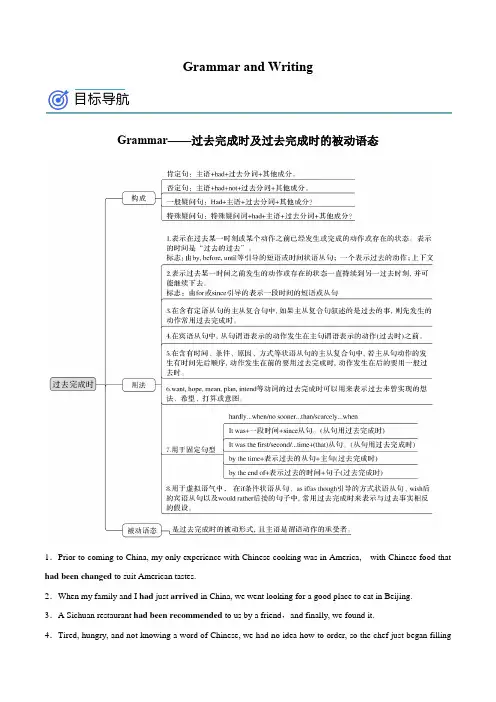
Grammar and Writing目标导航Grammar——过去完成时及过去完成时的被动语态1.Prior to coming to China, my only experience with Chinese cooking was in America, with Chinese food that had been changed to suit American tastes.2.When my family and I had just arrived in China, we went looking for a good place to eat in Beijing.3.A Sichuan restaurant had been recommended to us by a friend,and finally, we found it.4.Tired, hungry, and not knowing a word of Chinese, we had no idea how to order, so the chef just began fillingour table with the best food we had ever eaten.【自主发现】过去完成时表示在过去某一时刻或某一动作之前发生的动作或存在的状态。
过去完成时的肯定句结构是主语+had+过去分词+其他成分,否定句结构是主语+had+not+过去分词+其他成分,被动语态结构是主语+had been+过去分词。
语法知识一、过去完成时的用法1.用于told,said,knew,heard,thought,found等动词后面的宾语从句中,表示动作发生在这些动词之前。
He told me that he had seen the film the day before.他告诉我他前一天已经看过那部电影了。
She said that she had never been to the Great Wall.她说她从未去过长城。
人教版高中英语必修2unit3课文知识点详解
即学即用 (1)—Excuse me,could you tell me the way to
the British Museum? —Sorry,I’m a stranger here. —A. A.Thanks anyway B.It doesn’t matter C.Never mind D.No problem 解析 A.不管怎样,还是要谢谢你。B.没关系。 C.不要紧;不用担心。D.没问题。句意为: ——打扰了,你能告诉我去大英博物馆的路 吗?——抱歉,我在这儿是个陌生人。——不 管怎样,还是要谢谢你。
(3)mark含义广泛,指事物留下的深刻印记,比 sign更侧重于区别性或指示性的标志。 (4)symbol指被人们选出的物体或图案,用来代 表 另一事物,作为该事物的标记或象征。 The dove is the symbol of peace. 鸽子是和平的象征。
即学即用
(1)The soldiers are hiding in the trees and
raised aised raising
即学即用 (1)我本来想事情会很容易,但是出现了许多问题。
I thought it would be easy,but a lot of problems have arisen . (2)事故由粗心大意引起。 Accidents arise from carelessness.
是我的一切。
with the help of my electronic
brain which neverwhfiocrhgentesvearnyftohrignegt是s 状语,
说an明yt主hi谓ng部分的伴随状况。在这个with短语中,
包含一个定语从句
Unit 3课文文本和翻译 人教版高中英语必修第二册

人教版高中英语新教材必修二Unit 3课文文本和翻译STRONGER TOGETHER: HOW WE HAVE BEEN CHANGEDBY THE INTERNET我们一起更加强大:我们是如何被互联网改变的Much has been written about the wonders of the World Wide Web. There are countless articles telling us how the Internet has made our lives more convenient. We no longer have to wait in line or carry cash around when we go shopping. We can get the most updated information from large databases. We can download software, documents, and images whenever we need them. But the Internet has done much more for people than simply make life more convenient. People’s lives have been changed by online communities and social networks.关于万维网奇迹的文章有很多。
有无数的文章告诉我们互联网是如何使我们的生活更加方便。
当我们去购物时,我们不再需要排队或随身携带现金。
我们可以从大型数据库获得最新的信息。
我们可以随时下载软件、文档和图像。
但互联网为人们带来的不仅仅是简单地让生活更加便利。
在线社区和社交网络改变了人们的生活。
Jan Tchamani, an English teacher in Birmingham, UK, suddenly developed a serious illness and had to quit her job. At age 50, she found herself out of work and stuck at home with only her computer to keep her company. After a while, she discovered that surfing the Internet could help her feel less lonely and bored. She could listen to music, watch films, play games, and explore the world. She also joined an online group wh ere she could talk about her problems and get support and advice from others. She realised that one of the greatest benefits of the Internet was its ability to remove the distance that usually exists between people.英国伯明翰的一位英语教师简•夏曼尼突然得了重病,因此不得不辞职。
人教版高中英语必修二(Book 2 Unit 3)

人教版高中英语必修二(Book 2 Unit 3)Unit 3 Computers核心单词1. common adj. 共同的,普遍的;常见的常用结构:in common 共有,公用(在句中多作状语)have nothing/little/a lot/something in common (with) sb. 与某人没有/许多/有些共同之处in common with 和……一样common sense/knowledge 常识common welfare 公共福利易混辨析common/ordinary/usual/normalcommon 指"共有的,公共的;共同的;常见的"。
反义词为rare。
common作"普通的"讲时可与ordinary换用。
如"普通人"也可以说成common people。
ordinary 意为"普通的,平淡无奇的",指没有什么特别的地方。
usual 意为"平常的,通常的,一向的",含惯例之意。
normal 意为"正常的"。
Jane and I have nothing in common.=I have nothing in common with Jane. 我与简毫无共同之处。
The problems are common to all societies. 这些问题是所有社会的通病。
In common with many young people, he prefers pop songs.和许多年轻人一样,他喜欢流行歌曲。
He is in ordinary clothes. 他穿着平常的衣服。
We meet every day at the usual place. 我们每天在往常那个地方见面。
单项填空Harry visited the bookstore every week. He became sucha______________customer that the bookseller gave him some books as presents.A. commonB. normalC. usualD. average解析:选C。
高中英语人教版必修二Unit-3知识点汇总及强化练习
Unit 3 Computers 单元要点预览Ⅰ词语辨析Ⅱ词性变化Ⅲ重点词汇1. sum n. 金额; 款项; 总数; 总和[典例]1). He was fined the sum of 200. 他被处以200英镑罚金。
2). The sum of 5 and 3 is 8. 5加3的和是8。
[重点用法]in sum简言之; 总而言之sum sb/sth up形成对某人[某事物]的看法[练习] 中译英1). 总之, 计划告吹了。
______________________________________________________________________ 2). 我认为她是个很能干的经理。
______________________________________________________________________2. advantage n.优点;优势;有利条件[典例]1). He has the advantage of a steady job. 他有工作稳定的有利条件。
2). They took full advantage of the hotel's facilities. 他们充分利用旅馆的设备。
[重点用法]take advantage of 对……加以利用;欺骗to sb.’s advantage 对某人有利have /get/win an advantage over 〔of〕胜过;优于[练习] 中译英1).协议对我们有利。
______________________________________________________________________ 2).她利用了我的慷慨。
______________________________________________________________________3. goal n. 球门;进球得的分;目标[典例]1). He headed the ball into an open goal. 他乘虚把球顶入球门2). We won by three goals to one 以三比一获胜。
人教版高中英语 必修二 Unit3 《Computers Reading》 课件 (共25张PPT)
Parents’ view on mobile phone Smart phones
Debate show
Should we use smart phones in school?
Rules: • One student one point • Stand up to express your idea • Loudly • Clearly
Homework
1. Read the passage fluently after class; 2. Finish <名校学案> reading.
Mobile/cell phone
I am an electronic machine that can store, organize and find information, do calculations and control other machines. My nickname is “PC”.
13、He who seize the right moment, is the right man.谁把握机遇,谁就心想事成。2021/8/122021/8/122021/8/122021/8/128/12/2021 •14、谁要是自己还没有发展培养和教育好,他就不能发展培养和教育别人。2021年8月12日星期四2021/8/122021/8/122021/8/12 •15、一年之计,莫如树谷;十年之计,莫如树木;终身之计,莫如树人。2021年8月2021/8/122021/8/122021/8/128/12/2021 •16、教学的目的是培养学生自己学习,自己研究,用自己的头脑来想,用自己的眼睛看,用自己的手来做这种精神。2021/8/122021/8/12August 12, 2021 •17、儿童是中心,教育的措施便围绕他们而组织起来。2021/8/122021/8/122021/8/122021/8/12
新教材2023年高中英语 Unit 3 Section Ⅲ课件 新人教版必修第二册
6.__o_n___ the Internet在网上 7.first __o_f___ all首先,第一 8.give __o_u_t___分发;发出(气味;热等) 9.in order __t_o___为了…… 10.be mean __t_o___对……刻薄/小气
Ⅲ.重点句型 1.This app keeps you ___u_p_d_a_te_d___ on all your favourite topics. 这个应用程序让你更新所有你最喜欢的话题。 2.However,__th_e__m_o_r_e___ polite you are,___t_h_e_l_e_s_s__ likely it is you will be attacked. 然而,你越有礼貌,你就越不可能受到攻击。
4.__W__i-_F_i____ n. 无线保真(用无线电波而非网线在计算机网络传输 数据的系统)
5.__p_r_e_ss____ vt. 按,压;敦促 →__p_r_e_ss_u_r_e____ n. 压力
6.__b_u_t_to_n____ n. 按钮;纽扣 7.__f_il_e____ n. 文件;文件夹;档案 8.__d_i_sc_o_u_n_t____ n. 折扣 vt. 打折 9.__a_c_c_o_u_n_t ___ n. 账户;描述
→__a_c_c_o_u_n_ta_n_t____ n. 会计
10.__c_l_ic_k____ vt. & vi. 点击 11.__t_h_e_ft____ n. 偷(窃);盗窃罪
→___t_h_ie_f___ n. 贼;小偷;窃贼 12.__r_u_d_e___ adj. 粗鲁的;无礼的
→___r_u_d_e_n_e_ss___ n. 粗鲁;无礼 13.__t_a_rg_e_t____ n. 目标;对象;靶子 vt. 把……作为攻击目标 14.__f_a_ls_e____ adj. 假的;错误的
人教版高中英语必修二Unit3Warmingup
P2 L3 But I was always so lonely _s_t_an_d_i_ng_ there by myself, until in the early 1960s,they gave me a family c_o_n_n_e_ct_e_d_ by a network.
高中英语课件
(金戈铁骑 整理制作)
Unit 3 Computers
Period 1 Warming up
Heavy! Difficult! Hard! Tired!
1. Easy! 2. Fast! 3. Free!
camera
monitor
screen
host computer
keyboard
Some people use the computer wrongly.
Homework
1. Review the text 2. Recite Para one 3. Finish Ex. 1/2 on Page 20.
Reading: Who am I?
Skimming: Read and answer these questions:
1. Who am I?
A computer.
2. Who was the first person to invent the earliest computer?
Charles Babbage
The development of computers:
Calculating machine 计算器
Analytical machine 分析机
Internet
Universal machine 万能机,通用机器
人教版高中英语必修2 Unit 3
必修二Unit 3 Computers1. In pairs discuss what they have in common. common adj. 共同的,普遍的;常见的常用结构:①in common共有,公用(在句中多作状语)② in common with 和……一样----In common with many young people, he prefers pop songs.③have nothing/little/a lot/something in common with sb.与某人没有/许多/有些共同之处---Jane and I have nothing in common.=I have nothing in common with Jane.④common sense/knowledge 常识⑤common welfare 公共福利辨析:common,ordinary,usual,general,normalcommon指因许多事物或许多人所共同具有而常见的意思。
ordinary指由于与一般事物性质和标准相同,因而显得平常,无奇特之处。
usual“通常的,惯常的”,含有“随集体风俗或个人习惯而常常发生”之意。
normal意为“正常的”,强调正常性。
2. Work out a list and compare it with your partner.compare...with/to...把。
和。
作比较--- Compare this with/to that, and you’ll find which is better.注意:(1)compare...to...还有“把。
比作。
”之意,不可用compare...with...替换。
Shakespeare compared the world to a stage.(2)过去分词短语compared with(与。