
初中英语北师大版八年级下册Unit1TechnologyandtheFuture单元练习
初中英语北师大版八年级下册Unit1 Technology and the
Future单元练习
一、听力(听力)(共20小题;共20分)
Ⅰ. 听句子,选择与其相对应的图片。
其中有一幅图片是多余的。
每个句子读一遍。
(5分)
Ⅱ. 听对话及问题,选择正确答案。
每段对话及问题读两遍。
(5分)
6. A. The boy's schoolwork. B. Thy boy's future. C. The boy's school.
7. A. In Shanghai. B. In Harbin. C. In Hangzhou.
8. A. Steve. B. Billy. C. Sandy.
9. A. At home. B. At school. C. In the library.
10. A. Because robots won't do the work well.
B. Because more people will have no jobs.
C. Because there will be less pollution.
Ⅲ. 听两段较长对话,选择正确答案。
每段对话读两遍。
(5分)
听第一段对话,回答第11-12题。
11. Who says milk is good for Jerry's health?
A. His mother.
B. His teacher.
C. The doctor.
12. How often does Jerry eat French fries?
A. Often.
B. Always.
C. Never.
听第二段对话,回答第13-15题。
13. How many days will the journey last?
A. 5 days.
B. 15 days.
C. 30 days.
14. When will the journey finish?
A. On September 10.
B. On September 20.
C. On September 25.
15. Where will the journey finish?
A. In Liverpool.
B. In Paris.
C. In London.
Ⅳ. 听短文,选择正确答案。
短文读两遍。
(5分)。
北师大版初中英语八年级下册句型讲解Unit1 Technology and the FutureUnit6 Detectives(句式)
Unit 1 Technology and the Future句式精讲精练:句式精讲1. Students will not need to go to schools any more.not…any more意为“不再……”,相当于no more。
例如:N ow she isn’t afraid any more. 现在她不再害怕了。
(1)more and more意为“越来越多的”。
“比较级+and+比较级”表示“越来越……”。
如果形容词/副词的比较级在其前加more构成的,则用“more and more+形容词/副词原级”表示“越来越……”。
例如:He runs faster and faster. 他跑的越来越快。
Our city is becoming more and more beautiful. 我们的城市正变得越来越美丽。
(2)make use of意为“使用,利用”。
use此处用作名词,意为“用,使用”。
make good use of 意为“好好利用”。
例如:You should make better use of your dictionaries. 你们应该更有效地使用词典。
3. People are much more comfortable online these days.“much+形容词/副词的比较级”意为“……得多”,much表示程度。
例如:I am much taller than you. 我比你高得多。
【拓展】常见的用于修饰比较级的副词(短语)有much, even, far, rather, a little, a bit, a lot等。
例如:I am feeling even worse today. 我今天甚至感到更严重了。
The shoes are a little bigger for me. 这双鞋对于我来说有点大。
4. Not everybody will have a computer and not everyone can connect to the Internet.not everybody/everyone意为“不是所有人”,否定的是一部分,不是全部。
北师大版英语八年级下册Unit 1单词及短语
Unit 1 Technology and the FutureGetting Ready名词Nouns1. technology科技e.g.: The use of new technology is core to our strategy.2. future未来,将来e.g.: We need to plan for the future.3. pocket 口袋,衣袋e.g.: I put the note in my pocket.4. keyboard键盘e.g.: He still plays keyboard for a local band to keep his hand in.5. smartphone智能手机e.g.: Smartphones are popular now, but I think robots will be popular in the future.6. robot机器人e.g.: These cars are built by robots.7. telephone电话,电话机e.g.: You can reserve seats over the telephone.8. screen屏幕;银幕e.g.: They were staring at the television screen.形容词Adjectives1. electronic 电子的e.g.: This dictionary is available in electronic form.短语Expressions1. touch screen 触摸屏e.g.: The general method of using the touch screen is introduced.Lesson 1 Schools of the Future名词Nouns1. ID (=identification)身份证明e.g.: I think smart ID will be useful at school.2. mark成绩;记号e.g.: Students can use them to borrow books and check their marks online.3. e-book电子书e.g.: In the future, students may only need to bring an e-book to school.4. invention发明,创意e.g.: Every year, new inventions and products appear.5. product产品;产物e.g.: The product is at the design stage.6. development发展e.g.: No one is sure, but here are some possible developments.7. software软件e.g.: The robots will have special software from the school.8. LCD (=liquid crystal display)液晶显示器e.g.: Classrooms might be in open areas and use large LCD screens.9. progress进步,进展e.g.: He made great progress in chemistry this year.10. system系统;体系e.g.: This is the one major drawback of the new system.11. card卡片e.g.: Students will need to use smart ID cards to get into schools.动词Verbs1. allow 允许e.g.: The system will also allow students to see teaching videos and notes online.2. teach教e.g.: She teaches at our local school.形容词Adjectives1. smart 智能的;聪明的e.g.: This smart washing machine will dispense an optimal amount of water for the load.2. traditional传统的,习俗的e.g.: Many teachers do not believe there will be traditional classes or classrooms.副词Adverbs1. already 已经,早已e.g.: In fact, some schools are already doing this.2. closely密切地;接近地e.g.: This can help parents follow their child’s progress closely.兼类词Words with Multiple Part of Speech1. store v.存储;保存n.百货商店e.g.: The e-book will store all their school materials and students can write notes and answers on the screen.短语Expressions1. come true 实现;成为现实e.g.: Do you believe they will come true?2. make use of使用;利用e.g.: Nowadays more and more factories make use of robots.Lesson 2 Online Life名词Nouns1. ticket票,券e.g.: My parents often book air tickets.2. professor教授e.g.: He was made (a) professor at the age of 40.3. president总经理,总裁;总统,国家主席e.g.: Do you have any comment, Mr President?4. e-ticket电子票e.g.: You do not have to go to the station. You can buy an e-ticket.5. media传媒e.g.: The trial was fully reported in the media.6. X-ray X射线检查;X光e.g.: The doctor studied the X-rays of her lungs.7. opinion意见,想法e.g.: I’ve recently changed my opinion of her.动词Verbs1. chat 聊天,交谈e.g.: He’s been on the computer all morning, chat ting with his friends.2. connect连接e.g.: Not everybody will have a computer and not everyone can connect to the Internet.形容词Adjectives1. medical 医疗的e.g.: Medical care is still free at the point of use.2. elderly年纪较大的,上了年纪的e.g.: Not many elderly people do their shopping online.3. social社交的;社会的e.g.: All of us felt like social outcasts.4. ill有病,不舒服e.g.: She was taken ill suddenly.副词Adverbs1. almost 几乎;差不多e.g.: I think people will do almost everything online in the future.兼类词Words with Multiple Part of Speech1. book v.预订n.书e.g.: I’d like to book a table for two for 8 o’clock tonight.短语Expressions1. social media 社群媒体e.g.: Social media has become so popular! We seldom talk to our friends face to face!2. in person 亲自;亲身e.g.: I agree that everyone will be online in the future, but people will still do some things in person.Lesson 3 Tomorrow’s Jobs名词Nouns1. company公司e.g.: In our company, quality is high on the agenda.2. choice选择e.g.: Some time ago, people did not have many choices about their jobs.3. service服务e.g.: We are here to provide the public with a service.4. college学院;大学e.g.: The college has strong links with local industry.5. manager经理e.g.: I don’t know what to make of the new manager.6. purpose目的;意图e.g.: What is the purpose of the text?7. listener倾听者e.g.: I’m a regular listener to her show.8. decision决定e.g.: You also need to plan well and make good decisions quickly.9. situation情况;形势;位置e.g.: In your situation, I would look for another job.动词Verbs1. develop 发展;加强e.g.: Their relationship has developed over a number of years.2. sell 出售,卖e.g.: We offered them a good price but they wouldn’t sell.3. imagine想象,设想e.g.: There will be many other changes we cannot imagine now.4. compare比较;对比e.g.: It is interesting to compare their situation and ours.5. require需要e.g.: What will the future job market require of students at school today?6. include包括e.g.: They include good communication skills, decision-making skills and problem-solving skills.7. express表达e.g.: Teachers have expressed concern about the changes.形容词Adjectives1. fixed 固定的,不变的e.g.: They worked with fixed hours in fixed places and did not have much need to develop new skills.2. present 现在的,当前的;出席的e.g.: We do not have any more information at the present time.3. increasing渐增的,越来越多的e.g.: His increasing financial difficulties forced him to take desperate measures.副词Adverbs1. instead 反而;代替e.g.: Lee was ill so I went instead.2. rather 相反,而是;相当;稍微e.g.: The instructions were rather complicated.兼类词Words with Multiple Part of Speech1. whole adj.全部的,所有的;整体的n.整体e.g.: They usually worked near their hometown and they often stayed in one job for their whole life.2. decision-making adj. 做决策n.做决策e.g.: Employees should have a voice in the decision-making process.3. problem-solving adj. 解决问题的n.解决问题e.g.: He is an expert in team-building and problem-solving.4. plan v.计划,打算n.计划;方案e.g.: Do you have any plans for the summer?5. deal v.经营n.协议e.g.: We did a deal with the management on overtime.短语Expressions1. on the other hand 另一方面e.g.: On the other hand, with increasing competition in the job market, most people want to, and often need to, develop new job skills.2. instead of代替,作为……的替换e.g.: In the future, more people will be able to sell their skills and services to many different companies instead of working for one company for many years.3. work from home在家工作e.g.: More people will work from home.4. at the same time同时;然而e.g.: You need to express your ideas clearly and at the same time be a good listener.5. deal with处理;解决e.g.: As there will always be problems to solve, the ability to deal with difficult situations is a key to your success.6. rather than而不是e.g.: I hope they make you excited rather than scared.Communication Workshop名词Nouns1. conclusion结尾;结论e.g.: I’ve come to the conclusion that he’s not the right person for the job.2. introduction引言;介绍e.g.: The notes are intended as an introduction to the course.3. businessman商界人士;企业家e.g.: I should have got a better price for the car, but I’m not much of a businessman.4. net网络;网e.g.: He hammered the ball into the net.5. pool游泳池;池塘e.g.: I like sports, so I will also play football with my friends and go swimming at the swimming pool.动词Verbs1. surf (在互联网上)浏览;冲浪e.g.: I will enjoy my job very much because I love surfing the net.形容词Adjectives1. spare 空闲的;闲置的e.g.: We’ve got a spare bedroom, if you’d like to stay.2. successful获得成功的,有成就的e.g.: In twenty years, I will be thirty-four years old. I think I will be a successful and happy person.兼类词Words with Multiple Part of Speech1. set v.放置n.一组,一套e.g.: She set a tray down on the table.短语Expressions1. set up 建立;创立e.g.: I will be a businessman then and will set up my own website.2. according to根据,依据e.g.: Instead, I will work from home according to my own timetable.。
北师大版八年级英语下册Unit 1 Lesson 1 Schools of the Future教案
Unit 1 Technology and the FutureLesson 1 Schools of the Future教案教学内容:北师大版英语八年级下册Unit 1 Technology and the Future Lesson 1 Schools of the Future部分内容。
教学目标(Objectives):1.确保学生认识和理解一些基本单词的意义和简单口头运用(To learn the meaning and simple usages of some words and phrases)。
2.学习使用本单元重点句型及表达(To use the typical sentences to express)。
3.鼓励学生大胆发言及表达(To encourage the students to express bravely)。
4.培养学生对英语学科的兴趣(To make the students interest in English learning)。
5.增强学生听说读写译的能力(To strengthen the ability of listening, speaking, reading, writing and translating)。
教学重点(Key Points):在学习了单词的基础上,以单词为载体,进行主要句型的学习,并了解其中的语法现象,根据具体情境,学会交流对话,侧重句型语法学习,交际意向和课外拓展为重点。
教学方法:游戏,音频,情景教学法,Pair-work两人小组活动,Group-work小组活动,多媒体辅助教学。
教学难点:学生处于初中阶段,对英语有了初步了解,有了一定的词汇储备,对于八年级下学期学生的要求重点是在会读会说的基础上,能掌握一些基本单词的拼写和造句,了解一定的语法内涵,与人进行简单沟通交流。
教学准备:课件、照片素材、音频文件、教学道具。
教学设计:Step1. GreetingStep2.Warm-up/Leading(热身/课程导入)Warm-up QuestionLook at the photo. Which do you think will be useful at school? Why?Example:I think smart ID will be useful at school. Students can use them to borrow books and check their marks online....Step3.Presentation(呈现新课)1.Words Learning!1)老师放映课件,用中文询问同学看到了什么?同学们会看到课件上呈现的图画。
北师大版英语八年级下册Unit 1 Lesson 1 Schools of the Future 教
Unit 1 Technology and the FutureLesson 1 Schools of the Future教案教学内容:北师大版英语八年级下册Unit 1 Technology and the Future Lesson 1 Schools of the Future部分内容。
教学目标(Objectives):1.确保学生认识和理解一些基本单词的意义和简单口头运用(To learn the meaning and simple usages of some words and phrases)。
2.学习使用本单元重点句型及表达(To use the typical sentences to express)。
3.鼓励学生大胆发言及表达(To encourage the students to express bravely)。
4.培养学生对英语学科的兴趣(To make the students interest in English learning)。
5.增强学生听说读写译的能力(To strengthen the ability of listening, speaking, reading, writing and translating)。
教学重点(Key Points):在学习了单词的基础上,以单词为载体,进行主要句型的学习,并了解其中的语法现象,根据具体情境,学会交流对话,侧重句型语法学习,交际意向和课外拓展为重点。
教学方法:游戏,音频,情景教学法,Pair-work两人小组活动,Group-work小组活动,多媒体辅助教学。
教学难点:学生处于初中阶段,对英语有了初步了解,有了一定的词汇储备,对于八年级下学期学生的要求重点是在会读会说的基础上,能掌握一些基本单词的拼写和造句,了解一定的语法内涵,与人进行简单沟通交流。
教学准备:课件、照片素材、音频文件、教学道具。
教学设计:Step1. GreetingStep2.Warm-up/Leading(热身/课程导入)Warm-up QuestionLook at the photo. Which do you think will be useful at school? Why?Example:I think smart ID will be useful at school. Students can use them to borrow books and check their marks online....Step3.Presentation(呈现新课)1.Words Learning!1)老师放映课件,用中文询问同学看到了什么?同学们会看到课件上呈现的图画。
北师大版英语八年级下册 Unit 1 Technology and the Future Lesso
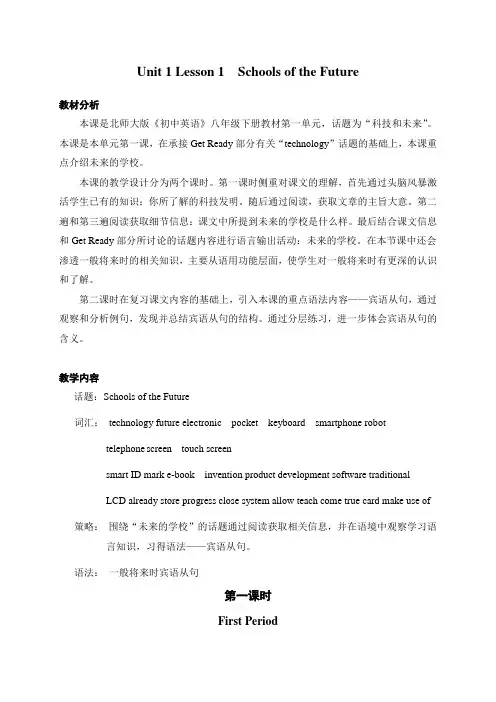
Unit 1 Lesson 1 Schools of the Future教材分析本课是北师大版《初中英语》八年级下册教材第一单元,话题为“科技和未来”。
本课是本单元第一课,在承接Get Ready部分有关“technology”话题的基础上,本课重点介绍未来的学校。
本课的教学设计分为两个课时。
第一课时侧重对课文的理解,首先通过头脑风暴激活学生已有的知识:你所了解的科技发明。
随后通过阅读,获取文章的主旨大意。
第二遍和第三遍阅读获取细节信息:课文中所提到未来的学校是什么样。
最后结合课文信息和Get Ready部分所讨论的话题内容进行语言输出活动:未来的学校。
在本节课中还会渗透一般将来时的相关知识,主要从语用功能层面,使学生对一般将来时有更深的认识和了解。
第二课时在复习课文内容的基础上,引入本课的重点语法内容——宾语从句,通过观察和分析例句,发现并总结宾语从句的结构。
通过分层练习,进一步体会宾语从句的含义。
教学内容话题:Schools of the Future词汇:technology future electronic pocket keyboard smartphone robottelephone screen touch screensmart ID mark e-book invention product development software traditionalLCD already store progress close system allow teach come true card make use of 策略:围绕“未来的学校”的话题通过阅读获取相关信息,并在语境中观察学习语言知识,习得语法——宾语从句。
语法:一般将来时宾语从句第一课时First Period教学目标:在本课学习结束时,学生能够:1. 能够理解、朗读本课出现的生词和了解现代科技有心的产品。
2. 能够利用本节课出现的科技单词进行简单的交流。
北师大版英语八年级下册Unit 1 Lesson 1 Schools of the Future 教学设计2

Unit 1 Technology and the FutureLesson 1 Schools of the Future 教学设计Teaching aims:1. 通过创设一些情境让学生积极谈论学校未来样子,在此过程提升学生的口语表达水平。
2. 读懂课文中的学校未来描述,根据短文获取相关的信息,培养学生英语阅读的能力。
3. 将课文主题与生活紧密联系,培养学生在生活中学习英语、运用英语的能力。
4. 通过学习让学生能够熟练运用宾语从句的表达。
Key points:重点学习宾语从句。
Difficult points:引导学生在活动中、生活中灵活运用句型,培养学生英语阅读的能力。
Teaching preparations:PPT, cards, pictures.Teaching procedures:Step 1: Warm-upWhat will the schools be like in the future?Taller buildingsBetter environmentRobot teachersE-bookClassroom with bed…Step 2: Introduction — Learn the news wordse-bookrobot teachersmart IDonline learningDiscussionLook at the photos, Which do you think will be useful at school? Why?Step 3: ReadingDo the readingThe school of TomorrowConsolidationRead the text. Match the headings with the correct paragraphs.Read the text. Match the headings with the correct paragraphs.Paragraph 1Paragraph 2Paragraph 3Paragraph 4a. New Ideas of Classesb. Online Learningc. E-books for schoold. Robot TeachersConsolidationWhich of these things does the writer mention? Read the text again and tick.Work in pairsI think smart ID will be useful at school. Students can use them to borrow books and checks their marks online.I think robot teachers will be useful at school…Work in pairsI think smart ID will be useful at school. Students can use them to borrow books and checks their marks online.I think robot teachers will be useful at school…Step 4: GrammarRead the following sentences and complete the sentences from the text.Many teachers do not believe (that) there will be traditionalclasses or classrooms.They will know what the students are studying.Some people wonder if students will even need to go to schools any more.1. Some people think___________2. Many people believe _________3. Most people think ___________宾语从句1. I think that I’ve hurt my back .2. I’m afraid that I can’t get up .3. I think that the doctor had better see you .4. The doctor says that he will come at once.5. I’m sure that you need an X-ray .Step 5: Homework1.Review the new words and useful expressions in Lesson 1.2. Show your opinion about the future schools.3. Preview the new lesson, Lesson 2。
北师大版八年级英语下册Unit 1第二课时课件
修改作文
1.根据同伴的评价 2.学习范文中的好句子 3.自己的感悟
Homework
继续修改作文
这一 样个 的人 人所 才受 有的 学教 问育 。超
过 了 自 己 的 智 力 ,
You made my day!
我们,还在路上……
北师大版《初中英语》八年级下册
Unit 1 Technology and the Future
Lesson 4 Communication 第二课时
Workshop
Байду номын сангаас
小组互评
范文欣赏
In the coming 100 years, how would our life turn out to be? To my viewpoint, there must be great changes at that time. First of all, it is extremely possible that robots can bring us a lot of convenience and gaiety. Robots will help us in many fields, for example, they can reduce our workloading of housework and communicate with us just like our close friends to make us happy. Secondly, human beings can live in the sea when hot summer comes. Thirdly, our cars can fly just like aeroplanes. At last, people may be not so busy and they can spend a holiday on moon.
北师大版八年级英语下 Unit 1 Technology and the Future Lesson 1 Schools of the Future教学 (共23张PPT)
What will the future school might be like?
Name
1.What cannot be changed in future schools?
2.Which technology will be used in future schools?
Turn your group survey result into Survey
charmates.
4
Online Learning
Teachers will give homework online in the future.
This can help parents follow their child’s
progress closely. They can check their child’s
3rd reading <The School of Tomorrow>
2.What will the futurcelacslassrosroomoms be like? Many teachers do notsbelieve there will be traditional classes or classrooms. Each student in a class might study different materials at the same time. Classrooms might be in open areas and use large LCD screens.
北师大版初中英语八年假期中基础知识unit1Technology and the Future (共
• Many teachers do not believe there will be more traditional classes or classrooms. 许多老师认为不会 有更多的传统课堂和教室。
• touch screen 触摸屏 • make use of 使用;利用 • come true 实现;成为现实 • in person 亲自;亲身 • social media 社会媒体 • rather than 而不是 • deal with 处理;解决 • at the same time 同时 • instead of代替,作为……的替换 • on the other hand 另一方面 • according to 根据;依据
• 因为永远都会有问题需要解决,处理困境 的能力成为了你成功的关键。
• To solve动词不定式修饰problems做后置定 语。
• To deal with difficult situations 动词不定式修 饰the ability做后置定语。
• I think in the future more people will work for fun and fewer people will work for money. 我认为在未来更多 的人会为乐趣而工作,更少的人会为金钱而工作。
• Also, it is common for people to change jobs and by doing so, they can have different work experiences. 换工作对人们来说也很正常, 如此,他们可以拥有不同的工作经历。
新北师大版八年级英语下册Unit 1 Technology and the Future Lesson 1 Schools of the Future 第二课时课件
Match the sentence parts below.
1. The students agreed… 2. No one knows… 3. Tim thinks… 4. Tina is sure… a …where the books are. b …she’ll do well in in the next exam. c …that their test was difficult. d …his school will be different in the
Answer the questions
What do some people think of robots? Some people think that these robots will
help students with their homewobots know about the will students? They know what the students are studying and
Homework
编一个对话谈论未来的学校。用上宾 语从句。
北师大版《初中英语》八年级下册
Unit 1 Technology and the Future Lesson 1 School of the Future
第二课时
Revision
1.What will robot teachers do in the future? 2. What will classes be like in the future? 3. What will students do with ebooks ? 4. What will people do online in the future?