
pep 小学英语六年级上 unit 2 ways to go to school part B
Role Play
四人小组中先选好角色,其 中一人扮演盲人,一人扮演 带路的人,一位同学负责演 示交通标志,另外一位根据 上一位同学的交通标志说出 相应的指令,带路的同学要 根据指令带着“盲人”做出 相应的动作。
Look
the traffic rules.
Go
Stop and wait
Slow down and wait
黄灯慢行并停止
Remember (记住)the
Stop and wait at a red light.
红灯停止并等待
traffic rules
交通规则
Go at a green light.
绿灯行
Slow down and stop, slow down and stop. At a yellow light, slow down and stop. Stop and wait, stop and wait. At a red light, stop and wait. Go, go, go. At a green light, we can go.
Don't ____ go at a red light. must stop and wait. You ______
green light
Go at a green light. ___
能
can go at a red light. You _____
Slow down and stop
at a yellow light.
yellow light
Slow down stop at a yellow light. Slow down and stop
[sləʊ] [daʊn]
Don't go at a yellow light. You must slow down and stop.
必须
red light
Stop Stop and wait at a red light
minutes.
读课文第17页15分钟
with your best friends after class.
尝试和好友课后玩“角色扮演”的游戏
2. Try to play the game “Role-pk! The park is over there!
Let’s go!
Please wait! It’s red now! We must stop and wait!
Divide Ss into two groups.
Play it natually. (表演自然!) ★ ★
With proper intonation. (表演有声有色!) ★ ★ ★ ★
Unit 2 Ways to go to school
B Let’s learn
What other lights can you see in our life?
traffic lights
red light yellow light
green light
What do they mean(意义)?
slow down No, you can’t. You must __________ and _______. wait
Now the light is ______. green Can I go? Yes, you can.
1. Read the dialogue on P17 for 15
at the traffic lights.
at a yellow light. at a green light.
at a red light.
Remember
Let’s talk
Where does Wu Yifan want to go?
How can he get there?
ride a bike
helmet
What do you learn about riding a bike from the dialogue(对话)?
Look, the light is ____. red Can I go?
No, you can’t. You must _____ stop and _______. wait The light is ______. yellow Can I go?
人教PEP版英语六年级上册Unit2《Waystogotoschool》单元教学设计

人教PEP版英语六年级上册Unit 2《Ways to go to school》单元教学设计一. 教材分析人教PEP版英语六年级上册Unit 2《Ways to go to school》主要围绕交通方式来学校这一主题展开。
通过本单元的学习,学生能够掌握表示交通方式的词汇和句型,如“by bus”, “on foot”, “by trn”等,并能够运用这些词汇和句型进行简单的交流。
教材通过富有趣味性的故事和情境,激发学生的学习兴趣,提高他们的语言运用能力。
二. 学情分析六年级的学生已经具备了一定的英语基础,能够听、说、读、写一些简单的英语单词和句型。
他们在学习过程中,需要通过丰富的教学活动和实践机会,进一步提高自己的语言运用能力。
同时,学生对于交通方式有一定的了解,可以通过生活经验和观察,更好地学习和掌握相关词汇和句型。
三. 教学目标1.知识目标:学生能够掌握表示交通方式的词汇和句型,如“by bus”,“on foot”, “by trn”等,并能够正确运用这些词汇和句型进行交流。
2.能力目标:学生能够通过听、说、读、写的训练,提高自己的语言运用能力,能够用英语简单介绍自己或他人的上学交通方式。
3.情感目标:学生能够激发对英语学习的兴趣,增强学习的自信心,培养合作和分享的良好学习习惯。
四. 教学重难点1.重点:学生能够掌握表示交通方式的词汇和句型,如“by bus”, “onfoot”, “by trn”等,并能够正确运用这些词汇和句型进行交流。
2.难点:学生能够灵活运用所学的词汇和句型,进行创编对话或故事,提高语言运用能力。
五. 教学方法1.情境教学法:通过创设生动、有趣的生活情境,激发学生的学习兴趣,提高他们的语言运用能力。
2.交际法:通过学生之间的互动交流,培养他们的合作意识和语言表达能力。
3.任务型教学法:通过完成具体任务,引导学生主动参与学习过程,提高他们的实践能力。
六. 教学准备1.教学课件:制作精美的教学课件,包括图片、动画、视频等,激发学生的学习兴趣。
人教PEP版六年级英语上册Unit2 Ways to go to school课件
Do and say
One points to the lights. The other says and does the actions. Then exchange.
Let’s do role-play
Slow down and stop! Stop and wait! Let's go!
Rules: 1.Make four students in a group. 2.One student holds the traffic lights
and says. 3.Another student works as a blind man. 4.The other two students help the blind
✓ Practice the dialogue in roles.
✓ Act out in groups. ✓ Retell the dialogue and
create new dialogues.
Look and do
One puts up the lights one by one. The other does the actions. Then exchange.
Make a traffic bulletin board.
The traffic signs
Don’t walk. Turn right. Slow down! Don’t turn right!
Don’t turn left! Don’t ride bicycles! Go straight on!
and stop.
Go.
Read and act
Mike: Look! The park is over there! Let’s go!
最新pep人教版六年级英语上册Unit 2 Ways to go to school 知识点总结

最新pep人教版六年级英语上册知识点总结Unit 2Ways to go to school?单词:by (表示方式)乘bus 公共汽车plane 飞机ship (大)船subway地铁train 火车slow 放慢速度;慢的down 减少;降低stop停下early 早到的helmet 头盔attention 注意traffic 交通Germany德国sled 雪橇fast 快的ferry轮渡短语:by plane 坐飞机by ship 坐轮船on foot步行by bike 骑自行车by bus 坐公共汽车by train 坐火车by subway 乘地铁by plane坐飞机slow down 慢下来traffic lights交通灯traffic rules交通规则Stop at a red light 红灯停Wait at a yellow light 黄灯等Go at a green light 绿灯行pay attention to 注意句子:1、How do you come to school? 你怎么来学校的?2、Usually, I come on foot. 通常我走路来。
3、Don’t go at the red light! 别闯红灯!4、I must pay attention to the traffic lights! 我必须注意交通信号灯!5、In the USA people on bikes must wear one. 在美国骑自行车的人必须戴(头盔)。
知识点:1、on foot 步行乘坐其他交通工具大都可以用介词by…, 但是步行只能用介词on 。
on foot 相当于walk,只是walk是动词。
2、go to the park前面一定要加the.如果要去的地方有具体的名字,就不能再加the , 如果要去的地方没有具体名字,一定要在前面加the。
但go to school除外,前面绝对不能加the,这里是固定搭配。
六年级英语上册课件-Unit 2 Ways to go to school-人教PEP
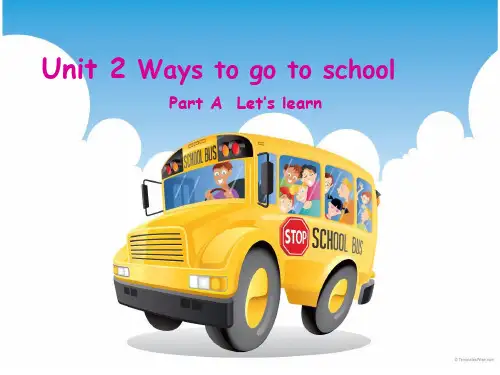
B. I come to school by foot.
Go to other cities.(城市)
A: How do you get to … ? B:__________ .
From
How ?
To
China Your school Huaibei Hefei
…
By car By train By plane By subway On foot …
USA London Sydney Sanya Beijing …
A: How do you get to the USA from China ?
B : By plane .
Read and answer.
( F ) 1. You can go to other cities on foot . ( T ) 2. Go by plane is fast but it’s expensive.
( T ) 3.By subway is cheaper than by taxi. ( T ) 4. It’s convenient(方便的) to get to places .
bike
bus
car
Taxi
taxi
ship
train
subway
How do you come to school? I come to school ______. by plane by car by taxi by bus
by bike by train by subway
on foot
There are many ways to get to places. If you want to go to someplace in your city, you can go on foot , by bike, by bus or by car. It’s very fast to go by taxi, but it’s a bit expensive(贵的). Going by subway is a good idea, but you should make sure there is a subway station nearby. When you go to other cities or go abroad, you will go by plane , by train or by ship .It’s very fast to go by plane, but it’s also expensive. If you have a lot of time, you can go by train or by ship .
人教PEP版六年级上册英语Unit 2 Ways to go to school课件

你如何去公园的?
Warm-up
Let’s go to the nature park.
我们去自然公园吧!
Hooray!
万岁!
How do we get there?
By bus.
Warm-up
learn
How do they go to school ? 他们是如何去学校的呢?
Lily
John
ZhangPeng
ChenJie
Warm-up
Lily
乘公交
ZhangPen g
乘出租车
learn
John
步行
ChenJie
乘地铁
Warm-up
learn
On foot [ ɔn fʊt ] 步行
——How do you get to school from your home? —— By taxi
...
Warm-up
1、抄写今天学习的7个单词和7个短语。 2、仿写今天学习过的句型。 3、背诵今天学习的7个单词和7个短语。
to school by
bus.
Lily
I go to school by subway.
ChenJie
I go to school on
foot.
I go to school by
taxi.
learn
John ZhangPeng
Warm-up
learn
问: How do you go to school? 你如何去学校的?
答 By + 任意交通工具 e g:by bus. 乘公交车。 :
人教PEP六年级英语上册《Unit2 Ways to go to school》课件
Come to school
Interview
Go home
A: Good morning! B: Good morning! A: How do you come to school? B1:… B2:… B3:…
I ____ come to school ____.
Monday Tuesday Wednesday Thursday Friday Saturday Sunday
Usually
Often
sometimes
Usually usually I come on foot . on foot on foot
This is my home, It’s near the school, so I usually come on foot.
About me
But on Monday I must come early. So …
How do I come to school?
I sometimes come by bus.
2. Talk about the ways to go or come to some places with your friends.
(和朋友们一起谈论去某些地方或者来某些地方的交 通方式)
Goodbye!
古
人
云
:
有“
一读
个万
在卷
路书
上,
。行
”万
从里
古路
至。
今”
,今
学人
习说
人教PEP版英语六年级上册Unit 2《Ways to go to school》教案
人教PEP版英语六年级上册Unit 2《Ways to go to school》教案一. 教材分析人教PEP版英语六年级上册Unit 2《Ways to go to school》主要讨论了学生们上学的方式。
通过本节课的学习,学生能够掌握表示交通工具的词汇,如bus, car, trn, bike等,以及表达方式“How do you go to school?”和“I go to school by…”。
教材内容贴近学生生活,有利于激发学生的学习兴趣和积极性。
二. 学情分析六年级的学生已经具备了一定的英语基础,能够听、说、读、写一些简单的单词和句子。
但是,部分学生在发音和听力方面还存在困难,需要重点关注和辅导。
此外,学生对于不同的交通工具有一定的了解,但可能对于一些表达方式还不够熟悉,需要在课堂上进行操练和巩固。
三. 教学目标1.知识目标:学生能够掌握表示交通工具的词汇,如bus, car, trn, bike等;学生能够用英语询问和回答关于上学方式的问题。
2.能力目标:学生能够听、说、读、写关于上学方式的相关句子;学生能够运用所学知识进行实际交流。
3.情感目标:学生能够激发对英语学习的兴趣,增强自信心;学生能够了解不同的上学方式,培养良好的交通意识。
四. 教学重难点1.重点:学生能够掌握表示交通工具的词汇,如bus, car, trn, bike等;学生能够用英语询问和回答关于上学方式的问题。
2.难点:学生能够正确运用动词短语“go by”表达上学方式;学生能够听懂并运用不同的 transportation 词汇进行交流。
五. 教学方法1.任务型教学法:通过设定实际情境,让学生在完成任务的过程中运用所学知识,提高学生的实际运用能力。
2.情境教学法:通过创设情境,激发学生的学习兴趣,提高学生的参与度。
3.分组合作学习:分组进行讨论和交流,培养学生团队合作精神和沟通能力。
六. 教学准备1.教材:人教PEP版英语六年级上册Unit 2《Ways to go to school》2.多媒体教学设备:用于展示图片、视频等教学资源3.教学卡片:用于单词和句子的操练4.计时器:用于控制教学环节的时间七. 教学过程1.导入(5分钟)利用多媒体展示不同交通工具的图片,如bus, car, trn, bike等,引导学生进行观察和思考。
版pep六年级上册unit2ways to go to school
— How do you get there? — By bus.
— How do you get to Beijing? —By train. — How do you get to the USA from China? —By plane.
本编为大家提供各种类型的PPT课件,如数学课件、语文课件、英语 课件、地理课件、历史课件、政治课件、化学课件、物理课件等等, 想了解不同课件格式和写法,敬请下载! Moreover, our store provides various types of classic sample essays, such as contract agreements, documentary evidence, planning plans, summary reports, party and youth organization materials, reading notes, post reading reflections, essay encyclopedias, lesson plan materials, other sample essays, etc. If you want to learn about different formats and writing methods of sample essays, please stay tuned!
飞机 = plane
by plane
乘坐飞机
— How do you come to school? — I usually/ often/ sometimes...
usually: 通常 often:经常 sometimes:有时候
I usually come to school on foot. I often come to school by bus. I sometimes come to school by bike.
人教PEP版英语六上Unit 2《Ways to go to school》(B Let’s tal
人教PEP版英语六上Unit 2《Ways to go to school》(B Let’s talk)说课稿一. 教材分析《人教PEP版英语六上Unit 2(B Let’s talk)》的内容主要是围绕学生们的上学方式展开对话。
通过本节课的学习,学生们可以进一步掌握一般疑问句的构成和用法,以及表达自己上学方式的词汇和句型。
此外,本节课还通过介绍不同的上学方式,让学生们了解到生活中的多样性,培养他们的观察力和想象力。
二. 学情分析在本节课之前,学生们已经学习了有关日常生活中的基本词汇和句型,对于一般疑问句也有一定的了解。
但是,对于表达自己上学方式的词汇和句型,以及如何运用一般疑问句进行问答,学生们可能还比较陌生。
因此,在教学过程中,需要注重引导学生们理解和运用这些新知识。
三. 说教学目标1.知识目标:让学生掌握有关上学方式的词汇和句型,理解一般疑问句的构成和用法。
2.能力目标:培养学生们的观察力、想象力和表达能力,使他们能够用英语熟练地表达自己的上学方式。
3.情感目标:通过介绍不同的上学方式,让学生们认识到生活中的多样性,培养他们的环保意识和团队合作精神。
四. 说教学重难点1.重点:让学生掌握有关上学方式的词汇和句型,理解一般疑问句的构成和用法。
2.难点:引导学生运用一般疑问句进行问答,以及如何正确地表达自己的上学方式。
五. 说教学方法与手段1.采用情境教学法,通过设定不同的上学场景,让学生们在真实的情境中学习和运用英语。
2.运用任务型教学法,让学生们在完成具体任务的过程中,提高自己的观察力、想象力和表达能力。
3.利用多媒体教学手段,如图片、视频等,丰富教学内容,激发学生们的学习兴趣。
六. 说教学过程1.热身(5分钟):通过播放一首关于上学方式的英文歌曲,让学生们融入到英语学习的氛围中,同时复习已学的相关词汇和句型。
2.引入(10分钟):教师展示一张自己上学的图片,向学生们提问:“How do I go to school?”,引导学生回答并介绍自己的上学方式。
新PEP六上Unit 2 Ways to go to school完整版
I come by taxi.
How does he get there?
He gets there ….
by car
by bus
by bike
by taxi
How do you come to school?
I come to school on foot.
I walk to school.
绿色圃中小学教育网
How does she go to work?
by train She goes to work ___________.
She takes the train to work.
How does he go to work?
He goes to work by subway.
经…乘… 轮船
出租车 公共汽车 火车
地铁
步行
慢的 减少,降低 慢下来
飞机
停下
subway 地铁 by 乘… 步行 on foot 轮船 ship 慢的 slow 出租车 taxi bus 公共汽车 down 减少,降低 train 火车 slow down 慢下来 plane 飞机 stop 停止
Mike: Good morning, Mrs Smith! Mrs Smith: Hi, children. You’re early. How do you come to school? Amy: Usually,I come on foot. Sometimes I come by bus. Mike: I often come by bike. Amy:How do you come to school, Mrs Smith?By car? Mrs Smith: Sometimes,But I usually walk. Mike: That’s good exercise.