
小学三年级英语下册第五单元教案
矿产资源开发利用方案编写内容要求及审查大纲
矿产资源开发利用方案编写内容要求及《矿产资源开发利用方案》审查大纲一、概述
㈠矿区位置、隶属关系和企业性质。
如为改扩建矿山, 应说明矿山现状、
特点及存在的主要问题。
㈡编制依据
(1简述项目前期工作进展情况及与有关方面对项目的意向性协议情况。
(2 列出开发利用方案编制所依据的主要基础性资料的名称。
如经储量管理部门认定的矿区地质勘探报告、选矿试验报告、加工利用试验报告、工程地质初评资料、矿区水文资料和供水资料等。
对改、扩建矿山应有生产实际资料, 如矿山总平面现状图、矿床开拓系统图、采场现状图和主要采选设备清单等。
二、矿产品需求现状和预测
㈠该矿产在国内需求情况和市场供应情况
1、矿产品现状及加工利用趋向。
2、国内近、远期的需求量及主要销向预测。
㈡产品价格分析
1、国内矿产品价格现状。
2、矿产品价格稳定性及变化趋势。
三、矿产资源概况
㈠矿区总体概况
1、矿区总体规划情况。
2、矿区矿产资源概况。
3、该设计与矿区总体开发的关系。
㈡该设计项目的资源概况
1、矿床地质及构造特征。
2、矿床开采技术条件及水文地质条件。
2024年三年级英语第五单元教案
2024年三年级英语第五单元教案一、教学目标知识与技能目标掌握第五单元的基本词汇和表达,包括课本中出现的新单词、短语和日常用语。
能够运用所学词汇和句型结构进行简单的英语对话和交流,包括描述人物、物品、活动和场景等。
能够理解和朗读课文,并能根据课文内容回答问题、完成填空等任务。
过程与方法目标通过多元化的教学活动,培养学生的英语学习兴趣和积极性。
鼓励学生主动参与课堂互动,提高他们的合作学习和自主学习能力。
通过角色扮演、小组讨论等形式,培养学生的语言表达能力和思维逻辑能力。
情感、态度和价值观目标培养学生的跨文化意识,增强对多元文化的理解和尊重。
通过英语学习,增强学生的自信心和成就感,形成积极向上的学习态度。
鼓励学生树立远大的理想,明确学习目标,为未来的学习和生活奠定坚实的基础。
二、教学重点和难点教学重点第五单元的重点词汇和句型结构,包括新出现的单词、短语和日常用语。
课文的朗读和理解,特别是对话部分和长句子的表达。
运用所学词汇和句型进行简单的英语对话和交流,包括描述人物、物品、活动和场景等。
教学难点对于部分基础较弱的学生,词汇的记忆和句型的掌握可能会遇到困难。
学生在进行英语对话和交流时,可能会遇到表达不流畅、语法错误等问题。
课文的朗读和理解,特别是长句子的发音和意思把握,对于部分学生来说可能是一个挑战。
三、教学过程1. 导入新课通过播放与第五单元主题相关的英文歌曲或视频,激发学生的学习兴趣。
提问学生关于歌曲或视频内容的问题,引导学生用英语进行回答,为新课的学习做好铺垫。
简要介绍第五单元的学习目标和内容,让学生明确学习任务和目标。
2. 词汇学习展示第五单元的重点词汇和短语,让学生跟读并记忆。
通过图片、实物或动作演示等方式,帮助学生理解词汇的含义并加深记忆。
设计词汇游戏或竞赛,让学生在轻松愉快的氛围中巩固所学词汇。
3. 课文学习播放课文的录音或视频,让学生感受地道的英语发音和语调。
引导学生跟读课文,注意发音、语调和停顿等技巧。
三年级下册英语教案Unit5Is this your classroom_鲁科版(五四制)(三起)-
Lesson 1 Is this your classroom?课型:新授一、教学目标:(一)知识目标1、能听懂、会说并认读2个单词:school, playground.2、会听说2个单词:office,lab.3、能听懂、会说并认读句型“Is this your classroom?”“No. It’s the lab.”“This is the teacher s’ office.” “That’s the playground.”4、能根据元音字母Aa和Ee的发音规律把26个字母归类(二)能力目标运用所学句型议论学校场所。
(三)情感目标关注先生的内在需求,在活动中培养先生的协作精神和竞争认识,培养先生热爱学校生活的积极情感态度。
二、教学重难点:教学重点1、能听懂、会说并认读3个单词:school, playground.2、能听懂、会说并认读单词句型“Is this yourclassroom?”“No. It’s the lab.”“This is theteacher’s office.”“That’s the playground.”.并运用所学句型议论学校场所。
教学难点26个字母根据发音进行分类.三、教学方法:情境教学法、任务型教学法、交际教学法四、教学预备:多媒体课件、录音机、磁带、单词卡、字母卡、电子白板五、教学过程Step 1 Warming up1.Greetings.2.Let’s chant .复习上单元出现的歌谣.设计意图:热身活动活跃了课堂气氛,使先生尽快投入到英语课堂中来,chant部分滚动复习了之前所学的知识。
Step 2.Presentation1.Leading-in大屏幕出示课件,介绍本人的学校场所来拉近来先生与新知的距离。
让先生看大屏幕,教师播放图片:look, This is our school. It’s nice. This is the teacher s’ office. It’s the lab. That’s the playground.利用文本情景进行新知识的呈现与学习。
(湘少版)三年级英语下册《unit 5 第一课时》教案设计
(湘少版)三年级英语下册《Unit 5 第一课时》教案设计一、教学目标1.能准确朗读和理解词汇和短语:T-shirt、jeans、shorts、jacket、skirt、dress、socks、boots、shoes、big、small、long、short、try on。
2.能够听懂、会说并正确使用对话中的句型,如:“Can I help you?”、“I want to try on…”、“It’s too big/small/long/short”等。
3.能够进行简单的购物对话,并了解常见的购物礼节和语言表达方式。
二、教学重点1.T-shirt、jeans、shorts、jacket、skirt、dress、socks、boots、shoes这些单词的发音和辨析。
2.购物对话中的常用短语和句型的掌握和练习。
3.学生在教师的引导下进行简单的英语购物对话,提高英语口语交流能力。
三、教学内容1. 新单词、短语T-shirt、jeans、shorts、jacket、skirt、dress、socks、boots、shoes、big、small、long、short、try on。
2. 对话训练1.A: Can I help you?2.B: Yes, please. I want to try on a T-shirt.3.A: What size do you need?4.B: I need a small one.5.A: Here you are.6.B: It’s too big/small/long/short. Do you have a smaller/bigger one?7.A: Sure, here is a smaller/bigger one.8.B: This one is perfect/nice. I’ll take it.3. 练习与巩固角色扮演:演员分为两个人,一人扮演售货员,一人扮演顾客,进行英语购物对话。
三年级英语下册第五单元教案
课堂教学设计方案Unit5第1课时总计6课时主备人:投放日期年月日一次备课二次备课 Unit 5 Do you like pears?第一课时教学目标1、能听懂、会说一些进餐时需表达的语言: Let us buy somefruit.Do you like …?Yes,I do。
No,I don,t。
Here you are.Thank you. Have some …。
Can I have some …?并能在实际情景中进行运用。
要求模仿正确,语调自然。
2、能正确听,说,读,写单词fun run duck under并知道其在单词中的发音。
教学重点、难点:能听说、认读pear, apple, banana, orange, watermelon,grape,strawberry等有关水果的单词,并能在日常生活中使用。
教学过程:一、教学内容与分析1、Let's talk.本部分通过一个真实自然的情景会话,要求学生能理解对话大意,能用正确的语音语调朗读对话,教给学生如何表达自己喜欢的水果并能在图片、实物和教师的帮助下,在语境中运用Do you like …?\Yes ,I do。
No I don’t I like …2. Let's play.本部分通过一个图片的游戏,使学生巩固Let's talk中所学的有关水果的单词以及 Do you like …?\ Yes ,I do。
No I don’t Ilike …....的用法。
二、课前准备1. 教师准备相关水果的图片卡三、教学步骤1、热身(1)学生自由口语交谈(Free talk in pairs)(3-5分钟)。
(2)复习Unit 4中Let's do部分。
2、新课展示(1)教师先组织学生观察Let’s talk 的教学挂图,引入水果店买水果的话题,然后用实物或图片引出图中单词apple,pear,orange并进行教学。
(完整)PEP小学英语人教版三年级下册unit5教案
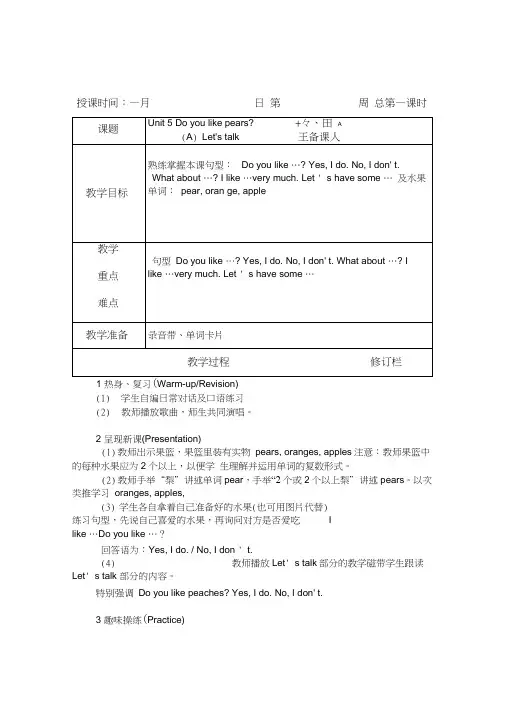
授课时间:—月日第周总第—课时1 热身、复习(Warm-up/Revision)(1)学生自编日常对话及口语练习(2)教师播放歌曲,师生共同演唱。
2 呈现新课(Presentation)(1)教师出示果篮,果篮里装有实物pears, oranges, apples注意:教师果篮中的每种水果应为2个以上,以便学生理解并运用单词的复数形式。
(2)教师手举“梨”讲述单词pear,手举“2个或2 个以上梨”讲述pears。
以次类推学习oranges, apples,(3)学生各自拿着自己准备好的水果(也可用图片代替)练习句型,先说自己喜爱的水果,再询问对方是否爱吃Ilike …Do you like …?回答语为:Yes, I do. / No, I don ' t.(4)教师播放Let' s talk 部分的教学磁带学生跟读Let' s talk 部分的内容。
特别强调Do you like peaches? Yes, I do. No, I don' t.3 趣味操练(Practice)授课时间:—月___________ 日第____________ 周总第—课时授课时间:—月___________ 日第____________ 周总第—课时教学过程、热身/ 复习(Warm-up/Revision )1、 表演 A 部分 Let ' s talk < 小组表演的形式展示对话。
2、 g ameI like …孩子在小组里说说。
二、呈现新课(Presentation )1、 教师在黑板上贴上各种的水果,装扮成一个水果店。
教师说:“ Look, there are many fruits. ” 教师指着 许多的水果,重复“fruits ” 一词。
2、 教师提问:“ What do I like? Can you guess? ” 引导孩子用:“ Do you like …?”进行猜测。
PEP小学英语三年级下册第五单元教案
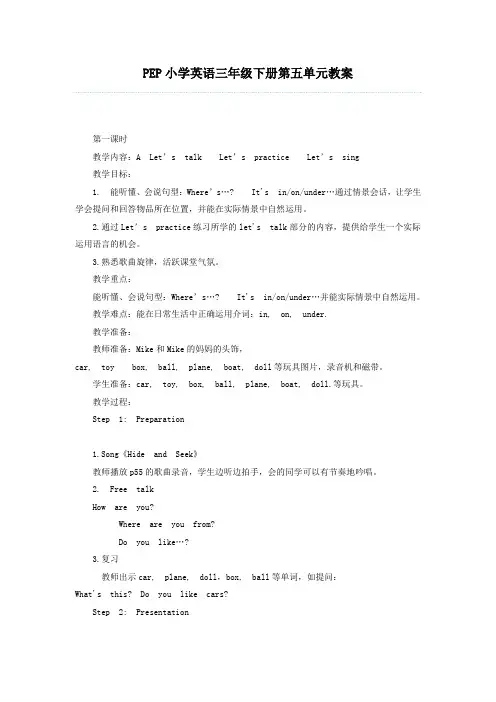
PEP小学英语三年级下册第五单元教案第一课时教学内容:A Let’s talk Let’s practice Let’s sing教学目标:1. 能听懂、会说句型:Where’s…? It's in/on/under…通过情景会话,让学生学会提问和回答物品所在位置,并能在实际情景中自然运用。
2.通过Let’s practice练习所学的let's talk部分的内容,提供给学生一个实际运用语言的机会。
3.熟悉歌曲旋律,活跃课堂气氛。
教学重点:能听懂、会说句型:Where’s…? It's in/on/under…并能实际情景中自然运用。
教学难点:能在日常生活中正确运用介词:in, on, under.教学准备:教师准备:Mike和Mike的妈妈的头饰,car, toy box, ball, plane, boat, doll等玩具图片,录音机和磁带。
学生准备:car, toy, box, ball, plane, boat, doll.等玩具。
教学过程:Step 1: Preparation1.Song《Hide and Seek》教师播放p55的歌曲录音,学生边听边拍手,会的同学可以有节奏地吟唱。
2. Free talkHow are you?Where are you from?Do you like…?3.复习教师出示car, plane, doll,box, ball等单词,如提问:What's this? Do you like cars?Step 2: Presentation1.复习完car, box, ball, plane, doll等玩具单词后,将这些玩具放在toy box 中,T: What's this?Ss: It's a box.(可以用汉语回答)T: Yes, It's a box . It's a toy box.. 然后手指里面的玩具说:They are toys. 领读并板书toy box., 指名读。
(湘少版)三年级英语下册《Unit 5 Period 3》教案设计
(湘少版)三年级英语下册《Unit 5 Period 3》教案设计一、教学目标1.学生能够认识、理解并正确运用本课时的重点单词和短语。
2.学生能够理解和运用本课时的日常用语。
3.学生能够听懂、朗读、理解本课时的对话,并能流利地进行类似的对话。
4.学生能够运用本课时学习的语言知识,进行交际表达,有效地表达自己的想法和意见。
二、教学重点1.认识、理解并正确运用本课时的重点单词和短语。
2.听懂、朗读、理解本课时的对话,并能流利地进行类似的对话。
三、教学难点能够理解和运用本课时的日常用语,有效地表达自己的想法和意见。
四、教学过程1. Warming-up教师打招呼并询问学生今天的感受。
通过聊天的方式建立师生关系,同时也为下面的学习做好铺垫。
2. Pre-reading通过播放一段3分钟的视频,让学生了解户外运动的乐趣和好处。
同时引导学生思考,为什么做运动对我们的身体好。
3. While-reading教师出示本节课的主要单词和短语,让学生进行朗读和记忆。
同时,播放视频让学生跟读,加深学生的印象。
4. Post-reading教师出示对话内容,让学生进行听说练习。
学生通过模仿和运用,更好地掌握语言知识。
5. Summary and Homework教师总结本次课的内容,让学生明确今日任务并布置作业。
作业要求学生录制一段一分钟的户外运动影像,并在下节课上交。
五、教学评估老师将根据学生的表现和作业完成情况进行评估。
作业要求学生按照指定要求进行完成,若未按要求完成,将扣除部分分数。
六、教学反思本次课重点突出,难点突出,教学策略灵活多样,以学生为中心,充分调动学生的积极性和主动性,创造了良好的课堂氛围。
但是,时间有些紧张,希望在下次教学中更好地把握时间,让学生有更充足的练习机会。
小学英语三年级下册第五单元教案4篇
小学英语三年级下册第五单元教案4篇小学英语三年级下册第五单元教案篇1教学目标:1.能听懂特殊疑问句What is this并能根据情况用It is a...回答。
2. 能使用特殊疑问句What is this向他人询问和确认某件物品,语音语调正确。
3. 能听懂,会说duck, cow, pig, dog, cat的单数形式,发音准确。
重点难点:1. 能听懂特殊疑问句What is this并能根据情况用It is a...回答。
2. 能使用特殊疑问句What is this向他人询问和确认某件物品,语音语调正确。
教学过程:一、Warmup1. Sing a song(歌曲营造活跃轻松的气氛。
)2. Read the words one by one.3. Each group introduces aname of animal themselves.(热身环节让学生复习学过的单词,为本课学习打下基础。
同时,发挥学生的主动性,让他们为自己组取一个动物名字进行小组竞赛。
有趣的同时,从一开始就培养他们的合作精神。
并由此开始了一个过程性评价。
)二、Revision1. Ask and answer.T: Do you like animals What is thisSs: It’s a dog.T: Now we are on a farm. Theclass is a farm.Ss: Ok.T: Let’s listen to the tape.T: Now read after teacher:What’s this(学生跟读句型,师相机纠正学生读音。
)Ss: Read one by one.T: What’s this (师出示动物图片,提问。
)Ss: It’s acow/dog/pig/cat/duck.2. A riddle: It’s an animal.It’s big. It has a big nose and big ears. It has small eyes.What is it3. Draw a pig on theblackboard.(通过问答,复习所学的动物名词。
人教版三年级英语下册第五单元教案
人教版三年级英语下册第五单元教案人教版三年级英语下册第五单元教案教学目标•掌握有关动物和宠物的词汇,如tiger、elephant、panda、cat、dog等;•通过听说读写的综合训练,提高学生的英语交流能力;•培养学生的观察力和动手能力。
教学重点和难点教学重点•掌握有关动物和宠物的词汇;•运用学过的句型进行简单的对话。
教学难点•用英语谈论个人喜欢的动物和宠物。
教学准备•PPT课件;•单词卡片或图片。
教学过程Step 1 导入新课1.Greet the students.2.Review the vocabulary of animals learned in the previousunit.Step 2 学习新词汇1.Present the new vocabulary of animals and pets usingflashcards or pictures.2.Teach the pronunciation and meaning of each word.3.Practice the new vocabulary through various activities,such as word guessing game or TPR (Total PhysicalResponse) activities.Step 3 听力训练1.Play a recording of animal sounds and have studentsguess which animal it is.2.Play a listening game where students listen todescriptions of animals and guess the correct animal. 3.Practice listening skills through sentence dictation orcompletion exercises.Step 4 口语练习1.Model a simple dialogue using the target vocabulary,such as “Do you like tigers?” - “Yes, I do. Tigersare my favorite animals.”2.Have students pair up and practice similar dialogueswith their classmates.3.Conduct group discussions where students share theirfavorite animals or pets and explain why they like them. Step 5 阅读训练1.Introduce a short reading passage about animals or pets.2.Read the passage aloud as a class and have studentsfollow along.3.Ask comprehension questions to check their understandingof the text.4.Have students read the passage individually or in pairsand answer related questions.Step 6 书写练习1.Review the names of animals and pets.2.Practice writing the names of animals and pets inEnglish.3.Introduce simple sentences related to animals and petsand have students practice writing them.Step 7 游戏活动1.Play a memory game where students have to remember thenames of animals and pets.2.Play a guessing game where students describe an animalor pet and others have to guess which one it is.3.Have students create their own mini story using thetarget vocabulary and share it with the class.Step 8 总结与作业1.Summarize the key points of the lesson and review thevocabulary.2.Assign homework, such as writing a short paragraph abouttheir favorite animal or pet.3.Encourage students to continue practicing their Englishoutside of the classroom.教学反思本节课主要围绕动物和宠物展开,通过听说读写的综合训练,帮助学生巩固和运用所学的词汇和句型。
三年级英语下册第五单元教案优秀教学设计
三年级英语下册第五单元教案优秀教学设计全文共3篇示例,供读者参考篇1Title: Lesson Plan for Grade 3 English Unit 5Objective:1. Students will be able to identify and use vocabulary related to nature.2. Students will be able to describe different weather conditions.3. Students will be able to ask and answer questions about the weather.4. Students will be able to write a short paragraph about their favorite weather.Warm-up (10 minutes):- Begin the lesson by showing students pictures of different weather conditions (sunny, rainy, cloudy, snowy, windy).- Ask students to name the weather in each picture and describe how they feel about it.- Review vocabulary related to weather by playing a game of charades where students act out different weather conditions.Introduction (15 minutes):- Introduce new vocabulary related to nature such as "flowers", "trees", "grass", "lake", "mountain", "river".- Show pictures of these items and ask students to repeat after you.- Use flashcards to reinforce the new vocabulary.Main Activity (30 minutes):- Divide the students into pairs and have them role-play asking and answering questions about the weather. For example, "What's the weather like today?" "It's sunny." "How do you feel about sunny weather?" "I feel happy."- Give students a worksheet with pictures of different weather conditions and have them write a short description of each.- Have students work in groups to create a short skit about a weather-related scenario.Closing (10 minutes):- Have students share their skits with the class.- Review the vocabulary and key phrases learned in the lesson.- Assign homework for students to write a short paragraph about their favorite weather.Assessment:- Observe students during the role-playing activities to assess their speaking and listening skills.- Review students' worksheets to check for understanding of vocabulary and writing skills.- Evaluate students' participation in the group activities and skit performance.Overall, this lesson plan aims to engage students in learning about weather and nature through interactive and hands-on activities. By incorporating a variety of learning styles and opportunities for practice, students will be able to confidently use and describe vocabulary related to weather and nature.篇2Grade 3 English Unit 5 Lesson PlanTheme: At the doctor'sObjectives:1. Students will be able to identify and recognize vocabulary related to visiting the doctor.2. Students will be able to understand and use simple present tense verbs in the context of going to the doctor.3. Students will be able to role-play a doctor-patient scenario using the vocabulary and language learned.Materials:- Flashcards of vocabulary words (doctor, nurse, patient, medicine, etc.)- Whiteboard and markers- Role-play props (stethoscope, bandages, thermometer, etc.)Warm-up:Begin the lesson by showing students flashcards of vocabulary words related to visiting the doctor. Have students repeat the words after you and try to guess the meaning of eachword. Encourage them to use gestures or facial expressions to convey the meaning if they are unsure.Lead-in:Write the following dialogue on the board:Doctor: Hello, how can I help you today?Patient: I feel sick. My head hurts and I have a fever.Doctor: Let me take your temperature and check your ears.Ask students to read the dialogue with you and discuss what is happening. Explain that they will be learning about visiting the doctor in today's lesson.Presentation:Introduce new vocabulary words related to visiting the doctor, such as symptoms (headache, fever, cough) and medical professionals (doctor, nurse). Use visuals and gestures to help students understand the meaning of each word. Have students repeat the words after you several times.Practice:Divide students into pairs and have them practice the dialogue from the lead-in activity. Encourage them to use thenew vocabulary words they have learned. Circulate around the room to provide assistance and feedback as needed.Role-play:After practicing the dialogue with a partner, have students choose roles (doctor or patient) and perform the dialogue in front of the class. Provide props such as a stethoscope, bandages, and thermometer to make the role-play more realistic. Encourage students to use the vocabulary and language learned in the lesson.Closure:To wrap up the lesson, review the new vocabulary words and language structures with the class. Have students give examples of when they might need to visit the doctor and what symptoms they might have. Encourage them to share their experiences and ask questions if they have any.Homework:For homework, have students write a short paragraph describing a visit to the doctor. They should include the symptoms they are experiencing, what the doctor did to help, and how they felt afterwards. Encourage students to use the vocabulary and language structures learned in class.Assessment:Assess students' understanding of the lesson by observing their participation in the role-play activity, their use of vocabulary words, and their ability to communicate effectively in English. Provide feedback to help students improve their language skills.Overall, this lesson plan is designed to engage students in learning about visiting the doctor in a fun and interactive way. By using a variety of activities and materials, students will be able to effectively communicate in English and gain confidence in using the language in real-life situations.篇3Grade 3 English Unit 5 Lesson Plan - Excellent Teaching DesignI. Objectives:By the end of this lesson, students will be able to:1. Understand and use vocabulary related to daily routines and activities.2. Construct simple sentences to talk about their own daily routines.3. Improve listening, speaking, reading, and writing skills in English.II. Materials:1. Flashcards with pictures of daily routines and activities.2. Whiteboard and markers.3. Worksheets with fill-in-the-blank exercises.4. A clock to demonstrate telling time.III. Warm-up (10 minutes):- Begin the lesson by greeting the students and asking them about their daily routines. Engage the students in a discussion about what they do in the morning, afternoon, and evening.- Show flashcards with pictures of different daily activities and ask students to identify them.IV. Presentation (20 minutes):- Introduce new vocabulary related to daily routines using flashcards. Practice pronunciation and spelling as a class.- Model simple sentences using the new vocabulary, such as "I brush my teeth in the morning" or "She eats breakfast before school."- Encourage students to ask questions using the new vocabulary, such as "When do you have lunch?" or "What do you do after school?"V. Practice (30 minutes):- Divide the class into pairs or small groups and have students practice making sentences about their own daily routines. Monitor and provide feedback as needed.- Use fill-in-the-blank worksheets for students to complete individually, focusing on the correct use of the new vocabulary in sentences.- Play a listening game where students listen to a series of sentences about daily routines and try to guess the missing word.VI. Production (20 minutes):- Have students create a daily routine schedule for themselves, including times and activities. They can draw pictures or use stickers to represent each activity.- Encourage students to share their schedules with the class, practicing speaking and listening skills.VII. Review and Assessment (10 minutes):- Review key vocabulary and sentence structures from the lesson. Ask students questions to check their understanding and retention of the material.- Assess students informally during class activities and provide positive reinforcement for correct answers and efforts.VIII. Homework:- Assign students to write a short paragraph about their daily routines, using the new vocabulary and sentence structures learned in class. Encourage creativity and personalization in their writing.IX. Extension:- For advanced students, challenge them to create a daily routine skit or role play with a partner. This will further practice speaking and listening skills in a fun and interactive way.Overall, this lesson plan is designed to engage students in meaningful language practice while learning about daily routines. By incorporating various activities and assessments, students will have the opportunity to develop their English skills in a comprehensive and enjoyable manner.。