
高中英语(外研版)选修八Module 3 Foreign Food教案 (1)
外研版高中英语Book 8 Module 3 Foreign Food Part One Teaching Design Period 1 Reading
Goals
●To learn about the variety of foreign food all across the globe
●Take advantage of the contexts in this module to first learn some practical words.
Meanwhile, develop the stu dents’ cultural abilities.
●As to the goal of this module, students should fold their thoughts about foods in
the world and the influence of foods on people. If possible, describe some Chinese typical dish and offer some health suggestions.
▇Procedures
St ep 1: Warming up by learning about “food” and learning to talk about food: Hello, class! Before we begin our reading of Module 3, let’s try to understand some famous quotations about food and their reactions to these sayings:
Warming up by thinking of the names of foreign food:
Boys and girls, can you think of as many as the names of food?
Step 2: Before you read
Please introduce the words for this module, paying attention to the pronunciation of
the words, the relationship between their pronunciation and spelling.
Practice for words study:
Ok, we are to have a spelling quiz. Read every sentence and fill the blanks with proper forms of the words in this module.
1) We use our____to speak and taste different smells.
2) The kings will hold a large state____for foreign guests.
3) Many high school students are____ with cyber games.
4) Before a meal, foreign people would like to drink some____ wine.
5) The Japanese invaders are____ enough in the world.
Step 3: While you read
1. Pre-reading
2. A diagram of the reading
3. Complete the articles with one word in each blank
(1)I think the Chinese people are o_ with food. I could know from the following e_ in
1998.This f_ meal consisted of many dishes. Plates are placed dangerously b_ one on top of another. I thought the first w_ of food was the t_ number to be served. I was wrong. Everyone else just t_ a bit of each dish and waited for more. I thought this amount could f_ an army. Besides, the Chinese seemed to like every part of animal, including ears, t_, tail and lungs. In the end, the b_ ended up with everyone full enough after eating so many Chinese d__.
(2)The next experience was in the c_ of a London publisher. I was a_ at the people’s graceful m_ while I stood feeling very c_. The waiter was serving food according to their r__. They were eating the cold l__ for the Chinese, for cold food represented p__. Once I o__ something strange. The things inside sandwiches and baked potatoes are also v__ kinds of mashed food. To me, I would never mash food into an u__ shape. Anyway, one thing I do a__ is the polite manner in which British eat, even if it is just a potato.
Step 4: After you read
1. Copy all the useful expressions into your Expression Book and make your own sentences with them.
Step 5: comprehension of the articles --- Do Activity 6 on Page 32
1. Pair the students to answer the questions, and then ask them to check their answers with another pair.
2. Call back the answers from the whole class, having one student read a question and another answer it.
Step 6: Intensive reading: Read the passage carefully and do activity 5 in pairs.
1. Ask the students to do this on their own, then check with a partner.
2. Call back the answers from the whole class, having a student read out the sentences then explain the difference in meaning.
Step 7: Revision of the words learned
1. Read through the words in activity4. Ask the students to match the words individually and then check with their partners.
2. Call back the answers from the class. Pay attention to their pronunciation while reading these key words. If possible, explain them in great detail.
Step 8: Do Activity 7 on Page 32 (summary of the reading part)
1. Classify the class into groups of four to discuss the questions. Appoint a delegate to present their views afterwards.
2. Call back the answers from the delegates for the class, and open the points up for class discussion widely.
Step 9: Post-reading
Step 10: Closing down by learning about foreign food。
高中英语外研版高中选修8Module3ForeignFood-教案
Book8 Module 3Foreign Food群文阅读语篇教学设计“基于核心素养,教学目标引领,提高课堂教学质量”主题语境:人与社会——跨文化沟通语篇类型:介绍性文章(多模态形式)授课时长:一课时(60分钟)一、教材分析:本模块采用题材、功能、结构和任务相结合的体系,彰显了教材的特点。
本课分为三个部分,第一部分为Module 8 Book 3 Reading and V ocabulary中的Passage1, 本文是记叙文,一个美国人用幽默的方式介绍了他在中国的感受到的几次饮食文化差异,这个部分为课堂的核心,采用不同的方式精讲,第二部分对课前预习部分的讲解,选自《阅读联播》教程,Eating Customs;是英国一家人来中国旅游,在北京体验到的不同饮食习惯差异;第三部分为Module 8 Book 3 中的Reading(2)Passage 3: An Embarrassing Moment. 讲述英国国王Edward vii为他的客人化解了一场餐桌礼仪的尴尬的故事。
该课把这三篇文章融为一体,目的是通过在不同的语境介绍不同的饮食文化差异,最终升华到一个主题意义,培养学生的批判思维,我们应该包容的姿态接受他人文化的唯一性,尊重文化的多样性。
二、学情分析高三学生已经具备了一定的阅读能力,词汇基础,文章的分析能力;虽然这三篇文章的题材都是记叙文,但是选8的教材在词汇上,语言表述上升了一定的难度,给学生设置一定的挑战性,而且本课堂的容量较大,目的是为了通过不同的文章找出它们的共同点,深化到相同的主题意义,理解文化内涵,表达自己的观点。
三、教学重点:四、教学难点:五、教学和学习方法六、课程资源:相关视频,课件,有关内容的资料,学生用导学案。
七、教学安排价。
外研版高中英语选修8教学课件 Module3 Foreign Food
cold food means 16.________ and you don’t give it to a guest.I alsomliexarned that the
(2)What impressed the writer most at the banquet? A.At first,everyone just tasted a bit of each dish. B.How bad a real Chinese banquet could be. C.The quantity of food served. D.He saw a kid cheerfully chewing a chicken’s head.
To my surprise,more dishes arrived.There was enough tfoee5d.________ a whole armays.pAenctother 6.________ of “food culture” is that the Chinese seem to epaatrat lmost every 7.________ of every anhimorarol—r much to the 8.________ of many westerners.And there are other kinds of foods thatahcacevpet taken longer for me to 9.________ex.Tahmeplienfamous choudoufu is an 10.________.
外研新标准-选修八-Module 3 Foreign Food

Module 3 Foreign Food教学设计Step 1 RevisionFinish the Ex. in Web.Step 2 Function1.Finish Activity 1.2.Discuss the answers to Activity 1.3.Pair work: discuss and finish Activity 3 and 4.4.Group work: Discuss Activity 2, Give answers as many as possible.Step 3 Grammar定语的种类形容词作定语I thought this vast wave of food was the total number of dishes to be served.His words moved everyone present.代词作定语Our government tries every possible means to satisfy our needs.What problem do you have in learning a foreign language.数词作定语English is spoken as an official language in more than sixty countries across the world.Over two hundred auto workers are not on strike.名词或名词所有格作定语I still remember what I ate: a tuna fish and cheese sandwich.In many homes, the willow pattern plates are kept for special occasions, when important guests come to dinner.Where is the president’s office?分词作定语The rising sun in the early morning looks bigger than the one at noon.Do you know the girl singing over there?There are lots of fallen leaves in autumn.The man badly wounded in the stomach lay on the ground, motionless.动词不定式作定语The letters to be delivered to the manager arrived five minutes ago.He is always the first person to leave the office.介词短语作定语One evening, he was entertaining the ruler of a small island in the Pacific.Antarctica is the coldest place on earth.副词作定语He was then president of the company.The food here goes against the Chinese sense of beauty and style at the dinner table.词组或合成词作定语With a face all smiles he told me that he had done well in the experiment.Is there anything the matter with you?Who is that blue-eyed girl?There are more well-to-do families now.从句作定语The perfect host is the one who saves his guest from embarrassing whatever the cost.Yet Antarctic is full of wildlife, which has adapted to its extreme conditions.Step 4 Homework1.Finish the Web Ex. on grammar2.Ex 2 as homework in Ex. Book.。
外研版高中英语选修8《Module 3 Foreign Food》课件设计
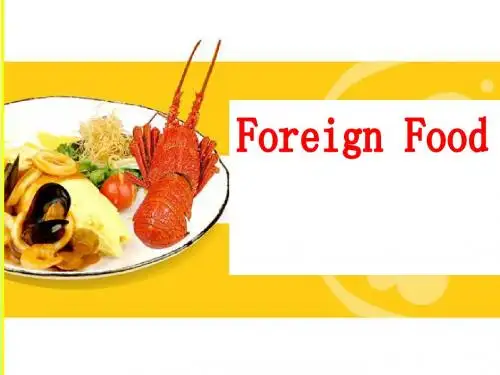
• 1) The Chinese always prepare the food carefully.
• F2) TThhee Chineesseeaat thtehebabnaqnuqeut aeteajtuestjuasbtiat obfiteovefry
• deivsehrbyedcaisuhsebtehceyauksneewthtehyerdeiwdenr’et tsatislltemganoyodd.ishes to come / to be served.
• 3) The fact that Chinese tend to eat every part of
• every animal shocks many Westerners.
• 4) When asked for pigs’ ears, the American guy at
• the meat count was confused by the writer.
Step 2 Careful reading
• 1. Why couldn’t the author make out the Because all the food was mixed together.
• food contained in the boxes?
• 2. WThheaBt rairteishthceondsiifdfereitnnt oartmtitauld, es to cold • fwohoidle btheetwCeheinneBsertithiisnhkaitn’sdimChpionlietes.e?
end up successful one day.
Step 4 Fill in the blanks
高中英语外研版高中Module 3 Foreign Food教案
Lesson PlanBook8Unit 3 Foreign FoodThe Willow Pattern Plate授课教师:彭杰所用教材:高中三年级第八册外语教学与研究出版社The analysis of Teaching material:Module 8 Reading and VocabularyType: Reading .Topic: The Willow Pattern PlateThe analysis of the studentstotal 41 students, Class 2.students of this stage are quick in thought and they are eager to show what they know and they have a certain ability to read. And they are very active, curious, express their ideas, and they are willing to take part in various classroom activities and like to work together with their classmates.Teaching aims:aims: Students will master the main idea of the passage and know the basic contents of The willow Pattern Plate through different reading skills.aims: Students will be able to retell the main idea of the passage and can express their attitude towards the works of art and the development of China in their own words.aims: Students will strengthen the love of ancient Chinese art treasures, become independent and self-improved, learn to cooperate and cultivate the sprite of creating a better world.Key points:Students will grasp the main idea of the passage and be familiar with the basic contents of The willow Pattern Plate rough extensive reading.Difficult pointsStudents will be able to retell the main idea of the passage and can express their views about the work of art.Teaching and learning methodsTask-based language teaching methodCooperative and independent learning methodsTeaching proceduresStep1:lead-inShow student pictures about different food culture between China and European countries. and ask them questions :Q:What have we learned about different food culture in the last lesson?(Brainstorm) Step2:pre-readingShow the key word-plate and ask students to predict what will be talked about in the passage.Q:What’s the features of the plate?Step3:while-reading①skimming: Ask the students questions and lead to sentence structure.:Q: what is the main idea of the passage.Q: how is the passage organized.Let them divide the passage.②scanning: Ask students to find answers to fill in the table:SubjectOriginChineseelements③Intensive readingLet Students describe the story and learn the plot briefly.④Make a summary.Fill in the blanks and retell the story.The willow pattern plate ___ ___ the willow tree in the centre. It's one of the best-known designs on ____ plates, but it ____ from Chinese designs. In about 1780,ships _____ Chinese tea and plates traveling between China and European countries. Josiah Spode ____ elements from different Chinese designs and ________ the most famous plates. He _______(design)a bridge, a boat, a _______and a__ in the foreground, ______(add) two songbirds. From the depiction, we have a better understanding of the heartbreaking love story. The lovers, Kun Xi and Chang, were forced to ____ _____and killed in the fire. At last, their souls _____ ________ ______songbirds in the sky.Step4:Make a conclusionStep5: homeworkexercise book—Period 6new words.Step6:Blackboard layout。
外研高中选修八 Module 3 教案 1
她把成功归功于幸运。
The young writer owed his success to his teacher's encouragement.
年轻作家把自己的成功归于他老师的鼓励。
I owe him ten dollars.
按规定我们都要到场。
It requires that ...有...的必要
require sth. of sb.
对某人有...的要求
require sb. to do sth.
要求某人做某事
4.contain
Pig iron may contain 4%of carbon.
生铁可含百分之四的碳。
At the sight of this cruelty, he could hardly contain his anger.
所有乘客都必须出示车票。
We did all that was required of us.
我们做了要求我们所做的一切。
The emergency requires that it should be done.
情况紧急,非这样做不可。
The rules require us all to be present.
介绍的方式很重要。
He had an absent-minded manner.
他表现出心不在焉的样子。
Mind your manners.注意礼貌。
She has written a book on theБайду номын сангаасmanners and customs of the ancient Egyptians.
外研版高中英语选修8 Module 3《Foreign Food》(第1课时)ppt课件
• I_____________________I finished my work in time.
• (3)由于糟糕的天气,足球比赛被取消了。 • ________________the bad weather,the
football match was called off. 课堂讲练7C互中动小学课件
• 11.佳肴,珍馐(dnel.i)c_ac_y______→美d味elic的ious
(adj.)________
infamous
famous
• 12.臭名昭著的,声名狼籍app的etising
(aadppje.)ti_te________→著名的(adj.)________
• 13.开胃的,增进食欲的
课堂讲练7C互中动小学课件
• (4)(常与of连用)有……的味道
• This soup tastes of chicken.
• 这汤有鸡的味道。
• (5)体验;领略;经历
• to taste the joys of freedom
• 领略自由的欢乐
• 注意:
• taste可作系动词,意为“尝起来”;无被动
课堂讲练7C互中动小学课件
• 知识拓展 • (1)owe一般不用于进行时态,也不用于被动
语态。 • (2)owing adj. 拖欠的;未付的;未偿还的 • own vt. 拥有;adj. 自己的 • owing to prep. 因为;由于
课堂讲练7C互中动小学课件
a cold. • 我的味觉不是很好,我感冒了。 • ②Chocolate has a sweet taste. • 巧克力有甜味。 • (2)欣赏力;鉴赏力;体验;经历
高中英语(外研版)选修八 Module 3 Foreign Food学案 (1)
Module 3 Foreign Food学习目标: 掌握重点词汇短语,了解和交通环境问题相关的表达。
学习重点:词汇的学习和积累学习难点:写一篇关于人们日常饮食方面的短文,和小组讨论并提出建议。
学法指导:自主学习,借助辞典和考试报预习,并将不明白的问题划出。
合作探究学习,通过组员之间或者组间的合作去完成较难问题。
情感态度与价值观:了解国外人们生活饮食,提出一些可行性建议,热爱生活,保护环境。
words period 11.eggplant .n. ( c ) dark purple but occasionally white or yellow2.lemon .n.Bottled lemon juice is no good you must use the real thing.3.bakery .n. ( c ) The bakery serves us with fresh bread daily.4.loaf .n.A loaf of breadHe bought a loaf of bread.Half a loaf is better than no bread..5.artificial adj—not made of natural materials or substancesIt was not until1884 that the first artificial fiber was made.假的,伪造的I was fitted an artificial tooth by the dentist.I can't stand his artificial smiles.7.CustomerWe aim to offer good value and service to all our customers.We've had several letters from satisfied customers.Regular customer He's one of our r egular customers.best/biggest/largest customerThey are one of our biggest customers.awkward/tricky/tough etc customer8.pan ,n,--[countable] 1Cook the pasta in a large pan of boiling water.a frying panI cracked two eggs into the frying pan.9. owe vt.① owe sb sth / owe sth to sbI owe the landlord one hundred dollars. / I owe one hundred dollars to the landlord.②(to) We owe a lot to our parents.He gave me a lot of help. I owed much to him.③ [(+to)] owe sth to sth /sbHe owes his success to good luck.。
外研版高中英语选修8 Module3教案高二外研选修8 Module 3 Foreign Food教案
Module 3 Foreign Food I.模块教学目标III. 教材分析与教材重组1. 教材分析本模块以Foreign Food为话题,通过与饮食文化相关的材料反映了世界各地饮食文化的差异和丰富多彩,从而激发学生的学习兴趣和了解世界饮食文化的愿望,使他们更加热爱生活,追求生活中美好的事物。
本模块所选内容贴近学生生活,教师可以借助听、说、读、写和讨论等一系列扎实有效的教学活动,充分调动学生的积极性,提高其语言运用能力。
1.1 INTRODUCTION 以几幅食物图片切入话题,然后让学生讨论有关食物的谚语,为后面的阅读做好铺垫。
1.2 READING AND VOCABULARY(1)中包括两篇文章:第一篇文章主要通过一个美国人第一次参加中国宴席和吃臭豆腐的经历以及他对于中餐从吃惊到接受的过程,反映了中餐的特点和东西方饮食文化的差异;第二篇是描述一个中国人第一次在英国吃“西餐”的经历,以及因饮食文化的差异所引发的感受。
从这两篇文章,我们可以看出中西方饮食文化的差异。
两者各有千秋,“中餐”种类丰富,味美可口,而“西餐”似乎很简单,但餐桌礼仪却值得我们借鉴学习。
这两篇文章语言简练,幽默风趣。
与课文相关的练习Activities 1 and 3 要求学生采用快速浏览的方法确定相关的主题,潜移默化中培养学生skimming 这一重要阅读技巧;Activities 4 and 5 要求学生掌握与课文相关的语言知识;Activities 6 and 7 要求学生进一步理解课文并在此基础上进行讨论。
1. 3 GRAMMAR 分两部分。
GRAMMAR(1)旨在通过一系列语法练习,使学生掌握单词、短语和不定式,-ing形式, -ed形式作定语的用法。
GRAMMAR(2)通过多种形式的语法练习,要求学生掌握定语从句中的关系词及非限制性定语从句的用法。
教师可在此基础上做些拓展性和巩固性练习设计。
1. 4 VOCABULARY AND LISTENING和SPEAKING两部分有两项任务:一是听有关英国餐桌礼仪方面的文章录音,然后完成与录音内容相关的练习;二是就中西方餐桌礼仪的不同分组讨论并回答问题。
外研版高中英语选修八Module 3Foreign FoodGrammar学案1
Module 3 Foreign FoodPeriod 2 Grammar 1+Grammar 2+ Everyday English►Grammar (1) + Grammar (2) -- Review of attributes★讲解1 :定语是修饰名词的成份,作定语的可以是单词(名词、代词、数词和形容词)、短语(不定时短语、分词短语、介词短语和句子(用作定语的句子就是定语从句)。
一般单个的单词作定语放在该修饰名词之前,短语和句子放在该修饰名词之后。
1)Tell me about the person in charge of your class.2)The first people to arrive in American were Indians.3)Tell the students lying in bed to get up right away .4)The man wounded badly in the stomach needs to be sent to hospital as soon as possible.△做做看:1) When we plan our vacation ,mother often offers ________suggestion.A carefulB practicalC effectiveD acceptable2) Mr.Smith,_______ of the ______speech , started to read a novel.A tired, boringB tiring ; boredC tired ; boredD tiring ; boring3) Their cheerful voice showed that they were having a ________discussion.A noisyB seriousC completeD friendly★讲解2 :done/ to be done /being done 作定语的区别:1)The building built last year is our classroom building.2)The building to be built next year is our computer centre.3)The building being built now is our library .总结之用法:1)2)3)★讲解3:关系代词which 和that 的区别:1) 非限制性定语从句只用which2)当先行词为不定代词或被不定代词来修饰时(all ,everything ,anything nothing everybody 等),只用that3) 先行词被形容词最高级或no, the only ,the very ,the last 等来修饰时,只用that4) 先行词即指人又指物时,用that★讲解4引导非限制性定语从句的which 和asA )AS 后常接expect, know ,report ,say , see, 等动词的被动语态和happen的主动语态,有“正如;像”的意思As is known to everybody , the moon travels round the earth once every month. B)which 一般仅用来指代前面整个句子,不用在句首Tsunami is so terrible that it always causes great losses , as has happened in some countries in south-east Asia.He is quite pleased , as/ which can be seen from his face.★讲解5:介词+关系代词whom/which引导的定语从句:介词的选择遵循4个基本原则:1)根据定语从句的谓语动词:Is this the car for which you paid a high price .2)根据定语从句的形容词The two things about which Karl Marx was not sure were the grammar and some of the idioms3)根据定语从句的先行词This is the pilot for whom I bought a camera.This is the pilot with whom my brother has worked for ten years.This is the pilot by whom my son was saved.4)根据句子的意思This is the school in which I studied three years ago.△做做看:1)There are two buildings, _______stands nearly a hundred feet high .A the largerB the larger of themC the larger one thatD the larger of which2) The journey around the world took the old sailor nine months ,______The sailing time was 226 days.A of whichB during whichC from whichD for which3)Is this the reason ______ at the meeting for his carelessness in his work ?A he explainedB what he explainedC how he explainedD why he explained►Language points of Grammar 21 eat up all the food2 pay a compliment to the chef3 AS he grew up , he found American food compared to his mother’s cooking.( Activity 3 )4 make Italian pasta dishes ( Activity 3 )5 lie east of Australia (Activity 4)6 take-away food (Activity 5)►Everyday English1 As a rule 一般说来2 goes without saying 不用说/显然,当然3 make a beeline 径直朝某地走去4 on close terms with 与。