
冀教版八年级英语下册各课知识点总结
Unit 1 短语: 1. be scared of sb./sth./doing sth. Be scared to do sth.(L 1) 2. have /have a shower(L 1) 3. neither...nor... (L2) 4. on one’s /the way to... (L2) 5. A field trip (L2) 6. run around (L2) 7. play on the swing(s) (L2) 8. one by one (L3)→year by rear,day by day,step by step...... 9. go for walks (L3) 10. long for (L4) 11. all year around (L4) 12. plenty of (L4) 13. think of (L4) 14. feel like (L4) 15. because of (L4) 16. hundreds of (L4) 17. turn around →turn in /turn down/turn on/tune up/turn off/turn into/turn to (L5) 18.come down→come in/out/back/on (L5) 18. give sb. a push (L5) 19. look like→look at/for/after/over/up/out (L5) 20. hold on (L5) 21. fall off与 fall down (L5) 22. instead of (L5) 23. Take care of =look after (L5) 24. not... any more (L5) 25. Not A to B 直到B才A (L5) 26. so much与 so many (L5) 句型: 1. What’s the weather like ?=How is the weather? (L 1) 2. I hope not!(L 1) 3. see sb. doing /do sth. (L2) 4. practice doing sth. (L2) 5. look forward to sth./doing sth. (L12) Unit 2 短语: 1. cover B with A 用 A 覆盖 B→ be covered with... (L7) 2. worry about =be worried about (L7) 3. turn into=change into (L7) 4. for sure →be sure to do sth./be sure of sth./be/make sure that (L7) 5. fill A with B用 B 把A 装满 (L7) 6. by the way →in the way/on the way to/in a way(在某种意义上)/by way of(经由)(L7) 7. be made up of (L7) 8. take energy from (L8) 9. carry away (L8) 10.in a word (L8) 11.be made from →be made of/be made in (L8) 12.in the shade (L8) 13.the best way to do sth.(L9) 14. at work (L9) 15.log into 登录 (L9) 16.make sure (L10) 17.keep away from (L10) 18.best of all (L10) 19.close up (L11) 20.open up (L11) 21.as long as (L11) 22.at the top of=on the top of (L12) 句型: 1. help (to) do sth./help sb.(to) do sth./help sb.with sth. (L8) 2. make sb do sth. (L8) 3.show sb.sth.=show sth.to sb. (L9) 4.Have fun doing sth. (L9) 5.decide to do sth. (L10) 6.try to do sth. (L10) 7.consider doing . (L10) 8.continue to do/doing sth. (L11) 9.send sth. to sb. (L12) 10.come to doing sth. 做某事 (L12) Unit 3 短语: 1. go on a vacation (L13) 2. up to (L14) 3. be famous for →be famous as (L14) 4. escape from (L16) 5. April Fools’ Day (L16) 6. play a trick on sb.→play a joke on sb.(L16) 7. the number of与 a number of(L16) 8. at the beginning of (L17) 9. drop to (L17) 10. in blance (L17) 11. cut down (L17) 12. as well (L17) 13. in danger→in trouble (L17) 14. learn about sth. (L18) 15. touch one’s heart (L18) 16. stay health/keep health (L18) 句型: 1. ask sb. (not) to do sth. (L13) 2. remind sb. of sth. (L14) 3. avoid doing sth. (L14) 4. not only A but also B (L14) 5. No photos ! (L15) 6. feed sth . to ....../feed on sth. (L15) 7. Protect A from/against B保护 A免遭B(L16) 8. stop A from doing B→keep...from doing sth. →prevent ...from doing sth. (L16) 9. warn sb.about sth. (L18) 10. used to doing sth. (L18) Unit 4 短语: 1.use sth. to do sth. (L19) 2.chat with sb. (L19) 3.more than =over→less than (L19) 4.seach for 搜索、寻找 seach....for 搜索。。。来寻找。。。 (L20) 5.the key to... (L20) 6.depend on (L20) 7.search engine (L20) 8.in ancient times (L21) 9.pass on (L21) 10.write down (L21) 11.by hand (L21) 12.grow up (L22) 13.come true (L22) 14.be able to (L23) 15.stay in touch with =keep in touch with (L23) 16.stay up (L23) 17.be harmful to (L23) 18.set up a time (L24) 句型; 1. begin to do sth. (L19) 2. keep on doing sth, (L21) 3. get sb./sth + 过去分词 使某人/某物被。。。;使某人/某物处于。。。状态 (L23) 4. prefer sth./prefer to do sth./prefer doing A to doing B (L24) Unit 5 短语: 1. make money (L 25) 2. come up to (L 26) 3. for sale (L 26) 4. go /walk over to (L 26) 5. tie...... into...... (L 26) 6. business English (L 27) 7. be different from (L 27) 8. make sense (L 27) 9. move up (L 27) 10. beef up (L 27) 11. hear of=hear about (L 27) 12. help yourself →help yourself...... (L 28) 13. on time(L 28) 14. Be surprised to do →be surprised at→in surprise →by surprise →to one’s surprise(L 28) 15. push a product(L 29) 16. stand out(L 29) 17. catch one’s eye (L 29) 18. have an interested in=be interested in(L 29) 19. get to 渐渐(L 29) 20. sell out of(L 30) 21. less than(L 30) 句型: 1. What .....for ? (L 26) 2. afford to do sth. (L 26) 3. try/do one’s best to do sth.(L 28) 4. succeed in doing sth.(L 29) Unit 6 短语: 1. stand on one’s foot(L 31) 2. set a new world record(L 31) 3. break a record→hold a record(L 31) 4. be full of (32) 5. every four years (33) 6. take part in(33) 7. both......and..... (33) 8. take place (33) 9. no matter (34) 10. stay the same (34) 11. one’s own (34) 12. stand for (34) 13. have an influence on (35) 14. time after time (35) 15. do one’s best =try one’s best (35) 16. as a result (36)
八年级冀教版英语知识点

八年级冀教版英语知识点随着国家对英语学习的重视,学生的英语学习也愈发重要。
在八年级的学习中,冀教版英语是一种非常普及的学习方式。
本文将详细介绍八年级冀教版英语的各个知识点,帮助学生更好地掌握英语。
一、语法语法是英语学习的重要基础。
在八年级中,学生应该重点学习以下语法:1. 时态:继续进行时、过去进行时、现在完成时、过去完成时等。
2. 从句:名词性从句、定语从句、状语从句等。
3. 单词和词组的用法:情态动词、连词、比较级和最高级、副词等。
二、听力听力是英语学习的重要一环。
在八年级中,学生需要通过听力来提高听力能力,并能够理解语音、语调、典型表达等。
学生可以通过以下方式来提高听力:1. 多听英语听力材料,比如电视节目、电影、音乐等。
2. 记下生词和难点后进行复述。
3. 做听力训练题目。
三、阅读阅读是英语学习中提高语感、增加可理解力的途径之一。
八年级英语的阅读主要包括课本阅读和外部资料阅读。
学生可以通过以下方式增强阅读能力:1. 阅读课本中的文章,摘要词和语法,理解文章大意。
2. 阅读与所学内容相关的材料,如新闻、故事、科普文章等。
3. 多做阅读题目,了解文章的细节和深层含义。
四、口语口语是英语的重要组成部分,也是考察英语能力的重要方面之一。
在八年级中,学生应该以正确发音、适当语调、丰富词汇和流畅语句为目标。
学生可以通过以下方式来提高口语:1. 练习朗读短文和对话。
2. 观看英文电影和电视节目,并模仿演员的口音和语速。
3. 参与英语口语角。
五、写作写作是英语学习的一个重要方面。
在八年级中,学生应该掌握范文结构和常见英文写作形式,如书信、日记、演讲稿等。
学生可以通过以下方式来提高写作水平:1. 学习范文,了解结构和用词的技巧。
2. 利用所学的语言知识,动手写日记和信件等。
3. 掌握基础的写作句型和词组,磨练写作技巧。
以上是八年级冀教版英语的知识点介绍,希望能帮助学生更好地掌握英语。
无论是语法、听力,阅读、口语还是写作,都需要学生不断努力,坚持练习。
冀教版八年级下册英语第一课知识点

冀教版八年级下册英语第一课知识点
词汇:课文中会出现一些新的词汇,需要学生掌握它们的意思和用法。
例如,"festival"(节日)、"tradition"(传统)、"decorate"(装饰)、"lantern"(灯笼)等。
语法:本课主要涉及到现在进行时态的用法。
学生需要了解现在进行时的构成和用法,即be动词(am/is/are)+动词的现在分词形式。
例如,"I am reading a book."(我正在读一本书。
)
句型:学生需要掌握一些常用的句型,如肯定句、否定句和疑问句的构成和用法。
例如,"She is decorating the house."(她正在装饰房子。
)"They are not playing football."(他们不在踢足球。
)"Are you watching TV?"(你在看电视吗?)
阅读理解:学生需要通过阅读理解课文中的内容,回答相关的问题。
这有助于提高学生的阅读理解能力和语言理解能力。
文化知识:本课还涉及到中国传统节日——元宵节的相关知识。
学生需要了解元宵节的起源、庆祝方式以及与之相关的传统习俗。
冀教版八年级下册英语知识点单元归纳总结
冀教版八年级下册英语知识点单元归纳总结1.Some people are scared of spiders。
XXX.2.The sun goes up in the XXX.3.The children were making a lot of noise while playing.4.We arrived in Beijing last night。
We will arrive at the train n in ten minutes。
We will be there soon.5.I XXX't leave the party until midnight.6.I saw my friend reading a book and ped to say hello.7.XXX.8.He hit me on the head when we were playing。
She hit him in the face when they were arguing.9.He turned around to see who was calling his name.10.XXX.11.He gave me a push to help me start running.12.Can you help me with my homework。
Can you help me do my math problems?13.We got off the bus at the next。
14.I XXX and how much I miss her.15.They worked all day on the project and finally finished it.16.The students lined up one by one to get their books signed.17.Please hold on and I will transfer your call to the correct department。
冀教版八年级英语下各课知识点总结计划
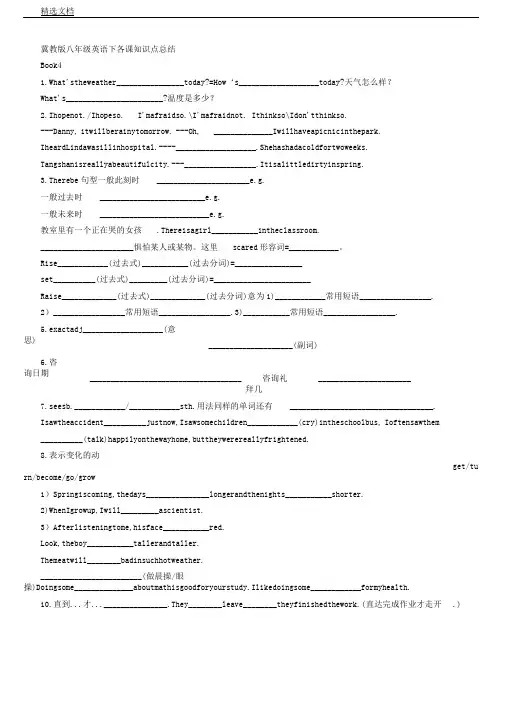
冀教版八年级英语下各课知识点总结Book41.What'stheweather________________today?=How‘s___________________today?天气怎么样?What's_______________________?温度是多少?2.Ihopenot./Ihopeso. I'mafraidso.\I'mafraidnot. Ithinkso\Idon'tthinkso.---Danny, itwillberainytomorrow. ---Oh, ______________Iwillhaveapicnicinthepark.IheardLindawasillinhospital.----___________________.Shehashadacoldfortwoweeks.Tangshanisreallyabeautifulcity.---_________________.Itisalittledirtyinspring.3.Therebe句型一般此刻时______________________e.g.一般过去时_________________________e.g.一般未来时__________________________e.g.教室里有一个正在哭的女孩.Thereisagirl___________intheclassroom.______________________惧怕某人或某物。
这里scared形容词=____________。
Rise____________(过去式)___________(过去分词)=________________set__________(过去式)_________(过去分词)=_______________________Raise_____________(过去式)_____________(过去分词)意为1)____________常用短语_________________.2)_________________常用短语_________________.3)___________常用短语_________________.5.exactadj___________________(意思)____________________(副词)6.咨询日期__________________________________________________________咨询礼拜几7.seesb.____________/____________sth.用法同样的单词还有__________________________________.Isawtheaccident__________justnow,Isawsomechildren____________(cry)intheschoolbus, Ioftensawthem__________(talk)happilyonthewayhome,buttheywerereallyfrightened.8.表示变化的动get/tu rn/become/go/grow1)Springiscoming,thedays_______________longerandthenights___________shorter.2)WhenIgrowup,Iwill_________ascientist.3)Afterlisteningtome,hisface___________red.Look,theboy___________tallerandtaller.Themeatwill________badinsuchhotweather.________________________(做晨操/眼操)Doingsome______________aboutmathisgoodforyourstudy.Ilikedoingsome____________formyhealth.10.直到...才..._______________.They________leave________theyfinishedthework.(直达完成作业才走开.)冀教版八年级英语下各课知识点总结11.表示穿着________加颜色,或加颜色衣服。
(2021年整理)冀教版八年级下册英语知识点单元归纳总结

(完整版)冀教版八年级下册英语知识点单元归纳总结编辑整理:尊敬的读者朋友们:这里是精品文档编辑中心,本文档内容是由我和我的同事精心编辑整理后发布的,发布之前我们对文中内容进行仔细校对,但是难免会有疏漏的地方,但是任然希望((完整版)冀教版八年级下册英语知识点单元归纳总结)的内容能够给您的工作和学习带来便利。
同时也真诚的希望收到您的建议和反馈,这将是我们进步的源泉,前进的动力。
本文可编辑可修改,如果觉得对您有帮助请收藏以便随时查阅,最后祝您生活愉快业绩进步,以下为(完整版)冀教版八年级下册英语知识点单元归纳总结的全部内容。
(完整版)冀教版八年级下册英语知识点单元归纳总结编辑整理:张嬗雒老师尊敬的读者朋友们:这里是精品文档编辑中心,本文档内容是由我和我的同事精心编辑整理后发布到文库,发布之前我们对文中内容进行仔细校对,但是难免会有疏漏的地方,但是我们任然希望(完整版)冀教版八年级下册英语知识点单元归纳总结这篇文档能够给您的工作和学习带来便利.同时我们也真诚的希望收到您的建议和反馈到下面的留言区,这将是我们进步的源泉,前进的动力。
本文可编辑可修改,如果觉得对您有帮助请下载收藏以便随时查阅,最后祝您生活愉快业绩进步,以下为 <(完整版)冀教版八年级下册英语知识点单元归纳总结〉这篇文档的全部内容。
冀教版八年级英语下册知识点归纳Unit 11。
be scared of sb./sth。
恐惧某人/某物2。
go up 上升,与rise 同义,与go down 或set 相反3. make a noise 发出声响,吵闹4. arrive in 到达,表示到达某一城市、国家等大地方时,用介词in;表示到达某一村庄、车站等小地方时,用介词at ;到达的地方用副词表示时,可不用介词。
5。
not…until…直到……才……6。
see…doing…停止做某事7. go cycling 相当于 go to ride a bike ,意思是去骑车.8. nit sb. on the head 表示“打某人的头",表示的“打某人的脸”要用hit sb。
冀教版八年级下册英语18课知识点
冀教版八年级下册英语18课知识点全文共3篇示例,供读者参考篇1Knowledge points of Lesson 18 in Jibei Edition Grade 8 EnglishLesson 18 of the Jibei Edition Grade 8 English textbook covers a variety of topics related to leisure activities, travel, and hobbies. In this lesson, students will learn about different types of hobbies, how to talk about their leisure activities and interests, as well as some vocabulary related to travel. Let's take a closer look at the key knowledge points of this lesson:1. Hobbies:- Vocabulary related to hobbies, such as painting, playing chess, reading, collecting stamps, etc.- How to talk about your hobbies using phrases like "I enjoy...", "I like...", "My favorite hobby is...", etc.- Expressing preferences and opinions about hobbies, such as "I prefer painting to playing chess," "I think reading is more interesting than watching TV," etc.2. Leisure activities:- Vocabulary related to leisure activities, such as hiking, swimming, biking, etc.- How to talk about your leisure activities using phrases like "I often go...", "I enjoy...", "One of my favorite activities is...", etc.- Describing how often you do certain activities, such as "I go swimming twice a week," "I like hiking on weekends," etc.3. Travel:- Vocabulary related to travel, such as airport, hotel, ticket, suitcase, etc.- How to talk about your travel experiences using phrases like "I went to...", "I stayed at...", "I traveled by...", etc.- Asking and answering questions about travel plans, such as "Where did you go on your last vacation?" "How did you get there?" "Where did you stay?" etc.Overall, Lesson 18 is focused on improving students' ability to talk about their hobbies, leisure activities, and travel experiences in English. By mastering the vocabulary and phrases related to these topics, students will be able to communicate more effectively about their interests and experiences in English.篇2Knowledge Points of Lesson 18 in Grade 8 English TextbookLesson 18 in the Grade 8 English textbook is a important lesson that covers a variety of knowledge points. In this lesson, students will learn about new vocabulary words, grammar structures, and reading comprehension skills. Let's break down some of the key knowledge points of this lesson:1. Vocabulary:In Lesson 18, students will be introduced to new words and phrases related to sports and hobbies. Some of the key vocabulary words include: exercise, competition, tournament, coach, champion, athlete, referee, leisure, etc. Students should practice using these words in sentences to improve their vocabulary skills.2. Grammar:In terms of grammar, Lesson 18 focuses on the use of comparative and superlative adjectives. Students will learn how to compare two or more things using words like "more", "less", "better", "worse", "best", "worst", etc. For example, "Swimming is more popular than basketball" or "Tennis is the best sport for me".3. Reading Comprehension:The reading passage in Lesson 18 is about the benefits of playing sports and hobbies. Students will practice reading for main ideas, details, and inferences. They will also learn how to summarize the key points of a text and express their own opinions about the topic.4. Writing Skills:In the writing section of Lesson 18, students will have the opportunity to write a short paragraph about their favorite sports or hobbies. They will practice using descriptive language, organizing their ideas coherently, and using proper grammar and punctuation.Overall, Lesson 18 is a comprehensive lesson that covers a wide range of knowledge points in English. By mastering the vocabulary words, grammar structures, reading comprehension skills, and writing strategies in this lesson, students will bewell-equipped to communicate effectively in English and develop their language proficiency.篇3Knowledge Points of Lesson 18 from the Eighth Grade Book of Hebei Education EditionLesson 18 of the eighth grade book in the Hebei Education Edition covers various important knowledge points related to English language learning. In this lesson, students will focus on vocabulary, grammar, and reading comprehension. Let’s explore the key knowledge points in this lesson.Vocabulary:1. Weather-related vocabulary: Students will learn words such as sunny, cloudy, rainy, snowy, windy, and stormy. They will understand how to describe different types of weather using these words.2. Clothing vocabulary: Students will learn words for different types of clothing items such as coat, sweater, scarf, boots, hat, and gloves. They will be able to identify and describe various clothing items in English.3. Action verbs related to weather: Students will learn verbs such as shine, rain, snow, blow, and storm. They will understand how to use these verbs to describe different weather conditions.Grammar:1. Present Continuous Tense: Students will learn how to form sentences using the present continuous tense to describe actions happening at the moment or around the present time.They will understand the structure of this tense and how to use it correctly in sentences.2. Adverbs of Frequency: Students will learn adverbs such as always, usually, often, sometimes, rarely, and never. They will understand how to use these adverbs to describe how often different activities or events occur.Reading Comprehension:1. Students will read a passage about a weather report and answer questions related to the weather conditions described in the report. They will demonstrate their understanding of the vocabulary and grammar points covered in the lesson by answering these questions accurately.2. Students will also be asked to write a short paragraph describing the weather in their city using the vocabulary and grammar structures they have learned in the lesson. They will practice using the new language skills they have acquired to communicate effectively in English.Overall, Lesson 18 of the eighth grade book in the Hebei Education Edition is designed to help students improve their vocabulary, grammar, and reading comprehension skills in English. By mastering the key knowledge points in this lesson,students will be able to communicate more fluently and accurately in English.。
冀教版八年级下册英语18课知识点
冀教版八年级下册英语18课知识点Knowledge Points of Lesson 18 in the Eighth Grade Book II of Hope TextbookLesson 18 is a crucial lesson in the eighth-grade English curriculum. It covers various essential topics and language structures that are essential for students to master. In this article, we will dive deep into the knowledge points of this lesson to help students understand and excel in their English learning journey.1. Vocabulary:The lesson introduces new vocabulary words related to tourism and travel, such as destination, accommodation, itinerary, tourist attraction, etc. Students should familiarize themselves with these words and understand their meanings in context.2. Grammar:Lesson 18 focuses on the use of the present perfect tense. Students will learn how to form sentences using this tense and understand when to use it in different situations. They will also practice using time expressions like "already," "just," and "yet" with the present perfect tense.3. Reading Comprehension:The lesson includes a reading passage about a student's trip to Beijing. Students will practice reading for comprehension and understanding the main idea, supporting details, and key vocabulary in the text.4. Listening Skills:Students will listen to a dialogue between two friends discussing their travel plans. They will practice listening for specific information, such as dates, times, and locations, to understand the conversation.5. Speaking Practice:In this lesson, students will engage in various speaking activities, such as role-plays, group discussions, and presentations. They will practice describing their travel experiences, talking about tourist attractions, and discussing travel plans with their classmates.6. Writing Tasks:Students will have the opportunity to practice their writing skills by writing a travel diary entry or a postcard to a friend. They will focus on using descriptive language, organizing their ideas cohesively, and using correct grammar and punctuation.Overall, Lesson 18 is packed with valuable knowledge points that will help students enhance their English language skills. By mastering the vocabulary, grammar, reading, listening, speaking, and writing tasks in this lesson, students will become more confident and proficient in using English in real-world situations. It is essential for students to actively participate in class activities, complete their homework assignments, and continuously practice their English skills to achieve success in this lesson and beyond.。
英语冀教版八年级下册第四课知识点
英语冀教版八年级下册第四课知识点全文共3篇示例,供读者参考英语冀教版八年级下册第四课知识点(一)第一单元1. advise sb. to do sth. 建议某人做某事2. between...and... 在...和...之间3. would like to do =want to do 想要做某事4. write down 写下记下5. go for walks=go for a walk:去散步6. get out of bed = get up起床7. go ahead 说吧,请吧8. think of 想出/认为/考虑think about 考虑/思考9. one...the other 一个...另一个...10. agree with sb.同意某人agree to do 同意做… 11. it's fun to do sth. 做某事很有趣12. encourage sb to do sth:鼓励某人做某13. to one’s surprise 让某人感到惊奇地是,14. stop to do sth. 停下来去做…stop doing sth. 停止做…15. play the violin/ piano 拉小提琴/弹钢琴16. two more questions= another two questions另两个问题17. be up to … 由… 而定18. be ready to do sth. = get ready to do sth. 准备做某事19. introduce … to sb. 把……介绍给某人20. have been a…for + 一段时间成为…有一段时间了21. a girl named mary 一个名叫玛丽的女孩22. see a movie = see a film = watch a movie看电影23. get to know 逐渐认识24. buy sb. sth. = buy sth. for sb. 给某人买某物25. wear clothes = be in clothes 穿着衣服put on clothes 穿上衣服26. dress up 打扮,装扮27. feel lucky to do sth. 做某事感到幸运28. have the pleasure of doing… 很高兴做… 29. make a deal 达成协议30. invite sb. to do sth. 邀请某人做某事英语冀教版八年级下册第四课知识点(二)第二单元1. do well in = be good at 在……做得好2. have a cough 咳嗽3. be late for:...迟到4. have a math exan:进行一次数学考试5. not… at all 一点也不…6. learn about:学会了解7. in two minutes 两分钟后(将来时) 8. too much sth. 太多的某物(事) 9. make sb. do sth. 使某人做某事10. see sb. do sth. 看见某人做了某事see sb. doing sth. 看见某人正在做某事11. the best way to do sth. 做某事的最佳方式12. lots of = a lot of 许多的13. help sb. with sth. = help sb. (to) do sth 帮助某人做某事14. turn off/ on the light 关掉/打开灯turn down 把…调小turn up 把…调大15. half an hour 半小时half past ten 十点半a quarter = fifteen minutes 一刻钟a quarter to three 差一刻三点three thirty 三点三十分= half past three 三点半a quarter past three 三点一刻= a quarter after three 16. on time 准时;按时(时间点) in time 及时(时间范围内)17. look for:寻找(强调动作) find 找到(强调结果) 18. may be =maybe = perhaps 可能(是),大概;或许; 19. children's day 儿童节mother's day 母亲节father's day 父亲节teachers' day 教师节20. give sb. a talk = give a talk to sb. 给某人做报告21. remind sb. of sth. 使某人想起…22. has been to 去过某地has gone to 去了某地has been in 呆在某地23. in the future 在将来24. be convenient for… 对…方便英语冀教版八年级下册第四课知识点(三)第三单元1. national day 国庆节mid-autumn festival 中秋节thanksgiving day = thanksgiving 感恩节2. make a wish 许愿3. such as / for example 比如,例如4. be the same as:与...一样5. blow out:吹灭6. get together:聚在一起7. around the world=all over the world:全世界8. be in fashion:流行9. in early october 十月上旬in late november 十一月下旬10. try (it/ them) on 试穿(它/它们) 11. add… to… 把… 加入… 12. face to face 面对面13. give sb a big hug = hug sb. 拥抱某人14. stay in touch with… 与… 保持联系15. as usual 像往常一样16. find out (通过各种途径)找出;找到17. send sth. to sb. 把某物寄/送给某人18. pass sb. sth. = pass sth. to sb. 把某物递给某人19. best wishes to sb. 向某人致以最美好的祝愿20. on one's thirteenth birthday 在某人十三岁生日之际21. on the top of 在……的上面22. a seven-day holiday 一个七天的假期23. have no luck 不走运24. many thanks for sth. 非常感谢你的某物thanks a lot for doing sth. 非常感谢你做了某事give thanks to... for ... 为... 感谢… 25. fit sb. very well 非常合某人身26. send sth. to sb. = send sb. sth. 给某人邮寄某物27. have to = must 必须;不得不;not have to = needn't 不必28. have fun doing sth. 做某事很开心29.forget to do sth. 忘记要做某事forget doing sth. 忘记已做过某事30. take a deep breath 做一个深呼吸。
冀教版八下英语知识点
冀教版八下英语知识点冀教版八年级英语(上)主要包括以下几个知识点:Unit 1:Me, Myself and I主要学习关于个人介绍和自我认识的词汇和句型。
例如:name, age, birthday, hobby等。
同时还包括祈使句的用法和用于交际的句型。
Unit 3:What are you doing for vacation?主要学习有关计划和打算的词汇和句型。
例如:plan, want to, decide to等。
同时还包括一些与旅游和度假有关的词汇和句型。
Unit 4:What's the best movie theater?主要学习有关比较级和最高级形容词的用法,以及比较级和最高级副词的用法。
例如:better, best, worse, worst等。
同时也会学习一些与音乐、电影、舞台剧等有关的词汇和句型。
Unit 5:Do you want to watch a game show?主要学习一些与电视节目有关的词汇和句型,以及一些表示兴趣和爱好的词汇和句型。
例如:like, love, enjoy等。
同时还会学习一些与体验和采访有关的词汇和句型。
Unit 7:I'd like some noodles.主要学习有关点菜和做菜的词汇和句型。
例如:order, menu, dish等。
同时也会学习一些与食物和饮食文化有关的词汇和句型。
Unit 8:When is your birthday?主要学习有关日期、月份和星期的词汇和句型。
例如:date, month, week等。
同时还会学习一些与生日、节日和庆祝有关的词汇和句型。
这些知识点是冀教版八年级英语(上)的主要内容,通过学习这些知识点,可以帮助学生学会用英语进行个人介绍、表达频率、谈论健康和计划、比较事物、谈论兴趣爱好、探讨学科和职业、点菜和做菜、谈论日期和节日等。
冀教版英语八年级下册第一二课
Unit 1 Spring is coming Lesson 1 What’s theWeatherLike?教材知识全解1、It will be snowy and hot today.今天将要下雪且很热。
snowy 是形容词,表示“下雪多的”。
它由名词snow+后缀-y 构成。
类似的派生词还有: cloud →cloudy rain →rainy sun →sunny wind →windy ice →icy fog →foggy 2、I ’m scard of thunder! 我害怕雷声! (1)be scared of sb/sth “害怕、恐惧某人/某物” 其中 scared 是形容词。
如: People are scared of earthquakes. 人们害怕地震。
Don ’t be scared of failure.不要害怕失败。
(2) scare 作动词时,表示“使恐吓,惊吓” 如:The tsunami scared the Japenese people on March 11,2011.2011年3月11日的海啸使日本人民非常恐惧。
3、I hope not!它的肯定表达为:I hope so.常指希望前面提到的情况发生,意为“希望如此”,和I hope not.意思正好相反。
如:—It ’s going to rain today. 今天要下雨。
—I hope so./I hope not. 我希望如此。
/我希望不会。
类似的表达有:I think so./I don ’t think so. I ’m afaid so./I ’m afraid not. 如: —Do you think the Rockets will win? 你认为火箭队会获胜吗?—I think so./I don ’t think so. 我认为会获胜。
/我认为不会获胜。
重点难点全解1、It’s rather cool today,isn’t it? 今天很凉爽,是吧?这是一个反意疑问句,反意疑问句表示说话人对所陈述的事情有所怀疑或不肯定,想通过对方的回答来加以肯定或否定。