
人教版 英语七年级上 Unit4 知识点梳理
Unit4 Where’s my schoolbag?
一、重点词组汇
1. on the sofa在沙发上
2.in your schoolbag在你的书包里
3. under your bed在你的床底下
4. under the table在桌子底下
5. come on 快点儿
6. under the chair在椅子下
7. on your head在你头上
8.be tidy整洁的
9. in our room 在我们房间里
10.in the bookcase在书橱里
11. on the teacher's desk在老师办公桌上
12. on their bed在他们的床上
二、重点句型
1. Where is+单数名词?
Where’s his tape player?
他的录音机在哪里?
Where are+复数名词?
Where are my books?
我的书在哪里?
2. It's/They’re on/ under/in...
It's under the table.它在桌子底下。
They're on the sofa.它们在沙发上。
3. Is... in/on/ under the+名词?
Is it on your desk?
它在你的书桌上吗?
Are... in/on/ under... ?
Are the keys on the sofa?
钥匙在沙发上吗?
4. I think it's in your grandparents’ room.
我觉得它在你爷爷奶奶的房间里。
5. I don't know.
我不知道。
6. The English books are under the radio.
英语书在收音机的下面。
7. I'm tidy, but Gina is not.
我爱整洁,但是吉娜不(整洁)。
8. I have a clock.
我有一个时钟。
9. Gina' s books are everywhere...
吉娜的书到处都是.....
10. Gina always asks.
吉娜总是问。
三、日常交际用语.
1.- Where are my books?
我的书在哪儿?
They are on the sofa.
在沙发上。
2.一Is it under the table?
它在桌子下面吗?
No, it isn't.It's on the table.
不,它在桌子上面。
3. Come on, Jack!
快点儿,杰克!
4. Where' s the model plane?
飞机模型在哪儿?
It’s under the bed.
在床底下。
四、句型
1. -Where's...? /Where are... ?
一It's in/ on/ under... /They’re in/ on/ under. . .
2....,and...
3. The/形容词性物主代词十名词+ is/are十介词+the/形容词性物主代词十名词.
4...., but...
五、重点语法
Where引导的特殊疑问句
教材例句
1.一Where's the map?
一一It’ s in your grandparents’ room.
2.一Where are my books?
They're on the sofa.
3.一-Where's his pencil box?
-It's in his schoolbag.
4. -Where are their keys?
They’re on the table.
语法解读
1.基本结构: Where is/are+主语?常用来询问某人或某物在哪儿。
2.用法
(1)where 后面的动词是is还是are,是由后面的主语来决定的,若主语是单数(除l,you外)用is,若主语是复数用are
(2)主语常见的形式有以下几种:
①定冠词the+名词。
如:动201 10 val
Where's the pen?钢笔在哪里?
②形容词性物主代词或"名词所有格十名
词”。
如:
Where's Jim' S baseball?
吉姆的棒球在哪里?
③人称代词的主格形式。
如:
Where' s he?他在哪里?
(3)回答"Where is/are... ?"句型,通常有以下几种方式:
①用"He/She/It is+方位介词短语”或"They' re+方位介词短语”。
这是比较规范的答语。
如: 一Where is your brother?
你的弟弟在哪里?
He is in his room.
一他在他的房间里。
②直接回答地点。
如:
一-Where’s your clock?
你的时钟在哪里?
On the table.
在桌上。
③在口语中还可以根据实际情况选择较为灵活的回答方式。
如:
一Where's Jim's ruler?
一吉姆的尺子在哪里?
--I don't know.
我不知道。
六、书面表达
写作主题汇
本单元的重点是用方位介词及介词短语来描述物品的位置关系。
描述时,一定要按照空间顺序,否则就会给人杂乱无章的感觉。
●.佳句锦囊
1. I have a nice room.
我有一个漂亮的房间。
2. This is my room.
这是我的房间。
3. Some pictures are on the wall.
墙上有一些照片。
4. I have a desk in my room.
在我的房间里,我有一张书桌。
5. There is a football under the chair. 椅子下有一个足球。
6. Near the bed,you can see my plant. 在床附近,你可以看到我的植物。
7. My room is nice and tidy.
我的房间漂亮又整洁。
8. I love my room very much.
我非常爱我的房间。
人教版英语七年级上册Unit4知识点
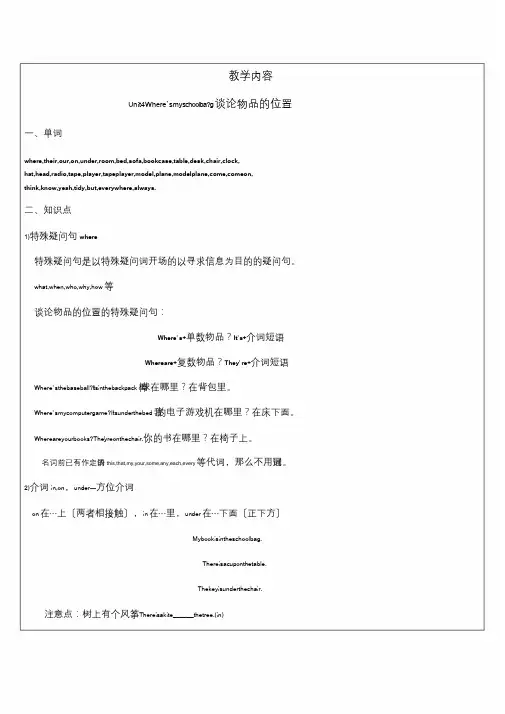
教学内容Unit4Where’smyschool b a?g谈论物品的位置一、单词where,their,our,on,under,room,bed,sofa,bookcase,table,desk,chair,clock,hat,head,radio,tape,player,tapeplayer,model,plane,modelplane,come,comeon,think,know,yeah,tidy,but,everywhere,always.二、知识点1)特殊疑问句where特殊疑问句是以特殊疑问词开场的以寻求信息为目的的疑问句。
what,when,who,why,how等谈论物品的位置的特殊疑问句:Where’s+单数物品?It’s+介词短语。
Whereare+复数物品?They’re+介词短语。
Where’sthebaseball?I’t sinthebackpack棒.球在哪里?在背包里。
Where’smycomputergame?I’t sunderthebed我.的电子游戏机在哪里?在床下面。
Whereareyourbooks?The’y reonthechair.你的书在哪里?在椅子上。
名词前已有作定语的this,that,my,your,some,any,each,every等代词,那么不用冠词。
2)介词in,on,under---方位介词on在⋯上〔两者相接触〕,in在⋯里,under在⋯下面〔正下方〕Mybookisintheschoolbag.Thereisacuponthetable.Thekeyisunderthechair.注意点:树上有个风筝。
Thereisakite______thetree.(in)树上有个苹果。
Thereisanapple______thetree.(on,树上长的、结的)墙上有副画。
Thereisapicture______thewall.(on)墙上有扇窗户。
人教版七年级上册英语第四单元知识点归纳

人教版七年级上册英语第四单元知识点归纳Unit 4: Where Is My Schoolbag?Vocabulary: table。
bed。
sofa。
chair。
on。
under。
come。
desk。
think。
room。
hat。
head。
know。
clock。
tape player。
model plane。
tidy。
our。
everywhere。
always。
bookcase。
come on。
yeah.Phrases: on the sofa。
under the table。
come on。
on their bed。
on your head。
in his schoolbag.___:1.Where is the schoolbag。
- It's under the table.2.Where is his pencil box。
- It's in his schoolbag.3.Where is your ruler。
- It's on the chair.4.Where are their keys。
- They're on the desk.5.Are the keys on the sofa。
- Yes。
they are。
/ No。
they aren't。
They're on the table.Note:Don't et to use the verb "be" (is/are) in these ___.Where" is a n word used to ask about the n of someone or something。
The structure of a special ___ is "Where + be + subject"。
The form of the verb "be" depends on the subject。
人教版英语七年级上册unit4单词音频+课文音频+知识梳理
人教版英语七年级上册unit4单词音频+课文音频+知识梳理人教版英语七年级上册Unit4单词音频+课文音频+知识梳理_on▲点右上方绿标即可收听where [wɛə] adv.在哪里;到哪里table ['teibl] n.桌子bed [bed] n.床bookcase ['bukkeis] n.书架;书柜sofa ['səufə] n.沙发chair [tʃɛə] n.椅子on [ɔn] prep.在…上under ['ʌndə] prep.在…下e [kʌm] v.来;来到e on 快点儿desk [desk] n.书桌think [θiŋk] v.认为;想;思考room [ru:m, rum] n.房间their [ðɛə] pron.他(她,它)们的hat [hæt] n.帽子head [hed] n.头yeah [jʒə] interj.是的;对know [nəu] n.知道,了解radio ['reidiəu] n.收音机;无线电广播clock [klɔk] n.时钟tape [teip] n.磁带;录音带;录像带player ['pleiə] n.播放机tape player 录音机model ['mɔdl] n.模型plane [plein] n.飞机model plane 飞机模型tidy ['taidi] adj.整洁的;井井有条的but [bʌt] conj.但是our ['auə] pron.我们的everywhere ['evriwɛə] adv.处处;到处;各个地方always ['ɔ:lweiz, 'ɔ:lwəz] adv.总是Unit4 课文▲点右上方绿标即可收听Unit4 知识梳理【重点短语】1. my pencil box 我的铅笔盒2. on the sofa 在沙发上3. in your schoolbag 在你的书包里4. under your bed 在你的床底下5. in your grandparents’ room 在你祖父母的房间里6. a tape player 一台录音机7. a model plane 一个飞机模型8. English books 英语书9. in the bookcase 在书柜里10. under the radio 在收音机下面11. on the teacher’s desk 在讲台上12. on your head 在你头上【重点句型】1.—Where’s the schoolbag? 书包在哪里?—I t ’s under the table. 在餐桌下。
七年级上册英语unit4知识点人教版
七年级上册英语unit4知识点人教版七年级上册英语Unit 4 知识点人教版Unit 4 主要内容是介绍食物和饮料的名称和种类,以及询问和谈论这些食物和饮料的偏好和习惯。
本课程也介绍了如何用食品词汇描述食物的味道,讨论何时喜欢和不喜欢某些食物,并学习询问和回答有关日常饮食习惯的一些简单句型。
下面是本单元的重点:一、食物和饮料名称在本单元中,我们将学习一些食物和饮料的名称和种类,例如:1. Food食品:hamburger 汉堡包French fries 炸薯条pizza 披萨hot dog 热狗spaghetti 意大利面chicken wings 鸡翅2. Drinks饮料:water 水juice 果汁milk 牛奶tea 茶soda 苏打水coffee 咖啡二、描述食品味道在本单元中,我们将学习如何用食品词汇和形容词来描述食品的味道。
例如:1. Taste口味:sweet 甜的sour 酸的spicy 辣的salty 咸的bitter 苦的2. Texture质地:crispy 酥脆的chewy 嚼劲十足的tender嫩的soft 柔软的hard 坚硬的三、更多有关食品和饮料的句型和表达除了上面的词汇和描述外,还有更多有关食品和饮料的句型和表达必须了解。
例如:1. Do you like…?你喜欢……吗?Do you like pizza?你喜欢披萨吗?2. What’s your favourite…?你最喜欢的是……What’s your favourite food?你最喜欢的食物是什么?3. I like…我喜欢……I like chicken wings.我喜欢鸡翅。
4. I don’t like…我不喜欢……I don’t like spicy food.我不喜欢辣的食物。
5. How about you?你呢?I like hamburgers. How about you?我喜欢汉堡包,你呢?6. Can I have some…?我可以要一些……吗?Can I have some water?我可以要一些水吗?本单元的这些内容都是学生学习英语的基本知识。
人教版七年级英语上册Unit4 单词 知识梳理 词汇句式精讲

人教版七年级英语上册Unit4单词知识梳理词汇句式精讲Unit4 单词where [wɛə] adv.在哪里;到哪里table ['teibl] n.桌子bed [bed] n.床bookcase ['bukkeis] n.书架;书柜sofa ['səufə] n.沙发chair [tʃɛə] n.椅子on [ɔn] prep.在…上under ['ʌndə] prep.在…下come [kʌm] v.来;来到come on 快点儿desk [desk] n.书桌think [θiŋk] v.认为;想;思考room [ru:m, rum] n.房间their [ðɛə] pron.他(她,它)们的hat [hæt] n.帽子head [hed] n.头yeah [jʒə] interj.是的;对know [nəu] n.知道,了解radio ['reidiəu] n.收音机;无线电广播clock [klɔk] n.时钟tape [teip] n.磁带;录音带;录像带player ['pleiə] n.播放机tape player 录音机model ['mɔdl] n.模型plane [plein] n.飞机model plane 飞机模型tidy ['taidi] adj.整洁的;井井有条的but [bʌt] conj.但是our ['auə] pron.我们的everywhere ['evriwɛə] adv.处处;到处;各个地方always ['ɔ:lweiz, 'ɔ:lwəz] adv.总是02Unit4 知识梳理Unit4 Where’s my schoolbag?【重点短语】1. my pencil box 我的铅笔盒2. on the sofa 在沙发上3. in your schoolbag 在你的书包里4. under your bed 在你的床底下5. in your grandparents’room 在你祖父母的房间里6. a tape player 一台录音机7. a model plane 一个飞机模型8. English books 英语书9. in the bookcase 在书柜里10. under the radio 在收音机下面11. on the teacher’s desk 在讲台上12. on your head 在你头上【重点句型】1.—Where’s the schoolbag? 书包在哪里?—I t ’s under the table. 在餐桌下。
Unit4Where'smyschoobag单元语法知识和重要句子人教版英语七年级上册
人教版英语七年级上册正式单元第四单元Unit 4 Where’s my schoolbag?语法知识及重点句子复习Unit 4 Where’s my schoolbag?1、谈论物品的位置,用疑问词where,表示“在哪里”Where’s + 单数物品?(用于询问单数物品所在的位置)回答:It’s + 介词短语. (其中的it就代指单数物品)Where are + 复数物品?(用于询问复数物品所在的位置)回答:They’re + 介词短语. (其中的they就代指复数物品)例如:棒球在哪?它在背包里。
Where’s the baseball? It’s in the backpack.又如:他的钢笔在哪里?它们在铅笔盒里面。
Where are his pens? They are in the pencil boxes.简言之,Where’s …?回答:It’s… \ Where are…?回答:They are…当名词前已有作定语的this, that, my, your, some, any, each, every等代词,则不用冠词the。
2、表位置的介词及其构成的介词短语。
(1)、on 在......上(两者相接触);例如:on the sofa 在沙发上; on his bed在他的床上; on the table在桌子上。
(2)、in 在......里;例如:in the bookcase在书柜里面; in her schoolbag在她的书包里面; in Alice’s room在爱丽丝的房间里面。
(3)、under 在......下面(正下方);例如:under the chair 在椅子底下; under his bed 在他的床底下;under Tom’s desk在汤姆的书桌底下。
3、e on! 快点儿,杰克!此处的e on 表示“催促”,类似的表达“Hurry up!”4、Gina’s books are everywhere. 吉娜的书到处都是。
2024年人教版七年级上册英语情境式单元知识点背记——UNIT 4
UNIT 4 My Favourite Subjectbiology /baɪ'ɒlədʒi/ n.生物学Biology is my favourite subject. 生物是我最喜欢的学科。
IT /'aɪ'tiː/(=information technology /tek'nɒlədʒi/) 信息技术IT is very important in the 21st century. 信息技术在21 世纪很重要。
geography /dʒi'ɒɡrəfi/ n.地理(学)Geography can help us know the world better.地理可以帮助我们更好地了解世界。
history /'hɪstri/n.历史;历史课China has a long and rich history. 中国有着悠久而丰富的历史。
【拓展】in history 在历史上boring /'bɔːrɪŋ/adj.乏味的;令人生厌的My job is boring. I do the same things every day.我的工作很无聊,我每天都在做同样的事情。
【拓展】bored adj.感到厌烦的(修饰人);boring令人厌烦的(修饰物)。
useful /'juːsfl/adj.有用的;有益的Here are some useful tips. 这里是一些有用的提示。
【拓展】useless adj.无用的;无价值的exciting /ɪk'saɪtɪŋ/adj.令人激动的;使人兴奋的The match is very exciting. 这场比赛很令人激动。
【拓展】excited 表示“( 感到)兴奋的”,主语是人;exciting 表示“令人激动的;使人兴奋的”,主语为物或事。
past /pɑːst/n.过去;过去的事情adj.过去的prep.在……之后It’s interesting to learn about the past. 了解过去是很有趣的。
人教版七年级上册英语知识点全第四单元unit4知识点
教学重、难点掌握方位介词的用法Unit4 重点词汇: where 、table 、bed、 bookcase 、 sofa 、 chair 、 on、 under 、come、 desk、tidy 1、、 always...重点短语:2、on the sofa在沙发上on the table在桌上on your head在你的头上under the chair在椅子下under the bed在床下under the table在桌下in your schoolbag在你的书包里in the bookcase在书柜里in your grandparents’ room在你爷爷奶奶的房间里come on 快点where 引导的特殊疑问句,用于询问“某人或某物在哪里”,若谓语动词为be 动词,其结构为“ Where + be +主语?”,be动词要与后面的主语保持一致。
其答语,用“主语+be+表示地点的的介词短语”为避免重复,句中的主语一般用代词代替。
----Where is/are...?----It’ s/They’ re on /in/under...----Where is my English book?----It’ s on the desk.1)My clock is on the table?(就画线部分提问)________ ________ your clock?2)你的爸爸在哪?(翻译下列句子)______________________________________________3、 on在,, 的上面(接触)on the sofa/desk/table/bed on the tree在树上(本身固有的)in在,, 的里面in your schoolbag/room in the tree在树上(外来的事物)under 在,, 的下面(正下方)under your bed/desk若表示“某物在某地”则用“物+ be +介词短语”结构。
七年级上册英语人教版unit4知识点
七年级上册英语人教版unit4知识点Unit4是七年级上册英语人教版中的一个重要单元。
本篇文章将为大家总结该单元中的重点知识点。
1.动词“be”的变化“be”是英语中最常用的动词之一,表示“是”的意思。
它的变化形式如下:I amYou areHe/She/It isWe areYou areThey are2.时间表达在英语中,表示时间有两种方式,一种是使用数字,如“2:30”,另一种是使用口语表述,如“half past two”。
下面是表示时间的表达方式:数字表达方式:2:00——two o'clock3:15——quarter past three4:45——quarter to five5:30——half past five口语表达方式:2:00——two o'clock3:15——quarter past three4:45——quarter to five5:30——half past five3.一般现在时一般现在时用来表示现在的状态或行为。
具体用法如下:主语 + 动词原形(第三人称单数动词在末尾加-s/es)例如:I like ice cream.She watches TV every night.They play football after school.4.形容词比较级和最高级形容词比较级和最高级用来进行比较。
比较级表示两个事物之间的比较,最高级表示三个或三个以上事物之间的比较。
下面是比较级和最高级的形式:形容词比较级:单音节词 + er例如:big——biggerthin——thinner双音节词或多音节词 + more例如:interesting ——more interesting difficult——more difficult形容词最高级:单音节词 + est例如:big——biggest thin——thinnest双音节词或多音节词 + the most 例如:interesting——the most interestingdifficult——the most difficult5.物品价格询问和回答询问价格通常用句型“How much is/are + 名词?”回答价格时用句型“It is + 数字 + 美元/元”。
Unit4知识归纳人教版英语七年级上册(1)
Unit 4 知识归纳短语归纳:1.on the sofa在沙发上2.in the bookcase 在书柜里面3.under the chair 在椅子下面4.on one’s bed/head/desk 在某人的床上/头上/书桌上(on Peter’s head 在皮特的头上/ on my bed 在我的床上)5.in one’s schoolbag/room 在书包里6.under one’s bed 在床底下7.e on 快点8.be tidy 整洁的9.tape player 录音机10.model plane飞机模型11.have a clock有一个时钟必背典句:1.Where is + 单数名词?.......在哪里?It’s in/on/under.......... 它在......里面/上面/下面。
Where are + 复数名词?.....在哪里?They are in/on/under...... 它们在.......里面/上面/下面。
( Where is my pencil box?我的铅笔盒在哪?It's under your bed. 它在你的床底下。
)( Where are my books? 我的书在哪?They are in the bookcase. 它们在这个书柜里。
)2. e on, Jack. 快点儿,杰克。
3. I think it’s in your grandparents’ room.我认为它在你(外)祖父母的房间里。
4.I don’t know. 我不知道。
5.Sb. always do/does sth. 某人总是做某事。
(Gina always asks “Where’s my schoolbag?”)(He always says sorry. 他总是说对不起。
)6.Sb/Sth. be tidy. 某人/某物是整洁的。
( I’m tidy. 我是整洁的。