
河北省保定市七年级英语上Unit 4 Food and Restaurants 复习学案(无答案)
河北省保定市七年级英语上Unit 4 Food and Restaurants 复习学案(无答案) 1 / 5 河北省保定市七年级英语上U4
学生姓名 性别 年级 学科 英语 授课教师 上课时间 第( )次课 共( )次课 课时:
教学课题 Unit 4 Food and Restaurants
教学目标 U4的重要短语及句型
教学重点与难点
名词的用法及特殊点
【名词】 1.定义:名词是所有事物的名称,包括人、物及抽象概念。 2.名词的分类。
专有名词(首字母大写) 普通名词
国名、地名、人名、机构 可数名词 不可数名词 个体名词:表单个的人和事物 集体名词:表一群人或一些事物 抽象名词:表状态、品质、行为、情感等 物质名词
China, Lucy, University of Cambridge, car, room, pen... people, family... love, knowledge... water, air, fire, rice...
3.名词的数:可数名词和不可数名词。 1) 可数名词: 一般来说个体名词和集体名词可以用数目来计算,称为可数名词。可数名词有单数和复数两种形式。 例如: a book, two books, a student, three students, a family, many families。 2) 不可数名词 不可数名词不能用数字计算包括物质名词( air, water等)及抽象名词(advice, hate)等。所以它通常只有单数形式。如: English, air, water, cotton, work… 3)可数名词的复数形式 规则名词的复数形式 规则 常考例词 1. 一般在名词词尾加-s: map—_________ bird—__________ orange—___________
2. 以s, x, ch, sh结尾的名词加-es: box—_________ class—_________ watch—_________ dish—_________ 河北省保定市七年级英语上Unit 4 Food and Restaurants 复习学案(无答案) 2 / 5 3. 以-f或-fe结尾
变-f或-fe为v在加-es knife—_________小刀 wife—_________妻子 thief—_________小偷 leaf—_________树叶 life—_________生命 shelf—_________书架 【口诀】妻子持刀去宰狼,小偷吓得发了慌; 躲在架后保己命,半片树叶遮目光。
直接加-s 【口诀】海湾(gulf)边、屋顶(roof)上,首领(chief)农仆(serf)相望; 谁说他们无信仰(belief), 语气定在手帕(handkerchief)上
4. 以-y结尾 以辅音字母加y结尾的名词,变y为i+es baby—________ family—________ city—________
以元音字母(a, e, i, o, u)加y结尾的名词直接加s
boy—________ toy—________ day—________
5. 以o结尾的名词后面加s(无生命) 或es(有生命) 无生命:photo—________相片 radio—________收音机 zoo—________动物园 有生命:tomato—________西红柿 potato—________土豆 hero—________英雄 Negro—________黑人
不规则名词的复数形式 规则 常考例词
1. 不规则名词 child---__________ foot---__________ tooth---__________ goose----__________ mouse---__________ man---__________ woman---__________ fireman---__________ woman teacher-----__________ (对比:apple tree --- apple trees) 注意:与 man 和 woman构成的合成词,其复数形式也 是-men 和-women。 2. 单复同形 deer、sheep、fish、Chinese、Japanese
3. 国人的变化:中日不变,英法变,其他s加后面
Chinese---__________ Japanese---__________ Englishman---__________ Frenchman---__________ Australia---__________ German---__________ 注意:an Englishman----two Englishmen. 但German不是合成词,故复数形式为Germans
【语法专练】 There___ not ____ milk in the cup on the table . A. are, many B. are , much C. is ,many D. is ,much 2.There ______pencil box and some flowers on the desk. A. is a B. are some C. has a D. have some 3.Look! There __________ a boy and some girls playing games in the garden. A. is B. are C. have D. be 4.----There is no air or water on the moon. Is there? ---- ____. 河北省保定市七年级英语上Unit 4 Food and Restaurants 复习学案(无答案) 3 / 5 A. Yes, there are B. No, there isn't C. Yes, there isn't D. No, there is 5.There ____ pencil-box, two books and some flowers on the desk. A. is a B. are some C. has a D. have some 6.The boys have got already. A. two bread B. two breads C. two pieces of bread D. two piece of bread 7.__________something wrong with my car. Can I use yours? A. It is B. It was C. There is D. There was 8.We have a lot of ______to do every day. A.work B. works C. job D. jobs 9. He has three________under the bed. A. pair of shoes B. pairs of shoe C. pairs of shoes D.pair of shoe 10.There are two ________and three________in the room. A. American, Japanese B. Americans, Japanese C. American, Japaneses D. Americans, Japaneses
【综合练习】 一、单项选择 1. Tom, you should have a rest and drink _______ orange juice.
A. a glass B. glass of C. a glass of D. an glass of 2. Please _______ your name on the paper. A. put on B. write on C. write down D. get down 3. She is very excited and her eyes are _______ tears. A. full with B. filled of C. full of D. full in 4. It's time _______. A. supper B. have supper C. to supper D. for supper 5. - _______ for one piece of cake? -Twenty yuan. A. How many B. How C. How much D. What 6. -Would you like some meat? -_______. I'm full. A. Yes, please B. Yes, I would C. No, thanks D. No, I don't 7.—May I have________? —OK.Here you are. A.any bottles of pop B.some bottles of pop C.some bottle of pop D.some bottles of pops 8.—________one donut? —One yuan. A.How much for B.How many for C.How much D.How many 9.—Would you like ________ to eat? —No,thanks. A.something B.anything
七年级英语上册 Unit 4 Food and Restaurants教案 冀教版

I. Teaching objectives 单元教学目标Skill Focus 听Listen to people talking about food during the meal.说Talk about the food, fruit and drinks they like and dislike.读Read the texts fluently.写Write short passages about their likes and what they do in the day.Language Focus 功能句式1.Would you like some ___? Yes, please. / No, thanks.2.What would you like for breakfast / lunch / supper?I’d like some ____.3.I like ____. I don’t like _____.4.How much for one ___? I’ll take _____.5.Are you ready to ___?词汇1. 掌握词汇table, food, breakfast, lunch, supper, apple, banana, bread, cake, egg,fish, meat, milk, noodles, rice, tea, morning, afternoon, evening,eleven, twelve, thirteen, fourteen, fifteen, sixteen, seventeen, eighteen,nineteen, twenty, would, not2. 认知词汇eat, want, drink, get, go, come, put, take, order, do, don’t, night, dad,homework, bed, dream, time, dumpling, water, fruit, lot, restaurant,pear, peach, strawberry, glass, juice, can, coke, bottle, cup, coffee, salt,pepper, soup, vegetable, ice-cream, porridge, cereal, sugar, melon,chicken, pizza, hamburger, French fries, pop, hot dog, donut,sandwich, waiter, hungry, thirsty, much, ready, sorry, sweet, good,some, delicious, any, but, then, for.3. 重点词汇food, breakfast, lunch, supper, apple, banana, bread, cake, egg, fish,meat, milk, noodles, rice, tea4. 短语get up, go to bed, Good night, a glass of…, a can of…, a bottle of…, acup of …, French fries语法1. Countable nouns and uncountable nouns.2. Simple present tense.重点句子1.I’m hungry / thirsty.2.Do you like water? Yes, I do. / No, I don’t.3.What’s your favorite food? My favorite food is noodles.4.Would you like some dumplings? Yes, please. / No, thanks.5.I like salt on French fries.6.How much for one donut? One yuan.II. Teaching materials analyzing 教材分析1. 教材分析通过本单元学习,帮助学生掌握一日三餐的表达法,英语国家中最常见的饮料与食品的名称,了解一些西方饮食习惯并能用简单的英语在就餐时进行交谈。
冀教版七年级上册《unit 4 food and restaurants》全单元教案(重点资料).doc

Unit 4 Food and Restaurants I. Teaching objectives 单元教学目标II. Teaching materials analyzing 教材分析1. 教材分析通过本单元学习,帮助学生掌握一日三餐的表达法,英语国家中最常见的饮料与食品的名称,了解一些西方饮食习惯并能用简单的英语在就餐时进行交谈。
1.1Lesson 25 Meat and Fish学习食物名称,学习表达饥饿,口渴和自己的喜好。
1.2 Lesson 27 Vegetables and Fruit 掌握食物名称,描述自己最喜欢吃的食物及学习11到15的数字。
1.3 Lesson 29 Let’s Eat! Let’s Drink! 掌握饮料的名称及计量单位并继续学习16到20的数字,以一首歌曲来复习食物名称。
1.4 Lesson 28 What’s for Breakfast? 通过学习掌握食物名称及在早餐对话当中了解中西方早餐饮食差别。
1.5 Lesson 30 Pizza and Hamburgers通过对话学习食物名称及用作料的习惯。
1.6 Lesson 31 In the Restaurant 通过对话学习谈论价格的表达方式和在饭店就餐时的日常用语。
1.7 Lesson 26 Breakfast, Lunch and Supper通过对一天中活动的描述学习行为动词的一般现在时态。
1.8 Lesson 32 Unit Review 通过练习及对话来复习整个单元的主要单词和表达法。
2. 课型设计与课时分配Period 1 Lesson 25 Listening and speakingPeriod 2 Lesson 27 Listening, speaking and readingPeriod 3 Lesson 29 Listening, singing and readingPeriod 4 Lesson 28 Listening, reading and speakingPeriod 5 Lesson 30 Listening, speaking and readingPeriod 6 Lesson 31 Listening, reading, speaking and singingPeriod 7 Lesson 26 Listening, reading and speakingPeriod 8 Lesson 32 Task-based speakingIII. Teaching plans for each period 分课时教案Period 1 Listening and speakingTarget language目标语言1. Words and phrases 生词和短语meat, fish, table, food, hungry, thirsty, eat, want, think, chicken, water, but, don’t2. Key sentences 重点句子Do you like ___?Yes. I like. / No. I don’t like.Ability goals 能力目标Enable students to say some words about food and the expressions to show hunger and thirst.Enable students to talk about their likes and dislikes.Learning ability goals学能目标Help students grasp the words about food.Teaching important points 教学重点The words about food and the expression about what they want to drink and eat.Teaching difficult points 教学难点Learn to express what they want to drink and eat.Teaching methods 教学方法Listening and speaking.Teaching aids 教具准备Audiotape and pictures.Teaching procedures & ways 教学过程与方式Step I Revisiona. GreetingT: Good morning, boys and girls.Ss: Good morning, Miss / Mr …b. Ask and answer about feelings to review “How do you feel? I feel / am happy / sad / cold / hot / tired / warm / cool.T: How do you feel, Peter?S1: I am happy because I joined the football club.T: OK. How do you feel, Lucy?S2: I am hot.Step II Presentation (1)a. Look and learnUse pictures to present “food, meat, fish, chicken, water and table.”T: Look at this picture. They are food. Food.Ss: Food.T: What’s this? Oh, it’s meat. Meat.Ss: Meat.Learn other words in the same way.b. Act and speakPretend and do the actions to teach “I’m hungry / thirsty. I want to eat / drink.”T: Oh, they are… (Teacher waits for the Ss’ answer.)Ss: Food.T: How about it? What’s this?Ss: It’s meat.T: How about this?Ss: Chicken.T: You’re great. Look! They must be delicious. (Do the action.) I’m hungry. I want to eat. Hungry.Ss: Hungry.T: I want to eat. (Do the eating action.)Ss: (Do the same action.) I want to eat.T: How about this? What’s this? (Point to water.)Ss: Water.T: Right. I’m thirsty. I want to drink. (Do the drinking action.) Thirsty.Ss: Thirsty.T: I want to drink. (Do the action).Ss: (Do the same action.) I want to drink.Step III Practice (1)a. Lead the students to read several times.b. Listen to the tape and repeat.Explain the sentences in Chinese if necessary.c. Role play the dialogue and let several groups present in front of class.Step IV Presentation (2)Ask and answer with several students to present “Do you like? Yes, I do. / No, I don’t. I like ____.”T: Hello, Xiao Hong. (Point to the fish) Do you like fish?S1: Yes, I do.T: Do you like fish, Xiao Qiang?S2: No, I don’t. I like meat.T: How about you, Mary? Do you like fish?S3: No, I like chicken.T: Oh, I see. Xiao Hong likes fish. Xiao Qiang doesn’t like fish. He likes meat. Mary likes chicken.Then write the sentence pattern on the blackboard.“____ likes ____. But he / she doesn’t like ____.Then ask some Ss to say some sentences using this pattern.Step V Practice (2)a. Listen and repeatb. Make a survey in groups about their likes and dislikes. Fill in the form and give a report.c. Learn a song to tell them not to eat what they like too much.Step VI Homeworka. Finish the exercises in the activity book.b. Use the expressions in the text to make up a dialogue in pairs.c. Preview Lesson 27.Period 2 Listening, speaking and readingTarget language目标语言1. Words and phrases 生词和短语noodle, rice, tea, banana, eleven, twelve, thirteen, fourteen, fifteen, vegetable, delicious, fruit, pear, peach, strawberry 2. Key sentences 重点句子What’s you favorite food?My favorite food is ___.Ability goals 能力目标Enable students to say some words about fruit and the numbers from eleven to fifteen and the expressions to talk about what food they like.Learning ability goals学能目标Help students grasp the expressions to talk about their favorite food, the numbers from 11 to 15 and know the plural forms of some nouns.Teaching important points 教学重点The key sentences: What’s your favorite food? My favorite food is____.The numbers from 11 to 15Teaching difficult points 教学难点The plural forms of peach and strawberry.Teaching methods 教学方法Listening, speaking and reading.Teaching aids 教具准备Audiotape and pictures.Teaching procedures & ways 教学过程与方式Step I Revisiona. GreetingT: Good morning, boys and girls.Ss: Good morning, Miss / Mr …b. Show dialogues they made.c. Look at the pictures and say the words in Lesson 25.Step II Presentation (1)Show the pictures of foods and fruits and introduce the new words: tea, fruit, rice, vegetables, noodles, pear, banana, peach, strawberry.T: What’s this? It’s tea / fruit / rice.Ss: Tea / Fruit / Rice.T: What are they? They are vegetables / noodle.Ss: Vegetables. / Noodles.Read the new words one by one.Step III Practice (1)a. Listen to the tape and repeat.b. Listen and pointGet one member out of every group to the front. The teacher says the food’s name and the students point at the picture quickly. Then the teacher lets other students to say the food’s names. And see which group is the fastest.Step IV Presentation (2)Ask and answer with students and present “What’s your favorite food / fruit? My favorite food / fruit is ___. ____ is / are delicious.”T: My favorite food is rice. Rice is delicious. It’s nice. What’s your favorite food, Mary?S1: My favorite food is noodles.T: I like noodles, too. Noodles are nice. Noodles are delicious.Ss: Delicious.T: What’s your favorite fruit?S2: My favorite fruit is apples.T: Apples are delicious.Explain the meaning of “delicious” if necessary.Step V Practice (2)a. Listen and answerListen to the tape and answer the following questions:1. Does Li Ming like rice? (Yes.)2. Does Li Ming like meat? (No.)3. What’s Li Ming’s favorite food? (His favorite food is noodles.)b. Listen to the tape and repeat.c. Ask and answer in a chaind. Tell the students to eat more fruit and vegetables, less meat.Step VI Presentation (3)Ask the students to count from one to ten. Then read “eleven” to “fifteen”. And explain the numbers with “teen” at the end to represent “ten”.Step VII Practice (3)a. Lead the students to read the numbers seven times.b. Write numbers and let them call out them.T: (Write “11” on the blackboard.) How many?Ss: Eleven.T: Good.c. Listen to the tape and repeat.Let the students pay attention to the plural forms of the nouns.d. Tell a jokeTom comes from school on the first of September. “Tom, how do you like your new teacher?” asks his mother. “I don’t like her, mom. Because she says four and seven is eleven and then five and six is eleven too.Step VIII Homeworka. Remember the new words.b. Preview Lesson 29.c. Finish the exercises in the activity book.Period 3 Listening, singing and readingTarget language目标语言Words and phrases 生词和短语apple, sixteen, seventeen, eighteen, nineteen, twenty, melon, coffee, cup, a cup of, bottle, a bottle of, coke, can, a can of,juice, glass, a glass ofAbility goals 能力目标Enable students to say some words about drinks and the numbers from 16 to 20.Learning ability goals学能目标Help students grasp the words about drinks and the numbers from 16 to 20.Teaching important points 教学重点Learn the words about drinks and the numbers from 16 to 20. Teaching difficult points 教学难点Countable nouns and uncountable nouns.Teaching methods 教学方法Listening, singing and reading.Teaching aids 教具准备Audiotape and pictures.Teaching procedures & ways 教学过程与方式Step I Revisiona. GreetingT: Good morning, boys and girls.Ss: Good morning, Miss / Mr …b. Look at pictures and say the new words in Lesson 27.c. Ask and answerAsk and answer with several individual students to review “Do you like ____? Yes, I do. / No, I don’t.” and “What’s your favorite food / fruit? My favorite food/fruit is ____. ___ is / are delicious.”Step II Presentation (1)a. Show some pictures and introduce juice, coke, water, and coffee. And read the words several times.b. Tell the students about the difference between countable nouns and uncountable nouns.可数名词:可以被数词直接修饰,有复数形式。
2020学年【冀教版】七年级上册:Unit4《FoodandRestaurants》(Lessons19、20)导学案

2020学年冀教版英语精品资料Lesson 19:Time for breakfast备课时间:2012.10.12 主备人:集体备课:七年级英语教师审核签字教学目标:1.掌握本课出现的新单词:restaurant fifteen cereal would salad sugar delicious cup2.掌握本课出现的新句型:1) Time for breakfast .2) What’s for breakfast ,Dad?3.熟悉对话内容,并能运用所学语言点进行对话练习。
课前预习:一.写出下列单词并记忆:1.饿的2.茶3. 色拉____4.早餐____5.午餐_____6. 晚餐_______7.麦片粥______8. 面包______9. 果汁_____ 10. 糖_____11.玻璃杯______ 12. 水果______13.茶杯_____14. 可口______15. 当然_____16. 制作______二.自学课文,翻译下列句子1、Time for breakfast . ___________________2、What’s for breakfast ? _______________________3、What would you like ? ______________________4、Can I have a salad ? __________________5、I just want a cup of tea .___________________课内检测:教师渴根据自己的需要检查单词的背诵情况合作探究一.朗读课文,根据课文内容判断正误:1. It’s time for breakfast. ( )2. Lynn would like some dread and a cup of tea . ( )3. Jenny wants to have some cereal . ( )4. Mrs.Smith is not very hungry . ( )5. Lynn can have a salad for breakfast .( )二.小组合作完成以下内容, 教师根据学生情况进行知识点的补充。
冀教版英语七上Unit 4《Food and Restaurants》全单元教学设计

冀教版英语七上Unit 4《Food and Restaurants》全单元教学设计一. 教材分析冀教版英语七上Unit 4《Food and Restaurants》以食物和餐厅为主题,通过介绍各种食物和餐厅的相关词汇、句型和语法,让学生学会表达自己对食物和餐厅的看法。
本单元包括两个听说读写任务,分别是讨论最喜欢的食物和餐厅以及写一封推荐信。
教材内容丰富,贴近生活,有利于激发学生的学习兴趣和参与积极性。
二. 学情分析七年级的学生已经掌握了基本的英语语法和词汇,具备一定的听说读写能力。
他们对食物和餐厅这一主题比较感兴趣,容易产生共鸣。
但部分学生可能在口语表达和写作方面还存在一定的困难,需要教师在教学中给予关注和指导。
三. 教学目标1.知识目标:学生能够掌握本单元所学的词汇、句型和语法,正确运用它们进行口头和书面表达。
2.能力目标:学生能够在实际情境中运用本单元所学内容进行交流,提高听说读写能力。
3.情感目标:学生能够培养对食物的兴趣,学会欣赏和分享美食文化。
四. 教学重难点1.重点:本单元的词汇、句型和语法。
2.难点:如何运用所学内容进行实际交流和写作。
五. 教学方法1.任务型教学法:通过设定各种真实的任务,让学生在完成任务的过程中运用所学知识。
2.情境教学法:创设各种与食物和餐厅相关的情境,激发学生的学习兴趣和参与积极性。
3.合作学习法:鼓励学生之间进行互动交流,共同完成学习任务。
六. 教学准备1.教学材料:教材、多媒体课件、食物和餐厅的图片、卡片等。
2.教学设备:投影仪、计算机、音响等。
七. 教学过程1.导入(5分钟)利用食物和餐厅的图片,引导学生谈论他们最喜欢的食物和餐厅,激发学生的学习兴趣。
2.呈现(10分钟)展示本节课的主要内容,包括词汇、句型和语法。
通过图片、卡片等形式,让学生直观地感知和学习新知识。
3.操练(10分钟)分组进行角色扮演,模拟在餐厅的场景,让学生运用所学词汇和句型进行实际交流。
冀教版英语七年级上册:Unit 4 Food and restaurants 教案6
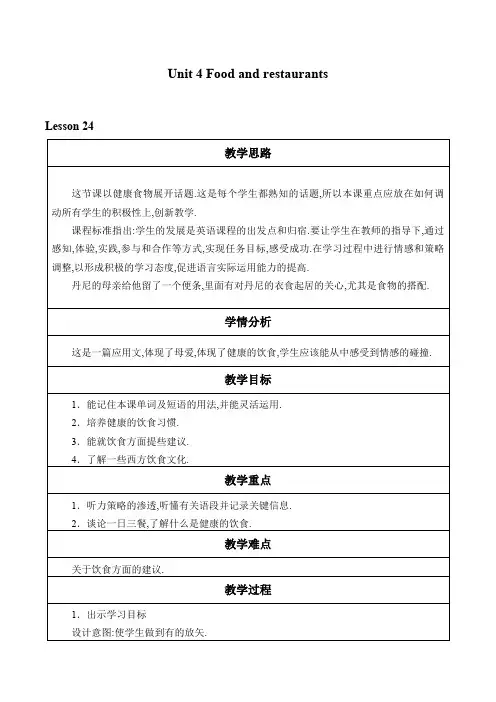
学情分析
这是一篇应用文,体现了母爱,体现了健康的饮食,学生应该能从中感受到情感的碰撞.
教学目标
1.能记住本课单词及短语的用法,并能灵活运用.
2.培养健康的饮食习惯.
3.能就饮食方面提些建议.
4.了解一些西方饮食文化.
教学重点
(2)If you ___________________(得到充足的休息),you'll feel good.
(3)Don't ____________(看电视) for so long, it's bad for your eyes.
(4)Do you speak English ______________(每天)?
Example:
A: How many vegetables do you eat every day?
B: …
A: How much water do you drink every day?
设计意图:通过编对话,进行语言输出,培养学生利用英语来做事情的能力.
7.Do you know what the short form means?
设计意图:听力训练,捕捉信息.
4.In group of four, read the whole text and ask as many questions as you can.
5.练习
(1)My father ____________(不在) last month. He went to the U.S.
p.s.,UFO,Doc..min.,No.,WHO., WTO…
设计意图:拓展知识,开阔视野.
七年级英语上册 unit 4 food and restaurants复习课件

第四页,共三十二页。
03 语法集训
2021/12/13
(一)可数名词与不可数名词
Байду номын сангаас
名词(míng cí)是表示人或事物的名称的词。
名词
(míng cí)
的分类 名词(míng cí)
专有名词
普通名词
可数名词 不可数名词
名词 的数
可数名词的数
规则变化
不规则变化
不可数名词没有数的变化
第五页,共三十二页。
时,now也可用在一般现在时中。
2021/12/13
第十五页,共三十二页。
03 语法(yǔfǎ)集训
eg:What’s the time now?现在几点了? I usually go to bed at 10:00. 我通常(tōngcháng)在10点钟上床睡觉。
She often has porridge for breakfast. 她早饭经常喝粥。
2021/12/13
第二十七页,共三十二页。
03 语法(yǔfǎ)集训
13.There is some _______A_ in the fridge. It’s fresh.
简略回答为Yes,主语+ she doesn’t.—是的,她喜欢/不,她
do./No,主语+don’t
不喜欢
2021/12/13
第二十二页,共三十二页。
03 语法(yǔfǎ)集训
特 特殊疑问词+do+主语 特殊疑问词+does+主语+实
殊 +实义动词原形+其他?
义动词原形+其他?
疑
问 eg:What do you do你是 eg:Where does Tom live?汤姆
Unit4FoodandRestaurants复习课件冀教版七年级英语上册
语法点
可数名词 2.名词复数的不规则变化 (1)改变内部的元音字母: foot→ feet, tooth→ teeth, mouse→ mice,man→ men, woman→ women (2)单复数同形: sheep→ sheep, deer→ deer, Chinese→ Chinese, (3)加ren: child→ children (3)集体名词:
必背句型
2.What’s for breakfast/lunch/supper? 早餐、午餐、晚餐吃什么? 3.What would you like (to do) sth.? 你想要(做)什么? 4.Do you want to come with me? 你想和我一起来吗?
必背句型
5.Good job!/Well done!/Great!/Wonderful!/Excellent!/Perfect! 做得好! 6.Are you ready to order? 你准备好点餐了吗? 7. How much is/are sth.? / How much for sth.?/What’s the price of sth.? 某物多少钱?
……的缩写,简称
12.put...on...把......放在......上
13.have to do sth.
不得不(客观)
must do sth.
必须(主观)
14.take sb. to some place 带某人去某地
必背句型
1.(It’s) time to do sth. 到干某事的时候了。 (It’s) time for sth. 到.......的时候了 It’s time for sb. to do sth. 到某人做......的时候了
初中英语(冀教版)七年级上册(七上)- Unit 4 Food and Restaurants教学设计 (新版)冀教版.doc
教学目标
Language goals:①.Restaurant, fifteen, would, salad, sugar, delicious, Mary, cup, a cup/glass of②.Time for…What’s for breakfast? What would you like? I’d like…
Step you have for breakfast?/ What’s for breakfast?
S1: I have….
T:What would you like? S2: I would like….
Step IIIListen and read
教学过程
教师活动
Part One: Preview
PreviewAims:①Make the class read the words and the text of this lesson.
②. Know the meaning of the text and then translatesome expressions.
Part Two: New Lesson
Step1: Review and Check
a. Greeting.
T: Good morning, boys and girls. Ss: Good morning, Miss / Mr…
b. Look at pictures and say the words of food, fruit and drink.
Step VI Practice and a quiz
1. Ex4 (Page51)
2. Ex3 (Page51)
英语:Unit 4 《 Food and Restaurants》教案(9)(冀教版七年级上)
Unit 4 Food and RestaurantsLesson 27 Vegetables and FruitTeaching Content:Mastery words and expressions: tea, rice, noodle, eleven, twelve, thirteen, banana, fourteen, fifteenKnown words and expressions: fruit, delicious, pear, peach, strawberryTeaching Aims:1.know about more words of fruit, vegetables and food;2.Learn numbers.Teaching Important Points:1.Talk about likes and dislikes;2.Count from 1-15.Teaching Difficult Points:Talk about likes and dislikes.Teaching Preparation: FlashcardsTeaching Aids: Audiotape, FlashcardsType of Lesson: New LessonTeaching Procedure:Step1.1. Remind the students to talk about their daily life again. When to get up /go to school / have lunch?2. Make dialogues. “Would you like …?” “Yes, please.” “No, thanks.”Play “race and write”This is just like “Race and Do”. The students only race to write numbers that you call out. Divide the class into groups of two or three. Each student needs a piece of paper. Call out numbers from one to fifteen. The students try to e the first in their group to write the corresponding digits.Step2. Use flashcards to learn the words: tea, fruit, rice, vegetables, and noodles. Remind the names of food we learned.Step3. Practice the dialogues:The main patterns are: “What would you like…?” “What’s your favourite food?”Step4.Listen to the tape and answer the questions:1.Does Li Ming like rice?2.Does Li Ming like meat?3.What’s Li Ming’s favourite food?Step5. Listen to the tape as the students follow in their books. Check the answers. After listening two or three times, let them listen again with their books closed.Step6. PracticeTeacher: My favourite food is dumplings. What’s your favourite food?S1: My favourite food is noodles. What’s your favourite food?S2: My favourite food is rice. What’s your favourite food? ...Step7. The teacher has a race. Let the students to say the numbers from 1-15 one by one. The students who can’t say the correct number sit down. So at last the students who stand are winners.Step8. Finish the activity book.SummaryTalking about likes and dislikes is familiar to the students. The numbers from 11-15 are so long words. So spend more time on the numbers.Lesson 28 What’s for Breakfast?Teaching Content:Mastery words and expressions: milk, cake, egg, breadKnown words and expressions: ice cream, cereal, porridge, put, sugarTeaching Aims:1.Know about the food and drink habits in western countries.2.The similarities and differences between China and Canada in the daily life.Teaching Important Points:1.Learn more words about food in China and western countries.2.People in different countries have different food for breakfast.Teaching Difficult Points:Patterns:1.Time for breakfast.2. I’d like porridge for breakfast.3.I put milk and sugar on it.Teaching Preparation: FlashcardsTeaching Aids: Audiotape, FlashcardsType of Lesson: New lessonTeaching Procedure:Step1.1. Remind the students to count the numbers from 1-15.2 .Let’s have a short dictation about the numbers.Step2. Use flashcards or drawings to show the food to the students. At the same time, ask questions: “Do you like this?” “Yes, I do.” “No, I don’t. I like…”Step3. Drill:Point to pictures. Teacher asks questions. Let students answer. Then the next students do this one by one. Teacher: Do you like this?S1: Yes, I do.S2: Do you like this?S3: No, I don’t. I like rice. Rice is okay. …Step4.Listen to the tape and imitate after it for several times until they can read it correctly and fluently.Step5 Listen to Part2 “Porridge or Cereal”. Answer the following questions.1.What are Li Ming and Jenny doing?2.What would Li Ming like for breakfast?3.What does Jenny put in the cereal?Step6 Read the text loudly and check the answers. If they can’t understand “Porridge or Cereal”, the teacher uses the pictures to help them catch the meaning.Step7 Listen again and try to imitate after it. After a while, they can repeat with their books closed.Step8 Read the dialogues aloud in roles on pairs. Then change the roles, practice again.Step9 Ask several volunteers to come to the front and act the dialogue out.Step10 1 Finish off the activity book.Make up new dialogues according to the text.SummarySome patterns are difficult for students to understand. So practice is the key to grasp them..。
七年级英语上册 Unit 4 Food and Restaurants Lesson 20 I L
七年级英语上册Unit 4 Food and Restaurants Lesson 20 I Like the Supermarket导学案(新版)冀教版编辑整理:尊敬的读者朋友们:这里是精品文档编辑中心,本文档内容是由我和我的同事精心编辑整理后发布的,发布之前我们对文中内容进行仔细校对,但是难免会有疏漏的地方,但是任然希望(七年级英语上册Unit 4 Food and Restaurants Lesson 20 I Like the Supermarket导学案(新版)冀教版)的内容能够给您的工作和学习带来便利。
同时也真诚的希望收到您的建议和反馈,这将是我们进步的源泉,前进的动力。
本文可编辑可修改,如果觉得对您有帮助请收藏以便随时查阅,最后祝您生活愉快业绩进步,以下为七年级英语上册Unit 4 Food and Restaurants Lesson 20 I Like the Supermarket导学案(新版)冀教版的全部内容。
Lesson 20 I Like the Supermarket!【学习目标】1、学习的任务和目标1。
Language goals:full,cookies,chocolate,everything,meat,job,have to,come with,be full of,on the table,write down,good job。
To use these phrases with their classmates.Can talk about the topic of shopping。
2、学习的重点1) The important vocabulary:full,cookies,chocolate,everything,meat,job,have to,come with,be full of,on the table,write down,good job.2)Talk about the topic of shopping。