
新闽教版英语六年级下册重点内容归纳
闽教版英语六年级下册重点内容归纳(Unit 3)
班级 姓名
词组
1.not well不太好
2.very hot非常热
3.go and tell sb. 去告诉某人
4.in his bedroom 在他的卧室
5.take you to hospital 带你去医院
6.have a headache 头疼
7.have a cold 感冒
8.have a toothache 牙疼
9.have a fever 发烧
10.open your mouth 张开你的嘴
11.mustn’t = must not 不可以,不许,禁止 needn’t 不必
12.drink a lot of water 喝大量的水
13.give you some medicine 给你开点药
14.take the medicine 吃药
15.talk in the library 在图书馆里说话
16.cross the street 过街
17.go to the park 去公园
18.take off his jacket 脱掉他的夹克衫
19.put on his jacket 穿上他的夹克衫
句子:
1.How are you? 你好吗?
2.I’m not well. 我不太好。
3.You’re very hot. 你很烫。
4.I’ll go and tell Mom. 我要去告诉妈妈。
5.He is ill.他生病了。
6.Is he in his bedroom? 他在他的卧室吗?
7.What’s wrong with you? 你怎么了?
8.I have a headache. 我头疼。
9.I’ll take you to hospital. 我要带你去医院。
10. I have a cold. 我感冒了。
11. I have a toothache. 我牙疼。
12.I have a fever. 我发烧了。
13.Open your mouth and say,“Ah.” 张开你的嘴说“啊。”
14.Are you thirsty? 你渴吗?
15.You mustn’t go to school. 你不能去学校。
16.You must drink a lot of water. 你必须喝大量的水。
17.I;ll give you some medicine. 我要给你开点药。
18.You must take the medicine. 你必须吃药。
19.You mustn’t talk in the library. 你不可以在图书馆里说话。
20.You mustn’t cross the street. 你不可以过街。
六年级下英语复习归纳-Unit1—Unit2_闽教版
六年级下英语复习归纳-Unit1—Unit2_闽教版闽教版小学英语六年级下册Unit1—Unit2复习归纳:(词语和词组)形容词:每一的;每个的every 凌乱的messy名胜古迹:白宫the White House颐和园the Summer Palace长城the Great Wall动词:(暂)住:逗留stay 学习learn制作make 浇水;水water动词过去式:make的过去式made名词:假期vacation 衣服clothes树林woods 家务housework 计划plan 表/堂兄弟姐妹cousin其他:似乎;好像seem 以前;过去past休息rest 再again野营camp 奇妙的境地wonderland 去美国go to the USA擦桌子clean the table扫地sweep the floor 浇花water the flowers 一个邋遢的男孩 a messy boy为他for him每个早上every morning在星期天on Sunday句子:1.暑假你去了哪里?Where were you in the summer vacation?2.我待在中国。
I stayed in China.3.你每天都有整理你的床铺吗?Do you make your bed every day?4.过去王涛有铺他的床吗?Did Wang Tao make his bed in the past?5.他现在有铺他的床吗?Does he make his bed now?。
六年级下册英语闽教版重点句型总结
六年级下册英语闽教版重点句型总结In the second semester of the sixth grade, students studying English using the Fujian Education Edition textbook will encounter various key sentence patterns. These sentence patterns are important for students to understand and use in order to improve their English language skills. In this article, we will summarize the key sentence patterns from the textbook and provide examples to help students better understand and apply them.1. "What do you think of...?"This sentence pattern is used to ask for someone's opinion about something. For example:What do you think of the movie we watched yesterday?What do you think of the new school uniform?2. "I think..."This sentence pattern is used to express one's own opinion. For example:I think the movie we watched yesterday was exciting.I think the new school uniform looks great.3. "How do you like...?"This sentence pattern is used to ask for someone's opinion about something. For example:How do you like the book I lent you?How do you like the new hairstyle?4. "I like..."This sentence pattern is used to express one's own preference. For example:I like the book you lent me. It's very interesting.I like the new hairstyle. It suits you well.5. "Why do you like...?"This sentence pattern is used to ask for the reason behind someone's preference. For example:Why do you like playing basketball?Why do you like the color blue?6. "Because..."This sentence pattern is used to provide a reason for one's preference. For example:I like playing basketball because it's a fun and active sport.I like the color blue because it reminds me of the ocean.7. "Can/Could you...?"This sentence pattern is used to make a request or ask for a favor. For example:Can you help me carry these books?Could you lend me your pen?8. "Sure/Of course."This sentence pattern is used to agree to a request or favor. For example:Sure, I can help you carry these books.Of course, I can lend you my pen.9. "Sorry, I can't..."This sentence pattern is used to politely decline a request or favor. For example:Sorry, I can't help you carry these books. I have too much to carry myself.Sorry, I can't lend you my pen. I need it for class.10. "Would you like...?"This sentence pattern is used to offer something to someone. For example:Would you like some cake?Would you like to join us for lunch?11. "Yes, please/No, thank you."This sentence pattern is used to accept or decline an offer politely. For example: Yes, please. I would love some cake.No, thank you. I already had lunch.12. "What's your favorite...?"This sentence pattern is used to ask about someone's favorite thing. For example: What's your favorite subject in school?What's your favorite sport?13. "My favorite...is..."This sentence pattern is used to express one's favorite thing. For example:My favorite subject in school is English.My favorite sport is swimming.By understanding and practicing these key sentence patterns, students will be able to communicate more effectively in English. It is important to remember that language learning requires consistent practice and exposure to the language. So, keep practicingand using these sentence patterns in your daily conversations to improve your English skills. Good luck!。
新闽教版小学英语六年级同步知识要点
六年级上册语言知识点归纳(单词)一.单词:1.国家:Australia 澳大利亚Australian 澳大利亚的the USA(America)美国American 美国的the UK(England) 英国English 英国的China 中国Chinese 中国的;中国人;汉语2.奥运会有关单词:Olympic Games 奥林匹克运动会Summer Olympic 夏季奥运会Winter Olympic 冬季奥运会the 29th Olympic Games第29届奥运会ring 环hold 举办world 世界dream 梦想3.家务:make the bed 整理床pick up the toys 拾起玩具water the flowers 浇花wash clothes 洗衣服4.服装:dress 连衣裙shorts 短裤trousers 裤子schoolbag 书包socks 短袜cap 鸭舌帽a pair of shoes 一双鞋子 a pair of glasses 一副眼镜5.食品:fruit salad 水果色拉hot dog 热狗candy 糖果corn 玉米soup 汤beef 牛肉vegetable salad 蔬菜色拉6.宇宙:sun 太阳moon 月亮star 星星earth 地球7.节日:Thanksgiving dinner 感恩节晚餐National Day 国庆节Tree Planting Day 植树节Teachers’ Day 教师节8.生活物品:basket 篮子washing machine 洗衣机plant 植物9.动词:pass 传递catch 接住bring 带来keep 保持walk 步行water 水;浇水10.房间:bedroom 卧室toilet 卫生间floor 地板11.其他类menu 菜单strong 强壮的12. 动词词组类walk to school 步行上学take a taxi 打的六年级上册语言知识点归纳(句子)1. They take place every four every years. 他们每四年举行一次。
六年级下英语复习归纳-Unit7—Unit8_闽教版

六年级下英语复习归纳-Unit7—Unit8_闽教版闽教版小学英语六年级下册Unit7—Unit8复习归纳:(词语和词组)食物:玉米corn 南瓜馅饼pumpkinpie火鸡turkey 饺子dumpling地瓜yam 蔬果汁juice蔬菜vegetable 可乐Coke茶tea汉堡hamburger热狗hot dog节日:感恩节Thanksgiving 圣诞节Christmas Day 元旦New Year ‘s Day教师节Teachers’ day 地球日Earth Day 春节Spring Festival 儿童节Children ‘s Day五一劳动节May Day国家:中国China 澳大利亚Australia美国America 英国EnglandAustralian 中国(人)的Chinese 澳大利亚(人)的美国(人)的American 英国(人)的English年份:逛庙会go to the fair美国食物American food在1620年9月in September 1620一些英国人some English people乘船in a boat到达美国get to America建造他们的新家make their new home足够的食物enough food种植玉米grow corn一艘模型船 a model boat一个大餐会 a big dinner party有一个大丰收have a very good harvest 重点句型:1.11月的第4个星期四。
The 4th Thursday of November.2.你是怎样度过的?How do you spend it ?3.感恩节你通常吃些什么?What do you usually have for Thanksgiving.4.你想要来点火鸡吗?是的,请来一些。
/不,谢谢。
Would you like some turkey? Yes ,please./No,thanks.5.请把地瓜递给我。
六年级下英语复习归纳-Unit4—Unit6_闽教版
六年级下英语复习归纳-Unit4—Unit6_闽教版在10月1号on October 1st在早上in the morning九曲溪the Jiuqu Stream爬山climb the mountains乘竹筏go on a raft trip到学校get to school起床get up今天早上this morning吃早饭have breakfast去跑步go running打篮球或踢足球play basketball or football 好的饮食习惯good diet去上学go to school句子:1.10月1日我们乘火车到了武夷山。
On October 1st , we went to Wuyishan by train.2.早上我们爬了山,还去看了瀑布。
In the morning we climbed the mountains and went to see the waterfalls.3.下午我们乘竹筏沿九曲溪漂流而下。
In the afternoon we went on a raft trip down the Jiuqu Stream.4.我们很想念你。
We miss you.5.你们今天都做了什么?What did you do today?6.你们去看瀑布了吗?Did you go to see the waterfalls?7.那真是有趣极了。
It was very interesting.8.你什么时候回来?When did you come back?9.我知道你会过得很愉快的。
I’m sure yo u had a good time.10.从山上,我们看到了许多竹筏沿溪而下。
From the mountains, we saw many rafts going down the stream.11.我们听了关于山水的有趣故事。
We listened to interesting stories about the mountains and the stream.12.在路上我们拍了许多照片。
复习提纲(素材)闽教版英语六年级下册
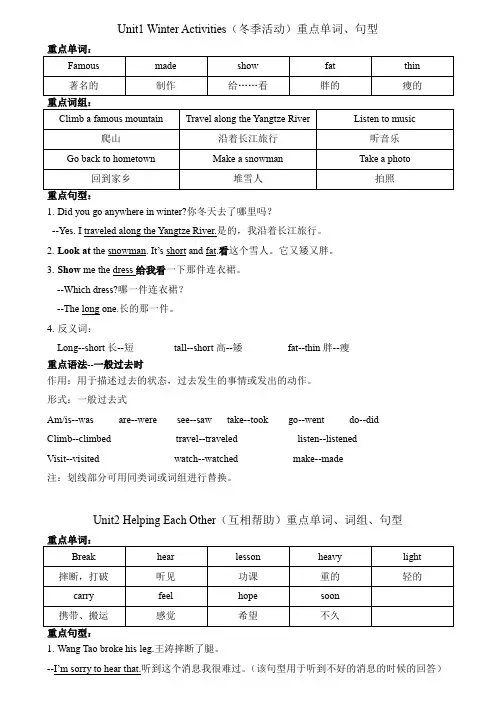
Unit1 Winter Activities(冬季活动)重点单词、句型1.Did you go anywhere in winter?你冬天去了哪里吗?--Yes. I traveled along the Yangtze River.是的,我沿着长江旅行。
2.Look at the snowman. It’s short and fat.看这个雪人。
它又矮又胖。
3.Show me the dress给我看一下那件连衣裙。
--Which dress?哪一件连衣裙?--The long one.长的那一件。
4.反义词:Long--short长--短tall--short高--矮fat--thin胖--瘦重点语法--一般过去时作用:用于描述过去的状态,过去发生的事情或发出的动作。
形式:一般过去式Am/is--was are--were see--saw take--took go--went do--didClimb--climbed travel--traveled listen--listenedVisit--visited watch--watched make--made注:划线部分可用同类词或词组进行替换。
Unit2 Helping Each Other(互相帮助)重点单词、词组、句型1.Wang Tao broke his leg.王涛摔断了腿。
--I’m sorry to hear that.听到这个消息我很难过。
(该句型用于听到不好的消息的时候的回答)2.What can we do to help him?我们能做什么来帮助他?--We can take some fruits with us.我们可以带些水果去。
3.The basket is heavy.这个篮子很重。
4.I’m worried about my lessons.我担心我的功课5.I can help you with your English.我可以帮助你学习英语。
闽教版小学六年级英语总复习重点
闽教版⼩学六年级英语总复习重点 六年级的同学们很快就要进⼊复习阶段了,那么同学们应该怎样复习闽教版⼩学呢?⼀起来看看店铺整理的闽教版⼩学六年级英语总复习的重点,希望对您有⽤。
闽教版⼩学六年级英语总复习重点⼀ 不规则动词过去式: sing sang 唱 eat ate吃 go went去 leave left离开 take took 拍;照 have had有;吃 buy bought买 see saw看见 prepare准备 relax放松 get got到达 go/went ice-skating 去滑冰 cousin 堂兄弟;堂姐妹⼯作 I’ll= I will miss想念 buy/bought presents 买礼物 row/rowed a boat 划船 see/saw elephants 看⼤象 go/went skiing 去滑雪 learn / learned Chinese学中⽂ take /took pictures 拍照 climb/climbed a mountain 爬⼭ sing and dance /sang and danced 跳舞 重要句型: 问过去发⽣的动作要借助动词did,特殊疑问句为句型是: 疑问词+did+主语+V原形+? Where did you go on your holiday? 假期你去了哪⾥? I went to Xinjiang. 我去了新疆. What did you do on your holiday?你假期⼲了什么? I sang and danced. 我即唱了歌⼜跳了舞. How did you go there? 你怎样去的? I went by train. 我坐⽕车去的. When did you go? 你什么时候去的? I went last Monday. 我上周⼀去的. It was a long holiday. 这是⼀个长的假期. For the last day of the holiday, we relaxed and prepared to go back to work or school. 闽教版⼩学六年级英语总复习重点⼆ ⼀、重点 have a ferewell party 开告别会 sing songs 唱歌 play the piano 弹钢琴 play the erhu 拉⼆胡 do Chinese kung fu 表演中国功夫 say hello/goodbye to sb. 向某⼈问好/告别 invite sb. to … 邀请某⼈… ⼆、重点 1 It is the end of the school year. 这是学期末。
闽教小学六年级英语下册Unit1—Unit2复习归纳
每个早上
every morning
在星期天
on Sunday
句子:
1.暑假你去了哪里?|
Where were you in the summer vacation?
2.我待在中国。
I stayed inChina.
3.你每天都有整理你的床铺吗?
Do you make your bed every day?
动词过去式:
make的过去式
made
名词:
假期
vacation
衣服
clothes
树林
woods
家务
housework
计划
plan
表/堂兄弟姐妹
cousin
其他:
似乎;好像
seem
以前;过去
past
休息
rest
再
again
野营
camp
奇妙的境地
wonderland
去美国
go to theUSA
待在中国
打扫自己的房间
clean my room
洗我的衣服
wash my clothes
帮我妈妈购物
help my mother do the shopping
擦桌子
clean the table
扫地
sweep the floor
浇花
water the flowers
一个邋遢的男孩
a messy boy
为他
在上午
in the morning
去游泳
go swimming
在
在晚上
in the evening
在海里游泳
swim in the sea
最新闽教版小学英语六年级下册知识点汇总(1).docx
闽教版小学英语六年级下册知识点汇总(1)Unit1 Winter Activities一.词组1.寒假活动类climb a famous mountain攀登一座名山travel along the Yangtze River沿着长江旅行go to see my friend 去看我的朋友listen to music 听音乐go back to my hometown 回老家 take many photos照很多相片 make a snowman 堆雪人 big ice city 大冰城2.特征形容词类tall 高的short 矮的thin 瘦的fat 胖的big 大的small 小的long 长的short 短的二.句型1.Did you go anywhere in winter?你寒假有去哪里玩吗? Yes.I climbed a famous mountain是.的。
我爬了一座名山。
Itraveled along the Yangtze River我.沿着长江旅行。
I went to see my friend.我去看我的朋友了。
We listened to music together我.们一起听音乐。
I went back to my hometown.我回老家了。
I went to see a big ice city我.去看大冰城了。
2.Show me the dress, please请.给我看那条连衣裙。
Show me the skirt, please请.给我看那条裙子。
Show me the photo, please请.给我看看照片。
Unit2 Helping Each Other一.词组1. 互助类break the leg摔断了腿in hospital 住院 a heavy box一个重的箱子a light box 一个轻的箱子Chinese语文math 数学English 英语carry a basket提篮子二.句型1.Wang Tao broke his leg王.涛摔断了腿。
2022年闽教版六年级英语下册Unit 1-Unit 8知识点归纳
六年级下册Unit 1—Unit 8知识点归纳词汇工作〔job〕职业:farmer 农民cook 厨师nurse 护士dancer 舞蹈演员police officer 警察driver 驾驶员singer 歌唱演员worker 工人doctor 医生scientist 科学家疾病类:fever 发烧headache 头疼wrong 不正常的medicine 药toothache 牙痛ill 病的,不适的地点类:dining room 餐厅lab 实验室middle school 中学teachers' office 教师办公室computer room 电脑室music room 音乐室科目subject:physics 物理chemistry 化学geography 地理history 历史lesson 功课math 数学反义词类:thin 瘦的fat 胖的light 轻的heavy 重的tall 高的short 短的动词类:travel 旅行show 给……看cross 横穿open 张开break 摔断feel 感觉到carry 携带hope 希望hear 听见kiss 亲吻love 爱grow 种植learn 学习study 学习miss 想念动词词组:go back 回到have a cold 感冒have a fever 发烧have a toothache 牙疼名词词组:the Yangtze river 长江Ice and Snow Festival 冰雪节year book 毕业留念册其它类:street 街道address 地址information 信息surprise 惊喜 a lot of 大量的soon 不久true 确实的famous 著名的重点句型Unit 1 Winter ActivitiesDid you go anywhere in winter 冬天你有去哪里吗?I climbed a mountain. 我去爬山了。